Problems
Filters
68 problems found
1990 Paper 2 Q4
A plane contains \(n\) distinct given lines, no two of which are parallel, and no three of which intersect at a point. By first considering the cases \(n=1,2,3\) and \(4\), provide and justify, by induction or otherwise, a formula for the number of line segments (including the infinite segments). Prove also that the plane is divided into \(\frac{1}{2}(n^{2}+n+2)\) regions (including those extending to infinity).
Solution: With \(n=1\) line, the plane is divided in half. With \(n=2\) lines the plane is divided into four pieces. (Each of the previous pieces are split in half) With \(n=3\) lines the plane is divided into up to \(7\) pieces. (The new line crosses two lines in two places dividing \(3\) regions into \(2\), thus increasing the number of regions by \(3\)). With \(n=4\) lines the plane is divided into \(11\) pieces. (The new line crosses three lines in three places doubling the number of regions of \(4\) places). Claim: With \(n\) lines the plane is divided into \(\frac12(n^2+n+2)\) regions. Proof: (By induction) (Base case) When \(n=1\) clearly the line is divided into \(2\) regions, and \(\frac12 (1^2 + 1^2 + 2) = 2\) so the base case is true. (Inductive step) Suppose our formula is true for \(n=k\), so we have placed \(k\) lines in general position and divided the plane into \(\frac12(k^2+k+2)\) regions. When we place a new line it will meet those \(k\) lines in \(k\) places (since no lines are parallel) and there will be k+1 regions the line will run through (since no three lines meet at a point). Each of those \(k+1\) regios is now split in half, so there are \(k+1\) "new regions". Therefore there are now \(\frac12(k^2+k+2)+(k+1) = \frac12(k^2+k+1+2k+2) = \frac12 ((k+1)^2+(k+1)+1)\) regions, ie our hypothesis is true for \(n=k+1\). (Conclusion) Therefore since our statement is true for \(n=1\) and since if it is true for some \(n=k\) it is true for \(n=k+1\) by the principle of mathematical induction it is true for all \(n \geq 1\) Proof: (Alternative). There are \(\binom{n}{2}\) places where the lines meet. Each intersection is the most extreme point (say lowest) for one region (if two are tied, rotate by a very small amount) so this is a unique mapping. There will be \(n+1\) regions which are infinite and don't have a most extreme point, hence \(\binom{n}{2} + n+1 = \frac12(n^2-n)+n+1 = \frac12(n^2+n+2)\)
1990 Paper 2 Q16
Each day, I choose at random between my brown trousers, my grey trousers and my expensive but fashionable designer jeans. Also in my wardrobe, I have a black silk tie, a rather smart brown and fawn polka-dot tie, my regimental tie, and an elegant powder-blue cravat which I was given for Christmas. With my brown or grey trousers, I choose ties (including the cravat) at random, except of course that I don\textquoteright t wear the cravat with the brown trousers or the polka-dot tie with the grey trousers. With the jeans, the choice depends on whether it is Sunday or one of the six weekdays: on weekdays, half the time I wear a cream-coloured sweat-shirt with \(E=mc{}^{2}\) on the front and no tie; otherwise, and on Sundays (when naturally I always wear a tie), I just pick at random from my four ties. This morning, I received through the post a compromising photograph of myself. I often receive such photographs and they are equally likely to have been taken on any day of the week. However, in this particular photograph, I am wearing my black silk tie. Show that, on the basis of this information, the probability that the photograph was taken on Sunday is \(11/68\). I should have mentioned that on Mondays I lecture on calculus and I therefore always wear my jeans (to make the lectures seem easier to understand). Find, on the basis of the complete information, the probability that the photograph was taken on Sunday. [The phrase `at random' means `with equal probability'.]
1989 Paper 1 Q4
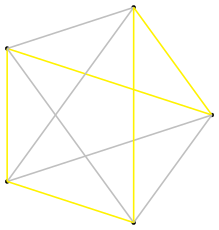
Six points \(A,B,C,D,E\) and \(F\) lie in three dimensional space and are in general positions, that is, no three are collinear and no four lie on a plane. All possible line segments joining pairs of points are drawn and coloured either gold or silver. Prove that there is a triangle whose edges are entirely of one colour. {[}\(Hint\): consider segments radiating from \(A.\){]} Give a sketch showing that the result is false for five points in general positions.
Solution: Consider the \(5\) segements radiating from \(A\). By the pigeonhole principle, at least \(3\) of them must be the same colour (say gold and say reaching \(B,C,D\)). If any of the segments joining any of \(B,C,D\) are gold then we have found a monochromatic gold triangle. But if none of them are gold, they are all silver, therefore \(BCD\) is a monochromatic silver triangle.
1989 Paper 2 Q16
Widgets are manufactured in batches of size \((n+N)\). Any widget has a probability \(p\) of being faulty, independent of faults in other widgets. The batches go through a quality control procedure in which a sample of size \(n\), where \(n\geqslant2\), is taken from each batch and tested. If two or more widgets in the sample are found to be faulty, all widgets in the batch are tested and all faults corrected. If fewer than two widgets in the sample are found to be faulty, the sample is replaced in the batch and no faults are corrected. Show that the probability that the batch contains exactly \(k\), where \(k\leqslant N\), faulty widgets after quality control is \[ \frac{\left[N+1+k\left(n-1\right)\right]N!}{\left(N-k+1\right)!k!}p^{k}\left(1-p\right)^{N+n-k}, \] and verify that this formula also gives the correct answer for \(k=N+1\). Show that the expected number of faulty widgets in a batch after quality control is \[ \left[N+n+pN(n-1)\right]p(1-p)^{n-1}. \]
Solution: \begin{align*} \mathbb{P}(\text{exactly }k\text{ faults after test}) &= \mathbb{P}(k\text{ faults in non-tested, 0 in batch})+\mathbb{P}(k-1\text{ faults in non-tested, 1 in batch}) \\ &=\binom{N}{k}(1-p)^{N-k}p^k\binom{n}{0}(1-p)^n+\binom{N}{k-1}(1-p)^{N-k+1}p^{k-1}\binom{n}{1}(1-p)^{n-1}p \\ &= (1-p)^{N-k+n}p^k \cdot \left ( \binom{N}{k}+n\binom{N}{k-1} \right) \\ &= (1-p)^{N-k+n}p^k \cdot \left (\frac{N!}{k!(N-k)!}+\frac{N!n}{(k-1)!(N-k+1)!}\right) \\ &= (1-p)^{N-k+n}p^k \frac{N!}{k!(N-k+1)!} \cdot \left ((N-k+1)+nk \right) \\ &= \frac{\left[N+1+k\left(n-1\right)\right]N!}{\left(N-k+1\right)!k!}p^{k}\left(1-p\right)^{N+n-k} \end{align*} When \(k = N+1\) we get: \begin{align*} \frac{(N+1)n N!}{(N+1)!} p^{N+1}(1-p)^{N+n-k} &= np^{N+1}(1-p)^{N+n-k} \end{align*} and the probability is: \begin{align*} \mathbb{P}(\text{exactly }N+1\text{ faults after test}) &= \mathbb{P}(N\text{ faults in non-tested, 1 in batch}) \\ &= \binom{N}{N}p^N \cdot \binom{n}{1}p(1-p)^{N-1} \\ &= np^{N+1}(1-p)^{N+n-k} \end{align*} So the formula does work for \(k = N+1\). \begin{align*} \mathbb{E}(faults) &= \sum_{k=0}^{N+1} k \cdot \mathbb{P}(\text{exactly }k\text{ faults after test}) \\ &= \sum_{k=0}^{N+1} k \cdot \frac{\left[N+1+k\left(n-1\right)\right]N!}{\left(N-k+1\right)!k!}p^{k}\left(1-p\right)^{N+n-k} \\ &= \sum_{k=1}^{N+1} \frac{\left[N+1+k\left(n-1\right)\right]N!}{\left(N-k+1\right)!(k-1)!}p^{k}\left(1-p\right)^{N+n-k} \\ &= \sum_{k=1}^{N+1} \left[N+1+k\left(n-1\right)\right] p(1-p)^{n-1}\binom{N}{k-1}p^{k-1}\left(1-p\right)^{N-k+1} \\ &= p(1-p)^{n-1} \cdot \left ( (N+1+n-1)\sum_{k=1}^{N+1} \binom{N}{k-1}p^{k-1}\left(1-p\right)^{N-k+1}+ (n-1)\sum_{k=1}^{N+1} (k-1)\binom{N}{k-1}p^{k-1}\left(1-p\right)^{N-k+1} \right) \\ &= p(1-p)^{n-1} \left ((N+1+n-1) + (n-1)pN \right) \\ &= \left[N+n+pN(n-1)\right]p(1-p)^{n-1} \end{align*}
1988 Paper 1 Q4
Each of \(m\) distinct points on the positive \(y\)-axis is joined by a line segment to each of \(n\) distinct points on the positive \(x\)-axis. Except at the endpoints, no three of these segments meet in a single point. Derive formulae for \begin{questionparts} \item the number of such line segments; \item the number of points of intersections of the segments, ignoring intersections at the endpoints of the segments. \end{questionpart} If \(m=n\geqslant3,\) and the two segments with the greatest number of points of intersection, and the two segments with the least number of points of intersection, are excluded, prove that the average number of points of intersection per segment on the remaining segments is \[ \frac{n^{3}-7n+2}{4(n+2)}\,. \]
Solution:
- There are \(m \cdot n\) line segments, since each of the \(m\) points on the \(y\)-axis correspond to \(n\) points of the \(x\)-axis.
- Every pair of points on the \(x\)-axis and pair of points on the \(y\) axis will generate \(4\) lines, but only \(1\) of those points will meet in the middle, therefore there will be \(\binom{m}{2} \binom{n}{2}\) intersections.
1988 Paper 3 Q15
Each day, books returned to a library are placed on a shelf in order of arrival, and left there. When a book arrives for which there is no room on the shelf, that book and all books subsequently returned are put on a trolley. At the end of each day, the shelf and trolley are cleared. There are just two-sizes of book: thick, requiring two units of shelf space; and thin, requiring one unit. The probability that a returned book is thick is \(p\), and the probability that it is thin is \(q=1-p.\) Let \(M(n)\) be the expected number of books that will be put on the shelf, when the length of the shelf is \(n\) units and \(n\) is an integer, on the assumption that more books will be returned each day than can be placed on the shelf. Show, giving reasoning, that
- \(M(0)=0;\)
- \(M(1)=q;\)
- \(M(n)-qM(n-1)-pM(n-2)=1,\) for \(n\geqslant2.\)
Solution:
- \(M(0) = 0\) since if there's no space on the shelf, we wont be able to put any books on the shelf.
- If the shelf has length \(1\) it can only fit a thin book. For a thin book to be placed on the shelf, the very first book which comes to be placed must be thin. But this happens with probability \(q\). Therefore \(M(1) = q\).
- Suppose no books have been placed on the shelf, then with probability \(p\) a large book gets placed on the shelf, and the expected number of books to be placed on the shelf is equivalent to how many books will be placed on the shelf if the shelf only had \(n-2\) spaces. This is \(M(n-2)\). Similar if the book which arrives first is thin (with probability \(q\)) then there will be \(M(n-1)\) more books placed on the shelf in expectation. We've just added \(1\) more book, therefore \(M(n) = 1+pM(n-2) + qM(n-1)\) or rearranging \(M(n) - qM(n-1) - pM(n-2) = 1\).
1988 Paper 3 Q16
Balls are chosen at random without replacement from an urn originally containing \(m\) red balls and \(M-m\) green balls. Find the probability that exactly \(k\) red balls will be chosen in \(n\) choices \((0\leqslant k\leqslant m,0\leqslant n\leqslant M).\) The random variables \(X_{i}\) \((i=1,2,\ldots,n)\) are defined for \(n\leqslant M\) by \[ X_{i}=\begin{cases} 0 & \mbox{ if the \(i\)th ball chosen is green}\\ 1 & \mbox{ if the \(i\)th ball chosen is red. } \end{cases} \] Show that
- \(\mathrm{P}(X_{i}=1)=\dfrac{m}{M}.\)
- \(\mathrm{P}(X_{i}=1\mbox{ and }X_{j}=1)=\dfrac{m(m-1)}{M(M-1)}\), for \(i\neq j\).
Solution: There are \(\displaystyle \binom{m}{k} \binom{M-m}{n-k}\) ways to choose \(k\) red and and \(n-k\) green balls out of a total \(\displaystyle \binom{M}{n}\) ways to choose balls. Therefore the probability is: \[ \mathbb{P}(\text{exactly }k\text{ red balls in }n\text{ choices}) = \frac{\binom{m}{k} \binom{M-m}{n-k}}{ \binom{M}{n}}\]
- Note that there is nothing special about the \(i\)th ball chosen. (We could consider all draws look at the \(i\)th ball, or consider all draws apply a permutation to make the \(i\)th ball the first ball, and both would look like identical sequences). Therefore \(\mathbb{P}(X_i = 1) = \mathbb{P}(X_1 = 1) = \frac{m}{M}\).
- Similarly we could apply a permutation to all sequences which takes the \(i\)th ball to the first ball and the \(j\)th ball to the second ball, therefore: \begin{align*} \mathbb{P}(X_i = 1, X_j = 1) &= \mathbb{P}(X_1 = 1, X_2 = 1) \\ &= \mathbb{P}(X_1 = 1) \cdot \mathbb{P}(X_2 = 1 | X_1 = 1) \\ &= \frac{m}{M} \cdot \frac{m-1}{M-1} \\ &= \frac{m(m-1)}{M(M-1)} \end{align*}
1987 Paper 1 Q14
\(A,B\) and \(C\) play a table tennis tournament. The winner of the tournament will be the first person to win two games in a row. In any game, whoever is not playing acts as a referee, and each playerhas equal chance of winning the game. The first game of the tournament is played between \(A\) and \(B\), with \(C\) as referee. Thereafter, if the tournament is still undecided at the end of any game, the winner and referee of that game play the next game. The tournament is recorded by listing in order the winners of each game, so that, for example, \(ACC\) records a three-game tournament won by \(C\), the first game having been won by \(A\). Determine which of the following sequences of letters could be the record of a complete tournament, giving brief reasons for your answers:
- \(ACB\),
- \(ABB\),
- \(ACBB\).
Solution:
- \(ACB\) is not a complete tournament since no-one has won two matches.
- \(ABB\) is not a possible complete tournament since it implies \(B\) won game 2, which is between \(A\) (winner of game 1) and \(C\) (referee of game 1).
- \(ACBB\) is a valid tournament, \(A\) beat \(B\), then \(C\) beat \(A\), then \(B\) beat \(C\) and finally \(B\) beat \(A\) to win.