Problems
Filters
1531 problems found
2008 Paper 3 Q7
The points \(A\), \(B\) and \(C\) in the Argand diagram are the vertices of an equilateral triangle described anticlockwise. Show that the complex numbers \(a\), \(b\) and \(c\) representing \(A\), \(B\) and \(C\) satisfy \[2c= (a+b) +\mathrm{i}\sqrt3(b-a).\] Find a similar relation in the case that \(A\), \(B\) and \(C\) are the vertices of an equilateral triangle described clockwise.
- The quadrilateral \(DEFG\) lies in the Argand diagram. Show that points \(P\), \(Q\), \(R\) and \(S\) can be chosen so that \(PDE\), \(QEF\), \(RFG\) and \(SGD\) are equilateral triangles and \(PQRS\) is a parallelogram.
- The triangle \(LMN\) lies in the Argand diagram. Show that the centroids \(U\), \(V\) and \(W\) of the equilateral triangles drawn externally on the sides of \(LMN\) are the vertices of an equilateral triangle. \noindent [{\bf Note:} The {\em centroid} of a triangle with vertices represented by the complex numbers \(x\),~\(y\) and~\(z\) is the point represented by \(\frac13(x+y+z)\,\).]
2008 Paper 3 Q8
- The coefficients in the series \[ S= \tfrac13 x + \tfrac 16 x^2 + \tfrac1{12} x^3 + \cdots + a_rx^r + \cdots \] satisfy a recurrence relation of the form \(a_{r+1} + p a_r =0\). Write down the value of \(p\). By considering \((1+px)S\), find an expression for the sum to infinity of \(S\) (assuming that it exists). Find also an expression for the sum of the first \(n+1\) terms of \(S\).
- The coefficients in the series \[ T=2 + 8x +18x^2+37 x^3 +\cdots + a_rx^r + \cdots \] satisfy a recurrence relation of the form \(a_{r+2}+pa_{r+1} +qa_r=0\). Find an expression for the sum to infinity of \(T\) (assuming that it exists). By expressing \(T\) in partial fractions, or otherwise, find an expression for the sum of the first \(n+1\) terms of \(T\).
2008 Paper 3 Q9
A particle of mass \(m\) is initially at rest on a rough horizontal surface. The particle experiences a force \(mg\sin \pi t\), where \(t\) is time, acting in a fixed horizontal direction. The coefficient of friction between the particle and the surface is \(\mu\). Given that the particle starts to move first at \(t=T_0\), state the relation between \(T_0\) and \(\mu\).
- For \(\mu = \mu_0\), the particle comes to rest for the first time at \(t=1\). Sketch the acceleration-time graph for \(0\le t \le 1\). Show that \[ 1+\left(1-\mu_0^2\right)^{\frac12} -\mu_0\pi +\mu_0 \arcsin \mu_0 =0\,. \]
- For \(\mu=\mu_0\) sketch the acceleration-time graph for \(0\le t\le 3\). Describe the motion of the particle in this case and in the case \(\mu=0\).
2008 Paper 3 Q10
A long string consists of \(n\) short light strings joined together, each of natural length \(\ell\) and modulus of elasticity \(\lambda\). It hangs vertically at rest, suspended from one end. Each of the short strings has a particle of mass \(m\) attached to its lower end. The short strings are numbered \(1\) to \(n\), the \(n\)th short string being at the top. By considering the tension in the \(r\)th short string, determine the length of the long string. Find also the elastic energy stored in the long string. A uniform heavy rope of mass \(M\) and natural length \(L_0\) has modulus of elasticity \(\lambda\). The rope hangs vertically at rest, suspended from one end. Show that the length, \(L\), of the rope is given by \[ L=L_0\biggl(1+ \frac{Mg}{2\lambda}\biggr), \] and find an expression in terms of \(L\), \(L_0\) and \(\lambda\) for the elastic energy stored in the rope.
2008 Paper 3 Q11
A circular wheel of radius \(r\) has moment of inertia \(I\) about its axle, which is fixed in a horizontal position. A light string is wrapped around the circumference of the wheel and a particle of mass \(m\) hangs from the free end. The system is released from rest and the particle descends. The string does not slip on the wheel. As the particle descends, the wheel turns through \(n_1\) revolutions, and the string then detaches from the wheel. At this moment, the angular speed of the wheel is \(\omega_0\). The wheel then turns through a further \(n_2\) revolutions, in time \(T\), before coming to rest. The couple on the wheel due to resistance is constant. Show that \[ \frac12 \omega_0 T = 2 \pi n_2\] and \[ I =\dfrac {mgrn_1T^2 -4\pi mr^2n_2^2}{4\pi n_2(n_1+n_2)}\;. \]
2008 Paper 3 Q12
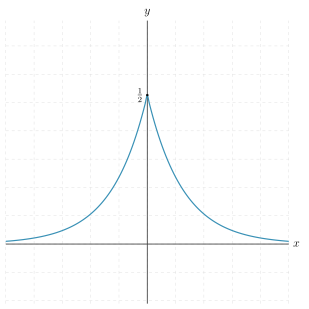
Let \(X\) be a random variable with a Laplace distribution, so that its probability density function is given by \[ \f(x) = \frac12 \e^{-\vert x \vert }\;, \text{ \(-\infty < x < \infty \)}. \tag{\(*\)} \] Sketch \(\f(x)\). Show that its moment generating function \({\rm M}_X(\theta)\) is given by \({\rm M}_X(\theta)= (1-\theta^2)^{-1}\) and hence find the variance of \(X\). A frog is jumping up and down, attempting to land on the same spot each time. In fact, in each of \(n\) successive jumps he always lands on a fixed straight line but when he lands from the \(i\)th jump (\(i=1\,,2\,,\ldots\,,n\)) his displacement from the point from which he jumped is \(X_i\,\)cm, where \(X_i\) has the distribution \((*)\). His displacement from his starting point after \(n\) jumps is \(Y\,\)cm (so that \(Y=\sum\limits_{i=1}^n X_i\)). Each jump is independent of the others. Obtain the moment generating function for \(Y/ \sqrt {2n}\) and, by considering its logarithm, show that this moment generating function tends to \(\exp(\frac12\theta^2)\) as \(n\to\infty\). Given that \(\exp(\frac12\theta^2)\) is the moment generating function of the standard Normal random variable, estimate the least number of jumps such that there is a \(5\%\) chance that the frog lands 25 cm or more from his starting point.
Solution:
2008 Paper 3 Q13
A box contains \(n\) pieces of string, each of which has two ends. I select two string ends at random and tie them together. This creates either a ring (if the two ends are from the same string) or a longer piece of string. I repeat the process of tying together string ends chosen at random until there are none left. Find the expected number of rings created at the first step and hence obtain an expression for the expected number of rings created by the end of the process. Find also an expression for the variance of the number of rings created. Given that \(\ln 20 \approx 3\) and that \(1+ \frac12 + \cdots + \frac 1n \approx \ln n\) for large \(n\), determine approximately the expected number of rings created in the case \(n=40\,000\).
Solution: Let \(X_i\) be the indicator variable a loop is formed when there are \(i\) strings in the bag, so \(\mathbb{P}(X_i = 1) = \frac{1}{2i-1}\). Therefore \begin{align*} && Y_n &= X_n + Y_{n-1} \\ && Y_n &= X_n + \cdots + X_1 \\ \Rightarrow && \E[Y_n] &= \frac{1}{2n-1} + \frac{1}{2n-3} + \cdots + \frac{1}{1} \\ && \var[Y_n] &= \sum_{i=1}^n \frac{1}{2i-1} \frac{2i-2}{2i-1} \\ &&&= 2\sum_{i=1}^n \frac{i-1}{(2i-1)^2} \end{align*} \begin{align*} && \E[Y_{n}] &= 1 + \frac13 + \cdots + \frac{1}{2n-1} \\ &&&= 1 + \frac12 + \cdots + \frac1{2n} - \frac12\left (1 + \frac12 + \cdots + \frac1n \right) \\ &&&\approx \ln 2n -\frac12 \ln n \\ &&&= \ln 2 \sqrt{n} \\ \\ && \E[Y_{40\,000}] &= \ln 2 \sqrt{40\,000} \\ &&&= \ln 400 \\ &&&= 2 \ln 20 \approx 6 \end{align*}
2007 Paper 1 Q1
A positive integer with \(2n\) digits (the first of which must not be \(0\)) is called a balanced number if the sum of the first \(n\) digits equals the sum of the last \(n\) digits. For example, \(1634\) is a \(4\)-digit balanced number, but \(123401\) is not a balanced number.
- Show that seventy \(4\)-digit balanced numbers can be made using the digits \(0, 1, 2, 3\) and \(4\).
- Show that \(\frac16 {k \left( k+1 \right) \left( 4k+5 \right) }\) \(4\)-digit balanced numbers can be made using the digits \(0\) to \(k\). You may use the identity $\displaystyle \sum _{r=0}^{n} r^2 \equiv \tfrac{1}{6} {n \left( n+1 \right) \left( 2n+1 \right) } \;$.
Solution:
- For each number from \(1\) to \(8\) (4+4), we can count the number of ways it can be achieved in any way, or without including a leading \(0\). \begin{array}{c|c|c|c} \text{total} & \text{ways with }0 & \text{ways without } 0 & \text{comb}\\ \hline 8 & 1 & 1 & 1\\ 7 & 2 & 2 & 4 \\ 6 & 3 & 3 & 9 \\ 5 & 4 & 4 & 16 \\ 4 & 5 & 4 & 20 \\ 3 & 4 & 3 & 12 \\ 2 & 3 & 2 & 6 \\ 1 & 2 & 1 & 2 \\ \hline &&& 70 \end{array}
- For \(2k\) to \(k+1\) there are \(1 \times 1 + 2 \times 2 + \cdots i\times i+\cdots + k\times k\) ways to achieve this, (we can choose anything from \(k\) to \(k-i+1\) for the first digit, and we can never have a \(0\). For \(1\) to \(k\) we can have \(1 \times 2 + 2 \times 3 + \cdots + k \times (k+1)\) since we cannot start with a \(0\), but can have anything less than or equal to \(i\) for the first digit, and then with the \(0\) we can have the same thing starting with \(0\). Hence the answer is: \begin{align*} && S &= \sum_{i=1}^k i^2 + \sum_{i=1}^k i (i+1) \\ &&&= 2\sum_{i=1}^k i^2 + \sum_{i=1}^k i \\ &&&= \frac{1}{3} k(k+1)(2k+1) + \frac12k(k+1) \\ &&&= k(k+1) \left (\frac{2k+1}{3} + \frac{1}{2} \right) \\ &&&= \frac16 k(k+1)(4k+2+3) \\ &&&= \frac16 k(k+1)(4k+5) \end{align*}
2007 Paper 1 Q2
- Given that \(A = \arctan \frac12\) and that \(B = \arctan\frac13\,\) (where \(A\) and \(B\) are acute) show, by considering \(\tan \left( A + B \right)\), that \(A + B = {\frac{1}{4}\pi }\). The non-zero integers \(p\) and \(q\) satisfy \[ \displaystyle \arctan {\frac1 p} + \arctan {\frac1 q} = {\frac\pi 4}\,. \] Show that \( \left ( p-1 \right) \left(q-1 \right) = 2\) and hence determine \(p\) and \(q\).
- Let \(r\), \(s\) and \(t\) be positive integers such that the highest common factor of \(s\) and \(t\) is \(1\). Show that, if \[ \arctan {\frac1 r} + \arctan \frac s {s+t} = {\frac\pi 4}\,, \] then there are only two possible values for \(t\), and give \(r\) in terms of \(s\) in each case.
Solution:
- \begin{align*} && \tan (A+B) &= \frac{\tan A + \tan B}{1-\tan A \tan B}\\ &&&= \frac{\tan \arctan \frac12 + \tan \arctan \frac13}{1-\tan \arctan \frac12 \tan \arctan \frac13}\\ &&&= \frac{\frac12+\frac13}{1-\frac16} \\ &&&= \frac{3+2}{5} \\ &&&= 1 \\ \Rightarrow && A+B &= \frac{\pi}{4} + n \pi \end{align*} but since \(A,B\) are acute \(0 < A+B < \pi\), so \(A+B = \frac{\pi}{4}\) \begin{align*} && 1 &= \tan \frac{\pi}{4} \\ &&&= \tan \left ( \arctan {\frac1 p} + \arctan {\frac1 q}\right) \\ &&&= \frac{\frac1p + \frac1q}{1-\frac1{pq}} \\ &&&= \frac{q+p}{pq-1} \\ \Rightarrow && pq-1 &= q+p \\ \Rightarrow && 0 &= pq-q-p-q \\ &&&= (p-1)(q-1)-2 \\ \Rightarrow && 2 &= (p-1)(q-1) \end{align*} But \(p\),\(q\) are integers, so \(p-1 \in \{-2,-1,1,1\} \Rightarrow p \in \{-1,0,2,3\}\) but we cannot have \(p= 0\), so we must have \((p,q) = (2,3), (3,2)\)
- \begin{align*} && 1 &= \tan \frac{\pi}{4} \\ &&&= \tan \left ( \arctan {\frac1 r} + \arctan \frac s {s+t} \right) \\ &&&= \frac{\frac1r + \frac{s}{s+t}}{1-\frac{s}{r(s+t)}} \\ &&&= \frac{s+t+sr}{r(s+t)-s} \\ \Rightarrow && rs+rt-s &= s+t + sr \\ \Rightarrow && 0 &= rt-2s-t \\ &&2s&= t(r-1) \end{align*} Since \((s,t) =1\), we must have \(t \mid 2\), so \( t = 1,2\) and \(r = 2s+1\) or \(r=s+1\) respectively.
2007 Paper 1 Q3
Prove the identities \(\cos^4\theta -\sin^4\theta \equiv \cos 2\theta\) and $\cos^4 \theta + \sin^4 \theta \equiv 1 - {\frac12} \sin^2 2 \theta$. Hence or otherwise evaluate \[ \int_0^{\frac{1}{2}\pi} \cos^4 \theta \; \d \theta \;\;\;\; \mbox{and}\;\;\;\; \int_0^{\frac{1}{2}\pi} \sin^4 \theta \; \d \theta \,. \] Evaluate also \[ \int_0^{\frac{1}{2}\pi} \cos^6 \theta \; \d \theta \;\;\;\; \mbox{and}\;\;\;\; \int_0^{\frac{1}{2}\pi} \sin^6 \theta \; \d \theta \,. \]
Solution: \begin{align*} && \cos^4 \theta - \sin^4 \theta &= (\cos^2 \theta - \sin^2 \theta)(\cos^2 \theta + \sin^2 \theta) \\ &&&= \cos^2 \theta - \sin^2 \theta \\ &&&= \cos 2 \theta \\ \\ && 1&= (\cos^2 \theta + \sin^2 \theta)^2 \\ &&&= \cos^4 \theta + \sin^4 \theta + 2 \sin^2 \theta \cos^2 \theta \\ &&&= \cos^4 \theta + \sin^4 \theta + \frac12 ( \sin^2 2 \theta) \\ \Rightarrow && \cos^4 \theta + \sin^4 \theta &= 1 - \tfrac12 \sin^2 2 \theta \end{align*} \begin{align*} && I &= \int_{0}^{\pi/2} \cos^4 \theta \d \theta \\ && J &= \int_0^{\pi/2} \sin^4 \theta \d \theta \\ && I-J &= \int_0^{\pi/2} \cos 2 \theta \d \theta = 0 \\ && I+J &= \int_0^{\pi/2} (1- \frac12 \sin^2 2 \theta) \d \theta \\ &&&= \frac{\pi}{2} - \frac14 \int_0^{\pi} \sin^2 \theta \d \theta \\ &&&= \frac{\pi}{2} - \frac{\pi}{8} \\ &&&= \frac{3\pi}{8} \\ \Rightarrow && I=J &= \frac{3\pi}{16} \end{align*} \begin{align*} && \cos^6 \theta + \sin^6 \theta &= (\cos^2 \theta + \sin^2 \theta)(\cos^4 \theta - \cos^2 \theta \sin^2 \theta + \sin^4 \theta) \\ &&&= 1-\tfrac12 \sin^2 2\theta - \tfrac14 \sin^2 2 \theta \\ &&&= 1 - \tfrac34 \sin^2 2 \theta \\ %&& \cos^6 \theta - \sin^6 \theta &= (\cos^2 \theta - \sin^2 \theta)(\cos^4 \theta + \cos^2 \theta \sin^2 \theta + \sin^4 \theta) \\ %&&&= \cos 2 \theta (1 - \tfrac12 \sin^2 2 \theta + \tfrac14 \sin^2 2 \theta) \\ %&&&= \cos 2 \theta (1 - \tfrac14 \sin^2 2 \theta) \\ \end{align*} \begin{align*} && I &= \int_{0}^{\pi/2} \cos^6 \theta \d \theta \\ && J &= \int_0^{\pi/2} \sin^6 \theta \d \theta \\ && I-J &= 0 \\ && I+J &= \int_0^{\pi/2} (1 - \tfrac34 \sin^2 2 \theta) \d \theta \\ &&&= \frac{\pi}{2} - \frac{3\pi}{16} = \frac{5\pi}{16} \\ \Rightarrow && I = J &= \frac{5\pi}{32} \end{align*}
2007 Paper 1 Q4
Show that \(x^3-3xbc + b^3 + c^3\) can be written in the form \(\left( x+ b+ c \right) {\rm Q}( x)\), where \({\rm Q}( x )\) is a quadratic expression. Show that \(2{\rm Q }( x )\) can be written as the sum of three expressions, each of which is a perfect square. It is given that the equations \(ay^2 + by + c =0\) and \(by^2 + cy + a = 0\) have a common root \(k\). The coefficients \(a\), \(b\) and \(c\) are real, \(a\) and \(b\) are both non-zero, and \(ac \neq b^2\). Show that \[ \left( ac - b^2 \right) k = bc - a^2 \] and determine a similar expression involving \(k^2\). Hence show that \[ \left( ac - b^2 \right) \left(ab-c^2 \right) = \left( bc - a^2 \right)^2 \] and that \( a^3 -3abc + b^3 +c^3 = 0\,\). Deduce that either \(k=1\) or the two equations are identical.
Solution: \begin{align*} && x^3 - 3xbc+b^3 + c^3 &= (x+b+c)(x^2-x(b+c)+b^2+c^2-bc) \\ &&&= \tfrac12(x+b+c)((x-b)^2+(x-c)^2+(b-c)^2) \\ \end{align*} We must have: \begin{align*} && 0 &= ak^2 + bk+c \tag{1}\\ &&0 &= bk^2+ck+a \tag{2}\\ b*(1)&& 0 &= abk^2 + b^2k+cb \\ a*(2)&& 0 &= abk^2 + ack + a^2 \\ \Rightarrow && 0 &= k(ac-b^2)+a^2-bc \\ \Rightarrow && (ac-b^2)k &= bc-a^2 \\ \\ c*(1) && 0 &= ack^2+bck+c^2 \\ b*(2) && 0 &= b^2k^2+bck+ab \\ \Rightarrow && 0 &= (ac-b^2)k^2 +c^2-ab \\ \Rightarrow && (ac-b^2)k^2 &= ab-c^2 \\ \\ \Rightarrow && \frac{ab-c^2}{ac-b^2} &= k^2 = \left (\frac{bc-a^2}{ac-b^2} \right)^2 \\ \Rightarrow && (ab-c^2)(ac-b^2) &= (bc-a^2)^2 \\ \Rightarrow && a^2bc - ab^3-ac^3+b^2c^2 &= b^2c^2-2a^2bc+a^4 \\ \Rightarrow && 0 &= a^4+ab^3+ac^3-3a^2bc \\ &&&= a(a^3+b^3+c^3-3abc) \\ \underbrace{\Rightarrow}_{a \neq 0} && 0 &= a^3+b^3+c^3-3abc \\ &&&= (a+b+c)((a-b)^2+(b-c)^2+(c-a)^2) \end{align*} Therefore \(a+b+c = 0\). (Since otherwise \(a=b=c\) but \(ac \neq b^2\)). This means \(1\) is a root of our equations. Therefore, either \(k = 1\) or they have both roots in common, ie they are the same equation up to a scalar factor. ie \(b = la, c = lb, a= lc \Rightarrow l^3 = 1 \Rightarrow l = 1\). Therefore, they are the same equation.
2007 Paper 1 Q5
Note: a regular octahedron is a polyhedron with eight faces each of which is an equilateral triangle.
- Show that the angle between any two faces of a regular octahedron is \(\arccos \left( -{\frac1 3} \right)\).
- Find the ratio of the volume of a regular octahedron to the volume of the cube whose vertices are the centres of the faces of the octahedron.
Solution:
- Suppose the vertices are \((\pm1, 0,0), (0,\pm1,0), (0,0,\pm1)\), then clearly this is an octahedron. We can measure the angle between the faces, by looking at vectors in the same plane and also in two of the faces: \(\langle \frac12, \frac12, - 1\rangle\) and \(\langle \frac12, \frac12, 1\rangle\), then by considering the dot product: \begin{align*} && \cos \theta &= \frac{\frac14+\frac14-1}{\frac14+\frac14+1} \\ &&&= \frac{-2}{6} = -\frac13 \end{align*}
- The volume of our octahedron is \(2 \cdot \frac13 \cdot \underbrace{\sqrt{2}^2}_{\text{base}} \cdot \underbrace{1}_{\text{height}} = \frac43\). The centre of two touching faces are \(\langle \frac13, \frac13, \frac13 \rangle\) and \(\langle \frac13, \frac13, -\frac13 \rangle\) and so the length of the side of the cube is \(\frac23\) and so the volume of the cube is \(\frac8{27}\). Therefore the ratio is \(\frac{2}{9}\)
2007 Paper 1 Q6
- Given that \(x^2 - y^2 = \left( x - y \right)^3\) and that \(x-y = d\) (where \(d \neq 0\)), express each of \(x\) and \(y\) in terms of \(d\). Hence find a pair of integers \(m\) and \(n\) satisfying \(m-n = \left( \sqrt {m} - \sqrt{n} \right)^3\) where \(m > n > 100\).
- Given that \(x^3 - y^3 = \left( x - y \right)^4\) and that \(x-y = d\) (where \(d \neq 0\)), show that \(3xy = d^3 - d^2\). Hence show that \[ 2x = d \pm d \sqrt {\frac{4d-1 }{3}} \] and determine a pair of distinct positive integers \(m\) and \(n\) such that \(m^3 - n^3 = \left( m - n \right)^4\).
Solution:
- \(\,\) \begin{align*} && x^2-y^2 &=(x-y)^3 \\ \Rightarrow && x+y &=d^2 \\ && x-y &= d \\ \Rightarrow && x &= \tfrac12(d^2+d) \\ && y &= \tfrac12(d^2-d) \end{align*} Therefore consider \(x^2 = m, y^2 = n\), so \(m = \tfrac14(d^2+d)^2, n = \tfrac14(d^2-d)^2\) so we want \(d^2-d > 20\), so \(d = 6, n = 225, m = 441\).
- \(\,\) \begin{align*} && x^3-y^3 &= (x-y)^4 \\ \Rightarrow && x^2+xy+y^2 &= (x-y)^3 \\ && d^3 &= (x-y)^2+3xy \\ && d^3 &= d^2 + 3xy \\ \Rightarrow && 3xy &= d^3 - d^2 \\ \Rightarrow && 3x(x-d) &= d^3-d^2 \\ \Rightarrow && 0 &= 3x^2-3dx-(d^3-d^2) \\ \Rightarrow && 2x &=d \pm \sqrt{d^2+4\frac{(d^3-d^2)}{3}} \\ &&&= d \pm d \sqrt{\frac{3+4d-4}{3}} \\ &&&= d \pm d \sqrt{\frac{4d-1}{3}} \end{align*} Therefore we need \(\frac{4d-1}{3}\) to be an odd square. \(y = x-d = -\frac{d}{2} \pm \frac{d}{2} \sqrt{\frac{4d-1}{3}}\). Since we want positive values, we should take the positive square roots. \(d = \frac{3 \cdot 3^2 + 1}{4} = 7\) we have \(2x = 7 +7 \cdot 3 = 28 \Rightarrow x = 14, y = 7\)
2007 Paper 1 Q7
- The line \(L_1\) has vector equation $\displaystyle {\bf r} = \begin{pmatrix} 1 \\ 0 \\ 2 \end{pmatrix} + \lambda \begin{pmatrix} \hphantom{-} 2 \\ \hphantom{-} 2 \\ -3 \end{pmatrix} $. The line \(L_2\) has vector equation $\displaystyle {\bf r} = \begin{pmatrix} \hphantom{-} 4 \\ -2 \\ \hphantom{-} 9 \end{pmatrix} + \mu \begin{pmatrix} \hphantom{-} 1 \\ \hphantom{-} 2 \\ -2 \end{pmatrix} . $ Show that the distance \(D\) between a point on \(L_1\) and a point on \(L_2\) can be expressed in the form \[ D^2 = \left(3\mu -4 \lambda-5 \right)^2 + \left( \lambda -1 \right)^2 + 36\,. \] Hence determine the minimum distance between these two lines and find the coordinates of the points on the two lines that are the minimum distance apart.
- The line \(L_3\) has vector equation ${\bf r} = \begin{pmatrix} 2 \\ 3 \\ 5 \end{pmatrix} + \alpha \begin{pmatrix} 0 \\ 1 \\ 0 \end{pmatrix} . $ The line \(L_4\) has vector equation $ {\bf r} = \begin{pmatrix} \hphantom{-} 3 \\ \hphantom{-} 3 \\ -2 \end{pmatrix} + \beta \begin{pmatrix} \, 4k\\ 1-k \\ \!\!\! -3k \end{pmatrix} . $ Determine the minimum distance between these two lines, explaining geometrically the two different cases that arise according to the value of \(k\).
2007 Paper 1 Q8
A curve is given by the equation \[ y = ax^3 - 6ax^2+ \left( 12a + 12 \right)x - \left( 8a + 16 \right)\,, \tag{\(*\)} \] where \(a\) is a real number. Show that this curve touches the curve with equation \[ y=x^3 \tag{\(**\)} \] at \(\left( 2 \, , \, 8 \right)\). Determine the coordinates of any other point of intersection of the two curves.
- Sketch on the same axes the curves \((*)\) and \((**)\) when \(a = 2\).
- Sketch on the same axes the curves \((*)\) and \((**)\) when \(a = 1\).
- Sketch on the same axes the curves \((*)\) and \((**)\) when \(a = -2\).
Solution: \begin{align*} && y &= ax^3 - 6ax^2+ \left( 12a + 12 \right)x - \left( 8a + 16 \right) \\ && y(2) &= 8a-24a+24a+24-8a-16 \\ &&&= 8 \\ && y'(x) &= 3ax^2-12ax+(12a+12) \\ && y'(0) &= 12a-24a+12a+12 \\ &&&= 12 \end{align*} Therefore since our curve has the same value and gradient at \((2,8)\) as \(y = x^3\) they must touch at this point. Therefore \begin{align*} && ax^3 - 6ax^2+ \left( 12a + 12 \right)x - \left( 8a + 16 \right) - x^3 &= (x-2)^2((a-1)x-(2a+4)) \end{align*} Therefore if \(a \neq 1\), they touch again when \(x = \frac{2a+4}{a-1}\).


