Problems
Filters
48 problems found
1989 Paper 3 Q14
D: 1700.0
B: 1472.2
moments of inertia
variable density
disc
pulley system
impulse
rough pulley
rotational dynamics
inelastic string
Atwood machine
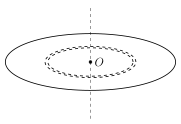
- A solid circular disc has radius \(a\) and mass \(m.\) The density is proportional to the distance from the centre \(O\). Show that the moment of inertia about an axis through \(C\) perpendicular to the plane of the disc is \(\frac{3}{5}ma^{2}.\)
- A light inelastic string has one end fixed at \(A\). It passes under and supports a smooth pulley \(B\) of mass \(m.\) It then passes over a rough pulley \(C\) which is a disc of the type described in (i), free to turn about its axis which is fixed and horizontal. The string carries a particle \(D\) of mass \(M\) at its other end. The sections of the string which are not in contact with the pulleys are vertical. The system is released from rest and moves under gravity for \(t\) seconds. At the end of this interval the pulley \(B\) is suddenly stopped. Given that \(m<2M\), find the resulting impulse on \(D\) in terms of \(m,M,g\) and \(t\). {[}You may assume that the string is long enough for there to be no collisions between the elements of the system, and that the pulley \(C\) is rough enough to prevent slipping throughout.{]}
Solution:
- \begin{align*} m &= \int_0^a \underbrace{(\rho r)}_{\text{mass per area}} \underbrace{\pi r^2}_{\text{area}} \d r \\ &= \rho \pi \frac{a^3}{3} \\ \\ I &= \sum m r^2 \\ &= \sum (\rho r) \pi r^2 \cdot r^2 \\ &\to \int_0^a \rho \pi r^4 \\ &= \frac15 \rho \pi a^5 \\ &= \frac35 m a^2 \end{align*}
- \begin{align*} \text{N2}(\downarrow, D): && Mg -T_C &= Mf \\ \overset{\curvearrowright}{C} && (T_C - T_B)a &= I \frac{f}{a} \\ &&&= \frac35 m a f \\ \text{N2}(\uparrow, B): && 2T_B-mg &= \frac12 m f \\ \\ \Rightarrow && Mg-T_B &= \left (M + \frac35 m \right)f \\ \Rightarrow && Mg - \frac12 mg &= \left (M + \frac35 m + \frac14 m \right)f \\ \Rightarrow && f &= \frac{(M-\frac12 m)g}{M + \frac{17}{20} m} \\ &&&= \frac{(2M-m)g}{2M +\frac{17}{10}m} \end{align*} Therefore the speed after a time \(t\) is \(\displaystyle \frac{(2M-m)g}{2M +\frac{17}{10}m} t\) and the impulse will be the change in momentum, ie \(\displaystyle \frac{(2M-m)g}{2M +\frac{17}{10}m} Mt\)

1989 Paper 3 Q15
D: 1700.0
B: 1503.8
probability
cumulative distribution function
uniform distribution
order statistics
median
probability density function
integration
expectation
variance
The continuous random variable \(X\) is uniformly distributed over the interval \([-c,c].\) Write down expressions for the probabilities that:
- \(n\) independently selected values of \(X\) are all greater than \(k\),
- \(n\) independently selected values of \(X\) are all less than \(k\),
Solution:
- \begin{align*} \mathbb{P}(n\text{ independent values of }X > k) &= \prod_{i=1}^n \mathbb{P}(X > k) \\ &= \left ( \frac{c-k}{2c}\right)^n \end{align*}
- \begin{align*} \mathbb{P}(n\text{ independent values of }X < k) &= \prod_{i=1}^n \mathbb{P}(X < k) \\ &= \left ( \frac{k+c}{2c}\right)^n \end{align*}
1989 Paper 3 Q16
D: 1700.0
B: 1484.0
probability
conditional probability
approximating binomial to normal distribution
normal approximation
hypothesis testing
population model
joint probability table
continuity correction
It is believed that the population of Ruritania can be described as follows:
- \(25\%\) are fair-haired and the rest are dark-haired;
- \(20\%\) are green-eyed and the rest hazel-eyed;
- the population can also be divided into narrow-headed and broad-headed;
- no narrow-headed person has green eyes and fair hair;
- those who are green-eyed are as likely to be narrow-headed as broad-headed;
- those who are green-eyed and broad-headed are as likely to be fair-headed as dark-haired;
- half of the population is broad-headed and dark-haired;
- a hazel-eyed person is as likely to be fair-haired and broad-headed as dark-haired and narrow-headed.
Solution:


