Problems
Filters
52 problems found
1991 Paper 1 Q7
According to the Institute of Economic Modelling Sciences, the Slakan economy has alternate years of growth and decline, as in the following model. The number \(V\) of vloskan (the unit of currency) in the Slakan Treasury is assumed to behave as a continuous variable, as follows. In a year of growth it increases continuously at an annual rate \(aV_{0}\left(1+(V/V_{0})\right)^{2}.\) During a year of decline, as long as there is still money in the Treasury, the amount decreases continuously at an annual rate \(bV_{0}\left(1+(V/V_{0})\right)^{2};\) but if \(V\) becomes zero, it remains zero until the end of the year. Here \(a,b\) and \(V_{0}\) are positive constants. A year of growth has just begun and there are \(k_{0}V_{0}\) vloskan in the Treasury, where \(0\leqslant k_{0} < a^{-1}-1\). Explain the significance of these inequalities for the model to be remotely sensible. If \(k_{0}\) is as above and at the end of one year there are \(k_{1}V_{0}\) vloskan in the Treasury, where \(k_{1} > 0\), find the condition involving \(b\) which \(k_{1}\) must satisfy so that there will be some vloskan left after a further year. Under what condition (involving \(a,b\) and \(k_{0}\)) does the model predict that unlimited growth will take place in the third year (but not before)?
1991 Paper 3 Q1
- Evaluate \[ \sum_{r=1}^{n}\frac{6}{r(r+1)(r+3)}. \]
- Expand \(\ln(1+x+x^{2}+x^{3})\) as a series in powers of \(x\), where \(\left|x\right|<1\), giving the first five non-zero terms and the general term.
- Expand \(\mathrm{e}^{x\ln(1+x)}\) as a series in powers of \(x\), where \(-1 < x\leqslant1\), as far as the term in \(x^{4}\).
Solution:
- \begin{align*} && \frac{6}{r(r+1)(r+3)} &= \frac{2}{r} - \frac{3}{r+1} + \frac{1}{r+3} \\ \Rightarrow && \sum_{r=1}^n \frac{6}{r(r+1)(r+3)} &= \sum_{r=1}^n \l \frac{2}{r} - \frac{3}{r+1} + \frac{1}{r+3} \r \\ &&&= \sum_{r=1}^n \frac{2}{r} - \sum_{r=1}^n \frac{3}{r+1} + \sum_{r=1}^n \frac{1}{r+3} \\ &&&= \sum_{r=1}^n \frac{2}{r} - \sum_{r=2}^{n+1} \frac{3}{r} + \sum_{r=3}^{n+2} \frac{1}{r} \\ &&& = \frac{2}{1} + \frac{2}{2} - \frac{3}{2} - \frac{3}{n+1} + \frac{1}{n+1} + \frac{1}{n+2} \\ &&& = \frac{3}{2} - \frac{2}{n+1} + \frac{1}{n+2} \end{align*}
- \begin{align*} && \ln (1 + x+ x^2 + x^3) &= \ln \l \frac{1-x^4}{1-x} \r \\ &&&= \ln (1-x^4) - \ln(1-x) \\ &&&= \sum_{k=1}^{\infty} -\frac{x^{4k}}{k} - \sum_{k=1}^{\infty} - \frac{x^k}{k} \\ &&&= x + \frac12x^2+\frac13x^3-\frac34x^4+\frac15x^5 + \cdots \\ &&&= \sum_{k=1}^{\infty}a_k x^k \end{align*} Where \(a_k = \frac{1}{k}\) if \(k \neq 0 \pmod{4}\) otherwise \(a_k = -\frac{3}{k}\) if \(k \equiv 0 \pmod{4}\)
- \begin{align*} \exp(x \ln (1+x) ) &= \exp\l x \l x-\frac12x^2+\frac13x^3-\cdots \r \r \\ &= \exp\l x^2-\frac12x^3+\frac13x^4 \r \\ &= 1 + \l x^2-\frac12x^3+\frac13x^4 \r + \frac12 \l x^2-\frac12x^3+\frac13x^4 \r^2 + \cdots \\ &= 1 + x^2-\frac12x^3+\frac13x^4 + \frac12x^4 + \cdots \\ &= 1 + x^2 -\frac12x^3+\frac56x^4+\cdots \end{align*}
1990 Paper 1 Q5
- Evaluate \[ \int_{1}^{3}\frac{1}{6x^{2}+19x+15}\,\mathrm{d}x\,. \]
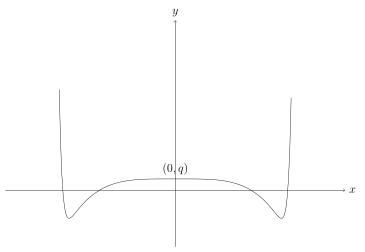
- Sketch the graph of the function \(\mathrm{f}\), where \(\mathrm{f}(x)=x^{1760}-x^{220}+q\), and \(q\) is a constant. Find the possible numbers of \textit{distinct }roots of the equation \(\mathrm{f}(x)=0\), and state the inequalities satisfied by \(q\).
Solution:
- \begin{align*} \int_{1}^{3}\frac{1}{6x^{2}+19x+15}\,\mathrm{d}x &= \int_1^3 \frac1{(2x+3)(3x+5)} \d x \\ &= \int_1^3 \l \frac{2}{2x+3} - \frac{3}{3x+5} \r \d x \\ &= \left [\ln(2x+3) - \ln(3x+5) \right ]_1^3 \\ &= \l \ln9 - \ln14 \r - \l \ln 5 - \ln 8 \r \\ &= \ln \frac{72}{70} \\ &= \ln \frac{36}{35} \end{align*}
- When \(q = 0\) the roots are \(-1, 0, 1\) There can be \(0, 2, 3, 4\) roots. There will be no roots if \(q > -\min (x^{1760} - x^{220})\) since the whole graph will be above the axis. There will be \(2\) roots if \(q = -\min (x^{1760} - x^{220})\) or \(q > 0\) There will be \(4\) roots if \(0 > q > -\min (x^{1760} - x^{220})\). There will be \(3\) roots if \(q =0\)
1988 Paper 1 Q5
Given that \(b>a>0\), find, by using the binomial theorem, coefficients \(c_{m}\) (\(m=0,1,2,\ldots\)) such that \[ \frac{1}{\left(1-ax\right)\left(1-bx\right)}=c_{0}+c_{1}x+c_{2}x^{2}+\ldots+c_{m}x^{m}+\cdots \] for \(b\left|x\right|<1\). Show that \[ c_{m}^{2}=\frac{a^{2m+2}-2(ab)^{m+1}+b^{2m+2}}{(a-b)^{2}}\,. \] Hence, or otherwise, show that \[ c_{0}^{2}+c_{1}^{2}x+c_{2}^{2}x^{2}+\cdots+c_{m}^{2}x^{m}+\cdots=\frac{1+abx}{\left(1-abx\right)\left(1-a^{2}x\right)\left(1-b^{2}x\right)}\,, \] for \(x\) in a suitable interval which you should determine.
Solution: \begin{align*} \frac{1}{(1-ax)(1-bx)} &=\frac{1}{b-a} \l \frac{b}{1-bx}-\frac{a}{1-ax}\r \\ &= \frac{1}{b-a} \l \sum_{k=0}^{\infty} b(bx)^k-\sum_{k=0}^{\infty} a(ax)^k \r \\ &= \frac{1}{b-a} \sum_{k=0}^{\infty} \l b^{k+1} - a^{k+1} \r x^k \end{align*} Therefore \(\displaystyle c_m = \frac{b^{k+1}-a^{k+1}}{b-a}\). \begin{align*} c_m^2 &= \frac{(b^{m+1}-a^{m+1})^2}{(b-a)^2} \\ &= \frac{a^{2m+2} - 2(ab)^{m+1} + b^{2m+2}}{(b-a)^2} \end{align*} \begin{align*} \sum_{m=0}^{\infty} c_m x^m &= \sum_{m=0}^{\infty} \l \frac{a^{2m+2} - 2(ab)^{m+1} + b^{2m+2}}{(b-a)^2} \r x^m \\ &= \frac{1}{(b-a)^2} \l \sum_{m=0}^{\infty} a^{2m+2} x^m-2\sum_{m=0}^{\infty} (ab)^{m+1} x^m+\sum_{m=0}^{\infty} b^{2m+2} x^m \r \\ &= \frac{1}{(b-a)^2} \l a^2\sum_{m=0}^{\infty} a^{2m} x^m-2ab\sum_{m=0}^{\infty} (ab)^{m} x^m+b^2\sum_{m=0}^{\infty} b^{2m} x^m \r \\ &= \frac{1}{(b-a)^2} \l \frac{a^2}{1-a^2x^2} - \frac{2ab}{1-abx} + \frac{b^2}{1-b^2x^2}\r \\ &= \frac{1+ab}{(1-a^2x)(1-abx)(1-b^2x)} \end{align*} Where geometric series will converge if \(|a^2x| < 1, |b^2x| < 1, |abx| < 1\), ie \(|x| < \min (\frac{1}{a^2}, \frac{1}{b^2} )\)
1988 Paper 1 Q9
Find the following integrals:
- \(\ {\displaystyle \int_{1}^{\mathrm{e}}\frac{\ln x}{x^{2}}\,\mathrm{d}x}\,,\)
- \(\ {\displaystyle \int\frac{\cos x}{\sin x\sqrt{1+\sin x}}\,\mathrm{d}x.}\)
Solution:
- \begin{align*} \int_{1}^{\mathrm{e}}\frac{\ln x}{x^{2}}\,\mathrm{d}x &= \left [-\frac{\ln x}{x} \right]_1^e + \int_1^e \frac{1}{x^2} \, \d x \\ &= -\frac{1}{e} + \left [ -\frac{1}{x} \right]_1^e \\ &= 1 - \frac{2}{e} \end{align*}
- \begin{align*} \int\frac{\cos x}{\sin x\sqrt{1+\sin x}}\,\mathrm{d}x &= \int \frac{2u}{(u^2-1)u} \d u \tag{\(u^2 = 1+\sin x\)} \\ &= \int \frac{1}{u-1} - \frac{1}{u+1} \d u \\ &= \ln(u-1) - \ln (u+1) + C \\ &= \ln \l \frac{u-1}{u+1} \r + C \\ &= \ln \l \frac{\sqrt{\sin x + 1} + 1}{\sqrt{\sin x + 1} -1} \r + C \end{align*}
1988 Paper 2 Q1
The function \(\mathrm{f}\) is defined, for \(x\neq1\) and \(x\neq2\) by \[ \mathrm{f}(x)=\frac{1}{\left(x-1\right)\left(x-2\right)} \] Show that for \(\left|x\right|<1\) \[ \mathrm{f}(x)=\sum_{n=0}^{\infty}x^{n}-\frac{1}{2}\sum_{n=0}^{\infty}\left(\frac{x}{2}\right)^{n} \] and that for \(1<\left|x\right|<2\) \[ \mathrm{f}(x)=-\sum_{n=1}^{\infty}x^{-n}-\frac{1}{2}\sum_{n=0}^{\infty}\left(\frac{x}{2}\right)^{n} \] Find an expression for \(\mbox{f}(x)\) which is valid for \(\left|x\right|>2\).
Solution: \begin{align*} && \f(x) &= \frac1{(x-1)(x-2)} \\ &&&=\frac{1}{x-2} -\frac{1}{x-1} \\ \end{align*} Therefore, for \(|x| < 1\) \begin{align*} && \f(x) &=\frac{1}{x-2} -\frac{1}{x-1} \\ &&&= -\frac12 \frac{1}{1-\frac{x}{2}} + \frac{1}{1-x} \\ &&&= \sum_{n=0}^{\infty} x^n - \frac12 \sum_{n=0}^\infty \l \frac{x}2 \r^2 \end{align*} where both geometric series converge since \(|x| < 1\) and \(|\frac{x}{2}| < 1\) When \(1 < |x|< 2 \Rightarrow |\frac{1}{x}| < 1\), we must have: \begin{align*} && \f(x) &=\frac{1}{x-2} -\frac{1}{x-1} \\ &&&= -\frac12 \frac{1}{1-\frac{x}{2}} + \frac1{x}\frac{1}{1-\frac{1}{x}} \\ &&&= - \frac12 \sum_{n=0}^\infty \l \frac{x}2 \r^2 - \frac{1}{x} \sum_{n=0}^{\infty} x^{-n} \\ &&&= - \frac12 \sum_{n=0}^\infty \l \frac{x}2 \r^2 - \sum_{n=1}^{\infty} x^{-n} \\ \end{align*} Finally, when \(|x| > 2\), ie \(|\frac{2}{x}| < 1\) we have \begin{align*} && \f(x) &=\frac{1}{x-2} -\frac{1}{x-1} \\ &&& =\frac1{x} \frac{1}{1-\frac{2}{x}} - \frac{1}{x}\frac{1}{1-\frac{1}{x}} \\ &&&= \frac1{x} \sum_{n=0}^{\infty} \l \frac{2}{x} \r^n - \sum_{n=1}^{\infty}x^{-n} \\ &&&= \sum_{n=1}^{\infty} 2^{n-1} x^{-n} - \sum_{n=1}^{\infty}x^{-n} \\ \end{align*}
1987 Paper 2 Q6
Let \[ I=\int_{-\frac{1}{2}\pi}^{\frac{1}{2}\pi}\frac{\cos^{2}\theta}{1-\sin\theta\sin2\alpha}\,\mathrm{d}\theta\, , \] where \(0<\alpha<\frac{1}{4}\pi\). Show that \[ I=\int_{-\frac{1}{2}\pi}^{\frac{1}{2}\pi}\frac{\cos^{2}\theta}{1+\sin\theta\sin2\alpha}\,\mathrm{d}\theta\, , \] and hence that \[ I=\frac{\pi}{\sin^{2}2\alpha}-\cot^{2}2\alpha\int_{-\frac{1}{2}\pi}^{\frac{1}{2}\pi}\frac{\sec^{2}\theta}{1+\cos^{2}2\alpha\tan^{2}\theta}\,\mathrm{d}\theta. \] Show that \(I=\frac{1}{2}\pi\sec^{2}\alpha\), and state the value of \(I\) if \(\frac{1}{4}\pi<\alpha<\frac{1}{2}\pi\).
Solution: \begin{align*} \int_{-\frac{1}{2}\pi}^{\frac{1}{2}\pi}\frac{\cos^{2}\theta}{1-\sin\theta\sin2\alpha}\,\mathrm{d}\theta &= \int_{u = \frac12 \pi}^{u = -\frac12 \pi} \frac{\cos^2 (-u)}{1-\sin(-u) \sin 2 \alpha} -\d u \tag{\(u = -\theta\)} \\ &= \int_{\frac12 \pi}^{-\frac12 \pi} \frac{\cos^2 u}{1+\sin u \sin 2 \alpha} -\d u \\ &= \int_{-\frac12 \pi}^{\frac12 \pi} \frac{\cos^2 u}{1+\sin u \sin 2 \alpha} \d u \\ &= \int_{-\frac12 \pi}^{\frac12 \pi} \frac{\cos^2 \theta}{1+\sin \theta \sin 2 \alpha} \d \theta \\ \end{align*} Since \(\displaystyle \frac{1}{(1-a^2u^2)} = \frac12 \l \frac{1}{1+au} + \frac1{1-au} \r\) \begin{align*} \int_{-\frac12 \pi}^{\frac12 \pi} \frac{\cos^2 \theta}{1+\sin \theta \sin 2 \alpha} \d \theta &= \int_{-\frac12 \pi}^{\frac12 \pi} \frac{\cos^2 \theta}{1-\sin ^2\theta \sin^2 2 \alpha} \d \theta \\ &= \int_{-\frac12 \pi}^{\frac12 \pi} \frac{1-\sin^2 \theta}{1-\sin ^2\theta \sin^2 2 \alpha} \d \theta \\ &= \int_{-\frac12 \pi}^{\frac12 \pi} \frac{(1-\sin ^2\theta \sin^2 2 \alpha) \frac{1}{\sin^2 2\alpha} + 1 - \cosec^2 2\alpha}{1-\sin ^2\theta \sin^2 2 \alpha} \d \theta \\ &= \frac{\pi}{\sin^2 2\alpha} -\cot^2 2\alpha \int_{-\frac{\pi}2}^{\frac{\pi}2} \frac{1}{1 - \sin^2 \theta \sin^2 2 \alpha} \d \theta \\ &= \frac{\pi}{\sin^2 2\alpha} -\cot^2 2\alpha \int_{-\frac{\pi}2}^{\frac{\pi}2} \frac{1}{1 - \sin^2 \theta (1-\cos^2 2 \alpha)} \d \theta \\ &= \frac{\pi}{\sin^2 2\alpha} -\cot^2 2\alpha \int_{-\frac{\pi}2}^{\frac{\pi}2} \frac{1}{\cos^2 \theta +\sin^2 \theta \cos^2 2 \alpha} \d \theta \\ &= \frac{\pi}{\sin^2 2\alpha} -\cot^2 2\alpha \int_{-\frac{\pi}2}^{\frac{\pi}2} \frac{\sec^2 \theta}{1 +\tan^2 \theta \cos^2 2 \alpha} \d \theta \\ \end{align*} Finally, using the substitution \(u =|\cos 2 \alpha | \tan \theta, \d u = |\cos 2 \alpha |\sec^2 \theta \d \theta\) \begin{align*} \int_{-\frac{\pi}2}^{\frac{\pi}2} \frac{\sec^2 \theta}{1 +\tan^2 \theta \cos^2 2 \alpha} \d \theta &= |\sec 2\alpha|\int_{u = -\infty}^{u = \infty} \frac{1}{1 + u^2} \d u \\ &= |\sec 2 \alpha|\pi \end{align*} and so \begin{align*} I &= \frac{\pi}{\sin^2 2\alpha} -\cot^2 2\alpha |\sec 2 \alpha|\pi \\ &= \frac{\pi}{\sin^2 2\alpha} \l 1-\cos 2\alpha \r \\ &= \frac{\pi}{4\sin^2 \alpha\cos^2 \alpha} \l 2 \sin^2 \alpha \r \\ &= \frac{\pi}{2 \cos^2 \alpha} = \frac{\pi}{2} \sec^2 \alpha \end{align*} When \(\alpha\) small enough that the modulus doesn't flip the sign. When if \(\frac{1}{4}\pi<\alpha<\frac{1}{2}\pi\) we have: \begin{align*} I &= \frac{\pi}{\sin^2 2\alpha} -\cot^2 2\alpha |\sec 2 \alpha|\pi \\ &= \frac{\pi}{\sin^2 2\alpha} \l 1+\cos 2\alpha \r \\ &= \frac{\pi}{4\sin^2 \alpha\cos^2 \alpha} \l 2 \cos^2 \alpha \r \\ &= \frac{\pi}{2 \sin^2 \alpha} = \frac{\pi}{2} \cosec^2 \alpha \end{align*}