Problems
Filters
91 problems found
2007 Paper 3 Q5
Let \(y = \ln (x^2-1)\,\), where \(x >1\), and let \(r\) and \(\theta\) be functions of \(x\) determined by \(r= \sqrt{x^2-1}\) and \(\coth\theta= x\). Show that \[ \frac {\d y}{\d x} = \frac {2\cosh \theta}{r} \text{ and } \frac {\d^2 y}{\d x^2} = -\frac {2 \cosh 2\theta}{r^2}\,, \] and find an expression in terms of \(r\) and \(\theta\) for \(\dfrac {\d^3 y}{\d x^3}\,\). Find, with proof, a similar formula for \(\dfrac{\d^n y}{\d x^n}\) in terms of \(r\) and \(\theta\).
Solution: \begin{align*} && y &= \ln(x^2 -1) \\ && r &= \sqrt{x^2-1} \\ && \coth \theta &= x \\ && r &= \sqrt{\coth^2 \theta - 1} = \sqrt{\textrm{cosech}^2 \theta} = \textrm{cosech} \theta \\ && \frac{\d y}{\d x} &= \frac{2x}{x^2-1} \\ &&&= \frac{2 \coth \theta}{r^2} \\ &&&= \frac{2 \cosh \theta}{\sinh \theta \cdot r \cdot \textrm{cosech} \theta } \\ &&&= \frac{2 \cosh \theta}{r } \\ \\ && \frac{\d^2 y}{\d x^2} &= \frac{2(x^2-1)-4x^2}{(x^2-1)^2} \\ &&&= \frac{-2(1+x^2)}{r^2 \textrm{cosech}^2 r} \\ &&&= -\frac{2(1 + \coth^2 \theta) \sinh^2 \theta}{r^2} \\ &&&= -\frac{2(\sinh^2 \theta + \cosh^2 \theta)}{r^2} \\ &&&= -\frac{2 \cosh 2 \theta}{r^2} \\ \\ && \frac{\d^3 y}{\d x^3} &= \frac{-4x(x^2-1)^2-(-2x^2-2)\cdot2(x^2-1)\cdot 2x}{(x^2-1)^4} \\ &&&= \frac{-4x(x^2-1)+8x(x^2+1)}{(x^2-1)^3}\\ &&&= \frac{4x^3+12x}{(x^2-1)^3} \\ &&&=\frac{\sinh^3 \theta (4\coth^3 \theta + 12\coth \theta )}{r^3} \\ &&&=\frac{4\cosh^3 \theta + 12\cosh \theta \sinh^2 \theta}{r^3} \\ &&&= \frac{4 \cosh 3 \theta}{r^3} \\ \end{align*} Claim: \(\frac{\d^n y}{\d x^n} = (-1)^{n+1}\frac{2(n-1)!\cosh n \theta}{r^n}\) Proof: By induction. Base cases already proven \begin{align*} \frac{\d r}{\d x} &= \frac{x}{\sqrt{x^2-1}} = \frac{\coth \theta}{\textrm{cosech} \theta} = \cosh \theta \\ \frac{\d \theta}{\d x} &= - \sinh^2 \theta \\ \\ \frac{\d^{n+1} y}{\d x^{n+1}} &= (-1)^{n+1}(n-1)!\frac{\d}{\d x} \left ( \frac{2\cosh n \theta}{r^n}\right) \\ &= (-1)^{n+1}\frac{2 n \sinh n \theta \cdot r^n \cdot \frac{\d \theta}{\d x}- 2\cosh n \theta \cdot nr^{n-1} \frac{\d r}{\d x} }{r^{2n}} \\ &= (-1)^{n+2}\frac{2n( \cosh n \theta\cosh \theta + r\sinh n \theta \sinh^2 \theta) }{r^{n+1}} \\ &= (-1)^{n+2}n!\frac{2\cosh(n+1) \theta }{r^{n+1}} \\ \end{align*} We can think of this as \(\ln(x^2-1) = \ln(x+1)+\ln(x-1)\) and also note \(x \pm 1 = \coth \theta \pm 1 = \frac{\cosh \theta \pm \sinh \theta}{\sinh \theta} = \frac{e^{\pm \theta}}{\sinh \theta}\) \begin{align*} && \frac{\d^n}{\d x^n} \ln(x^2-1) &= (n-1)!(-1)^{n-1} \left ( \frac{1}{(x+1)^n} + \frac{1}{(x-1)^n} \right) \\ &&&= (-1)^{n-1}(n-1)! \left ( \frac{\sinh^n \theta}{e^{n\theta}} + \frac{\sinh^n \theta}{e^{-n\theta}} \right) \\ &&&= (-1)^{n-1} (n-1)!2\cosh n \theta \cdot \sinh^n \theta \\ &&&= (-1)^{n-1}(n-1)! \frac{2 \cosh n \theta }{r^n} \end{align*}
2006 Paper 1 Q4
By sketching on the same axes the graphs of \(y=\sin x\) and \(y=x\), show that, for \(x>0\):
- \(x>\sin x\,\);
- \(\dfrac {\sin x} {x} \approx 1\) for small \(x\).
2006 Paper 1 Q9
A block of mass \(4\,\)kg is at rest on a smooth, horizontal table. A smooth pulley \(P\) is fixed to one edge of the table and a smooth pulley \(Q\) is fixed to the opposite edge. The two pulleys and the block lie in a straight line. Two horizontal strings are attached to the block. One string runs over pulley \(P\); a particle of mass \(x\,\)kg hangs at the end of this string. The other string runs over pulley \(Q\); a particle of mass \(y\,\)kg hangs at the end of this string, where \(x > y\) and \(x + y = 6\,\). The system is released from rest with the strings taut. When the \(4\,\)kg block has moved a distance \(d\), the string connecting it to the particle of mass \(x\,\)kg is cut. Show that the time taken by the block from the start of the motion until it first returns to rest (assuming that it does not reach the edge of the table) is \(\sqrt{d/(5g)\,} \,\f(y)\), where \[ \f(y)= \frac{10}{ \sqrt{6-2y}}+ \left(1 + \frac{4}{ y} \right) \sqrt {6 -2y}. \] Calculate the value of \(y\) for which \(\f'(y)=0\).
2006 Paper 2 Q2
Using the series \[ \e^x = 1 + x +\frac{x^2}{2!} + \frac{x^3}{3!} + \frac{x^4}{4!}+\cdots\,, \] show that \(\e>\frac83\). Show that \(n!>2^n\) for \(n\ge4\) and hence show that \(\e<\frac {67}{24}\). Show that the curve with equation \[ y= 3\e^{2x} +14 \ln (\tfrac43-x)\,, \qquad {x<\tfrac43} \] has a minimum turning point between \(x=\frac12\) and \(x=1\) and give a sketch to show the shape of the curve.
Solution: \begin{align*} && e &= 1 + 1 + \frac{1}{2!} + \frac{1}{3!} + \cdots \\ &&&> 1 + 1+ \frac12 + \frac16 \\ &&&= \frac{12+3+1}{6} = \frac83 \end{align*} \(4! = 24 > 16 = 2^4\), notice that \(n! = \underbrace{n \cdot (n-1) \cdots 5}_{>2^{n-4}} \cdot \underbrace{4!}_{>2^4} >2^n\). \begin{align*} && e &= 1 + 1 + \frac{1}{2!} + \frac{1}{3!} + \cdots \\ &&&< \frac83 + \frac{1}{2^4} + \frac{1}{2^5} + \cdots \\ &&&= \frac83 + \frac{1}{2^4} \frac{1}{1-\tfrac12} \\ &&&= \frac83 + \frac1{8} \\ &&&= \frac{67}{24} \end{align*} \begin{align*} && y &= 3e^{2x} +14 \ln(\tfrac43-x) \\ && y' &= 6e^{2x} - \frac{14}{\tfrac43-x} \\ && y'(\tfrac12) &= 6e - \frac{14}{\tfrac43-\tfrac12} \\ &&&= 6e -\tfrac{84}{5} = 6(e-\tfrac{14}5) < 0 \\ && y'(1) &= 6e^2 - \frac{14}{\tfrac43-1} \\ &&&= 6e^2 - 42 = 6(e^2-7) \\ &&&> 6(\tfrac{64}{9} - 7) > 0 \end{align*} Therefore \(y'\) changes from negative (decreasing) to positive (increasing) in our range, and therefore there is a minima in this range.

2006 Paper 3 Q8
\(\triangle\) is an operation that takes polynomials in \(x\) to polynomials in \(x\); that is, given any polynomial \(\h(x)\), there is a polynomial called \(\triangle \h(x)\) which is obtained from \(\h(x)\) using the rules that define \(\triangle\). These rules are as follows:
- \(\triangle x = 1\,\);
- \(\triangle \big( \f(x)+\g(x)\big) = \triangle \f(x) + \triangle\g(x)\,\) for any polynomials \(\f(x)\) and \(\g(x)\);
- \(\triangle \big( \lambda \f(x)\big) =\lambda \triangle \f(x)\) for any constant \(\lambda\) and any polynomial \(\f(x)\);
- \(\triangle \big( \f(x)\g(x)\big) = \f(x) \triangle \g(x) +\g(x)\triangle \f(x)\) for any polynomials \(\f(x)\) and \(\g(x)\).
Solution: Claim: If \(f\) is a constant, then \(\triangle f = 0\) Proof: First consider \(f(x) = 1, g(x) = x\) then we must have: \begin{align*} && \triangle (1x) &= 1 \triangle x + x \triangle 1 \tag{iv} \\ &&&= 1 \cdot 1 + x \triangle 1 \tag{i} \\ \Rightarrow && 1 &= 1 + x \triangle 1 \tag{i} \\ \Rightarrow && \triangle 1 &= 0 \\ \Rightarrow && \triangle c &= 0 \tag{iii} \end{align*} \begin{align*} && \triangle (x^2) &= x \triangle x + x \triangle x \tag{iv} \\ &&&= x \cdot 1 + x \cdot 1 \tag{i} \\ &&&= 2x \\ \\ && \triangle (x^3) &= x^2 \triangle x + x \triangle (x^2) \tag{iv} \\ &&&= x^2 \cdot 1 + x \cdot 2x \tag{\(\triangle x^2 = 2x\)}\\ &&&= 3x^2 \end{align*} Claim: \(\triangle h(x) = \frac{\d h(x)}{\d x}\) for any polynomial \(h\) Proof: Since both \(\triangle\) and \(\frac{\d}{\d x}\) are linear (properties \((ii)\) and \((iii)\)) it suffices to prove that: \(\triangle x^n = nx^{n-1}\). For this we proceed by induction. Base cases (we've proved up to \(n = 3\) so we're good). Suppose it's true for some \(n\), then consider \(n + 1\), \begin{align*} && \triangle (x^{n+1}) &= x \triangle (x^n) + x^n \triangle x \tag{iv} \\ &&&= x \cdot n x^{n-1} + x^n \triangle x \tag{Ind. hyp.} \\ &&&= nx^n + x^n \tag{i} \\ &&&= (n+1)x^{n} \end{align*} Therefore it's true for for \(n+1\). Therefore by induction it's true for all \(n\).
2006 Paper 3 Q9
A long, light, inextensible string passes through a small, smooth ring fixed at the point \(O\). One end of the string is attached to a particle \(P\) of mass \(m\) which hangs freely below \(O\). The other end is attached to a bead, \(B\), also of mass \(m\), which is threaded on a smooth rigid wire fixed in the same vertical plane as \(O\). The distance \(OB\) is \(r\), the distance \(OH\) is \(h\) and the height of the bead above the horizontal plane through~\(O\) is \(y\), as shown in the diagram.
2005 Paper 2 Q1
Find the three values of \(x\) for which the derivative of \(x^2 \e^{-x^2}\) is zero. Given that \(a\) and \(b\) are distinct positive numbers, find a polynomial \(\P(x)\) such that the derivative of \(\P(x)\e^{-x^2}\) is zero for \(x=0\), \(x=\pm a\) and \(x=\pm b\,\), but for no other values of \(x\).
Solution: \begin{align*} && y &= x^2e^{-x^2} \\ \Rightarrow && y' &= 2xe^{-x^2} +x^2 \cdot (-2x)e^{-x^2} \\ &&&= e^{-x^2}(2x-2x^3) \\ &&&= 2e^{-x^2}x(1-x^2) \end{align*} Therefore the derivative is zero iff \(x = 0, \pm 1\) \begin{align*} && y &= \P(x) e^{-x^2} \\ \Rightarrow && y' &= e^{-x^2} (\P'(x)-2x\P(x)) \end{align*} Therefore we want \(\P'(x) - 2x\P(x) = Kx(x^2-a^2)(x^2-b^2)\) Since this has degree \(5\), we should look at polynomials degree \(4\) for \(\P\). We can also immediately see that \(0\) is a root of \(\P'(x)\), so \(\P(x) = a_4x^4+a_3x^3+a_2x^2+a_0\). WLOG \(a_4 = 1\) and \(K = -2\), so \begin{align*} && -2(x^5-(a^2+b^2)x^3+a^2b^2x) &= 4x^3+3a_3x^2+2a_2x- 2x(x^4+a_3x^3+a_2x^2+a_0) \\ &&&= -2x^5-2a_3 x^4+(4-2a_2)x^3+(2a_2-2a_0)x \\ \Rightarrow && a_3 &= 0 \\ && a^2+b^2 &= 2-a_2 \\ \Rightarrow && a_2 &= 2-a^2-b^2 \\ && a^2b^2 &= a_0-a_2 \\ \Rightarrow && a_0 &= a^2b^2 + 2-a^2-b^2 \\ \Rightarrow && \P(x) &= x^4+(2-a^2-b^2)x^2+(a^2-1)(b^2-1)x \end{align*}
2004 Paper 1 Q4
Differentiate \(\sec {t}\) with respect to \(t\).
- Use the substitution \(x=\sec t\) to show that $\displaystyle \int^2_{\sqrt 2} \frac{1}{ x^3\sqrt {x^2-1} } \; \mathrm{d}x =\frac{\sqrt 3 - 2}{8} + \frac {\pi}{24} \;.$
- Determine $\displaystyle \int \frac{1} {( x+2) \sqrt {(x+1)(x+3)} } \; \mathrm{d}x \;$.
- Determine $\displaystyle \int \frac {1} {(x+2) \sqrt {x^2+4x-5} } \; \mathrm{d}x \;$.
Solution: \[\frac{\d}{\d t} \left ( \sec t \right) = \frac{\sin t }{\cos^2 t} = \sec t \tan t \]
- \(\,\) \begin{align*} && I_1 &= \int_{\sqrt{2}}^2 \frac{1}{x^3 \sqrt{x^2-1}} \\ x = \sec t, \d x = \sec t \tan t:&&&= \int_{t=\pi/4}^{t=\pi/3} \frac{1}{\sec^3 t \tan t} \sec t \tan t \d t \\ &&&= \int_{t=\pi/4}^{t=\pi/3} \cos^2 t \d t \\ &&&= \int_{t=\pi/4}^{t=\pi/3} \frac{1+\cos 2t}{2} \d t \\ &&&= \frac12 \frac{\pi}{12} + \frac12 \left (\sin \frac{\pi}{3} - \sin \frac{\pi}{4} \right) \\ &&&= \frac{\pi}{24} + \frac{\sqrt{3}-2}{8} \\ \end{align*}
- \(\,\) \begin{align*} && I_2 &= \int \frac{1}{(x+2)\sqrt{(x+1)(x+3)}} \d x \\ &&&= \int \frac{1}{(x+2)\sqrt{(x+2)^2-1}} \d x \\ &&&= \int \frac{1}{u\sqrt{u^2-1}} \d u \\ &&&= \sec^{-1} u + C \\ &&&= \sec^{1} (x+2) + C \end{align*}
- \(\,\) \begin{align*} && I_3 &= \int \frac{1}{(x+2)\sqrt{(x+2)^2 - 9}} \d x \\ &&&= \int\frac{1}{9(\frac{x+2}{3})\sqrt{(\frac{x+2}3)^2 - 1}} \d x \\ u = \frac{x+2}{3}, 3\d u =\d x &&&= \frac19 \int \frac{1}{u\sqrt{u^2-1}} 3 \d u \\ &&&= \frac13 \sec^{-1} u + C \\ &&&= \frac13 \sec^{-1} \frac{x+2}{3} + C \end{align*}
2003 Paper 3 Q1
Given that \(x+a>0\) and \(x+b>0\,\), and that \(b>a\,\), show that \[ \frac{\mathrm{d} \ }{\mathrm{d} x} \arcsin \left ( \frac{x + a }{ \ x + b} \right) = \frac{ \sqrt{\;b - a\;}} {( x + b ) \sqrt{ a + b + 2x} \ \ } \] and find $\displaystyle \frac{\mathrm{d} \ }{ \mathrm{d} x} \; \mathrm{arcosh} \left ( \frac{x + b }{ \ x + a} \right)$. Hence, or otherwise, integrate, for \(x > -1\,\),
- \[ \int \frac{1}{ ( x + 1) \sqrt{x + 3} } \mathrm{d} x \]
- \[ \int \frac{1} {( x + 3 ) \sqrt{x + 1} } \mathrm{d} x \] .
Solution: \begin{align*} \frac{\mathrm{d} \ }{\mathrm{d} x} \arcsin \left ( \frac{x + a }{ \ x + b} \right ) &= \frac{1}{\sqrt{1-\left ( \frac{x + a }{ \ x + b} \right )^2}} \left ( \frac{b-a}{(x+b)^2} \right) \\ &= \frac{b-a}{(x+b)\sqrt{(x+b)^2-(x+a)^2}} \\ &= \frac{b-a}{(x+b)\sqrt{(b-a)(2x+b+a)}} \\ &= \frac{\sqrt{b-a}}{(x+b)\sqrt{a+b+2x}} \\ \\ \frac{\mathrm{d} \ }{ \mathrm{d} x} \; \mathrm{arcosh} \left ( \frac{x + b }{ \ x + a} \right) &= \frac{1}{\sqrt{\left ( \frac{x + b }{ \ x + a} \right)^2-1}} \left ( -\frac{b-a}{(x+a)^2} \right) \\ &= -\frac{b-a}{(x+a)\sqrt{(x+b)^2-(x+a)^2}} \\ &= -\frac{b-a}{(x+a)\sqrt{(b-a)(a+b+2x)}} \\ &= -\frac{\sqrt{b-a}}{(x+a)\sqrt{a+b+2x}} \end{align*}
- \begin{align*} \int \frac{1}{ ( x + 1) \sqrt{x + 3} } \mathrm{d} x &= \int \frac{1}{(x+1)\sqrt{\frac12 (2x+6)}} \d x\\ &= \int \frac{\sqrt{2}}{(x+1)\sqrt{2x+1+5}} \d x \\ &= \frac{\sqrt{2}}{2}\int \frac{\sqrt{5-1}}{(x+1)\sqrt{2x+1+5}} \d x \\ &= - \frac{\sqrt{2}}{2}\textrm{arcosh} \left ( \frac{x+5}{x+1} \right) + C \end{align*}
- \begin{align*} \int \frac{1}{(x+3)\sqrt{x+1}} \d x &= \int \frac{1}{(x+3)\sqrt{\tfrac12(2x+2)}} \d x + C \\ &= \int \frac{\sqrt{3-1}}{(x+3)\sqrt{2x+3-1}} \d x \\ &= \textrm{arcsin} \left ( \frac{x-1}{x+3} \right) \end{align*}
2003 Paper 3 Q3
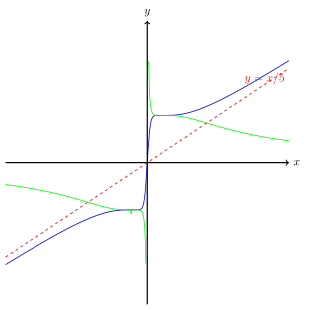
If \(m\) is a positive integer, show that \(\l 1+x \r^m + \l 1-x \r^m \ne 0\) for any real \(x\,\). The function \(\f\) is defined by \[ \f (x) = \frac{ (1+x )^m - ( 1-x )^m}{ (1+x )^m + (1-x )^m} \;. \] Find and simplify an expression for \(\f'(x)\). In the case \(m=5\,\), sketch the curves \(y = \f (x)\) and \(\displaystyle y = \frac1 { \f (x )}\;\).
Solution: If \(m\) is even, clearly that expression is positive since it's the sum of two (different) squares. If \(m\) is odd, then we can expand it as a sum of powers of \(x^2\) with a leading coefficient of \(1\) so it is also positive. \begin{align*} && f (x) = \frac{ (1+x )^m - ( 1-x )^m}{ (1+x )^m + (1-x )^m} \\ && f'(x) &= \frac{(m(1+x )^{m-1} + m( 1-x )^{m-1})((1+x)^m + (1-x)^m ) - ((1+x )^m - ( 1-x )^m)(m(1+x)^{m-1} - m(1-x)^{m-1} )}{\l (1+x)^m + (1-x)^m \r^2} \\ &&&= \frac{2m(1+x)^m(1-x)^{m-1}+2m(1+x)^{m-1}(1-x)^m}{\l (1+x)^m + (1-x)^m \r^2} \\ &&&= \frac{2m(1+x)^{m-1}(1-x)^{m-1}(1+x+1-x)}{\l (1+x)^m + (1-x)^m \r^2} \\ &&&= \frac{4m(1+x)^{m-1}(1-x)^{m-1}}{\l (1+x)^m + (1-x)^m \r^2} \\ \end{align*}
2002 Paper 1 Q2
Let \(f(x) = x^m(x-1)^n\), where \(m\) and \(n\) are both integers greater than \(1\). Show that the curve \(y=f(x)\) has a stationary point with \(0 < x < 1\). By considering \(f''(x)\), show that this stationary point is a maximum if \(n\) is even and a minimum if \(n\) is odd. Sketch the graphs of \(f(x)\) in the four cases that arise according to the values of \(m\) and \(n\).
Solution: \begin{align*} && f'(x) &= mx^{m-1}(x-1)^n + nx^m(x-1)^{n-1} \\ &&&= (m(x-1)+nx)x^{m-1}(x-1)^{n-1} \\ &&&= (x(m+n) - m)x^{m-1}(x-1)^{n-1} \\ \end{align*} Therefore when \(x = \frac{m}{m+n}\) there is a stationary point with \(0 < x < 1\). \begin{align*} && f''(x) &= m(m-1)x^{m-2}(x-1)^n + 2mnx^{m-1}(x-1)^{n-1} + n(n-1)x^{m}(x-1)^{n-2} \\ &&&= (m(m-1)(x-1)^2 +2mnx(x-1)+n(n-1)x^2)x^{m-2}(1-x)^{n-2} \\ \Rightarrow && f'' \left ( \frac{m}{m+n} \right) &= \left ( m(m-1) \frac{n^2}{(m+n)^2} - 2mn\frac{mn}{(m+n)^2} + n(n-1) \frac{m^2}{(m+n)^2} \right) \frac{m^{m-2}}{(m+n)^{m-2}} \frac{(-1)^{n-2}n^{n-2}}{(m+n)^{n-2}} \\ &&&= (-1)^{n-2}\frac{m^{m-1}n^{n-1}}{(m+n)^{m+n-2}} \left ( (m-1)n-2mn+(n-1)m\right) \\ &&&= (-1)^{n-2}\frac{m^{m-1}n^{n-1}}{(m+n)^{m+n-2}} \left ( -m-n\right) \\ &&&= (-1)^{n-1} \frac{m^{m-1}n^{n-1}}{(m+n)^{m+n-3}} \end{align*} Therefore this is positive (and a minimum) when \(n\) is odd and negative (and a maximum) when \(n\) is even.


2002 Paper 1 Q3
Show that \((a+b)^2\le 2a^2+2b^2\,\). Find the stationary points on the curve $y=\big(a^2\cos^2\theta +b^2\sin^2\theta\big)^{\frac12} + \big(a^2\sin^2\theta +b^2\cos^2\theta\big)^{\frac12}\,$, where \(a\) and \(b\) are constants. State, with brief reasons, which points are maxima and which are minima. Hence prove that \[ \vert a\vert +\vert b \vert \le \big(a^2\cos^2\theta +b^2\sin^2\theta\big)^{\frac12} + \big(a^2\sin^2\theta +b^2\cos^2\theta\big)^{\frac12} \le \big(2a^2+2b^2\big)^{\frac12} \;. \]
Solution: \begin{align*} && 2a^2+2b^2 &= a^2 + b^2 + (a^2+b^2) \\ &&&\underbrace{\geq}_{AM-GM} a^2+b^2+2\sqrt{a^2b^2} \\ &&&= a^2+b^2 + 2|a||b| \\ &&&\geq a^2+b^2 + 2ab \\ &&&= (a+b)^2 \end{align*} Assume \(a^2 \neq b^2\), otherwise the curve is a constant. \begin{align*} && y & = \big(a^2\cos^2\theta +b^2\sin^2\theta\big)^{\frac12} + \big(a^2\sin^2\theta +b^2\cos^2\theta\big)^{\frac12}\\ && \frac{\d y}{\d \theta} &= \tfrac12 \left (a^2\cos^2\theta +b^2\sin^2\theta \right)^{-\frac12} \cdot (2 \sin \theta \cos \theta (b^2 - a^2)) + \tfrac12 (a^2\sin^2\theta +b^2\cos^2\theta)^{-\frac12} \cdot (2 \sin \theta \cos \theta (a^2 - b^2) \\ &&&= \tfrac12\sin2 \theta (b^2 - a^2) \left ( \left (a^2\cos^2\theta +b^2\sin^2\theta \right)^{-\frac12} - (a^2\sin^2\theta +b^2\cos^2\theta)^{-\frac12}\right) \\ \therefore \frac{\d y}{\d x} = 0 \Rightarrow && \sin 2\theta = 0 & \text{ or } a^2\cos^2\theta +b^2\sin^2\theta = a^2\sin^2\theta +b^2\cos^2\theta \\ \Rightarrow && \theta &= 0, \frac{\pi}{2}, \pi, \frac{3\pi}{2}, 2\pi \\ && (a^2-b^2) \cos ^2\theta &= (a^2-b^2) \sin^2 \theta \\ \Rightarrow && \theta &= \frac{\pi}{4}, \frac{3\pi}{4}, \frac{5\pi}{4}, \frac{7\pi}{4} \end{align*} WLOG \(b^2 - a^2 > 0\), then the two parts of the derivative look like:

2000 Paper 1 Q4
- Show that, for \(0\le x\le 1\), the largest value of \(\displaystyle \frac{x^6}{(x^2+1)^4}\) is \(\frac1{16}\).
- Find constants \(A\), \(B\), \(C\) and \(D\) such that, for all \(x\), \[ \frac{1}{(x^2+1)^4}= \frac{\d \ }{\d x} \left( \frac{Ax^5+Bx^3+Cx}{(x^2+1)^3}\right) +\frac{Dx^6}{(x^2+1)^4}. \]
- Hence, or otherwise, prove that \[ \frac{11}{24} \le \int_{0}^{1}\frac{1}{(x^{2}+1)^{4}}\, \d x \le \frac{11}{24} + \frac 1{16} \; . \]
Solution:
- \(x^2 + 1 \geq 2x \Rightarrow \frac{1}{x^2+1} \leq \frac1{2x} \Rightarrow \frac{x^6}{(x^2+1)^4}\leq \frac{x^6}{16x^2} = \frac1{16}x^2 \leq \frac1{16}\) with equality when \(x = 1\)
- \(\,\) \begin{align*} && RHS &= \frac{\d \ }{\d x} \left( \frac{Ax^5+Bx^3+Cx}{(x^2+1)^3}\right) +\frac{Dx^6}{(x^2+1)^4} \\ &&&= \frac{(5Ax^4+3Bx^2+C)(x^2+1)^3-6x(x^2+1)^2(Ax^5+Bx^3+Cx)}{(x^2+1)^6}+\frac{Dx^6}{(x^2+1)^4} \\ &&&= \frac{(5Ax^4+3Bx^2+C)(x^2+1)-6x(Ax^5+Bx^3+Cx)+Dx^6}{(x^2+1)^4} \\ &&&= \frac{(D-A) x^6 + (5A-3B) x^4 + (3B-5C)x^2 + C}{(x^2+1)^4} \\ \Rightarrow && C &= 1 \\ && 3B &= 5 \quad\quad\quad\Rightarrow B = \frac53 \\ && 5A &= 3B = 5\Rightarrow A = 1 \\ && D &= A \quad\quad \Rightarrow D = 1 \end{align*}
- So \begin{align*} && I &= \int_{0}^{1}\frac{1}{(x^{2}+1)^{4}}\, \d x \\ &&&= \int_{0}^{1}\frac{\d \ }{\d x} \left( \frac{Ax^5+Bx^3+Cx}{(x^2+1)^3}\right) +\frac{Dx^6}{(x^2+1)^4} \, \d x \\ &&&= \left [ \frac{Ax^5+Bx^3+Cx}{(x^2+1)^3} \right]_0^1 + \int_{0}^{1}\frac{Dx^6}{(x^2+1)^4} \, \d x \\ &&& \leq \frac{A+B+C}{8} + \frac1{16} \\ &&&= \frac{2+\frac53}{8} + \frac1{16} = \frac{11}{24} + \frac{1}{16} \\ && I &\geq \left [ \frac{Ax^5+Bx^3+Cx}{(x^2+1)^3} \right]_0^1 = \frac{11}{24} \end{align*}
2000 Paper 1 Q7
Let \[ {\f}(x)=a x-\frac{x^{3}}{1+x^{2}}, \] where \(a\) is a constant. Show that, if \(a\ge 9/8\), then \(\mathrm{f}' (x) \ge0\) for all \(x\).
Solution: \begin{align*} && f(x) &= a x-\frac{x^{3}}{1+x^{2}} \\ \Rightarrow && f'(x) &= a - \frac{3x^2(1+x^2)-x^3 \cdot 2 x}{(1+x^2)^2} \\ &&&= a - \frac{-x^4+3x^2}{(1+x^2)^2} \\ &&&= a - \frac{-t^2+3t}{(1+t)^2} \\ &&&= \frac{a+2at+at^2-t^2-3t}{(1+t)^2} \\ &&&= \frac{(a-1)t^2+(2a-3)t+a}{(1+t)^2} \\ \\ && 0 \leq \Delta &= (2a-3)^2 - 4 \cdot (a-1) \cdot a \\ &&&= 4a^2-12a+9 - 4a^2+4a \\ &&&= -8a + 9 \\ \Leftrightarrow && a &\geq 9/8 \end{align*} Therefore if \(a \geq 9/8\) the numerator is always non-negative and \(f'(x) \geq 0\)
2000 Paper 2 Q2
Prove that if \({(x-a)^{2}}\) is a factor of the polynomial \(\p(x)\), then \(\p'(a)=0\). Prove a corresponding result if \((x-a)^4\) is a factor of \(\p(x).\) Given that the polynomial $$ x^6+4x^5-5x^4-40x^3-40x^2+32x+k $$ has a factor of the form \({(x-a)}^4\), find \(k\).
Solution: First notice that \(p(x) = (x-a)^2q(x)\) so \(p'(x) = 2(x-a)q(x) + (x-a)^2q'(x) = (x-a)(2q(x)+(x-a)q'(x))\), in particular \(p'(a) = 0\) so \(x-a\) is a root of \(p'(x)\). If \((x-a)^4\) is a root of \(p(x)\) then \(p^{(3)}(a)= 0\). The proof is similar. Differentiating \(3\) times we obtain: \(6 \cdot 5 \cdot 4 x^3 + 4 \cdot 5 \cdot 4 \cdot 3 x^2 - 5\cdot4 \cdot 3 \cdot 2 x-40 \cdot 3 \cdot 2 \cdot 1 = 5!(x^3+2x^2-x-2) = 5!(x+2)(x^2-1)\). So our possible (repeated) roots are \(x=-2,-1,1\). We can check \(p'(x) = 6x^5+20x^4-20x^3-120x^2-80x+32\), and see \(p'(1) = 36 - 200 \neq 0\), \(p'(-1) = -6+20+20-120+80+32 \neq 0\), therefore \(a = -2\)