Problems
Filters
74 problems found
2001 Paper 3 Q2
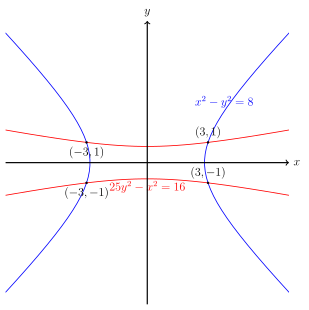
Show that \( \cosh^{-1} x = \ln ( x + \sqrt{x^2-1})\). Show that the area of the region defined by the inequalities \(\displaystyle y^2 \ge x^2-8\) and \(\displaystyle x^2\ge 25y^2 -16 \) is \((72/5) \ln 2\).
Solution: \begin{align*} && x &= \cosh y \\ \Rightarrow && x &= \tfrac12 (e^y + e^{-y} ) \\ \Rightarrow && 0 &= e^{2y} - 2xe^y + 1 \\ \Rightarrow && e^y &= \frac{2x \pm \sqrt{4x^2-4}}{2} \\ &&&= x \pm \sqrt{x^2-1} \\ \Rightarrow &&e^y &= x + \sqrt{x^2-1} \tag{by convention \(\cosh^{-1} > 0\)} \\ \Rightarrow && y &= \ln (x + \sqrt{x^2-1}) \end{align*}
2000 Paper 2 Q6
Show that \[ \sin\theta = \frac {2t}{1+t^2}, \ \ \ \cos\theta = \frac{1-t^2}{1+t^2}, \ \ \ \frac{1+\cos\theta}{\sin\theta} = \tan (\tfrac{1}{2}\pi-\tfrac{1}{2}\theta), \] where \(t =\tan\frac{1}{2}\theta\). Use the substitution \(t =\tan\frac{1}{2}\theta\) to show that, for \(0<\alpha<\frac{1}{2}\pi\), \[ \int_0^{\frac{1}{2}\pi} {1 \over {1 + \cos\alpha \sin \theta}} \,\d\theta =\frac{\alpha}{\sin\alpha}\,, \] and deduce a similar result for \[ \int_0^{\frac{1}{2}\pi} {1 \over {1 + \sin\alpha \cos \theta}} \,\d\theta \,. \]
Solution: \begin{align*} && \frac{2t}{1+t^2} &= \frac{2 \sin \tfrac12 \theta \cos\tfrac12 \theta }{\cos^2 \tfrac12 \theta + \sin^2 \tfrac12 \theta} \\ &&&= \frac{\sin \theta}{1} = \sin \theta \\ \\ && \frac{1-t^2}{1+t^2} &= \frac{\cos^2 \tfrac12 \theta - \sin^2 \tfrac12 \theta}{\cos^2 \tfrac12 \theta + \sin^2 \tfrac12 \theta} \\ &&&= \frac{\cos \theta }{1} = \cos \theta \\ \\ && \tan(\tfrac12 \pi - \tfrac12 \theta) &= \frac{1}{t} \\ && \frac{1+\cos \theta}{\sin \theta} &= \frac{1 + \frac{1-t^2}{1+t^2}}{\frac{2t}{1+t^2}} \\ &&&= \frac{2}{2t} = \frac1t = \tan(\tfrac12\pi - \tfrac12 \theta) \end{align*} Notice also that \(\frac{\d t}{\d \theta} = \tfrac12 \sec^2 \tfrac12 \theta = \tfrac12(1 + t^2)\) so \begin{align*} && I &= \int_0^{\frac12 \pi} \frac{1}{1 + \cos \alpha \sin \theta} \d \theta \\ t = \tan \tfrac12 \theta, \d \theta = \frac{2}{1+t^2} \d t: &&&= \int_{0}^{1} \frac{1}{1 + \cos \alpha \frac{2t}{1+t^2}}\frac{2}{1+t^2} \d t \\ &&&= \int_0^1 \frac{2}{1+t^2 + 2\cos \alpha t} \d t \\ &&&= \int_0^1 \frac{2}{(t + \cos \alpha)^2+\sin^2 \alpha} \d t \\ &&&= \left [ \frac{2}{\sin \alpha} \tan^{-1} \left ( \frac{t+ \cos \alpha}{\sin \alpha} \right) \right]_0^1 \\ &&&= \frac{2}{\sin \alpha} \left ( \tan^{-1} \left ( \frac{1+ \cos \alpha}{\sin \alpha} \right) - \tan^{-1} \left ( \frac{ \cos \alpha}{\sin \alpha} \right) \right) \\ &&&= \frac{2}{\sin \alpha} \left ( \tan^{-1} \left (\tan (\tfrac12 \pi - \tfrac12 \alpha \right) - \tan^{-1} \left (\tan(\tfrac12\pi - \alpha )\right) \right) \\ &&&= \frac{2}{\sin \alpha} \left ( \tfrac12 \pi - \tfrac12 \alpha - \tfrac12 \pi + \alpha \right) \\ &&&= \frac{\alpha}{\sin \alpha} \end{align*} \begin{align*} && J &= \int_0^{\tfrac12 \pi} \frac{1}{1 + \sin \alpha \cos \theta} \d \theta \\ &&&= \int_0^{\tfrac12 \pi} \frac{1}{1 + \cos (\tfrac12 \pi - \alpha) \sin \theta} \d \theta \\ &&&= \frac{\tfrac12 \pi - \alpha}{\cos \alpha} \end{align*}
2000 Paper 3 Q2
Use the substitution \(x = 2-\cos \theta \) to evaluate the integral $$ \int_{3/2}^2 \left(x - 1 \over 3 - x\right)^{\!\frac12}\! \d x. $$ Show that, for \(a < b\), $$ \int_p^q \left( x - a \over b - x\right)^{\!\frac12} \!\d x = \frac{(b-a)(\pi +3{\surd3} -6)}{12}, $$ where \(p= {(3a+b)/4}\) and \(q={(a+b)/2}\).
1998 Paper 1 Q2
Show, by means of a suitable change of variable, or otherwise, that \[ \int_{0}^{\infty}\mathrm{f}((x^{2}+1)^{1/2}+x)\,{\mathrm d}x =\frac{1}{2} \int_{1}^{\infty}(1+t^{-2})\mathrm{f}(t)\,{\mathrm d}t. \] Hence, or otherwise, show that \[ \int_{0}^{\infty}((x^{2}+1)^{1/2}+x)^{-3}\,{\mathrm d}x =\frac{3}{8}. \]
Solution: \begin{align*} && t &= (x^2+1)^{1/2}+x \\ && 1&=t^2-2tx \\ && x &= \frac{t^2-1}{2t} = \frac12 \left (t - \frac1t\right) \\ && \frac{\d x}{\d t} &= \frac12 \left ( 1+ \frac{1}{t^2} \right) \\ \Rightarrow && \int_0^{\infty} f((x^2+1)^{1/2}+x) \d x &= \int_{t=1}^{t = \infty}f(t) \frac12(1 + t^{-2}) \d t\\ &&&= \frac12 \int_1^{\infty}(1+t^{-2})f(t) \d t \end{align*} \begin{align*} \int_{0}^{\infty}((x^{2}+1)^{1/2}+x)^{-3}\,{\mathrm d}x &= \frac12 \int_1^{\infty}(1+t^{-2})t^{-3} \d t \\ &= \frac12 \left [\frac{-1}{2}t^{-2}-\frac{1}{4}t^{-4} \right]_{1}^{\infty} \\ &= \frac12 \left ( \frac12 + \frac14\right) = \frac38 \end{align*}
1998 Paper 2 Q4
The integral \(I_n\) is defined by $$I_n=\int_0^\pi(\pi/2-x)\sin(nx+x/2)\,{\rm cosec}\,(x/2)\,\d x,$$ where \(n\) is a positive integer. Evaluate \(I_n-I_{n-1}\), and hence evaluate \(I_n\) leaving your answer in the form of a sum.
Solution: \begin{align*} && I_n - I_{n-1} &= \int_0^\pi \left ( \frac{\pi}{2} - x \right) \left ( \sin\left(nx + \frac{x}{2}\right) - \sin \left ((n-1)x + \frac{x}{2} \right)\right) \cosec \frac{x}{2} \d x \\ &&&= \int_0^\pi \left ( \frac{\pi}{2} - x \right) \left (2 \sin \left ( \frac{nx + \frac{x}{2} - (n-1)x - \frac{x}{2} }{2}\right)\cos nx \right) \cosec \frac{x}{2} \d x \\ &&&= \int_0^\pi \left ( \frac{\pi}{2} - x \right) \left (2 \sin \left ( \frac{x}{2}\right)\cos nx \right) \cosec \frac{x}{2} \d x \\ &&&=2 \int_0^\pi \left ( \frac{\pi}{2} - x \right) \cos nx \d x \\ &&&=\pi \left [ \frac{\sin nx}{n}\right]_0^{\pi} - 2\int_0^\pi x \cos n x \d x \\ &&&= 0 - 2\left[ \frac{x \sin nx}{n} \right]_0^{\pi} + 2\int_0^\pi \frac{\sin nx}{n} \d x \\ &&&= 2\left[ -\frac{\cos nx}{n^2} \right]_0^{\pi} \\ &&&=2 \frac{1-(-1)^{n}}{n^2} \\ \\ && I_0 &= \int_0^\pi (\pi/2 - x) \d x =0 \\ \Rightarrow && I_{2k+2} = I_{2k+1} &= 4 \left (\frac{1}{1^2} + \frac{1}{3^2} + \cdots + \frac{1}{(2k+1)^2} \right) \end{align*}
1998 Paper 3 Q2
Let $$ {\rm I}(a,b) = \int_0^1 t^{a}(1-t)^{b} \, \d t \; \qquad (a\ge0,\ b\ge0) .$$
- Show that \({\rm I}(a,b)={\rm I}(b,a)\),
- Show that \({\rm I}(a,b)={\rm I}(a+1,b)+{\rm I}(a,b+1)\).
- Show that \((a+1){\rm I}(a,b)=b{\rm I}(a+1,b-1)\) when \(a\) and \(b\) are positive and hence calculate \({\rm I}(a,b)\) when \(a\) and \(b\) are positive integers.
Solution:
- Let \(u = 1-t, \d u = -\d t\), then: \begin{align*} \mathrm{I}(a,b) &= \int_0^1 t^a(1-t)^b \d t \\ &= \int_{u=1}^{u=0} -(1-u)^a u^b \d u \\ &= \int_0^1(1-u)^a u^b \d u \\ &= \mathrm{I}(b, a) \end{align*}
- \begin{align*} \mathrm{I}(a+1,b)+\mathrm{I}(a,b+1) &= \int_0^1 t^{a+1}(1-t)^b + t^a(1-t)^{b+1} \d t \\ &= \int_0^1 (t+(1-t))t^a(1-t)^b \d t \\ &= \int_0^1 t^a(1-t)^b \d t \\ &= \mathrm{I}(a,b) \end{align*}
- Integrating by parts with \(\frac{du}{dt} = t^a, v = (1-t)^{b}\)\begin{align*} \mathrm{I}(a,b) &= \int_0^1 t^a (1-t)^b \d t \\ &= \left [ \frac{t^{a+1}}{a+1} (1-t)^b \right ]_0^1 + \int_0^1 \frac{t^{a+1}}{a+1} b(1-t)^{b-1} \\ &= \frac{b}{a+1} \int_0^1 t^{a+1}(1-t)^{b-1} \d t \\ &= \frac{b}{a+1} \mathrm{I}(a+1,b-1) \end{align*} Claim: \(\mathrm{I}(a,b) = \frac{a!b!}{(a+b+1)!}\) Proof: Note that \(I(a,0) = \frac{1}{a+1}\) so the formula holds for this case. We will induct on \(b\). The base case is done. Suppose that for \(b = k\) our formula is true, ie: \(\mathrm{I}(a,k) = \frac{a!k!}{(a+k+1)!}\) for all \(a\) (and fixed \(k\)) \begin{align*} \mathrm{I}(a,k+1) &= \frac{k+1}{a+1} \mathrm{I}(a+1,k) \\ &= \frac{k+1}{a+1} \frac{(a+1)!k!}{(a+1+k+1)!} \\ &= \frac{a!(k+1)!}{(a+(k+1)+1)!} \end{align*} So the formula is true for \(b=k+1\). Therefore, since it is true if \(b=0\) and if \(b=k\) is true then \(b=k+1\) is true, it is true for all values of \(b\).
1998 Paper 3 Q7
Sketch the graph of \({\rm f}(s)={ \e}^s(s-3)+3\) for \(0\le s < \infty\). Taking \({\e\approx 2.7}\), find the smallest positive integer, \(m\), such that \({\rm f}(m) > 0\). Now let $$ {\rm b}(x) = {x^3 \over \e^{x/T} -1} \, $$ where \(T\) is a positive constant. Show that \({\rm b}(x)\) has a single turning point in \(0 < x < \infty\). By considering the behaviour for small \(x\) and for large \(x\), sketch \({\rm b}(x)\) for \(0\le x < \infty\). Let $$ \int_0^\infty {\rm b}(x)\,\d x =B, $$ which may be assumed to be finite. Show that \(B = K T^n\) where \(K\) is a constant, and \(n\) is an integer which you should determine. Given that \(\displaystyle{B \approx 2 \int_0^{Tm} {\rm b}(x) {\,\rm d }x}\), use your graph of \({\rm b}(x)\) to find a rough estimate for \(K\).
1997 Paper 1 Q6
Find constants \(a_{0}\), \(a_{1}\), \(a_{2}\), \(a_{3}\), \(a_{4}\), \(a_{5}\), \(a_{6}\) and \(b\) such that \[x^{4}(1-x)^{4}=(a_{6}x^{6}+a_{5}x^{5}+a_{4}x^{4}+a_{3}x^{3}+ a_{2}x^{2}+a_{1}x+a_{0})(x^{2}+1)+b.\] Hence, or otherwise, prove that \[\int_{0}^{1}\frac{x^{4}(1-x)^{4}}{1+x^{2}}{\rm d}x =\frac{22}{7}-\pi.\] Evaluate \(\displaystyle{\int_{0}^{1}x^{4}(1-x)^{4}{\rm d}x}\) and deduce that \[\frac{22}{7}>\pi>\frac{22}{7}-\frac{1}{630}.\]
Solution: Plugging in \(x = i\) we obtain \((1-i)^4 = (-2i)^2 = -4 \Rightarrow b = -4\). \begin{align*} x^4(1-x)^4 &= x^4(1-4x+6x^2-4x^3+x^4) \\ &= x^8-4x^7+6x^6-4x^5+x^4 \\ &= x^6(x^2+1) - x^6 -4x^7+6x^6-4x^5+x^4 \\ &= x^6(x^2+1) -4x^5(x^2+1)+4x^5 +5x^6-4x^5+x^4 \\ &= (x^6-4x^5)(x^2+1) +5x^4(x^2+1)-5x^4+x^4 \\ &= (x^6-4x^5+5x^4)(x^2+1) -4x^2(x^2+1)+4x^2 \\ &= (x^6-4x^5+5x^4-4x^2)(x^2+1) +4(x^2+1)-4 \\ &= (x^6-4x^5+5x^4-4x^2+4)(x^2+1) -4 \\ \end{align*} So \begin{align*} \int_0^1 \frac{x^4(1-x)^4}{1+x^2} \d x &= \int_0^1 (x^6-4x^5+5x^4-4x^2+4) - \frac{4}{1+x^2} \d x \\ &= \frac17 - \frac46+1-\frac43+4 - \pi \\ &= \frac{22}7 - \pi \end{align*} \begin{align*} \int_0^1 x^4(1-x)^4 \d x &= B(5,5) \\ &= \frac{4!4!}{9!} \\ &= \frac1{630} \end{align*} Therefore since \(0 < \frac{x^4(1-x)^4}{1+x^2} < x^4(1-x)^4\) we must have that \begin{align*} && 0 &< \frac{22}7 - \pi \\ \Rightarrow && \pi & < \frac{22}{7} \\ && \frac{22}{7} - \pi &< \frac1{630} \\ \Rightarrow && \frac{22}{7} - \frac1{630} &< \pi \end{align*} which is what we wanted.
1997 Paper 2 Q3
Find constants \(a,\,b,\,c\) and \(d\) such that $$\frac{ax+b}{ x^2+2x+2}+\frac{cx+d}{ x^2-2x+2}= \frac{1}{ x^4+4}.$$ Show that $$\int_0^1\frac {\d x}{ x^4+4}\;= \frac{1}{16} \ln 5 +\frac{1}{8} \tan^{-1}2 .$$
Solution: First notice that \((x^2+2+2x)(x^2+2-2x) = (x^2+2)^2-4x^2 = x^2+4\) and so \begin{align*} && \frac{1}{x^4+4} &= \frac{ax+b}{ x^2+2x+2}+\frac{cx+d}{ x^2-2x+2} \\ \Rightarrow && 1 &= (ax+b)(x^2-2x+2) + (cx+d)(x^2+2x+2) \\ &&&= (a+c)x^3+(b-2a+d+2c)x^2+(2a-2b+2c+2d)x+2b+2d \\ \Rightarrow && 0 &= a+c \\ && 2a &= b+d+2c \\ && b &= a+c+d \\ && \frac12 &= b+d \\ \Rightarrow && c &= -a \\ && 2a &= \frac12+2(-a) \\ \Rightarrow && a &= \frac18, c = -\frac18 \\ && b &= d \\ \Rightarrow && b &= \frac14, d = \frac14 \end{align*} Therefore \begin{align*} \int_0^1\frac {\d x}{ x^4+4} &= \int_0^1 \frac18\left ( \frac{x+2}{x^2+2x+2} -\frac{x-2}{x^2-2x+2}\right) \d x \\ &= \frac1{16}\int_0^1 \left ( \frac{2x+2+2}{x^2+2x+2} -\frac{2x-2-2}{x^2-2x+2}\right) \d x \\ &= \frac1{16} \left [ \ln(x^2+2x+2) -\ln(x^2-2x+2)\right]_0^1 + \frac1{16} \int_0^1 \left ( \frac{2}{(x+1)^2+1} + \frac{2}{(x-1)^2+1} \right) \d x \\ &= \frac1{16} \left (\ln 5 - \ln 1 -(\ln 2-\ln 2) \right) + \frac18 \left [ \tan^{-1} (x+1)+\tan^{-1}(x-1) \right]_0^1 \\ &= \frac1{16} \ln 5 + \frac18 \left (\tan^{-1} 2+\tan^{-1} 0 - \tan^{-1}1-\tan^{-1} (-1) \right) \\ &= \frac1{16} \ln 5+ \frac18 \tan^{-1} 2 \end{align*}
1996 Paper 1 Q4
Show that \[ \int_{0}^{1}\frac{1}{x^{2}+2ax+1}\,\mathrm{d}x=\begin{cases} \dfrac{1}{\sqrt{1-a^{2}}}\tan^{-1}\sqrt{\dfrac{1-a}{1+a}} & \text{ if }\left|a\right|<1,\\ \dfrac{1}{2\sqrt{a^{2}-1}}\ln |a+\sqrt{a^{2}-1}| & \text{ if }\left|a\right|>1. \end{cases} \]
Solution: First suppose \(|a| < 1\), then \begin{align*} && I &= \int_0^1 \frac{1}{x^2+2ax+1} \d x \\ &&&= \int_0^1 \frac{1}{(x+a)^2 +1-a^2} \d x \\ &&&= \int_0^1 \frac{1}{(x+a)^2 +(\sqrt{1-a^2})^2} \d x \tag{\(1-a^2 > 0\)}\\ &&&= \left [\frac{1}{\sqrt{1-a^2}} \tan^{-1} \frac{x+a}{\sqrt{1-a^2}} \right]_0^1 \\ &&&= \frac{1}{\sqrt{1-a^2}} \left ( \tan^{-1} \frac{a+1}{\sqrt{1-a^2}} - \tan^{-1} \frac{a}{\sqrt{1-a^2}} \right) \\ &&&= \frac{1}{\sqrt{1-a^2}} \tan^{-1} \left ( \frac{\frac{a+1}{\sqrt{1-a^2}}-\frac{a}{\sqrt{1-a^2}}}{1+\frac{(a+1)a}{1-a^2}} \right) \\ &&&= \frac{1}{\sqrt{1-a^2}} \tan^{-1} \left ( \frac{\frac{1}{\sqrt{1-a^2}}}{\frac{1+a}{1-a^2}} \right) \\ &&&= \frac{1}{\sqrt{1-a^2}} \tan^{-1} \left ( \frac{1-a}{\sqrt{1-a^2}}\right) \\ &&&= \frac{1}{\sqrt{1-a^2}} \tan^{-1} \sqrt { \frac{1-a}{1+a}} \\ \end{align*} Second, suppose \(|a| > 1\), then \begin{align*} && I &= \int_0^1 \frac{1}{x^2+2ax+1} \d x \\ &&&= \int_0^1 \frac{1}{(x+a)^2-(a^2-1)} \d x \\ &&&= \int_0^1 \frac{1}{(x+a-\sqrt{a^2-1})(x+a+\sqrt{a^2-1})} \d x \tag{\(a^2-1 > 0\)} \\ &&&= \frac{1}{2\sqrt{a^2-1}}\int_0^1 \left ( \frac{1}{x+a-\sqrt{a^2-1}} - \frac{1}{x+a+\sqrt{a^2-1}} \right) \d x \\ &&&= \frac{1}{2\sqrt{a^2-1}} \left [ \ln |x+a-\sqrt{a^2-1}|- \ln |x+a+\sqrt{a^2-1}| \right]_0^1 \\ &&&= \frac{1}{2\sqrt{a^2-1}} \left ( \ln |1+a-\sqrt{a^2-1}| - \ln|1+a+\sqrt{a^2-1}| - \ln|a-\sqrt{a^2-1}| +\ln|a + \sqrt{a^2-1}| \right) \\ &&&= \frac{1}{2\sqrt{a^2-1}} \ln | \frac{(1+a-\sqrt{a^2-1})(a+\sqrt{a^2-1})}{(1+a+\sqrt{a^2-1})(a-\sqrt{a^2-1})}|\\ &&&= \frac{1}{2\sqrt{a^2-1}} \ln |\frac{a+a^2-(a^2-1) +\sqrt{a^2-1}}{1+a-\sqrt{a^2-1}}| \\ &&&= \frac{1}{2\sqrt{a^2-1}} \ln |\frac{(1+a +\sqrt{a^2-1})^2}{(1+a)^2-(a^2-1)}| \\ &&&= \frac{1}{2\sqrt{a^2-1}} \ln |\frac{1+2a+a^2+a^2-1+2(1+a)\sqrt{a^2-1}}{2+2a}| \\ &&&= \frac{1}{2\sqrt{a^2-1}} \ln |a+\sqrt{a^2-1}| \\ \end{align*}
1996 Paper 1 Q6
Let \(\mathrm{f}(x)=\dfrac{\sin(n+\frac{1}{2})x}{\sin\frac{1}{2}x}\) for \(0 < x\leqslant\pi.\)
- Using the formula \[ 2\sin\tfrac{1}{2}x\cos kx=\sin(k+\tfrac{1}{2})x-\sin(k-\tfrac{1}{2})x \] (which you may assume), or otherwise, show that \[ \mathrm{f}(x)=1+2\sum_{k=1}^{n}\cos kx\,. \]
- Find \({\displaystyle \int_{0}^{\pi}\mathrm{f}(x)\,\mathrm{d}x}\) and \({\displaystyle \int_{0}^{\pi}\mathrm{f}(x)\cos x\,\mathrm{d}x}.\)
Solution:
- \(\,\) \begin{align*} && 2\sin \tfrac12 x \sum_{k=1}^n \cos kx &= \sum_{k=1}^n 2\sin \tfrac12 x \cos kx \\ &&&= \sum_{k=1}^n \left ( \sin(k+\tfrac12)x - \sin(k - \tfrac12)x \right) \\ &&&= \left ( \sin\tfrac32x - \sin\tfrac12x \right) + \\ &&&\quad \quad \left ( \sin\tfrac52x - \sin \tfrac32 x \right) + \\ &&&\quad \quad \quad +\cdots + \\ &&&\quad \quad \quad \quad +\left ( \sin(n+\tfrac12)x - \sin(n - \tfrac12)x \right) \\ &&&= \sin(n+\tfrac12)x - \sin \tfrac12 x \\ \Rightarrow && \sin(n+\tfrac12)x &= \sin \tfrac12 x + 2\sin \tfrac12 x \sum_{k=1}^n \cos kx \\ \Rightarrow && f(x) &= 1 + 2 \sum_{k=1}^n \cos kx \end{align*}
- \(\,\) \begin{align*} && \int_0^{\pi} f(x) \d x &= \int_0^{\pi} \left (1 + 2 \sum_{k=1}^n \cos kx \right) \d x \\ &&&= \pi + 2 \left [ \sum_{k=1}^n \frac{1}{k} \sin k x\right]_0^\pi \\ &&&= \pi \\ \\ && \int_0^{\pi} f(x) \cos x \d x &= \int_0^{\pi} \left (\cos x + 2 \sum_{k=1}^n \cos kx \cos x \right) \d x \\ &&&= 0 + \sum_{k=1}^n \left ( \int_0^{\pi} 2 \cos k x \cos x \d x \right) \\ &&&= \sum_{k=1}^n \left ( \int_0^{\pi} (\cos (k+1)x - \cos (k-1) x)\d x\right) \\ &&&= -\pi \end{align*}
1996 Paper 2 Q4
Show that \(\cos 4u=8\cos^{4}u-8\cos^{2}u+1\). If \[ I=\int_{-1}^{1} \frac{1}{\vphantom{{\big(}^2}\; \surd(1+x)+\surd(1-x)+2\; }\;{\rm d}x ,\] show, by using the change of variable \(x=\cos t\), that \[ I= \int_0^\pi \frac{\sin t}{4\cos^{2}\left(\frac{t}{4}-\frac{\pi}{8}\right)}\,{\rm d}t.\] By using the further change of variable \(u=\frac{t}{4}-\frac{\pi}{8}\), or otherwise, show that \[I=4\surd{2}-\pi-2.\] \noindent[You may assume that \(\tan\frac{\pi}{8}=\surd{2}-1\).]
Solution: \begin{align*} && \cos 4u &= 2\cos^2 2u - 1 \\ &&&= 2 (2\cos^2 u - 1)^2 - 1 \\ &&&= 2(4\cos^4u - 4\cos^2 u + 1) - 1\\ &&&= 8\cos^4u - 8\cos^2 u + 1 \end{align*} \begin{align*} && I &= \int_{-1}^1 \frac{1}{\sqrt{1+x}+\sqrt{1-x}+2} \d x \\ x = \cos t, \d x = - \sin t \d t: &&&= \int_{t = \pi}^{t=0} \frac{1}{\sqrt{1+\cos t} + \sqrt{1-\cos t} + 2} (- \sin t ) \d t \\ &&&= \int_0^\pi \frac{\sin t}{\sqrt{2 \cos^2 \frac{t}{2}}+\sqrt{2 \sin^2 \frac{t}{2}}+2} \d t \\ &&&= \int_0^\pi \frac{\sin t}{\sqrt{2}(\cos \frac{t}{2} + \sin \frac{t}{2}) + 2} \d t \\ &&&= \int_0^\pi \frac{\sin t}{\sqrt{2}(\sqrt{2} \cos (\frac{t}{2}-\frac{\pi}{4})) + 2} \d t \\ &&&= \int_0^\pi \frac{\sin t}{2(1+\cos (\frac{t}{2}-\frac{\pi}{4}))} \d t \\ &&&= \int_0^\pi \frac{\sin t}{4\cos^2(\frac{t}{4}-\frac{\pi}{8})} \d t \\ \\ u = \tfrac{t}{4} -\tfrac{\pi}{8}, \d u = \tfrac14 \d t:&&&=\int_{-\frac{\pi}{8}}^{\frac{\pi}{8}} \frac{\sin (4u+\frac{\pi}{2})}{4 \cos^2 u} 4 \d u \\ &&&= \int_{-\frac{\pi}{8}}^{\frac{\pi}{8}} \frac{\cos4u}{\cos^2 u} \d u \\ &&&= \int_{-\frac{\pi}{8}}^{\frac{\pi}{8}} 4 (2 \cos^2 u-1)-4 + \sec^2 u \d u \\ &&&= \int_{-\frac{\pi}{8}}^{\frac{\pi}{8}} 4 \cos 2u-4 + \sec^2 u \d u \\ &&&= \left [2\sin 2u - 4u + \tan u \right]_{-\pi/8}^{\pi/8} \\ &&&= 4 \sin \frac{\pi}{4} - \pi+ 2\tan \frac{\pi}{8} \\ &&&= \frac{4}{\sqrt{2}} - \pi + 2\sqrt{2}-2 \\ &&&= 4\sqrt{2} - \pi - 2 \end{align*}
1996 Paper 3 Q3
Find \[ \int_{0}^{\theta}\frac{1}{1-a\cos x}\,\mathrm{d}x\,, \] where \(0 < \theta < \pi\) and \(-1 < a < 1.\) Hence show that \[ \int_{0}^{\frac{1}{2}\pi}\frac{1}{2-a\cos x}\,\mathrm{d}x=\frac{2}{\sqrt{4-a^{2}}}\tan^{-1}\sqrt{\frac{2+a}{2-a}}\,, \] and also that \[ \int_{0}^{\frac{3}{4}\pi}\frac{1}{\sqrt{2}+\cos x}\,\mathrm{d}x=\frac{\pi}{2}\,. \]
Solution: Let \(t = \tan \tfrac{x}{2}\), then \(\cos x = \frac{1-t^2}{1+t^2}, \frac{d t}{d x} =\tfrac12 (1+t^2)\) so the integral is: \begin{align*} \int_0^{\theta} \frac{1}{1-a \cos x} \d x &= \int_{0}^{\tan \frac{\theta}{2}} \frac{1}{1-a \left (\frac{1-t^2}{1+t^2} \right)} \frac{2}{1+t^2} \d t \\ &= \int_0^{\tan \frac{\theta}{2}} \frac{2}{1+t^2-a+at^2} \d t \\ &= \int_0^{\tan \frac{\theta}{2}} \frac{2}{1-a+(1+a) t^2} \d t \\ &= \frac{2}{1+a}\int_0^{\tan \tfrac{\theta}{2}} \frac{1}{\left (\frac{1-a}{1+a} \right)+t^2} \d t \\ &= \frac{2}{1+a} \sqrt{\frac{1+a}{1-a}} \tan^{-1} \left ( \sqrt{\frac{1+a}{1-a}} \tan \frac{\theta}{2} \right) + C \\ &= \frac{2}{\sqrt{1-a^2}}\tan^{-1} \left ( \sqrt{\frac{1+a}{1-a}} \tan \frac{\theta}{2} \right) + C \end{align*} Therefore \begin{align*} \int_{0}^{\frac{1}{2}\pi}\frac{1}{2-a\cos x}\,\mathrm{d}x &= \frac12 \int_0^{\frac12 \pi} \frac{1}{1-\tfrac{a}{2} \cos x} \d x \\ &= \left [\frac12 \frac{2}{\sqrt{1-\frac{a^2}{4}}} \tan^{-1} \left ( \sqrt{\frac{1+\frac{a}{2}}{1-\frac{a}{2}} } \tan\frac{\theta}{2} \right) \right]_0^{\pi/2} \\ &= \frac12 \frac{2}{\sqrt{1-\frac{a^2}{4}}} \tan^{-1} \left ( \sqrt{\frac{1+\frac{a}{2}}{1-\frac{a}{2}} } \tan\frac{\pi}{4} \right) \\ &= \frac{2}{\sqrt{4-a^2}} \tan^{-1} \left ( \sqrt{\frac{2+a}{2-a} } \right) \\ \end{align*} \begin{align*} \int_{0}^{\frac{3}{4}\pi}\frac{1}{\sqrt{2}+\cos x}\,\mathrm{d}x &= \frac{1}{\sqrt{2}} \int_0^{\frac34 \pi} \frac{1}{1 -\left(- \frac{1}{\sqrt{2}} \right)\cos x} \d x \\ &= \frac{1}{\sqrt{2}} \left [ \frac{2}{\sqrt{1-\tfrac12}} \tan^{-1} \left ( \sqrt{\frac{1-\frac{1}{\sqrt{2}}}{1+\frac{1}{\sqrt{2}}} } \tan\frac{\theta}{2} \right) \right]_0^{3\pi/4} \\ &= \frac{1}{\sqrt{2}} \frac{2}{\sqrt{1/2}} \tan^{-1} \left ( \sqrt{\frac{\sqrt{2}-1}{\sqrt{2}+1} } \tan\frac{3\pi}{8} \right) \\ &= 2 \tan^{-1} \left ( \sqrt{\frac{(\sqrt{2}-1)^2}{2-1} } \tan\frac{3\pi}{8} \right)\\ &= 2 \tan^{-1} \left ( (\sqrt{2}-1) \tan\frac{3\pi}{8} \right) \end{align*} If \(t = \tan \tfrac{3\pi}{8}\), then \(-1 = \tan \tfrac{3\pi}{4} = \frac{2t}{1-t^2} \Rightarrow t^2-2t-1 = 0 \Rightarrow t = 1\pm \sqrt{2}\), since \( t > 0\), we must have \(t = 1 + \sqrt{2}\), so \begin{align*} \int_{0}^{\frac{3}{4}\pi}\frac{1}{\sqrt{2}+\cos x}\,\mathrm{d}x &= 2 \tan^{-1} \left ((\sqrt{2}-1)(\sqrt{2}+1) \right) \\ &= 2 \tan^{-1} 1 \\ &= 2 \frac{\pi}{4} \\ &= \frac{\pi}{2} \end{align*}
1995 Paper 1 Q2
- Suppose that \[ S=\int\frac{\cos x}{\cos x+\sin x}\,\mathrm{d}x\quad\mbox{ and }\quad T=\int\frac{\sin x}{\cos x+\sin x}\,\mathrm{d}x. \] By considering \(S+T\) and \(S-T\) determine \(S\) and \(T\).
- Evaluate \({\displaystyle \int_{\frac{1}{4}}^{\frac{1}{2}}(1-4x)\sqrt{\frac{1}{x}-1}\,\mathrm{d}x}\) by using the substitution \(x=\sin^{2}t.\)
Solution:
- \begin{align*} && S + T &= \int \frac{\cos x + \sin x }{\cos x + \sin x} \d x \\ &&&= \int \d x \\ &&&= x + C \\ && S - T &= \int \frac{\cos x - \sin x}{\cos x + \sin x} \d x \\ &&&= \ln( \cos x + \sin x) + C \\ \Rightarrow && 2S &= x + \ln(\cos x + \sin x) + C \\ \Rightarrow && S &= \frac12 \left ( x + \ln(\cos x + \sin x) \right) + C \\ \Rightarrow && 2T &= x - \ln(\cos x + \sin x) + C \\ \Rightarrow && T &= \frac12 \left ( x - \ln(\cos x + \sin x) \right) + C \end{align*}
- \begin{align*} && I &= \int_{1/4}^{1/2} (1-4x)\sqrt{\frac1x-1} \d x \\ x = \sin^2 t, \d x = 2 \sin t \cos t \d t: &&&= \int_{\pi/6}^{\pi/4} (1-4\sin^2 t) \sqrt{\frac{1-\sin^2 t}{\sin^2 t}} 2 \sin t \cos t \d t\\ &&&=\int_{\pi/6}^{\pi/4} (1-4\sin^2 t)\frac{\cos t}{\sin t} 2 \sin t \cos t \d t \\ &&&= \int_{\pi/6}^{\pi/4} (1-4\sin^2 t) 2 \cos^2 t \d t \\ &&&= \int_{\pi/6}^{\pi/4} \left ( 2\cos^2t - 8 \sin^2t \cos^2 t \right) \d t \\ &&&= \int_{\pi/6}^{\pi/4} \left ( 1+\cos2t - 2 \sin^2 2t \right) \d t \\ &&&= \int_{\pi/6}^{\pi/4} \left ( 1+\cos2t +(\cos 4t-1)\right) \d t \\ &&&= \left[\frac12 \sin 2t + \frac14 \sin 4t \right]_{\pi/6}^{\pi/4} \\ &&&= \left ( \frac12 \right) - \left (\frac12 \frac{\sqrt{3}}{2} + \frac14 \frac{\sqrt{3}}{2} \right) \\ &&&= \frac{4-3\sqrt{3}}{8} \end{align*}
1995 Paper 1 Q5
If \[ \mathrm{f}(x)=nx-\binom{n}{2}\frac{x^{2}}{2}+\binom{n}{3}\frac{x^{3}}{3}-\cdots+(-1)^{r+1}\binom{n}{r}\frac{x^{r}}{r}+\cdots+(-1)^{n+1}\frac{x^{n}}{n}\,, \] show that \[ \mathrm{f}'(x)=\frac{1-(1-x)^{n}}{x}\,. \] Deduce that \[ \mathrm{f}(x)=\int_{1-x}^{1}\frac{1-y^{n}}{1-y}\,\mathrm{d}y. \] Hence show that \[ \mathrm{f}(1)=1+\frac{1}{2}+\frac{1}{3}+\cdots+\frac{1}{n}\,. \]
Solution: \begin{align*} f(x) & =nx-\binom{n}{2}\frac{x^{2}}{2}+\binom{n}{3}\frac{x^{3}}{3}-\cdots+(-1)^{r+1}\binom{n}{r}\frac{x^{r}}{r}+\cdots+(-1)^{n+1}\frac{x^{n}}{n} \\ f'(x) &= n - \binom{n}{2} x + \binom{n}{3}x^2 - \cdots (-1)^{r+1} \binom{n}{r} + \cdots + (-1)^{n+1} x^{n-1} \\ &= \frac{1-(1-x)^n}{x} \end{align*} Therefore, since \(\displaystyle f(x) = \int_0^xf'(t)\,dt\) \begin{align*} f(x) &= \int_0^x \frac{1 - (1-t)^n}{t} \, dt \\ &= \int_{1}^{1-x} \frac{1-y^n}{1-y} (-1)\, dy \tag{Let \(y = 1-t, \frac{dy}{dt} = -1\)} \\ &= \boxed{\int_{1-x}^1 \frac{1-y^n}{1-y} dy} \\ &= \int_{1-x}^1 \l 1 + y + y^2 + \cdots + y^{n-1} \r \, dy \\ &= \left [ y + \frac{y^2}{2} + \frac{y^3}{3} + \cdots + \frac{y^n}{n} \right]_{1-x}^1 \\ \end{align*} So when \(x = 1, 1-x = 0\) so we exactly have the sum required.