Problems
Filters
1531 problems found
2012 Paper 2 Q11
A small block of mass \(km\) is initially at rest on a smooth horizontal surface. Particles \(P_1\), \(P_2\), \(P_3\), \(\ldots\) are fired, in order, along the surface from a fixed point towards the block. The mass of the \(i\)th particle is \(im\) (\(i = 1, 2, \ldots\))and the speed at which it is fired is \(u/i\,\). Each particle that collides with the block is embedded in it. Show that, if the \(n\)th particle collides with the block, the speed of the block after the collision is \[ \frac{2nu}{2k +n(n+1)}\,. \] In the case \(2k = N(N+1)\), where \(N\) is a positive integer, determine the number of collisions that occur. Show that the total kinetic energy lost in all the collisions is \[ \tfrac12 mu^2\bigg( \sum_{n=2}^{N+1} \frac 1 n \bigg)\,. \]
Solution: \begin{align*} \text{COM}: && \sum_{i=1}^n im \cdot \frac{u}{i} &= \left ( km + \sum_{i=1}^n im \right) v \\ \Rightarrow && nu &= \left ( k + \frac{n(n+1)}{2} \right) v \\ \Rightarrow && v &= \frac{2nu}{2k + n(n+1)} \end{align*} If \(2k = N(N+1)\), there will be no more collisions when \(v_n > \frac{u}{n+1}\), ie \begin{align*} && \frac{u}{n+1} &<\frac{2nu}{2k + n(n+1)} \\ \Leftrightarrow && N(N+1) + n(n+1) &< 2n(n+1) \\ \Leftrightarrow && N(N+1) &< n(n+1) \\ \end{align*} Therefore \(n = N+1\) and there will be \(N+1\) collisions. The loss of kinetic energy is: \begin{align*} && \text{initial k.e.} &= \sum_{k=1}^{N+1} \frac12 im \cdot \frac{u^2}{i^2} \\ &&&= \frac12 m u^2 \left ( \sum_{k=1}^{N+1} \frac{1}{i}\right) \\ && \text{final k.e.} &= \frac12 \left ( k + \frac{(N+1)(N+2)}{2}\right)m \left ( \frac{2(N+1)u}{N(N+1)+(N+1)(N+2)} \right)^2 \\ &&&= \frac12 m u^2 \frac{2(N+1)^2}{(N+1)(2N+2)} \\ &&&= \frac12 mu^2 \\ \Rightarrow && \Delta \text{ k.e.} &= \frac12 m u^2 \left ( \sum_{k=2}^{N+1} \frac{1}{i}\right) \end{align*}
2012 Paper 2 Q12
A modern villa has complicated lighting controls. In order for the light in the swimming pool to be on, a particular switch in the hallway must be on and a particular switch in the kitchen must be on. There are four identical switches in the hallway and four identical switches in the kitchen. Guests cannot tell whether the switches are on or off, or what they control. Each Monday morning a guest arrives, and the switches in the hallway are either all on or all off. The probability that they are all on is \(p\) and the probability that they are all off is \(1-p\). The switches in the kitchen are each on or off, independently, with probability \(\frac12\).
- On the first Monday, a guest presses one switch in the hallway at random and one switch in the kitchen at random. Find the probability that the swimming pool light is on at the end of this process. Show that the probability that the guest has pressed the swimming pool light switch in the hallway, given that the light is on at the end of the process, is \(\displaystyle \frac{1-p}{1+2p}\).
- On each of seven Mondays, guests go through the above process independently of each other, and each time the swimming pool light is found to be on at the end of the process. Given that the most likely number of days on which the swimming pool light switch in the hallway was pressed is 3, show that \(\frac14 < p < \frac{5}{14}\).
Solution:
- \(\,\) \begin{align*} && \mathbb{P}(\text{hall switch on}) &= \underbrace{p \cdot \frac34 }_{\text{already on and not flipped}}+ \underbrace{(1-p) \cdot \frac14}_{\text{not on and flipped}} \\ &&&= \frac14 +\frac12 p\\ && \mathbb{P}(\text{kitchen on}) &= \frac12 \\ \Rightarrow && \mathbb{P}(\text{pool is on}) &= \frac18 + \frac14p \end{align*} \begin{align*} && \mathbb{P}(\text{flipped hall switch} | \text{pool on}) &= \frac{\mathbb{P}(\text{flipped hall and pool on})}{\mathbb{P}(\text{pool on})} \\ &&&= \frac{(1-p)\frac14 \cdot \frac 12}{\frac18 + \frac14 p} \\ &&&= \frac{1-p}{1+2p} \end{align*}
- The number of days the swimming pool light was pressed is \(X = B\left (7, \frac{1-p}{1+2p} \right)\), and we have that \(\mathbb{P}(X = 2) < \mathbb{P}(X = 3) > \mathbb{P}(X=4)\) (since the binomial is unimodal). Let \(q = \frac{1-p}{1+2p} \) \begin{align*} && \mathbb{P}(X = 2) &< \mathbb{P}(X = 3) \\ \Rightarrow && \binom{7}{2} q^2(1-q)^5 &< \binom{7}{3}q^3(1-q)^4 \\ \Rightarrow && 21(1-q) &< 35q \\ \Rightarrow && 21 &< 56q \\ \Rightarrow && \frac{3}{8} &< \frac{1-p}{1+2p} \\ \Rightarrow && 3+6p &< 8-8p \\ \Rightarrow && 14p &< 5\\ \Rightarrow && p &< \frac5{14} \\ \\ && \mathbb{P}(X = 3) &> \mathbb{P}(X = 4) \\ \Rightarrow && \binom{7}{3} q^3(1-q)^4 &> \binom{7}{4}q^4(1-q)^3 \\ \Rightarrow &&(1-q)&> q \\ \Rightarrow && \frac12 &> q \\ \Rightarrow && \frac12 &> \frac{1-p}{1+2p} \\ \Rightarrow && 1+2p &> 2-2p \\ \Rightarrow && 4p &> 1\\ \Rightarrow && p &> \frac1{4} \end{align*} Therefore \(\frac14 < p < \frac{5}{14}\) as required.
2012 Paper 2 Q13
In this question, you may assume that \(\displaystyle \int_0^\infty \!\!\! \e^{-x^2/2} \d x = \sqrt{\tfrac12 \pi}\,\). The number of supermarkets situated in any given region can be modelled by a Poisson random variable, where the mean is \(k\) times the area of the given region. Find the probability that there are no supermarkets within a circle of radius \(y\). The random variable \(Y\) denotes the distance between a randomly chosen point in the region and the nearest supermarket. Write down \(\P(Y < y)\) and hence show that the probability density function of \(Y\) is \(\displaystyle 2\pi y k \e^{-\pi k y^2}\) for \(y\ge0\). Find \(\E(Y)\) and show that \(\var(Y) = \dfrac{4-\pi}{4\pi k}\).
Solution: A circle radius \(y\) has a number of supermarkets \(X\) where \(X \sim Po(k \pi y^2)\). \[ \mathbb{P}(X = 0) = e^{-k\pi y^2} \frac{1}{0!} = e^{-k\pi y^2} \] The probability \(\mathbb{P}(Y < y) = 1-\mathbb{P}(Y \geq y) = 1-e^{-k\pi y^2}\), and in particular \(f_Y(y) = 2k\pi y e^{-k\pi y^2}\) (by differentiating). \begin{align*} && \mathbb{E}(Y) &= \int_0^\infty yf_Y(y) \d y \\ &&&= \int_0^\infty 2\pi y^2 k e^{-\pi k y^2} \d y \\ \sigma^2 = \frac{1}{2k\pi}:&&&= \pi k \sqrt{2 \pi}\sigma \int_{-\infty}^\infty \frac{1}{\sqrt{2 \pi} \sigma }y^2 e^{-\frac12 \cdot 2\pi k y^2} \d y \\ &&&=\pi k \sqrt{2 \pi}\sigma \mathbb{E}\left (N(0, \sigma^2)^2 \right) \\ &&&= \pi k \sqrt{2 \pi}\sigma\sigma^2 \\ &&&= \pi k \sqrt{2 \pi} \frac{1}{(2k\pi)^{3/2}} \\ &&&= \frac{1}{2\sqrt{k}} \end{align*} \begin{align*} && \mathbb{E}(Y^2) &= \int_0^\infty y^2f_Y(y) \d y \\ &&&= \int_0^\infty 2\pi y^3 k e^{-\pi k y^2} \d y \\ &&&= \int_0^{\infty}y^2 2y \pi k e^{-\pi k y^2} \d y \\ \\ &&&= \left [-y^2 e^{-\pi k y^2}\right]_0^{\infty}+\int_0^\infty 2ye^{-\pi k y^2} \d y \\ &&&= \left [-\frac{1}{\pi k}e^{-\pi k y^2} \right]_0^{\infty} \\ &&&= \frac{1}{\pi k} \\ \Rightarrow && \textrm{Var}(Y) &= \mathbb{E}(Y^2) - \left [ \mathbb{E}(Y)\right]^2 \\ &&&= \frac{1}{\pi k} - \frac{1}{4k} \\ &&&= \frac{4 - \pi}{4\pi k} \end{align*}
2012 Paper 3 Q1
Given that \(\displaystyle z = y^n \left( \frac{\d y}{\d x}\right)^{\!2}\), show that \[ \frac{\d z}{\d x} = y^{n-1} \frac{\d y}{\d x} \left( n \left(\frac{\d y}{\d x}\right)^{\!2} + 2y \frac{\d^2y}{\d x^2}\right) . \]
- Use the above result to show that the solution to the equation \[ \left(\frac{\d y}{\d x}\right)^{\!2} + 2y \frac{\d^2y}{\d x^2} = \sqrt y \ \ \ \ \ \ \ \ \ \ (y>0) \] that satisfies \(y=1\) and \(\dfrac{\d y}{\d x}=0\) when \(x=0\) is \(y= \big ( \frac38 x^2+1\big)^{\frac23}\).
- Find the solution to the equation \[ \left(\frac{\d y}{\d x}\right)^{\!2} -y \frac{\d^2y}{\d x^2} + y^2=0 \] that satisfies \(y=1\) and \(\dfrac{\d y}{\d x}=0\) when \(x=0\).
Solution: \begin{align*} &&z &= y^n \left( \frac{\d y}{\d x}\right)^{2} \\ \Rightarrow && \frac{\d z}{\d x} &= ny^{n-1}\left( \frac{\d y}{\d x}\right)^{3} + y^{n} \cdot 2 \left( \frac{\d y}{\d x}\right) \left( \frac{\d^2 y}{\d x^2}\right) \\ &&&= y^{n-1} \left( \frac{\d y}{\d x}\right) \left (n \left( \frac{\d y}{\d x}\right)^2 + 2y \frac{\d^2 y}{\d x^2} \right) \end{align*}
- Let \(z = y (y')^2\), then \begin{align*} && \frac{\d z}{\d x} &= y' \sqrt{y} \\ &&&= \sqrt{z} \\ \Rightarrow && \int z^{-1/2} \d z &= x+C \\ \Rightarrow && 2\sqrt{z} &= x + C \\ x = 0, z=0: && C &= 0 \\ \Rightarrow && y(y')^2 &= \frac14 x^2 \\ \Rightarrow &&\sqrt{y} \frac{\d y}{\d x} &= \frac{1}{2}x\\ \Rightarrow && \int \sqrt{y} \d y &= \int \frac{1}{2}x\d x \\ \Rightarrow && \frac23y^{3/2} &=\frac14x^2 + K \\ x = 0, y = 1: && K &= \frac23 \\ \Rightarrow && y &= \left (\frac38 x^2 + 1 \right)^{2/3} \end{align*}
- Let \(z = y^{-2} (y')^2\) \begin{align*} && \frac{\d z}{\d x} &= y^{-3} \frac{\d y}{\d x} \left (-2 \left( \frac{\d y}{\d x}\right) + 2y \frac{\d^2 y}{\d x^2} \right) \\ &&&= y^{-3} \frac{\d y}{\d x} 2y^2 \\ &&&= 2y^{-1}(y') = 2 \sqrt{z} \\ \Rightarrow && 2\sqrt{z} &= 2x + C \\ x = 0, z = 0: && C&= 0 \\ \Rightarrow && z &= x^2 \\ \Rightarrow && \frac{\d y}{\d x} &= xy \\ \Rightarrow && \ln |y| &= \frac12 x^2 + K \\ x =0 , y =1; && K &= 0 \\ \Rightarrow && y &= e^{\frac12 x^2} \end{align*}
2012 Paper 3 Q2
In this question, \(\vert x \vert <1\) and you may ignore issues of convergence.
- Simplify \[ (1-x)(1+x)(1+x^2)(1+x^4) \cdots (1+x^{2^n})\,, \] where \(n\) is a positive integer, and deduce that \[ \frac1{1-x} = (1+x)(1+x^2)(1+x^4) \cdots (1+x^{2^n}) + \frac {x^{2^{n+1}}}{1-x}\,. \] Deduce further that \[ \ln(1-x) = - \sum_{r=0}^\infty \ln \left (1+ x ^{2^r}\right) \,, \] and hence that \[ \frac1 {1-x} = \frac 1 {1+x} + \frac {2x}{1+x^2} + \frac {4x^3}{1+x^4} +\cdots\,. \]
- Show that \[ \frac{1+2x}{1+x+x^2} = \frac{1-2x}{1-x+x^2} + \frac{2x-4x^3}{1-x^2+x^4} + \frac {4x^3-8x^7}{1-x^4+x^8} + \cdots\,. \]
Solution:
- \begin{align*} (1-x)&(1+x)(1+x^2)(1+x^4) \cdots (1+x^{2^n}) \\ &= (1-x^2)(1+x^2)(1+x^4) \cdots (1+x^{2^n}) \\ &= (1-x^4)(1+x^4) \cdots (1+x^{2^n}) \\ &= 1-x^{2^{n+1}} \\ \end{align*} Therefore, \begin{align*} && \frac{1}{1-x} - \frac{x^{2^{n+1}}}{1-x} &= (1+x)(1+x^2)\cdots(1+x^{2^n}) \\ \Rightarrow && \frac{1}{1-x} &=(1+x)(1+x^2)\cdots(1+x^{2^n})+ \frac{x^{2^{n+1}}}{1-x} \\ \Rightarrow && -\ln (1-x) &= \sum_{r=0}^{\infty} \ln (1+x^{2^r}) \\ \Rightarrow && \ln(1-x) &= - \sum_{r=0}^{\infty} \ln (1+x^{2^r}) \\ \underbrace{\Rightarrow}_{\frac{\d}{\d x}} && \frac{1}{1-x} &= \sum_{r=0}^{\infty} \frac{2^r x^{2^r-1}}{1+x^{2^r}} \\ &&&= \frac{1}{1+x} + \frac{2x}{1+x^2} + \frac{4x^3}{1+x^4} + \cdots \end{align*}
- Consider \begin{align*}(1+x+x^2)&(1-x+x^2)(1-x^2+x^4)\cdots(1-x^{2^n}+x^{2^{n+1}}) \\ &= (1+x^2 + x^4)(1-x^2+x^4) \cdots (1-x^{2^n}+x^{2^{n+1}}) \\ &= (1-x^{2^{n+1}}+x^{2^{n+2}}) \\ \end{align*} Therefore, \begin{align*} && \frac{1}{1+x+x^2} &= (1-x+x^2)(1-x^2+x^4)\cdots(1-x^{2^n}+x^{2^{n+1}}) + \frac{x^{2^{n+1}}}{1+x+x^2} -\frac{x^{2^{n+2}}}{1+x+x^2} \\ \Rightarrow && -\ln(1+x+x^2) &= \sum_{r=0}^\infty \ln (1 - x^{2^r}+x^{2^{r+1}}) \\ \underbrace{\Rightarrow}_{\frac{\d}{\d x}} && -\frac{1+2x}{1+x+x^2} &= \sum_{r=0}^{\infty} \frac{ -2^r x^{2^r-1}+2^{r+1}x^{2^{r+1}-1}}{1 - x^{2^r}+x^{2^{r+1}}} \\ &&&= \frac{-1+2x}{1-x+x^2}+\frac{-2x+4x^3}{1-x^2+x^4} + \frac{-4x^3+8x^7}{1-x^4+x^8} + \cdots \end{align*} Which is the desired result when we multiply both sides by \(-1\)
2012 Paper 3 Q3
It is given that the two curves \[ y=4-x^2 \text{ and } m x = k-y^2\,, \] where \(m > 0\), touch exactly once.
- In each of the following four cases, sketch the two curves on a single diagram, noting the coordinates of any intersections with the axes:
- \(k < 0\, \);
- \(0 < k < 16\), \(k/m < 2\,\);
- \(k > 16\), \(k/m > 2\,\);
- \(k > 16\), \(k/m < 2\,\).
- Now set \(m=12\). Show that the \(x\)-coordinate of any point at which the two curves meet satisfies \[ x^4-8x^2 +12x +16-k=0\,. \] Let \(a\) be the value of \(x\) at the point where the curves touch. Show that \(a\) satisfies \[ a^3 -4a +3 =0 \] and hence find the three possible values of \(a\). Derive also the equation \[ k= -4a^2 +9a +16\,. \] Which of the four sketches in part (i) arise?
Solution:
- \(\,\)

- \(\,\)

- \(\,\)

- \(\,\)

- \(\,\)
- Suppose \(m = 12\) \begin{align*} && y &= 4-x^2 \\ && 12x &= k-y^2 \\ \Rightarrow && 12 x&=k-(4-x^2)^2 \\ &&&= k-16+8x^2-x^4 \\ \Rightarrow && 0 &= x^4- 8x^2+12x+16-k \end{align*} When the curves touch, we will have repeated root, ie \(a\) is a root of \(4x^3-16x+12 \Rightarrow a^3-4a+3 =0\). \begin{align*} &&0 &= a^3-4a+3 \\ &&&= (a-1)(a^2+a-3) \\ \Rightarrow &&a &= 1, \frac{-1 \pm \sqrt{13}}{2} \end{align*} \begin{align*} && 0 &= a^4-8a^2+12a+16-k \\ \Rightarrow && k &= a(a^3-8a+12)+16 \\ &&&= a(4a-3-8a+12)+16 \\ &&&= -4a^2+9a+16 \\ \\ \Rightarrow && a = 1& \quad k = 21 \\ && k &= -4(3-a)+9a+16 = 13a+4\\ && a = \frac{-1-\sqrt{13}}2& \quad k = \frac{-5 - 13\sqrt{13}}{2} < 0 \\ && a = \frac{-1+\sqrt{13}}2& \quad k = \frac{-5 + 13\sqrt{13}}{2} \\ \end{align*} So we have type (a), and (d).
2012 Paper 3 Q4
- Show that \[ \sum_{n=1} ^\infty \frac{n+1}{n!} = 2\e - 1 \] and \[ \sum _{n=1}^\infty \frac {(n+1)^2}{n!} = 5\e-1\,. \] Sum the series $\displaystyle \sum _{n=1}^\infty \frac {(2n-1)^3}{n!} \,.$
- Sum the series $\displaystyle \sum_{n=0}^\infty \frac{(n^2+1)2^{-n}}{(n+1)(n+2)}\,$, giving your answer in terms of natural logarithms.
Solution:
- \begin{align*} \sum_{n=1}^{\infty} \frac{n+1}{n!} &= \sum_{n=1}^\infty \left ( \frac{1}{(n-1)!} + \frac{1}{n!} \right) \\ &= \sum_{n=0}^\infty \frac{1}{n!} + \sum_{n=1}^\infty \frac{1}{n!} \\ &= \sum_{n=0}^\infty \frac{1}{n!} + \sum_{n=0}^\infty \frac{1}{n!} - 1 \\ &= e + e - 1 \\ &= 2e-1 \end{align*} \begin{align*} \sum_{n=1}^{\infty} \frac{(n+1)^2}{n!} &= \sum_{n=1}^{\infty} \frac{n(n-1) + 3n + 1}{n!} \\ &= \sum_{n=2}^{\infty} \frac{1}{(n-2)!} + 3 \sum_{n=1}^\infty \frac1{(n-1)!} + \sum_{n=1}^\infty \frac{1}{n!} \\ &= \sum_{n=0}^{\infty} \frac{1}{n!} + 3 \sum_{n=0}^\infty \frac1{n!} + \sum_{n=0}^\infty \frac{1}{n!} -1 \\ &= 5e-1 \end{align*} \begin{align*} \sum_{n=1}^\infty \frac{(2n-1)^3}{n!} &= \sum_{n=1}^\infty \frac{8n^3-12n^2+6n-1}{n!} \\ &= \sum_{n=1}^\infty \frac{8n(n-1)(n-2)+12n^2-10n-1}{n!} \\ &= \sum_{n=1}^\infty \frac{8n(n-1)(n-2)+12n(n-1)+2n-1}{n!} \\ &= 8 e+12e+2e-(e-1) \\ &=21e+1 \end{align*}
- \begin{align*} \frac{n^2+1}{(n+1)(n+2)} &= \frac{n^2+3n+2-3n-1}{(n+1)(n+2)}\\ &= 1 - \frac{3n+1}{(n+1)(n+2)} \\ &= 1 + \frac{2}{n+1} - \frac{5}{n+2} \\ -\log(1-x) &= \sum_{n=1}^\infty \frac1{n}x^{n} \\ \log(2) &= \sum_{n=1}^\infty \frac{2^{-n}}{n} \\ \sum_{n=0}^\infty \frac{(n^2+1)2^{-n}}{(n+1)(n+2)} &= \sum_{n=0}^{\infty} 2^{-n} + 2 \sum_{n=0}^\infty \frac{2^{-n}}{n+1}-5 \sum_{n=0}^\infty \frac{2^{-n}}{n+2} \\ &= 2 + 2\log2-5 \sum_{n=2}^\infty \frac{2^{-n+2}}{n} \\ &= 2 + 2 \log 2 - 5 \left (2\log 2 - 2 \right) \\ &= 12-8\log2 \end{align*}
2012 Paper 3 Q5
- The point with coordinates \((a, b)\), where \(a\) and \(b\) are rational numbers,is called an integer rational point if both \(a\) and \(b\) are integers; a non-integer rational point if neither \(a\) nor \(b\) is an integer.
- \(\bf (a)\) Write down an integer rational point and a non-integer rational point on the circle \(x^2+y^2 =1\).
- [\bf (b)] Write down an integer rational point on the circle \(x^2+y^2=2\). Simplify \[ (\cos\theta + \sqrt m \sin\theta)^2 + (\sin\theta - \sqrt m \cos\theta)^2 \, \] and hence obtain a non-integer rational point on the circle \(x^2+y^2=2\,\).
- The point with coordinates \((p+\sqrt 2 \, q\,,\, r+\sqrt 2 \, s)\), where \(p\), \(q\), \(r\) and \(s\) are rational numbers, is called: an integer \(2\)-rational point if all of \(p\), \(q\), \(r\) and \(s\) are integers; a non-integer \(2\)-rational point if none of \(p\), \(q\), \(r\) and \(s\) is an integer.
- \(\bf (a)\) Write down an integer \(2\)-rational point, and obtain a non-integer \(2\)-rational point, on the circle \(x^2+y^2=3\,\).
- [\bf(b)] Obtain a non-integer \(2\)-rational point on the circle \(x^2+y^2=11\,\).
- [\bf(c)]Obtain a non-integer \(2\)-rational point on the hyperbola \(x^2-y^2 =7 \).
Solution:
- \(\bf (a)\) \((1, \sqrt2)\) is an integer \(2\)-rational point. \((\frac35 + \frac45\sqrt2, \frac45 - \frac{3}{5}\sqrt2)\) is a non-integer \(2\)-rational point.
- [\bf(b)] First notice that \((\sqrt2)^2 +3^2 = 11\) so then consider \((1 + \tfrac32\sqrt2, 1-\tfrac32\sqrt2)\) will work as \(\pi/4\) degree rotation.
- [\bf(c)] First notice \(3^2-(\sqrt2)^2 = 2\). Notice that \((k\sec \theta + \sqrt{m} \tan \theta)^2 - (k\tan \theta + \sqrt{m} \sec \theta)^2 = k^2-m\). Taking \(k= 3\) we have \((3 \cdot \frac{13}{5} + \frac{12}{5}\sqrt{2}, 3\cdot\frac{12}5+\frac{13}{5}\sqrt2)\)
2012 Paper 3 Q6
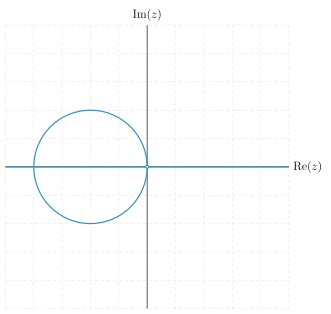
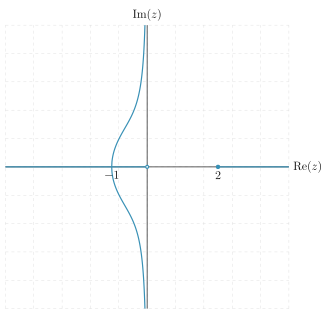
Let \(x+{\rm i} y\) be a root of the quadratic equation \(z^2 + pz +1=0\), where \(p\) is a real number. Show that \(x^2-y^2 +px+1=0\) and \((2x+p)y=0\). Show further that either \(p=-2x\) or \(p=-(x^2+1)/x\) with \(x\ne0\). Hence show that the set of points in the Argand diagram that can (as \(p\) varies) represent roots of the quadratic equation consists of the real axis with one point missing and a circle. This set of points is called the root locus of the quadratic equation. Obtain and sketch in the Argand diagram the root locus of the equation \[ pz^2 +z+1=0\, \] and the root locus of the equation \[ pz^2 + p^2z +2=0\,.\]
Solution: \begin{align*} && 0 &= z^2 + pz + 1\\ &&&= (x+iy)^2 + (x+iy)p + 1 \\ &&& = (x^2-y^2+px+1) + (2xy+py)i \\ \Rightarrow && 0 &= x^2 - y^2 + px + 1 \\ && 0 &= (2x+p)y \\ \Rightarrow && p &= -2x \\ \text{ or } && y &= 0 \\ \Rightarrow && p &= -(x^2+1)/x \end{align*} Therefore as \(p\) varies with either have \(y = 0\) and \(x\) taking any real value except \(0\) ie the real axis minus the origin. Or \(p = -2x\) and \(-y^2-x^2+1 = 0 \Rightarrow x^2 + y^2 = 1\) which is a circle. Suppose \(pz^2 + z + 1 = 0\) \begin{align*} && 0 &= pz^2 + z +1\\ &&&= p(x+iy)^2 + (x+iy) + 1\\ &&&= (px^2-py^2+x+1) + (2xyp + y) i \\ \Rightarrow && 0 &= (2xp+1)y \\ \Rightarrow && y & = 0, p = \frac{-(x+1)}{x^2}, x \neq 0 \\ \text{ or } && p &= -\frac{1}{2x}\\ \Rightarrow && 0 &= -\frac{1}{2}x + \frac{y^2}{2x} + x + 1 \\ &&&= \frac{y^2 - x^2 +2x^2 + 2x}{2x} \\ &&&= \frac{(x+1)^2+y^2-1}{2x} \end{align*} So we either have the real axis (except \(0\)) or a circle radius \(1\) centre \((-1, 0)\) (excluding \(x = 0\)).
2012 Paper 3 Q7
A pain-killing drug is injected into the bloodstream. It then diffuses into the brain, where it is absorbed. The quantities at time \(t\) of the drug in the blood and the brain respectively are \(y(t)\) and \(z(t)\). These satisfy \[ \dot y = - 2(y-z)\,, \ \ \ \ \ \ \ \dot z = - \dot y -3z\, , \] where the dot denotes differentiation with respect to \(t\). Obtain a second order differential equation for \(y\) and hence derive the solution \[ y= A\e^{-t} + B\e ^{-6t}\,, \ \ \ \ \ \ \ z= \tfrac12 A \e^{-t} - 2 B \e^{-6t}\,, \] where \(A\) and \(B\) are arbitrary constants. \begin{questionparts} \item Obtain the solution that satisfies \(z(0)=0\) and \(y(0)= 5\). The quantity of the drug in the brain for this solution is denoted by \(z_1(t)\). \item Obtain the solution that satisfies $ z(0)=z(1)= c$, where \(c\) is a given constant. %\[ %C=2(1-\e^{-1})^{-1} - 2(1-\e^{-6})^{-1}\,. %\] The quantity of the drug in the brain for this solution is denoted by \(z_2(t)\). \item Show that for \(0\le t \le 1\), \[ z_2(t) = \sum _{n=-\infty}^{0} z_1(t-n)\,, \] provided \(c\) takes a particular value that you should find. \end {questionparts}
2012 Paper 3 Q8
The sequence \(F_0\), \(F_1\), \(F_2\), \(\ldots\,\) is defined by \(F_0=0\), \(F_1=1\) and, for \(n\ge0\), \[ F_{n+2} = F_{n+1} + F_n \,. \]
- Show that \(F_0F_3-F_1F_2 = F_2F_5- F_3F_4\,\).
- Find the values of \(F_nF_{n+3} - F_{n+1}F_{n+2}\) in the two cases that arise.
- Prove that, for \(r=1\), \(2\), \(3\), \(\ldots\,\), \[ \arctan \left( \frac 1{F_{2r}}\right) =\arctan \left( \frac 1{F_{2r+1}}\right)+ \arctan \left( \frac 1{F_{2r+2}}\right) \] and hence evaluate the following sum (which you may assume converges): \[ \sum_{r=1}^\infty \arctan \left( \frac 1{F_{2r+1}}\right) \,. \]
2012 Paper 3 Q9
A pulley consists of a disc of radius \(r\) with centre \(O\) and a light thin axle through \(O\) perpendicular to the plane of the disc. The disc is non-uniform, its mass is \(M\) and its centre of mass is at \(O\). The axle is fixed and horizontal. Two particles, of masses \(m_1\) and \(m_2\) where \(m_1>m_2\), are connected by a light inextensible string which passes over the pulley. The contact between the string and the pulley is rough enough to prevent the string sliding. The pulley turns and the vertical force on the axle is found, by measurement, to be~\(P+Mg\).
- The moment of inertia of the pulley about its axle is calculated assuming that the pulley rotates without friction about its axle. Show that the calculated value is \[ \frac{((m_1 + m_2)P - 4m_1m_2g)r^2} {(m_1 + m_2)g - P}\,. \tag{\(*\)}\]
- Instead, the moment of inertia of the pulley about its axle is calculated assuming that a couple of magnitude \(C\) due to friction acts on the axle of the pulley. Determine whether this calculated value is greater or smaller than \((*)\). Show that \(C<(m_1-m_2)rg\).
2012 Paper 3 Q10
A small ring of mass \(m\) is free to slide without friction on a hoop of radius \(a\). The hoop is fixed in a vertical plane. The ring is connected by a light elastic string of natural length \(a\) to the highest point of the hoop. The ring is initially at rest at the lowest point of the hoop and is then slightly displaced. In the subsequent motion the angle of the string to the downward vertical is \(\phi\). Given that the ring first comes to rest just as the string becomes slack, find an expression for the modulus of elasticity of the string in terms of \(m\) and \(g\). Show that, throughout the motion, the magnitude \(R\) of the reaction between the ring and the hoop is given by \[ R = ( 12\cos^2\phi -15\cos\phi +5) mg \] and that \(R\) is non-zero throughout the motion.
2012 Paper 3 Q11
One end of a thin heavy uniform inextensible perfectly flexible rope of length \(2L\) and mass \(2M\) is attached to a fixed point \(P\). A particle of mass \(m\) is attached to the other end. Initially, the particle is held at \(P\) and the rope hangs vertically in a loop below \(P\). The particle is then released so that it and a section of the rope (of decreasing length) fall vertically as shown in the diagram.
2012 Paper 3 Q12
- A point \(P\) lies in an equilateral triangle \(ABC\) of height 1. The perpendicular distances from \(P\) to the sides \(AB\), \(BC\) and \(CA\) are \(x_1\), \(x_2\) and \(x_3\), respectively. By considering the areas of triangles with one vertex at \(P\), show that \(x_1+x_2+x_3=1\). Suppose now that \(P\) is placed at random in the equilateral triangle (so that the probability of it lying in any given region of the triangle is proportional to the area of that region). The perpendicular distances from \(P\) to the sides \(AB\), \(BC\) and \(CA\) are random variables \(X_1\), \(X_2\) and \(X_3\), respectively. In the case \(X_1= \min(X_1,X_2,X_3)\), give a sketch showing the region of the triangle in which \(P\) lies. Let \(X= \min(X_1,X_2,X_3)\). Show that the probability density function for \(X\) is given by \[ \f(x) = \begin{cases} 6(1-3x) & 0 \le x \le \frac13\,, \\ 0 & \text{otherwise}\,. \end{cases} \] Find the expected value of \(X\).
- A point is chosen at random in a regular tetrahedron of height 1. Find the expected value of the distance from the point to the closest face. \newline [The volume of a tetrahedron is \(\frac13 \times \text{area of base}\times\text{height}\) and its centroid is a distance \(\frac14\times \text{height}\) from the base.]