Problems
Filters
48 problems found
1988 Paper 2 Q15
An examination consists of several papers, which are marked independently. The mark given for each paper can be an integer from \(0\) to \(m\) inclusive, and the total mark for the examination is the sum of the marks on the individual papers. In order to make the examination completely fair, the examiners decide to allocate the mark for each paper at random, so that the probability that any given candidate will be allocated \(k\) marks \((0\leqslant k\leqslant m)\) for a given paper is \((m+1)^{-1}\). If there are just two papers, show that the probability that a given candidate will receive a total of \(n\) marks is \[ \frac{2m-n+1}{\left(m+1\right)^{2}} \] for \(m< n\leqslant2m\), and find the corresponding result for \(0\leqslant n\leqslant m\). If the examination consists of three papers, show that the probability that a given candidate will receive a total of \(n\) marks is \[ \frac{6mn-4m^{2}-2n^{2}+3m+2}{2\left(m+1\right)^{2}} \] in the case \(m< n\leqslant2m\). Find the corresponding result for \(0\leqslant n\leqslant m\), and deduce the result for \(2m< n\leqslant3m\).
Solution: In order to receive \(n\) marks over the two papers, where \(m < n \leq 2m\) the student must receive \(k\) and \(n-k\) marks in each paper. Since \(n > m\), \(n-k\) is a valid mark when \(n-k \leq m\) ie when \(n-m\leq k\), therefore the probability is: \begin{align*} \sum_{k = n-m}^m \mathbb{P}(\text{scores }k\text{ and }n-k) &= \sum_{k=n-m}^m \frac{1}{(m+1)^2} \\ &= \frac{m-(n-m-1)}{(m+1)^2} \\ &= \frac{2m-n+1}{(m+1)^2} \end{align*} If \(0 \leq n \leq m\) then we need \(n-k\) marks in the second paper to be positive, ie \(n-k \geq 0 \Rightarrow n \geq k\), so \begin{align*} \sum_{k = 0}^n \mathbb{P}(\text{scores }k\text{ and }n-k) &= \sum_{k = 0}^n \frac{1}{(m+1)^2} \\ &= \frac{n+1}{(m+1)^2} \end{align*} On the first paper, they can score any number of marks, since \(n > m\), so we must have: \begin{align*} \sum_{k=0}^m \mathbb{P}(\text{scores }k\text{ and }n-k) &= \frac{1}{m+1} \sum_{k=0}^m \mathbb{P}(\text{scores }n-k\text{ on second papers}) \\ &= \frac{1}{m+1}\l \sum_{k=0}^{n-m} \frac{2m-(n-k)+1}{(m+1)^2} +\sum_{k=n-m+1}^m \frac{n-k+1}{(m+1)^2}\r \end{align*}
1988 Paper 2 Q16
Find the probability that the quadratic equation \[ X^{2}+2BX+1=0 \] has real roots when \(B\) is normally distributed with zero mean and unit variance. Given that the two roots \(X_{1}\) and \(X_{2}\) are real, find:
- the probability that both \(X_{1}\) and \(X_{2}\) are greater than \(\frac{1}{5}\);
- the expected value of \(\left|X_{1}+X_{2}\right|\);
Solution: The roots are \(X_1, X_2 = -B \pm \sqrt{B^2-1}\)
- The smallest root will be \(-B - \sqrt{B^2-1}\). For this to be larger than \(\frac15\) we must have, \begin{align*} && -B -\sqrt{B^2-1} &\geq \frac15 \\ \Rightarrow && -B - \frac15 &\geq \sqrt{B^2 - 1} \\ \Rightarrow && B^2 + \frac25 B + \frac1{25} &\geq B^2 - 1 \\ \Rightarrow && \frac25 B \geq -\frac{26}{25} \\ \Rightarrow && B \geq -\frac{13}{5} \end{align*} Therefore \(-\frac{13}5 \leq B \leq -1\). Therefore we want: \begin{align*} \frac{\P(-\frac{13}5 \leq B \leq -1)}{\P(B < -1) + \P(B > 1)} &= \frac{\Phi(-1) - \Phi(-\frac{13}{5})}{\Phi(-1)+1-\Phi(1)} \\ &= \frac{0.1586\ldots - 0.0046\ldots}{0.1586\ldots + 1- 0.8413\ldots} \\ &= 0.4853\ldots \\ &= 0.485 \,\,(3 \text{ s.f.}) \end{align*}
- \(X_1 + X_2 = -2B\). Therefore we want: \begin{align*} \mathbb{E}(|X_1 + X_2| &= \mathbb{E}(|2B|) \\ &= 2 \l\frac{1}{2\Phi(-1)} \int_1^{\infty} B \frac{1}{\sqrt{2 \pi}} e^{-\frac12 B^2} \, \d B+\frac{1}{2\Phi(-1)} \int_{-\infty}^{-1} B \frac{1}{\sqrt{2 \pi}} e^{-\frac12 B^2} \, \d B \r \\ &= \frac{4}{2\Phi(-1)} \int_1^{\infty} B \frac{1}{\sqrt{2 \pi}} e^{-\frac12 B^2} \, \d B \\ &=\frac{4}{2\sqrt{2 \pi} \Phi(-1)} \left [ -e^{-\frac12 B^2}\right]_1^{\infty} \\ &= \frac{4}{2\sqrt{2 \pi} \Phi(-1) \sqrt{e}} \\ &= 3.0502\ldots \\ &= 3.05\,\, (3\text{ s.f.}) \end{align*}
1988 Paper 3 Q1
Sketch the graph of \[ y=\frac{x^{2}\mathrm{e}^{-x}}{1+x}, \] for \(-\infty< x< \infty.\) Show that the value of \[ \int_{0}^{\infty}\frac{x^{2}\mathrm{e}^{-x}}{1+x}\,\mathrm{d}x \] lies between \(0\) and \(1\).
Solution:

1988 Paper 3 Q2
The real numbers \(u_{0},u_{1},u_{2},\ldots\) satisfy the difference equation \[ au_{n+2}+bu_{n+1}+cu_{n}=0\qquad(n=0,1,2,\ldots), \] where \(a,b\) and \(c\) are real numbers such that the quadratic equation \[ ax^{2}+bx+c=0 \] has two distinct real roots \(\alpha\) and \(\beta.\) Show that the above difference equation is satisfied by the numbers \(u_{n}\) defined by \[ u_{n}=A\alpha^{n}+B\beta^{n}, \] where \[ A=\frac{u_{1}-\beta u_{0}}{\alpha-\beta}\qquad\mbox{ and }\qquad B=\frac{u_{1}-\alpha u_{0}}{\beta-\alpha}. \] Show also, by induction, that these numbers provide the only solution. Find the numbers \(v_{n}\) \((n=0,1,2,\ldots)\) which satisfy \[ 8(n+2)(n+1)v_{n+2}-2(n+3)(n+1)v_{n+1}-(n+3)(n+2)v_{n}=0 \] with \(v_{0}=0\) and \(v_{1}=1.\)
Solution: First notice that \(u_n = \alpha^n\) and \(u_n = \beta^n\) both satisfy the recurrence, since: \begin{align*} && a \alpha^2 + b \alpha + c &= 0 \\ \Rightarrow && a \alpha^{n+2} + b \alpha^{n+1} + c \alpha^n &= 0 \\ \Rightarrow && a u_{n+2} + bu_{n+1} + cu_n &=0 \end{align*} Notice also that if \(u_n\) and \(v_n\) both satisfy the recurrence, then any linear combination of them will satisfy the recurrence: \begin{align*} && \begin{cases} au_{n+2} + bu_{n+1} + cu_n &= 0 \\ av_{n+2} + bv_{n+1} + cv_n &= 0 \\ \end{cases} \\ \Rightarrow && a (\lambda u_{n+2}+ \mu v_{n+2}) + b (\lambda u_{n+1}+ \mu v_{n+1}) + c (\lambda u_{n}+ \mu v_{n}) &= 0 \end{align*} by adding a linear combination of the top two equations. Therefore it suffices to check that the constants \(A\) and \(B\) are such that we match \(u_0\) and \(u_1\). \(\frac{u_1 - \beta u_0}{\alpha - \beta} + \frac{u_1 - \alpha u_0}{\beta - \alpha} = u_0\) and \(\frac{u_1 - \beta u_0}{\alpha - \beta}\alpha + \frac{u_1 - \alpha u_0}{\beta - \alpha}\beta = u_1\). So we are done. Suppose we have another sequence, then we first notice that the first and second terms must be identical to each other. Suppose the first \(k\) terms are identical, then since the \(k+1\)th term depends only on the \(k\) and \(k-1\)th terms (both of which are equal) the \(k+1\)th term is the same. Therefore, by the principle of mathematical induction, all terms are the same. First notice that if you put \(v_n = (n+1)w_n\) we have \begin{align*} && 8(n+3)(n+2)(n+1)w_{n+2} - 2(n+3)(n+2)(n+1)w_{n+1} - (n+3)(n+2)(n+1)w_n &= 0 \\ \Rightarrow && 8w_{n+2}-2w_{n+1}-w_n &= 0 \end{align*} This has characteristic equation \(8\lambda^2 - 2\lambda - 1 = 0 \Rightarrow \lambda = \frac12, -\frac14\). Therefore the general solution is \(w_n = A \l \frac12 \r^n + B \l -\frac14\r^n\) and \(v_n = (n+1)\l A \l \frac12 \r^n + B \l -\frac14\r^n \r\). When \(n = 0\) we have \(A+B = 0 \Rightarrow B =-A\). When \(n=1\) we have \(1 = 2 \l \frac{A}{2} + \frac{A}{4} \r \Rightarrow A = \frac{4}{3}\), therefore \[ v_n = \frac{4}{3}(n+1) \l \frac{1}{2^n} + \l -\frac14\r^n \r\]
1988 Paper 3 Q3
Give a parametric form for the curve in the Argand diagram determined by \(\left|z-\mathrm{i}\right|=2.\) Let \(w=(z+\mathrm{i})/(z-\mathrm{i}).\) Find and sketch the locus, in the Argand diagram, of the point which represents the complex number \(w\) when \begin{questionparts} \item \(\left|z-\mathrm{i}\right|=2;\) \item \(z\) is real; \item \(z\) is imaginary. \end{questionpart}
Solution: There are many possible parametric forms, for example \(z = i + 2e^{it}, z = 2\ cos \theta + (1 + 2\sin \theta)i\) etc. It is a circle radius \(2\) about the point \(i\).
- \begin{align*}
w &= \frac{z+i}{z-i} \\
&= \frac{2i + 2e^{it}}{2e^{it}} \\
&= 2 + ie^{-it}
\end{align*}
This is obvious a circle radius \(1\) about the point \(2\).

- If \(z\) is real, then \begin{align*} w &= \frac{z+i}{z-i} \\ &= \frac{(z+i)^2}{z^2+1} \\ &= \frac{z^2-1 + 2zi}{z^2+1} \end{align*} We can quickly notice this describes a circle radius \(1\) about \(0\). Alternatively, \(|z+i| = |z-i| \Rightarrow |\frac{z+i}{z-i}| = 1\) so we must be talking about points on the unit circle. Since this is a Mobius transform we know it maps lines and circles to lines and circles, therefore it must map to the unit circle;
- If \(z\) is purely imaginary, say \(it\) then:
\begin{align*}
w &= \frac{z+i}{z-i} \\
&= \frac{(it+i)(i-it)}{(-1+t)^2} \\
&= \frac{t^2-1}{(t-1)^2}
\end{align*}
Which is purely real, and can take all real values.

1988 Paper 3 Q4
A kingdom consists of a vast plane with a central parabolic hill. In a vertical cross-section through the centre of the hill, with the \(x\)-axis horizontal and the \(z\)-axis vertical, the surface of the plane and hill is given by \[ z=\begin{cases} \dfrac{1}{2a}(a^{2}-x^{2}) & \mbox{ for }\left|x\right|\leqslant a,\\ 0 & \mbox{ for }\left|x\right|>a. \end{cases} \] The whole surface is formed by rotating this cross-section about the \(z\)-axis. In the \((x,z)\) plane through the centre of the hill, the king has a summer residence at \((-R,0)\) and a winter residence at \((R,0)\), where \(R>a.\) He wishes to connect them by a road, consisting of the following segments: \begin{itemize} \item a path in the \((x,z)\) plane joining \((-R,0)\) to \((-b,(a^{2}-b^{2})/2a),\) where \(0\leqslant b\leqslant a.\) \item a horizontal semicircular path joining the two points \((\pm b,(a^{2}-b^{2})/2a),\) if \(b\neq0;\) \item a path in the \((x,z)\) plane joining \((b,(a^{2}-b^{2})/2a)\) to \((R,0).\) \end{itemiz} The king wants the road to be as short as possible. Advise him on his choice of \(b.\)
Solution: The path can be broken down into \(5\) sections. 1. The section from \((-R,0)\) to \((-a,0)\) which will have distance \(R-a\) and is unchangeable. 2. The distance from \((-a,0)\) to \((-b, \frac{a^2-b^2}{2a})\) whose distance we will calculate shortly. 3. The distance from \((-b, \frac{a^2-b^2}{2a})\) to \((b, \frac{a^2-b^2}{2a})\) which will have distance \(\pi b\). 4. The distance from \((b, \frac{a^2-b^2}{2a})\) to \((a,0)\) which will have the same distance as 2. 5. The distance from \((a,0)\) to \((R,0)\) which will have distance \(R-a\) and we have no control over. \begin{align*} \text{distance 2.} &= \int_b^a \sqrt{1 + \left ( \frac{x}{a}\right)^2 } \d x \end{align*} We want to minimize the total, by varying \(b\), so it makes sense to differentiate and set to zero. \begin{align*} &&0&= -2\sqrt{1+\frac{b^2}{a^2}} + \pi \\ \Rightarrow && \frac{\pi^2}{4} &= 1 + \frac{b^2}{a^2} \\ \Rightarrow && b &= a \sqrt{\frac{\pi^2}{4}-1} \end{align*} Since \(\pi \approx 3\) this point is outside our range \(0 \leq b \leq a\), and our derivative is always positive. Therefore the distance is always increasing and the king would be better off going around the hill as soon as he arrives at it.
1988 Paper 3 Q5
A firm of engineers obtains the right to dig and exploit an undersea tunnel. Each day the firm borrows enough money to pay for the day's digging, which costs £\(c,\) and to pay the daily interest of \(100k\%\) on the sum already borrowed. The tunnel takes \(T\) days to build, and, once finished, earns £\(d\) a day, all of which goes to pay the daily interest and repay the debt until it is fully paid. The financial transactions take place at the end of each day's work. Show that \(S_{n},\) the total amount borrowed by the end of day \(n\), is given by \[ S_{n}=\frac{c[(1+k)^{n}-1]}{k} \] for \(n\leqslant T\). Given that \(S_{T+m}>0,\) where \(m>0,\) express \(S_{T+m}\) in terms of \(c,d,k,T\) and \(m.\) Show that, if \(d/c>(1+k)^{T}-1,\) the firm will eventually pay off the debt.
Solution: After \(n\) days they will have borrowed \(c\) for \(n-1\) days, \(c\) for \(n-2\) days, etc until \(c\) for no days. Therefore the outstanding balance will be: \begin{align*} c + (1+k)\cdot c+ (1+k)^2 \cdot c + \cdots + (1+k)^{n-1} \cdot c &= c\frac{(1+k)^n-1}{(1+k)-1} \\ &= \frac{c[(1+k)^n-1]}{k} \end{align*} At the end of \(T\) days the outstanding balance will be \(S_T = \frac{c[(1+k)^T-1]}{k}\). We can think of each payment of \(d\) during the subsequent period as being equivalent of a payment of \(d (1+k)^{m-1}\) \(m\) days later (as otherwise they would have accrued the equivalent amount in interest. Therefore after \(m\) days the amount paid back (equivalent) is: \begin{align*} (1+k)^{m-1} \cdot d + (1+k)^{m-2} \cdot d + \cdots + d &= \frac{d[(1+k)^m-1]}{k} \end{align*} Therefore the net position, \(S_{T+m}\) will be: \begin{align*} S_{T+m} &= \frac{c[(1+k)^T-1](1+k)^m-d[(1+k)^m-1]}{k} \\ &= \frac{(1+k)^m [c ((1+k)^T-1)-d]+d}{k} \end{align*} Therefore they will eventually pay back their debts if \( [c ((1+k)^T-1)-d]\) is negative. ie \(d > c((1+k)^T-1) \Rightarrow d/c > (1+k)^T-1\)
1988 Paper 3 Q6
Let \(\mathrm{f}(x)=\sin2x\cos x.\) Find the 1988th derivative of \(\mathrm{f}(x).\) Show that the smallest positive value of \(x\) for which this derivative is zero is \(\frac{1}{3}\pi+\epsilon,\) where \(\epsilon\) is approximately equal to \[ \frac{3^{-1988}\sqrt{3}}{2}. \]
Solution: \begin{align*} && f(x) &= \sin 2x \cos x \\ &&&= \frac12 \l \sin 3x + \sin x \r \\ \Rightarrow && f^{(1988)}(x) &= \frac12 \l 3^{1988} (-1)^{994} \sin 3x+ (-1)^{994} \sin x \r \\ &&&= \boxed{\frac12 \left (3^{1998} \sin 3x + \sin x \right)} \\ \\ f^{(1988)}(x) = 0: && 0 &= 3^{1988} \sin 3x + \sin x \\ \Rightarrow && 0 &= 3^{1988} ( 3\sin x-4\sin^3 x) + \sin x \\ \Rightarrow && 0 &= \sin x \left (1+3^{1989}-4\cdot 3^{1988}\sin^{2} x \right) \end{align*} Since \(\sin x\) will first contribute a zero when \(x = \frac{\pi}{2}\) we focus on the second bracket, in particular, we need: \begin{align*} && \sin^2 x &= \frac{3}{4} \left ( 1 + \frac{1}{3^{1988}} \right) \\ \Rightarrow && \sin x &= \frac{\sqrt{3}}2 \left (1 + \frac{1}{2 \cdot 3^{1988}} + \cdots \right ) \end{align*} Since near \(\frac{\pi}{3}\), \begin{align*} \sin (\frac{\pi}{3} + \epsilon) &= \sin \frac{\pi}{3} \cos \epsilon + \cos \frac{\pi}{3} \sin \epsilon \\ &\approx \frac{\sqrt{3}}{2} (1-\epsilon^2 + \cdots ) + \frac{1}{2}(\epsilon + \cdots) \\ &= \frac{\sqrt{3}}2 + \frac12 \epsilon + \cdots \end{align*} Therefore by comparison we can see that \(x = \frac{\pi}{3} + \frac{\sqrt{3}}{2} 3^{-1988}\) will be a very good approximation for the root.
1988 Paper 3 Q7
For \(n=0,1,2,\ldots,\) the functions \(y_{n}\) satisfy the differential equation \[ \frac{\mathrm{d}^{2}y_{n}}{\mathrm{d}x^{2}}-\omega^{2}x^{2}y_{n}=-(2n+1)\omega y_{n}, \] where \(\omega\) is a positive constant, and \(y_{n}\rightarrow0\) and \(\mathrm{d}y_{n}/\mathrm{d}x\rightarrow0\) as \(x\rightarrow+\infty\) and as \(x\rightarrow-\infty.\) Verify that these conditions are satisfied, for \(n=0\) and \(n=1,\) by \[ y_{0}(x)=\mathrm{e}^{-\lambda x^{2}}\qquad\mbox{ and }\qquad y_{1}(x)=x\mathrm{e}^{-\lambda x^{2}} \] for some constant \(\lambda,\) to be determined. Show that \[ \frac{\mathrm{d}}{\mathrm{d}x}\left(y_{m}\frac{\mathrm{d}y_{n}}{\mathrm{d}x}-y_{n}\frac{\mathrm{d}y_{m}}{\mathrm{d}x}\right)=2(m-n)\omega y_{m}y_{n}, \] and deduce that, if \(m\neq n,\) \[ \int_{-\infty}^{\infty}y_{m}(x)y_{n}(x)\,\mathrm{d}x=0. \]
Solution: \begin{align*} && y_0(x) &= e^{-\lambda x^2} \\ && \lim_{x \to \pm \infty} y_0(x) &= 0 \Leftrightarrow \lambda > 0 \\ && \lim_{x \to \pm \infty} y'_0(x) &= \lim_{x \to \pm \infty} 2x\lambda e^{-\lambda x^2} \\ &&&= 0\Leftrightarrow \lambda > 0 \\ && y''_0(x) &= 4x^2 \lambda^2 e^{-\lambda x^2} + 2\lambda e^{-\lambda x^2} \\ \\ && y''_0 - \omega^2 x^2 y_0+(2\cdot 0 + 1) \omega y_0 &= e^{-\lambda x^2} \l 4x^2 \lambda^2 + 2 \lambda - \omega^2 x^2 + \omega\r \\ &&&=0 \Leftrightarrow \lambda = \pm \frac{\omega}{2} \end{align*} Therefore \(y_0\) satisfies if \(\lambda = \frac{\omega}{2}\) Similarly for \(y_1\), \begin{align*} && y_1(x) &= xe^{-\lambda x^2} \\ && \lim_{x \to \pm \infty} y_1(x) &= 0 \Leftrightarrow \lambda > 0 \\ && \lim_{x \to \pm \infty} y'_1(x) &= \lim_{x \to \pm \infty} \l -2x^2 \lambda e^{-\lambda x^2} + e^{-\lambda x^2} \r \\ &&&= 0\Leftrightarrow \lambda > 0 \\ && y''_0(x) &= e^{-\lambda x^2} \l 4x^3 \lambda^2-4x\lambda - 2x\lambda \r \\ &&&= e^{-\lambda x^2} \l 4x^3 \lambda^2-6x\lambda \r \\ && y''_1 - \omega^2 x^2 y_1+(2\cdot 1 + 1) \omega y_1 &= e^{-\lambda x^2} \l 4x^3\lambda^2-6x\lambda-\omega^2x^3+3\omega x\r \\ &&&=0 \Leftrightarrow \lambda = \pm \frac{\omega}{2} \end{align*} Therefore \(y_1\) satisfies if \(\lambda = \frac{\omega}{2}\) \begin{align*} \frac{\mathrm{d}}{\mathrm{d}x}\left(y_{m}\frac{\mathrm{d}y_{n}}{\mathrm{d}x}-y_{n}\frac{\mathrm{d}y_{m}}{\mathrm{d}x}\right) &= y'_my'_n+y_my''_n - y'_ny'_m-y_ny''_m \\ &= y_my''_n - y_ny''_m \\ &= y_m(\omega^2 x^2 y_n - (2n+1)\omega y_n) - y_n(\omega^2 x^2 y_m - (2m+1)\omega y_m) \\ &= y_my_n (2m-2n)\omega \\ &= 2(m-n) \omega y_my_n \end{align*} Therefore: \begin{align*} \int_{-\infty}^{\infty} y_m(x)y_n(x) \d x &= \int_{-\infty}^{\infty} \frac{1}{2(m-n)} \frac{\mathrm{d}}{\mathrm{d}x}\left(y_{m}\frac{\mathrm{d}y_{n}}{\mathrm{d}x}-y_{n}\frac{\mathrm{d}y_{m}}{\mathrm{d}x}\right) \d x \\ &= \frac{1}{2(m-n)} \left [ y_{m}\frac{\mathrm{d}y_{n}}{\mathrm{d}x}-y_{n}\frac{\mathrm{d}y_{m}}{\mathrm{d}x}\right]_{-\infty}^{\infty} \\ &\to 0 \end{align*} This condition is known as Orthogonality. In fact this question is talking about a Sturm-Liouville orthogonality condition, in particular for the quantum harmonic oscillator, and the eigenfunctions are related to Hermite polynomials.
1988 Paper 3 Q8
Find the equations of the tangent and normal to the parabola \(y^{2}=4ax\) at the point \((at^{2},2at).\) For \(i=1,2,\) and 3, let \(P_{i}\) be the point \((at_{i}^{2},2at_{i}),\) where \(t_{1},t_{2}\) and \(t_{3}\) are all distinct. Let \(A_{1}\) be the area of the triangle formed by the tangents at \(P_{1},P_{2}\) and \(P_{3},\) and let \(A_{2}\) be the area of the triangle formed by the normals at \(P_{1},P_{2}\) and \(P_{3}.\) Using the fact that the area of the triangle with vertices at \((x_{1},y_{1}),(x_{2},y_{2})\) and \((x_{3},y_{3})\) is the absolute value of \[ \tfrac{1}{2}\det\begin{pmatrix}x_{1} & y_{1} & 1\\ x_{2} & y_{2} & 1\\ x_{3} & y_{3} & 1 \end{pmatrix}, \] show that \(A_{3}=(t_{1}+t_{2}+t_{3})^{2}A_{1}.\) Deduce a necessary and sufficient condition in terms of \(t_{1},t_{2}\) and \(t_{3}\) for the normals at \(P_{1},P_{2}\) and \(P_{3}\) to be concurrent.
Solution: \(\frac{dy}{dt} = 2a, \frac{dx}{dt} = 2at \Rightarrow \frac{dy}{dx} = \frac{1}{t}\). Therefore the equation of the tangent will be \(\frac{y - 2at}{x-at^2} = \frac{1}{t} \Rightarrow y = \frac1tx +at\) and normal will be \(\frac{y-2at}{x-at^2} = -t \Rightarrow y = t(at^2-x+2a)\). The tangents will meet when: \begin{align*} && \begin{cases} t_iy -x &= at_i^2 \\ t_j y - x &= at_j^2 \\ \end{cases} \\ \Rightarrow &&(t_i - t_j)y &= a(t_i-t_j)(t_i+t_j) \\ \Rightarrow && y &= a(t_i+t_j) \\ && x &= at_it_j \end{align*} The normals will meet when: \begin{align*} && \begin{cases} y +t_i x &= at_i^3+2at_i \\ y +t_j x &= at_j^3+2at_j \\ \end{cases} \\ \Rightarrow &&(t_i - t_j)x &= a(t_i-t_j)(t_i^2+t_it_j+t_j^2+2) \\ \Rightarrow && x&= a(t_i^2+t_it_j+t_j^2+2) \\ && y &= -at_it_j(t_i+t_j) \end{align*} Therefore the area of our triangles will be: \begin{align*} \tfrac{1}{2}\det\begin{pmatrix}at_1t_2 & a(t_1+t_2) & 1\\ at_2t_3 & a(t_2+t_3) & 1\\ at_3t_1 & a(t_3+t_1) & 1 \end{pmatrix} &= \frac{a^2}{2}\det\begin{pmatrix}t_1t_2 & (t_1+t_2) & 1\\ t_2t_3 & (t_2+t_3) & 1\\ t_3t_1 & (t_3+t_1) & 1 \end{pmatrix} \\ &= \frac{a^2}{2}\det\begin{pmatrix}t_1t_2 & (t_1+t_2) & 1\\ t_2(t_3-t_1) & (t_3-t_1) & 0\\ t_1(t_3-t_2) & (t_3-t_2) & 0 \end{pmatrix} \\ &= \frac{a^2}{2}|(t_2-t_1)(t_3-t_2)(t_1-t_3)| \end{align*} and \begin{align*} \tfrac{1}{2}\det\begin{pmatrix}a(t_1^2+t_1t_2+t_2^2+2) & -at_1t_2(t_1+t_2) & 1\\ a(t_2^2+t_2t_3+t_3^2+2) & -at_2t_3(t_2+t_3) & 1\\ a(t_3^2+t_3t_1+t_1^2+2) & -at_3t_1(t_3+t_1) & 1\\ \end{pmatrix} &= \frac{a^2}{2}\det\begin{pmatrix}(t_1^2+t_1t_2+t_2^2+2) & -t_1t_2(t_1+t_2) & 1\\ (t_2^2+t_2t_3+t_3^2+2) & -t_2t_3(t_2+t_3) & 1\\ (t_3^2+t_3t_1+t_1^2+2) & -t_3t_1(t_3+t_1) & 1\\ \end{pmatrix} \\ &= \frac{a^2}{2}\det\begin{pmatrix}(t_1^2+t_1t_2+t_2^2+2) & -t_1t_2(t_1+t_2) & 1\\ t_3^2-t_1^2+t_2(t_3-t_1) & t_2(t_1^2+t_1t_2-t_2t_3-t_3^2) & 0\\ t_3^2-t_2^2+t_1(t_3-t_2) & t_1(t_2^2+t_2t_1-t_1t_3-t_3^2) & 0\\ \end{pmatrix} \\ &= \frac{a^2}{2}\det\begin{pmatrix}(t_1^2+t_1t_2+t_2^2+2) & -t_1t_2(t_1+t_2) & 1\\ (t_3-t_1)(t_3+t_2+t_1) & t_2(t_1-t_3)(t_1+t_3+t_2) & 0\\ (t_3-t_2)(t_3+t_2+t_1) & t_1(t_2-t_3)(t_1+t_2+t_3)& 0\\ \end{pmatrix} \\ &= \frac{a^2}{2}(t_1+t_2+t_3)^2|(t_2-t_1)(t_3-t_2)(t_1-t_3)| \end{align*} as required. The normals will be concurrent iff the area of their triangle is \(0\). This is certainly true if \(t_1+t_2+t_3 = 0\). In fact the only if is also true, since no \(3\) tangents can be concurrent.
1988 Paper 3 Q9
Let \(G\) be a finite group with identity \(e.\) For each element \(g\in G,\) the order of \(g\), \(o(g),\) is defined to be the smallest positive integer \(n\) for which \(g^{n}=e.\)
- Show that, if \(o(g)=n\) and \(g^{N}=e,\) then \(n\) divides \(N.\)
- Let \(g\) and \(h\) be elements of \(G\). Prove that, for any integer \(m,\) \[ gh^{m}g^{-1}=(ghg^{-1})^{m}. \]
- Let \(g\) and \(h\) be elements of \(G\), such that \(g^{5}=e,h\neq e\) and \(ghg^{-1}=h^{2}.\) Prove that \(g^{2}hg^{-2}=h^{4}\) and find \(o(h).\)
Solution: \begin{questionparts} \item Show that, if \(o(g)=n\) and \(g^{N}=e,\) then \(n\) divides \(N.\) Using the division algorithm, write \(N = qn + r\) where \(0 \leq r < n\) to divide \(N\) by \(n\). Then we have \(e = g^N = g^{qn + r} = g^{qn}g^r = (g^{n})^qg^r = e^qg^r = g^r\) therefore \(r\) is a number smaller than \(n\) such that \(g^r = e\). Therefore either \(r = 0\) or \(o(g) = r\), but by definition \(o(g) = n\) therefore \(r = 0\) and \(n \mid N\). \item Let \(g\) and \(h\) be elements of \(G\). Prove that, for any integer \(m,\) \[ gh^{m}g^{-1}=(ghg^{-1})^{m}. \] \((ghg^{-1})^m = \underbrace{(ghg^{-1})(ghg^{-1})\cdots(ghg^{-1})}_{m \text{ times}} = gh(g^{-1}g)h(g^{-1}g)\cdots (g^{-1}g)hg^{-1} = gh^mg^{-1}\) \item Let \(g\) and \(h\) be elements of \(G\), such that \(g^{5}=e,h\neq e\) and \(ghg^{-1}=h^{2}.\) Prove that \(g^{2}hg^{-2}=h^{4}\) and find \(o(h).\) \(g^2hg^{-2} = g(ghg^{-1})g^{-1} = gh^2g^{-1} = (ghg^{-1})^2 = (h^2)^2 = h^4\). \(h = g^{5}hg^{-5} = g^4ghg^{-1}g^{-4} = g^4h^2g^{-4} = g^3(ghg^{-1})^2g^{-3} = g^3h^4g^{-3} = h^32\) Therefore \(e = h^{31}\). Therfore \(o(h) \mid 31 \Rightarrow \boxed{o(h) = 31}\) since \(31\) is prime and \(o(h) \neq 1\)
1988 Paper 3 Q10
Four greyhounds \(A,B,C\) and \(D\) are held at positions such that \(ABCD\) is a large square. At a given instant, the dogs are released and \(A\) runs directly towards \(B\) at constant speed \(v\), \(B\) runs directly towards \(C\) at constant speed \(v\), and so on. Show that \(A\)'s path is given in polar coordinates (referred to an origin at the centre of the field and a suitable initial line) by \(r=\lambda\mathrm{e}^{-\theta},\) where \(\lambda\) is a constant. Generalise this result to the case of \(n\) dogs held at the vertices of a regular \(n\)-gon (\(n\geqslant3\)).
Solution:


1988 Paper 3 Q11
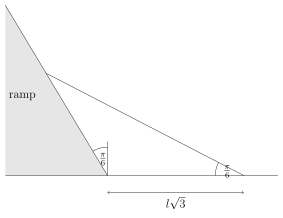
A uniform ladder of length \(l\) and mass \(m\) rests with one end in contact with a smooth ramp inclined at an angle of \(\pi/6\) to the vertical. The foot of the ladder rests, on horizontal ground, at a distance \(l/\sqrt{3}\) from the foot of the ramp, and the coefficient of friction between the ladder and the ground is \(\mu.\) The ladder is inclined at an angle \(\pi/6\) to the horizontal, in the vertical plane containing a line of greatest slope of the ramp. A labourer of mass \(m\) intends to climb slowly to the top of the ladder.
- Find the value of \(\mu\) if the ladder slips as soon as the labourer reaches the midpoint.
- Find the minimum value of \(\mu\) which will ensure that the labourer can reach the top of the ladder.
Solution:
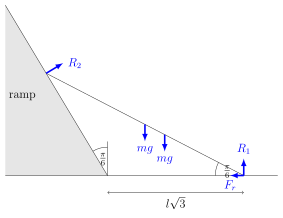
- \begin{align*} \text{N2}(\uparrow): && R_1 + R_2\sin(\frac{\pi}{6})-2mg &= 0 \\ \text{N2}(\rightarrow): && R_2 \cos (\frac{\pi}{6})-F_r &= 0 \\ \overset{\curvearrowleft}{X}: && lmg \cos \tfrac{\pi}{6} - l R_2 \cos \tfrac{\pi}{6} &= 0 \\ \\ \Rightarrow && R_2 &= mg \\ \Rightarrow && R_1 &= 2mg - \frac12mg \\ &&&=\frac32mg \\ \Rightarrow && \frac{\sqrt{3}}2mg - \mu\frac32mg &= 0 \\ \Rightarrow && \mu &= \frac{1}{\sqrt{3}} \end{align*}
- \begin{align*} \text{N2}(\uparrow): && R_1 + R_2\sin(\frac{\pi}{6})-2mg &= 0 \\ \overset{\curvearrowleft}{X}: && \frac12 lmg \cos \tfrac{\pi}{6}+xmg \cos \tfrac{\pi}{6} - l R_2 \cos \tfrac{\pi}{6} &= 0 \\ \\ \Rightarrow && R_2 &= mg(\frac{1}2+\frac{x}{l}) \\ \Rightarrow && R_1 &= 2mg - \frac12mg(\frac{1}2+\frac{x}{l}) \\ &&&=(\frac74 - \frac{x}{2l})mg \\ &&&\geq \frac{5}{4}mg\\ \text{N2}(\rightarrow): && R_2 \cos (\frac{\pi}{6})-\mu R_1& \leq 0 \\ \Rightarrow && \frac{\sqrt{3}}2mg - \mu\frac54mg &\leq 0 \\ \Rightarrow && \mu &\geq \frac{2\sqrt{3}}{5} \end{align*}
1988 Paper 3 Q12
A smooth billiard ball moving on a smooth horizontal table strikes another identical ball which is at rest. The coefficient of restitution between the balls is \(e(<1)\). Show that after the collision the angle between the velocities of the balls is less than \(\frac{1}{2}\pi.\) Show also that the maximum angle of deflection of the first ball is \[ \sin^{-1}\left(\frac{1+e}{3-e}\right). \]
Solution:

1988 Paper 3 Q13
A goalkeeper stands on the goal-line and kicks the football directly into the wind, at an angle \(\alpha\) to the horizontal. The ball has mass \(m\) and is kicked with velocity \(\mathbf{v}_{0}.\) The wind blows horizontally with constant velocity \(\mathbf{w}\) and the air resistance on the ball is \(mk\) times its velocity relative to the wind velocity, where \(k\) is a positive constant. Show that the equation of motion of the ball can be written in the form \[ \frac{\mathrm{d}\mathbf{v}}{\mathrm{d}t}+k\mathbf{v}=\mathbf{g}+k\mathbf{w}, \] where \(\mathbf{v}\) is the ball's velocity relative to the ground, and \(\mathbf{g}\) is the acceleration due to gravity. By writing down horizontal and vertical equations of motion for the ball, or otherwise, find its position at time \(t\) after it was kicked. On the assumption that the goalkeeper moves out of the way, show that if \(\tan\alpha=\left|\mathbf{g}\right|/(k\left|\mathbf{w}\right|),\) then the goalkeeper scores an own goal.
Solution: Applying \(\mathbf{F} = m\mathbf{a} = m \frac{\d \mathbf{v}}{dt}\) we have: \begin{align*} && m \frac{\d \mathbf{v}}{d t} &= m\mathbf{g} - mk(\mathbf{v} - \mathbf{w}) \\ \Rightarrow && \frac{\d \mathbf{v}}{d t} +k \mathbf{v} &= \mathbf{g} + k \mathbf{w} \\ \\ \Rightarrow && e^{k t} \l \frac{\d \mathbf{v}}{d t} +k \mathbf{v} \r &= e^{kt} ( \mathbf{g} + k \mathbf{w}) \\ \Rightarrow && \frac{\d}{\d t} \l e^{kt} \mathbf{v} \r &= e^{kt}( \mathbf{g} + k \mathbf{w}) \\ \Rightarrow && e^{kt} \mathbf{v} &= \frac{1}ke^{kt}( \mathbf{g} + k \mathbf{w}) + c \\ \Rightarrow && \mathbf{v}_0 &= \frac{1}{k} ( \mathbf{g} + k \mathbf{w})+c \\ \Rightarrow && \mathbf{v} &= e^{-kt} \l \mathbf{v_0} - \frac{1}{k}\mathbf{g} - \mathbf{w} \r + \frac{1}{k} \mathbf{g} + \mathbf{w} \\ \Rightarrow && \mathbf{x} &= -\frac{1}{k}e^{-kt} \l \mathbf{v_0} - \frac{1}{k}\mathbf{g} - \mathbf{w} \r + \frac{1}{k} \mathbf{g}t + \mathbf{w}t+C \\ \Rightarrow && \mathbf{0} &= -\frac{1}{k} \l \mathbf{v_0} - \frac{1}{k}\mathbf{g} - \mathbf{w} \r + C \\ \Rightarrow && \mathbf{x} &= \frac1{k}\l 1- e^{-kt} \r\l \mathbf{v_0} - \frac{1}{k}\mathbf{g} - \mathbf{w} \r + \frac{1}{k} \mathbf{g}t + \mathbf{w}t \end{align*} Position at time \(t\) is: \begin{align*} && x_x &= \frac1{k} ( 1-e^{-kt})(u_x - w)+wt \\ && x_y &= \frac1{k} ( 1-e^{-kt})(u_x \frac{g}{kw} - \frac{g}{k})+\frac{1}{k}gt \\ &&&= \frac{g}{kw} \left ( ( 1-e^{-kt})(u_x - w)+wt \right) \\ &&&= \frac{g}{kw} x_x \end{align*} Therefore if \(x_x\) is ever \(0\) then \(x_y\) will also be zero. But the ball must eventually hit the ground, and when it does, it will be in the process of scoring an own goal.