Problems
Filters
47 problems found
2000 Paper 3 Q1
Sketch on the same axes the two curves \(C_1\) and \(C_2\), given by
Solution:

1999 Paper 1 Q11
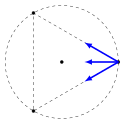
The force of attraction between two stars of masses \(m_{1}\) and \(m_{2}\) a distance \(r\) apart is \(\gamma m_{1}m_{2}/r^{2}\). The Starmakers of Kryton place three stars of equal mass \(m\) at the corners of an equilateral triangle of side \(a\). Show that it is possible for each star to revolve round the centre of mass of the system with angular velocity \((3\gamma m/a^{3})^{1/2}\). Find a corresponding result if the Starmakers place a fourth star, of mass \(\lambda m\), at the centre of mass of the system.
Solution: The net force on the planets will always be towards the centre of mass (by symmetry or similar arguments). Therefore it suffices to check whether we can find a speed where the planets follow uniform circular motion, ie \(F = mr \omega^2\). (But clearly this is possible, we just need to find the speed)

1998 Paper 3 Q2
Let $$ {\rm I}(a,b) = \int_0^1 t^{a}(1-t)^{b} \, \d t \; \qquad (a\ge0,\ b\ge0) .$$
- Show that \({\rm I}(a,b)={\rm I}(b,a)\),
- Show that \({\rm I}(a,b)={\rm I}(a+1,b)+{\rm I}(a,b+1)\).
- Show that \((a+1){\rm I}(a,b)=b{\rm I}(a+1,b-1)\) when \(a\) and \(b\) are positive and hence calculate \({\rm I}(a,b)\) when \(a\) and \(b\) are positive integers.
Solution:
- Let \(u = 1-t, \d u = -\d t\), then: \begin{align*} \mathrm{I}(a,b) &= \int_0^1 t^a(1-t)^b \d t \\ &= \int_{u=1}^{u=0} -(1-u)^a u^b \d u \\ &= \int_0^1(1-u)^a u^b \d u \\ &= \mathrm{I}(b, a) \end{align*}
- \begin{align*} \mathrm{I}(a+1,b)+\mathrm{I}(a,b+1) &= \int_0^1 t^{a+1}(1-t)^b + t^a(1-t)^{b+1} \d t \\ &= \int_0^1 (t+(1-t))t^a(1-t)^b \d t \\ &= \int_0^1 t^a(1-t)^b \d t \\ &= \mathrm{I}(a,b) \end{align*}
- Integrating by parts with \(\frac{du}{dt} = t^a, v = (1-t)^{b}\)\begin{align*} \mathrm{I}(a,b) &= \int_0^1 t^a (1-t)^b \d t \\ &= \left [ \frac{t^{a+1}}{a+1} (1-t)^b \right ]_0^1 + \int_0^1 \frac{t^{a+1}}{a+1} b(1-t)^{b-1} \\ &= \frac{b}{a+1} \int_0^1 t^{a+1}(1-t)^{b-1} \d t \\ &= \frac{b}{a+1} \mathrm{I}(a+1,b-1) \end{align*} Claim: \(\mathrm{I}(a,b) = \frac{a!b!}{(a+b+1)!}\) Proof: Note that \(I(a,0) = \frac{1}{a+1}\) so the formula holds for this case. We will induct on \(b\). The base case is done. Suppose that for \(b = k\) our formula is true, ie: \(\mathrm{I}(a,k) = \frac{a!k!}{(a+k+1)!}\) for all \(a\) (and fixed \(k\)) \begin{align*} \mathrm{I}(a,k+1) &= \frac{k+1}{a+1} \mathrm{I}(a+1,k) \\ &= \frac{k+1}{a+1} \frac{(a+1)!k!}{(a+1+k+1)!} \\ &= \frac{a!(k+1)!}{(a+(k+1)+1)!} \end{align*} So the formula is true for \(b=k+1\). Therefore, since it is true if \(b=0\) and if \(b=k\) is true then \(b=k+1\) is true, it is true for all values of \(b\).
1998 Paper 3 Q6
- Show that four vertices of a cube, no two of which are adjacent, form the vertices of a regular tetrahedron. Hence, or otherwise, find the volume of a regular tetrahedron whose edges are of unit length.
- Find the volume of a regular octahedron whose edges are of unit length.
- Show that the centres of the faces of a cube form the vertices of a regular octahedron. Show that its volume is half that of the tetrahedron whose vertices are the vertices of the cube.
1997 Paper 1 Q7
Find constants \(a_{1}\), \(a_{2}\), \(u_{1}\) and \(u_{2}\) such that, whenever \({\mathrm P}\) is a cubic polynomial, \[\int_{-1}^{1}{\mathrm P}(t)\,{\mathrm d}t =a_{1}{\mathrm P}(u_{1})+a_{2}{\mathrm P}(u_{2}).\]
Solution: Since this is true for all cubic polynomials, it must be true in particular for \(1, x, x^2, x^3\), therefore: \begin{align*} \int_{-1}^{1} 1 {\mathrm d}t &=a_{1}+a_{2} &=2\\ \int_{-1}^{1} x {\mathrm d}t &=a_{1}u_1+a_{2}u_2 &= 0 \\ \int_{-1}^{1} x^2 {\mathrm d}t &=a_{1}u_1^2+a_{2}u_2^2 &= \frac23\\ \int_{-1}^{1} x^3 {\mathrm d}t &=a_{1}u_1^3+a_{2}u_2^3 &= 0\\ \end{align*} \begin{align*} && \begin{cases} a_{1}+a_{2} &=2 \\ a_{1}u_1+a_{2}u_2 &= 0 \\ a_{1}u_1^2+a_{2}u_2^2 &= \frac23\\ a_{1}u_1^3+a_{2}u_2^3 &= 0\\ \end{cases} \\ \Rightarrow && \begin{cases} a_{1}(u_1^2 - \frac13) + a_{2}(u_2^2 - \frac13) &= 0 \\ a_{1}u_1(u_1^2 - \frac13) + a_{2}u_2(u_2^2 - \frac13) &= 0 \end{cases} \\ \Rightarrow && \begin{cases} u_i = \pm \frac1{\sqrt{3}} \\ a_i = 1\end{cases} \end{align*} Therefore we have: \[\int_{-1}^{1}{\mathrm P}(t)\,{\mathrm d}t ={\mathrm P} \l \frac1{\sqrt{3}} \r+{\mathrm P}\l -\frac1{\sqrt{3}} \r \] [Note: this question is actually asking about Gauss-Legendre polynomials, and could be done directly by appealing to standard results]
1997 Paper 2 Q7
Let $$y^2=x^2(a^2-x^2),$$ where \(a\) is a real constant. Find, in terms of \(a\), the maximum and minimum values of \(y\). Sketch carefully on the same axes the graphs of \(y\) in the cases \(a=1\) and \(a=2\).
Solution: \begin{align*} && y^2 &= x^2a^2-x^2 \\ &&&= \frac{a^4}{4} -\left ( x^2 -\frac{a^2}{2} \right)^2 \end{align*} Therefore the maximum and minimum values of \(y\) are \(\pm \frac{a^2}2\)

1996 Paper 2 Q8
Suppose that \[{\rm f}''(x)+{\rm f}(-x)=x+3\cos 2x\] and \({\rm f}(0)=1\), \({\rm f}'(0)=-1\). If \({\rm g}(x)={\rm f}(x)+{\rm f}(-x)\), find \({\rm g}(0)\) and show that \({\rm g}'(0)=0\). Show that \[{\rm g}''(x)+{\rm g}(x)=6\cos 2x,\] and hence find \({\rm g}(x)\). Similarly, if \({\rm h}(x)={\rm f}(x)-{\rm f}(-x)\), find \({\rm h}(x)\) and show that \[{\rm f}(x)=2\cos x -\cos2x-x.\]
Solution: \begin{align*} && g(0) &= f(0)+f(-0) = 2f(0) = 2 \\ && g'(x) &= f'(x) - f'(-x) \\ && g'(0) &= f'(0) - f'(-0) = 0 \\ && g''(x) &= f''(x) +f''(-x) \\ \Rightarrow && g''(x) + g(x) &= f''(x) +f''(-x) + f(x) + f(-x) \\ &&&= f''(x)+ f(-x) +f''(-x) + f(x) \\ &&&= x + 3 \cos 2x + (-x + 3 \cos (-2x) ) \\ &&&= 6 \cos 2x \\ \end{align*} Considering the homogeneous part, we should expected a solution of the form \(g(x) = A \sin x + B \cos x\). Seeking an integrating factor of the form \(g(x) = C \cos 2x\) we see that \(-4C \cos 2x + C \cos 2x = 6 \cos 2x \Rightarrow -3C = 6 \Rightarrow C = -2\). Therefore the general solution is \begin{align*} && g(x) &= A\sin x + B \cos x - 2\cos 2x \\ && g(0) &= B - 2 = 2\\ && g'(0) &= A = 0 \\ \Rightarrow && g(x) &= 4\cos x - 2\cos 2x \\ \end{align*} \begin{align*} && h(0) &= f(0) - f(-0) = 0 \\ && h'(x) &= f'(x) + f'(-x) \\ && h'(0) &= f'(0) + f'(-0) = -2 \\ && h''(x) &= f''(x) - f''(-x) \\ \Rightarrow && h''(x) - h(x) &= f''(x) - f''(-x) -( f(x) - f(-x)) \\ &&&= f''(x) +f(-x)- (f''(-x) + f(x)) \\ &&&= x + 3\cos 2x - (-x + 3 \cos(-2x)) \\ &&&= 2x \end{align*} Considering the homogeneous part, we should expect a solution of the form \(Ae^x + Be^{-x}\). For a specific integral, we can take \(-2x\), ie \begin{align*} && h(x) &= Ae^x + Be^{-x} - 2x \\ && h(0) &= A+B =0 \\ && h'(0) &= A-B-2 =-2 \\ \Rightarrow && A &=B = 0 \\ \Rightarrow && h(x) &= -2x \end{align*} Therefore \(f(x) = \frac12(f(x) + f(-x)) + \frac12(f(x) -f(-x)) = 2\cos x - \cos 2x -x\)
1994 Paper 2 Q3
The function \(\mathrm{f}\) satisfies \(\mathrm{f}(0)=1\) and \[ \mathrm{f}(x-y)=\mathrm{f}(x)\mathrm{f}(y)-\mathrm{f}(a-x)\mathrm{f}(a+y) \] for some fixed number \(a\) and all \(x\) and \(y\). Without making any further assumptions about the nature of the function show that \(\mathrm{f}(a)=0\). Show that, for all \(t\),
- \(\mathrm{f}(t)=\mathrm{f}(-t)\),
- \(\mathrm{f}(2a)=-1\),
- \(\mathrm{f}(2a-t)=-\mathrm{f}(t)\),
- \(\mathrm{f}(4a+t)=\mathrm{f}(t)\).
Solution: Let \(P(x,y)\) be the statement that the functional equation holds, then: \begin{align*} P(0,0): && f(0) &= f(0)f(0)-f(a)f(a) \\ \Rightarrow && 1 &= 1 - f(a)^2 \\ \Rightarrow && f(a)^2 &= 0 \\ \Rightarrow && f(a) &= 0 \end{align*}
- \begin{align*} P(0,t): && f(-t) &= f(0)f(t) - f(a)f(a-t) \\ \Rightarrow && f(-t) &= f(t) - 0 \\ \Rightarrow && f(t) &= f(-t) \end{align*}
- \begin{align*} P(a,a): && f(0) &= f(a)f(a)-f(0)f(2a) \\ \Rightarrow && 1 &= 0 - f(2a) \\ \Rightarrow && f(2a) &= -1 \end{align*}
- \begin{align*} P(2a,t): && f(2a-t) &= f(2a)f(t) - f(-a)f(a+t) \\ \Rightarrow && f(2a-t) &= -f(t)-f(a)f(a+t) \\ &&&= -f(t)-0 \\ \Rightarrow && f(2a-t) &= -f(t) \end{align*}
- \begin{align*} && f(4a+t) &= f(2a-(-2a-t)) \\ &&&=-f(2a+t) \\ &&&=-f(2a-(-t)) \\ &&&=f(-t) \\ &&&=f(t) \end{align*}
1994 Paper 2 Q5
- Show that the equation \[ (x-1)^{4}+(x+1)^{4}=c \] has exactly two real roots if \(c>2,\) one root if \(c=2\) and no roots if \(c<2\).
- How many real roots does the equation \(\left(x-3\right)^{4}+\left(x-1\right)^{4}=c\) have?
- How many real roots does the equation \(\left|x-3\right|+\left|x-1\right|=c\) have?
- How many real roots does the equation \(\left(x-3\right)^{3}+\left(x-1\right)^{3}=c\) have?
Solution:
- \(\,\) \begin{align*} && c &= (x-1)^4+(x+1)^4 \\ &&&= 2x^4+12x^2+2 \\ \Rightarrow && 0 &= (x^2+6)^2-\frac{c}{2} - 35 \\ \Rightarrow && \underbrace{x^2+6}_{\geq 6} &= \pm \sqrt{35 + \frac{c}{2}}\\ \end{align*} Therefore there are two solutions if \(c > 2\), one solution if \(c = 2\) and no solutions otherwise.
- \(\,\) This equation is the same equation if \(y = x-2\), ie there are two solutions if \(c > 2\), one solution if \(c = 2\) and no solutions otherwise.
- Rewriting as \(|x-1|+|x+1| = c\) we have For \(x < -1\): \(1-x-1-x = -2x\) For \(-1 \leq x \leq 1\): \(1-x+x+1 = 2\) For \(x > 1\): \(x-1+x+1 = 2x\) Therefore there are infinitely many solutions if \(c = 2\) (the interval \([-3,-1]\)), two solutions if \(c > 2\) and none otherwise.
- Rewriting as \((x-1)^3+(x+1)^3\) we have \(x^3+6x = c\). Notice that \(3x^2+6 > 0\) so the function is increasing, ie there is one solution for all \(c\)
1992 Paper 1 Q3
Evaluate
- \({\displaystyle \int_{-\pi}^{\pi}\left|\sin x\right|\,\mathrm{d}x,}\)
- \({\displaystyle \int_{-\pi}^{\pi}\sin\left|x\right|\,\mathrm{d}x},\)
- \({\displaystyle \int_{-\pi}^{\pi}x\sin x\,\mathrm{d}x},\)
- \({\displaystyle \int_{-\pi}^{\pi}x^{10}\sin x\,\mathrm{d}x.}\)
Solution:
- \begin{align*} \int_{-\pi}^\pi |\sin x | \d x &= \int_{-\pi}^{0} - \sin x \d x + \int_0^\pi \sin x \d x \\ &= \left [\cos x \right]_{-\pi}^{0} +[-\cos x]_0^{\pi} \\ &= 1-(-1)+(1)-(-1) \\ &= 4 \end{align*}
- \begin{align*} \int_{-\pi}^\pi \sin | x | \d x &= \int_{-\pi}^0 - \sin x \d x + \int_0^\pi \sin x \d x \\ &= 4 \end{align*}
- \begin{align*} \int_{-\pi}^\pi x \sin x \d x &= \left [ -x \cos x \right]_{-\pi}^\pi + \int_{-\pi}^{\pi} \cos x \d x \\ &= \pi -(-\pi) + \left [\sin x \right]_{-\pi}^\pi \\ &= 2\pi \end{align*}
- \begin{align*} \int_{-\pi}^{\pi} x^{10} \sin x \d x &\underbrace{=}_{x^{10}\sin x \text{ is odd}} 0 \end{align*}
1992 Paper 3 Q5
The tetrahedron \(ABCD\) has \(A\) at the point \((0,4,-2)\). It is symmetrical about the plane \(y+z=2,\) which passes through \(A\) and \(D\). The mid-point of \(BC\) is \(N\). The centre, \(Y\), of the sphere \(ABCD\) is at the point \((3,-2,4)\) and lies on \(AN\) such that \(\overrightarrow{AY}=3\overrightarrow{YN}.\) Show that \(BN=6\sqrt{2}\) and find the coordinates of \(B\) and \(C\). The angle \(AYD\) is \(\cos^{-1}\frac{1}{3}.\) Find the coordinates of \(D\). [There are two alternative answers for each point.]
Solution: Since \(B\) and \(C\) are reflections of each other in the plane \(y+z=2\) (since that's what it means to be symmetrical), we must have that \(N\) also lies on the plane \(y+z=2\). Since \(\overrightarrow{AY}=3\overrightarrow{YN}.\) we must have \(\overrightarrow{AN}=\overrightarrow{AY}+\overrightarrow{YN} = \frac43\overrightarrow{AY} = \frac43\begin{pmatrix} 3\\-6\\6\end{pmatrix} = \begin{pmatrix} 4\\-8\\8\end{pmatrix}\) and \(N\) is the point \((4,-4,6)\) (which fortunately is on our plane as expected). \(Y\) is the point \((3,-2,4)\) \(|\overrightarrow{AY}| = \sqrt{3^2+(-6)^2+6^2} = 3\sqrt{1+4+4} = 9\)

1991 Paper 1 Q5
A set of \(n\) distinct vectors \(\mathbf{a}_{1},\mathbf{a}_{2},\ldots,\mathbf{a}_{n},\) where \(n\geqslant2\), is called regular if it satisfies the following two conditions:
- there are constants \(\alpha\) and \(\beta\), with \(\alpha>0\), such that for any \(i\) and \(j\), \[ \mathbf{a}_{i}\cdot\mathbf{a}_{j}=\begin{cases} \alpha^{2} & \mbox{ when }i=j\\ \beta & \mbox{ when }i\neq j, \end{cases} \]
- the centroid of \(\mathbf{a}_{1},\mathbf{a}_{2},\ldots,\mathbf{a}_{n}\) is the origin \(\mathbf{0}.\) {[}The centroid of vectors \(\mathbf{b}_{1},\mathbf{b}_{2},\ldots,\mathbf{b}_{m}\) is the vector \(\frac{1}{m}(\mathbf{b}_{1}+\mathbf{b}_{2}+\cdots+\mathbf{b}_{m}).\){]}
Solution: \begin{align*} && \mathbf{0} &= \sum_i \mathbf{a}_i \tag{ii} \\ \Rightarrow && 0 &= \mathbf{a}_i \cdot \mathbf{0} \\ &&&= \sum_j \mathbf{a}_i \cdot \mathbf{a}_j \\ &&&= (n-1)\beta + \alpha^2 \tag{i} \\ \Rightarrow && (n-1)\beta &= -\alpha^2 \end{align*} Suppose we have \(\mathbf{a}_j = \binom{x}{y}\), \(j \neq 1\) then \(x = \beta\). We also must have \(\beta^2 + y^2 = 1\), so there are at most two values for \(y\), ie two extra vectors. ie \(n = 2, 3\). If \(n = 2 \Rightarrow \mathbf{a}_2 = - \mathbf{a}_1\). If \(n = 3\) \begin{align*} && \mathbf{0} &= \binom{1}{0} + \binom{\beta}{y} + \binom{\beta}{-y} \\ \Rightarrow && \beta = -1/2 \\ \Rightarrow && y &= \pm \frac{\sqrt{3}}{2} \end{align*} Suppose $\mathbf{a}_{1}=\begin{pmatrix}1\\ 0\\ 0 \end{pmatrix}\(, \)\mathbf{a}_{2}=\begin{pmatrix}\cos \theta \\ \sin \theta \\ 0 \end{pmatrix}$ (since we need \(\mathbf{a}_2 \cdot \mathbf{a}_2 = 1\)). \(\beta = \cos \theta\)). We can have \(\cos \theta = - 1\). Suppose we have \(\mathbf{a}_j =\begin{pmatrix}x\\ y \\ z \end{pmatrix}\), so \(x = \cos \theta\), and \(y^2 + z^2 = \sin^2 \theta\), so we can write it as: \(\mathbf{a}_j =\begin{pmatrix} \cos \theta \\ \sin \theta \cos \phi \\ \sin \theta \sin \phi \end{pmatrix}\). We must also have \(\beta = \begin{pmatrix} \cos \theta \\ \sin \theta \cos \phi \\ \sin \theta \sin \phi \end{pmatrix} \cdot \begin{pmatrix} \cos \theta \\ \sin \theta\\ 0 \end{pmatrix} = \cos^2 \theta + \sin^2 \theta \cos \phi = \cos \theta\), so \(\cos \phi = \frac{\cos \theta - \cos^2\theta}{1-\cos^2 \theta} = \frac{\cos \theta}{1+\cos \theta}\). Therefore there is one value for \(\cos \phi\), so at most two values for \(\sin \phi\), Therefore we can have either \(2, 3,4\) or \(5\) different values in the set. \(n = 2\), we've already handled. If \(n = 3\), then \(\beta = -\frac12\), \(\cos \phi = -1\), so we can only have two different values for \(\sin \theta\), ie: \(\displaystyle \left \{\begin{pmatrix} 1\\ 0 \\ 0 \end{pmatrix}, \begin{pmatrix} -1/2\\ \frac{\sqrt{3}}{2} \\ 0 \end{pmatrix}, \begin{pmatrix} -1/2\\ -\frac{\sqrt{3}}{2} \\ 0 \end{pmatrix} \right \}\) Finally, if \(n = 4\), we have \(\beta = -\frac13\), \(\cos \phi = \frac{-1/3}{2/3} = -\frac12\). \(\sin \theta = \pm \frac{\sqrt{3}}{2}\) \(\displaystyle \left \{\begin{pmatrix} 1\\ 0 \\ 0 \end{pmatrix}, \begin{pmatrix} -\frac13\\ \frac{2\sqrt{2}}{3} \\ 0 \end{pmatrix}, \begin{pmatrix} -\frac13\\ -\frac{\sqrt{2}}{3} \\ \frac{\sqrt{6}}{3} \end{pmatrix},\begin{pmatrix} -\frac13\\ -\frac{\sqrt{2}}{3} \\ -\frac{\sqrt{6}}{3} \end{pmatrix} \right \}\) \(\displaystyle \left \{\begin{pmatrix} 1\\ 0 \\ 0 \end{pmatrix}, \begin{pmatrix} -\frac13\\ -\frac{2\sqrt{2}}{3} \\ 0 \end{pmatrix}, \begin{pmatrix} -\frac13\\ \frac{\sqrt{2}}{3} \\ \frac{\sqrt{6}}{3} \end{pmatrix},\begin{pmatrix} -\frac13\\ \frac{\sqrt{2}}{3} \\ -\frac{\sqrt{6}}{3} \end{pmatrix} \right \}\) If \(n = 5\), then \(\beta = -\frac14\), \(\cos \phi = \frac{-1/4}{3/4} = -\frac13\). \(\sin \theta = \frac{\sqrt{15}}{4}\), \(\sin \phi = \frac{2\sqrt{2}}{3}\) \(\displaystyle \left \{\begin{pmatrix} 1\\ 0 \\ 0 \end{pmatrix}, \begin{pmatrix} -\frac14\\ \frac{\sqrt{15}}{4} \\ 0 \end{pmatrix}, \begin{pmatrix} -\frac14\\ -\frac{\sqrt{15}}{4} \\ 0 \end{pmatrix}, \begin{pmatrix} -\frac14\\ \frac{\sqrt{15}}{12} \\ \frac{\sqrt{30}}{6} \end{pmatrix}, \begin{pmatrix} -\frac14\\ -\frac{\sqrt{15}}{12} \\ -\frac{\sqrt{30}}{6} \end{pmatrix}, \right \}\)
1989 Paper 1 Q7
Sketch the curve \(y^{2}=1-\left|x\right|\). A rectangle, with sides parallel to the axes, is inscribed within this curve. Show that the largest possible area of the rectangle is \(8/\sqrt{27}\). Find the maximum area of a rectangle similarly inscribed within the curve given by \(y^{2m}=\left(1-\left|x\right|\right)^{n}\), where \(m\) and \(n\) are positive integers, with \(n\) odd.
Solution:

1989 Paper 3 Q13
The points \(A,B,C,D\) and \(E\) lie on a thin smooth horizontal table and are equally spaced on a circle with centre \(O\) and radius \(a\). At each of these points there is a small smooth hole in the table. Five elastic strings are threaded through the holes, one end of each beging attached at \(O\) under the table and the other end of each being attached to a particle \(P\) of mass \(m\) on top of the table. Each of the string has natural length \(a\) and modulus of elasticity \(\lambda.\) If \(P\) is displaced from \(O\) to any point \(F\) on the table and released from rest, show that \(P\) moves with simple harmonic motion of period \(T\), where \[ T=2\pi\sqrt{\frac{am}{5\lambda}}. \] The string \(PAO\) is replaced by one of natural length \(a\) and modulus \(k\lambda.\) \(P\) is displaced along \(OA\) from its equilibrium position and released. Show that \(P\) still moves in a straight line with simple harmonic motion, and, given that the period is \(T/2,\) find \(k\).
Solution:

1988 Paper 2 Q7
The integral \(I\) is defined by \[ I=\int_{1}^{2}\frac{(2-2x+x^{2})^{k}}{x^{k+1}}\,\mathrm{d}x \] where \(k\) is a constant. Show that \[ I=\int_{0}^{1}\frac{(1+x^{2})^{k}}{(1+x)^{k+1}}\,\mathrm{d}x=\int_{0}^{\frac{1}{4}\pi}\frac{\mathrm{d}\theta}{\left[\sqrt{2}\cos\theta\cos\left(\frac{1}{4}\pi-\theta\right)\right]^{k+1}}=2\int_{0}^{\frac{1}{8}\pi}\frac{\mathrm{d}\theta}{\left[\sqrt{2}\cos\theta\cos\left(\frac{1}{4}\pi-\theta\right)\right]^{k+1}}. \] Hence show that \[ I=2\int_{0}^{\sqrt{2}-1}\frac{(1+x^{2})^{k}}{(1+x)^{k+1}}\,\mathrm{d}x \] Deduce that \[ \int_{1}^{\sqrt{2}}\left(\frac{2-2x^{2}+x^{4}}{x^{2}}\right)^{k}\frac{1}{x}\,\mathrm{d}x=\int_{1}^{\sqrt{2}}\left(\frac{2-2x+x^{2}}{x}\right)^{k}\frac{1}{x}\,\mathrm{d}x \]
Solution: \begin{align*} I &=\int_{1}^{2}\frac{(2-2x+x^{2})^{k}}{x^{k+1}}\,\mathrm{d}x \\ u = x-1 &, \quad \d u = \d x \\ &= \int_{u = 0}^{u=1} \frac{(u^2+1)^k}{(u+1)^{k+1}} \d u \\ &= \boxed{\int_0^1 \frac{(1+x^2)^k}{(1+x)^{k+1}} \d x} \\ x = \tan \theta &, \quad \d x = \sec^2 \theta \d \theta \\ &= \int_{\theta = 0}^{\theta = \pi/4} \frac{\sec^{2k+2} \theta }{(1 + \tan \theta)^{k+1}} \d \theta \\ &= \int_0^{\pi/4} \frac{\d \theta}{\cos^{2k+2} \theta (\frac{\sin \theta + \cos \theta}{\cos \theta})^{k+1}} \\ &= \int_0^{\pi/4} \frac{\d \theta}{\cos^{k+1} \theta ({\sin \theta + \cos \theta})^{k+1}} \\ &= \int_0^{\pi/4} \frac{\d \theta}{\cos^{k+1} \theta (\sqrt{2} \cos (\frac{\pi}{4} - \theta))^{k+1}} \\ I &= \boxed{ \int_0^{\pi/4} \frac{\d \theta}{(\sqrt{2}\cos \theta \cos (\frac{\pi}{4} - \theta))^{k+1}}} \\ \end{align*} Since \(f(\theta) = \cos \theta \cos (\frac{\pi}{4} - \theta)\) is symmetric about \(\frac{\pi}{8}\) this integral is twice the integral to \(\frac{\pi}{8}\). \(\tan 2 \theta = \frac{2\tan \theta}{1 - \tan^2 \theta} \Rightarrow 1 = \frac{2 \tan \frac{\pi}{8}}{1 - \tan^2 \frac{\pi}{8}} \Rightarrow \tan \frac{\pi}{8} = \sqrt{2}-1\). Therefore, using the same substitution we must have: \[ I=2\int_{0}^{\sqrt{2}-1}\frac{(1+x^{2})^{k}}{(1+x)^{k+1}}\,\mathrm{d}x \] Let \(u = x^2\), then \(\d u = 2 x\d x\) \begin{align*} \int_{1}^{\sqrt{2}}\left(\frac{2-2x^{2}+x^{4}}{x^{2}}\right)^{k}\frac{1}{x}\,\mathrm{d}x &= \int_{u = 1}^{u = 2} \l \frac{2-2u+u^2}{u}\r^k \frac{1}{2u} \d u \\ &= \frac12 I \\ &= \int_{0}^{\sqrt{2}-1}\frac{(1+x^{2})^{k}}{(1+x)^{k+1}}\,\mathrm{d}x \\ u = 1+x & \quad \d u = \d x \\ &= \int_1^{\sqrt{2}} \frac{(1+(u-1)^2)^k}{u^{k+1}} \d u \\ &= \int_{1}^{\sqrt{2}}\left(\frac{2-2u+u^{2}}{u}\right)^{k}\frac{1}{u}\,\mathrm{d}x \\ &= \int_{1}^{\sqrt{2}}\left(\frac{2-2x+x^{2}}{x}\right)^{k}\frac{1}{x}\,\mathrm{d}x \end{align*}