Problems
Filters
35 problems found
1991 Paper 1 Q4
\(\ \)
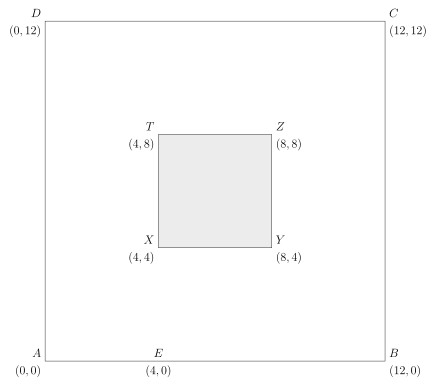
- as small as possible,
- as large as possible.
Solution:
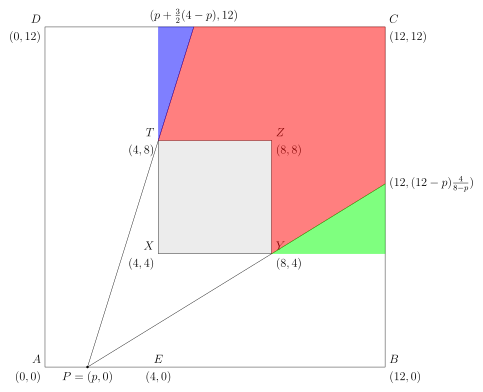
- Since the area not visible is increasing as \(p\) increases, we would like \(p\) to be as large as possible, ie \(p = 4\).
- Similarly, he can see the most when \(p =0\)
1991 Paper 2 Q1
Let \(\mathrm{h}(x)=ax^{2}+bx+c,\) where \(a,b\) and \(c\) are constants, and \(a\neq0\). Give a condition which \(a,b\) and \(c\) must satisfy in order that \(\mathrm{h}(x)\) can be written in the form \[ a(x+k)^{2},\tag{*} \] where \(k\) is a constant. If \(\mathrm{f}(x)=3x^{2}+4x\) and \(\mathrm{g}(x)=x^{2}-2\), find the two constant values of \(\lambda\) such that \(\mathrm{f}(x)+\lambda\mathrm{g}(x)\) can be written in the form \((*)\). Hence, or otherwise, find constants \(A,B,C,D,m\) and \(n\) such that \begin{alignat*}{1} \mathrm{f}(x) & =A(x+m)^{2}+B(x+n)^{2}\\ \mathrm{g}(x) & =C(x+m)^{2}+D(x+n)^{2}. \end{alignat*} If \(\mathrm{f}(x)=3x^{2}+4x\) and \(\mathrm{g}(x)=x^{2}+\alpha\) and it is given by that there is only one value of \(\lambda\) for which \(\mathrm{f}(x)+\lambda\mathrm{g}(x)\) can be written in the form \((*)\), find \(\alpha\).
Solution: For \(h(x)\) to be written in this form \(b^2=4ac\). Suppose \(f(x) = 3x^2+4x\), \(g(x) = x^2-2\). then, \begin{align*} && f(x) + \lambda g(x) &= (3+\lambda)x^2+4x - 2 \lambda \\ \Rightarrow && 0 &= 16 + 8(3+\lambda) \lambda \\ \Rightarrow && 0 &= 2+ 3 \lambda + \lambda^2 \\ &&&= (\lambda +1)(\lambda + 2) \\ \Rightarrow && \lambda &= -1 , -2 \\ \end{align*} \begin{align*} && f(x) - g(x) &= 2(x+1)^2 \\ && f(x) -2g(x) &= (x+2)^2 \\ \Rightarrow && g(x) &= 2(x+1)^2 - (x+2)^2 \\ && f(x) &= 4(x+1)^2 - (x+2)^2 \end{align*} Suppose \(f(x) = 3x^2+4x, g(x) = x^2 + \alpha\), then \begin{align*} && f(x) + \lambda g(x) &= (3+\lambda)x^2+4x+\lambda \alpha \\ \Rightarrow && 0 &= 16 -2\lambda \alpha(\lambda + 3) \\ && 0 &= \alpha \lambda^2 +3\lambda-8 \\ \Rightarrow && 0 &= 9 +32 \alpha \\ \Rightarrow && \alpha &= -\frac{9}{32} \end{align*}
1991 Paper 2 Q11
The Ruritanian army is supplied with shells which may explode at any time in flight but not before the shell reaches its maximum height. The effect of the explosion on any observer depends only on the distance between the exploding shell and the observer (and decreases with distance). Ruritanian guns fire the shells with fixed muzzle speed, and it is the policy of the gunners to fire the shell at an angle of elevation which minimises the possible damages to themselves (assuming the ground is level) - i.e. they aim so that the point on the descending trajectory that is nearest to them is as far away as possible. With that intention, they choose the angle of elevation that minimises the damage to themselves if the shell explodes at its maximum height. What angle do they choose? Does the shell then get any nearer to the gunners during its descent?
1988 Paper 1 Q7
The function \(\mathrm{f}\) is defined by \[ \mathrm{f}(x)=ax^{2}+bx+c. \] Show that \[ \mathrm{f}'(x)=\mathrm{f}(1)\left(x+\tfrac{1}{2}\right)+\mathrm{f}(-1)\left(x-\tfrac{1}{2}\right)-2\mathrm{f}(0)x. \] If \(a,b\) and \(c\) are real and such that \(\left|\mathrm{f}(x)\right|\leqslant1\) for \(\left|x\right|\leqslant1\), show that \(\left|\mathrm{f}'(x)\right|\leqslant4\) for \(\left|x\right|\leqslant1\). Find particular values of \(a,b\) and \(c\) such that, for the corresponding function \(\mathrm{f}\) of the above form \(\left|\mathrm{f}(x)\right|\leqslant1\) for all \(x\) with \(\left|x\right|\leqslant1\) and \(\mathrm{f}'(x)=4\) for some \(x\) satisfying \(\left|x\right|\leqslant1\).
Solution: Let \(f(x) = ax^2 + bx + c\) then \begin{align*} f'(x) &= 2ax + b \\ f(0) &= c \\ f(1) &= a+b+c \\ f(-1) &= a-b+c \\ f(1)+f(-1) &= 2(a+c) \\ f(1)-f(-1) &= 2b \\ f'(x) &= x(f(1)+f(-1)) + \frac12 (f(1) - f(-1)) - 2f(0)x \end{align*} as required. Since \(f'(x)\) is a straight line, the maximum value is either at \(1, -1\) or it's constant and either end suffices. \begin{align*} |f'(1)| & \leq |f(1)|\frac{3}{2} + |f(-1)| \frac12 + 2 |f(0)| \\ &\leq \frac{3}{2} + \frac12 + 2 \\ &= 4 \\ \\ |f'(-1)| & \leq |f(1)|\frac{1}{2} + |f(-1)| \frac32 + 2 |f(0)| \\ &\leq \frac{3}{2} + \frac12 + 2 \\ &= 4 \\ \end{align*} Therefore \(|f'(x)| \leq 4\). Suppose \(|f'(x)| = 4\) for some value in \(x \in [-1,1]\), then it must be either \(-1\) or \(1\). If \(f'(1) = 4\) then \(f(1) = 1, f(-1) = 1, f(0) = -1\) so \(f(x) = 1+ k(x^2-1) \Rightarrow f(x) = 1+2(x^2-1) = 2x^2 -1\). If \(f'(-1) = 4\) then \(f(1) = -1, f(-1) = -1, f(0) = 1 \Rightarrow f(x) = -2x^2 + 1\)
1988 Paper 2 Q3
The quadratic equation \(x^{2}+bx+c=0\), where \(b\) and \(c\) are real, has the properly that if \(k\) is a (possibly complex) root, then \(k^{-1}\) is a root. Determine carefully the restriction that this property places on \(b\) and \(c\). If, in addition to this property, the equation has the further property that if \(k\) is a root, then \(1-k\) is a root, find \(b\) and \(c\). Show that \[ x^{3}-\tfrac{3}{2}x^{2}-\tfrac{3}{2}x+1=0 \] is the only cubic equation of the form \(x^{3}+px^{2}+qx+r=0\), where \(p,q\) and \(r\) are real, which has both the above properties.
Solution: Suppose \(k\) is a root of our quadratic. There are two possibilities, if \(k^{-1} = k\) then we must have \(k^2 = 1\) so either \(\pm 1\) is a root or we must have \((x-k)(x-k^{-1}) = x^2+bx+c\). In the first case we can have: \begin{align*} x^2+bx +c = (x-1)^2 &\Rightarrow b = -2, c = 1 \\ x^2+bx +c = (x+1)^2 &\Rightarrow b = 2, c = 1 \\ x^2+bx +c = (x-1)(x+1) &\Rightarrow b = 0, c = 1 \\ \end{align*} In the other cases, \(c = 1\) and \(b = k^{-1}+k\). Therefore we must have \(c = 1\) and \(b\) can take any values. The statement "if \(k\) is a root then \(1-k\) is a root" implies these two roots are different, so we must have \(1-k = k^{-1} \Rightarrow k-k^2 = 1 \Rightarrow k^2-k+1 = 0\) so \(b = -1, c = 1\). Suppose \(x^3+px^2+qx+r = 0\) has the first property, then for any root \(k\) we must have: \(k^3 + pk^2 + qk + r = 0\) and \(1 + pk^{-1} + qk^{-2} + rk^{-3} = 0\) therefore \(x^3+px^2+qx+r\) and \(rx^3+qx^2+px+1 = 0\) must have identical roots (since \(x = \pm\) either wont work here since they imply having the roots \(1, 0\) or \(-1, 2, \frac12\) which is exactly our equation. Therefore \(r = 1, p = q\). Suppose \(x^3 + px^2 + px+1 = 0\) has the property that if \(k\) is a root \(1-k\) is a root, therefore: \begin{align*} 0 &= (1-k)^3+p(1-k)^2 + p(1-k) + 1 \\ &= 1 -3k+3k^2-k^3+p-2kp+pk^2+p-pk+1 \\ &= -k^3+(3+p)k^2+(-3-3p)k+(2+2p) \end{align*} Since these roots must be the same as the original roots, we must have \(3+p = -p, -3-3p = -p, 2+2p = -1 \Rightarrow p = -\frac32\)