Problems
Filters
52 problems found
2004 Paper 3 Q1
Show that \[ \int_0^a \frac{\sinh x}{2\cosh^2 x -1} \, \mathrm{d} x = \frac{1}{2 \sqrt{2}} \ln \l \frac{\sqrt{2}\cosh a -1}{\sqrt{2}\cosh a +1}\r + \frac{1}{2 \sqrt{2}} \ln \l \frac{\sqrt{2}+1}{\sqrt{2}-1}\r \] and find \[ \int_0^a \frac{\cosh x}{1+2\sinh^2 x} \, \mathrm{d} x \, . \] Hence show that \[ \int_0^\infty \frac{\cosh x - \sinh x}{1+2\sinh^2 x} \, \mathrm{d} x = \frac{\pi}{2\sqrt{2}} - \frac{1}{2 \sqrt{2}} \ln \l \frac{\sqrt{2}+1}{\sqrt{2}-1}\r \, . \] By substituting \(u = \e^x\) in this result, or otherwise, find \[ \int_1^\infty \frac{1}{1+u^4} \, \mathrm{d} u \, . \]
2003 Paper 1 Q6
Evaluate the following integrals, in the different cases that arise according to the value of the positive constant \(a\,\):
- \[ \displaystyle \int_0^1 \frac 1 {x^2 + (a+2)x +2a} \; \d x \]
- \[\displaystyle \int _{1}^2\frac 1 {u^2 +au +a-1} \; \d u\]
Solution:
- \(\,\) \begin{align*} && I &= \int_0^1 \frac 1 {x^2 + (a+2)x +2a} \; \d x \\ &&&= \int_0^1 \frac{1}{(x+a)(x+2)} \d x\\ \end{align*} Case 1: \(a = 2\) \begin{align*} && I &= \int_0^1 \frac{1}{(x+2)^2} \d x \\ &&&= \left [ -(x+2)^{-1}\right]_0^1 = \frac12 - \frac13 = \frac16 \end{align*} Case 2: \(a \neq 2, a \not \in [0,1]\) \begin{align*} && I &=\frac{1}{a-2} \int_0^1 \left ( \frac{1}{x+2} - \frac{1}{x+a} \right) \d x \\ &&&= \frac{1}{a-2} \left [ \ln |x+2| - \ln |x + a|\right]_0^1 \\ &&&= \frac{1}{a-2} \left ( \ln \frac{3}{|1+a|} - \ln \frac{2}{|a|} \right) \\ &&&= \frac{1}{a-2} \ln \frac{3|a|}{2|a+1|} \end{align*} Case 3: \(a \in [0, 1]\), \(I\) does not converge
- \(\,\) \begin{align*} && J &= \int _{1}^2\frac 1 {u^2 +au +a-1} \; \d u \\ &&&= \int_1^2 \frac{1}{(u+a-1)(u+1)} \d u \\ x = u-1:&&&= \int_0^1 \frac{1}{(x+a)(x+2)} \d x \end{align*} So it's the same as the previous integral
2003 Paper 1 Q8
A liquid of fixed volume \(V\) is made up of two chemicals \(A\) and \(B\,\). A reaction takes place in which \(A\) converts to \(B\,\). The volume of \(A\) at time \(t\) is \(xV\) and the volume of \(B\) at time \(t\) is \(yV\) where \(x\) and \(y\) depend on \(t\) and \(x+y=1\,\). The rate at which \(A\) converts into \(B\) is given by \(kVxy\,\), where \(k\) is a positive constant. Show that if both \(x\) and \(y\) are strictly positive at the start, then at time \(t\) \[ y= \frac {D\e^{kt}}{1+D \e^{kt}} \;, \] where \(D\) is a constant. Does \(A\) ever completely convert to \(B\,\)? Justify your answer.
Solution: We have \(\dot{A} = -kVxy\) or \(\dot{x}V = -kVxy\), ie \(\dot{x} = -kxy\) and similarly \(\dot{y} = kxy = k(1-y)y\). \begin{align*} && \frac{\d y}{\d t} &= ky(1-y) \\ \Rightarrow && \int k \d t &= \int \frac{1}{y(1-y)} \d y \\ \Rightarrow && kt &= \int \left ( \frac{1}{y} + \frac{1}{1-y} \right) \d y \\ &&&= \ln y - \ln (1-y) + C\\ \Rightarrow && kt &= \ln \frac{y}{D(1-y)} \\ \Rightarrow && De^{kt} &= \frac{y}{1-y} \\ \Rightarrow && y(1+De^{kt}) &= De^{kt} \\ \Rightarrow && y &= \frac{De^{kt}}{1+De^{kt}} \end{align*} As \(t \to \infty\) \(y \to \frac{D}{D} = 1\) so depending on how fine grained we want to go we might say that 'yes it completely converts' when there is an immeasurably small amount of \(A\) left, or we might say it doesn't since it only tends to \(1\) and never actually reaches it.
2003 Paper 2 Q8
It is given that \(y\) satisfies $$ {{\d y} \over { \d t}} + k\left({{t^2-3t+2} \over {t+1}}\right)y = 0\;, $$ where \(k\) is a constant, and \(y=A \) when \(t=0\,\), where \(A\) is a positive constant. Find \(y\) in terms of \(t\,\), \(k\) and \(A\,\). Show that \(y\) has two stationary values whose ratio is \((3/2)^{6k}\e^{-5{k}/2}.\) Describe the behaviour of \(y\) as \(t \to +\infty\) for the case where \(k> 0\) and for the case where \(k<0\,.\) In separate diagrams, sketch the graph of \(y\) for \(t>0\) for each of these cases.
Solution: \begin{align*} && \frac{\d y}{\d t} &= - k \left (\frac{t^2-3t+2}{t+1} \right) y \\ \Rightarrow && \int \frac1y \d y &= -k\int \left (t-4 + \frac{6}{t+1}\right) \d t \\ \Rightarrow && \ln y &= -k \left ( \frac12 t^2 -4t + 6\ln (t+1) \right) + C \\ (t,y) = (0,A): && \ln A &=C \\ \Rightarrow && \ln y &= -k \left ( \frac12 t^2 -4t + 6\ln (t+1) \right) + \ln A \\ && \ln \left ( \frac{y}{A}(t+1)^{6k} \right) &= -k \l \frac12 t^2 - 4t \r \\ \Rightarrow && y &= A\frac{\exp \l -k(\frac12 t^2-4t)\r}{(t+1)^{6k}} \end{align*} \(y\) wil have stationary values when \(\frac{\d y}{\d t} = 0\), ie \begin{align*} k \left (\frac{t^2-3t+2}{t+1} \right) y &= 0 \\ k \left ( \frac{(t-2)(t-1)}{t+1} \right) y &= 0 \end{align*} ie when \(y = 0, t = 1, t =2\). Clearly \(y = 0\) is not a solution, so \(y\) has the values: \begin{align*} t = 1: && y &= A\frac{\exp \l -k(\frac12 -4)\r}{(2)^{6k}} \\ &&&= A \frac{e^{7/2 k}}{2^{6k}} \\ t = 2: && y &= A\frac{\exp \l -k(2 -8)\r}{(3)^{6k}} \\ &&&= A \frac{e^{6 k}}{3^{6k}} \\ \text{ratio}: && \frac{e^{7/2k}}{2^{6k}} \cdot \frac{3^{6k}}{e^{6k}} &= (3/2)^{6k} e^{-5k/2} \end{align*} If \(k > 0\) as \(t \to \infty\) \(y \to 0\) since the \(e^{-kt^2/2}\) term dominates everything. If \(k < 0\) as \(t \to \infty\) \(y \to \infty\) as since the \(e^{-kt^2}\) term also dominates but now it growing to infinity faster than everything else.

2002 Paper 1 Q7
Let \[ I= \int_0^a \frac {\cos x}{\sin x + \cos x} \; \d x \, \quad \mbox{ and } \quad J= \int_0^a \frac {\sin x}{\sin x + \cos x} \; \d x \;, \] where \(0\le a < \frac{3}{4}\pi\,\). By considering \(I+J\) and \(I-J\), show that $ 2I= a + \ln (\sin a +\cos a)\;. $ Find also:
- \(\displaystyle \int_0^{\frac{1}{2}\pi} \frac {\cos x}{p\sin x + q\cos x} \; \d x \,\), where \(p\) and \(q\) are positive numbers; %
- [(ii)] %\(\displaystyle \int_0^{\frac{1}{2}\pi/2} \frac {\cos x}{\sin (x+k)} \; \d x \,\), where \(0 < k < \pi/2\,\);
- \(\displaystyle \int_0^{\frac{1}{2}\pi} \frac {\cos x+4}{3\sin x + 4\cos x+ 25} \; \d x \,\).
Solution: \begin{align*} && I + J &= \int_0^a \frac{\sin x + \cos x}{\sin x + \cos x } \d x = a \\ && I - J &= \int_0^a \frac{\cos x - \sin x}{\sin x + \cos x} \d x \\ &&&= \left [\ln ( \sin x + \cos x) \right]_0^a = \ln (\sin a + \cos a) - \ln 1 = \ln(\sin a + \cos a) \\ \\ \Rightarrow && 2I &= a + \ln(\sin a + \cos a) \end{align*}
- Let \(\displaystyle I = \int_0^{\frac12 \pi} \frac{\cos x}{p \sin x + q \cos x} \d x, J = \int_0^{\frac12 \pi} \frac{\sin x}{p \sin x + q \cos x} \d x\) so \begin{align*} && qI + pJ &= \frac{\pi}{2} \\ && pI - qJ &= \int_0^{\frac12 \pi} \frac{p \cos x - q \sin x}{p \sin x + q \cos x } \d x \\ &&&= \left [\ln (p \sin x + q \cos x) \right]_0^{\pi/2} \\ &&&= \ln(p) - \ln(q) = \ln \frac{p}{q} \end{align*}
- \(\,\) \begin{align*} && \int_0^{\frac{\pi}{2}} \frac{\cos x}{\sin(x + k)} \d x &= \int_0^{\frac{\pi}{2}} \frac{\cos x}{\sin(x) \cos(k) + \cos(x) \sin (k)} \d x \\ &&&= \ln \tan k \end{align*}
- Let \(\displaystyle I = \int_0^{\pi/2} \frac{\cos x + 4}{3 \sin x + 4 \cos x + 25} \d x, J = \int_0^{\pi/2} \frac{\sin x + 3}{3 \sin x + 4 \cos x + 25} \d x\), so \begin{align*} && 4I + 3J &= \int_0^{\pi/2} \frac{3 \sin x + 4 \cos x + 25}{3 \sin x + 4 \cos x + 25} \d x \\ &&&= \frac{\pi}{2} \\ && 3I - 4J &= \int_0^{\pi/2} \frac{3\cos x - 4 \sin x}{3 \sin x + 4 \cos x + 25} \d x \\ &&&= \left [\ln(3 \sin x + 4 \cos x + 25) \right]_0^{\pi/2} \\ &&&= \ln (28) - \ln (29) = \ln \frac{28}{29} \\ \Rightarrow && 25I &= 2\pi + 3 \ln \frac{28}{29} \\ \Rightarrow && I &= \frac{2}{25} \pi + \frac{3}{25} \ln \frac{28}{29} \end{align*}
2001 Paper 2 Q6
Show that \[ \int_0^1 \frac{x^4}{1+x^2} \, \d x = \frac \pi {4} - \frac 23 \;. \] Determine the values of
- \(\displaystyle \int_0^1 x^3 \; \tan ^{-1} \left(\frac {1-x} {1+x} \right) \,\d x \)
- \(\displaystyle \int_0^1 \frac {(1-y)^3} {(1+y)^5} \; {{\tan}^{-1} y}\, \d y\)
Solution: \begin{align*} && \int_0^1 \frac{x^4}{1+x^2} \d x &= \int_0^1 \frac{(x^2-1)(1+x^2)+1}{x^2+1} \d x\\ &&&= \int_0^1 \frac{1}{1+x^2} \d x -\int_0^1 (1-x^2) \d x \\ &&&= \left [\tan^{-1}x \right]_0^1 - \left [x - \tfrac13x^3 \right]_0^1 \\ &&&= \frac{\pi}{4} - \frac23 \end{align*}
- \(\,\) \begin{align*} && I &= \int_0^1 x^3 \; \tan ^{-1} \left(\frac {1-x} {1+x} \right) \,\d x \\ &&&= \left [ \frac{x^4}{4}\tan ^{-1} \left(\frac {1-x} {1+x} \right) \right]_0^1 -\int_0^1 \frac{x^4}{4} \frac{1}{1 +\left(\frac {1-x} {1+x} \right) ^2 } \cdot \frac{-2}{(1+x)^2} \d x \\ &&&= \frac{1}{2} \int_0^1 \frac{x^4}{(1+x)^2+(1-x)^2} \d x \\ &&&= \frac{1}{4} \int_0^1 \frac{x^4}{1+x^2} \d x \\ &&&= \frac{\pi}{16} - \frac{1}{6} \end{align*}
- \(\,\) \begin{align*} && J &= \int_0^1 \frac {(1-y)^3} {(1+y)^5} \; {{\tan}^{-1} y}\, \d y \\ &&&= \left [ \frac {(y(1+y^2)} {(1+y)^4} \tan^{-1}y \right]_0^1 - \int_0^1 \frac {(y(1+y^2)} {(1+y)^4} \frac{1}{1+y^2} \d y \\ &&&= \frac{\pi}{32} - \int_0^1 \frac{y}{(1+y)^4} \d y \\ &&&= \frac{\pi}{32} - \left[ - \frac{3y+1}{6(1+y)^3} \right]_0^1 \\ &&&= \frac{\pi}{32} +\frac{4}{6 \cdot 8} - \frac{1}{6} \\ &&&= \frac{\pi}{32} - \frac{1}{12} \end{align*}
2000 Paper 1 Q4
- Show that, for \(0\le x\le 1\), the largest value of \(\displaystyle \frac{x^6}{(x^2+1)^4}\) is \(\frac1{16}\).
- Find constants \(A\), \(B\), \(C\) and \(D\) such that, for all \(x\), \[ \frac{1}{(x^2+1)^4}= \frac{\d \ }{\d x} \left( \frac{Ax^5+Bx^3+Cx}{(x^2+1)^3}\right) +\frac{Dx^6}{(x^2+1)^4}. \]
- Hence, or otherwise, prove that \[ \frac{11}{24} \le \int_{0}^{1}\frac{1}{(x^{2}+1)^{4}}\, \d x \le \frac{11}{24} + \frac 1{16} \; . \]
Solution:
- \(x^2 + 1 \geq 2x \Rightarrow \frac{1}{x^2+1} \leq \frac1{2x} \Rightarrow \frac{x^6}{(x^2+1)^4}\leq \frac{x^6}{16x^2} = \frac1{16}x^2 \leq \frac1{16}\) with equality when \(x = 1\)
- \(\,\) \begin{align*} && RHS &= \frac{\d \ }{\d x} \left( \frac{Ax^5+Bx^3+Cx}{(x^2+1)^3}\right) +\frac{Dx^6}{(x^2+1)^4} \\ &&&= \frac{(5Ax^4+3Bx^2+C)(x^2+1)^3-6x(x^2+1)^2(Ax^5+Bx^3+Cx)}{(x^2+1)^6}+\frac{Dx^6}{(x^2+1)^4} \\ &&&= \frac{(5Ax^4+3Bx^2+C)(x^2+1)-6x(Ax^5+Bx^3+Cx)+Dx^6}{(x^2+1)^4} \\ &&&= \frac{(D-A) x^6 + (5A-3B) x^4 + (3B-5C)x^2 + C}{(x^2+1)^4} \\ \Rightarrow && C &= 1 \\ && 3B &= 5 \quad\quad\quad\Rightarrow B = \frac53 \\ && 5A &= 3B = 5\Rightarrow A = 1 \\ && D &= A \quad\quad \Rightarrow D = 1 \end{align*}
- So \begin{align*} && I &= \int_{0}^{1}\frac{1}{(x^{2}+1)^{4}}\, \d x \\ &&&= \int_{0}^{1}\frac{\d \ }{\d x} \left( \frac{Ax^5+Bx^3+Cx}{(x^2+1)^3}\right) +\frac{Dx^6}{(x^2+1)^4} \, \d x \\ &&&= \left [ \frac{Ax^5+Bx^3+Cx}{(x^2+1)^3} \right]_0^1 + \int_{0}^{1}\frac{Dx^6}{(x^2+1)^4} \, \d x \\ &&& \leq \frac{A+B+C}{8} + \frac1{16} \\ &&&= \frac{2+\frac53}{8} + \frac1{16} = \frac{11}{24} + \frac{1}{16} \\ && I &\geq \left [ \frac{Ax^5+Bx^3+Cx}{(x^2+1)^3} \right]_0^1 = \frac{11}{24} \end{align*}
2000 Paper 2 Q9
In an aerobatics display, Jane and Karen jump from a great height and go through a period of free fall before opening their parachutes. While in free fall at speed \(v\), Jane experiences air resistance \(kv\) per unit mass but Karen, who spread-eagles, experiences air resistance \mbox{\(kv + (2k^2/g)v^2\)} per unit mass. Show that Jane's speed can never reach \(g/k\). Obtain the corresponding result for Karen. Jane opens her parachute when her speed is \(g/(3{k})\). Show that she has then been in free fall for time \(k^{-1}\ln (3/2)\). Karen also opens her parachute when her speed is \(g/(3{k})\). Find the time she has then been in free fall.
Solution: Looking at the forces on Jane, \(kv < g \Rightarrow v < \frac{g}{k}\). For Karen we have \begin{align*} kv + (2k^2/g)v^2 &< g\\ -g^2 + gkv + (2k^2)v^2 &< 0 \\ (2kv-g)(kv+g) &< 0\\ \Rightarrow v &< \frac{g}{2k} \end{align*} \begin{align*} && \dot{v} &= g - kv \\ \Rightarrow && \frac{\dot{v}}{g - kv} &= 1 \\ \Rightarrow && T &= \int_0^{g/(3k)} \frac{1}{g - kv} dv \\ && &= \int_0^{g/(3k)} \frac{1}{g - kv} dv\\ && &= \int_0^{g/(3k)} \frac{1}{g - kv} dv \\ && &= \left [-\frac{1}{k} \ln \l g - kv \r \right ]_0^{g/(3k)} \\ && &= \frac{1}{k} \ln \l g \r - \frac{1}{k} \ln \l \frac{2}{3}g \r\\ &&&= \frac{1}{k} \ln \l \frac{3}{2} \r \end{align*} \begin{align*} && \dot{v} &= g - kv - (2k^2/g)v^2 \\ \Rightarrow && \frac{\dot{v}}{g - kv - (2k^2/g)v^2} &= 1 \\ \Rightarrow && T &= \int_0^{g/(3k)} \frac{1}{g - kv - (2k^2/g)v^2} dv \\ && &= \int_0^{g/(3k)} \frac{g}{(g-2kv)(kv+g)} dv\\ && &= \int_0^{g/(3k)} \l \frac{2}{3(g-2kv)} + \frac{1}{3(kv+g)} \r dv\\ && &= \left [ \l -\frac{1}{3k} \ln (g-2kv) + \frac{1}{3k}\ln(kv+g) \r \right ]_0^{g/(3k)} \\ && &= \left [ \l -\frac{1}{3k}\ln \l \frac{g}{3} \r + \frac{1}{3k}\ln \l \frac{4g}{3} \r \r \right ] - \left [- \frac1{3k} \ln(g) + \frac{1}{3k} \ln (g) \right ] \\ && &= \frac{1}{3k} \ln \l 4 \r \end{align*} NB: \(\sqrt[3]{4} \approx 1.58 > \frac{3}{2}\) so Karen has been in free-fall for longer, but not \emph{much} longer than Jane.
1998 Paper 2 Q3
Show that the sum \(S_N\) of the first \(N\) terms of the series $$\frac{1}{1\cdot2\cdot3}+\frac{3}{\cdot3\cdot4}+\frac{5}{3\cdot4\cdot5}+\cdots +\frac{2n-1}{n(n+1)(n+2)}+\cdots$$ is $${1\over2}\left({3\over2}+{1\over N+1}-{5\over N+2}\right).$$ What is the limit of \(S_N\) as \(N\to\infty\)? The numbers \(a_n\) are such that $$\frac{a_n}{a_{n-1}}=\frac{(n-1)(2n-1)}{(n+2)(2n-3)}.$$ Find an expression for \(a_n/a_1\) and hence, or otherwise, evaluate \(\sum\limits_{n=1}^\infty a_n\) when \(\displaystyle a_1=\frac{2}{9}\;\).
Solution: First notice by partial fractions: \begin{align*} \frac{2n-1}{n(n+1)(n+2)} &= \frac{-1/2}{n} + \frac{3}{n+1} + \frac{-5/2}{n+2} \\ &= \frac{-1}{2n} + \frac{3}{n+1} - \frac{5}{2(n+2)} \end{align*} And therefore: \begin{align*} \sum_{n = 1}^N \frac{2n-1}{n(n+1)(n+2)} &= -\frac12 \sum_{n=1}^N \frac1n +3\sum_{n=1}^N \frac1{n+1} -\frac52 \sum_{n=1}^N \frac1{n+2} \\ &= -\frac12-\frac14 + \frac{3}{2}+ \sum_{n=3}^N (3-\frac12 -\frac52)\frac1n + \frac{3}{N+1} - \frac{5}{2(N+1)} - \frac{5}{2(N+2)} \\ &= \frac12 \l \frac32+\frac1{N+1}-\frac{5}{N+2} \r \end{align*} As \(N \to \infty, S_N \to \frac{3}{4}\). \begin{align*} && \frac{a_n}{a_{n-1}}&=\frac{(n-1)(2n-1)}{(n+2)(2n-3)} \\ \Rightarrow && \frac{a_n}{a_1} &= \frac{a_n}{a_{n-1}} \cdot \frac{a_{n-1}}{a_{n-2}} \cdots \frac{a_2}{a_1} \\ &&&= \frac{(n-1)(2n-1)}{(n+2)(2n-3)} \cdot \frac{(n-2)(2n-3)}{(n+1)(2n-5)} \cdots \frac{(1)(3)}{(4)(1)} \\ &&&= \frac{(2n-1)3\cdot 2\cdot 1}{(n+2)(n+1)n} \\ &&& = \frac{6(2n-1)}{n(n+1)(n+2)} \end{align*} Therefore \(a_n = \frac{4}{3} \frac{2n-1}{n(n+1)(n+2)}\) and so our sequence is \(\frac43\) the earlier sum, ie \(1\)
1997 Paper 2 Q3
Find constants \(a,\,b,\,c\) and \(d\) such that $$\frac{ax+b}{ x^2+2x+2}+\frac{cx+d}{ x^2-2x+2}= \frac{1}{ x^4+4}.$$ Show that $$\int_0^1\frac {\d x}{ x^4+4}\;= \frac{1}{16} \ln 5 +\frac{1}{8} \tan^{-1}2 .$$
Solution: First notice that \((x^2+2+2x)(x^2+2-2x) = (x^2+2)^2-4x^2 = x^2+4\) and so \begin{align*} && \frac{1}{x^4+4} &= \frac{ax+b}{ x^2+2x+2}+\frac{cx+d}{ x^2-2x+2} \\ \Rightarrow && 1 &= (ax+b)(x^2-2x+2) + (cx+d)(x^2+2x+2) \\ &&&= (a+c)x^3+(b-2a+d+2c)x^2+(2a-2b+2c+2d)x+2b+2d \\ \Rightarrow && 0 &= a+c \\ && 2a &= b+d+2c \\ && b &= a+c+d \\ && \frac12 &= b+d \\ \Rightarrow && c &= -a \\ && 2a &= \frac12+2(-a) \\ \Rightarrow && a &= \frac18, c = -\frac18 \\ && b &= d \\ \Rightarrow && b &= \frac14, d = \frac14 \end{align*} Therefore \begin{align*} \int_0^1\frac {\d x}{ x^4+4} &= \int_0^1 \frac18\left ( \frac{x+2}{x^2+2x+2} -\frac{x-2}{x^2-2x+2}\right) \d x \\ &= \frac1{16}\int_0^1 \left ( \frac{2x+2+2}{x^2+2x+2} -\frac{2x-2-2}{x^2-2x+2}\right) \d x \\ &= \frac1{16} \left [ \ln(x^2+2x+2) -\ln(x^2-2x+2)\right]_0^1 + \frac1{16} \int_0^1 \left ( \frac{2}{(x+1)^2+1} + \frac{2}{(x-1)^2+1} \right) \d x \\ &= \frac1{16} \left (\ln 5 - \ln 1 -(\ln 2-\ln 2) \right) + \frac18 \left [ \tan^{-1} (x+1)+\tan^{-1}(x-1) \right]_0^1 \\ &= \frac1{16} \ln 5 + \frac18 \left (\tan^{-1} 2+\tan^{-1} 0 - \tan^{-1}1-\tan^{-1} (-1) \right) \\ &= \frac1{16} \ln 5+ \frac18 \tan^{-1} 2 \end{align*}
1996 Paper 1 Q4
Show that \[ \int_{0}^{1}\frac{1}{x^{2}+2ax+1}\,\mathrm{d}x=\begin{cases} \dfrac{1}{\sqrt{1-a^{2}}}\tan^{-1}\sqrt{\dfrac{1-a}{1+a}} & \text{ if }\left|a\right|<1,\\ \dfrac{1}{2\sqrt{a^{2}-1}}\ln |a+\sqrt{a^{2}-1}| & \text{ if }\left|a\right|>1. \end{cases} \]
Solution: First suppose \(|a| < 1\), then \begin{align*} && I &= \int_0^1 \frac{1}{x^2+2ax+1} \d x \\ &&&= \int_0^1 \frac{1}{(x+a)^2 +1-a^2} \d x \\ &&&= \int_0^1 \frac{1}{(x+a)^2 +(\sqrt{1-a^2})^2} \d x \tag{\(1-a^2 > 0\)}\\ &&&= \left [\frac{1}{\sqrt{1-a^2}} \tan^{-1} \frac{x+a}{\sqrt{1-a^2}} \right]_0^1 \\ &&&= \frac{1}{\sqrt{1-a^2}} \left ( \tan^{-1} \frac{a+1}{\sqrt{1-a^2}} - \tan^{-1} \frac{a}{\sqrt{1-a^2}} \right) \\ &&&= \frac{1}{\sqrt{1-a^2}} \tan^{-1} \left ( \frac{\frac{a+1}{\sqrt{1-a^2}}-\frac{a}{\sqrt{1-a^2}}}{1+\frac{(a+1)a}{1-a^2}} \right) \\ &&&= \frac{1}{\sqrt{1-a^2}} \tan^{-1} \left ( \frac{\frac{1}{\sqrt{1-a^2}}}{\frac{1+a}{1-a^2}} \right) \\ &&&= \frac{1}{\sqrt{1-a^2}} \tan^{-1} \left ( \frac{1-a}{\sqrt{1-a^2}}\right) \\ &&&= \frac{1}{\sqrt{1-a^2}} \tan^{-1} \sqrt { \frac{1-a}{1+a}} \\ \end{align*} Second, suppose \(|a| > 1\), then \begin{align*} && I &= \int_0^1 \frac{1}{x^2+2ax+1} \d x \\ &&&= \int_0^1 \frac{1}{(x+a)^2-(a^2-1)} \d x \\ &&&= \int_0^1 \frac{1}{(x+a-\sqrt{a^2-1})(x+a+\sqrt{a^2-1})} \d x \tag{\(a^2-1 > 0\)} \\ &&&= \frac{1}{2\sqrt{a^2-1}}\int_0^1 \left ( \frac{1}{x+a-\sqrt{a^2-1}} - \frac{1}{x+a+\sqrt{a^2-1}} \right) \d x \\ &&&= \frac{1}{2\sqrt{a^2-1}} \left [ \ln |x+a-\sqrt{a^2-1}|- \ln |x+a+\sqrt{a^2-1}| \right]_0^1 \\ &&&= \frac{1}{2\sqrt{a^2-1}} \left ( \ln |1+a-\sqrt{a^2-1}| - \ln|1+a+\sqrt{a^2-1}| - \ln|a-\sqrt{a^2-1}| +\ln|a + \sqrt{a^2-1}| \right) \\ &&&= \frac{1}{2\sqrt{a^2-1}} \ln | \frac{(1+a-\sqrt{a^2-1})(a+\sqrt{a^2-1})}{(1+a+\sqrt{a^2-1})(a-\sqrt{a^2-1})}|\\ &&&= \frac{1}{2\sqrt{a^2-1}} \ln |\frac{a+a^2-(a^2-1) +\sqrt{a^2-1}}{1+a-\sqrt{a^2-1}}| \\ &&&= \frac{1}{2\sqrt{a^2-1}} \ln |\frac{(1+a +\sqrt{a^2-1})^2}{(1+a)^2-(a^2-1)}| \\ &&&= \frac{1}{2\sqrt{a^2-1}} \ln |\frac{1+2a+a^2+a^2-1+2(1+a)\sqrt{a^2-1}}{2+2a}| \\ &&&= \frac{1}{2\sqrt{a^2-1}} \ln |a+\sqrt{a^2-1}| \\ \end{align*}
1995 Paper 2 Q8
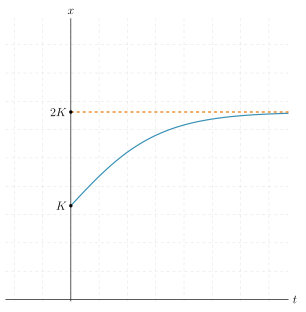
If there are \(x\) micrograms of bacteria in a nutrient medium, the population of bacteria will grow at the rate \((2K-x)x\) micrograms per hour. Show that, if \(x=K\) when \(t=0\), the population at time \(t\) is given by \[ x(t)=K+K\frac{1-\mathrm{e}^{-2Kt}}{1+\mathrm{e}^{-2Kt}}. \] Sketch, for \(t\geqslant0\), the graph of \(x\) against \(t\). What happens to \(x(t)\) as \(t\rightarrow\infty\)? Now suppose that the situation is as described in the first paragraph, except that we remove the bacteria from the nutrient medium at a rate \(L\) micrograms per hour where \(K^{2}>L\). We set \(\alpha=\sqrt{K^{2}-L}.\) Write down the new differential equation for \(x\). By considering a new variable \(y=x-K+\alpha,\) or otherwise, show that, if \(x(0)=K\) then \(x(t)\rightarrow K+\alpha\) as \(t\rightarrow\infty\).
Solution: \begin{align*} && \dot{x} &= (2K-x)x \\ \Rightarrow && \int \d t &= \int \frac{1}{(2K-x)x} \d x \\ &&&= \int \frac1{2K}\left ( \frac{1}{2K-x} + \frac{1}{x} \right) \d x \\ &&&= \frac{1}{2K} \left (\ln x - \ln (2K-x) \right) \\ \Rightarrow && 2Kt+C &= \ln \frac{x}{2K-x} \\ t = 0, x = K: && C &= \ln \frac{K}{2K-K} = 0 \\ \Rightarrow && e^{2Kt} &= \frac{x}{2K-x} \\ \Rightarrow && e^{-2Kt} &= \frac{2K}{x} -1 \\ \Rightarrow && x &= \frac{2K}{1+e^{-2Kt}} \\ &&&= K + K \frac{1-e^{-2Kt}}{1+e^{-2Kt}} \end{align*}
1993 Paper 1 Q2
If \(\left|r\right|\neq1,\) show that \[ 1+r^{2}+r^{4}+\cdots+r^{2n}=\frac{1-r^{2n+2}}{1-r^{2}}\,. \] If \(r\neq1,\) find an expression for \(\mathrm{S}_{n}(r),\) where \[ \mathrm{S}_{n}(r)=r+r^{2}+r^{4}+r^{5}+r^{7}+r^{8}+r^{10}+\cdots+r^{3n-1}. \] Show that, if \(\left|r\right|<1,\) then, as \(n\rightarrow\infty,\) \[ \mathrm{S}_{n}(r)\rightarrow\frac{1}{1-r}-\frac{1}{1-r^{3}}\,. \] If \(\left|r\right|\neq1,\) find an expression for \(\mathrm{T}_{n}(r),\) where \[ \mathrm{T}_{n}(r)=1+r^{2}+r^{3}+r^{4}+r^{6}+r^{8}+r^{9}+r^{10}+r^{12}+r^{14}+r^{15}+r^{16}+\cdots+r^{6n}. \] If \(\left|r\right|<1,\) find the limit of \(\mathrm{T}_{n}(r)\) as \(n\rightarrow\infty.\) What happens to \(\mathrm{T}_{n}(r)\) as \(n\rightarrow\infty\) in the three cases \(r>1,r=1\) and \(r=-1\)? In each case give reasons for your answer.
Solution: \begin{align*} && S &= 1 + r^2 + r^4 + \cdots + r^{2n} \\ && r^2S &= \quad \,\,\,\, r^2 + r^4 + \cdots+r^{2n}+r^{2n+2} \\ \Rightarrow && (1-r^2)S &= 1 - r^{2n+2} \\ \Rightarrow && S &= \frac{1-r^{2n+2}}{1-r^2} \end{align*} \begin{align*} && S_n(r) &= r + r^2 + r^4 + r^5 + r^7 + \cdots + r^{3n-1} \\ &&&= 1 + r + r^2 + \cdots + r^{3n} - (1 + r^3 + r^6 + r^{3n}) \\ &&&= \frac{1-r^{3n+1}}{1-r} - \frac{1-r^{3n+3}}{1-r^3} \\ \\ \Rightarrow && \lim_{n \to \infty} S_n(r) &= \frac{1-0}{1-r} - \frac{1-0}{1-r^3} = \frac{1}{1-r} - \frac{1}{1-r^3} \end{align*} \begin{align*} && T_n(r) &= 1 + r^2 + r^3 + r^4 + r^6 + \cdots + r^{6n} \\ &&&= \frac{1-r^{6n+6}}{1-r^6} + \frac{r^2-r^{6n+2}}{1-r^6} + \frac{r^3-r^{6n+3}}{1-r^6} + \frac{r^4-r^{6n+4}}{1-r^6} \\ &&&= \frac{1+r^2+r^3+r^4-r^{6n}(r^2+r^3+r^4+r^6))}{1-r^6} \\ \\ &&\lim_{n \to \infty} T_n(r) &= \frac{1+r^2+r^3+r^4}{1-r^6} \end{align*} If \(r > 1\) clear it diverges. if \(r = 1\) same story. if \(r = -1\) the sums in blocks of \(4\) are all \(1+1-1+1 = 2 > 0\) and so it also diverges.
1993 Paper 3 Q4
Sum the following infinite series.
- \[ 1 + \frac13 \bigg({\frac12}\bigg)^2 +\frac15\bigg(\frac12\bigg)^4 + \cdots + \frac{1}{2n+1} \bigg(\frac12\bigg)^{2n} + \cdots \] .
- \[ 2 -x -x^3 +2x^4 - \cdots + 2x^{4k} - x^{4k+1} - x^{4k+3} +\cdots \] where \(|x| < 1\).
- \[ \sum _{r=2}^\infty {r\, 2^{r-2} \over 3^{r-1} } \].
- \[ \sum_{r=2}^\infty {2 \over r(r^2-1) } \].
Solution:
- \begin{align*} && \sum_{i=0}^{\infty} x^{2i+1}&= \frac{x}{1-x^2} \\ \Rightarrow &&&=\frac12 \left ( \frac{1}{1-x} - \frac{1}{1+x} \right) \\ \underbrace{\Rightarrow}_{\int} && \sum_{i=0}^{\infty} \frac{1}{2i+1} x^{2i+2} &= \frac12 \left ( -\ln (1-x) - \ln(1+x) \right) \\ \underbrace{\Rightarrow}_{x = 1/2} && \sum_{i=0}^\infty \frac{1}{2i+1} \left (\frac12 \right)^{2i+2} &= -\frac12 \ln \frac12 - \frac12 \ln \frac32 \\ &&&= -\frac12 \ln \frac34 \\ &&\frac14\sum_{i=0}^\infty \frac{1}{2i+1} \left (\frac12 \right)^{2i}&= \frac12 \ln \frac43 \\ \Rightarrow&& S &= 2 \ln \frac43 \end{align*}
- \begin{align*} \sum_{k=0}^{\infty} \left (2x^{4k} - x^{4k+1} - x^{4k+3} \right) &= \sum_{k=0}^{\infty} \left (2 - x^{1} - x^{3} \right) x^{4k} \\ &= \frac{2-x-x^3}{1-x^4} \\ &= \frac{(1-x)(2+x+x^2)}{(1-x)(1+x+x^2+x^3)} \\ &= \frac{2+x+x^2}{1+x+x^2+x^3} \end{align*}
- \begin{align*} && \frac{1}{(1-x)^2} &= \sum_{r=0}^{\infty} r x^{r-1} \\ \Rightarrow && 9 &= \sum_{r=1}^{\infty} r \left ( \frac23 \right)^{r-1} \\ \Rightarrow && \sum_{r=2}^{\infty} r \left ( \frac{2^{r-2}}{3^{r-1}} \right) &= \frac12 \left ( 9 - 1 \right) \\ &&&= 4 \end{align*}
- \begin{align*} && \frac{2}{r(r^2-1)} &= \frac{1}{r-1} - \frac{2}{r} + \frac{1}{r+1} \\ \Rightarrow && \sum_{r=2}^{\infty} \left ( \frac{1}{r-1} - \frac{2}{r} + \frac{1}{r+1} \right) &= \sum_{r=2}^{\infty} \left ( \frac{1}{r-1} - \frac{1}{r} - \frac{1}{r} + \frac{1}{r+1} \right) \\ &&&= \sum_{r=2}^{\infty} \left ( \frac{1}{r-1} - \frac{1}{r} \right)-\sum_{r=2}^{\infty} \left ( \frac{1}{r} - \frac{1}{r+1} \right) \\ &&&= 1 - \frac12 \\ &&&= \frac12 \end{align*}
1992 Paper 2 Q8
Calculate the following integrals
- \({\displaystyle \int\frac{x}{(x-1)(x^{2}-1)}\,\mathrm{d}x}\);
- \({\displaystyle \int\frac{1}{3\cos x+4\sin x}\,\mathrm{d}x}\);
- \({\displaystyle \int\frac{1}{\sinh x}\,\mathrm{d}x}.\)
Solution:
- \begin{align*} \int\frac{x}{(x-1)(x^{2}-1)}\,\mathrm{d}x &= \int \frac{x}{(x-1)^2 (x+1)} \d x \\ &= \int \frac{1}{2(x-1)^2} + \frac{1}{4(x-1)} - \frac{1}{4(x+1)} \d x \\ &= -\frac12 (x-1)^{-1} + \frac14 \ln(x-1) - \frac14 \ln (x+1) + C \end{align*}
- \begin{align*} \int \frac{1}{3 \cos x + 4 \sin x } \d x &= \int \frac{1}{5 \cos (x - \cos^{-1}(3/5))} \d x \\ &= \frac15 \int \sec (x - \cos^{-1}(3/5)) \d x\\ &= \frac15 \left (\ln | \sec (x - \cos^{-1}(3/5)) + \tan (x - \cos^{-1}(3/5)) | \right) + C \end{align*}
- \begin{align*} \int \frac{1}{\sinh x} \d x &= \int \frac{2}{e^x - e^{-x}} \\ &= \int \frac{2e^x}{e^{2x}-1} \d x \\ &=\int \frac{e^x}{e^x-1} - \frac{e^x}{e^x+1} \d x \\ &= \ln (e^x - 1) + \ln (e^x+1) + C \end{align*}