Problems
Filters
219 problems found
2017 Paper 2 Q6
Let \[ S_n = \sum_{r=1}^n \frac 1 {\sqrt r \ } \,, \] where \(n\) is a positive integer.
- Prove by induction that \[ S_n \le 2\sqrt n -1\, . \]
- Show that \((4k+1)\sqrt{k+1} > (4k+3)\sqrt k\,\) for \(k\ge0\,\). Determine the smallest number \(C\) such that \[ S_n \ge 2\sqrt n + \frac 1 {2\sqrt n} -C \,.\]
Solution:
- Claim: \(S_n \leq 2\sqrt{n} -1\). Proof: (By induction) (Base case: \(n = 1\)). \(\frac{1}{\sqrt{1}} \leq 1 = 2 \cdot \sqrt1 - 1\). Therefore the base case is true. (Inductive step): Suppose our result is true for \(n = k\). Then consider \(n = k+1\). \begin{align*} && \sum_{r=1}^{k+1} \frac{1}{\sqrt{r}} &=\sum_{r=1}^{k} \frac{1}{\sqrt{r}} + \frac{1}{\sqrt{k+1}} \\ &&&\leq 2\sqrt{k} - 1 + \frac{1}{\sqrt{k+1}} \\ &&&= \frac{2 \sqrt{k}\sqrt{k+1}+1}{\sqrt{k+1}} - 1 \\ &&&\underbrace{\leq}_{AM-GM} \frac{(k+k+1)+1}{\sqrt{k+1}} - 1 \\ &&&=\frac{2(k+1)}{\sqrt{k+1}} - 1 \\ &&&= 2\sqrt{k+1}-1 \end{align*} Therefore, since if our statement is true for \(n = k\), it is also true for \(n = k+1\). By the principle of mathematical induction we can say that it is true for all \(n \geq 1, n \in \mathbb{Z}\)
- Claim: \((4k+1)\sqrt{k+1} > (4k+3)\sqrt k\,\) for \(k\ge0\,\) Proof: \begin{align*} && (4k+1)\sqrt{k+1} &> (4k+3)\sqrt k \\ \Leftrightarrow && (4k+1)^2(k+1) &> (4k+3)^2k \\ \Leftrightarrow && (16k^2+8k+1)(k+1) &> (16k^2 + 24k+9)k \\ \Leftrightarrow && 16 k^3 + 24 k^2 + 9 k +1&> 16k^3 + 24k^2+9k \end{align*} But this last inequality is clearly true, hence our original inequality is true. Suppose \(S_n \geq 2\sqrt{n} + \frac{1}{2 \sqrt{n}} - C\), then adding \(\frac{1}{\sqrt{n+1}}\) to both sides we have: \begin{align*} S_{n+1} &\geq 2\sqrt{n} + \frac{1}{2 \sqrt{n}} - C + \frac{1}{\sqrt{n+1}} \\ &= 2\sqrt{n+1} + \frac{1}{2\sqrt{n+1}} - C + \frac{1}{2\sqrt{n+1}} +\frac{1}{2 \sqrt{n}} +2(\sqrt{n} - \sqrt{n+1})\\ &= 2\sqrt{n+1} + \frac{1}{2\sqrt{n+1}} - C + \frac{1}{2\sqrt{n+1}} +\frac{1}{2 \sqrt{n}} -\frac{2}{\sqrt{n+1} + \sqrt{n}}\\ \end{align*} Therefore as long as the inequality is satisfied for \(n=1\), ie \(1 \geq 2\sqrt{1} + \frac{1}{2 \sqrt{1}} - C = \frac52 - C \Rightarrow C \geq \frac32\)
2016 Paper 1 Q11
The point \(O\) is at the top of a vertical tower of height \(h\) which stands in the middle of a large horizontal plain. A projectile \(P\) is fired from \(O\) at a fixed speed \(u\) and at an angle \(\alpha\) above the horizontal. Show that the distance \(x\) from the base of the tower when \(P\) hits the plain satisfies \[ \frac{gx^2}{u^2} = h(1+\cos 2\alpha) + x \sin 2\alpha \,. \] Show that the greatest value of \(x\) as \(\alpha\) varies occurs when \(x=h\tan2\alpha\) and find the corresponding value of \(\cos 2\alpha\) in terms of \(g\), \(h\) and \(u\). Show further that the greatest achievable distance between \(O\) and the landing point is \(\dfrac {u^2}g +h\,\).
Solution: \begin{align*} \rightarrow: && x &= u \cos \alpha t\\ \Rightarrow && t &= \frac{x}{u \cos \alpha}\\ \uparrow: && -h &= u\sin \alpha t- \frac12gt^2 \\ && - h &= x\tan \alpha - \frac12 g \frac{x^2}{u^2}\sec^2 \alpha \\ \Rightarrow && \frac{gx^2}{u^2} &= h(2\cos^2 \alpha) + x2 \tan \alpha \cos^2 \alpha \\ &&&= h(1 + \cos 2 \alpha) + x \sin 2\alpha \\ \frac{\d}{\d \alpha}: && \frac{g}{u^2} 2 x \frac{\d x}{\d \alpha} &= -2h \sin 2 \alpha + 2x \cos 2 \alpha +\frac{\d x}{\d \alpha} \sin 2 \alpha \\ \Rightarrow && \frac{\d x}{\d \alpha} \left ( \frac{2xg}{u^2} - \sin 2 \alpha \right) &= 2\cos 2 \alpha (x -h \tan 2 \alpha) \end{align*} Since the turning point will be a maximum must be \(x = h \tan 2 \alpha\). Therefore, let \(c = \cos 2 \alpha\) \begin{align*} && \frac{gh^2}{u^2} \tan^2 2 \alpha &= h(1 + \cos 2 \alpha) + h \tan 2 \alpha \sin 2 \alpha \\ \Rightarrow && \frac{gh}{u^2}(c^{-2}-1) &= 1+c+\frac{1-c^2}{c} \\ \Rightarrow && \frac{gh(1-c^2)}{u^2c^2} &= \frac{c+c^2+1-c^2}{c}\\ &&&= \frac{1+c}{c} \\ \Rightarrow && \frac{gh(1-c)}{u^2c} &= 1 \\ \Rightarrow && u^2c &= gh(1-c) \\ \Rightarrow && c(u^2+gh) &= gh \\ \Rightarrow && \cos 2 \alpha &= \frac{gh}{u^2+gh} \\ \\ \Rightarrow && d_{max}^2 &= h^2 + h^2 \tan^2 2 \alpha \\ &&&= h^2\sec^2 2 \alpha \\ &&&= h^2 \frac{(u^2+gh)^2}{g^2h^2} \\ &&&= \frac{(u^2+gh)^2}{g^2} \\ &&&= \left (\frac{u^2}{g}+h \right)^2 \\ \Rightarrow && d_{max} &= \frac{u^2}{g}+h \end{align*}
2016 Paper 2 Q4
Let \[ y=\dfrac{x^2+x\sin\theta+1}{x^2+x\cos\theta+1} \,.\]
- Given that \(x\) is real, show that \[ (y\cos\theta -\sin\theta)^2 \ge 4 (y-1)^2 \,. \] Deduce that \[ y^2+1 \ge 4(y-1)^2 \,, \] and hence that \[ \dfrac {4-\sqrt7}3 \le y \le \dfrac {4+\sqrt7}3 \,. \]
- In the case $y= \dfrac {4+\sqrt7}3 \,$, show that \[\sqrt{y^2+1}=2(y-1)\] and find the corresponding values of \(x\) and \(\tan\theta\).
Solution:
- \(\,\) \begin{align*} && y&=\frac{x^2+x\sin\theta+1}{x^2+x\cos\theta+1} \\ \Leftrightarrow && 0 &= x^2(y-1) + x(y \cos \theta - \sin \theta) + y-1 \\ \Leftrightarrow && 0 &\leq \Delta = (y\cos \theta - \sin \theta)^2 - 4(y-1)^2 \\ \Leftrightarrow && (y\cos \theta - \sin \theta)^2 &\geq 4(y-1)^2 \end{align*} [Assuming that \(y \neq 1\), if \(y = 1\) then the RHS is \(0\) and it is automatically satisfied]. Notice that \((y\cos \theta - \sin \theta)^2 \leq (y^2+1)(\cos^2 \theta + \sin^2 \theta)\) by Cauchy-Schwarz, so \(y^2 + 1 \geq 4(y-1)^2\). \begin{align*} && y^2 + 1 &\geq 4(y-1)^2 \\ \Leftrightarrow && 0 &\geq 3y^2-8y+3 \\ \text{c.v.} && y&= \frac{8 \pm \sqrt{64-4\cdot3 \cdot 3}}{6} \\ &&&= \frac{4 \pm \sqrt{16-9}}{3} = \frac{4 \pm \sqrt{7}}3 \end{align*} so \(\frac{4-\sqrt{7}}3 \leq y \leq \frac{4+\sqrt7}3\).
- If \(y = \frac{4+\sqrt7}3\) then \(y - 1 = \frac{1+\sqrt7}3\) and since \(y^2+1 = 4(y-1)^2\) taking square roots we obtain \(\sqrt{y^2+1} = 2(y-1)\). Since equality must hold in our C-S identity, we must have \(\langle y, -1 \rangle\) parallel to \( \langle \cos \theta , \sin \theta \rangle\), ie \(\tan \theta = -\frac{3}{4+\sqrt{7}}\) and \begin{align*} && x & = \frac{-(y \cos \theta - \sin \theta) \pm \sqrt{\Delta}}{2(y-1)} \\ &&&= \frac{\pm2(y-1)}{2(y-1)} \\ &&&= \pm1 \end{align*}
2016 Paper 3 Q6
Show, by finding \(R\) and \(\gamma\), that \(A \sinh x + B\cosh x \) can be written in the form \(R\cosh (x+\gamma)\) if \(B>A>0\). Determine the corresponding forms in the other cases that arise, for \(A>0\), according to the value of \(B\). Two curves have equations \(y = \textrm{sech} x\) and \(y = a\tanh x + b\,\), where \(a>0\).
- In the case \(b>a\), show that if the curves intersect then the \(x\)-coordinates of the points of intersection can be written in the form \[ \pm\textrm{arcosh} \left( \frac 1 {\sqrt{b^2-a^2}}\right) - {\rm artanh \,} \frac a b .\]
- Find the corresponding result in the case \(a>b>0\,\).
- Find necessary and sufficient conditions on \(a\) and \(b\) for the curves to intersect at two distinct points.
- Find necessary and sufficient conditions on \(a\) and \(b\) for the curves to touch and, given that they touch, express the \(y\)-coordinate of the point of contact in terms of \(a\).
Solution: \begin{align*} && R\cosh(x + \gamma) &=R \cosh x \cosh \gamma + R \sinh x \sinh \gamma \\ \Rightarrow && R \cosh \gamma &= B \\ && R \sinh \gamma &= A \\ \Rightarrow && R^2 &= B^2 - A^2 \\ \Rightarrow && \tanh \gamma &= \frac{A}{B} \\ \end{align*} Therefore it is possible, by writing \(R = \sqrt{B^2-A^2}\) and \(\gamma = \textrm{artanh} \left ( \frac{A}{B} \right)\). This works as long as \(|B| > A > 0\). Supposing \(A >|B| \), try \(S \sinh (x + \delta) = S \sinh x \cosh \delta +S \cosh x \sinh \delta\) \begin{align*} && S \cosh \delta &= A \\ && -S \sinh \delta &= B \\ \Rightarrow && S^2 &= A^2 - B^2 \\ \Rightarrow && \tanh \delta &= \frac{B}{A} \\ \end{align*} Therefore in this case we can write \(\sqrt{A^2-B^2} \sinh \left (x + \tanh^{-1} \left ( \frac{B}{A} \right) \right)\) If \(A = \pm B > 0\) we can we have \(A \sinh x + B \cosh x = \pm Ae^{\pm x}\)
- Suppose \(y \cosh x = 1\) and \(y \cosh x = a \sinh x +b \cosh x\) so \begin{align*} && 1 & = a \sinh x + b \cosh x \\ &&&= \sqrt{b^2-a^2} \cosh(x + \textrm{artanh} \frac{a}{b} ) \\ \Rightarrow && x + \textrm{artanh} \frac{a}{b} &= \pm \textrm{arcosh} \left ( \frac{1}{\sqrt{b^2-a^2}} \right) \\ \Rightarrow && x &= \pm \textrm{arcosh} \left ( \frac{1}{\sqrt{b^2-a^2}} \right) -\textrm{artanh} \frac{a}{b} \end{align*}
- If \( a > b > 0\) we have \begin{align*} && 1 & = \sqrt{a^2-b^2} \sinh \left ( x - \textrm{artanh} \frac{b}{a} \right) \\ \Rightarrow && x &= \textrm{arsinh} \left ( \frac{1}{\sqrt{a^2-b^2}} \right) + \textrm{artanh} \left ( \frac{b}{a} \right) \end{align*}
- To intersect at distinct points we must have \(b > a\) and \(\textrm{arcosh} \left ( \frac{1}{\sqrt{b^2-a^2}} \right) \neq 0\) which is always true.
- For the curves to touch, we need them to intersect and have matching derivatives, ie \begin{align*} && -\tanh x \cdot \textrm{sech}x &= a\textrm{sech}^2 x \\ \Rightarrow && 0 &= \textrm{sech}^2 x (a + \sinh x) \\ \Rightarrow && x &= -\textrm{arsinh} \, a\\ \Rightarrow && \sinh x &= - a\\ \Rightarrow &&\cosh x &= \sqrt{1 + a^2} \\ \end{align*} So if the curves touch, we must have \(1 = -a^2+b\sqrt{1+a^2} \Rightarrow b = \sqrt{1+a^2}\) and since this does work it is a necessary and sufficient condition. We will also have the \(y\) coordinate is \(\frac{1}{\sqrt{1+a^2}}\)
2015 Paper 1 Q3
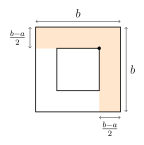
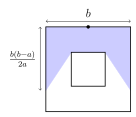
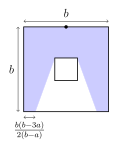
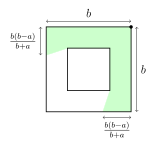
A prison consists of a square courtyard of side \(b\) bounded by a perimeter wall and a square building of side \(a\) placed centrally within the courtyard. The sides of the building are parallel to the perimeter walls. Guards can stand either at the middle of a perimeter wall or in a corner of the courtyard. If the guards wish to see as great a length of the perimeter wall as possible, determine which of these positions is preferable. You should consider separately the cases \(b<3a\) and \(b>3a\,\).
Solution:
2015 Paper 1 Q6
The vertices of a plane quadrilateral are labelled \(A\), \(B\), \(A'\) and \(B'\), in clockwise order. A point \(O\) lies in the same plane and within the quadrilateral. The angles \(AOB\) and \(A'OB'\) are right angles, and \(OA=OB\) and \(OA'=OB'\). Use position vectors relative to \(O\) to show that the midpoints of \(AB\), \(BA'\), \(A'B'\) and \(B'A\) are the vertices of a square. Given that the lengths of \(OA\) and \(OA'\) are fixed (and the conditions of the first paragraph still hold), find the value of angle \(BOA'\) for which the area of the square is greatest.
Solution: Let \(O\) be the origin, and let \(\mathbf{a}, \mathbf{b}, \mathbf{a}', \mathbf{b}'\) be the four points. The conditions give us \begin{align*} && \mathbf{a} \cdot \mathbf{b} &= 0 \\ && |\mathbf{a}| &= |\mathbf{b}| \\ && \mathbf{a}' \cdot \mathbf{b}' &= 0 \\ && |\mathbf{a}'| &= |\mathbf{b}'| \\ \end{align*} So \begin{align*} \text{midpoint }AB \text{ to midpoint } BA' &= (\tfrac12(\mathbf{a}+\mathbf{b}) - \tfrac12(\mathbf{b}+\mathbf{a}'))\cdot (\tfrac12(\mathbf{a}+\mathbf{b}) - \tfrac12(\mathbf{b}+\mathbf{a}')) \\ &= \frac12(\mathbf{a}-\mathbf{a}')\cdot \frac12(\mathbf{a} - \mathbf{a}') \\ \text{midpoint }BA' \text{ to midpoint } A'B' &= (\tfrac12(\mathbf{b}+\mathbf{a}') - \tfrac12(\mathbf{a}'+\mathbf{b}')) \cdot (\tfrac12(\mathbf{b}+\mathbf{a}') - \tfrac12(\mathbf{a}'+\mathbf{b}'))\\ &= \frac12(\mathbf{b}-\mathbf{b}')\cdot \frac12(\mathbf{b} - \mathbf{b}') \\ &= \frac14 (|\mathbf{b}|^2 + |\mathbf{b}'|^2 - 2\mathbf{b}\cdot\mathbf{b}')\\ &= \frac14(|\mathbf{a}|^2 + |\mathbf{a}'|^2 - 2\mathbf{b}\cdot\mathbf{b}') \\ \text{midpoint }A'B' \text{ to midpoint } B'A &= (\tfrac12(\mathbf{a}'+\mathbf{b}') - \tfrac12(\mathbf{b}'+\mathbf{a})) \cdot (\tfrac12(\mathbf{a}'+\mathbf{b}') - \tfrac12(\mathbf{b}'+\mathbf{a}))\\ &= \frac12(\mathbf{a}'-\mathbf{a})\cdot \frac12(\mathbf{a}' - \mathbf{a}) \\ \text{midpoint }B'A \text{ to midpoint } AB &= (\tfrac12(\mathbf{b}'+\mathbf{a}) - \tfrac12(\mathbf{a}+\mathbf{b})) \cdot (\tfrac12(\mathbf{b}'+\mathbf{a}) - \tfrac12(\mathbf{a}+\mathbf{b}))\\ &= \frac12(\mathbf{b}'-\mathbf{b})\cdot \frac12(\mathbf{b}' - \mathbf{b}) \\ \end{align*} So it's sufficient to prove \(\mathbf{a}\cdot \mathbf{a}' = \mathbf{b}\cdot \mathbf{b}'\) but this is clear from looking at a diagram for 1 second. Given the length of the square is what it is, we want to minimise \(\mathbf{b}\cdot \mathbf{b}'\) which is when they are vertically opposite each other, ie \(\angle BOA' = 90^\circ\)
2015 Paper 1 Q7
Let \[ \f(x) = 3ax^2 - 6x^3\, \] and, for each real number \(a\), let \({\rm M}(a)\) be the greatest value of \(\f(x)\) in the interval \(-\frac13 \le x \le 1\). Determine \({\rm M} (a)\) for \(a\ge0\). [The formula for \({\rm M} (a)\) is different in different ranges of \(a\); you will need to identify three ranges.]
Solution: \(f'(x) = 6ax-18x^2\), therefore \(f\) has turning points at \(0\) and \(\frac{a}3\) (ie decreasing for \(x \leq 0\) and \(x \geq \frac{a}{3}\) and increasing otherwise). Therefore possible maxima are \(f(-\tfrac13), f(\frac{a}{3}), f(1)\) where we consider \(\frac{a}{3}\) if \(a \leq 3\) and \(1\) otherwise. \(f(-\frac13) = \frac{a}{3} + \frac{2}{9} = \frac{3a+2}{9}\) \(f(\frac{a}{3}) = \frac{a^3}{3} - \frac{2a^3}{9} = \frac{a^3}{9}\) \(f(1) = 3(a-2)\) Comparing \(\frac{a^3}{9}\) to \(\frac{3a+2}{9}\) we have a double root at \(a = -1\) and a single root at \(a = 2\), therefore \(\frac{a^3}9\) is larger if \(a \geq 2\) Comparing \(3(a-2)\) to \(\frac{3a+2}9\) we have a cross-over at \(a = \frac{7}3\). Therefore we have: \begin{align*} M(a) &= \begin{cases} \frac{3a+2}{9} & 0 \leq a \leq 2 \\ \frac{a^3}{9} & 2 \leq a \leq 3 \\ 3(a-2) & 3 \leq a \end{cases} \end{align*}
2015 Paper 1 Q9
A short-barrelled machine gun stands on horizontal ground. The gun fires bullets, from ground level, at speed \(u\) continuously from \(t=0\) to \(t= \dfrac{\pi}{ 6\lambda}\), where \(\lambda\) is a positive constant, but does not fire outside this time period. During this time period, the angle of elevation \(\alpha\) of the barrel decreases from \(\frac13\pi\) to \(\frac16\pi\) and is given at time \(t\) by \[ \alpha =\tfrac13 \pi - \lambda t\,. \] Let \(k = \dfrac{g}{2\lambda u}\). Show that, in the case \(\frac12 \le k \le \frac12 \sqrt3\), the last bullet to hit the ground does so\\[2pt] at a distance \[ \frac{ 2 k u^2 \sqrt{1-k^2}}{g} \] from the gun. What is the corresponding result if \(k<\frac12\)?
Solution: The bullet fired at time \(t\) will hit the ground at time \(t+\frac{2u \sin (\frac13\pi - \lambda t)}{g}\). To find the last time a bullet hits the ground, we can differentiate, noting that \begin{align*} && T(t) &= t + \frac{2u \sin \alpha}{g} \\ \Rightarrow && T'(t) &= 1 - \frac{2u\lambda}{g} \cos \alpha \\ && T''(t) &= \frac{2u \lambda^2}{g} \sin \alpha > 0 \end{align*} If \(k = \frac{g}{2\lambda u} \in [\frac12, \frac12\sqrt{3}]\) then notice that this turning point is always achieved, and will be a maximum. It will be when \(\cos \alpha = k, \sin \alpha = \sqrt{1-k^2}\). The distance will be \(u \cos \alpha \cdot \frac{2 u \sin \alpha}{g} = \frac{2ku^2\sqrt{1-k^2}}{g}\). If \(k < \frac12\) then the last bullet to hit the ground will be the last bullet fired, ie \(\frac{2u^2 \sin \frac16\pi \cos \frac16\pi}{g} = \frac{u^2 \sin \frac13 \pi}{g} = \frac{\sqrt{3}u^2}{2g}\)
2015 Paper 1 Q10
A bus has the shape of a cuboid of length \(a\) and height \(h\). It is travelling northwards on a journey of fixed distance at constant speed \(u\) (chosen by the driver). The maximum speed of the bus is \(w\). Rain is falling from the southerly direction at speed \(v\) in straight lines inclined to the horizontal at angle \(\theta\), where \(0<\theta<\frac12\pi\). By considering first the case \(u=0\), show that for \(u>0\) the total amount of rain that hits the roof and the back or front of the bus in unit time is proportional to \[ h\big \vert v\cos\theta - u \big\vert + av\sin\theta \,. \] Show that, in order to encounter as little rain as possible on the journey, the driver should choose \( u=w\) if either \(w< v\cos\theta\) or \( a\sin\theta > h\cos\theta\). How should the speed be chosen if \(w>v\cos\theta\) and \( a\sin\theta < h\cos\theta\)? Comment on the case \( a\sin\theta = h\cos\theta\). How should the driver choose \(u\) on the return journey?
2015 Paper 2 Q13
The maximum height \(X\) of flood water each year on a certain river is a random variable with probability density function \(\f\) given by \[ \f(x) = \begin{cases} \lambda \e^{-\lambda x} & \text{for \(x\ge0\)}\,, \\ 0 & \text{otherwise,} \end{cases} \] where \(\lambda\) is a positive constant. It costs \(ky\) pounds each year to prepare for flood water of height \(y\) or less, where \(k\) is a positive constant and \(y\ge0\). If \(X \le y\) no further costs are incurred but if \(X> y\) the additional cost of flood damage is \(a(X - y )\) pounds where \(a\) is a positive constant.
- Let \(C\) be the total cost of dealing with the floods in the year. Show that the expectation of \(C\) is given by \[\mathrm{E}(C)=ky+\frac{a}{\lambda}\mathrm{e}^{-\lambda y} \, . \] How should \(y\) be chosen in order to minimise \(\mathrm{E}(C)\), in the different cases that arise according to the value of \(a/k\)?
- Find the variance of \(C\), and show that the more that is spent on preparing for flood water in advance the smaller this variance.
Solution:
- \(\,\) \begin{align*} && \mathbb{E}(C) &= \int_0^\infty \text{cost}(x) f(x) \d x \\ &&&= ky + \int_y^{\infty} a(x-y) \lambda e^{-\lambda x} \d x\\ &&&= ky + \int_0^{\infty} a u \lambda e^{-\lambda u -\lambda y} \d x \\ &&&= ky + ae^{-\lambda y} \left( \left [ -ue^{-\lambda u} \right]_0^\infty -\int_0^\infty e^{-\lambda u} \d u\right) \\ &&&= ky + \frac{a}{\lambda}e^{-\lambda y} \\ \\ && \frac{\d \mathbb{E}(C)}{\d y} &= k - ae^{-\lambda y} \\ \Rightarrow && y &= \frac{1}{\lambda}\ln \left ( \frac{a}{k} \right) \end{align*} Since \(\mathbb{E}(C)\) is clearly increasing when \(y\) is very large, the optimal value will be \(\frac{1}{\lambda}\ln \left ( \frac{a}{k} \right)\), if \(\frac{a}{k} > 1\), otherwise you should spend nothing on flood defenses.
- \begin{align*} && \mathbb{E}(C^2) &= \int_0^{\infty} \text{cost}(x)^2 f(x) \d x \\ &&&= \int_0^{\infty}(ky + a(x-y)\mathbb{1}_{x > y})^2 f(x) \d x \\ &&&= k^2y^2 + \int_y^{\infty}2kya(x-y)f(x)\d x + \int_y^{\infty}a^2 (x-y)^2 f(x) \d x \\ &&&= k^2y^2 + \frac{2kya}{\lambda}e^{- \lambda y}+a^2e^{-\lambda y}\int_{u=0}^\infty u^2 \lambda e^{-\lambda u} \d u \\ &&&= k^2y^2 + \frac{2kya}{\lambda}e^{-\lambda y}+a^2e^{-\lambda y}(\textrm{Var}(Exp(\lambda)) + \mathbb{E}(Exp(\lambda))^2\\ &&&= k^2y^2 + \frac{2kya}{\lambda}e^{-\lambda y} + a^2e^{-\lambda y} \frac{2}{\lambda^2} \\ && \textrm{Var}(C) &= k^2y^2 + \frac{2kya}{\lambda}e^{-\lambda y} + a^2e^{-\lambda y} \frac{2}{\lambda^2} - \left ( ky + \frac{a}{\lambda} e^{-\lambda y}\right)^2 \\ &&&= a^2e^{-\lambda y} \frac{2}{\lambda^2} - a^2 e^{-2\lambda y}\frac{1}{\lambda^2} \\ &&&= \frac{a^2}{\lambda^2} e^{-\lambda y}\left (2 - e^{-\lambda y} \right) \\ \\ && \frac{\d \textrm{Var}(C)}{\d y} &= \frac{a^2}{\lambda^2} \left (-2\lambda e^{-\lambda y} +2\lambda e^{-2\lambda y} \right) \\ &&&= \frac{2a^2}{\lambda} e^{-\lambda y}\left (e^{-\lambda y}-1 \right) \leq 0 \end{align*} so \(\textrm{Var}(C)\) is decreasing in \(y\).
2014 Paper 1 Q3
The numbers \(a\) and \(b\), where \(b > a\ge0\), are such that \[ \int_a^b x^2 \d x = \left ( \int_a^b x \d x\right)^{\!\!2}\,. \]
- In the case \(a=0\) and \(b>0\), find the value of \(b\).
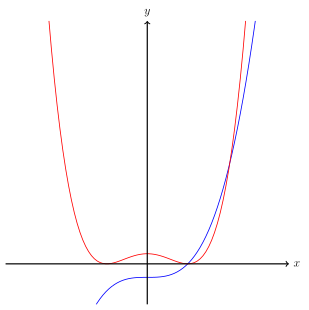
- In the case \(a=1\), show that \(b\) satisfies \[ 3b^3 -b^2-7b -7 =0\,. \] Show further, with the help of a sketch, that there is only one (real) value of \(b\) that satisfies this equation and that it lies between \(2\) and \(3\).
- Show that \(3p^2 + q^2 = 3p^2q\), where \(p=b+a\) and \(q=b-a\), and express \(p^2\) in terms of \(q\). Deduce that \(1< b-a\le\frac43\).
Solution:
- \(\,\) \begin{align*} && \int_0^b x^2 \d x &= \left ( \int_0^b x \d x \right)^2 \\ \Rightarrow && \frac{b^3}{3} &= \left ( \frac{b^2}{2} \right)^2 \\ \Rightarrow && b &= \frac{4}{3} \end{align*}
- \(\,\)
\begin{align*}
&& \int_1^b x^2 \d x &= \left ( \int_1^b x \d x \right)^2 \\
\Rightarrow && \frac{b^3}{3} - \frac{1}{3} &= \left ( \frac{b^2}{2} - \frac{1}{2} \right)^2 \\
\Rightarrow && 4(b^3 - 1) &= 3(b^2-1)^2 \\
\Rightarrow && 4(b^3-1) &= 3(b^4-2b^2+1) \\
\Rightarrow && 0 &= 3b^4-4b^3-6b^2+7 \\
&&&= (b-1)(3b^3-b^2-7b-7) \\
\Rightarrow && 0 &= 3b^3-b^2-7b-7
\end{align*}
Let \(f(x) = 3x^3-x^2-7x-7\) then \(f(2) = 3 \cdot 8 - 4 - 14 - 7 = -1 < 0\), \(f(3) = 3 \cdot 27 - 9 - 21 - 7 = 44 > 0\) therefore the root must lie between \(2\) and \(3\).
- \(,\) \begin{align*} && \int_a^b x^2 \d x &= \left ( \int_a^b x \d x \right)^2 \\ \Rightarrow && \frac{b^3}{3} - \frac{a^3}{3} &= \left ( \frac{b^2}{2} - \frac{a^2}{2} \right)^2 \\ \Rightarrow && 4(b^3 - a^3) &= 3(b^2-a^2)^2 \\ \Rightarrow && 4(b^2+ab+a^2) &= 3(b-a)(b+a)^2 \\ \Rightarrow && 4 \left ( \left ( \frac{p+q}{2}\right)^2+\left ( \frac{p+q}{2}\right)\left ( \frac{p-q}{2}\right)+\left ( \frac{p-q}{2}\right)^2\right) &= 3qp^2 \\ \Rightarrow && 3p^2 + q^2 &= 3qp^2 \\ \Rightarrow && 3p^2(q-1) &= q^2 \\ \Rightarrow && p^2 &= \frac{q^2}{3(q-1)} \\ \Rightarrow && 1 &\leq \frac{1}{3(q-1)} \\ \Rightarrow && 3(q-1) &\leq 1 \\ \Rightarrow && q & \leq \frac{4}{3} \\ \end{align*}
2014 Paper 1 Q4
An accurate clock has an hour hand of length \(a\) and a minute hand of length \(b\) (where \(b>a\)), both measured from the pivot at the centre of the clock face. Let \(x\) be the distance between the ends of the hands when the angle between the hands is \(\theta\), where \(0\le\theta < \pi\). Show that the rate of increase of \(x\) is greatest when \(x=(b^2-a^2)^\frac12\). In the case when \(b=2a\) and the clock starts at mid-day (with both hands pointing vertically upwards), show that this occurs for the first time a little less than 11 minutes later.
Solution: The position of the hands are \(\begin{pmatrix} a\sin(-t) \\ a \cos(-t) \end{pmatrix}\) and \(\begin{pmatrix} b\sin(-60t) \\ b \cos(-60t) \end{pmatrix}\), the distance between the hands is \begin{align*} x &= \sqrt{\left ( a \sin t - b \sin 60t\right)^2+\left ( a \cos t - b \cos 60t\right)^2} \\ &= \sqrt{a^2+b^2-2ab\left (\sin t \sin 60t+\cos t \cos 60t \right)} \\ &= \sqrt{a^2+b^2-2ab \cos(59t)} = \sqrt{a^2+b^2-2ab \cos \theta} \\ \\ \frac{\d x}{\d \theta} &= \frac{ab \sin \theta}{ \sqrt{a^2+b^2-2ab \cos \theta}} \\ \frac{\d^2 x}{\d \theta^2} &= \frac{ab \cos \theta\sqrt{a^2+b^2-2ab \cos \theta} - \frac{a^2b^2 \sin^2 \theta}{\sqrt{a^2+b^2-2ab \cos \theta}} }{a^2+b^2-2ab \cos \theta} \\ &= \frac{ab \cos \theta(a^2+b^2-2ab \cos \theta) - a^2b^2 \sin^2 \theta }{(a^2+b^2-2ab \cos \theta)^{3/2}} \\ &= \frac{ab \cos \theta(a^2+b^2-2ab \cos \theta) - a^2b^2(1-\cos^2 \theta)}{(a^2+b^2-2ab \cos \theta)^{3/2}} \\ &= \frac{ab(a^2+b^2) \cos \theta-a^2b^2 \cos \theta- a^2b^2}{(a^2+b^2-2ab \cos \theta)^{3/2}} \\ &= \frac{-ab(a\cos \theta -b)(b \cos \theta - a)}{(a^2+b^2-2ab \cos \theta)^{3/2}} \\ \end{align*} So the rate of increase is largest when \(\cos \theta = \frac{a}{b}\) (since \(\frac{b}{a}\) is impossible. Therefore when \(x = \sqrt{a^2+b^2-2ab \frac{a}{b}} = \sqrt{a^2+b^2-2a^2} = \sqrt{b^2-a^2}\) If \(b = 2a\) then \(\cos \theta = \frac{a}{2a} = \frac12 = \frac{\pi}{3} = 60^\circ\) The relative speed of the hands is \(5.5^\circ\) per minute, so \(\frac{60}{5.5} = \frac{120}{11} \approx 11\) but clearly also less than since \(121 = 11^2\).
2014 Paper 1 Q5
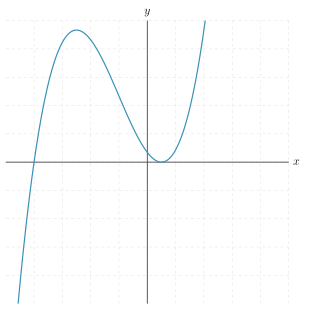
- Let \(f(x) = (x+2a)^3 -27 a^2 x\), where \(a\ge 0\). By sketching \(f(x)\), show that \(f(x)\ge 0\) for \(x \ge0\).
- Use part (i) to find the greatest value of \(xy^2\) in the region of the \(x\)-\(y\) plane given by \(x\ge0\), \(y\ge0\) and \(x+2y\le 3\,\). For what values of \(x\) and \(y\) is this greatest value achieved?
- Use part (i) to show that \((p+q+r)^3 \ge 27pqr\) for any non-negative numbers \(p\), \(q\) and \(r\). If \((p+q+r)^3 = 27pqr\), what relationship must \(p\), \(q\) and \(r\) satisfy?
Solution:
- Note that \(f(x) = (x+2a)^3 - 27a^2x\) so \(f'(x) = 3(x+2a)^2-27a^2 = 3x^2+12ax-15a^2 = (x-a)(3x+15a)\) so the turning points are at \(x = a, x = -5a\). But \(f(a) = 0\), so the curve just touches the \(x\)-axis. Note also that \(f(0) = 8a^3 \geq 0\) so:
- \(\,\) \begin{align*} && 0 &\leq (x+2y)^3 - 27y^2 x \\ &&& \leq 3^3 - 27 y^2 x \\ &&&= 27(1-y^2x) \\ \Rightarrow && xy^2 &\leq1 \end{align*} with equality when \(x = y = 1\)
- Notice that \begin{align*} && 0 &\leq (p+q+r)^3 - 27\left (\frac{q+r}{2}\right)^2 p \\ \Rightarrow && (p+q+r)^3 &\geq 27\left (\frac{q+r}{2}\right)^2 p \\ &&&\underbrace{\geq}_{AM-GM} 27\left (\sqrt{qr}\right)^2 p \\ &&&= 27pqr \end{align*} Equality can only hold if \(p = \frac{q+r}{2}\), but by symmetry we must also have \(q = \frac{r+p}{2}, r = \frac{p+q}{2}\) ie \(p = q = r\). And indeed equality does hold in this case.
2014 Paper 1 Q12
A game in a casino is played with a fair coin and an unbiased cubical die whose faces are labelled \(1, 1, 1, 2, 2\) and \(3.\) In each round of the game, the die is rolled once and the coin is tossed once. The outcome of the round is a random variable \(X\). The value, \(x\), of \(X\) is determined as follows. If the result of the toss is heads then \(x= \vert ks -1\vert\), and if the result of the toss is tails then \(x=\vert k-s\vert\), where \(s\) is the number on the die and \(k\) is a given number. Show that \(\mathbb{E}(X^2) = k +13(k-1)^2 /6\). Given that both \(\mathbb{E}(X^2)\) and \(\mathbb{E}(X)\) are positive integers, and that \(k\) is a single-digit positive integer, determine the value of \(k\), and write down the probability distribution of \(X\). A gambler pays \(\pounds 1\) to play the game, which consists of two rounds. The gambler is paid:
- \(\pounds w\), where \(w\) is an integer, if the sum of the outcomes of the two rounds exceeds \(25\);
- \(\pounds 1\) if the sum of the outcomes equals \(25\);
- nothing if the sum of the outcomes is less that \(25\).
Solution: \begin{align*} && \mathbb{E}(X^2) &= \frac12 \left (\frac16 \left ( 3(k -1)^2+2(2k-1)^2+(3k-1)^2 \right) +\frac16 \left ( 3(k -1)^2+2(k-2)^2+(k-3)^2 \right) \right) \\ &&&= \frac12 \left (\frac16 \left (20k^2-20k+6 \right) + \frac16 \left ( 6k^2-20k+20\right) \right) \\ &&&= \frac1{12} \left (26k^2-40k+ 26\right) \\ &&&= \frac{13}{6} (k^2+1) - \frac{10}{3}k \\ &&&= \frac{13}{6}(k-1)^2+k \end{align*} Since \(k\) a single digit positive number and \(\mathbb{E}(X^2)\) is an integer, \(6 \mid k-1 \Rightarrow k = 1, 7\). \begin{align*} \mathbb{E}(X | k=1) &= \frac12 \left (\frac16 \left ( 2+2 \right) +\frac16 \left ( 2+2 \right) \right) = \frac23 \not \in \mathbb{Z}\\ \mathbb{E}(X | k=7) &= \frac12 \left (\frac16 \left ( 3\cdot6+2\cdot13+20 \right) +\frac16 \left ( 3\cdot6+2\cdot5+4 \right) \right) = 8 \end{align*} Therefore \(k = 7\) The probability distribution is \begin{align*} && \mathbb{P}(X=4) = \frac1{12} \\ && \mathbb{P}(X=5) = \frac1{6} \\ && \mathbb{P}(X=6) = \frac12 \\ && \mathbb{P}(X=13) = \frac1{6} \\ && \mathbb{P}(X=20)= \frac1{12} \\ \end{align*} The only ways to score more than \(25\) are: \(20+6, 20+13, 20+20, 13+13\) The only ways to score exactly \(25\) are \(20+5\) \begin{align*} \mathbb{P}(>25) &= \frac1{12} \cdot\left(2\cdot \frac12+2\cdot\frac16+\frac1{12}\right) + \frac{1}{6^2} \\ &= \frac{7}{48} \\ \mathbb{P}(=25) &= \frac{2}{12 \cdot 6} = \frac{1}{36} \\ \\ \mathbb{E}(\text{payout}) &= \frac{7}{48}w + \frac{1}{36} = \frac{21w+4}{144} \end{align*} The casino needs \(\frac{21w+4}{144} < 1 \Rightarrow 21w< 140 \Rightarrow w < \frac{20}{3}\)
2014 Paper 2 Q2
This question concerns the inequality \begin{equation} \int_0^\pi \bigl( f(x) \bigr)^2 \d x \le \int_0^\pi \bigl( f'(x)\bigr)^2 \d x\,.\tag{\(*\)} \end{equation}
- Show that \((*)\) is satisfied in the case \(f(x)=\sin nx\), where \(n\) is a positive integer. Show by means of counterexamples that \((*)\) is not necessarily satisfied if either \(f(0) \ne 0\) or \(f(\pi)\ne0\).
- You may now assume that \((*)\) is satisfied for any (differentiable) function \(f\) for which \(f(0)=f(\pi)=0\). By setting \(f(x) = ax^2 + bx +c\), where \(a\), \(b\) and \(c\) are suitably chosen, show that \(\pi^2\le 10\). By setting \(f(x) = p \sin \frac12 x + q\cos \frac12 x +r\), where \(p\), \(q\) and \(r\) are suitably chosen, obtain another inequality for \(\pi\). Which of these inequalities leads to a better estimate for \(\pi^2\,\)?
Solution:
- If \(f(x) = \sin nx\) then \(f'(x) = n \cos n x\) and so \begin{align*} && LHS &= \int_0^\pi \sin^2 n x \d x \\ &&&= \left [ \frac{x+\frac1{2n}\sin 2n x}{2} \right ]_0^{\pi} \\ &&&= \frac{\pi}{2} \\ \\ && RHS &= \int_0^{\pi} n^2 \cos^2 n x \d x \\ &&&= n^2 \left [ \frac{\frac{1}{2n}\sin 2n x + x}{2} \right]_0^{\pi} \\ &&&= n^2\frac{\pi}{2} \geq LHS \end{align*} [\(f(0) = 0, f(\pi) \neq 0\)] Suppose \(f(x) = x\) then \(f'(x) = 1\) and \(LHS = \frac{\pi^3}{3} > \pi = RHS\). [\(f(0) \neq 0, f(\pi) = 0\)] Suppose \(f(x) = \pi - x\) then \(f'(x) = -1\) and \(LHS = \frac{\pi^3}{3} > \pi = RHS\)
- Suppose \(f(x) = x(\pi - x)\) then \(f'(x) = \pi - 2x\) and so \begin{align*} && \int_0^\pi x^2(\pi-x)^2 \d x &\leq \int_0^\pi (\pi-2x)^2 \d x \\ \Leftrightarrow && \left [\pi^2 \frac{x^3}{3} - 2\pi \frac{x^4}{4} + \frac{x^5}{5} \right]_0^{\pi} &\leq \left [ \pi^2x - 4\pi \frac{x^2}{2} + \frac{4x^3}{3} \right]_0^{\pi} \\ \Leftrightarrow && \pi^5 \left (\frac13 - \frac12+\frac15 \right) &\leq \pi^3 \left ( 1 - 2+\frac43 \right) \\ \Leftrightarrow && \pi^2 \frac{1}{30} &\leq \frac13 \\ \Leftrightarrow && \pi^2 &\leq 10 \end{align*} Suppose \(f(x) = p\sin \tfrac12 x + q \cos \tfrac12 x + r\), so \(f(0) = q + r\) and \(f(\pi) = p + r\), so say \(p = q = 1, r = -1\) \begin{align*} && LHS &= \int_0^{\pi} \left ( \sin \tfrac12 x + \cos \tfrac12 x-1\right)^2 \d x \\ &&&=\int_0^\pi \left ( \sin^2 \tfrac12 x + \cos^2 \tfrac12 x+1-2\sin \tfrac12 x - 2\cos \tfrac12 x+ \sin x \right)\\ &&&= \left [2x + 4\cos \tfrac12 x - 4\sin \tfrac12 x - \cos x \right]_0^{\pi} \\ &&&= \left ( 2\pi -4+1 \right) - \left ( 4-1 \right) \\ &&&= 2\pi -6\\ \\ && RHS&= \int_0^{\pi} \left ( \tfrac12 \cos \tfrac12 x -\tfrac12 \sin \tfrac12 x\right)^2 \d x \\ &&&= \int_0^{\pi} \left ( \tfrac14 \cos^2 \tfrac12 x +\tfrac14 \sin^2 \tfrac12 x-\tfrac14 \sin x\right) \d x \\ &&&= \frac{\pi}{4} - \frac12 \\ \Rightarrow && 2\pi -6 &\leq \frac{\pi}{4} - \frac12 \\ \Rightarrow && \frac{7\pi}{4} &\leq \frac{11}{2} \\ \Rightarrow && \pi &\leq \frac{22}{7} \end{align*} \(22^2/7^2 = 484/49 < 10\) therefore \(\pi \leq \frac{22}{7}\) is the better estimate.