Problems
Filters
37 problems found
1996 Paper 2 Q6
A proper factor of a positive integer \(N\) is an integer \(M\), with \(M\ne 1\) and \(M\ne N\), which divides \(N\) without remainder. Show that \(12\) has \(4\) proper factors and \(16\) has \(3\). Suppose that \(N\) has the prime factorisation \[N=p_{1}^{m_{1}}p_{2}^{m_{2}}\dots p_{r}^{m_{r}},\] where \(p_{1}, p_{2}, \dots, p_{r}\) are distinct primes and \(m_{1}, m_{2}, \dots, m_{r}\) are positive integers. How many proper factors does \(N\) have and why? Find:
- the smallest positive integer which has precisely 12 proper factors;
- the smallest positive integer which has at least 12 proper factors.
Solution: \(12\) has factors \(1,2,3,4,6,12\) of which \(4\) are neither \(1\) nor \(12\). \(16\) has factors \(1,2,4,8,16\) of which \(3\) are neither \(1\) nor \(16\). If \(N = p_1^{m_1} \cdots p_r^{m_r}\) then \(N\) has \((m_1+1)\cdots(m_r+1)\) factors since we can have between \(0 \leq k \leq m_i\) of the \(i\)th prime factor, whcih is \(m_i+1\) possibilities. We then need to subtract two for the proper factors, ie \((m_1+1)\cdots(m_r+1) - 2\).
- We need \((m_1 + 1) \cdots (m_r + 1) - 2 = 12\) ie \((m_1+1) \cdots (m_r +1) = 14\). Since \(14 = 2 \times 7\) we should have two prime factors, ie of the form \(p_1^6p_2^1\). The smallest number of this form is \(2^6 \cdot 3 = 192\)
- We wish to make \((m_1+1)\cdots(m_r+1) \geq 14\) with \(2^{m_1} \cdot 3^{m_2} \cdots p_r^{m_r}\) as small as possible and \(m_1 \geq m_2 \geq \cdots \geq m_r\). With \(1\) prime, the best we can do is \(2^{13}\). With \(2\) primes the best we can do is \(2^p \cdot 3^q\) with \((p+1)(q+1) \geq 14\). \begin{array}{c|c} q & p & N \\ \hline 0 & 13 & 2^{13} \\ 1 & 6 & 2^6 \cdot 3^1 \\ 2 & 5 & 2^5 \cdot 3^2 \\ 3 & 3.& 2^3 \cdot 3^3 \end{array} So the best here is \(2^6 \cdot 3\) With \(3\) primes, the best we can do is \(2^p 3^q 5^r\) with \(p \geq q \geq r\) and \((p+1)(q+1)(r+1) \geq 14\) \begin{array}{c|c|c|c} r & q & p & N \\ \hline 1 & 1 & 3 & 2^3 \cdot 3 \cdot 5 \\ 1 & 2 & 2& 2^2 \cdot 3^2 \cdot 5 \\ 2 & 2& 2 & 2^2 \cdot 3^2 \cdot 5^2 \end{array} With four primes we can achieve it immediately with \(2\cdot3\cdot5\cdot 7\) and more primes clearly wont help, so our best options is \(120\)
1994 Paper 2 Q1
In this question we consider only positive, non-zero integers written out in the usual (decimal) way. We say, for example, that 207 ends in 7 and that 5310 ends in 1 followed by 0. Show that, if \(n\) does not end in 5 or an even number, then there exists \(m\) such that \(n\times m\) ends in 1. Show that, given any \(n\), we can find \(m\) such that \(n\times m\) ends either in 1 or in 1 followed by one or more zeros. Show that, given any \(n\) which ends in 1 or in 1 followed by one or more zeros, we can find \(m\) such that \(n\times m\) contains all the digits \(0,1,2,\ldots,9\).
Solution: \begin{array}{c|c} \text{ends in} & \text{multiply by} \\ \hline 1 & 1 \\ 3 & 7 \\ 7 & 3 \\ 9 & 9 \end{array} If if \(n = 2^a \cdot 5^b \cdot c\) where \(c\) has no factors of \(2\) and \(5\) then we can multiply by \(2^b \cdot 5^a\) to obtain \(c\) followed by \(0\)s. Since \(c\) is neither even, nor a multiple of \(5\), by the earlier part of the question we can find a multiple such that it ends in \(1\). Suppose it is a \(k\) digit number, the consider Now consider \(1\underbrace{00\cdots0}_{k\text{ digits}}2\underbrace{00\cdots0}_{k\text{ digits}}\cdots 8\underbrace{00\cdots0}_{k\text{ digits}}9\cdot 0\), then clearly each section will end in the leading digit (ie all digits from \(1\) to \(9\)) and also end with a \(0\)
1993 Paper 1 Q3
- Find all the integer solutions with \(1\leqslant p\leqslant q\leqslant r\) of the equation \[ \frac{1}{p}+\frac{1}{q}+\frac{1}{r}=1\,, \] showing that there are no others.
- The integer solutions with \(1\leqslant p\leqslant q\leqslant r\) of \[ \frac{1}{p}+\frac{1}{q}+\frac{1}{r}>1\,, \] include \(p=1\), \(q=n,\) \(r=m\) where \(n\) and \(m\) are any integers satisfying \(1\leqslant m\leqslant n.\) Find all the other solutions, showing that you have found them all.
Solution:
- Suppose \(p > 3\) then there are clearly no solutions, since \(\frac1p+\frac1q+\frac1r \leq \frac{1}{4} + \frac{1}{4} + \frac{1}{4} < 1\) Therefore there are 3 cases: \(p = 3 \Rightarrow p = q = r = 3\) \(p = 2\): \begin{align*} && \frac12 = \frac1q + \frac1r \\ \Rightarrow && 0 = qr - 2q-2q \\ \Rightarrow && 4 &= (q-2)(r-2) \\ \end{align*} Therefore \((p,q,r) = (2, 3, 6), (2, 4, 4)\) \(p = 1\) we have a contradiction the other way.
- We have already shown \(p < 3\), so we just need to check \(p = 2\) (since \(p=1\) is described in the question). \begin{align*} && \frac12 &< \frac1q+\frac1r \\ \Rightarrow && qr &< 2q+2r \\ \Rightarrow && 4 &> (q-2)(r-2) \\ \end{align*} Therefore we can have \((q-2)(r-2) = 0 \Rightarrow p = 2, q = 2, r = n\) Or we have have \((q-2)(r-2) = 1 \Rightarrow q = 3, r = 3\) Or we can have \((q-2)(r-2) = 2 \Rightarrow q = 3, r= 4\)
1993 Paper 2 Q7
The integers \(a,b\) and \(c\) satisfy \[ 2a^{2}+b^{2}=5c^{2}. \] By considering the possible values of \(a\pmod5\) and \(b\pmod5\), show that \(a\) and \(b\) must both be divisible by \(5\). By considering how many times \(a,b\) and \(c\) can be divided by \(5\), show that the only solution is \(a=b=c=0.\)
Solution: \begin{array}{c|ccccc} a & 0 & 1 & 2 & 3 & 4 \\ a^2 & 0 & 1 & 4 & 4 & 1 \end{array} Therefore \(a^2 \in \{0,1,4\}\) and so we can have \begin{array} $2a^2+b^2 & 0 & 1 & 4 \\ \hline 0 & 0 & 1 & 4 \\ 1 & 2 & 3 & 1 \\ 4 & 3 & 4 & 2 \end{array} Therefore the only solution must have \(5 \mid a,b\), but then we can write them has \(5a'\) and \(5b'\) so the equation becomes \(2\cdot25 a'^2 + 25b'^2 = 5c^2\) ie \(5 \mid c^2 \Rightarrow 5 \mid c\). But that means we can always divide \((a,b,c)\) by \(5\), which is clearly a contradiction if we consider the lowest power of \(5\) dividing \(a,b,c\) for any solution.
1988 Paper 1 Q1
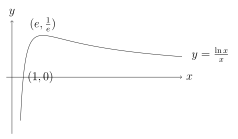
Sketch the graph of the function \(\mathrm{h}\), where \[ \mathrm{h}(x)=\frac{\ln x}{x},\qquad(x>0). \] Hence, or otherwise, find all pairs of distinct positive integers \(m\) and \(n\) which satisfy the equation \[ n^{m}=m^{n}. \]
Solution:
1987 Paper 3 Q1
Find the set of positive integers \(n\) for which \(n\) does not divide \((n-1)!.\) Justify your answer. [Note that small values of \(n\) may require special consideration.]
Solution: Claim: \(n \not \mid (n-1)!\) if and only if \(n\) is prime or \(4\) Proof: \((\Leftarrow)\)
- \(4 \not \mid 3! = 6\).
- If \(p\) is prime, then \(p \not \mid k\) for \(k < n\), therefore \(p \not \mid (n-1)!\)
1987 Paper 3 Q5
A secret message consists of the numbers \(1,3,7,23,24,37,39,43,43,43,45,47\) arranged in some order as \(a_{1},a_{2},\ldots,a_{12}.\) The message is encoded as \(b_{1},b_{2},\ldots,b_{12}\) with \(0\leqslant b_{j}\leqslant49\) and \begin{alignat*}{1} b_{2j} & \equiv a_{2j}+n_{0}+j\pmod{50},\\ b_{2j+1} & \equiv a_{2j+1}+n_{1}+j\pmod{50}, \end{alignat*} for some integers \(n_{0}\) and \(n_{1}.\) If the coded message is \(35,27,2,36,15,35,8,40,40,37,24,48,\) find the original message, explaining your method carefully.
Solution: Considering the odd numbers, we have \begin{array}{l|rrrrrr} b_{2j+1} & 35 & 2 & 15 & 8 & 40 & 24 \\ a_{2j+1}+n_1 & 35 & 1 & 13 & 5 & 36 & 19 \end{array} Considering the even numbers, we have \begin{array}{l|rrrrrr} b_{2j} & 27& 36 & 35 & 40 & 37 & 48 \\ a_{2j}+n_0 & 27 & 35 & 33 & 37 & 33 & 43 \end{array} There are three numbers in the original sequence which are repeated (\(43\)). By the pigeonhole principle, one of the odds or evens must have at least two of them. We can see that the even numbers have some number repeated twice (\(33\)). Therefore these must be the \(43\)s. Therefore \(n_0 = -10\) \begin{array}{l|rrrrrr} b_{2j} & 27& 36 & 35 & 40 & 37 & 48 \\ a_{2j}+n_0 & 27 & 35 & 33 & 37 & 33 & 43 \\ a_{2j} & 37 & 45 & 43 & 47 & 43 & 3 \end{array} This leaves the remaining numbers to be decoded from the original sequence as \(1,7,23,24,39,43\). Two of these numbers are consecutive (\(23\) and \(24\)), and two numbers in our sequence are \(35\) and \(36\). Therefore \(n_1\) must be \(12\). \begin{array}{l|rrrrrr} b_{2j+1} & 35 & 2 & 15 & 8 & 40 & 24 \\ a_{2j+1}+n_1 & 35 & 1 & 13 & 5 & 36 & 19 \\ a_{2j+1} & 23 & 39 & 1 &43 & 24& 7 \end{array} Therefore the original sequence was: \(23, 37, 39, 45, 1, 43, 43, 47, 24, 43, 7, 3\)