Problems
Filters
233 problems found
2017 Paper 1 Q2
- The inequality \(\dfrac 1 t \le 1\) holds for \(t\ge1\). By integrating both sides of this inequality over the interval \(1\le t \le x\), show that \[ \ln x \le x-1 \tag{\(*\)} \] for \(x \ge 1\). Show similarly that \((*)\) also holds for \(0 < x \le 1\).
- Starting from the inequality \(\dfrac{1}{t^2} \le \dfrac1 t \) for \(t \ge 1\), show that \[ \ln x \ge 1-\frac{1}{x} \tag{\(**\)} \] for \(x > 0\).
- Show, by integrating (\(*\)) and (\(**\)), that \[ \frac{2}{ y+1} \le \frac{\ln y}{ y-1} \le \frac{ y+1}{2 y} \] for \( y > 0\) and \( y\ne1\).
Solution:
- \(\,\) \begin{align*} (x \geq 1): && \int_1^x \frac{1}{t} \d t &\leq \int_1^x 1 \d t \\ \Rightarrow && \ln x - \ln 1 &\leq x - 1 \\ \Rightarrow && \ln x & \leq x - 1 \\ \\ (0 < x \leq 1):&& \int_x^1 1\d t &\leq \int_x^1 \frac{1}{t} \d t \\ \Rightarrow&& 1- x &\leq \ln 1 - \ln x \\ \Rightarrow&& \ln x &\leq x - 1 \end{align*}
- \(\,\) \begin{align*} (x \geq 1): && \int_1^x \frac{1}{t^2} \d t &\leq \int_1^x \frac{1}{t} \d t \\ \Rightarrow && -\frac1x+1 &\leq \ln x - \ln 1 \\ \Rightarrow && 1 - \frac1x &\leq \ln x \\ \\ (0 < x \leq 1): && \int_x^1 \frac{1}{t} \d t &\leq \int_x^1 \frac{1}{t^2} \d t \\ \Rightarrow && \ln 1 - \ln x & \leq -1 + \frac{1}{x} \\ \Rightarrow && 1 - \frac1x &\leq \ln x \\ \end{align*}
- \(\,\) \begin{align*} (1 < y): && \int_1^y \left (1 - \frac1{x} \right)\d x &\leq \int_1^y \ln x \d x \\ \Rightarrow && \left [x - \ln x \right]_1^y & \leq \left [ x \ln x - x\right]_1^y \\ \Rightarrow && y - \ln y - 1 &\leq y \ln y - y +1 \\ \Rightarrow && 2y-2 & \leq (y+1) \ln y \\ \Rightarrow && \frac{2}{y+1} & \leq \frac{\ln y}{y-1} \\ (0 < y < 1): && \int_y^1 \left (1 - \frac1{x} \right)\d x &\leq \int_y^1 \ln x \d x \\ \Rightarrow && \left [x - \ln x \right]_y^1 & \leq \left [ x \ln x - x\right]_y^1 \\ \Rightarrow && 1 - (y - \ln y) &\leq -1-(y \ln y-y) \\ \Rightarrow && 2-2y &\leq -(y+1)\ln y \\ \Rightarrow && \frac{2}{y+1} &\leq \frac{-\ln y}{1-y} \tag{\(1-y > 0\)} \\ \Rightarrow && \frac{2}{y+1} &\leq \frac{\ln y}{y-1} \\ \\ (1 < y): && \int_1^y \ln x \d x &\leq \int_1^y (x-1) \d x \\ \Rightarrow && \left [x \ln x -x \right]_1^y &\leq \left[ \frac12 x^2 - x \right]_1^y\\ \Rightarrow && y \ln y - y +1 &\leq \frac12y^2 - y+\frac12 \\ \Rightarrow && y \ln y &\leq \frac12 \left (y^2-1 \right) \\ \Rightarrow && \frac{\ln y}{y-1} &\leq \frac{y+1}{2y} \\ \\ (0 < y < 1) && \int_y^1 \ln x \d x &\leq \int_y^1 (x-1) \d x \\ \Rightarrow && \left [x \ln x -x \right]_y^1&\leq \left[ \frac12 x^2 - x \right]_y^1\\ \Rightarrow && -1-(y \ln y - y +1) &\leq-\frac12 - \left ( \frac12y^2 - y\right)\\ \Rightarrow && \frac12 \left (y^2-1 \right) &\leq y \ln y \\ \Rightarrow && \frac{\ln y}{y-1} & \leq \frac{y+1}{2y} \tag{\(y-1 < 0\)} \end{align*}
2017 Paper 1 Q6
In this question, you may assume that, if a continuous function takes both positive and negative values in an interval, then it takes the value \(0\) at some point in that interval.
- The function \(\f\) is continuous and \(\f(x)\) is non-zero for some value of \(x\) in the interval \(0\le x \le 1\). Prove by contradiction, or otherwise, that if \[ \int_0^1 \f(x) \d x = 0\,, \] then \(\f(x)\) takes both positive and negative values in the interval \(0\le x\le 1\).
- The function \(\g\) is continuous and \[ \int_0^1 \g(x) \, \d x = 1\,, \quad \int_0^1 x\g(x) \, \d x = \alpha\, , \quad \int_0^1 x^2\g(x) \, \d x = \alpha^2\,. \tag{\(*\)} \] Show, by considering \[ \int_0^1 (x - \alpha)^2 \g(x) \, \d x \,, \] that \(\g(x)=0\) for some value of \(x\) in the interval \(0\le x\le 1\). Find a function of the form \(\g(x) = a+bx\) that satisfies the conditions \((*)\) and verify that \(\g(x)=0\) for some value of \(x\) in the interval \(0\le x \le 1\).
- The function \(\h\) has a continuous derivative \(\h'\) and \[ \h(0) = 0\,, \quad \h(1) = 1\,, \quad \int_0^1 \h(x) \, \d x = \beta\,, \quad \int_0^1 x \h(x) \, \d x = \tfrac{1}{2}\beta (2 - \beta) \,. \] Use the result in part (ii) to show that \(\h^\prime(x)=0\) for some value of \(x\) in the interval \(0\le x\le 1\).
Solution:
- Claim: If \(f(x)\) non-zero for some \(x \in [0,1]\) and \(\int_0^1 f(x) \d x =0\) then \(f\) takes both positive and negative values in the interval \([0,1]\). Proof: Suppose not, then WLOG suppose \(f(x) > 0\) for some \(x \in [0,1]\). Then notice (since \(f\) is continuous) that there is some interval where \(f(x) > 0\) around the \(x\) we have already shown exists. But then \(\int_{\text{interval}} f(x) \d x > 0\) and since \(f(x) \geq 0\) everywhere \(\int_0^1 f(x) \d x > 0\), which is a contradiction.
- \(\,\) \begin{align*} && \int_0^1 (x - \alpha)^2 g(x) \d x &= \int_0^1 x^2g(x) \d x - 2 \alpha \int_0^1 x g(x) \d x + \alpha^2 \int_0^1 g(x) \d x \\ &&&= \alpha^2 - 2\alpha \cdot \alpha + \alpha^2 \cdot 1 \\ &&&= 0 \end{align*} Therefore \(g(x)(x-\alpha)^2\) is a continuous function which is either exactly \(0\) (in which case we've already found our \(0\)) or it is a continuous function which is both positive somewhere and has \(0\) integral, and therefore by part (i) must take both positive and negative values (and therefore takes \(0\) in between those points by continuity). \begin{align*} &&1 &= \int_0^1 a+bx \d x \\ &&&= a + \frac12 b \\ && \alpha &= \int_0^1 ax + bx^2 \d x \\ &&&= \frac12 a + \frac13 b \\ && \alpha^2 &= \int_0^1 ax^2 + bx^3 \d x\\ &&&= \frac13 a + \frac14 b \\ \Rightarrow && \frac1{36}(3a+2b)^2 &= \frac1{12}(4a+3b) \\ \Rightarrow && \frac1{36}(3a+2(2-2a))^2 &= \frac1{12}(4a+3(2-2a)) \\ \Rightarrow && (4-a)^2 &= 3(6-2a) \\ \Rightarrow && 16-8a+a^2 &= 18-6a \\ \Rightarrow && a^2-2a-2 &= 0 \\ \Rightarrow && (a-1)^2 - 3 &= 0 \\ \Rightarrow && a &= \pm \sqrt{3}+1 \\ && b &= \mp 2\sqrt{3} \end{align*} So say \(a = \sqrt{3}+1, b = -2\sqrt{3}\) This has a root at \(-\frac{a}{b} = \frac{1+\sqrt{3}}{2\sqrt{3}} = \frac{\sqrt{3}+3}{6} < 1\) so we have met our condition.
- Consider \(h'\), we must have \begin{align*} && \int_0^1 h'(x)\d x &= h(1)-h(0) =1\\ && \int_0^1 xh'(x) \d x &= \left [x h(x) \right]_0^1 - \int_0^1 h(x) \d x \\ &&&= 1 - \beta \\ && \int_0^1 x^2 h'(x) \d x &= \left [ x^2h(x) \right]_0^1 - \int_0^1 2xh(x) \d x \\ &&&= 1 - 2\tfrac12 \beta(2-\beta) \\ &&&= (1-\beta)^2 \end{align*} Therefore \(h'\) satisfies the conditions with \(\alpha = 1-\beta\), so \(h'\) must have a root in our interval.
2017 Paper 2 Q1
Note: In this question you may use without proof the result \( \dfrac{\d \ }{\d x}\big(\!\arctan x \big) = \dfrac 1 {1+x^2}\,\). Let \[ I_n = \int_0^1 x^n \arctan x \, \d x \;, \] where \(n=0\), 1, 2, 3, \(\ldots\) .
- Show that, for \(n\ge0\,\), \[ (n+1) I_n = \frac \pi 4 - \int _0^1 \frac {x^{n+1}}{1+x^2} \, \d x \, \] and evaluate \(I_0\).
- Find an expression, in terms of \(n\), for \((n+3)I_{n+2}+(n+1)I_{n}\,\). Use this result to evaluate \(I_4\).
- Prove by induction that, for \(n\ge1\), \[ (4n+1) I_{4n} =A - \frac12 \sum_{r=1}^{2n} (-1)^r \frac 1 {r} \,, \] where \(A\) is a constant to be determined.
Solution:
- \(\,\) \begin{align*} && I_n &= \int_0^1 x^n \arctan x \d x \\ &&&= \left [ \frac{x^{n+1}}{n+1} \arctan x\right]_0^1 - \int_0^1 \frac{x^{n+1}}{n+1} \frac{1}{1+x^2} \d x \\ &&&= \frac{1}{n+1} \frac{\pi}{4} - \frac{1}{n+1} \int_0^1 \frac{x^{n+1}}{1+x^2}\d x \\ \Rightarrow && (n+1)I_n &= \frac{\pi}{4} - \int_0^1 \frac{x^{n+1}}{1+x^2}\d x \\ && I_0 &= \frac{\pi}{4} - \int_0^1 \frac{x}{1+x^2} \d x \\ &&&= \frac{\pi}{4} - \left [\frac12 \ln(1+x^2) \right]_0^1 \\ &&&= \frac{\pi}{4} - \frac12 \ln 2 \end{align*}
- \(\,\) \begin{align*} && (n+3)I_{n+2} + (n+1)I_n &=\left ( \frac{\pi}{4} - \int_0^1 \frac{x^{n+3}}{1+x^2} \d x \right)+ \left (\frac{\pi}{4} - \int_0^1 \frac{x^{n+1}}{1+x^2} \d x \right) \\ &&&=\frac{\pi}{2}+ \int_0^1 \frac{x^{n+1}+x^{n+3}}{1+x^2} \d x \\ &&&=\frac{\pi}{2}+ \int_0^1 x^{n+1} \d x \\ &&&= \frac{\pi}{2} + \frac{1}{n+2} \\ && 3I_2 + I_0 &= \frac{\pi}{2} + \frac{1}{2} \\ \Rightarrow && 3I_2 &=\frac{\pi}{4} + \frac12 \ln 2 + \frac12 \\ && 5I_4 + 3I_2 &= \frac{\pi}{2} + \frac14 \\ \Rightarrow && 5I_4 &= \frac{\pi}{2} + \frac14 - \left ( \frac{\pi}{4} + \frac12 \ln 2 + \frac12\right) \\ &&&= \frac{\pi}4-\frac12 \ln 2-\frac14 \\ \Rightarrow && I_4 &= \frac15 \left (\frac{\pi}4-\frac12 \ln 2-\frac14 \right) \\ &&&= \frac1{20} \left (\pi - 2\ln 2 -1 \right) \end{align*}
- Claim: \[ (4n+1) I_{4n} =\frac{\pi}4-\frac12 \ln 2 - \frac12 \sum_{r=1}^{2n} (-1)^r \frac 1 {r} \,, \] Proof: Base case we have just shown above Assume true for \(n = k\), consider \(n = k+1\), then \begin{align*} && (4(k+1)+1) I_{4(k+1)} &= \frac{\pi}{2} + \frac{1}{4(k+1)} - (4k+3)I_{4k+2} \\ &&&= \frac{\pi}{2} + \frac{1}{4(k+1)} - \left (\frac{\pi}{2} + \frac{1}{2(2k+1)} - (4k+1)I_{4k} \right)\\ &&&= (4k+1)I_{4k} - \frac12 \left ( \frac{1}{2k+2} - \frac{1}{2k+1}\right) \\ &&&= \frac{\pi}4-\frac12 \ln 2 - \frac12 \sum_{r=1}^{2k} (-1)^r \frac 1 {r} - \frac12 \left ( \frac{1}{2k+2} - \frac{1}{2k+1}\right)\\ &&&= \frac{\pi}4-\frac12 \ln 2 - \frac12 \sum_{r=1}^{2(k+1)} (-1)^r \frac 1 {r} \\ \end{align*} as required.
2017 Paper 2 Q4
The Schwarz inequality is \[ \left( \int_a^b \f(x)\, \g(x)\,\d x\right)^{\!\!2} \le \left( \int_a^b \big( \f(x)\big)^2 \d x \right) \left( \int_a^b \big( \g(x)\big)^2 \d x \right) . \tag{\(*\)} \]
- By setting \( \f(x)=1\) in \((*)\), and choosing \(\g(x)\), \(a\) and \(b\) suitably, show that for \(t> 0\,\), \[ \frac {\e^t -1}{\e^t+1} \le \frac t 2 \,. \]
- By setting \( \f(x)= x\) in \((*)\), and choosing \( \g(x)\) suitably, show that \[ \int_0^1\e^{-\frac12 x^2}\d x \ge 12 \big(1-\e^{-\frac14})^2 \,. \]
- Use \((*)\) to show that \[ \frac {64}{25\pi} \le \int_0^{\frac12\pi} \!\! {\textstyle \sqrt{\, \sin x\, } } \, \d x \le \sqrt{\frac \pi 2 } \,. \]
Solution:
- Let \(f(x) = 1, g(x) = e^x, a = 0, b = t\), so \begin{align*} && \left ( \int_0^t e^x \d x \right)^2 &\leq \left (\int_0^t 1^2 \d x \right) \cdot \left (\int_0^t (e^x)^2 \d x \right) \\ \Rightarrow && (e^t-1)^2 &\leq t \cdot (\frac12e^{2t} - \frac12) \\ \Rightarrow && \frac{e^t-1}{e^t+1} & \leq \frac{t}{2} \end{align*}
- Let \(f(x) = x, g(x) = e^{-\frac14 x^2}, a = 0, b = 1\) \begin{align*} && \left ( \int_0^1 xe^{-\frac14 x^2} \d x \right)^2 &\leq \left (\int_0^1 x^2 \d x \right) \cdot \left (\int_0^1 (e^{-\frac14x^2})^2 \d x \right) \\ \Rightarrow && \left ( \left [-2e^{-\frac14x^2} \right]_0^1 \right)^2 & \leq \frac{1}{3} \int_0^1 e^{-\frac12 x^2} \d x \\ \Rightarrow && \int_0^1 e^{-\frac12 x^2} \d x & \geq 12(1-e^{-\frac14})^2 \end{align*}
- Let \(f(x) = 1, g(x) = \sqrt{\sin x}, a = 0, b = \tfrac12 \pi\), then \begin{align*} && \left ( \int_0^{\frac12 \pi} \sqrt{\sin x} \d x \right)^2 &\leq \left (\int_0^{\frac12 \pi} 1^2 \d x \right) \cdot \left (\int_0^{\frac12 \pi}|\sin x| \d x \right) \\ &&&= \frac{\pi}{2} \cdot 1 \\ \Rightarrow && \int_0^{\frac12 \pi} \sqrt{\sin x} \d x & \leq \sqrt{\frac{\pi}{2}} \end{align*} Let \(f(x) =(\sin x)^{\frac14}, g(x) = \cos x, a = 0, b = \tfrac12 \pi\), so \begin{align*} && \left ( \int_0^{\frac12 \pi} (\sin x)^{\frac14} \cos x \d x \right)^2 &\leq \left (\int_0^{\frac12 \pi} \cos^2 x \d x \right) \cdot \left (\int_0^{\frac12 \pi}\sqrt{\sin x} \d x \right) \\ \Rightarrow &&\left ( \left [\frac45 (\sin x)^{\frac54} \right]_0^{\frac12 \pi} \right)^2 & \leq \frac{\pi}{4} \int_0^{\frac12 \pi}\sqrt{\sin x} \d x \\ \Rightarrow && \frac{64}{25\pi} &\leq \int_0^{\frac12 \pi}\sqrt{\sin x} \d x \end{align*}
2017 Paper 2 Q10
A car of mass \(m\) makes a journey of distance \(2d\) in a straight line. It experiences air resistance and rolling resistance so that the total resistance to motion when it is moving with speed \(v\) is \(Av^2 +R\), where \(A\) and \(R\) are constants. The car starts from rest and moves with constant acceleration \(a\) for a distance \(d\). Show that the work done by the engine for this half of the journey is \[ \int_0^d (ma+R+Av^2) \, \d x \] and that it can be written in the form \[ \int_0^w \frac {(ma+R+Av^2)v}a\; \d v \,, \] where \(w =\sqrt {2ad\,}\,\). For the second half of the journey, the acceleration of the car is \(-a\).
- In the case \(R>ma\), show that the work done by the engine for the whole journey is \[ 2Aad^2 + 2Rd \,. \]
- In the case \(ma-2Aad< R< ma\), show that at a certain speed the driving force required to maintain the constant acceleration falls to zero. Thereafter, the engine does no work (and the driver applies the brakes to maintain the constant acceleration). Show that the work done by the engine for the whole journey is \[ 2Aad^2 + 2 Rd + \frac{(ma-R)^2}{4Aa} \, .\]
Solution: The force delivered by the engine must be \(ma + R + Av^2\), (so the net force is \(ma\)). Therefore the work done is \(\displaystyle \int_0^d F \d x = \int_0^d (ma + R + Av^2) \d x\) Notice that \(a = v \frac{\d v}{\d x} \Rightarrow \frac{a}{v} = \frac{\d v}{\d x}\) and so \begin{align*} && WD &= \int_0^d (ma + R + Av^2) \d x \\ &&&= \int_{x=0}^{x=d} (ma + R + Av^2) \frac{v}{a} \frac{\d v}{\d x} \d x \\ &&&= \int_{x=0}^{x=d} \frac{ (ma + R + Av^2)v}{a} \d v \\ \end{align*} Also notice that if we move with constant acceleration from rest for a distance \(d\) the final speed is \(v^2 = 2ad \Rightarrow v = \sqrt{2ad}\)
- For the second part of the journey, the engine will be putting out a force of \(-ma+R+Av^2>0\), and the car will have a final speed of \(0\) \begin{align*} WD &= \int_0^{w} \frac{(ma+R+Av^2)v}{a} \d v + \int_w^0 \frac{(-ma+R+Av^2)v}{-a} \d v \\ &= \int_0^w \frac{2(Rv+Av^3)}{a} \d v \\ &= \frac{Rw^2+\frac12Aw^4}{a} \\ &= \frac{R2ad+\frac12A4a^2d^2}{a} \\ &= 2Rd + 2Aad^2 \end{align*}
- If \(ma - 2Aad < R < ma\) then the driving force is still \(-ma+R+Av^2\) which is positive when \(v = \sqrt{2as}\) but negative when \(v = 0\), and therefore at some point in-between the driving force must be \(0\). The engine will stop working when \(-ma+R+Av^2 =0 \Rightarrow v = \sqrt{\frac{ma-R}{A}}\) so \begin{align*} WD &= \int_0^w \frac{(ma+R+Av^2)v}{a} \d v + \int_w^{ \sqrt{\frac{ma-R}{A}}} \frac{(-ma+R+Av^2)v}{-a} \d v \\ &= \int_0^w \frac{2(R+Av^2)v}{a} \d v - \int_0^{\sqrt{\frac{ma-R}{A}}} \frac{(-ma+R+Av^2)v}{a}\d v \\ &= 2Aad^2+2Rd + \frac1a\left (\frac12(R-ma)\frac{ma-R}{A} + \frac{A}{4}\left ( \frac{ma-R}{A}\right)^2 \right) \\ &= 2Aad^2+2Rd - \frac{(ma-R)^2}{Aa}\left (-\frac12+ \frac14 \right) \\ &= 2Aad^2+2Rd - \frac{(ma-R)^2}{4Aa} \end{align*}
2017 Paper 3 Q4
For any function \(\f\) satisfying \(\f(x) > 0\), we define the geometric mean, F, by \[ F(y) = e^{\frac{1}{y} \int_{0}^{y} \ln f(x) \, dx} \quad (y > 0). \]
- The function f satisfies \(\f(x) > 0\) and \(a\) is a positive number with \(a\ne1\). Prove that \[ F(y) = a^{\frac{1}{y} \int_{0}^{y} \log_a f(x) \, dx}. \]
- The functions f and g satisfy \(\f(x) > 0\) and \(\g(x) > 0\), and the function \(\h\) is defined by \(\h(x) = \f(x)\g(x)\). Their geometric means are F, G and H, respectively. Show that \(H(y)= \F(y) \G(y)\,\).
- Prove that, for any positive number \(b\), the geometric mean of \(b^x\) is \(\sqrt{b^y}\,\).
- Prove that, if \(\f(x)>0\) and the geometric mean of \(\f(x)\) is \(\sqrt{\f(y)}\,\), then \(\f(x) = b^x\) for some positive number \(b\).
Solution:
- \begin{align*} && a^{\frac{1}{y} \int_{0}^{y} \log_a f(x) \, dx} &= e^{\ln a \cdot \frac{1}{y} \int_{0}^{y} \log_a f(x) \, dx} \\ &&&= e^{\ln a \cdot \frac{1}{y} \int_{0}^{y} \frac{\ln f(x)}{\ln a} \, dx} \\ &&&= e^{ \frac{1}{y} \int_{0}^{y} \ln f(x) \, dx} \\ &&&= F(y) \end{align*}
- \(\,\) \begin{align*} && H(y) &= e^{\frac1y \int_0^y \ln h(x) \d x} \\ &&&= e^{\frac1y \int_0^y \ln (f(x)g(x))\d x} \\ &&&= e^{\frac1y \int_0^y \left ( \ln f(x)+\ln g(x) \right)\d x} \\ &&&= e^{\frac1y \int_0^y \ln f(x) \d x +\frac1y \int_0^y \ln g(x) \d x} \\ &&&= e^{\frac1y \int_0^y \ln f(x) \d x }e^{\frac1y \int_0^y \ln g(x) \d x} \\ &&&= F(y)G(y) \end{align*}
- Suppose \(f(x) = b^x\), then \begin{align*} && F(y) &= b^{\frac1y \int_0^y \log_b f(x) \d x} \\ &&&= b^{\frac1y \int_0^y x \d x}\\ &&&= b^{\frac1y \frac{y^2}{2}} \\ &&&= b^{\frac{y}2} = \sqrt{b^y} \end{align*}
- Suppose the geometric mean of \(f(x)\) is \(\sqrt{f(y)}\) then the geometric mean of \(f(x)^2\) is \(f(y)\) by the the second part.
2017 Paper 3 Q6
In this question, you are not permitted to use any properties of trigonometric functions or inverse trigonometric functions. The function \(\T\) is defined for \(x>0\) by \[ \T(x) = \int_0^x \! \frac 1 {1+u^2} \, \d u\,, \] and $\displaystyle T_\infty = \int_0^\infty \!\! \frac 1 {1+u^2} \, \d u\,$ (which has a finite value).
- By making an appropriate substitution in the integral for \(\T(x)\), show that \[\T(x) = \T_\infty - \T(x^{-1})\,.\]
- Let \(v= \dfrac{u+a}{1-au}\), where \(a\) is a constant. Verify that, for \(u\ne a^{-1}\), \[ \frac{\d v}{\d u} = \frac{1+v^2}{1+u^2} \,. \] Hence show that, for \(a>0\) and \(x< \dfrac1a\,\), \[ \T(x) = \T\left(\frac{x+a}{1-ax}\right) -\T(a) \,. \] Deduce that \[ \T(x^{-1}) = 2\T_\infty -\T\left(\frac{x+a}{1-ax}\right) -\T(a^{-1}) \] and hence that, for \(b>0\) and \(y>\dfrac1b\,\), \[ \T(y) =2\T_\infty - \T\left(\frac{y+b}{by-1}\right) - \T(b) \,. \]
- Use the above results to show that \(\T(\sqrt3)= \tfrac23 \T_\infty \,\) and \(\T(\sqrt2 -1)= \frac14 \T_\infty\,\).
Solution:
- \(\,\) \begin{align*} && T(x) &= \int_0^x \! \frac 1 {1+u^2} \, \d u \\ &&&= \int_0^{\infty} \frac{1}{1+u^2} \d u - \int_x^\infty \frac{1}{1+u^2} \d u \\ &&&= T_\infty - \int_x^\infty \frac{1}{1+u^2} \d u \\ u = 1/v, \d u = -1/v^2 \d v: &&&= T_\infty - \int_{v=x^{-1}}^{v=0} \frac{1}{1+v^{-2}} \frac{-1}{v^2} \d v \\ &&&= T_\infty - \int_{0}^{x^{-1}} \frac{1}{1+v^2} \d v \\ &&&= T_\infty - T(x^{-1}) \end{align*}
- Let \(v = \frac{u+a}{1-au}\) then \begin{align*} && \frac{\d v}{\d u} &= \frac{(1-au) \cdot 1 - (u+a)\cdot(-a)}{(1-au)^2} \\ &&&= \frac{1-au+au+a^2}{(1-au)^2} \\ &&&= \frac{1+a^2}{(1-au)^2} \\ \\ && \frac{1+v^2}{1+u^2} &= \frac{1 + \left ( \frac{u+a}{1-ua} \right)^2}{1+u^2} \\ &&&= \frac{(1-ua)^2+(u+a)^2}{(1-ua)^2(1+u^2)} \\ &&&= \frac{1+u^2a^2+u^2+a^2}{(1-ua)^2(1+u^2)} \\ &&&= \frac{(1+u^2)(1+a^2)}{(1-ua)^2(1+u^2)} \\ &&&= \frac{1+a^2}{(1-ua)^2} \end{align*} if \(a > 0, x < \frac1a\) then \begin{align*} && T(x) &= \int_0^x \frac{1}{1+u^2} \d u \\ &&&= \int_{v=a}^{v=\frac{a+x}{1-ax}} \frac{1}{1+u^2} \frac{1+u^2}{1+v^2} \d v \\ &&&= T\left ( \frac{x+a}{1-ax} \right) - T(a) \\ \\ \Rightarrow && T(x^{-1}) &= T_\infty - T(x) \\ &&&= T_\infty - 2T\left ( \frac{x+a}{1-ax} \right) + T(a) \\ &&&= T_\infty - 2T\left ( \frac{x+a}{1-ax} \right) + T_\infty-T(a^{-1}) \\ &&&= 2T_\infty - 2T\left ( \frac{x+a}{1-ax} \right) -T(a^{-1}) \end{align*} \(b > 0, y > \frac1b\) then \(y> 0, b > \frac1y\) (same as letting \(x = \frac1y, a = \frac1b\) \begin{align*} && T(y) &= 2T_\infty - 2T \left ( \frac{\frac1y+\frac1b}{1-\frac1{by}} \right) + T(b) \\ \Rightarrow && T(y) &= 2T_\infty - 2T \left ( \frac{b+y}{by-1} \right) + T(b) \\ \end{align*}
- Letting \(y = b = \sqrt{3}\) in the final equation \begin{align*} && T(\sqrt{3}) &= 2T_{\infty} - T \left ( \frac{\sqrt{3}+\sqrt{3}}{\sqrt{3}\sqrt{3}-1} \right) -T (\sqrt{3}) \\ &&&= 2T_\infty - 2T(\sqrt{3}) \\ \Rightarrow && T(\sqrt{3}) &= \tfrac23 T_\infty \end{align*} Let \(x = \sqrt2 - 1, a = 1\) so, \begin{align*} && T(\sqrt2 -1) &= T \left ( \frac{\sqrt2-1+1}{1-\sqrt2+1} \right)-T(1) \\ &&&= T \left ( \frac{\sqrt{2}}{2-\sqrt{2}} \right) - T(1) \\ &&&= T(\frac{\sqrt{2}(2+\sqrt{2})}{2}) - T(1) \\ &&&= T(\sqrt{2}+1) - T(1) \\ &&&= T_\infty - T(\sqrt2-1)-T(1) \\ \Rightarrow && T(\sqrt{2}-1) &= \frac12T_\infty-\frac12T(1) \\ && T(1) &= T_\infty - T(1) \\ \Rightarrow && T(1) &= \frac12 T_\infty \\ \Rightarrow && T(\sqrt2-1) &= \frac12T_\infty - \frac14T_\infty \\ &&&= \frac14 T_\infty \end{align*}
2016 Paper 1 Q2
Differentiate, with respect to \(x\), \[ (ax^2+bx+c)\,\ln \big( x+\sqrt{1+x^2}\big) +\big(dx+e\big)\sqrt{1+x^2} \,, \] where \(a\), \(b\), \(c\), \(d\) and \(e\) are constants. You should simplify your answer as far as possible. Hence integrate:
- \( \ln \big( x+\sqrt{1+x^2}\,\big) \,;\)
- \(\sqrt{1+x^2} \,; \)
- \( x\ln \big( x+\sqrt{1+x^2}\,\big) \,.\)
Solution: \begin{align*} && y &= (ax^2+bx+c)\,\ln \big( x+\sqrt{1+x^2}\big) +\big(dx+e\big)\sqrt{1+x^2} \\ && y' &= (2ax+b)\,\ln \big( x+\sqrt{1+x^2}\big) + (ax^2+bx+c) \frac{1}{x + \sqrt{1+x^2}} \cdot \left(1 + \frac{x}{\sqrt{1+x^2}} \right) + d\sqrt{1+x^2} + \frac{x(dx+e)}{\sqrt{1+x^2}} \\ &&&= (2ax+b)\,\ln \big( x+\sqrt{1+x^2}\big) + \frac{1}{\sqrt{1+x^2}} \left ( (ax^2+bx+c) + d(1+x^2) + x(dx+e) \right) \\ &&&= (2ax+b)\,\ln \big( x+\sqrt{1+x^2}\big) + \frac{1}{\sqrt{1+x^2}} \left ( (a+2d)x^2+(b+e)x+(d+c) \right) \\ \end{align*}
- We want \(a = 0, b = 1, d = 0, e = -1, c =0\), so \begin{align*} I &= \int \ln \big( x+\sqrt{1+x^2}\,\big) \,\d x \\ &= x\ln(x+\sqrt{1+x^2})-\sqrt{1+x^2}+C \end{align*}
- We want \(a = b =0, e = 0, d = \frac12, c = \frac12\), so \begin{align*} I &= \int \sqrt{1+x^2}\, \d x \\ &= \frac12\ln(x+\sqrt{1+x^2}) + \frac12x\sqrt{1+x^2}+C \end{align*}
- We want \(a = \frac12, b = 0, d = -\frac14, e = 0, c = \frac14\), so \begin{align*} I &= \int x \ln (x+\sqrt{1+x^2}) \, \d x \\ &= \left (\frac12 x^2+\frac14 \right)\ln(x+\sqrt{1+x^2}) -\frac14x\sqrt{1+x^2}+C \end{align*}
2016 Paper 2 Q7
Show that \[ \int_0^a \f(x) \d x= \int _0^a \f(a-x) \d x\,, \tag{\(*\)} \] where f is any function for which the integrals exist.
- Use (\(*\)) to evaluate \[ \int_0^{\frac12\pi} \frac{\sin x}{\cos x + \sin x} \, \d x \,. \]
- Evaluate \[ \int_0^{\frac14\pi} \frac{\sin x}{\cos x + \sin x} \, \d x \,. \]
- Evaluate \[ \int_0^{\frac14\pi} \ln (1+\tan x) \, \d x \,. \]
- Evaluate \[ \int_0^{\frac14 \pi} \frac x {\cos x \, (\cos x + \sin x)}\, \d x \,. \]
Solution: \begin{align*} u = a-x, \d u = - \d x: && \int_0^a f(x) \d x &= \int_{u=a}^{u=0} f(a-u) (-1) \d u \\ &&&= \int_0^a f(a-u) \d u \\ &&&= \int_0^a f(a-x) \d x \end{align*}
- \begin{align*} && I &= \int_0^{\frac12 \pi} \frac{\sin x}{\cos x + \sin x } \d x\\ &&&= \int_0^{\frac12 \pi} \frac{\sin (\frac12 \pi - x)}{\cos (\frac12 \pi-x) + \sin (\frac12 \pi-x) } \d x\\ &&&= \int_0^{\frac12 \pi} \frac{\cos x}{\sin x + \cos x } \d x\\ \Rightarrow && 2I &= \int_0^{\frac12 \pi} 1 \d x \\ \Rightarrow && I &= \frac{\pi}{4} \end{align*}
- \begin{align*} && I &= \int_0^{\frac14 \pi} \frac{\sin x}{\cos x + \sin x } \d x\\ &&&= \int_0^{\frac14 \pi} \frac{\sin (\frac14 \pi - x)}{\cos (\frac14 \pi-x) + \sin (\frac14 \pi-x) } \d x\\ &&&= \int_0^{\frac14 \pi} \frac{\frac1{\sqrt{2}} \cos x - \frac{1}{\sqrt{2}} \sin x}{\frac1{\sqrt{2}} \cos x + \frac{1}{\sqrt{2}} \sin x + \frac1{\sqrt{2}} \cos x - \frac{1}{\sqrt{2}} \sin x} \d x \\ &&&= \int_0^{\frac14 \pi} \frac{\cos x - \sin x}{2 \cos x} \d x \\ &&&= \left [\frac12 x + \ln(\cos x) \right]_0^{\pi/4} \\ &&&= \frac{\pi}{8} -\frac12\ln2 - 1 \end{align*}
- \begin{align*} && I &= \int_0^{\frac14\pi} \ln (1+\tan x) \, \d x \\ &&&= \int_0^{\frac14 \pi} \ln \left (1 + \tan \left(\frac{\pi}{4} - x\right) \right) \, \d x\\ &&&= \int_0^{\frac14 \pi} \ln \left (1 +\frac{1 - \tan x}{1+ \tan x} \right) \, \d x\\ &&&= \int_0^{\frac14 \pi} \ln \left (\frac{2}{1+ \tan x} \right) \, \d x\\ &&&= \frac{\pi}{4} \ln 2 - I \\ \Rightarrow && I &= \frac{\pi}{8} \ln 2 \end{align*}
- \begin{align*} && I &= \int_0^{\frac14 \pi} \frac x {\cos x \, (\cos x + \sin x)}\, \d x \\ &&&= \int_0^{\frac14 \pi} \frac {\frac14 \pi - x} {(\frac1{\sqrt{2}} \cos x + \frac{1}{\sqrt{2}} \sin x) \, (\frac{2}{\sqrt{2}}\cos x)}\, \d x \\ &&&= \int_0^{\frac14 \pi} \frac {\frac14 \pi - x} {\cos x \, (\cos x + \sin x)}\, \d x \\ \\ \Rightarrow && I &= \frac{\pi}{8} \int_0^{\pi/4} \frac{\sec^2 x}{1 + \tan x} \d x\\ &&&= \frac{\pi}{8} \left [\ln (1 + \tan x) \right]_0^{\pi/4} \\ &&&= \frac{\pi}{8} \ln 2 \end{align*}
2016 Paper 2 Q8
Evaluate the integral \[ \hphantom{ \ \ \ \ \ \ \ \ \ (m> \tfrac12)\,.} \int_{m-\frac12} ^\infty \frac 1{x^2}\, \d x { \ \ \ \ \ \ \ \ \ (m > \tfrac12)\,.} \] Show by means of a sketch that \[ \sum_{r=m}^n \frac 1 {r^2} \approx \int_{m-\frac12}^{n+\frac12} \frac1 {x^2} \, \d x \,, \tag{\(*\)} \] where \(m\) and \(n\) are positive integers with \(m < n\).
- You are given that the infinite series \(\displaystyle \sum_{r=1}^\infty \frac 1 {r^2}\) converges to a value denoted by \(E\). Use \((*)\) to obtain the following approximations for \(E\): \[ E\approx 2\,; \ \ \ \ E\approx \frac53\,; \ \ \ \ E\approx \frac{33}{20} \,.\]
- Show that, when \(r\) is large, the error in approximating \(\dfrac 1{r^2}\) by \(\displaystyle \int_{r-\frac12}^{r+\frac12} \frac 1 {x^2} \, \d x\) is approximately \(\dfrac 1{4r^4}\,\). Given that \(E \approx 1.645\), show that \(\displaystyle \sum_{r=1}^\infty \frac1{r^4} \approx 1.08\, \).
Solution: \begin{align*} && \int_{m-\frac12}^\infty \frac{1}{x^2} \d x &= \lim_{K \to \infty} \left [ -x^{-1} \right]_{m-\frac12}^K \\ &&&= \frac{1}{m-\frac12} - \lim_{K \to \infty }\frac{1}K \\ &&&= \frac{1}{m-\frac12} \end{align*}

- \(\,\) \begin{align*} E &\approx \int_{1-\frac12}^\infty \frac1{x^2} \d x = \frac{1}{1-\frac12} = 2 \\ E &\approx 1 + \int_{2-\frac12}^\infty \frac1{x^2} \d x= 1 + \frac{1}{2 - \frac12} = \frac53 \\ E &\approx 1 +\frac14 + \int_{3-\frac12}^\infty \frac1{x^2} \d x= \frac54 + \frac{1}{3-\frac12} \\ &= \frac54+\frac{2}{5} = \frac{33}{20} \end{align*}
- The error is \begin{align*} && \epsilon &= \int_{r-\frac12}^{r+\frac12} \frac 1 {x^2} \, \d x - \frac1{r^2} \\ &&&= \frac{1}{r-\frac12} - \frac{1}{r + \frac12} - \frac1{r^2} \\ &&&= \frac{1}{r^2 - \frac14} - \frac1{r^2} \\ &&&= \frac{\frac14}{r^2(r^2-\frac14)} \\ &&&\approx \frac{1}{4r^4} \end{align*} Therefore \begin{align*} && \sum_{n=1}^\infty \frac1{r^4} &\approx 4 \left ( 1 +\frac14 + \int_{3-\frac12}^\infty \frac1{x^2} \d x-\sum_{r=1}^\infty \frac{1}{r^2} \right) + 1 + \frac{1}{2^4}\\ &&&= 4 \left ( \frac{33}{20}-1.645 \right) + 1 + \frac{1}{2^4} \\ &&&= 4 \left ( 1.65-1.645 \right) + 1 + \frac{1}{2^4} \\ &&&= 1.0825 \approx 1.08 \end{align*}
2016 Paper 3 Q1
Let \[ \displaystyle I_n= \int_{-\infty}^\infty \frac 1 {(x^2+2ax+b)^n} \, \d x \] where \(a\) and \(b\) are constants with \(b > a^2\), and \(n\) is a positive integer.
- By using the substitution \(x + a = \sqrt{b- a^2} \, \tan u\,\), or otherwise, show that \[ I_1 = \dfrac \pi {\sqrt{b-a^2}}\, . \]
- Show that \(2n(b - a^2)\, I_{n+1} =(2n - 1) \, I_n\,\).
- Hence prove by induction that \[ I_n =\frac{\pi}{2^{2n-2}( b - a^2)^{n-\frac12}} \, \binom {2n-2}{n-1} \]
Solution:
- \(\,\) \begin{align*} && I_1 &= \int_{-\infty}^{\infty} \frac{1}{x^2+2ax+b} \d x \\ &&&= \int_{-\infty}^{\infty} \frac{1}{b-a^2 +(x+a)^2} \d x \\ &&&= \left [ \frac{1}{\sqrt{b-a^2}} \tan^{-1} \frac{x+a}{\sqrt{b-a^2}} \right]_{-\infty}^{\infty} \\ &&&= \frac{\pi}{\sqrt{b-a^2}} \end{align*}
- \(\,\) Here is the corrected LaTeX code for the second part, maintaining your exact styling and notation.
- \(\,\) \begin{align*} && I_{n} &= \int_{-\infty}^{\infty} \frac{1}{(x^2+2ax+b)^{n}} \d x \\ &&&= \left[ \frac{x}{(x^2+2ax+b)^n} \right]_{-\infty}^{\infty} - \int_{-\infty}^\infty x \cdot \frac{-n(2x+2a)}{(x^2+2ax+b)^{n+1}} \d x \\ &&&= 0 + n \int_{-\infty}^\infty \frac{2x^2+2ax}{(x^2+2ax+b)^{n+1}} \d x \\ &&&= n \int_{-\infty}^\infty \frac{2(x^2+2ax+b) - (2ax+2b)}{(x^2+2ax+b)^{n+1}} \d x \\ &&&= 2n I_n - n \int_{-\infty}^\infty \frac{2ax+2b}{(x^2+2ax+b)^{n+1}} \d x \\ &&&= 2n I_n - n \int_{-\infty}^\infty \frac{a(2x+2a) + 2(b-a^2)}{(x^2+2ax+b)^{n+1}} \d x \\ &&&= 2n I_n - n \int_{-\infty}^\infty \frac{a(2x+2a)}{(x^2+2ax+b)^{n+1}} \d x - 2n(b-a^2) I_{n+1} \\ &&&= 2n I_n - n \left[ \frac{-a}{n(x^2+2ax+b)^n} \right]_{-\infty}^\infty - 2n(b-a^2) I{n+1} \\ &&&= 2n I_n - 0 - 2n(b-a^2) I_{n+1} \\ \Rightarrow && 2n(b-a^2)I_{n+1} &= (2n-1)I_n \end{align*}
- \(\,\) \begin{align*} && I_{n+1} &= \frac{2n-1}{2n(b-a^2)} I_n \\ &&&= \frac{2n-1}{2n(b-a^2)} \cdot \frac{2n-3}{2(n-1)(b-a^2)} I_{n-1} \\ &&&= \frac{2n-1}{2n(b-a^2)} \cdot \frac{2n-3}{2(n-1)(b-a^2)} \cdots I_{1} \\ &&&= \frac{(2n-1)(2n-3) \cdots 1}{2n \cdot 2(n-1) \cdots 2 (b-a^2)^n} \frac{\pi}{\sqrt{b-a^2}} \\ &&&= \frac{(2n-1)(2n-3) \cdots 1}{2^n n!} \frac{\pi}{(b-a^2)^{n+\frac12}} \\ &&&= \frac{(2n-1)(2n-3) \cdots 1 \cdot 2n \cdot 2(n-1) \cdots 2}{2^{2n} n!n!} \frac{\pi}{(b-a^2)^{n+\frac12}} \\ &&&= \frac{(2n)!}{2^{2n}n!n!}\frac{\pi}{(b-a^2)^{n+\frac12}} \\ &&&= \frac{\pi}{2^{2n}(b-a^2)^{n+\frac12}} \binom{2n}{n} \\ \Rightarrow && I_n &= \frac{\pi}{2^{2n-2}(b-a^2)^{n-\frac12}} \binom{2n-2}{n-1} \\ \end{align*}
2016 Paper 3 Q3
- Given that \[ \int \frac {x^3-2}{(x+1)^2}\, \e ^x \d x = \frac{\P(x)}{Q(x)}\,\e^x + \text{constant} \,, \] where \(\P(x)\)and \(Q(x)\) are polynomials, show that \(Q(x)\) has a factor of \(x + 1\). Show also that the degree of \(\P(x)\) is exactly one more than the degree of \(Q(x)\), and find \(\P(x)\) in the case \(Q(x) =x+1\).
- Show that there are no polynomials \(\P(x)\) and \(Q(x)\) such that \[ \int \frac 1 {x+1} \, \, \e^x \d x = \frac{\P(x)}{Q(x)}\,\e^x +\text{constant} \,. \] You need consider only the case when \(\P(x)\) and \(Q(x)\) have no common factors.
Solution:
- \begin{align*} && \int \frac {x^3-2}{(x+1)^2}\, \e ^x \d x &= \frac{\P(x)}{Q(x)}\,\e^x + \text{constant} \\ \underbrace{\Rightarrow}_{\frac{\d}{\d x}} && \frac{x^3-2}{(x+1)^2}e^x &= \frac{P'(x)Q(x)-Q'(x)P(x)}{Q(x)^2}e^x + \frac{P(x)}{Q(x)}e^x \\ \Rightarrow && \frac{x^3-2}{(x+1)^2} &= \frac{(P(x)+P'(x))Q(x)-Q'(x)P(x)}{Q(x)^2} \\ \Rightarrow && Q(x)^2(x^3-2) &= ((P(x)+P'(x))Q(x)-Q'(x)P(x))(x+1)^2 \\ \Rightarrow && Q(-1) &= 0 \\ \Rightarrow && x+1 &\mid Q(x) \end{align*} We have \(\frac{x^3-2}{(x+1)^2}\) has degree \(1\) (plus some remainder term). Therefore \begin{align*} 1 &= \deg \l (P(x)+P'(x))Q(x)-Q'(x)P(x)\r - 2 \deg Q(x) \\ &= \deg P(x) + \deg Q(x) - 2 \deg Q(x) \\ &= \deg P(x) - \deg Q(x) \end{align*} as required. Suppose \(Q(x) = x+1, P(x) = ax^2+bx+c\) then \begin{align*} && \frac{x^3-2}{(x+1)^2} &= \frac{(P(x)+P'(x))(x+1)-P(x)}{(x+1)^2} \\ \Rightarrow && x^3-2 &= (P(x)+P'(x))(x+1) - P(x) \\ \Rightarrow && x^3-2 &= (ax^2+bx+c+2ax+b)(x+1) - (ax^2+bx+c) \\ &&&= a x^3+ x^2 (2 a + b) + x (2 a + b + c)+b \\ \Rightarrow && a &= 1 \\ && b &= -2 \\ && c &= 0 \end{align*} So \(P(x) = x^2-2x\)
- \begin{align*} && \int \frac1{x+1}e^x \d x &= \frac{P(x)}{Q(x)}e^x + c \\ \Rightarrow && \frac{1}{x+1} e^x &= \frac{P'(x)Q(x)-Q'(x)P(x)}{Q(x)^2}e^x + \frac{P(x)}{Q(x)}e^x \\ \Rightarrow && \frac{1}{x+1} &= \frac{(P(x)+P'(x))Q(x)-Q'(x)P(x)}{Q(x)^2} \end{align*} Therefore \(Q(-1) = 0\) and so \(x +1 \mid Q(x)\). Considering degrees, we must have that \(P(x)\) has degree \(1\) less than \(Q(x)\). Consider also the number of factors of \(x+1\) in the numerator and denominator. Since \(P(x)\) and \(Q(x)\) have no common factors, the \(Q(x)\) could have \(q\) factors and \(P(x)\) must have none. The denominator therefore has \(2q\) factors and the numerator must have \(q-1\) factors (coming from \(Q'(x)\)), we must have \(2q = (q-1) + 1\), but that implies \(q = 0\). Contradiction! \end{align*}
2016 Paper 3 Q11
A car of mass \(m\) travels along a straight horizontal road with its engine working at a constant rate \(P\). The resistance to its motion is such that the acceleration of the car is zero when it is moving with speed \(4U\).
- Given that the resistance is proportional to the car's speed, show that the distance \(X_1\) travelled by the car while it accelerates from speed \(U\) to speed \(2U\), is given by \[ \lambda X_1 = 2\ln \tfrac 9 5 - 1 \,, \] where \(\lambda= P/(16mU^3)\).
- Given instead that the resistance is proportional to the square of the car's speed, show that the distance \(X_2\) travelled by the car while it accelerates from speed \(U\) to speed \(2U\) is given by \[ \lambda X_2 = \tfrac43 \ln \tfrac 98 \,. \]
- Given that \(3.17<\ln 24 < 3.18\) and \(1.60<\ln 5 < 1.61\), determine which is the larger of \(X_1\) and \(X_2\).
Solution:
- \(\,\) \begin{align*} && F_{res} &= kv \\ && P &= Fv \\ v = 4U: && 0 &= F-F_{res} \\ \Rightarrow && 0 &= \frac{P}{4U} - 4Uk \\ \Rightarrow && k &= \frac{P}{16U^2} \\ \\ &&m v \frac{\d v}{\d x}&= \frac{P}{v} - \frac{P}{16U^2}v \\ \Rightarrow && X_1 &= \int_{v=U}^{v=2U} \frac{16U^2mv^2}{P(16U^2-v^2)} \d v \\ v = Ut&& &= \frac{16mU^2}{P} \int_{t=1}^{t=2}\left ( \frac{t^2}{16-t^2} \right)U\d t \\ &&&= \frac{16mU^3}{P} \int_1^2 \left ( -1 + \frac{16}{16-t^2} \right) \d t \\ &&&= \frac{16mU^3}{P} \int_1^2 \left ( -1 +\frac{2}{4+t} +\frac{2}{4-t} \right) \d t \\ &&&= \frac{1}{\lambda}\left (-1 + 2\ln(6)-2\ln(2)-2\ln(5)+2\ln(3) \right) \\ \Rightarrow && \lambda X_1 &= 2\ln \tfrac95-1 \end{align*}
- \(\,\) \begin{align*} && F_{res} = kv^2 \\ v = 4U: && 0 &= \frac{P}{4U} - 16U^2k \\ \Rightarrow && k &= \frac{P}{64U^3} \\ \\ && mv \frac{\d v}{\d x} &= \frac{P}{v} - \frac{P}{64U^3}v^2 \\ \Rightarrow && X_2 &= \int_{v=U}^{v=2U} \frac{64U^3mv^2}{P(64U^3-v^3)} \d v \\ &&&= \frac{64U^3m}{P} \int_{v=U}^{v=2U} \frac{v^2}{64U^3-v^3} \d v\\ v = Ut &&&= \frac{64U^3m}{P} \int_{t=1}^{t=2} \frac{U^2t^2}{64U^3-U^3v^3} U \d t\\ &&&= \frac{4}{\lambda} \int_1^2 \frac{t^2}{64-t^3} \d t \\ &&&= \frac{4}{\lambda} \left [ -\frac13\ln(64-t^3) \right]_1^2 \\ &&&= \frac{4}{3\lambda} \ln (63/56) \\ \Rightarrow && \lambda X_2 &= \tfrac43 \ln \tfrac98 \end{align*}
- \(\,\) \begin{align*} && 2\ln \tfrac95 - 1 &\overset{?}{>} \frac43 \ln \frac98 \\ \Leftrightarrow && 4 \ln 3 - 2\ln 5 - 1 &\overset{?}{>} \frac83\ln 3 -4 \ln 2 \\ \Leftrightarrow && \frac43(3\ln 3 + 3\ln 2 - 2 \ln 3) &\overset{?}{>} 2 \ln 5 + 1\\ \Leftrightarrow && \frac43\ln 24 &\overset{?}{>} 2 \ln 5 + 1\\ \end{align*} The \(LHS\) is \(>4.22\). The \(RHS\) is \(< 4.22\), and therefore our inequality holds, in particular, \(X_1 > X_2\).
2016 Paper 3 Q13
Given a random variable \(X\) with mean \(\mu\) and standard deviation \(\sigma\), we define the kurtosis, \(\kappa\), of \(X\) by \[ \kappa = \frac{ \E\big((X-\mu)^4\big)}{\sigma^4} -3 \,. \] Show that the random variable \(X-a\), where \(a\) is a constant, has the same kurtosis as \(X\).
- Show by integration that a random variable which is Normally distributed with mean 0 has kurtosis 0.
- Let \(Y_1, Y_2, \ldots, Y_n\) be \(n\) independent, identically distributed, random variables with mean 0, and let \(T = \sum\limits_{r=1}^n Y_r\). Show that \[ \E(T^4) = \sum_{r=1}^n \E(Y_r^4) + 6 \sum_{r=1}^{n-1} \sum_{s=r+1}^{n} \E(Y^2_s) \E(Y^2_r) \,. \]
- Let \(X_1\), \(X_2\), \(\ldots\)\,, \(X_n\) be \(n\) independent, identically distributed, random variables each with kurtosis \(\kappa\). Show that the kurtosis of their sum is \(\dfrac\kappa n\,\).
Solution: \begin{align*} &&\kappa_{X-a} &= \frac{\mathbb{E}\left(\left(X-a-(\mu-a)\right)^4\right)}{\sigma_{X-a}^4}-3 \\ &&&= \frac{\mathbb{E}\left(\left(X-\mu\right)^4\right)}{\sigma_X^4}-3\\ &&&= \kappa_X \end{align*}
- \(\,\) \begin{align*} && \kappa &= \frac{\mathbb{E}((X-\mu)^4)}{\sigma^4} - 3 \\ &&&= \frac{\mathbb{E}((\mu+\sigma Z-\mu)^4)}{\sigma^4} - 3 \\ &&&= \frac{\mathbb{E}((\sigma Z)^4)}{\sigma^4} - 3 \\ &&&= \mathbb{E}(Z^4)-3\\ &&&= \int_{-\infty}^{\infty} x^4\frac{1}{\sqrt{2\pi}} \exp \left ( - \frac12x^2 \right)\d x -3 \\ &&&= \left [\frac{1}{\sqrt{2\pi}}x^{3} \cdot \left ( -\exp \left ( - \frac12x^2 \right)\right) \right]_{-\infty}^{\infty} + \frac{1}{\sqrt{2\pi}} \int_{-\infty}^\infty 3x^2 \exp \left ( - \frac12x^2 \right) \d x - 3 \\ &&&= 0 + 3 \textrm{Var}(Z) - 3 =0 \end{align*}
- \(\,\) \begin{align*} && \mathbb{E}(T^4) &= \mathbb{E} \left [\left ( \sum\limits_{r=1}^n Y_r\right)^4\right] \\ &&&= \mathbb{E} \left [ \sum_{r=1}^n Y_r^4+\sum_{i\neq j} 4Y_iY_j^3+\sum_{i\neq j} 6Y_i^2Y_j^2+\sum_{i\neq j \neq k} 12Y_iY_jY_k^2 +\sum_{i\neq j\neq k \neq l}24 Y_iY_jY_kY_l\right] \\ &&&= \sum_{r=1}^n \mathbb{E} \left [ Y_r^4 \right]+\sum_{i\neq j} \mathbb{E} \left [ 4Y_iY_j^3\right]+\sum_{i\neq j} \mathbb{E} \left [ 6Y_i^2Y_j^2\right]+\sum_{i\neq j \neq k} \mathbb{E} \left [ 12Y_iY_jY_k^2\right] +\sum_{i\neq j\neq k \neq l} \mathbb{E} \left [ 24 Y_iY_jY_kY_l\right] \\ &&&= \sum_{r=1}^n \mathbb{E} \left [ Y_r^4 \right]+4\sum_{i\neq j} \mathbb{E} \left [ Y_i]\mathbb{E}[Y_j^3\right]+6\sum_{i\neq j} \mathbb{E} \left [ Y_i^2]\mathbb{E}[Y_j^2\right]+12\sum_{i\neq j \neq k} \mathbb{E} \left [ Y_i]\mathbb{E}[Y_j]\mathbb{E}[Y_k^2\right] +24\sum_{i\neq j\neq k \neq l} \mathbb{E} \left [ Y_i]\mathbb{E}[Y_j]\mathbb{E}[Y_k]\mathbb{E}[Y_l\right] \\ &&&= \sum_{r=1}^n \mathbb{E} \left [ Y_r^4 \right]+6\sum_{i\neq j} \mathbb{E} \left [ Y_i^2]\mathbb{E}[Y_j^2\right] \end{align*}
- Without loss of generality, we may assume they all have mean zero. Therefore we can consider the sitatuion as in the previous case with \(T\) and \(Y_i\)s. Note that \(\mathbb{E}(Y_i^4) = \sigma^4(\kappa + 3)\) and \(\textrm{Var}(T) = n \sigma^2\) \begin{align*} && \kappa_T &= \frac{\mathbb{E}(T^4)}{(\textrm{Var}(T))^2} - 3 \\ &&&= \frac{\sum_{r=1}^n \mathbb{E} \left [ Y_r^4 \right]+6\sum_{i\neq j} \mathbb{E} \left [ Y_i^2\right]\mathbb{E}\left[Y_j^2\right]}{n^2\sigma^4}-3 \\ &&&= \frac{n\sigma^4(\kappa+3)+6\binom{n}{2}\sigma^4}{n^2\sigma^4} -3\\ &&&= \frac{\kappa}{n} + \frac{3n + \frac{6n(n-1)}{2}}{n^2} - 3 \\ &&&= \frac{\kappa}{n} + \frac{3n^2}{n^2}-3 \\ &&&= \frac{\kappa}{n} \end{align*}
2015 Paper 1 Q4
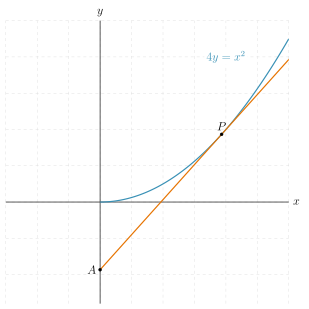
The midpoint of a rod of length \(2b\) slides on the curve \(y =\frac14 x^2\), \(x\ge0\), in such a way that the rod is always tangent, at its midpoint, to the curve. Show that the curve traced out by one end of the rod can be written in the form \begin{align*} x& = 2 \tan\theta - b \cos\theta \\ y& = \tan^2\theta - b \sin\theta \end{align*} for some suitably chosen angle \(\theta\) which satisfies \(0\le \theta < \frac12\pi\,\). When one end of the rod is at a point \(A\) on the \(y\)-axis, the midpoint is at point \(P\) and \(\theta = \alpha\). Let \(R\) be the region bounded by the following:
- the curve \(y=\frac14x^2\) between the origin and \(P\);
- the \(y\)-axis between \(A\) and the origin;
- the half-rod \(AP\).
Solution: At the point \((2t, t^2)\) the gradient is \(t\). Suppose \(\tan \theta = t\), then the point \(b\) away in each direction is \(\binom{2t}{t^2} \pm b \binom{\cos \theta}{\sin \theta}\), ie one end can be written in the form \((x,y) = (2\tan \theta - b \cos \theta, \tan^2 \theta - b \sin \theta)\). Notice we must have \(2\tan \alpha- b \cos \alpha= 0 \Rightarrow b = 2 \frac{\sin \alpha}{\cos ^2 \alpha}\), therefore the coordinates are \((2 \tan \alpha - 2 \tan \alpha, \tan^2 \alpha - 2\tan^2 \alpha) = (0, -\tan^2 \alpha)\) and \((4 \tan \alpha, 3\tan^2 \alpha)\)