Problems
Filters
62 problems found
2003 Paper 3 Q12
Brief interruptions to my work occur on average every ten minutes and the number of interruptions in any given time period has a Poisson distribution. Given that an interruption has just occurred, find the probability that I will have less than \(t\) minutes to work before the next interruption. If the random variable \(T\) is the time I have to work before the next interruption, find the probability density function of \(T\,\). I need an uninterrupted half hour to finish an important paper. Show that the expected number of interruptions before my first uninterrupted period of half an hour or more is \(\e^3-1\). Find also the expected length of time between interruptions that are less than half an hour apart. Hence write down the expected wait before my first uninterrupted period of half an hour or more.
2002 Paper 1 Q12
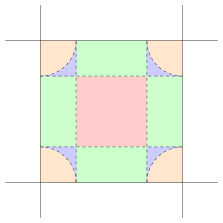
Harry the Calculating Horse will do any mathematical problem I set him, providing the answer is 1, 2, 3 or 4. When I set him a problem, he places a hoof on a large grid consisting of unit squares and his answer is the number of squares partly covered by his hoof. Harry has circular hoofs, of radius \(1/4\) unit. After many years of collaboration, I suspect that Harry no longer bothers to do the calculations, instead merely placing his hoof on the grid completely at random. I often ask him to divide 4 by 4, but only about \(1/4\) of his answers are right; I often ask him to add 2 and 2, but disappointingly only about \(\pi/16\) of his answers are right. Is this consistent with my suspicions? I decide to investigate further by setting Harry many problems, the answers to which are 1, 2, 3, or 4 with equal frequency. If Harry is placing his hoof at random, find the expected value of his answers. The average of Harry's answers turns out to be 2. Should I get a new horse?
Solution: Without loss of generality, let's assume that Harry is putting the center of his hoof within one square.
2002 Paper 1 Q13
The random variable \(U\) takes the values \(+1\), \(0\) and \(-1\,\), each with probability \(\frac13\,\). The random variable \(V\) takes the values \(+1\) and \(-1\) as follows:
| if \(U=1\,\), | then \(\P(V=1)= \frac13\) and \(\P(V=-1)=\frac23\,\); |
| if \(U=0\,\), | then \(\P(V=1)= \frac12\) and \(\P(V=-1)=\frac12\,\); |
| if \(U=-1\,\), | then \(\P(V=1)= \frac23\) and \(\P(V=-1)=\frac13\,\). |
- Show that the probability that both roots of the equation \(x^2+Ux+V=0\) are real is \(\frac12\;\).
- Find the expected value of the larger root of the equation \(x^2+Ux+V=0\,\), given that both roots are real.
- Find the probability that the roots of the equation $$x^3+(U-2V)x^2+(1-2UV)x + U=0$$ are all positive.
Solution:
- \(\,\) \begin{align*} && \mathbb{P}(\text{both roots real}) &= \mathbb{P}(\Delta \geq 0) \\ &&&= \mathbb{P}(U^2 \geq 4V) \\ &&&= \mathbb{P}(V = -1) \\ &&&= \tfrac13 ( \tfrac23 + \tfrac12 + \tfrac13) \\ &&&= \tfrac13 \cdot \tfrac 32 = \frac12 \end{align*}
- Our equations will be: \(x^2+x-1 = 0\) with larger root \(\frac{-1 + \sqrt{5}}{2}\) \(x^2-1 = 0\) with larger root \(1\) \(x^2-x-1 = 0\) with larger root \(\frac{1 + \sqrt5}{2}\) and the expected value is \begin{align*} && \E[\text{larger root}|\text{both real}] &= \frac23 \left ( \frac23 \cdot \frac{-1+\sqrt5}{2} + \frac12 \cdot 1 + \frac13 \cdot \frac{1+\sqrt5}{2} \right) \\ &&&= \frac23 \left ( \frac{2+3\sqrt5}{6} \right) \\ &&&= \frac{2+3\sqrt5}{9} \end{align*}
- Suppose we have \(x^3+(U-2V)x^2+(1-2UV)x + U = 0\), then for all roots to be positive, we need \(U < 0 \Rightarrow U = -1\) (otherwise there is a root at or below zero). Therefore our two possible cubics are: \(x^3 -3x^2+3x-1 = (x-1)^3\) (all roots positive) \(x^3+x^2-x-1 = (x-1)(x+1)^2\) (not all roots positive!) Therefore the probability is \(\frac13 \cdot \frac23 = \frac29\)
2001 Paper 2 Q12
The national lottery of Ruritania is based on the positive integers from \(1\) to \(N\), where \(N\) is very large and fixed. Tickets cost \(\pounds1\) each. For each ticket purchased, the punter (i.e. the purchaser) chooses a number from \(1\) to \(N\). The winning number is chosen at random, and the jackpot is shared equally amongst those punters who chose the winning number. A syndicate decides to buy \(N\) tickets, choosing every number once to be sure of winning a share of the jackpot. The total number of tickets purchased in this draw is \(3.8N\) and the jackpot is \(\pounds W\). Assuming that the non-syndicate punters choose their numbers independently and at random, find the most probable number of winning tickets and show that the expected net loss of the syndicate is approximately \[ N\; - \; %\textstyle{ \frac{5 \big(1- e^{-2.8}\big)}{14} \;W\;. \]
2000 Paper 2 Q12
Tabulated values of \({\Phi}(\cdot)\), the cumulative distribution function of a standard normal variable, should not be used in this question. Henry the commuter lives in Cambridge and his working day starts at his office in London at 0900. He catches the 0715 train to King's Cross with probability \(p\), or the 0720 to Liverpool Street with probability \(1-p\). Measured in minutes, journey times for the first train are \(N(55,25)\) and for the second are \(N(65,16)\). Journey times from King's Cross and Liverpool Street to his office are \(N(30,144)\) and \(N(25,9)\), respectively. Show that Henry is more likely to be late for work if he catches the first train. Henry makes \(M\) journeys, where \(M\) is large. Writing \(A\) for \(1-{\Phi}(20/13)\) and \(B\) for \(1-{\Phi}(2)\), find, in terms of \(A\), \(B\), \(M\) and \(p\), the expected number, \(L\), of times that Henry will be late and show that for all possible values of \(p\), $$BM \le L \le AM.$$ Henry noted that in 3/5 of the occasions when he was late, he had caught the King's Cross train. Obtain an estimate of \(p\) in terms of \(A\) and \(B\). [A random variable is said to be \(N\left({{\mu}, {\sigma}^2}\right)\) if it has a normal distribution with mean \({\mu}\) and variance \({\sigma}^2\).]
Solution: If Henry catches the first train, his journey time is \(N(55+30,25+144) = N(85,13^2)\). He is on time if the journey takes less than \(105\) minutes, \(\frac{20}{13}\) std above the mean. If he catches the second train, his journey times is \(N(65+25, 16+9) = N(90, 5^2)\). He is on time if his journey takes less than \(80\) minutes, ie \(\frac{10}{5} = 2\) standard deviations above the mean. This is more likely than from the first train. \(A = 1 - \Phi(20/13)\) is the probability he is late from the first train. \(B = 1 - \Phi(2)\) is the probability he is late from the second train. The expected number of lates is \(L = M \cdot p \cdot A + M \cdot (1-p) \cdot B\), since \(B \leq A\) we must have \(BM \leq L \leq AM\) \begin{align*} && \frac35 &= \frac{pA}{pA + (1-p)B} \\ \Rightarrow && 3(1-p)B &= 2pA \\ \Rightarrow && p(2A+3B) &= 3B \\ \Rightarrow && p &= \frac{3B}{2A+3B} \end{align*}
2000 Paper 3 Q12
In a lottery, any one of \(N\) numbers, where \(N\) is large, is chosen at random and independently for each player by machine. Each week there are \(2N\) players and one winning number is drawn. Write down an exact expression for the probability that there are three or fewer winners in a week, given that you hold a winning ticket that week. Using the fact that $$ {\biggl( 1 - {a \over n} \biggr) ^n \approx \e^{-a}}$$ for \(n\) much larger than \(a\), or otherwise, show that this probability is approximately \({2 \over 3}\) . Discuss briefly whether this probability would increase or decrease if the numbers were chosen by the players. Show that the expected number of winners in a week, given that you hold a winning ticket that week, is \( 3-N^{-1}\).
1999 Paper 1 Q14
When I throw a dart at a target, the probability that it lands a distance \(X\) from the centre is a random variable with density function \[ \mathrm{f}(x)=\begin{cases} 2x & \text{ if }0\leqslant x\leqslant1;\\ 0 & \text{ otherwise.} \end{cases} \] I score points according to the position of the dart as follows: %
- Show that my expected score from one dart is 15/8.
- I play a game with the following rules. I start off with a total score 0, and each time~I throw a dart my score on that throw is added to my total. Then: \newline \hspace*{10mm} if my new total is greater than 3, I have lost and the game ends; \newline \hspace*{10mm} if my new total is 3, I have won and the game ends; \newline \hspace*{10mm} if my new total is less than 3, I throw again. Show that, if I have won such a game, the probability that I threw the dart three times is 343/2231.
1999 Paper 2 Q14
You play the following game. You throw a six-sided fair die repeatedly. You may choose to stop after any throw, except that you must stop if you throw a 1. Your score is the number obtained on your last throw. Determine the strategy that you should adopt in order to maximize your expected score, explaining your reasoning carefully.
Solution: Once you have thrown, all previous throws are irrelevant so the only thing which can affect your decision is the current throw. Therefore the strategy must consist of a list of states we re-throw from, and a list of states we stick on. It must also be the case that if we stick on \(k\) we stick on \(k+1\) (otherwise we can improve our strategy by switching those two values around). Therefore we can form a table of our expected score: \begin{array}{c|c|c} \text{stop on} & \text{possible outcomes} & \E[\text{score}] \\ \hline \geq 2 & \{1,2,3,4,5,6\} & \frac{21}{6} = 3.5 \\ \geq 3 & \{1,3,4,5,6\} & \frac{19}{5} = 3.8 \\ \geq 4 & \{1,4,5,6\} & \frac{16}{4} = 4 \\ \geq 5 & \{1,5,6\} & \frac{12}{3} = 4 \\ =6 & \{1,6\} & \frac{7}{2} = 3.5 \end{array} Therefore the optimal strategy is to stop on \(4\) or higher. If we cared about variance we might look at the variance of the two best strategies, \(4\) or higher has a variance of \(\frac{1+16+25+36}{4} - 16 = 3.5\) and \(5\) or higher has a variance of \(\frac{1+25+36}3 - 16 = \frac{14}3 > 3.5\) so \(4\) or higher is probably better in most scenarios.
1999 Paper 3 Q13
The cakes in our canteen each contain exactly four currants, each currant being randomly placed in the cake. I take a proportion \(X\) of a cake where \(X\) is a random variable with density function \[{\mathrm f}(x)=Ax\] for \(0\leqslant x\leqslant 1\) where \(A\) is a constant.
- What is the expected number of currants in my portion?
- If I find all four currants in my portion, what is the probability that I took more than half the cake?
1999 Paper 3 Q14
In the basic version of Horizons (H1) the player has a maximum of \(n\) turns, where \(n \ge 1\). At each turn, she has a probability \(p\) of success, where \(0 < p < 1\). If her first success is at the \(r\)th turn, where \(1 \le r \le n\), she collects \(r\) pounds and then withdraws from the game. Otherwise, her winnings are nil. Show that in H1, her expected winnings are $$ p^{-1}\left[1+nq^{n+1}-(n+1)q^n\right]\quad\hbox{pounds}, $$ where \(q=1-p\). The rules of H2 are the same as those of H1, except that \(n\) is randomly selected from a Poisson distribution with parameter \(\lambda\). If \(n=0\) her winnings are nil. Otherwise she plays H1 with the selected \(n\). Show that in H2, her expected winnings are $$ {1 \over p}{\left(1-{\e^{-{\lambda}p}}\right)} -{{\lambda}q}{\e^{-{\lambda}p}} \quad\hbox{pounds}. $$
Solution: \begin{align*} && \E[H1] &= \sum_{r=1}^n r \cdot \mathbb{P}(\text{first success on }r\text{th turn}) \\ &&&= \sum_{r=1}^n r \cdot q^{r-1}p \\ &&&= p\sum_{r=1}^n r q^{r-1} \\ \\ && \frac{1-x^{n+1}}{1-x} &= \sum_{r=0}^n x^r \\ \Rightarrow && \sum_{r=1}^n r x^{r-1} &= \frac{-(n+1)x^n(1-x) +(1-x^{n+1})}{(1-x)^2} \\ &&&= \frac{1-(n+1)x^n+nx^{n+1}}{(1-x)^2} \\ \\ && \E[H1] &= p\sum_{r=1}^n r q^{r-1} \\ &&&= p\frac{1-(n+1)q^n+nq^{n+1}}{(1-q)^2} \\ &&&= p^{-1}(1-(n+1)q^{n} + nq^{n+1}) \end{align*} Not that if \(n =0\) , the formula for \(\E[H1] = 0\). So \begin{align*} && \E[H2] &= \E[\E[H1|n=N]] \\ &&&= p^{-1}\E \left [ 1-(N+1)q^{N} + Nq^{N+1}\right] \\ &&&= p^{-1}\E \left [ 1-((1-q)N+1)q^{N} \right] \\ &&&= p^{-1}\left (1 - p\E[Nq^N] - G_{Po(\lambda)}(q) \right) \\ &&&= p^{-1}(1-e^{-\lambda(1-q)}) - \E[Nq^N] \\ &&&= p^{-1}(1-e^{-\lambda(1-q)}) - q\lambda e^{-\lambda(1-q)} \\ &&&= p^{-1}(1-e^{-\lambda p}) - q\lambda e^{-\lambda p} \end{align*}
1998 Paper 1 Q14
To celebrate the opening of the financial year the finance minister of Genland flings a Slihing, a circular coin of radius \(a\) cm, where \(0 < a < 1\), onto a large board divided into squares by two sets of parallel lines 2 cm apart. If the coin does not cross any line, or if the coin covers an intersection, the tax on yaks remains unchanged. Otherwise the tax is doubled. Show that, in order to raise most tax, the value of \(a\) should be \[\left(1+{\displaystyle \frac{\pi}{4}}\right)^{-1}.\] If, indeed, \(a=\left(1+{\displaystyle \frac{\pi}{4}}\right)^{-1}\) and the tax on yaks is 1 Slihing per yak this year, show that its expected value after \(n\) years will have passed is \[ \left(\frac{8+\pi}{4+\pi}\right)^{n}.\]
1998 Paper 2 Q14
The staff of Catastrophe College are paid a salary of \(A\) pounds per year. With a Teaching Assessment Exercise impending it is decided to try to lower the student failure rate by offering each lecturer an alternative salary of \(B/(1+X)\) pounds, where \(X\) is the number of his or her students who fail the end of year examination. Dr Doom has \(N\) students, each with independent probability \(p\) of failure. Show that she should accept the new salary scheme if $$A(N+1)p < B(1-(1-p)^{N+1}).$$ Under what circumstances could \(X\), for Dr Doom, be modelled by a Poisson random variable? What would Dr Doom's expected salary be under this model?
Solution: \begin{align*} && \E[\text{salary}] &= B\sum_{k=0}^N \frac{1}{1+k}\binom{N}{k}p^k(1-p)^{N-k} \\ \\ && (q+x)^N &= \sum_{k=0}^N \binom{N}{k}x^kq^{N-k} \\ \Rightarrow && \int_0^p(q+x)^N \d x &= \sum_{k=0}^N \binom{N}{k} \frac{p^{k+1}}{k+1}q^{N-k} \\ && \frac{(q+p)^{N+1}-q^{N+1}}{N+1} &= \frac{p}{B} \E[\text{salary}] \\ \Rightarrow && \E[\text{salary}] &= B\frac{1-q^{N+1}}{p(N+1)} \end{align*} Therefore if \(Ap(N+1) < B(1-(1-p)^{N+1})\) the expected value of the new salary is higher. (Whether or not the new salary is worth it in a risk adjusted sense is for the birds). We could model \(X\) by a Poisson random variable if \(N\) is large and \(Np = \lambda \) is small. Suppose \(X \approx Po(\lambda)\) then \begin{align*} \E \left [\frac{B}{1+X} \right] &= B\sum_{k=0}^\infty \frac{1}{1+k}\frac{e^{-\lambda}\lambda^k}{k!} \\ &= \frac{B}{\lambda} \sum_{k=0}^\infty e^{-\lambda} \frac{\lambda^{k+1}}{(k+1)!} \\ &= \frac{B}{\lambda}e^{-\lambda}(e^{\lambda}-1) \\ &= \frac{B(1-e^{-\lambda})}{\lambda} = B \frac{1-e^{-Np}}{Np} \end{align*}
1998 Paper 3 Q14
A hostile naval power possesses a large, unknown number \(N\) of submarines. Interception of radio signals yields a small number \(n\) of their identification numbers \(X_i\) (\(i=1,2,...,n\)), which are taken to be independent and uniformly distributed over the continuous range from \(0\) to \(N\). Show that \(Z_1\) and \(Z_2\), defined by $$ Z_1 = {n+1\over n} {\max}\{X_1,X_2,...,X_n\} \hspace{0.3in} {\rm and} \hspace{0.3in} Z_2 = {2\over n} \sum_{i=1}^n X_i \;, $$ both have means equal to \(N\). Calculate the variance of \(Z_1\) and of \(Z_2\). Which estimator do you prefer, and why?
1997 Paper 1 Q13
Mr Blond returns to his flat to find it in complete darkness. He knows that this means that one of four assassins Mr 1, Mr 2, Mr 3 or Mr 4 has set a trap for him. His trained instinct tells him that the probability that Mr \(i\) has set the trap is \(i/10\). His knowledge of their habits tells him that Mr \(i\) uses a deadly trained silent anaconda with probability \((i+1)/10\), a bomb with probability \(i/10\) and a vicious attack canary with probability \((9-2i)/10\) \([i=1,2,3,4]\). He now listens carefully and, hearing no singing, concludes correctly that no canary is involved. If he switches on the light and the trap is a bomb he has probability \(1/2\) of being killed but if the trap is an anaconda he has probability \(2/3\) of survival. If he does not switch on the light and the trap is a bomb he is certain to survive but, if the trap is an anaconda, he has a probability \(1/2\) of being killed. His professional pride means that he must enter the flat. Advise Mr Blond, giving reasons for your advice.
Solution: \begin{array}{c|c|c|c} & A & B & C \\ \hline 1 & \frac{1}{10} \cdot \frac{2}{10} & \frac{1}{10} \cdot \frac{1}{10} & \frac{1}{10} \cdot \frac{7}{10} \\ 2 & \frac{2}{10} \cdot \frac{3}{10} &\frac{2}{10} \cdot \frac{2}{10} &\frac{2}{10} \cdot \frac{5}{10} \\ 3 & \frac{3}{10} \cdot \frac{4}{10} &\frac{3}{10} \cdot \frac{3}{10} &\frac{3}{10} \cdot \frac{3}{10} \\ 4 & \frac{4}{10} \cdot \frac{5}{10} &\frac{4}{10} \cdot \frac{4}{10} &\frac{4}{10} \cdot \frac{1}{10} \\ \hline & \frac{2+6+12+20}{100} & \frac{1 + 4 + 9 + 16}{100} & \frac{7 + 10 + 9 + 4}{100} \end{array} Therefore \(\mathbb{P}(A) = \frac{4}{10}, \mathbb{P}(B) = \frac{3}{10}, \mathbb{P}(C) = \frac{3}{10}\), in particular, \begin{align*} \mathbb{P}(A | \text{not }C) &= \frac{4}{7} \\ \mathbb{P}(B | \text{not }C) &= \frac{3}{7} \\ \end{align*} If he switches the light on, his probability of survival is \(\frac47 \cdot \frac23 + \frac37 \cdot \frac12 = \frac{25}{42}\), if he doesn't his probability is \(\frac12 \cdot \frac47 +\frac37= \frac{5}{7} = \frac{30}{42}\) therefore he shouldn't switch the light on.
1997 Paper 2 Q12
The game of Cambridge Whispers starts with the first participant Albert flipping an un-biased coin and whispering to his neighbour Bertha whether it fell `heads' or `tails'. Bertha then whispers this information to her neighbour, and so on. The game ends when the final player Zebedee whispers to Albert and the game is won, by all players, if what Albert hears is correct. The acoustics are such that the listeners have, independently at each stage, only a probability of 2/3 of hearing correctly what is said. Find the probability that the game is won when there are just three players. By considering the binomial expansion of \((a+b)^n+(a-b)^n\), or otherwise, find a concise expression for the probability \(P\) that the game is won when is it played by \(n\) players each having a probability \(p\) of hearing correctly. % Show in particular that, if \(n\) is even, %\(P(n,1/10) = P(n,9/10)\).% How do you explain this apparent anomaly? To avoid the trauma of a lost game, the rules are now modified to require Albert to whisper to Bertha what he hears from Zebedee, and so keep the game going, if what he hears from Zebedee is not correct. Find the expected total number of times that Albert whispers to Bertha before the modified game ends. \noindent [You may use without proof the fact that \(\sum_1^\infty kx^{k-1}=(1-x)^{-2}\) for \(\vert x\vert<1\).]