Problems
Filters
37 problems found
1995 Paper 2 Q10
Three small spheres of masses \(m_{1},m_{2}\) and \(m_{3},\) move in a straight line on a smooth horizontal table. (Their order on the straight line is the order given.) The coefficient of restitution between any two spheres is \(e\). The first moves with velocity \(u\) towards the second whilst the second and third are at rest. After the first collision the second sphere hits the third after which the velocity of the second sphere is \(u.\) Find \(m_{1}\) in terms of \(m_{2},m_{3}\) and \(e\). deduce that \[ m_{2}e>m_{3}(1+e+e^{2}). \] Suppose that the relation between \(m_{1},m_{2}\) and \(m_{3}\) is that in the formula you found above, but that now the first sphere initially moves with velocity \(u\) and the other two spheres with velocity \(v\), all in the same direction along the line. If \(u>v>0\) use the first part to find the velocity of the second sphere after two collisions have taken place. (You should not need to make any substantial computations but you should state your argument clearly.)
1992 Paper 3 Q12
\(\,\)
1991 Paper 1 Q13
\(\ \)\vspace{-1.5cm} \noindent
1990 Paper 1 Q11
A shell of mass \(m\) is fired at elevation \(\pi/3\) and speed \(v\). Superman, of mass \(2m\), catches the shell at the top of its flight, by gliding up behind it in the same horizontal direction with speed \(3v\). As soon as Superman catches the shell, he instantaneously clasps it in his cloak, and immediately pushes it vertically downwards, without further changing its horizontal component of velocity, but giving it a downward vertical component of velocity of magnitude \(3v/2\). Calculate the total time of flight of the shell in terms of \(v\) and \(g\). Calculate also, to the nearest degree, the angle Superman's flight trajectory initially makes with the horizontal after releasing the shell, as he soars upwards like a bird. {[}Superman and the shell may be regarded as particles.{]}
Solution: The particle has initial velocity \(\displaystyle \binom{v \cos \frac{\pi}{3}}{v \sin \frac{\pi}{3}}\) and acceleration \(\displaystyle \binom{0}{-g}\). It will have zero vertical speed (ie be at the top of its trajectory) when \(t = \frac{\sqrt{3}v}{2g}\). Since \(0 = v^2-u^2 + 2as\) the height achieved will be \(\frac{3v^2}{8g}\) At this point it will need to travel the same distance again, but this time the initial speed is \(\frac{3v}{2}\) so: \begin{align*} && \frac{3v^2}{8g} &= \frac{3v}{2} t + \frac12 g t^2 \\ \Rightarrow && 0 &= 4g^2t^2+12vgt - 3v^2 \\ \Rightarrow && t &= \l \frac{-3+2\sqrt{3}}{2} \r \frac{v}{g} \end{align*} Therefore the total time is: \begin{align*} \l \frac{\sqrt{3}}{2} - \frac32 + \sqrt{3} \r \frac{v}{g} &= \frac{3\sqrt{3}-3}{2}\frac{v}{g} \end{align*} \begin{align*} COM(\uparrow): && 0 &= 2m v_y - m \frac{3}{2}v \\ \Rightarrow &&v_y &= \frac34 v \\ COM(\rightarrow): && 3mV &= 2m (3v) +m \frac{v}{2} \\ \Rightarrow && V &= \frac{13}6\\ \end{align*} Therefore superman is now travelling at a vector of \(\displaystyle \binom{\frac{13}6}{\frac34}v\) ie an angle of \(\tan^{-1} \frac 9{26}\) to the horizontal, approximately \(19^\circ\)
1990 Paper 2 Q14
The identical uniform smooth spherical marbles \(A_{1},A_{2},\ldots,A_{n},\) where \(n\geqslant3,\) each of mass \(m,\) lie in that order in a smooth straight trough, with each marble touching the next. The marble \(A_{n+1},\) which is similar to \(A_{n}\) but has mass \(\lambda m,\) is placed in the trough so that it touches \(A_{n}.\) Another marble \(A_{0},\) identical to \(A_{n},\) slides along the trough with speed \(u\) and hits \(A_{1}.\) It is given that kinetic energy is conserved throughout.
- Show that if \(\lambda<1,\) there is a possible subsequent motion in which only \(A_{n}\) and \(A_{n+1}\) move (and \(A_{0}\) is reduced to rest), but that if \(\lambda>1,\) such a motion is not possible.
- If \(\lambda>1,\) show that a subsequent motion in which only \(A_{n-1},A_{n}\) and \(A_{n+1}\) move is not possible.
- If \(\lambda>1,\) find a possible subsequent motion in which only two marbles move.
Solution: Without loss of generality, let \(m = u = 1\).
- \begin{align*} \text{COM}: && 1&= v_n + \lambda v_{n+1} \\ && &= v_n + \lambda v_{n+1}\\ \text{COE}: && \frac12 &= \frac12 v_n^2 + \frac12 \lambda v_{n+1}^2 \\ && 1 &= v_n^2 +\lambda v_{n+1}^2 \\ \\ \Rightarrow && v_n^2 + 2\lambda v_n v_{n+1} + \lambda^2 v_{n+1}^2 &= v_n^2 + \lambda v_{n+1}^2 \\ && \lambda v_{n+1}^2 &= v_{n+1}^2 - 2 v_n v_{n+1} \\ && \lambda v_{n+1} &= (v_{n+1} - 2v_n) \\ && (1-\lambda)v_{n+1} &= 2v_n \end{align*} Since \(v_{n+1} > v_n > 0\) this is only possible if \(\lambda < 1\)
- \begin{align*} \text{COM}: && 1&= v_{n-1}+v_n+\lambda v_{n+1} \\ && 1&= v_{n-1} + v_n + \lambda v_{n+1} \\ \text{COE}: && \frac12 &= \frac12 v_{n-1}^2+\frac12v_n^2+\frac12\lambda v_{n+1}^2 \\ && 1&= v_{n-1}^2 + v_n^2 + \lambda v_{n+1}^2 \\ \\ \Rightarrow && 1 &= v_{n-1}^2 + v_n^2 + \lambda \frac{(1-v_{n-1}-v_n)^2}{\lambda^2} \\ &&&= v_{n-1}^2 + v_n^2 + \frac{(1-v_{n-1}-v_n)^2}{\lambda} \\ \Rightarrow && 1 &< v_{n-1}^2 + v_n^2 + (1-v_{n-1}-v_n)^2 \\ &&&= 2v_{n-1}^2+2v_n^2 + 1-2v_{n-1}-2v_{n-2} +2v_{n-1}v_n\\ \Rightarrow && v_{n-1}+v_n & <(v_{n-1}+v_n)^2 - v_{n-1}v_n \end{align*} but this cannot be true since \(0 < v_{n-1}+v_n < 1\) and \(v_n v_{n-1} > 0\)
- The only way this is possible is if the first and last marble are moving. \begin{align*} \text{COM}: && 1 &= v_0 +\lambda v_{n+1} \\ \text{COE}: && \frac12 &= \frac12 v_0^2 + \frac12 \lambda^2 v_{n+1} \\ && 1 &= v_0^2 + \lambda v_{n+1}^2 \\ \Rightarrow && 2v_0 + \lambda v_{n+1} &= v_{n+1} \\ \Rightarrow && v_{n+1} &=\frac{2}{1-\lambda} v_0 \\ \Rightarrow && v_0 &= \frac{1-\lambda}{1+\lambda} \\ && v_{n+1} &= \frac{2}{1+\lambda} \end{align*} which will work since \(v_0\) can travel backwards.
1990 Paper 3 Q12
A uniform smooth wedge of mass \(m\) has congruent triangular end faces \(A_{1}B_{1}C_{1}\) and \(A_{2}B_{2}C_{2},\) and \(A_{1}A_{2},B_{1}B_{2}\) and \(C_{1}C_{2}\) are perpendicular to these faces. The points \(A,B\) and \(C\) are the midpoints of \(A_{1}A_{2},B_{1}B_{2}\) and \(C_{1}C_{2}\) respectively. The sides of the triangle \(ABC\) have lengths \(AB=AC=5a\) and \(BC=6a.\) The wedge is placed with \(BC\) on a smooth horizontal table, a particle of mass \(2m\) is placed at \(A\) on \(AC,\) and the system is released from rest. The particle slides down \(AC,\) strikes the table, bounces perfectly elastically and lands again on the table at \(D\). At this time the point \(C\) of the wedge has reached the point \(E\). Show that \(DE=\frac{192}{19}a.\)
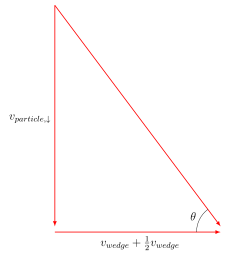
Solution: Conservation of energy, tells us that \(2m \cdot g \cdot 4a = 8amg\) is equal to \(\frac12 m v_{wedge}^2 + \frac12(2m)v_{particle}^2\). Conservation of momentum (horizontally) tells us that \(m v_{wedge}+2mv_{particle, \rightarrow} = 0 \Rightarrow v_{particle, \rightarrow} = -\frac12 v_{wedge}\).
1989 Paper 2 Q11
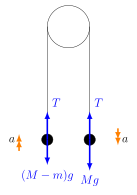
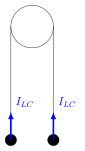
A lift of mass \(M\) and its counterweight of mass \(M\) are connected by a light inextensible cable which passes over a light frictionless pulley. The lift is constrained to move vertically between smooth guides. The distance between the floor and the ceiling of the lift is \(h\). Initially, the lift is at rest, and the distance between the top of the lift and the pulley is greater than \(h\). A small tile of mass \(m\) becomes detached from the ceiling of the lift. Show that the time taken for it to fall to the floor is \[ t=\sqrt{\frac{\left(2M-m\right)h}{Mg}}. \] The collision between the tile and the lift floor is perfectly inelastic. Show that the lift is reduced to rest by the collision, and that the loss of energy of the system is \(mgh\). Note: the question on the STEP database is \[ t=\sqrt{\frac{2\left(M-m\right)h}{Mg}}. \]
Solution: