Problems
Filters
39 problems found
2011 Paper 2 Q3
In this question, you may assume without proof that any function \(\f\) for which \(\f'(x)\ge 0\) is increasing; that is, \(\f(x_2)\ge \f(x_1)\) if \(x_2\ge x_1\,\).
- Let \(\f(x) =\sin x -x\cos x\). Show that \(\f(x)\) is increasing for \(0\le x \le \frac12\pi\,\) and deduce that \(\f(x)\ge 0\,\) for \(0\le x \le \frac12\pi\,\).
- Given that \(\dfrac{\d}{\d x} (\arcsin x) \ge1\) for \(0\le x< 1\), show that \[ \arcsin x\ge x \quad (0\le x < 1). \]
- Let \(\g(x)= x\cosec x\, \text{ for }0< x < \frac12\pi\). Show that \(\g\) is increasing and deduce that \[ ({\arcsin x})\, x^{-1} \ge x\,{\cosec x} \quad (0 < x < 1). \]
- Given that $\dfrac{\d}{\d x} (\arctan x)\le 1\text{ for }x\ge 0$, show by considering the function \(x^{-1} \tan x\) that \[ (\tan x)( \arctan x) \ge x^2 \quad (0< x < \tfrac12\pi). \]
Solution:
- Given \(\frac{\d}{\d x} (\arctan x) \leq 1\) we must have \(\frac{\d}{ \d x} (x-\arctan x) \geq 0\) for \(x \geq 0\), but since \( 0 - \arctan 0 = 0\) this means that \(x - \arctan x \geq 0\), ie \( \arctan x \geq x\) for \(x \geq 0\) \(g(x) = x^{-1} \tan x \Rightarrow g'(x) = -x^{-2}\tan x +x^{-1} \sec^2 x\). If we can show \(f(x) = x \sec ^2 x - \tan x\) is positive that would be great. However \(f'(x) = x 2 \tan x \sec^2 x \geq 0\) and \(f(0) = 0\) so \(f(x)\) is positive and \(g'(x)\) is positive and hence increasing, therefore \(g(x) \geq g(\arctan x) \Rightarrow \frac{\tan x}{x} \geq \frac{x}{\arctan x}\) from which the result follows.
2011 Paper 2 Q4
- Find all the values of \(\theta\), in the range \(0^\circ < \theta < 180^\circ\), for which \(\cos\theta=\sin 4\theta\). Hence show that \[ \sin 18^\circ = \frac14\left( \sqrt 5 -1\right). \]
- Given that \[ 4\sin^2 x + 1 = 4\sin^2 2x \,, \] find all possible values of \(\sin x\,\), giving your answers in the form \(p+q\sqrt5\) where \(p\) and \(q\) are rational numbers.
- Hence find two values of \(\alpha\) with \(0^\circ < \alpha < 90^\circ\) for which \[ \sin^23\alpha + \sin^25\alpha = \sin^2 6\alpha\,. \]
Solution:
- Note that \(\cos \theta = \sin (90^\circ - \theta)\) so \begin{align*} && \sin(90^\circ - \theta) &= \sin 4 \theta\\ && 90^\circ - \theta &= 4\theta +360^{\circ}k \\ && 90^\circ + \theta &= 4\theta +360^{\circ}k \\ \Rightarrow && 5\theta &= 90^\circ, 450^\circ, 810^\circ, \cdots \\ && 3 \theta &= 90^\circ, 450^\circ, \cdots \\ \Rightarrow && \theta &= 18^\circ, 90^\circ, 162^\circ, \ldots \\ && \theta &= 30^\circ, 150^\circ, \ldots \end{align*} Therefore \(\theta = 8^\circ, 30^\circ, 90^\circ, 150^\circ, 162^\circ\). Note also that: \begin{align*} && 0 &= \sin 4 \theta - \cos \theta \\ &&&= 2 \sin 2 \theta \cos 2 \theta- \cos \theta \\ &&&= 4 \sin \theta \cos \theta \cos 2 \theta - \cos \theta \\ &&&= \cos \theta \left (4 \sin \theta (1- 2\sin^2 \theta) - 1 \right) \\ &&&= \cos \theta \left (-8\sin^3 \theta +4\sin \theta - 1 \right) \\ &&&= \cos \theta (1 - 2 \sin \theta)(4 \sin^2 \theta+2\sin \theta -1)\\ \cos \theta = 0: && \theta &= 90^\circ \\ \sin \theta = \frac12: && \theta &= 30^{\circ} \\ && \theta &= \sin^{-1} \left ( \frac{-1\pm \sqrt5}{4} \right) \end{align*} Therefore \(\sin 18^{\circ} = \frac{\pm \sqrt{5}-1}{4}\), but since \(\sin 18^{\circ} > 0\) it must be the positive version.
- \(\,\) \begin{align*} && 4 \sin^2 x + 1 &= 4 \sin^2 2 x \\ &&&= 16 \sin^2 x \cos^2 x \\ &&&= 16 \sin^2 x (1- \sin^2 x) \\ \Rightarrow && 0 &= 16y^2 -12y+1 \\ \Rightarrow && \sin^2 x &= \frac{3\pm \sqrt5}{8} \\ &&&= \left ( \frac{1 \pm \sqrt5}{4} \right)^2 \\ \Rightarrow && \sin x &= \pm \frac{1 \pm \sqrt{5}}{4} \end{align*}
- \(\,\) \begin{align*} && \sin^2 x + \frac1{2^2} &= \sin^2 2x \end{align*} So if we can have \(\sin 5x = \pm \frac12\) and \(\sin 3x = \pm \frac{1 \pm \sqrt5}{4}\) then we are good, ie \begin{align*} && 5x &= 30^{\circ}, 150^{\circ}, 210^{\circ}, 330^{\circ}, 390^{\circ}, \cdots \\ \Rightarrow && x &= 6^{\circ}, 30^{\circ}, 42^{\circ}, 66^{\circ}, 78^{\circ} \\ \Rightarrow && 3x &= \boxed{18^{\circ}}, \cancel{90^{\circ}}, \boxed{126^{\circ}}, \boxed{198^{\circ}}, \boxed{78^{\circ}} \end{align*} So our solutions are \(x = 6^{\circ}, 42^{\circ}, 66^{\circ}, 78^{\circ}\) although it's interesting to note that \(x = 45^{\circ}\) is another solution
2011 Paper 2 Q5
The points \(A\) and \(B\) have position vectors \(\bf a \) and \(\bf b\) with respect to an origin \(O\), and \(O\), \(A\)~and~\(B\) are non-collinear. The point \(C\), with position vector \(\bf c\), is the reflection of \(B\) in the line through \(O\) and \(A\). Show that \(\bf c\) can be written in the form \[ \bf c = \lambda \bf a -\bf b \] where \(\displaystyle \lambda = \frac{2\,{\bf a .b}}{{\bf a.a}}\). The point \(D\), with position vector \(\bf d\), is the reflection of \(C\) in the line through \(O\) and \(B\). Show that \(\bf d\) can be written in the form \[ \bf d = \mu\bf b - \lambda \bf a \] for some scalar \(\mu\) to be determined. Given that \(A\), \(B\) and \(D\) are collinear, find the relationship between \(\lambda\) and \(\mu\). In the case \(\lambda = -\frac12\), determine the cosine of \(\angle AOB\) and describe the relative positions of \(A\), \(B\) and \(D\).
2011 Paper 2 Q6
For any given function \(\f\), let \[ I = \int [\f'(x)]^2 \,[\f(x)]^n \d x\,, \tag{\(*\)} \] where \(n\) is a positive integer. Show that, if \(\f(x)\) satisfies \(\f''(x) =k \f(x)\f'(x)\) for some constant \(k\), then (\(*\)) can be integrated to obtain an expression for \(I\) in terms of \(\f(x)\), \(\f'(x)\), \(k\) and \(n\).
- Verify your result in the case \(\f(x) = \tan x\,\). Hence find \[ \displaystyle \int \frac{\sin^4x}{\cos^{8}x} \, \d x\;. \]
- Find \[ \displaystyle \int \sec^2x\, (\sec x + \tan x)^6\,\d x\;. \]
Solution: If \(f''(x) = kf(x)f'(x)\) then we can see \begin{align*} && I &= \int [\f'(x)]^2 \,[\f(x)]^n \d x \\ &&&= \int f'(x) \cdot f'(x) [f(x)]^n \d x \\ &&&= \left[ f'(x) \cdot \frac{[f(x)]^{n+1}}{n+1} \right] - \int f''(x) \frac{[f(x)]^{n+1}}{n+1} \d x \\ &&&= \frac{1}{n+1} \left (f'(x) [f(x)]^{n+1} - \int kf'(x) [f(x)]^{n+2} \d x \right) \\ &&&= \frac{1}{n+1} \left (f'(x) [f(x)]^{n+1} - k \frac{[f(x)]^{n+3}}{n+3} \right) +C\\ &&&= \frac{[f(x)]^{n+1}}{n+1} \left ( f'(x) - \frac{k[f(x)]^2}{n+3} \right) + C \end{align*}
- If \(f(x) = \tan x, f'(x) = \sec^2 x, f''(x) = 2 \sec^2 x \tan x = 2 \cdot f(x) \cdot f'(x)\), so \(\tan\) satisfies the conditions for the theorem. \begin{align*} && I &= \int \sec^4 x \tan^n x \d x \\ &&&= \left [\sec^2x \cdot \frac{\tan^{n+1} x}{n+1} \right] - \int 2 \sec^2 x \tan x \cdot \frac{\tan^{n+1} x}{n+1} \d x \\ &&&= \left [\sec^2x \cdot \frac{\tan^{n+1} x}{n+1} \right] - 2 \cdot \frac{\tan^{n+3} x}{(n+1)(n+3)} \\ \end{align*} So \begin{align*} && I &= \int \frac{\sin^4 x}{\cos^8 x} \d x \\ &&&= \int \tan^4 x \sec^4 x \d x \\ &&&= \int [\sec^2 x]^2 [\tan x]^4 \d x \\ &&&= \frac{\tan^{5}x}{5} \left ( \sec^2 x - \frac{2 \tan^2 x}{7} \right) + C \end{align*}
- \begin{align*} && I &= \int \sec^2x\, (\sec x + \tan x)^6\,\d x \\ &&&= \int (\sec x (\sec x + \tan x))^2 \cdot (\sec x + \tan x )^4 \d x \\ &&&= \frac{(\sec x + \tan x)^5}{5} \left ( \sec x (\sec x + \tan x) - \frac{(\sec x + \tan x)^2}{7} \right) + C \end{align*}
2011 Paper 2 Q7
The two sequences \(a_0\), \(a_1\), \(a_2\), \(\ldots\) and \(b_0\), \(b_1\), \(b_2\), \(\ldots\) have general terms \[ a_n = \lambda^n +\mu^n \text { \ \ \ and \ \ \ } b_n = \lambda^n - \mu^n\,, \] respectively, where \(\lambda = 1+\sqrt2\) and \(\mu= 1-\sqrt2\,\).
- Show that $\displaystyle \sum_{r=0}^nb_r = -\sqrt2 + \frac 1 {\sqrt2} \,a_{\low n+1}\,$, and give a corresponding result for \(\displaystyle \sum_{r=0}^na_r\,\).
- Show that, if \(n\) is odd, $$\sum_{m=0}^{2n}\left( \sum_{r=0}^m a_{\low r}\right) = \tfrac12 b_{n+1}^2\,,$$ and give a corresponding result when \(n\) is even.
- Show that, if \(n\) is even, $$\left(\sum_{r=0}^na_r\right)^{\!2} -\sum_{r=0}^n a_{\low 2r+1} =2\,,$$ and give a corresponding result when \(n\) is odd.
2011 Paper 2 Q8
The end \(A\) of an inextensible string \(AB\) of length \(\pi\) is attached to a point on the circumference of a fixed circle of unit radius and centre \(O\). Initially the string is straight and tangent to the circle. The string is then wrapped round the circle until the end \(B\) comes into contact with the circle. The string remains taut during the motion, so that a section of the string is in contact with the circumference and the remaining section is straight. Taking \(O\) to be the origin of cartesian coordinates with \(A\) at \((-1,0)\) and \(B\) initially at \((-1, \pi)\), show that the curve described by \(B\) is given parametrically by \[ x= \cos t + t\sin t\,, \ \ \ \ \ \ y= \sin t - t\cos t\,, \] where \(t\) is the angle shown in the diagram.
2011 Paper 2 Q9
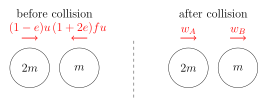
Two particles, \(A\) of mass \(2m\) and \(B\) of mass \(m\), are moving towards each other in a straight line on a smooth horizontal plane, with speeds \(2u\) and \(u\) respectively. They collide directly. Given that the coefficient of restitution between the particles is \(e\), where \(0 < e \le 1\), determine the speeds of the particles after the collision. After the collision, \(B\) collides directly with a smooth vertical wall, rebounding and then colliding directly with \(A\) for a second time. The coefficient of restitution between \(B\) and the wall is \(f\), where \(0 < f \le 1\). Show that the velocity of \(B\) after its second collision with \(A\) is \[ \tfrac23 (1-e^2)u - \tfrac13(1-4e^2)fu \] towards the wall and that \(B\) moves towards (not away from) the wall for all values of \(e\) and \(f\).
Solution:

2011 Paper 2 Q10
A particle is projected from a point on a horizontal plane, at speed \(u\) and at an angle~\(\theta\) above the horizontal. Let \(H\) be the maximum height of the particle above the plane. Derive an expression for \(H\) in terms of \(u\), \(g\) and \(\theta\). A particle \(P\) is projected from a point \(O\) on a smooth horizontal plane, at speed \(u\) and at an angle~\(\theta\) above the horizontal. At the same instant, a second particle \(R\) is projected horizontally from \(O\) in such a way that \(R\) is vertically below \(P\) in the ensuing motion. A light inextensible string of length \(\frac12 H\) connects \(P\) and \(R\). Show that the time that elapses before the string becomes taut is \[ (\sqrt2 -1)\sqrt{H/g\,}\,. \] When the string becomes taut, \(R\) leaves the plane, the string remaining taut. Given that \(P\) and \(R\) have equal masses, determine the total horizontal distance, \(D\), travelled by \(R\) from the moment its motion begins to the moment it lands on the plane again, giving your answer in terms of \(u\), \(g\) and \(\theta\). Given that \(D=H\), find the value of \(\tan\theta\).
2011 Paper 2 Q11
Three non-collinear points \(A\), \(B\) and \(C\) lie in a horizontal ceiling. A particle \(P\) of weight \(W\) is suspended from this ceiling by means of three light inextensible strings \(AP\), \(BP\) and \(CP\), as shown in the diagram. The point \(O\) lies vertically above \(P\) in the ceiling.
- Show that the unit vector in the direction \(PB\) can be written in the form \[ -\frac13\, {\bf i} - \frac{\sqrt2\,}3\, {\bf j} + \frac{\sqrt2\, }{\sqrt3 \,} \,{\bf k} \,,\] where \(\bf i\,\), \(\, \bf j\) and \(\bf k\) are the usual mutually perpendicular unit vectors with \(\bf j\) parallel to \(OA\) and \(\bf k\) vertically upwards.
- Find expressions in vector form for the forces acting on \(P\).
- Show that \(U=\sqrt6 V\) and find \(T\), \(U\) and \(V\) in terms of \(W\).
2011 Paper 2 Q12
Xavier and Younis are playing a match. The match consists of a series of games and each game consists of three points. Xavier has probability \(p\) and Younis has probability \(1-p\) of winning the first point of any game. In the second and third points of each game, the player who won the previous point has probability \(p\) and the player who lost the previous point has probability \(1-p\) of winning the point. If a player wins two consecutive points in a single game, the match ends and that player has won; otherwise the match continues with another game.
- Let \(w\) be the probability that Younis wins the match. Show that, for \(p\ne0\), \[ w = \frac{1-p^2}{2-p}. \] Show that \(w>\frac12\) if \(p<\frac12\), and \(w<\frac12\) if \(p>\frac12\). Does \(w\) increase whenever \(p\) decreases?
- If Xavier wins the match, Younis gives him \(\pounds1\); if Younis wins the match, Xavier gives him \(\pounds k\). Find the value of \(k\) for which the game is `fair' in the case when \(p =\frac23\).
- What happens when \(p = 0\)?
Solution:
- We can be in several states.
- No points played
- Y just won the last point
- X just won the last point
- Y won the game
- X won the game
- If \(p = \frac23\) then \(w = \frac{1-\frac49}{2-\frac23} = \frac{5}{12}\). The game is fair if \(\mathbb{E}(result) = 0\), ie \(\frac{5}{12} \cdot k - \frac{7}{12} 1 \Rightarrow k = \frac{7}{5} = 1.4\)
- If \(p = 0\) then they will keep playing forever, since no-one can win two points in a row.
2011 Paper 2 Q13
What property of a distribution is measured by its skewness?
- One measure of skewness, \(\gamma\), is given by \[ \displaystyle \gamma= \frac{ \E\big((X-\mu)^3\big)}{\sigma^3}\,, \] where \(\mu\) and \(\sigma^2\) are the mean and variance of the random variable \(X\). Show that \[ \gamma = \frac{ \E(X^3) -3\mu \sigma^2 - \mu^3}{\sigma^3}\,. \] The continuous random variable \(X\) has probability density function \(\f\) where \[ \f(x) = \begin{cases} 2x & \text{for } 0\le x\le 1\,, \\[2mm] 0 & \text{otherwise}\,. \end{cases} \] Show that for this distribution \(\gamma= -\dfrac{2\sqrt2}{5}\).
- The decile skewness, \(D\), of a distribution is defined by \[D= \frac { {\rm F}^{-1}(\frac9{10}) - 2{\rm F} ^{-1}(\frac12) + {\rm F}^{-1} (\frac1{10}) } {{\rm F}^{-1}(\frac9{10}) - {\rm F} ^{-1} (\frac1{10})}\,, \] where \({\rm F}^{-1}\) is the inverse of the cumulative distribution function. Show that, for the above distribution, \( D= 2 -\sqrt5\,.\) The Pearson skewness, \(P\), of a distribution is defined by \[ P = \frac{3(\mu-M)}{\sigma} \,,\] where \(M\) is the median. Find \(P\) for the above distribution and show that \(D > P > \gamma\,\).
Solution: Skewness is a measure of the symmetry (specifically the lack-thereof) in the distribution. How much mass is there on one side rather than another.
- \(\,\) \begin{align*} && \gamma &= \frac{\E \left [ (X - \mu)^3 \right ]}{\sigma^3} \\ &&&= \frac{\E \left [ X^3 - 3\mu X^2 + 3\mu^2 X - \mu^3 \right ]}{\sigma^3} \\ &&&= \frac{\E [ X^3 ]- 3\mu \E[X^2] + 3\mu^2 \E[X] - \mu^3 }{\sigma^3} \\ &&&= \frac{\E [ X^3 ]- 3\mu (\mu^2 + \sigma^2) + 3\mu^2\cdot \mu- \mu^3 }{\sigma^3} \\ &&&= \frac{\E [ X^3 ]- 3\mu \sigma^2 - \mu^3 }{\sigma^3} \\ \end{align*} \begin{align*} && f(x) &= \begin{cases} 2x & \text{for } 0\le x\le 1\,, \\[2mm] 0 & \text{otherwise}\,. \end{cases} \\ && \E[X] &= \int_0^1 2x^2 \d x \\ &&&= \frac23 \\ && \E[X^2] &= \int_0^1 2x^3 \d x \\ &&&= \frac12 \\ && \E[X^3] &= \int_0^1 2x^4 \d x \\ &&&= \frac25 \\ \\ && \mu &= \frac23 \\ && \sigma^2 &= \frac12 - \frac49 = \frac{1}{18} \\ && \gamma &= \frac{\frac25 - 3 \cdot \frac23 \cdot \frac1{18} - \frac8{27}}{\frac{1}{54\sqrt2}} \\ &&&= -\frac{2\sqrt2}{5} \end{align*}
- First note that \(\displaystyle F(x) = \int_0^x 2t \d t = x^2\) for \(x \in [0,1]\). In particular, \(F^{-1}(x) = \sqrt{x}\), so \begin{align*} && D &= \frac { {\rm F}^{-1}(\frac9{10}) - 2{\rm F} ^{-1}(\frac12) + {\rm F}^{-1} (\frac1{10}) } {{\rm F}^{-1}(\frac9{10}) - {\rm F} ^{-1} (\frac1{10})} \\ &&&= \frac{\sqrt{\frac9{10}} - 2 \sqrt{\frac5{10}} + \sqrt{\frac1{10}}}{\sqrt{\frac9{10}}-\sqrt{\frac1{10}}} \\ &&&= \frac{3-2\sqrt5+1}{3 - 1} \\ &&&= \frac{4-2\sqrt5}{2} = 2-\sqrt5 \end{align*} \begin{align*} && P &= \frac{3(\mu - M)}{\sigma} \\ &&&= \frac{3(\frac23 - \sqrt{\frac12})}{\frac{1}{3\sqrt2}} \\ &&&= 6 \sqrt2 - 9 \end{align*} First we compare \(P\) and \(D\), \(6\sqrt2-9\) and \(2-\sqrt5\) \begin{align*} && D & > P \\ \Leftrightarrow && 2-\sqrt5 &> 6\sqrt2 - 9 \\ \Leftrightarrow && 11 -6\sqrt2 &> \sqrt 5 \\ \Leftrightarrow && (121 + 72 - 132\sqrt2) & > 5 \\ \Leftrightarrow && 188 & > 132\sqrt2 \\ \Leftrightarrow && 47 & > 33 \sqrt 2\\ \Leftrightarrow && 2209 & > 2178 \end{align*} also \begin{align*} && P &> \gamma \\ \Leftrightarrow && 6\sqrt2 - 9 &> -\frac{2\sqrt2}{5} \\ \Leftrightarrow && 30\sqrt2 - 45 & > -2\sqrt2 \\ \Leftrightarrow && 32 \sqrt 2 &> 45 \\ \Leftrightarrow && 2048 &> 2025 \end{align*}
2011 Paper 3 Q1
- Find the general solution of the differential equation \[ \frac{\d u}{\d x} - \left(\frac { x +2}{x+1}\right)u =0\,. \]
- Show that substituting\(y=z\e^{-x}\) (where \(z\) is a function of \(x\)) into the second order differential equation \[ (x+1) \frac{\d ^2 y}{\d x^2} + x \frac{\d y}{\d x} -y = 0 \tag{\(*\)} \] leads to a first order differential equation for \(\dfrac{\d z}{\d x}\,\). Find \(z\) and hence show that the general solution of \((*)\) is \[ y= Ax + B\e^{-x}\,, \] where \(A\) and \(B\) are arbitrary constants.
- Find the general solution of the differential equation \[ (x+1) \frac{\d ^2 y}{\d x^2} + x \frac{\d y}{\d x} -y = (x+1)^2 . \]
Solution:
- \begin{align*} && 0 &= \frac{\d u}{\d x} - \left ( \frac{x+2}{x+1} \right)u \\ \Rightarrow && \int \frac1u \d u &= \int 1 + \frac1{x+1} \d x \\ \Rightarrow && \ln |u| &= x + \ln |x+1| + C \\ \Rightarrow && u &= A(x+1)e^x \end{align*}
- If \(y = ze^{-x}\), \(y' = (z'-z)e^{-x}\), \(y'' = (z''-2z'+z)e^{-x}\) \begin{align*} && 0 &= (x+1) \frac{\d ^2 y}{\d x^2} + x \frac{\d y}{\d x} -y \\ y = ze^{-x}: && 0 &= (x+1) \left ( \frac{\d^2 z}{\d x^2} - 2\frac{\d z}{\d x} +z\right)e^{-x} +x \left ( \frac{\d z}{\d x} -z\right)e^{-x} - ze^{-x} \\ &&&= (x+1) \frac{\d^2 z}{\d x^2} -(x+2)\frac{\d z}{\d x} \\ \Rightarrow && \frac{\d}{\d x} \left ( \frac{\d z}{\d x}\right) &= \left ( \frac{x+2}{x+1}\right) \frac{\d z}{\d x} \end{align*} Therefore \(\frac{\d z}{\d x} = A(x+1)e^x \) and so \begin{align*} z &= A \int (x+1)e^{x} \d x \\ &= A \left ( \left [ (x+1)e^x\right] - \int e^x \d x \right) \\ &= A(x+1)e^x - Ae^x + B \\ y &= Ax + Be^{-x} \end{align*}
- We have found the complementary solution. To find a particular integral consider \(y = ax^2 + bx + c\), then \(y' = 2ax+b, y'' = 2a\) and we have \begin{align*} && x^2+2x+1 &= 2a(x+1) + x(2ax+b) - (ax^2+bx+c) \\ \Rightarrow && x^2+2x+1 &= ax^2+ 2ax + 2a-c \\ \Rightarrow && a = 1, &c=1 \end{align*} so the general solution should be \[ y = Ax + Be^{-x} + x^2+1 \]
2011 Paper 3 Q2
The polynomial \(\f(x)\) is defined by \[ \f(x) = x^n + a_{{n-1}}x^{n-1} + \cdots + a_{2} x^2+ a_{1} x + a_{0}\,, \] where \(n\ge2\) and the coefficients \(a_{0}\), \(\ldots,\) \(a_{{n-1}}\) are integers, with \(a_0\ne0\). Suppose that the equation \(\f(x)=0\) has a rational root \(p/q\), where \(p\) and \(q\) are integers with no common factor greater than \(1\), and \(q>0\). By considering \(q^{n-1}\f(p/q)\), find the value of \(q\) and deduce that any rational root of the equation \(\f(x)=0\) must be an integer.
- Show that the \(n\)th root of \(2\) is irrational for \(n\ge2\).
- Show that the cubic equation \[ x^3- x +1 =0 \] has no rational roots.
- Show that the polynomial equation \[ x^n- 5x +7 =0 \] has no rational roots for \(n\ge2\).
Solution: Let \(\f(x) = x^n + a_{{n-1}}x^{n-1}+ \cdots + a_{2} x^2+ a_{1} x + a_{0}\), and suppose \(f(p/q) = 0\) with \((p,q) = 1\), the consider \begin{align*} && 0 &= q^{n-1}f(p/q) \\ &&&= \frac{p^n}{q} + \underbrace{a_{n-1}p^{n-1} + a_{n-2}p^{n-2}q + \cdots + a_0q^{n-1}}_{\in \mathbb{Z}} \\ \end{align*} But \(p^n/q \not \in \mathbb{Z}\) unless \(q = 1\) therefore \(p/q\) must be an integer, ie all rational roots are integers.
- Note that \(\sqrt[n]2\) is a root of \(x^n - 2 =0\), but this has no integer solutions. (We can try all factors of \(2\)). Therefore all its roots must be irrational, ie \(\sqrt[n]2\) is irrational for \(n \geq 2\)
- If \(n\) is a root of \(x^3 - x+1\) then it must be \(1\) or \(-1\) by the rational root theorem, ie \(1-1+1 \neq 0\) and \(-1 + 1 +1 \neq 0\), therefore no integer roots, therefore no rational roots.
- Suppose \(m\) is an integer root of \(x^n - 5x + 7 = 0\) then by considering parity we must have \(m^n - 5m + 7 \equiv 1 \pmod{2}\) therefore we cannot have any rational roots.
2011 Paper 3 Q3
Show that, provided \(q^2\ne 4p^3\), the polynomial \[ \hphantom{(p\ne0, \ q\ne0)\hspace{2cm}} x^3-3px +q \hspace {2cm} (p\ne0, \ q\ne0) \] can be written in the form \[ a(x-\alpha)^3 + b(x-\beta)^3\,, \] where \(\alpha\) and \(\beta\) are the roots of the quadratic equation \(pt^2 -qt +p^2=0\), and \(a\) and \(b\) are constants which you should express in terms of \(\alpha\) and \(\beta\). Hence show that one solution of the equation \(x^3-24x+48=0\,\) is \[ x= \frac{2 (2-2^{\frac13})}{1-2^{\frac13}} \] and obtain similar expressions for the other two solutions in terms of \(\omega\), where \(\omega = \mathrm{e}^{2\pi\mathrm{i}/3}\,\). Find also the roots of \(x^3-3px +q=0\) when \(p=r^2\) and \(q= 2r^3\) for some non-zero constant \(r\).
2011 Paper 3 Q4
The following result applies to any function \(\f\) which is continuous, has positive gradient and satisfies \(\f(0)=0\,\): \[ ab\le \int_0^a\f(x)\, \d x + \int_0^b \f^{-1}(y)\, \d y\,, \tag{\(*\)}\] where \(\f^{-1}\) denotes the inverse function of \(\f\), and \(a\ge 0\) and \(b\ge 0\).
- By considering the graph of \(y=\f(x)\), explain briefly why the inequality \((*)\) holds. In the case \(a>0\) and \(b>0\), state a condition on \(a\) and \(b\) under which equality holds.
- By taking \(\f(x) = x^{p-1}\) in \((*)\), where \(p>1\), show that if \(\displaystyle \frac 1p + \frac 1q =1\) then \[ ab \le \frac{a^p}p + \frac{b^q}q\,. \] Verify that equality holds under the condition you stated above.
- Show that, for \(0\le a \le \frac12 \pi\) and \(0\le b \le 1\), \[ ab \le b\arcsin b + \sqrt{1-b^2} \, - \cos a\,. \] Deduce that, for \(t\ge1\), \[ \arcsin (t^{-1}) \ge t - \sqrt{t^2-1}\,. \]