Problems
Filters
48 problems found
1990 Paper 1 Q16
A bus is supposed to stop outside my house every hour on the hour. From long observation I know that a bus will always arrive some time between 10 minutes before and ten minutes after the hour. The probability it arrives at a given instant increases linearly (from zero at 10 minutes before the hour) up to a maximum value at the hour, and then decreases linearly at the same rate after the hour. Obtain the probability density function of \(T\), the time in minutes after the scheduled time at which a bus arrives. If I get up when my alarm clock goes off, I arrive at the bus stop at 7.55am. However, with probability 0.5, I doze for 3 minutes before it rings again. In that case with probability 0.8 I get up then and reach the bus stop at 7.58am, or, with probability 0.2, I sleep a little longer, not reaching the stop until 8.02am. What is the probability that I catch a bus by 8.10am? I buy a louder alarm clock which ensures that I reach the stop at exactly the same time each morning. This clock keeps perfect time, but may be set to an incorrect time. If it is correct, the alarm goes off so that I should reach the stop at 7.55am. After 100 mornings I find that I have had to wait for a bus until after 9am (according to the new clock) on 5 occasions. Is this evidence that the new clock is incorrectly set? {[}The time of arrival of different buses are independent of each other.{]}
Solution: The probability density function will look like a triangle with base \(20\) minutes and therefore height \(\frac{1}{10}\) per minute, ie: \begin{align*} f_T(t) &= \begin{cases} \frac{1}{100}(t+10) & \text{if } -10 \leq t \leq 0 \\ \frac{1}{100}(10-t) & \text{if } 0 \leq t \leq 10 \\ 0 & \text{otherwise} \end{cases} \end{align*} \begin{align*} \mathbb{P}(\text{catch bus}) &=0.5 \mathbb{P}(\text{bus arrives after 7:55})+0.4 \mathbb{P}(\text{bus arrives after 7:58}) + 0.1 \mathbb{P}(\text{bus arrives after 8:02}) \\ &= \frac12 \cdot \left (1 - \frac18 \right) + \frac{2}{5} \cdot \left ( 1 - \frac{4^2}{5^2} \cdot \frac{1}{2} \right) + \frac{1}{10} \cdot \frac{4^2}{5^2} \cdot \frac12 \\ &= \frac{1\,483}{2\,000} \\ &\approx 74\% \end{align*} \begin{align*} \mathbb{P}(\text{catch bus}) &= \mathbb{P}(\text{bus arrives after 7:55}) \mathbb{P}(\text{catch next bus by 9:00}) \\ &= \frac78 + \frac18 \cdot \frac12 \\ &= \frac{15}{16} \end{align*} He should expect to miss \(6.25\) buses, so missing \(5\) seems about right. (Using a binomial calculation, seeing 5 or fewer buses is ~\(40\%\) which isn't suspicious).
1990 Paper 2 Q1
Prove that both \(x^{4}-2x^{3}+x^{2}\) and \(x^{2}-8x+17\) are non-negative for all real \(x\). By considering the intervals \(x\leqslant0\), \(0 < x\leqslant2\) and \(x > 2\) separately, or otherwise, prove that the equation \[ x^{4}-2x^{3}+x^{2}-8x+17=0 \] has no real roots. Prove that the equation \(x^{4}-x^{3}+x^{2}-4x+4=0\) has no real roots.
Solution: \begin{align*} x^4 - 2x^3+x^2 &= x^2(x^2-2x+1) \\ &= x^2(x-1)^2 > 0 \end{align*} Since \(x\)and \(x-1\) can't both be zero, and square cannot be negative. \begin{align*} x^2 - 8x+17 &= (x-4)^2 +1 \geq 1 > 0 \end{align*} If \(x \leq 2\) then \(x^4 - 2x^3+x^2 > 0\) and \(17-8x \geq 1\) so \(x^4-2x^3+x^2-8x+17 > 0\) If \(x > 2\) then \(x^4-2x^3 = x^3(x-2) \geq 0\) and \(x^2-8x+17 > 0\) so \(x^4-2x^3+x^2-8x+17 > 0\), so for all real numbers our polynomial is positive and therefore cannot have any roots. Note that: \(x^4-x^3+x^2 = x^2(x^2-x+1) > 0\) and \(x^2-4x+4 =(x-2)^2 \geq 0\) If \(x < 1\) then \(x^4-x^3+x^2 > 0\) and \(4(1-x) > 0\) so \(x^4-x^3+x^2-4x+4 > 0\). If \(x > 1\) then \(x^4-x^3 = x^3(x-1) > 0\) and \(x^2-4x+4 \geq 0\) therefore \(x^4-x^3+x^2-4x+4 > 0\). Therefore \(x^4-x^3+x^2-4x+4 > 0\) for all real \(x\) and hence there are no real roots.
1990 Paper 2 Q2
Prove that if \(A+B+C+D=\pi,\) then \[ \sin\left(A+B\right)\sin\left(A+D\right)-\sin B\sin D=\sin A\sin C. \] The points \(P,Q,R\) and \(S\) lie, in that order, on a circle of centre \(O\). Prove that \[ PQ\times RS+QR\times PS=PR\times QS. \]
Solution: \begin{align*} \sin(A+B)\sin(A+D) - \sin B \sin D &= \sin (A+B)\sin(\pi - B-C) - \sin B \sin (\pi - A - B - C) \\ &= \sin (A+B)\sin(B+C) - \sin B \sin(A+B+C) \\ &= \sin(A+B)\sin (B+C) - \sin B (\sin (A+B)\cos C +\cos(A+B) \sin C) \\ &= \sin(A+B)\cos B \sin C + \cos(A+B)\sin B \sin C \\ &= \sin A \sin C \cos^2 B + \cos A \sin B \cos B \sin C - \cos A \cos B \sin B \sin C + \sin A \sin^2 B \sin C \\ &= \sin A \sin C (\cos^2 B + \sin^2 B) \\ &= \sin A \sin C \end{align*}

1990 Paper 2 Q3
Sketch the curves given by \[ y=x^{3}-2bx^{2}+c^{2}x, \] where \(b\) and \(c\) are non-negative, in the cases: \begin{questionparts} \item \(2b < c\sqrt{3}\) \item \(2b=c\sqrt{3}\neq0\) \item \(c\sqrt{3} < 2b < 2c\), \item \(b=c\neq0\) \item \(b > c > 0\), \item \(c=0,b\neq0\) \item \(c=b=0\). \end{questionpart} Sketch also the curves given by \(y^{2}=x^{3}-2bx^{2}+c^{2}x\) in the cases \((i), (v)\) and \((vii)\).
Solution:


1990 Paper 2 Q4
A plane contains \(n\) distinct given lines, no two of which are parallel, and no three of which intersect at a point. By first considering the cases \(n=1,2,3\) and \(4\), provide and justify, by induction or otherwise, a formula for the number of line segments (including the infinite segments). Prove also that the plane is divided into \(\frac{1}{2}(n^{2}+n+2)\) regions (including those extending to infinity).
Solution: With \(n=1\) line, the plane is divided in half. With \(n=2\) lines the plane is divided into four pieces. (Each of the previous pieces are split in half) With \(n=3\) lines the plane is divided into up to \(7\) pieces. (The new line crosses two lines in two places dividing \(3\) regions into \(2\), thus increasing the number of regions by \(3\)). With \(n=4\) lines the plane is divided into \(11\) pieces. (The new line crosses three lines in three places doubling the number of regions of \(4\) places). Claim: With \(n\) lines the plane is divided into \(\frac12(n^2+n+2)\) regions. Proof: (By induction) (Base case) When \(n=1\) clearly the line is divided into \(2\) regions, and \(\frac12 (1^2 + 1^2 + 2) = 2\) so the base case is true. (Inductive step) Suppose our formula is true for \(n=k\), so we have placed \(k\) lines in general position and divided the plane into \(\frac12(k^2+k+2)\) regions. When we place a new line it will meet those \(k\) lines in \(k\) places (since no lines are parallel) and there will be k+1 regions the line will run through (since no three lines meet at a point). Each of those \(k+1\) regios is now split in half, so there are \(k+1\) "new regions". Therefore there are now \(\frac12(k^2+k+2)+(k+1) = \frac12(k^2+k+1+2k+2) = \frac12 ((k+1)^2+(k+1)+1)\) regions, ie our hypothesis is true for \(n=k+1\). (Conclusion) Therefore since our statement is true for \(n=1\) and since if it is true for some \(n=k\) it is true for \(n=k+1\) by the principle of mathematical induction it is true for all \(n \geq 1\) Proof: (Alternative). There are \(\binom{n}{2}\) places where the lines meet. Each intersection is the most extreme point (say lowest) for one region (if two are tied, rotate by a very small amount) so this is a unique mapping. There will be \(n+1\) regions which are infinite and don't have a most extreme point, hence \(\binom{n}{2} + n+1 = \frac12(n^2-n)+n+1 = \frac12(n^2+n+2)\)
1990 Paper 2 Q5
The distinct points \(L,M,P\) and \(Q\) of the Argand diagram lie on a circle \(S\) centred on the origin and the corresponding complex numbers are \(l,m,p\) and \(q\). By considering the perpendicular bisectors of the chords, or otherwise, prove that the chord \(LM\) is perpendicular to the chord \(PQ\) if and only if \(lm+pq=0.\) Let \(A_{1},A_{2}\) and \(A_{3}\) be three distinct points on \(S\). For any given point \(A_{1}'\) on \(S\), the points \(A_{2}',A_{3}'\) and \(A_{1}''\) are chosen on \(S\) such that \(A_{1}'A_{2}',A_{2}'A_{3}'\) and \(A_{3}'A_{1}''\) are perpendicular to \(A_{1}A_{2},A_{2}A_{3}\) and \(A_{3}A_{1},\) respectively. Show that for exactly two positions of \(A_{1}',\) the points \(A_{1}'\) and \(A_{1}''\) coincide. If, instead, \(A_{1},A_{2},A_{3}\) and \(A_{4}\) are four given distinct points on \(S\) and, for any given point \(A_{1}',\) the points \(A_{2}',A_{3}',A_{4}'\) and \(A_{1}''\) are chosen on \(S\) such that \(A_{1}'A_{2}',A_{2}'A_{3}',A_{3}'A_{4}'\) and \(A_{4}'A_{1}''\) are respectively perpendicular to \(A_{1}A_{2},A_{2}A_{3},A_{3}A_{4}\) and \(A_{4}A_{1},\) show that \(A_{1}'\) coincides with \(A_{1}''.\) Give the corresponding result for \(n\) distinct points on \(S\).
Solution: The perpendicular bisector of the chords runs through the origin, therefore \(LM\) is perpendicular to \(PQ\) if and only if \(\frac{l+m}{2}\) is perpendicular to \(\frac{p+q}{2}\), ie \begin{align*} && (l+m) &= it (p+q) \\ \Leftrightarrow && \frac{l+m}{p+q} & \in i \mathbb{R} \\ \Leftrightarrow && 0 &= \frac{l+m}{p+q} + \frac{l^*+m^*}{p^*+q^*} \\ &&&= \frac{l+m}{p+q} + \frac{\frac{r^2}{l}+\frac{r^2}{m}}{\frac{r^2}{p}+\frac{r^2}{q}} \\ &&&=\frac{l+m}{p+q} + \frac{l+m}{p+q} \frac{pq}{lm} \\ &&&= \frac{l+m}{p+q} \left ( \frac{lm+pq}{lm} \right) \end{align*} Therefore as long as \(l+m, p+q \neq 0\) \(lm+pq = 0\) is equivalent to the chords being perpendicular. In the case where (say) \(l,m\) is a diameter, then the condition for the chords to be perpendicular is that \(p,q\) is also a diameter and at right angles, but clearly this is also equivalent to our condition. Suppose \(A_1, A_2, A_3\) are distinct points on \(S\), and \(A_1'\) is given and suppose \(a_i, a_i'\) are the corresponding complex numbers, then the conditions are: \begin{align*} A_1'A_2' \perp A_1A_2: && 0 &= a_1'a_2' + a_1a_2 \\ A_2'A_3' \perp A_2A_3: && 0 &= a_2'a_3' + a_2a_3 \\ A_3'A_1'' \perp A_3A_1: && 0 &= a_3'a_1'' + a_3a_1 \\ \\ \Rightarrow && a_2' &= -\frac{a_1a_2}{a_1'} \\ && a_3' &= -\frac{a_2a_3}{a_2'} \\ &&&= \frac{a_1'a_2a_3}{a_1a_2} \\ &&&= \frac{a_1'a_3}{a_1} \\ && a_1'' &= - \frac{a_3a_1}{a_3'} \\ &&&= \frac{a_3a_1a_1}{a_1'a_3} \\ &&&= \frac{a_1^2}{a_1'} \\ \Rightarrow && a_1'a_1'' &= a_1^2 \end{align*} Therefore \(a_1' = a_1''\) if \(a_1' = \pm a_1\) Suppose we have \(4\) points, then \begin{align*} A_1'A_2' \perp A_1A_2: && 0 &= a_1'a_2' + a_1a_2 \\ A_2'A_3' \perp A_2A_3: && 0 &= a_2'a_3' + a_2a_3 \\ A_3'A_4' \perp A_3A_4: && 0 &= a_3'a_4' + a_3a_4 \\ A_4'A_1'' \perp A_4A_1: && 0 &= a_4'a_1'' + a_4a_1 \\ \\ \Rightarrow && a_4' &= -\frac{a_3a_4}{a_3'} \\ &&&= -\frac{a_1a_3a_4}{a_1'a_3} \\ &&&= -\frac{a_1a_4}{a_1'} \\ \Rightarrow && a_1'' &= -\frac{a_4a_1}{a_4'} \\ &&&= \frac{a_4a_1a_1'}{a_1a_4} \\ &&&= a_1' \end{align*} So they coincide. For \(n\) points if there are an even number of points they coincide, an odd number and there are two points when they coincide.
1990 Paper 2 Q6
Let \(a,b,c,d,p\) and \(q\) be positive integers. Prove that:
- if \(b > a\) and \(c > 1,\) then \(bc\geqslant2c\geqslant2+c\);
- if \(a < b\) and \(d < c\), then \(bc-ad\geqslant a+c\);
- if \({\displaystyle \frac{a}{b} < p < \frac{c}{d}}\), then \(\left(bc-ad\right)p\geqslant a+c\);
- if \({\displaystyle \frac{a}{b} < \frac{p}{q} < \frac{c}{d}},\) then \({\displaystyle p\geqslant\frac{a+c}{bc-ad}}\) and \({\displaystyle q\geqslant\frac{b+d}{bc-ad}}\).
Solution:
- If \(b > a\) and \(c > 1\) then \(c \geq 2 \underbrace{\Rightarrow}_{\times c} bc \geq 2c = c+c \underbrace{\geq}_{c \geq 2} 2 + c\)
- If \(a < b\) and \(d < c\) then \(b \geq a+1\) and \(c \geq d+1\) so \begin{align*} bc - ad &\underbrace{\geq}_{b \geq a+1} (a+1)c - ad \\ &\underbrace{\geq}_{d \leq c-1} (a+1)c - a(c-1) \\ &= a+c \end{align*}
- If \(\displaystyle \frac{a}{b} < p < \frac{c}{d}\) then \(a < pb\) and \(pd < c\) so by the previous part \((pb)c - a(pd) \geq a + c \Leftrightarrow (bc-ad)p \geq a+c\).
- If \(\displaystyle \frac{a}{b} < \frac{p}{q} < \frac{c}{d}\) then \(\displaystyle \frac{qa}{b} < p < \frac{qc}{d}\) and so by the previous part we must have \((bc-ad)qp \geq q(a+c) \Rightarrow p \geq \frac{a+c}{bc-ad}\). Similarly we have \(\frac{d}{c} < \frac{q}{p} < \frac{b}{a}\) and so \(q \geq \frac{b+d}{bc-ad}\)
1990 Paper 2 Q7
A damped system with feedback is modelled by the equation \[ \mathrm{f}'(t)+\mathrm{f}(t)-k\mathrm{f}(t-1)=0,\mbox{ }\tag{\(\dagger\)} \] where \(k\) is a given non-zero constant. Show that (non-zero) solutions for \(\mathrm{f}\) of the form \(\mathrm{f}(t)=A\mathrm{e}^{pt},\) where \(A\) and \(p\) are constants, are possible provided \(p\) satisfies \[ p+1=k\mathrm{e}^{-p}.\mbox{ }\tag{*} \] Show also, by means of a sketch, or otherwise, that equation \((*)\) can have \(0,1\) or \(2\) real roots, depending on the value of \(k\), and find the set of values of \(k\) for which such solutions of \((\dagger)\) exist. For what set of values of \(k\) do such solutions tend to zero as \(t\rightarrow+\infty\)?
Solution: Suppose \(f(t) = Ae^{pt}\) is a solution, then \begin{align*} && 0 &= Ape^{pt} + Ae^{pt} - Ake^{p(t-1)} \\ \Leftrightarrow && 0 &= p +1 - ke^{-p} \\ \Leftrightarrow && p+1 &= ke^{-p} \end{align*}

1990 Paper 2 Q8
The functions \(\mathrm{x}\) and \(\mathrm{y}\) are related by \[ \mathrm{x}(t)=\int_{0}^{t}\mathrm{y}(u)\,\mathrm{d}u, \] so that \(\mathrm{x}'(t)=\mathrm{y}(t)\). Show that \[ \int_{0}^{1}\mathrm{x}(t)\mathrm{y}(t)\,\mathrm{d}t=\tfrac{1}{2}\left[\mathrm{x}(1)\right]^{2}. \] In addition, it is given that \(\mbox{y}(t)\) satisfies \[ \mathrm{y}''+(\mathrm{y}^{2}-1)\mathrm{y}'+\mathrm{y}=0,\mbox{ }(*) \] with \(\mathrm{y}(0)=\mathrm{y}(1)\) and \(\mathrm{y}'(0)=\mathrm{y}'(1)\). By integrating \((*)\), prove that \(\mathrm{x}(1)=0.\) By multiplying \((*)\) by \(\mathrm{x}(t)\) and integrating by parts, prove the relation \[ \int_{0}^{1}\left[\mathrm{y}(t)\right]^{2}\,\mathrm{d}t=\tfrac{1}{3}\int_{0}^{1}\left[\mathrm{y}(t)\right]^{4}\,\mathrm{d}t. \] Prove also the relation \[ \int_{0}^{1}\left[\mathrm{y}'(t)\right]^{2}\,\mathrm{d}t=\int_{0}^{1}\left[\mathrm{y}(t)\right]^{2}\,\mathrm{d}t. \]
Solution: Consider \(\frac12 x(t)^2\) then differentiating we obtain \(x(t)x'(t) = x(t)y(t)\). Also note that \(x(0) = \int_0^0 y(u) \d u = 0\) Therefore, \begin{align*} \int_0^1 x(t)y(t) \d t &= \left [ \frac12 x(t)^2 \right]_0^1 \\ &= \frac12[x(1)]^2 \end{align*} \begin{align*} && 0 &= y'' + (y^2-1)y' + y \\ \Rightarrow && 0 &= \int_0^1 \l y'' + (y^2-1)y' + y \r \d t \\ &&&= \left [y'(t) + \frac13y^3-y+x \right]_0^1 \\ &&&= x(1) \end{align*} Therefore \(x(1) = 0\). \begin{align*} && 0 &= xy'' + (y^2-1)y' x+ yx \\ \Rightarrow && 0 &= \int_0^1 \l xy'' + (y^2-1)y'x + xy \r \d t \\ &&&= \left [ x y' +(\frac13 y^3-y)x \right]_0^1 - \int_0^1 yy'+\frac13y^4-y^2 \d t \\ &&&= 0 - \frac13 \int_0^1 [y(t)]^4 \d t - \int_0^1 [y(t)]^2 \d t \\ \Rightarrow && \int_0^1 [y(t)]^2 \d t &= \frac13 \int_0^1 [y(t)]^4 \d t \end{align*} \begin{align*} && 0 &= yy'' + (y^2-1)y' y+ y^2 \\ \Rightarrow && 0 &= \int_0^1 \l yy'' + (y^2-1)y'y + y^2 \r \d t \\ &&&= \left [ y y' +(\frac14 y^4-\frac12y^2) \right]_0^1 - \int_0^1 [y'(t)]^2 \d t + \int_0^1 y^2 \d t \\ &&&= 0 - \int_0^1 [y'(t)]^2 \d t + \int_0^1 y^2 \d t \\ \Rightarrow && \int_0^1 [y'(t)]^2 \d t &= \int_0^1 [y(t)]^2 \d t \end{align*}
1990 Paper 2 Q9
Show by means of a sketch that the parabola \(r(1+\cos\theta)=1\) cuts the interior of the cardioid \(r=4(1+\cos\theta)\) into two parts. Show that the total length of the boundary of the part that includes the point \(r=1,\theta=0\) is \(18\sqrt{3}+\ln(2+\sqrt{3}).\)
Solution:
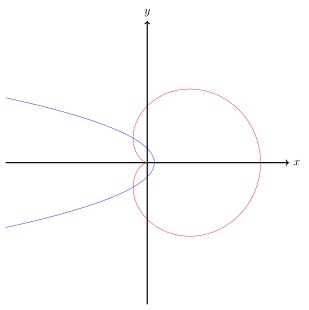
1990 Paper 2 Q10
Two square matrices \(\mathbf{A}\) and \(\mathbf{B}\) satisfies \(\mathbf{AB=0}.\) Show that either \(\det\mathbf{A}=0\) or \(\det\mathbf{B}=0\) or \(\det\mathbf{A}=\det\mathbf{B}=0\). If \(\det\mathbf{B}\neq0\), what must \(\mathbf{A}\) be? Give an example to show that the condition \(\det\mathbf{A}=\det\mathbf{B}=0\) is not sufficient for the equation \(\mathbf{AB=0}\) to hold. Find real numbers \(p,q\) and \(r\) such that \[ \mathbf{M}^{3}+2\mathbf{M}^{2}-5\mathbf{M}-6\mathbf{I}=(\mathbf{M}+p\mathbf{I})(\mathbf{M}+q\mathbf{I})(\mathbf{M}+r\mathbf{I}), \] where \(\mathbf{M}\) is any square matrix and \(\mathbf{I}\) is the appropriate identity matrix. Hence, or otherwise, find all matrices \(\mathbf{M}\) of the form $\begin{pmatrix}a & c\\ 0 & b \end{pmatrix}$ which satisfy the equation \[ \mathbf{M}^{3}+2\mathbf{M}^{2}-5\mathbf{M}-6\mathbf{I}=\mathbf{0}. \]
Solution: Since \(0 = \det \mathbf{0} = \det \mathbf{AB} = \det \mathbf{A} \det\mathbf{B}\) at least one of \(\det \mathbf{A}\) or \(\det \mathbf{B}\) is zero. If \(\det \mathbf{B} \neq 0\) then \(\mathbf{B}\) is invertible, and multiplying on the right by \(\mathbf{B}^{-1}\) gives us \(\mathbf{A} = \mathbf{0}\). If \(\mathbf{A} = \begin{pmatrix} 1 & 1 \\ 0 & 0 \end{pmatrix}\) and \(\mathbf{B} = \begin{pmatrix} 1 & 0 \\1 & 0 \end{pmatrix}\), then \(\det \mathbf{A} = \det \mathbf{B} = 0\), but \(\mathbf{AB} = \begin{pmatrix} 1 & 0 \\ 0 & 0 \end{pmatrix} \neq \mathbf{0}\) Since \(\mathbf{M}\) commutes with itself and the identity matrix, this is equivalent to factorising the polynomial over the reals. Therefore $$\mathbf{M}^{3}+2\mathbf{M}^{2}-5\mathbf{M}-6\mathbf{I}=(\mathbf{M}-2\mathbf{I})(\mathbf{M}+\mathbf{I})(\mathbf{M}+3\mathbf{I}),$$ Since we now know at least one of \(\det (\mathbf{M}-2\mathbf{I})\), \(\det (\mathbf{M}+\mathbf{I})\), \(\det (\mathbf{M}+3\mathbf{I})\), we should look at cases: Since at least one of those must be non-zero, we must have the following cases: \((a,b) = (2,-1), (-1,2), (-1,-3), (-3,-1), (2,-3), (-3,2)\) In each of those cases, we will have: \(\begin{pmatrix} 0 & c \\ 0 & b+k \end{pmatrix}\begin{pmatrix} a+l & c \\ 0 & 0 \end{pmatrix} = \begin{pmatrix} 0 & 0 \\ 0 & 0\end{pmatrix}\) and so all of those solutions are valid. So \(c\) can be anything as long as \((a,b)\) are in that set of solutions
1990 Paper 2 Q11
A disc is free to rotate in a horizontal plane about a vertical axis through its centre. The moment of inertia of the disc about this axis is \(mk^{2}.\) Along one diameter is a narrow groove in which a particle of mass \(m\) slides freely. At time \(t=0,\) the disc is rotating with angular speed \(\Omega,\) and the particle is at a distance \(a\) from the axis and is moving towards the axis with speed \(V\), where \(k^{2}V^{2}=\Omega^{2}a^{2}(k^{2}+a^{2}).\) Show that, at a later time \(t,\) while the particle is still moving towards the axis, the angular speed \(\omega\) of the disc and the distance \(r\) of the particle from the axis are related by \[ \omega=\frac{\Omega(k^{2}+a^{2})}{k^{2}+r^{2}}\qquad\mbox{ and }\qquad\frac{\mathrm{d}r}{\mathrm{d}t}=-\frac{\Omega r(k^{2}+a^{2})}{k(k^{2}+r^{2})^{\frac{1}{2}}}. \] Deduce that \[ k\frac{\mathrm{d}r}{\mathrm{d}\theta}=-r(k^{2}+r^{2})^{\frac{1}{2}}, \] where \(\theta\) is the angle through which the disc has turned at time \(t\). By making the substitution \(u=1/r\), or otherwise, show that \(r\sinh(\theta+\alpha)=k,\) where \(\sinh\alpha=k/a.\) Hence, or otherwise, show that the particle never reaches the axis.
1990 Paper 2 Q12
A straight staircase consists of \(N\) smooth horizontal stairs each of height \(h\). A particle slides over the top stair at speed \(U\), with velocity perpendicular to the edge of the stair, and then falls down the staircase, bouncing once on every stair. The coefficient of restitution between the particle and each stair is \(e\), where \(e<1\). Show that the horizontal distance \(d_{n}\) travelled between the \(n\)th and \((n+1)\)th bounces is given by \[ d_{n}=U\left(\frac{2h}{g}\right)^{\frac{1}{2}}\left(e\alpha_{n}+\alpha_{n+1}\right), \] where \({\displaystyle \alpha_{n}=\left(\frac{1-e^{2n}}{1-e^{2}}\right)^{\frac{1}{2}}}\). If \(N\) is very large, show that \(U\) must satisfy \[ U=\left(\frac{L^{2}g}{2h}\right)^{\frac{1}{2}}\left(\frac{1-e}{1+e}\right)^{\frac{1}{2}}, \] where \(L\) is the horizontal distance between the edges of successive stairs.
1990 Paper 2 Q13
A thin non-uniform rod \(PQ\) of length \(2a\) has its centre of gravity a distance \(a+d\) from \(P\). It hangs (not vertically) in equilibrium suspended from a small smooth peg \(O\) by means of a light inextensible string of length \(2b\) which passes over the peg and is attached at its ends to \(P\) and \(Q\). Express \(OP\) and \(OQ\) in terms of \(a,b\) and \(d\). By considering the angle \(POQ\), or otherwise, show that \(d < a^{2}/b\).
Solution:

1990 Paper 2 Q14
The identical uniform smooth spherical marbles \(A_{1},A_{2},\ldots,A_{n},\) where \(n\geqslant3,\) each of mass \(m,\) lie in that order in a smooth straight trough, with each marble touching the next. The marble \(A_{n+1},\) which is similar to \(A_{n}\) but has mass \(\lambda m,\) is placed in the trough so that it touches \(A_{n}.\) Another marble \(A_{0},\) identical to \(A_{n},\) slides along the trough with speed \(u\) and hits \(A_{1}.\) It is given that kinetic energy is conserved throughout.
- Show that if \(\lambda<1,\) there is a possible subsequent motion in which only \(A_{n}\) and \(A_{n+1}\) move (and \(A_{0}\) is reduced to rest), but that if \(\lambda>1,\) such a motion is not possible.
- If \(\lambda>1,\) show that a subsequent motion in which only \(A_{n-1},A_{n}\) and \(A_{n+1}\) move is not possible.
- If \(\lambda>1,\) find a possible subsequent motion in which only two marbles move.
Solution: Without loss of generality, let \(m = u = 1\).
- \begin{align*} \text{COM}: && 1&= v_n + \lambda v_{n+1} \\ && &= v_n + \lambda v_{n+1}\\ \text{COE}: && \frac12 &= \frac12 v_n^2 + \frac12 \lambda v_{n+1}^2 \\ && 1 &= v_n^2 +\lambda v_{n+1}^2 \\ \\ \Rightarrow && v_n^2 + 2\lambda v_n v_{n+1} + \lambda^2 v_{n+1}^2 &= v_n^2 + \lambda v_{n+1}^2 \\ && \lambda v_{n+1}^2 &= v_{n+1}^2 - 2 v_n v_{n+1} \\ && \lambda v_{n+1} &= (v_{n+1} - 2v_n) \\ && (1-\lambda)v_{n+1} &= 2v_n \end{align*} Since \(v_{n+1} > v_n > 0\) this is only possible if \(\lambda < 1\)
- \begin{align*} \text{COM}: && 1&= v_{n-1}+v_n+\lambda v_{n+1} \\ && 1&= v_{n-1} + v_n + \lambda v_{n+1} \\ \text{COE}: && \frac12 &= \frac12 v_{n-1}^2+\frac12v_n^2+\frac12\lambda v_{n+1}^2 \\ && 1&= v_{n-1}^2 + v_n^2 + \lambda v_{n+1}^2 \\ \\ \Rightarrow && 1 &= v_{n-1}^2 + v_n^2 + \lambda \frac{(1-v_{n-1}-v_n)^2}{\lambda^2} \\ &&&= v_{n-1}^2 + v_n^2 + \frac{(1-v_{n-1}-v_n)^2}{\lambda} \\ \Rightarrow && 1 &< v_{n-1}^2 + v_n^2 + (1-v_{n-1}-v_n)^2 \\ &&&= 2v_{n-1}^2+2v_n^2 + 1-2v_{n-1}-2v_{n-2} +2v_{n-1}v_n\\ \Rightarrow && v_{n-1}+v_n & <(v_{n-1}+v_n)^2 - v_{n-1}v_n \end{align*} but this cannot be true since \(0 < v_{n-1}+v_n < 1\) and \(v_n v_{n-1} > 0\)
- The only way this is possible is if the first and last marble are moving. \begin{align*} \text{COM}: && 1 &= v_0 +\lambda v_{n+1} \\ \text{COE}: && \frac12 &= \frac12 v_0^2 + \frac12 \lambda^2 v_{n+1} \\ && 1 &= v_0^2 + \lambda v_{n+1}^2 \\ \Rightarrow && 2v_0 + \lambda v_{n+1} &= v_{n+1} \\ \Rightarrow && v_{n+1} &=\frac{2}{1-\lambda} v_0 \\ \Rightarrow && v_0 &= \frac{1-\lambda}{1+\lambda} \\ && v_{n+1} &= \frac{2}{1+\lambda} \end{align*} which will work since \(v_0\) can travel backwards.