Problems
Filters
112 problems found
2018 Paper 2 Q1
Show that, if \(k\) is a root of the quartic equation \[ x^4 + ax^3 + bx^2 + ax + 1 = 0\,, \tag{\(*\)} \] then \(k^{-1}\) is a root. You are now given that \(a\) and \(b\) in \((*)\) are both real and are such that the roots are all real.
- Write down all the values of \(a\) and \(b\) for which \((*)\) has only one distinct root.
- Given that \((*)\) has exactly three distinct roots, show that either \(b=2a-2\) or \(b=-2a-2\,\).
- Solve \((*)\) in the case \(b= 2 a -2\,\), giving your solutions in terms of \(a\).
Solution: Let \(f(x) = x^4 + ax^3 + bx^2 + ax + 1\), and suppose \(f(k) = 0\). Since \(f(0) = 1\), \(k \neq 0\), therefore we can talk about \(k^{-1}\). \begin{align*} && f(k^{-1}) &= k^{-4} + ak^{-3} + bk^{-2} + ak^{-1} + 1 \\ &&&= k^{-4}(1 + ak + bk^2 + ak^3 + k^4) \\ &&&= k^{-4}(k^4+ak^3+bk^2+ak+1) \\ &&&= k^{-4}f(k) = 0 \end{align*} Therefore \(k^{-1}\) is also a root of \(f\)
- If \(f\) has only on distinct root, we must have \(f(x) = (x+k)^4\) therefore \(k = k^{-1} \Rightarrow k^2 = 1 \Rightarrow k = \pm1\), or \(a = 4, b = 6\) or \(a = -4, b = 6\)
- If \(f\) has exactly three distinct roots then one of the roots must be a repeated \(1\) or \(-1\), ie \(0 = f(1) = 1 + a + b + a + 1 = 2 + b +2a \Rightarrow b = -2a-2\) or \(0 = f(-1) = 1 -a + b -a + 1 \Rightarrow b = 2a - 2\)
- If \(b = 2a-2\), we have \begin{align*} && f(x) &= 1 + ax + (2a-2)x^2 + ax^3 + x^4 \\ &&&= (x^2+2x+1)(1+(a-2)x+x^2) \\ \Rightarrow && x &= \frac{2-a \pm \sqrt{(a-2)^2 - 4}}{2} \\ &&&= \frac{2-a \pm \sqrt{a^2-4a}}{2} \end{align*}
2018 Paper 2 Q5
In this question, you should ignore issues of convergence.
- Write down the binomial expansion, for \(\vert x \vert<1\,\), of \(\;\dfrac{1}{1+x}\,\) and deduce that %. By considering %$ %\displaystyle \int \frac 1 {1+x} \, \d x %\,, %$ %show that \[ \displaystyle \ln (1+x) = -\sum_{n=1}^\infty \frac {(-x)^n}n \, \] for \(\vert x \vert <1 \,\).
- Write down the series expansion in powers of \(x\) of \(\displaystyle \e^{-ax}\,\). Use this expansion to show that \[ \int_0^\infty \frac {\left(1- \e^{-ax}\right)\e^{-x}}x \,\d x = \ln(1+a) \ \ \ \ \ \ \ (\vert a \vert <1)\,. \]
- Deduce the value of \[ \int_0^1 \frac{x^p - x^q}{\ln x} \, \d x \ \ \ \ \ \ (\vert p\vert <1, \ \vert q\vert <1) \,. \]
Solution:
- \begin{align*} && \frac1{1+x} &= 1 - x+ x^2 - x^3+ \cdots \\ \Rightarrow && \int_0^x \frac{1}{1+t} \d t &= \int_0^x \sum_{n=0}^{\infty} (-t)^n \d t \\ &&&= \left [\sum_{n=0}^{\infty} -\frac{(-t)^{n+1}}{n+1} \right]_0^x \\ \Rightarrow &&\ln(1+x)&=- \sum_{n=1}^\infty \frac{(-x)^n}{n} \end{align*}
- \begin{align*} && e^{-ax} &= \sum_{n=0}^\infty \frac{(-a)^n}{n!} x^n \\ \Rightarrow && \int_0^{\infty} \frac{1}{x} \left (1-e^{-ax} \right)e^{-x} \d x &= \int_0^{\infty} \frac{1}{x} \left (-\sum_{n=1}^\infty \frac{(-a)^n}{n!}x^n \right)e^{-x} \d x \\ &&&= -\int_0^{\infty} \sum_{n=1}^\infty \frac{(-a)^n}{n!} x^{n-1} e^{-x} \d x \\ &&&= -\sum_{n=1}^\infty \frac{(-a)^n}{n!} \int_0^{\infty} x^{n-1} e^{-x} \d x \\ &&&= -\sum_{n=1}^\infty \frac{(-a)^n}{n!} (n-1)! \\ &&&= -\sum_{n=1}^\infty \frac{(-a)^n}{n} \\ &&&= \ln (1+a) \end{align*}
- \begin{align*} && \int_0^1 \frac{x^p - x^q}{\ln x} \, \d x &= \int_0^1 \frac{x^p(1 - x^{q-p})}{\ln x} \, \d x \\ e^{-u} = x, \d x = -e^{-u} \d u: &&&=\int_{u=\infty}^{0} \frac{e^{-pu}-e^{-qu}}{-u} (-e^{-u})\d u \\ &&&= \int_0^\infty \frac{e^{-u}(e^{-qu}-e^{-pu})}{u} \d u \\ &&&= \int_0^\infty \frac{e^{-(1+q)u}(1-e^{-(p-q)u})}{u} \d u \\ v = (1+q)u, \d v = (1+q) \d u: &&&=\int_0^{\infty} \frac{e^{-v}(1-e^{-\left(\frac{p-q}{1+q}\right)v}}{v}\d v \\ &&&= \ln \left(1 + \frac{p-q}{1+q} \right) \\ &&&= \ln \left ( \frac{1+p}{1+q} \right) \end{align*}
2018 Paper 2 Q8
- Use the substitution \(v= \sqrt y\) to solve the differential equation \[ \frac{\d y}{\d t} = \alpha y^{\frac12} - \beta y \ \ \ \ \ \ \ \ \ \ (y\ge0, \ \ t\ge0) \,, \] where \(\alpha\) and \(\beta\) are positive constants. Find the non-constant solution \(y_1(x)\) that satisfies \(y_1(0)=0\,\).
- Solve the differential equation \[ \frac{\d y}{\d t} = \alpha y^{\frac23} - \beta y \ \ \ \ \ \ \ \ \ \ (y\ge0, \ \ t\ge0) \,, \] where \(\alpha\) and \(\beta\) are positive constants. Find the non-constant solution \(y_2(x)\) that satisfies \(y_2(0)=0\,\).
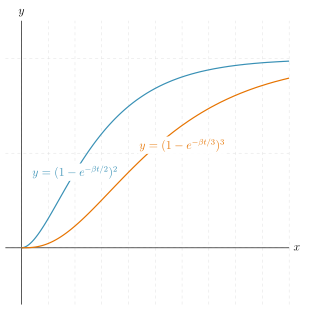
- In the case \(\alpha=\beta\), sketch \(y_1(x)\) and \(y_2(x)\) on the same axes, indicating clearly which is \(y_1(x)\) and which is \(y_2(x)\). You should explain how you determined the positions of the curves relative to each other.
Solution:
- Suppose \(v = \sqrt{y} \Rightarrow v^2 = y \Rightarrow 2v v' = y'\) so \begin{align*} && 2vv' &= \alpha v-\beta v^2 \\ \Rightarrow && 2v' &= \alpha - \beta v \\ \Rightarrow && v' + \frac{\beta}{2} v &= \frac{\alpha}{2} \\ \Rightarrow && \frac{\d}{\d t} \left (e^{\beta t/2} v \right) &= \frac{\alpha}{2} e^{\beta t/2} \\ \Rightarrow && e^{\beta t/2} v &=C+ \frac{\alpha}{\beta}e^{\beta t /2} \\ \Rightarrow && v &= Ce^{-\beta t/2} + \frac{\alpha}{\beta} \\ \Rightarrow && \sqrt{y} &= Ce^{-\beta t/2} + \frac{\alpha}{\beta} \\ y(0) = 0: && 0 &= C+\frac{\alpha}{\beta} \\ \Rightarrow && \sqrt{y} &= \frac{\alpha}{\beta} \left (1-e^{-\beta t/2} \right) \\ \Rightarrow && y &= \frac{ \alpha^2}{\beta^2} \left (1-e^{-\beta t/2} \right)^2 \end{align*}
- Try \(v = y^{1/3} \Rightarrow v^3 = y \Rightarrow 3v^2 v' = y'\) so \begin{align*} && y' &= \alpha v^2 - \beta y \\ \Rightarrow && 3v^2v' &= \alpha v^2 - \beta v^3 \\ \Rightarrow && v' +\frac{\beta}{3} v &= \frac{\alpha}{3} \\ \Rightarrow && (v e^{\beta t/3})' &= \frac{\alpha}{3}e^{\beta t/3} \\ \Rightarrow && v &= Ce^{-\beta t/3} + \frac{\alpha}{\beta} \\ v(0) = 0: && v &= \frac{\alpha}{\beta} \left (1 - e^{-\beta t/3} \right) \\ \Rightarrow && y &= \frac{\alpha^3}{\beta^3} \left (1 - e^{-\beta t/3} \right) ^3 \end{align*}
- \(y_1 = (1-e^{-\beta t/2})^2, y_2 = (1-e^{-\beta t/3})^3\)
By considering the differential equation, notice that \(0 < y_i < 1\) so \(y^{1/2} > y^{2/3}\) and therefore \(y_1' > y_2'\) and so \(y_1\) increases faster.
2018 Paper 3 Q8
In this question, you should ignore issues of convergence.
- Let \[ I = \int_0^1 \frac{\f(x^{-1}) } {1+x} \, \d x \,, \] where \(\f(x)\) is a function for which the integral exists. Show that \[ I = \sum_{n=1}^\infty \int_n^{n+1} \frac{\f(y) } {y(1+y)}\, \d y \] and deduce that, if \(\f(x) = \f(x+1)\) for all \(x\), then \[ I= \int_0^1 \frac{\f(x)} {1+x} \, \d x \,. \]
- The {\em fractional part}, \(\{x\}\), of a real number \(x\) is defined to be \(x-\lfloor x\rfloor\) where \(\lfloor x \rfloor\) is the largest integer less than or equal to \(x\). For example \(\{3.2\} = 0.2\) and \(\{3\}=0\,\). Use the result of part (i) to evaluate \[ \displaystyle \int _0^1 \frac { \{x^{-1}\}}{1+x}\, \d x \text{ and } \displaystyle \int _0^1 \frac { \{2x^{-1}\}}{1+x}\, \d x \,. \]
- (Bonus) Use the same method to evaluate \[ \int_0^1 \frac {x\{x^{-1}\}}{1-x^2} \, \d x \,. \]
- (Bonus - harder) Use the same method to evaluate \[ \int_0^1 \frac {x^2\{x^{-1}\}}{1-x^2} \, \d x \,. \]
Solution:
- \begin{align*} && I &= \int_0^1 \frac{f(x^{-1})}{1+x} \d x \\ u = x^{-1}, \d u = -x^{-2} \d x: &&&= \int_{\infty}^1 \frac{f(u)}{1+\frac{1}{u}} \frac{-1}{u^2} \d u \\ &&&= \int_1^{\infty} \frac{f(u)}{u(1+u)} \d u \\ &&&= \sum_{n=1}^{\infty} \int_n^{n+1} \frac{f(u)}{u(u+1)} \d u \\ \\ \text{if} f(x) = f(x+1)\, \forall x && &=\sum_{n=1}^{\infty} \int_{0}^1 \frac{f(x+n)}{(x+n)(x+n+1)} \d x \\ &&&= \sum_{n=1}^\infty \int_0^1 \frac{f(x)}{(x+n)(x+n+1)} \d x \\ &&&= \int_0^1 f(x) \l \sum_{n=1}^{\infty} \frac{1}{(x+n)(x+n+1)}\r \d x \\ &&&= \int_0^1 f(x) \l \sum_{n=1}^{\infty} \l \frac{1}{x+n} - \frac{1}{x+n+1} \r\r \d x \\ &&&= \int_0^1 f(x) \l \frac{1}{x+1} \r \d x \\ &&&= \int_0^1\frac{f(x)}{x+1} \d x \\ \end{align*}
- Since the fractional part is periodic with period \(1\), we can say \begin{align*} && \int_0^1 \frac{\{ x^{-1} \} }{1+x} \d x &= \int_0^1 \frac{\{ x\}}{x+1} \d x \\ &&&= \int_0^1 \frac{x}{x+1} \d x \\ &&&= \int_0^1 1-\frac{1}{x+1} \d x \\ &&&= [x - \ln (1+x) ]_0^1 \\ &&&= 1 - \ln 2 \end{align*} \begin{align*} && \int_0^1 \frac{\{ 2x^{-1}\}}{1+x} \d x &= \int_0^1 \frac{\{2x\}}{x+1} \d x \\ &&&= \int_0^{1/2} \frac{2x}{x+1} \d x +\int_{1/2}^{1} \frac{2x-1}{x+1} \d x \\ &&&= 2\int_0^1 \frac{x}{x+1} \d x + \int_{1/2}^1 \frac{-1}{x+1} \d x \\ &&&= 2 - 2\ln 2 - \l \ln 2 - \ln \tfrac32 \r \\ &&&= 2 - 4 \ln 2 + \ln 3 \\ &&&= 2 + \ln \tfrac {3}{16} \end{align*}
- \begin{align*} && \int_0^1 \frac{x \{ x^{-1} \} }{1-x^2} \d x &= \frac12 \l \int_0^1 \frac{ \{ x^{-1} \}}{1-x} - \frac{\{x^{-1} \}}{1+x} \d x\r \end{align*} Consider for \(f\) periodic with period \(1\) \begin{align*} \int_0^1 \frac{f(x^{-1})}{1-x} \d x &= \int_1^{\infty} \frac{f(u)}{u(u-1)} \d u \\ &= \sum_{n=1}^{\infty}\int_{n}^{n+1} \frac{f(u)}{u(u-1)} \d u \\ &= \sum_{n=1}^{\infty}\int_{0}^{1} \frac{f(u)}{(u+n)(u+n-1)} \d u \\ &= \int_{0}^{1} \sum_{n=1}^{\infty}\frac{f(u)}{(u+n)(u+n-1)} \d u \\ &= \int_{0}^{1} f(u) \sum_{n=1}^{\infty}\l\frac{1}{u+n-1} - \frac{1}{u+n} \r\d u \\ &= \int_0^1 \frac{f(u)}{u} \d u \end{align*} So we have \begin{align*} && \int_0^1 \frac{x \{ x^{-1} \} }{1-x^2} \d x &= \frac12 \l \int_0^1 \frac{ \{ x^{-1} \}}{1-x} - \frac{\{x^{-1} \}}{1+x} \d x \r \\ &&&= \frac12 \int_0^1 \frac{\{ x \}}{x} \d x - \frac12 (1 - \ln 2) \\ &&&= \frac12 - \frac12 + \frac12 \ln 2 \\ &&&= \frac12 \ln 2 \end{align*}
2017 Paper 1 Q1
- Use the substitution \(u= x\sin x +\cos x\) to find \[ \int \frac{x }{x\tan x +1 } \, \d x \,. \] Find by means of a similar substitution, or otherwise, \[ \int \frac{x }{x\cot x -1 } \, \d x \,. \]
- Use a substitution to find \[ \int \frac{x\sec^2 x \, \tan x}{x\sec^2 x -\tan x} \,\d x \, \] and \[ \int \frac{x\sin x \cos x}{(x-\sin x \cos x)^2} \, \d x \,. \]
Solution:
- \(\,\) \begin{align*} && I &= \int \frac{x}{x \tan x + 1} \d x \\ &&&= \int \frac{x \cos x}{x \sin x + \cos x} \d x \\ u = x \sin x + \cos x , \d u = x \cos x \d x: &&&= \int \frac{\d u}{u} \\ &&&= \ln u + C \\ &&&= \ln (x \sin x + \cos x) + C \\ \\ && J &= \int \frac{x}{x \cot x - 1} \d x \\ &&&= \int \frac{x \sin x }{x \cos x - \sin x} \d x \\ u = x \cos x - \sin x, \d u = x \sin x \d x: &&&= \int \frac{1}{u} \d u \\ &&&= \ln u + K \\ &&&= \ln (x \cos x -\sin x) + K \end{align*}
- \(\,\) \begin{align*} && I &= \int \frac{x \sec^2 x \tan x}{x \sec^2 x - \tan x} \d x \\ u = x\sec^2 x-\tan x, \d u = 2x \sec^2 x \tan x&&&= \frac12 \int \frac{1}{u} \d u \\ &&&= \frac12 \ln (x \sec^2 x - \tan x) + C \\ \\ && J &= \int \frac{x \sin x \cos x}{(x - \sin x \cos x)^2} \d x \\ u = x \sec^2 x -\tan x, \d u=2x \frac{\sin x}{\cos^3 x} &&&= \int \frac{x \sin x \cos x}{\cos^4x(x\sec^2 x -\tan x)^2} \d x \\ &&&= \frac12 \int \frac{1}{u^2} \d u \\ &&&= -\frac12u^{-1} + K \\ &&&= \frac{1}{2(\tan x - x \sec^2 x)} + K \end{align*}
2017 Paper 3 Q6
In this question, you are not permitted to use any properties of trigonometric functions or inverse trigonometric functions. The function \(\T\) is defined for \(x>0\) by \[ \T(x) = \int_0^x \! \frac 1 {1+u^2} \, \d u\,, \] and $\displaystyle T_\infty = \int_0^\infty \!\! \frac 1 {1+u^2} \, \d u\,$ (which has a finite value).
- By making an appropriate substitution in the integral for \(\T(x)\), show that \[\T(x) = \T_\infty - \T(x^{-1})\,.\]
- Let \(v= \dfrac{u+a}{1-au}\), where \(a\) is a constant. Verify that, for \(u\ne a^{-1}\), \[ \frac{\d v}{\d u} = \frac{1+v^2}{1+u^2} \,. \] Hence show that, for \(a>0\) and \(x< \dfrac1a\,\), \[ \T(x) = \T\left(\frac{x+a}{1-ax}\right) -\T(a) \,. \] Deduce that \[ \T(x^{-1}) = 2\T_\infty -\T\left(\frac{x+a}{1-ax}\right) -\T(a^{-1}) \] and hence that, for \(b>0\) and \(y>\dfrac1b\,\), \[ \T(y) =2\T_\infty - \T\left(\frac{y+b}{by-1}\right) - \T(b) \,. \]
- Use the above results to show that \(\T(\sqrt3)= \tfrac23 \T_\infty \,\) and \(\T(\sqrt2 -1)= \frac14 \T_\infty\,\).
Solution:
- \(\,\) \begin{align*} && T(x) &= \int_0^x \! \frac 1 {1+u^2} \, \d u \\ &&&= \int_0^{\infty} \frac{1}{1+u^2} \d u - \int_x^\infty \frac{1}{1+u^2} \d u \\ &&&= T_\infty - \int_x^\infty \frac{1}{1+u^2} \d u \\ u = 1/v, \d u = -1/v^2 \d v: &&&= T_\infty - \int_{v=x^{-1}}^{v=0} \frac{1}{1+v^{-2}} \frac{-1}{v^2} \d v \\ &&&= T_\infty - \int_{0}^{x^{-1}} \frac{1}{1+v^2} \d v \\ &&&= T_\infty - T(x^{-1}) \end{align*}
- Let \(v = \frac{u+a}{1-au}\) then \begin{align*} && \frac{\d v}{\d u} &= \frac{(1-au) \cdot 1 - (u+a)\cdot(-a)}{(1-au)^2} \\ &&&= \frac{1-au+au+a^2}{(1-au)^2} \\ &&&= \frac{1+a^2}{(1-au)^2} \\ \\ && \frac{1+v^2}{1+u^2} &= \frac{1 + \left ( \frac{u+a}{1-ua} \right)^2}{1+u^2} \\ &&&= \frac{(1-ua)^2+(u+a)^2}{(1-ua)^2(1+u^2)} \\ &&&= \frac{1+u^2a^2+u^2+a^2}{(1-ua)^2(1+u^2)} \\ &&&= \frac{(1+u^2)(1+a^2)}{(1-ua)^2(1+u^2)} \\ &&&= \frac{1+a^2}{(1-ua)^2} \end{align*} if \(a > 0, x < \frac1a\) then \begin{align*} && T(x) &= \int_0^x \frac{1}{1+u^2} \d u \\ &&&= \int_{v=a}^{v=\frac{a+x}{1-ax}} \frac{1}{1+u^2} \frac{1+u^2}{1+v^2} \d v \\ &&&= T\left ( \frac{x+a}{1-ax} \right) - T(a) \\ \\ \Rightarrow && T(x^{-1}) &= T_\infty - T(x) \\ &&&= T_\infty - 2T\left ( \frac{x+a}{1-ax} \right) + T(a) \\ &&&= T_\infty - 2T\left ( \frac{x+a}{1-ax} \right) + T_\infty-T(a^{-1}) \\ &&&= 2T_\infty - 2T\left ( \frac{x+a}{1-ax} \right) -T(a^{-1}) \end{align*} \(b > 0, y > \frac1b\) then \(y> 0, b > \frac1y\) (same as letting \(x = \frac1y, a = \frac1b\) \begin{align*} && T(y) &= 2T_\infty - 2T \left ( \frac{\frac1y+\frac1b}{1-\frac1{by}} \right) + T(b) \\ \Rightarrow && T(y) &= 2T_\infty - 2T \left ( \frac{b+y}{by-1} \right) + T(b) \\ \end{align*}
- Letting \(y = b = \sqrt{3}\) in the final equation \begin{align*} && T(\sqrt{3}) &= 2T_{\infty} - T \left ( \frac{\sqrt{3}+\sqrt{3}}{\sqrt{3}\sqrt{3}-1} \right) -T (\sqrt{3}) \\ &&&= 2T_\infty - 2T(\sqrt{3}) \\ \Rightarrow && T(\sqrt{3}) &= \tfrac23 T_\infty \end{align*} Let \(x = \sqrt2 - 1, a = 1\) so, \begin{align*} && T(\sqrt2 -1) &= T \left ( \frac{\sqrt2-1+1}{1-\sqrt2+1} \right)-T(1) \\ &&&= T \left ( \frac{\sqrt{2}}{2-\sqrt{2}} \right) - T(1) \\ &&&= T(\frac{\sqrt{2}(2+\sqrt{2})}{2}) - T(1) \\ &&&= T(\sqrt{2}+1) - T(1) \\ &&&= T_\infty - T(\sqrt2-1)-T(1) \\ \Rightarrow && T(\sqrt{2}-1) &= \frac12T_\infty-\frac12T(1) \\ && T(1) &= T_\infty - T(1) \\ \Rightarrow && T(1) &= \frac12 T_\infty \\ \Rightarrow && T(\sqrt2-1) &= \frac12T_\infty - \frac14T_\infty \\ &&&= \frac14 T_\infty \end{align*}
2016 Paper 2 Q2
Use the factor theorem to show that \(a+b-c\) is a factor of \[ (a+b+c)^3 -6(a+b+c)(a^2+b^2+c^2) +8(a^3+b^3+c^3) \,. \tag{\(*\)} \] Hence factorise (\(*\)) completely.
- Use the result above to solve the equation \[ (x+1)^3 -3 (x+1)(2x^2 +5) +2(4x^3+13)=0\,. \]
- By setting \(d+e=c\), or otherwise, show that \((a+b-d-e)\) is a factor of \[ (a+b+d+e)^3 -6(a+b+d+e)(a^2+b^2+d^2+e^2) +8(a^3+b^3+d^3+e^3) \, \] and factorise this expression completely. Hence solve the equation \[ (x+6)^3 - 6(x+6)(x^2+14) +8(x^3+36)=0\,. \]
Solution: Suppose \(c = a+b\) then \begin{align*} (a+b+c)^3 &-6(a+b+c)(a^2+b^2+c^2) +8(a^3+b^3+c^3) \\ &= (2(a+b))^3-6(2(a+b))(a^2+b^2+(a+b)^2) + 8(a^3+b^3+(a+b)^3) \\ &=16(a+b)^3 - 24(a+b)(a^2+b^2+ab)+8(a^3+b^3) \\ &= 8(a+b)(2(a+b)^2-3(a^2+b^2+ab)+(a^2-ab+b^2)) \\ &= 0 \end{align*} Therefore \(a+b-c\) is a factor. By symmetry \(a-b+c\) and \(-a+b+c\) are also factors. Since our polynomial is degree \(3\) it must be \(K(a+b-c)(b+c-a)(c+a-b)\) for some \(K\). Since the coefficient of \(a^3\) is \(3\), \(K = 3\). so we have: \(3(a+b-c)(b+c-a)(c+a-b)\)
- We want \(x + a + b = x+1\), \(x^2 + a^2 + b^2 = x^3+\frac52, x^3 + a^3 + b^3 = x^3+ \frac{13}{4}\). \(a+b = 1, a^2 + b^2 = 5/2\) so \(a = \frac32, b = -\frac12\) \begin{align*} 0 &= (x+1)^3 - 3(x+1)(2x^2+5)+2(4x^3+13) \\ &= 3(x +\frac{3}{2}+\frac{1}{2})(x - \frac{3}{2} - \frac{1}{2})(-x + \frac{3}{2} - \frac{1}{2}) \\ &= 3(x+2)(x-2)(1-x) \end{align*} and so the roots are \(x = 1, 2, -2\)
- Letting \(c = d+e\) we have \begin{align*} (a+b+d+e)^3 &-6(a+b+d+e)(a^2+b^2+d^2+e^2) +8(a^3+b^3+d^3+e^3) \\ &= (a+b+c)^3 -6(a+b+c)(a^2+b^2+c^2-2de) +8(a^3+b^3+c^3 - 3cde) \\ &= (a+b+c)^3 -6(a+b+c)(a^2+b^2+c^2)+8(a^3+b^3+c^3)+12(a+b+c)de - 24cde \\ &= \underbrace{(a+b+c)^3 -6(a+b+c)(a^2+b^2+c^2)+8(a^3+b^3+c^3)}_{\text{has a factor of }a+b-c} + 12(a+b-c)de \end{align*} Therefore there is a factor of \(a+b-c\) or \(a+b-d-e\). By symmetry we must have the factors: \((a+b-d-e)(a-b-d+e)(a-b+d-e)\) and so the final expression must be: \(K(a+b-d-e)(a-b-d+e)(a-b+d-e)\) The coefficient of \(a^3\) is \(3\), therefore \(K = 3\) We want \(x+a+b+c = x + 6\), \(x^2+a^2+b^2+c^2 = 14\) and \(x^3 + a^3+b^3+c^3 = 36\), ie \(a = 1,b=2,c=3\) would work, so \begin{align*} 0 &= (x+6)^3 - 6(x+6)(x^2+14) +8(x^3+36) \\ &= 3(x+1-2-3)(x-1+2-3)(x-1-2+3) \\ &= 3x(x-4)(x-2) \end{align*} ie the roots are \(x = 0, 2, 4\)
2016 Paper 2 Q6
This question concerns solutions of the differential equation \[ (1-x^2) \left(\frac{\d y}{\d x}\right)^2 + k^2 y^2 = k^2\, \tag{\(*\)} \] where \(k\) is a positive integer. For each value of \(k\), let \(y_k(x)\) be the solution of \((*)\) that satisfies \(y_k(1)=1\); you may assume that there is only one such solution for each value of \(k\).
- Write down the differential equation satisfied by \(y_1(x)\) and verify that \(y_1(x) = x\,\).
- Write down the differential equation satisfied by \(y_2(x)\) and verify that \(y_2(x) = 2x^2-1\,\).
- Let \(z(x) = 2\big(y_n(x)\big)^2 -1\). Show that \[ (1-x^2) \left(\frac{\d z}{\d x}\right)^2 +4n^2 z^2 = 4n^2\, \] and hence obtain an expression for \(y_{2n}(x)\) in terms of \(y_n(x)\).
- Let \(v(x) = y_n\big(y_m(x)\big)\,\). Show that \(v(x) = y_{mn}(x)\,\).
Solution:
- When \(k =1\), we have \((1-x^2)(y')^2 + y^2 = 1\). Notice that if \(y_1 = x\) we have \(y_1' = 1\) and \((1-x^2) \cdot 1 + x^2 = 1\) so \(y_1\) is a solution, and we are allowed to assume this is the only solution. And notice that \(y_1(1) = 1\).
- When \(k = 2\) we have \((1-x^2)(y')^2 + 4y^2 = 4\). Trying \(y_2 = 2x^2-1\) we see that \(y_2' = 4x\) and \((1-x^2)(4x)^2 + 4(2x^2-1)^2 = 16x^2-16x^4+16x^4-16x^2+4 = 4\). We can also check that \(y(1) = 2 \cdot 1^2 - 1 = 1\)
- Let \(z(x) = 2(y_n(x))^2-1\), then \begin{align*} && \frac{\d z}{\d x} &= 4y'_n(x)y_n(x) \\ \Rightarrow && LHS &= (1-x^2)\left ( \frac{\d z}{\d x} \right)^2 + 4n^2 z^2 \\ &&&= (1-x^2)16(y'_n(x))^2(y_n(x))^2 + 4n^2(2(y_n(x))^2-1)^2 \\ &&&= 16y_n^2(1-x^2) \left [\frac{n^2-n^2y_n^2}{(1-x^2)} \right] + 16n^2y_n^4-16n^2y_n^2+4n^2 \\ &&&= 4n^2 = RHS \end{align*} Therefore \(y_{2n}(x) = 2(y_n(x))^2-1 = y_2(y_n(x))\) (notice also that \(z(1) = 2(y_n(1))^2-1 = 2-1 = 1\)).
- Let \(v(x) = y_n(y_m(x))\) so \begin{align*} && (y_m')^2 &= \frac{m^2(1-y_m^2)}{1-x^2} \\ && (y_n')^2 &= \frac{n^2(1-y_n^2)}{1-x^2} \\ \\ && \frac{\d v}{\d x} &= y_n'(y_m(x)) \cdot y_m'(x) \\ && (1-x^2)(v')^2 &= (1-x^2) \cdot (y_n'(y_m(x)))^2 (y_m')^2 \\ &&&= (1-x^2) \cdot (y_n'(y_m(x)))^2 \left ( \frac{m^2(1-y_m^2)}{1-x^2} \right) \\ &&&= (y_n'(y_m(x)))^2 m^2(1-y_m^2) \\ &&&= \frac{n^2(1-(y_n(y_m(x)))^2)}{1-y_m^2}m^2(1-y_m^2) \\ &&&= n^2m^2(1-v^2) \end{align*} Therefore \(v\) satisfies our differential equation and \(v(1) = y_n(y_m(1)) = y_n(1) = 1\) so it must be our desired solution.
2016 Paper 2 Q7
Show that \[ \int_0^a \f(x) \d x= \int _0^a \f(a-x) \d x\,, \tag{\(*\)} \] where f is any function for which the integrals exist.
- Use (\(*\)) to evaluate \[ \int_0^{\frac12\pi} \frac{\sin x}{\cos x + \sin x} \, \d x \,. \]
- Evaluate \[ \int_0^{\frac14\pi} \frac{\sin x}{\cos x + \sin x} \, \d x \,. \]
- Evaluate \[ \int_0^{\frac14\pi} \ln (1+\tan x) \, \d x \,. \]
- Evaluate \[ \int_0^{\frac14 \pi} \frac x {\cos x \, (\cos x + \sin x)}\, \d x \,. \]
Solution: \begin{align*} u = a-x, \d u = - \d x: && \int_0^a f(x) \d x &= \int_{u=a}^{u=0} f(a-u) (-1) \d u \\ &&&= \int_0^a f(a-u) \d u \\ &&&= \int_0^a f(a-x) \d x \end{align*}
- \begin{align*} && I &= \int_0^{\frac12 \pi} \frac{\sin x}{\cos x + \sin x } \d x\\ &&&= \int_0^{\frac12 \pi} \frac{\sin (\frac12 \pi - x)}{\cos (\frac12 \pi-x) + \sin (\frac12 \pi-x) } \d x\\ &&&= \int_0^{\frac12 \pi} \frac{\cos x}{\sin x + \cos x } \d x\\ \Rightarrow && 2I &= \int_0^{\frac12 \pi} 1 \d x \\ \Rightarrow && I &= \frac{\pi}{4} \end{align*}
- \begin{align*} && I &= \int_0^{\frac14 \pi} \frac{\sin x}{\cos x + \sin x } \d x\\ &&&= \int_0^{\frac14 \pi} \frac{\sin (\frac14 \pi - x)}{\cos (\frac14 \pi-x) + \sin (\frac14 \pi-x) } \d x\\ &&&= \int_0^{\frac14 \pi} \frac{\frac1{\sqrt{2}} \cos x - \frac{1}{\sqrt{2}} \sin x}{\frac1{\sqrt{2}} \cos x + \frac{1}{\sqrt{2}} \sin x + \frac1{\sqrt{2}} \cos x - \frac{1}{\sqrt{2}} \sin x} \d x \\ &&&= \int_0^{\frac14 \pi} \frac{\cos x - \sin x}{2 \cos x} \d x \\ &&&= \left [\frac12 x + \ln(\cos x) \right]_0^{\pi/4} \\ &&&= \frac{\pi}{8} -\frac12\ln2 - 1 \end{align*}
- \begin{align*} && I &= \int_0^{\frac14\pi} \ln (1+\tan x) \, \d x \\ &&&= \int_0^{\frac14 \pi} \ln \left (1 + \tan \left(\frac{\pi}{4} - x\right) \right) \, \d x\\ &&&= \int_0^{\frac14 \pi} \ln \left (1 +\frac{1 - \tan x}{1+ \tan x} \right) \, \d x\\ &&&= \int_0^{\frac14 \pi} \ln \left (\frac{2}{1+ \tan x} \right) \, \d x\\ &&&= \frac{\pi}{4} \ln 2 - I \\ \Rightarrow && I &= \frac{\pi}{8} \ln 2 \end{align*}
- \begin{align*} && I &= \int_0^{\frac14 \pi} \frac x {\cos x \, (\cos x + \sin x)}\, \d x \\ &&&= \int_0^{\frac14 \pi} \frac {\frac14 \pi - x} {(\frac1{\sqrt{2}} \cos x + \frac{1}{\sqrt{2}} \sin x) \, (\frac{2}{\sqrt{2}}\cos x)}\, \d x \\ &&&= \int_0^{\frac14 \pi} \frac {\frac14 \pi - x} {\cos x \, (\cos x + \sin x)}\, \d x \\ \\ \Rightarrow && I &= \frac{\pi}{8} \int_0^{\pi/4} \frac{\sec^2 x}{1 + \tan x} \d x\\ &&&= \frac{\pi}{8} \left [\ln (1 + \tan x) \right]_0^{\pi/4} \\ &&&= \frac{\pi}{8} \ln 2 \end{align*}
2016 Paper 3 Q4
- By considering \(\displaystyle \frac1{1+ x^r} - \frac1{1+ x^{r +1}}\) for \(\vert x \vert \ne 1\), simplify \[ \sum_{r=1}^N \frac{x^r}{(1+x^r)(1+x^{r+1})} \] Show that, for \(\vert x \vert <1\), \[ \sum_{r=1}^\infty \frac{x^r}{(1+x^r)(1+x^{r+1})} = \frac x {1-x^2} \]
- Deduce that \[ \sum_{r=1}^\infty \textrm{sech}(ry)\textrm{sech}((r + 1)y) = 2\e^{-y} \textrm{cosech}(2 y) \] for \(y > 0\). Hence simplify \[ \sum_{r=-\infty}^\infty \textrm{sech}(ry) \textrm{sech}((r + 1)y) \] for \(y>0\).
Solution:
- \(\,\) \begin{align*} && \frac{1}{1+x^r} - \frac{1}{1+x^{r+1}} &= \frac{1+x^{r+1}-1-x^r}{(1+x^r)(1+x^{r+1})} \\ &&&= \frac{x^r(x-1)}{(1+x^r)(1+x^{r+1})} \\ \\ && \sum_{r=1}^N \frac{x^r}{(1+x^r)(1+x^{r+1})} &= \sum_{r=1}^N \frac{1}{x-1} \left ( \frac{1}{1+x^r} - \frac{1}{1+x^{r+1}}\right) \\ &&&= \frac{1}{x-1} \Bigg ( \frac{1}{1+x} + \cdots \\ &&& \qquad \qquad \quad - \frac{1}{1+x^2} + \frac{1}{1+x^2} + \cdots \\ &&& \qquad \qquad \quad - \frac{1}{1+x^3} + \frac{1}{1+x^3} + \cdots \\ &&& \qquad \qquad \quad - \cdots \\ &&& \qquad \qquad \quad - \frac{1}{1+x^{N+1}} \Bigg ) \\ &&&= \frac{1}{x-1} \left (\frac{1}{1+x} - \frac{1}{1+x^{N+1}} \right) \\ \\ && \sum_{r=1}^{\infty} \frac{x^r}{(1+x^r)(1+x^{r+1})} &= \lim_{N\to \infty} \frac{1}{x-1} \left (\frac{1}{1+x} - \frac{1}{1+x^{N+1}} \right) \\ &&&= \frac{1}{x-1} \left ( \frac{1}{1+x} - 1\right) \\ &&&= \frac{1}{x-1} \left ( \frac{-x}{1+x} \right) \\ &&&= \frac{x}{1-x^2} \end{align*}
- \(\,\) \begin{align*} && \sum_{r=1}^\infty \textrm{sech}(ry)\textrm{sech}((r + 1)y) &= \sum_{r=1}^\infty \frac{4}{(e^{ry}+e^{-ry})(e^{(r+1)y}+e^{-(r+1)y})} \\ &&&=\sum_{r=1}^\infty \frac{4e^{-(2r+1)y}}{(1+e^{-2ry})(1+e^{-2(r+1)y})} \\ x = e^{-2y}: &&&= \frac{4e^{-y}e^{-2y}}{1-e^{-4y}} \\ &&&= \frac{4e^{-y}e^{-2y}}{e^{-2y}(e^{2y}-e^{-2y})} \\ &&&=2e^{-y}\textrm{cosech}(2y) \end{align*} \begin{align*} && \sum_{r=-\infty}^\infty \textrm{sech}(ry) \textrm{sech}((r + 1)y) &= \sum_{r=1}^\infty \textrm{sech}(ry) \textrm{sech}((r + 1)y) + \sum_{r=-\infty}^0 \textrm{sech}(ry) \textrm{sech}((r + 1)y) \\ &&&= 2e^{-y}\textrm{cosech}(2y) + \sum_{r=0}^\infty \textrm{sech}(-ry) \textrm{sech}(-(r-1)y) \\ &&&= 2e^{-y}\textrm{cosech}(2y) + \sum_{r=0}^\infty \textrm{sech}((r-1)y) \textrm{sech}(ry) \\ &&&= 4e^{-y}\textrm{cosech}(2y) + \textrm{sech}(y) + \textrm{sech}(-y) \\ &&&= 4e^{-y}\textrm{cosech}(2y)+2\textrm{sech}(y) \\ &&&= 4e^{-y} \frac12 \textrm{sech}(y) \textrm{cosech}(y) + 2 \textrm{sech}(y) \\ &&&= 2\textrm{sech}(y) \left ( e^{-y} \textrm{cosech}(y)+1 \right) \\ &&&= 2\textrm{sech}(y) \left ( \frac{2}{e^{2y}-1} + 1 \right) \\ &&&= 2\textrm{sech}(y) \left ( \frac{e^{2y}+1}{e^{2y}-1} \right) \\ &&&= 2 \textrm{cosech}(y) \end{align*}
2016 Paper 3 Q8
- The function f satisfies, for all \(x\), the equation \[ \f(x) + (1- x)\f(-x) = x^2\, . \] Show that \(\f(-x) + (1 + x)\f(x) = x^2\,\). Hence find \(\f(x)\) in terms of \(x\). You should verify that your function satisfies the original equation.
- The function \({\rm K}\) is defined, for \(x\ne 1\), by \[{\rm K}(x) = \dfrac{x+1}{x-1}\,.\] Show that, for \(x\ne1\), \({\rm K(K(}x)) =x\,\). The function g satisfies the equation \[ \g(x)+ x\, \g\Big(\frac{ x+1 }{x-1}\Big) = x \ \ \ \ \ \ \ \ \ \ \ ( x\ne 1) \,. \] Show that, for \(x\ne1\), \(\g(x)= \dfrac{2x}{x^2+1}\,\).
- Find \(\h(x)\), for \(x\ne0\), \(x\ne1\), given that \[ \h(x)+ \h\Big(\frac 1 {1-x}\Big)= 1-x -\frac1{1-x} \ \ \ \ \ \ ( x\ne0, \ \ x\ne1 ) \,. \]
Solution:
- \(\,\) Let \(P(x)\) mean the proposition that \(f(x) + (1-x)f(-x) = x^2\) so \begin{align*} P(x): && f(x) + (1-x)f(-x) &= x^2 \\ P(-x): && f(-x)+(1+x)f(x) &= (-x)^2 = x^2 \\ \Rightarrow && f(x)+(1-x)\left (x^2-(1+x)f(x) \right) &= x^2 \\ \Rightarrow && f(x) \left (1 -(1-x^2) \right) &= x^2 + (x-1)x^2 \\ \Rightarrow && f(x)x^2 &= x^3 \\ \Rightarrow && f(x) &= x \end{align*} Notice that \(x + (1-x)(-x) = x^2\) so it does satisfy the functional equation.
- Let \(K(x) = \frac{x+1}{x-1}\) if \(x \neq 1\) so \begin{align*} && K(K(x)) &= \frac{K(x)+1}{K(x)-1} \\ &&&= \frac{\frac{x+1}{x-1}+1}{\frac{x+1}{x-1}-1} \\ &&&= \frac{\frac{2x}{x-1}}{\frac{2}{x-1}} \\ &&&= x \end{align*} Let \(Q(x)\) denote the proposition that \(g(x) + xg(K(x)) = x\) so \begin{align*} Q(x): && g(x) + xg(K(x)) &= x \\ Q(K(x)): && g(K(x)) + K(x)g(x) &= K(x) \\ \Rightarrow && g(x) +xK(x)[1-g(x)] &= x \\ \Rightarrow && g(x)[1-xK(x)] &= x(1-K(x)) \\ \Rightarrow && g(x) \frac{x-1-x^2-x}{x-1} &= \frac{-2x}{x-1} \\ \Rightarrow && g(x) &= \frac{2x}{x^2+1} \end{align*}. And notice that \(\frac{2x}{x^2+1} + x \frac{2\frac{x+1}{x-1}}{\left( \frac{x+1}{x-1}\right)^2+1} = \frac{2x}{x^2+1} + \frac{2x(x^2-1)}{2x^2+2} = x\)
- Consider \(H(x) = \frac{1}{1-x}\) then notice that \(H(H(x)) = \frac{1}{1-\frac{1}{1-x}} = \frac{x-1}{x}\) and \(H^3(x) = \frac{\frac{1}{1-x}-1}{\frac{1}{1-x}} = 1-(1-x) = x\). So So letting \(S(x)\) be the statement that \(h(x) + h(H(x)) = 1 - x - \frac{1}{1-x}\) we have \begin{align*} S(x): && h(x) + h(H(x)) &= 1 - x - H(x) \\ S(H(x)): && h(H(x)) + h(H^2(x)) &= 1 - H(x) - H^2(x) \\ S(H^2(x)): && h(H^2(x)) + h(x) &= 1 - H^2(x) - x \\ S(x) - S(H(x)) + S(H^2(x)): && 2h(x) &= 1 - 2x \\ \Rightarrow && h(x)& = \frac12 - x \end{align*} and notice that \(\frac12 -x +\frac12 - \frac{1}{1-x} = 1 - x - \frac{1}{1-x}\) so it does satisfy the equation.
2015 Paper 1 Q5
- The function \(\f\) is defined, for \(x>0\), by \[ \f(x) =\int_{1}^3 (t-1)^{x-1} \, \d t \,. \] By evaluating the integral, sketch the curve \(y=\f(x)\).
- The function \(\g\) is defined, for \(-\infty < x < \infty\), by \[ \g(x)= \int_{-1}^1 \frac 1 {\sqrt{1-2xt +x^2} \ }\, \d t \,.\] By evaluating the integral, sketch the curve \(y=\g(x)\).
Solution:
- \(\,\)
\begin{align*}
&& f(x) &= \int_1^3 (t-1)^{x-1} \d t \\
&&&= \left [ \frac1x(t-1)^{x} \right]_1^3 \\
&&&= \frac{2^x}{x}
\end{align*}

- \(\,\)
\begin{align*}
&& g(x) &= \int_{-1}^1 \frac{1}{\sqrt{1-2xt+x^2}} \d t \\
&&&= \left [ -\frac{1}{x}(1 +x^2 - 2xt)^{\frac12} \right]_{-1}^1 \\
&&&= \frac1x \left ( \sqrt{1+x^2+2x}-\sqrt{1+x^2-2x}\right) \\
&&&= \frac1x \left ( |1+x|-|1-x| \right)
\end{align*}

2015 Paper 2 Q6
- Show that \[ \mathrm{sec}^2\left(\tfrac14\pi-\tfrac12 x\right)=\frac{2}{1+\sin x} \,. \] Hence integrate \(\dfrac{1}{1+\sin x}\) with respect to \(x\).
- By means of the substitution \(y=\pi -x\), show that \[ \int_0^\pi x \f (\sin x)\, \d x = \frac \pi 2 \int_0^\pi \f(\sin x) \, \d x ,\] where \(\mathrm{f}\) is any function for which these integrals exist. Hence evaluate \[ \int_0^\pi \frac x {1+\sin x} \, \d x \,. \]
- Evaluate \[ \int_0^\pi\frac{ 2x^3 -3\pi x^2}{(1+\sin x)^2}\, \d x .\]
Solution:
- \(\,\) \begin{align*} && \sec^2\left(\tfrac14\pi-\tfrac12 x\right) &= \frac{1}{\cos^2 \left(\tfrac14\pi-\tfrac12 x\right)} \\ &&&= \frac{1}{\frac{1+\cos 2\left(\tfrac14\pi-\tfrac12 x\right)}{2}} \\ &&&= \frac{2}{1 + \cos \left(\tfrac12\pi- x\right)} \\ &&&= \frac{2}{1+\sin x} \\ \\ && \int \frac{1}{1+\sin x} \d x &= \int \tfrac12\sec^2\left(\tfrac14\pi-\tfrac12 x\right) \d x\\ &&&= - \tan\left(\tfrac14\pi-\tfrac12 x\right) + C \end{align*}
- \(\,\) \begin{align*} && I &= \int_0^{\pi} x f(\sin x) \d x \\ y = \pi - x, \d y = - \d x: &&&= \int_{y=\pi}^{y = 0} (\pi - y) f(\sin(\pi - y))(-1) \d y \\ &&&= \int_0^\pi (\pi - y) f(\sin y) \d y \\ &&&= \pi \int_0^\pi f(\sin y) \d y - I \\ \Rightarrow && I &= \frac{\pi}{2} \int_0^\pi f(\sin x) \d x \\ \\ \Rightarrow && \int_0^{\pi} \frac{x}{1 + \sin x} \d x &= \frac{\pi}{2} \int_0^{\pi} \frac{1}{1 + \sin x} \d x\\ &&&=\frac{\pi}{2} \left [- \tan\left(\tfrac14\pi-\tfrac12 x\right) \right]_0^{\pi} \\ &&&= \frac{\pi}{2} \left (-\tan (-\tfrac{\pi}{4}) + \tan \tfrac{\pi}{4} \right) \\ &&&= \pi \end{align*}
- \(\,\) \begin{align*} && J &= \int_0^{\pi} \frac{2x^3-3\pi x^2}{(1+\sin x)^2} \d x \\ y = \pi - x: &&&= \int_0^{\pi} \frac{2(\pi-y)^3-3\pi (\pi - y)^2}{(1+\sin x)^2 } \d y \\ &&&= \int_0^{\pi} \frac{-2 y^3 + 3 \pi y^2 - \pi^3}{(1+ \sin x)^2}\\ &&&= -\pi^3 \int_0^{\pi} \frac{1}{(1 + \sin x)^2} \d x -J \\ \Rightarrow && J &= -\frac{\pi^3}{2} \int_0^{\pi} \frac{1}{(1 + \sin x)^2} \d x\\ &&&= -\frac{\pi^3}{2} \int_0^\pi \tfrac14 \sec^4\left(\tfrac14\pi-\tfrac12 x\right) \d x \\ &&&= -\frac{\pi^3}{8} \int_0^\pi \sec^2\left(\tfrac14\pi-\tfrac12 x\right)\left (1 + \tan^2\left(\tfrac14\pi-\tfrac12 x\right) \right) \d x \\ &&&= -\frac{\pi^3}{8} \left [-\frac23 \tan^3\left(\tfrac14\pi-\tfrac12 x\right) - 2 \tan\left(\tfrac14\pi-\tfrac12 x\right) \right]_0^{\pi} \\ &&&= -\frac{\pi^3}{8} \left (\frac43+4 \right) \\ &&&= -\frac{2\pi^3}{3} \end{align*}
2015 Paper 3 Q1
- Let \[ I_n= \int_0^\infty \frac 1 {(1+u^2)^n}\, \d u \,, \] where \(n\) is a positive integer. Show that \[ I_n - I_{n+1} = \frac 1 {2n} I_n \] and deduce that \[ I_{n+1} = \frac{(2n)!\, \pi}{2^{2n+1}(n!)^2} \,. \]
- Let \[ J = \int_0^\infty \f\big( (x- x^{-1})^2\big ) \, \d x \,, \] where \(\f\) is any function for which the integral exists. Show that \[ J = \int_0^\infty x^{-2} \f\big( (x- x^{-1})^2\big) \, \d x \, = \frac12 \int_0^\infty (1 + x^{-2}) \f\big( (x- x^{-1})^2\big ) \, \d x \, = \int_0^\infty \f\big(u^2\big) \,\d u \,. \]
- Hence evaluate \[ \int_0^\infty \frac {x^{2n-2}}{(x^4-x^2+1)^n} \, \d x \,, \] where \(n\) is a positive integer.
Solution: \begin{align*} I_n - I_{n+1} &= \int_0^\infty \frac 1 {(1+u^2)^n}\, \d u - \int_0^\infty \frac 1 {(1+u^2)^{n+1}}\, \d u \\ &= \int_0^\infty \l \frac 1 {(1+u^2)^n}- \frac 1 {(1+u^2)^{n+1}} \r\, \d u \\ &= \int_0^\infty \frac {u^2} {(1+u^2)^{n+1}} \, \d u \\ &= \left [ u \frac{u}{(1+u^2)^{n+1}} \right]_0^{\infty} - \frac{-1}{2n}\int_0^{\infty} \frac{1}{(1+u^2)^n} \d u \tag{\(IBP: u = u, v' = \frac{u}{(1+u^2)^{n+1}}\)}\\ &= \frac{1}{2n} I_n \end{align*} \(\displaystyle I_1 = \int_0^{\infty} \frac{1}{1+u^2} \d u = \left [ \tan^{-1} u \right]_0^\infty = \frac{\pi}{2}\) as expected. We also have, \(I_{n+1} = \frac{2n(2n-1)}{2n \cdot 2n} I_n \), by rearranging the recurrence relation. Therefore, when we multiply out the top we will have \(2n!\) and the bottom we will have two factors of \(n!\) and two factors of \(2^n\) combined with the original \(\frac{\pi}{2}\) we get \[ I_{n+1} = \frac{(2n)! \pi}{2^{2n+1} (n!)^2} \] \begin{align*} J = \int_0^\infty f\big( (x- x^{-1})^2\big ) \, \d x &= \int_{u = \infty}^{u = 0} f((u^{-1}-u)^2)(-u^{-2} )\d u \tag{\(u = x^{-1}, \d u = -x^{-2} \d x\)} \\ &= \int^{u = \infty}_{u = 0} f((u^{-1}-u)^2)u^{-2} \d u \\ &= \int^{\infty}_{0} u^{-2}f((u-u^{-1})^2) \d u \\ \end{align*} Therefore adding the two forms for \(J\) we have \begin{align*} 2 J &= \int_0^\infty f\big( (x- x^{-1})^2\big ) \, \d x + \int_0^\infty x^{-2} f\big( (x- x^{-1})^2\big ) \, \d x \\ &= \int_0^\infty (1+x^{-2}) f\big( (x- x^{-1})^2\big ) \, \d x \end{align*} And letting \(u = x - x^{-1}\), we have \(\d u = (1 + x^{-2}) \d x\), and \(u\) runs from \(-\infty\) to \(\infty\) so we have: \begin{align*} \int_0^\infty (1+x^{-2}) f\big( (x- x^{-1})^2\big ) \, \d x &= \int_{-\infty}^\infty f(u^2) \, \d u \\ &=2 \int_{0}^\infty f(u^2) \, \d u \end{align*} Since both of these are \(2J\) we have the result we are after. Finally, \begin{align*} \int_0^\infty \frac {x^{2n-2}}{(x^4-x^2+1)^n} \, \d x &= \int_0^{\infty} \frac{x^{2n-2}}{x^{2n}(x^2-1+x^{-2})^n} \d x \\ &= \int_0^{\infty} \frac{x^{-2}}{((x-x^{-1})^2+1)^n} \d x \\ &= \int_0^{\infty} \frac{1}{(x^2+1)^n} \d x \tag{Where \(f(x) = (1+x^2)^{-n}\) in \(J\) integral} \\ &= I_n = \frac{(2n-2)! \pi}{2^{2n-1} ((n-1)!)^2} \end{align*}
2014 Paper 1 Q3
The numbers \(a\) and \(b\), where \(b > a\ge0\), are such that \[ \int_a^b x^2 \d x = \left ( \int_a^b x \d x\right)^{\!\!2}\,. \]
- In the case \(a=0\) and \(b>0\), find the value of \(b\).
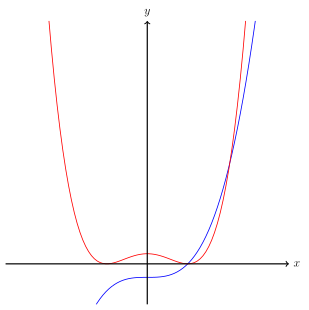
- In the case \(a=1\), show that \(b\) satisfies \[ 3b^3 -b^2-7b -7 =0\,. \] Show further, with the help of a sketch, that there is only one (real) value of \(b\) that satisfies this equation and that it lies between \(2\) and \(3\).
- Show that \(3p^2 + q^2 = 3p^2q\), where \(p=b+a\) and \(q=b-a\), and express \(p^2\) in terms of \(q\). Deduce that \(1< b-a\le\frac43\).
Solution:
- \(\,\) \begin{align*} && \int_0^b x^2 \d x &= \left ( \int_0^b x \d x \right)^2 \\ \Rightarrow && \frac{b^3}{3} &= \left ( \frac{b^2}{2} \right)^2 \\ \Rightarrow && b &= \frac{4}{3} \end{align*}
- \(\,\)
\begin{align*}
&& \int_1^b x^2 \d x &= \left ( \int_1^b x \d x \right)^2 \\
\Rightarrow && \frac{b^3}{3} - \frac{1}{3} &= \left ( \frac{b^2}{2} - \frac{1}{2} \right)^2 \\
\Rightarrow && 4(b^3 - 1) &= 3(b^2-1)^2 \\
\Rightarrow && 4(b^3-1) &= 3(b^4-2b^2+1) \\
\Rightarrow && 0 &= 3b^4-4b^3-6b^2+7 \\
&&&= (b-1)(3b^3-b^2-7b-7) \\
\Rightarrow && 0 &= 3b^3-b^2-7b-7
\end{align*}
Let \(f(x) = 3x^3-x^2-7x-7\) then \(f(2) = 3 \cdot 8 - 4 - 14 - 7 = -1 < 0\), \(f(3) = 3 \cdot 27 - 9 - 21 - 7 = 44 > 0\) therefore the root must lie between \(2\) and \(3\).
- \(,\) \begin{align*} && \int_a^b x^2 \d x &= \left ( \int_a^b x \d x \right)^2 \\ \Rightarrow && \frac{b^3}{3} - \frac{a^3}{3} &= \left ( \frac{b^2}{2} - \frac{a^2}{2} \right)^2 \\ \Rightarrow && 4(b^3 - a^3) &= 3(b^2-a^2)^2 \\ \Rightarrow && 4(b^2+ab+a^2) &= 3(b-a)(b+a)^2 \\ \Rightarrow && 4 \left ( \left ( \frac{p+q}{2}\right)^2+\left ( \frac{p+q}{2}\right)\left ( \frac{p-q}{2}\right)+\left ( \frac{p-q}{2}\right)^2\right) &= 3qp^2 \\ \Rightarrow && 3p^2 + q^2 &= 3qp^2 \\ \Rightarrow && 3p^2(q-1) &= q^2 \\ \Rightarrow && p^2 &= \frac{q^2}{3(q-1)} \\ \Rightarrow && 1 &\leq \frac{1}{3(q-1)} \\ \Rightarrow && 3(q-1) &\leq 1 \\ \Rightarrow && q & \leq \frac{4}{3} \\ \end{align*}