Problems
Filters
27 problems found
1994 Paper 2 Q10
A truck is towing a trailer of mass \(m\) across level ground by means of an elastic rope of natural length \(l\) whose modulus of elasticity is \(\lambda.\) At first the rope is slack and the trailer stationary. The truck then accelerates until the rope becomes taut and thereafter the truck travels in a straight line at a constant speed \(u\). Assuming that the effect of friction on the trailer is negligible, show that the trailer will collide with the truck at a time \[ \pi\left(\frac{lm}{\lambda}\right)^{\frac{1}{2}}+\frac{l}{u} \] after the rope first becomes taut.
1991 Paper 2 Q12
A particle is attached to one end \(B\) of a light elastic string of unstretched length \(a\). Initially the other end \(A\) is at rest and the particle hangs at rest at a distance \(a+c\) vertically below \(A\). At time \(t=0\), the end \(A\) is forced to oscillate vertically, its downwards displacement at time \(t\) being \(b\sin pt\). Let \(x(t)\) be the downwards displacement of the particle at time \(t\) from its initial equilibrium position. Show that, while the string remains taut, \(x(t)\) satisfies \[ \frac{\mathrm{d}^{2}x}{\mathrm{d}t^{2}}=-n^{2}(x-b\sin pt), \] where \(n^{2}=g/c\), and that if \(0 < p < n\), \(x(t)\) is given by \[ x(t)=\frac{bn}{n^{2}-p^{2}}(n\sin pt-p\sin nt). \] Write down a necessary and sufficient condition that the string remains taut throughout the subsequent motion, and show that it is satisfied if \(pb < (n-p)c.\)
1991 Paper 3 Q5
The curve \(C\) has the differential equation in polar coordinates \[ \frac{\mathrm{d}^{2}r}{\mathrm{d}\theta^{2}}+4r=5\sin3\theta,\qquad\text{for }\quad\frac{\pi}{5}\leqslant\theta\leqslant\frac{3\pi}{5}, \] and, when \(\theta=\dfrac{\pi}{2},\) \(r=1\) and \(\dfrac{\mathrm{d}r}{\mathrm{d}\theta}=-2.\) Show that \(C\) forms a closed loop and that the area of the region enclosed by \(C\) is \[ \frac{\pi}{5}+\frac{25}{48}\left[\sin\left(\frac{\pi}{5}\right)-\sin\left(\frac{2\pi}{5}\right)\right]. \]
Solution: First we seek the complementary function. \begin{align*} && \frac{\mathrm{d}^{2}r}{\mathrm{d}\theta^{2}}+4r &= 0 \\ \Rightarrow && r &= A \sin 2\theta + B \cos 2 \theta \end{align*} Next we seek a particular integral, of the form \(r = C \sin 3 \theta\). \begin{align*} && \frac{\mathrm{d}^{2}r}{\mathrm{d}\theta^{2}}+4r &= 5 \sin 3 \theta \\ \Rightarrow && -9C \sin 3 \theta + 4C \sin 3 \theta &= 5 \sin 3 \theta \\ \Rightarrow && C &= -1 \\ \end{align*} So our general solution is \(A \sin 2\theta + B \cos 2 \theta -\sin 3 \theta\). Plugging in boundary conditions we obtain: \begin{align*} \theta = \frac{\pi}{2}, r = 1: &&1 &= -B +1 \\ \Rightarrow && B &= 0 \\ \theta = \frac{\pi}{2}, \frac{\d r}{\d \theta} = -2: && -2 &= -2A \\ \Rightarrow && A &= 1 \end{align*} So the general solution is \(r = \sin 2 \theta - \sin 3 \theta = 2 \sin \left ( \frac{-\theta}{2} \right) \cos \left (\frac{5 \theta}{2} \right)\) First notice that for \(\theta \in \left [\frac{\pi}{5}, \frac{3 \pi}{5} \right]\) this is positive, and it is zero on the end points, therefore we are tracing out a a loop. The area of the loop will be: \begin{align*} A &= \int_{\pi/5}^{3\pi/5} \frac12 \left ( \sin 2 \theta - \sin 3 \theta \right)^2 \d \theta \\ &= \frac12\int_{\pi/5}^{3\pi/5} \sin^2 2\theta + \sin^2 3 \theta - 2 \sin 2 \theta \cos 3 \theta \d \theta \\ &= \frac12\int_{\pi/5}^{3\pi/5} \frac{1-2 \cos 4 \theta}{2} + \frac{1-2 \cos6 \theta}{2} - \sin5 \theta-\cos\theta \d \theta \\ &= \frac12 \left [\theta - \frac14 \sin 4 \theta-\frac16 \sin 6 \theta + \frac15 \cos 5 \theta - \sin \theta \right]_{\pi/5}^{3\pi/5} \\ &= \frac{\pi}{5} +\frac{25}{48}\left [ \sin\left(\frac{\pi}{5}\right)-\sin\left(\frac{2\pi}{5}\right) \right] \end{align*}
1990 Paper 2 Q8
The functions \(\mathrm{x}\) and \(\mathrm{y}\) are related by \[ \mathrm{x}(t)=\int_{0}^{t}\mathrm{y}(u)\,\mathrm{d}u, \] so that \(\mathrm{x}'(t)=\mathrm{y}(t)\). Show that \[ \int_{0}^{1}\mathrm{x}(t)\mathrm{y}(t)\,\mathrm{d}t=\tfrac{1}{2}\left[\mathrm{x}(1)\right]^{2}. \] In addition, it is given that \(\mbox{y}(t)\) satisfies \[ \mathrm{y}''+(\mathrm{y}^{2}-1)\mathrm{y}'+\mathrm{y}=0,\mbox{ }(*) \] with \(\mathrm{y}(0)=\mathrm{y}(1)\) and \(\mathrm{y}'(0)=\mathrm{y}'(1)\). By integrating \((*)\), prove that \(\mathrm{x}(1)=0.\) By multiplying \((*)\) by \(\mathrm{x}(t)\) and integrating by parts, prove the relation \[ \int_{0}^{1}\left[\mathrm{y}(t)\right]^{2}\,\mathrm{d}t=\tfrac{1}{3}\int_{0}^{1}\left[\mathrm{y}(t)\right]^{4}\,\mathrm{d}t. \] Prove also the relation \[ \int_{0}^{1}\left[\mathrm{y}'(t)\right]^{2}\,\mathrm{d}t=\int_{0}^{1}\left[\mathrm{y}(t)\right]^{2}\,\mathrm{d}t. \]
Solution: Consider \(\frac12 x(t)^2\) then differentiating we obtain \(x(t)x'(t) = x(t)y(t)\). Also note that \(x(0) = \int_0^0 y(u) \d u = 0\) Therefore, \begin{align*} \int_0^1 x(t)y(t) \d t &= \left [ \frac12 x(t)^2 \right]_0^1 \\ &= \frac12[x(1)]^2 \end{align*} \begin{align*} && 0 &= y'' + (y^2-1)y' + y \\ \Rightarrow && 0 &= \int_0^1 \l y'' + (y^2-1)y' + y \r \d t \\ &&&= \left [y'(t) + \frac13y^3-y+x \right]_0^1 \\ &&&= x(1) \end{align*} Therefore \(x(1) = 0\). \begin{align*} && 0 &= xy'' + (y^2-1)y' x+ yx \\ \Rightarrow && 0 &= \int_0^1 \l xy'' + (y^2-1)y'x + xy \r \d t \\ &&&= \left [ x y' +(\frac13 y^3-y)x \right]_0^1 - \int_0^1 yy'+\frac13y^4-y^2 \d t \\ &&&= 0 - \frac13 \int_0^1 [y(t)]^4 \d t - \int_0^1 [y(t)]^2 \d t \\ \Rightarrow && \int_0^1 [y(t)]^2 \d t &= \frac13 \int_0^1 [y(t)]^4 \d t \end{align*} \begin{align*} && 0 &= yy'' + (y^2-1)y' y+ y^2 \\ \Rightarrow && 0 &= \int_0^1 \l yy'' + (y^2-1)y'y + y^2 \r \d t \\ &&&= \left [ y y' +(\frac14 y^4-\frac12y^2) \right]_0^1 - \int_0^1 [y'(t)]^2 \d t + \int_0^1 y^2 \d t \\ &&&= 0 - \int_0^1 [y'(t)]^2 \d t + \int_0^1 y^2 \d t \\ \Rightarrow && \int_0^1 [y'(t)]^2 \d t &= \int_0^1 [y(t)]^2 \d t \end{align*}
1990 Paper 3 Q8
Let \(P,Q\) and \(R\) be functions of \(x\). Prove that, for any function \(y\) of \(x\), the function \[ Py''+Qy'+Ry \] can be written in the form \(\dfrac{\mathrm{d}}{\mathrm{d}x}(py'+qy),\) where \(p\) and \(q\) are functions of \(x\), if and only if \(P''-Q'+R=0.\) Solve the differential equation \[ (x-x^{4})y''+(1-7x^{3})y'-9x^{2}y=(x^{3}+3x^2)\mathrm{e}^{x}, \] given that when \(x=2,y=2\mathrm{e}^{2}\) and \(y'=0.\)
Solution: Suppose \(Py'' + Qy' + Ry = \frac{\d}{\d x}(p y' + qy)\), then \begin{align*} Py'' + Qy' + Ry &= \frac{\d}{\d x}(p y' + qy) \\ &= py'' + p'y' + qy' + q' y \\ &= py'' + (p'+q)y' + q' y \end{align*} Therefore \(P = p, Q = p'+q, R = q'\), Therefore \(q = Q-P'\) and \(R = Q'-P''\) or \(P'' -Q'+R = 0\). \((\Rightarrow)\) Suppose it can be written in that form, then the logic we have applied shows that equation is true. \((\Leftarrow)\) Suppose \(P''-Q'+R = 0\), then letting \(p = P, q = Q-P'\) we find functions of the form which will be expressed correctly. Notice that if \(P = x-x^4, Q = (1-7x^3), R = -9x^2\) then: \begin{align*} P'' - Q' + R &= -12x^2+21x^2-9x^2 \\ &= 0 \end{align*} Therefore we can write our second order ODE as: \begin{align*} && (x^{3}+3x)\mathrm{e}^{x} &= \frac{\d}{\d x} \left ( (x-x^4) y' +(1-7x^3-(1-4x^3))y \right) \\ &&&= \frac{\d}{\d x} \left ( (x-x^4) y' -3x^3y \right) \end{align*} Suppose \(z = (x-x^4)y' - 3x^2y\), then \(z = (2-2^4) \cdot 0 - 3 \cdot 2^2 \cdot 2e^2 = -24e^2\) when \(x = 2\). and we have: \begin{align*} && \frac{\d z}{\d x} &= (x^3+3x^2)e^x \\ \Rightarrow && z &= \int (x^3+3x^2)e^x \d x \\ &&&= x^3 e^x+c \\ \Rightarrow && -48e^2 &= e^2(8) + c \\ \Rightarrow && c &= -56e^2 \\ \Rightarrow && z &= e^x(x^3)-56e^2 \\ \end{align*} So our differential equation is: \begin{align*} && (x-x^4)y'-3x^3 y &= x^3e^x -5 6e^2 \\ \Rightarrow && (1-x^3)y' -3x^2y &= x^2 e^x - \frac{6e^2}{x} \\ \Rightarrow && \frac{\d }{\d x} \left ( (1-x^3)y \right) &= x^2e^x - \frac{56e^2}{x} \\ \Rightarrow && (1-x^3)y &= (x^2-2x+2)e^x - 56e^2 \ln x + k \\ \underbrace{\Rightarrow}_{x=2} && (1-2^3)2e^2 &= (2^2-2\cdot2 + 2)e^2 -56e^2 \ln 2 + k \\ \Rightarrow && k &= -16e^2+56 \ln 2 \cdot e^2 \\ \Rightarrow && y &= \frac{(x^2-2x+2)e^x - 56e^2 \ln x -16e^2+56 \ln 2 \cdot e^2}{(1-x^3)} \end{align*}
1989 Paper 2 Q7
By means of the substitution \(x^{\alpha},\) where \(\alpha\) is a suitably chosen constant, find the general solution for \(x>0\) of the differential equation \[ x\frac{\mathrm{d}^{2}y}{\mathrm{d}x^{2}}-b\frac{\mathrm{d}y}{\mathrm{d}x}+x^{2b+1}y=0, \] where \(b\) is a constant and \(b>-1\). Show that, if \(b>0\), there exist solutions which satisfy \(y\rightarrow1\) and \(\mathrm{d}y/\mathrm{d}x\rightarrow0\) as \(x\rightarrow0\), but that these conditions do not determine a unique solution. For what values of \(b\) do these conditions determine a unique solution?
Solution: Let \(z = x^\alpha, \frac{\d z}{\d x}=\alpha x^{\alpha-1} \), then \begin{align*} \frac{\d y}{\d x} &= \frac{\d y}{\d z} \frac{\d z}{\d x} \\ &= \alpha x^{\alpha-1}\frac{\d y}{\d z} \\ \\ \frac{\d^2 y}{\d x^2} &= \frac{\d }{\d x} \left ( \alpha x^{\alpha-1}\frac{\d y}{\d z} \right) \\ &= \alpha (\alpha-1)x^{\alpha-2} \frac{\d y}{\d z} + \alpha x^{\alpha-1} \frac{\d ^2 y}{\d z^2} \frac{\d z}{\d x} \\ &= \alpha(\alpha-1)x^{\alpha-2} \frac{\d y}{\d z} + \alpha^2 x^{2\alpha-2} \frac{\d ^2y}{\d z^2} \end{align*} \begin{align*} && 0 &=x\frac{\mathrm{d}^{2}y}{\mathrm{d}x^{2}}-b\frac{\mathrm{d}y}{\mathrm{d}x}+x^{2b+1}y \\ &&&= x \left ( \alpha(\alpha-1)x^{\alpha-2} \frac{\d y}{\d z} + \alpha^2 x^{2\alpha-2} \frac{\d ^2y}{\d z^2}\right) - b \left ( \alpha x^{\alpha-1}\frac{\d y}{\d z} \right) + x^{2b+1}y \\ &&&= \alpha^2 x^{2\alpha-1} \frac{\d^2 y}{\d z^2} +\left (\alpha(\alpha-1)x^{\alpha-1}-b\alpha x^{\alpha-1} \right) \frac{\d y}{\d z} + x^{2b+1} y \\ \end{align*} If we set \(\alpha = b +1\) the middle term disappears, so we get \begin{align*} && 0 &= (b+1)^2 x^{2b+1} \frac{\d^2 y}{\d z^2} + x^{2b+1} y \\ \Rightarrow && 0 &= (b+1)^2 \frac{\d^2 y}{\d z^2} + y \\ \Rightarrow && y &= A \sin \left (\frac{z}{b+1} \right) + B \cos \left (\frac{z}{b+1} \right) \\ &&&= \boxed{A \sin \left (\frac{x^{b+1}}{b+1} \right) + B \cos \left (\frac{x^{b+1}}{b+1} \right)} \\ \\ \lim_{x \to 0}: && y &\to B \\ && \frac{\d y}{\d x} &= A x^b \cos\left (\frac{x^{b+1}}{b+1} \right) - B x^b \sin\left (\frac{x^{b+1}}{b+1} \right) \\ b>0: && \frac{\d y}{\d x} &\to 0 \\ \end{align*} So there are infinitely many different solutions with \(B = 1\) and \(A\) is anything it wants to be. If \(b = 0\) \(y' \to A\) so \(A =0 \) and unique. If \(b < 0\) \(x^b \to \infty\) so we need \(A = 0\), unique. However, we also need \(y' \to 0\), so we need to check \(y' = -x^b \sin \left ( \frac{x^{b+1}}{b+1}\right) \to 0\), \begin{align*} y' &= -x^b \sin \left ( \frac{x^{b+1}}{b+1}\right) \\ &\approx -x^b \left ( \frac{x^{b+1}}{b+1}\right) \\ &= - \frac{x^{2b+1}}{b+1} \end{align*} so we need \(2b+1>0 \Rightarrow b > -\frac12\). Therefore the solution is unique on \((-\frac12,0]\)
1989 Paper 3 Q8
Given that \[ \frac{\mathrm{d}x}{\mathrm{d}t}=4(x-y)\qquad\mbox{ and }\qquad\frac{\mathrm{d}y}{\mathrm{d}t}=x-12(\mathrm{e}^{2t}+\mathrm{e}^{-2t}), \] obtain a differential equation for \(x\) which does not contain \(y\). Hence, or otherwise, find \(x\) and \(y\) in terms of \(t\) given that \(x=y=0\) when \(t=0\).
Solution: \begin{align*} && \frac{\d x}{\d t} &= 4(x-y) \\ && \frac{\d y}{\d t} &= x - 12(e^{2t}+e^{-2t}) \\ \Rightarrow && \frac{\d^2 x}{\d t^2} &= 4 \frac{\d x}{\d t}-4\frac{\d y}{\d t} \\ &&&= 4 \frac{\d x}{\d t}-4 \left ( x - 12(e^{2t}+e^{-2t}) \right) \\ \Rightarrow && \frac{\d^2 x}{\d t^2} - 4 \frac{\d x}{\d t}+4x &= 48 (e^{2t}+e^{-2t}) \end{align*} This differential equation has characteristic polynomial \(\lambda^2 - 4\lambda + 4 = (\lambda-2)^2\). Therefore we should expect a general solution of \((At+B)e^{2t}\). For particular integrals we should try \(ke^{-2t}\) and \(Ct^2 e^{2t}\). For the former, we have: \begin{align*} && 48 &= 4k+8k+k \\ \Rightarrow && k &= \frac{48}{13} \end{align*} For the latter we have: \begin{align*} &&4Ct^2e^{2t} -4C(2te^{2t}+2t^2e^{2t})+2C((1+2t)e^{2t}+2t^2e^{2t}) &= 48e^{2t} \\ \Rightarrow && 2C &= 48 \\ \Rightarrow && C &= 24 \end{align*} Therefore the solution should be: \begin{align*} x = (At+B)e^{2t} + \frac{48}{13}e^{-2t} + 24t^2 e^{2t} \\ x(0) = B + \frac{48}{13} \\ x'(0) = 2B+A-\frac{96}{13} \\ x =\frac{48}{13}((4t-1)e^{2t}+e^{-2t})+24t^2e^{2t} \\ y = x - \frac{1}{4} \frac{\d x}{\d t} \end{align*}
1988 Paper 2 Q12
One end of a thin uniform inextensible, but perfectly flexible, string of length \(l\) and uniform mass per unit length is held at a point on a smooth table a distance \(d(< l)\) away from a small vertical hole in the surface of the table. The string passes through the hole so that a length \(l-d\) of the string hangs vertically. The string is released from rest. Assuming that the height of the table is greater than \(l\), find the time taken for the end of the string to reach the top of the hole.
Solution: Consider some point once the string is moving, there will be \(x\) above the table and \(l - x\) hanging in the air. For the hanging string we must have \((l-x)mg - T = -(l-x)m\ddot{x}\). For the string on the table we must have that \(T = -xm \ddot{x}\). Eliminating T, we have \((l-x)g = -l \ddot{x}\) Solving the differential equation, we must have \(x = A \cosh \sqrt \frac{g}{l}t+B \sinh\sqrt \frac{g}{l}t+l\), Since \(x(0) = d, \dot{x}(0) = 0 \Rightarrow B = 0, A = (-d)\). Therefore \(x = l-(l-d) \cosh \sqrt \frac{g}{l} t \Rightarrow t =\sqrt \frac{l}{g} \cosh^{-1} \l \frac{l-x}{l-d} \r\) and we go over the edge when \(x = 0\), ie \(\sqrt \frac{l}{g} \cosh^{-1} \l \frac{l}{l-d} \r\)
1988 Paper 3 Q2
The real numbers \(u_{0},u_{1},u_{2},\ldots\) satisfy the difference equation \[ au_{n+2}+bu_{n+1}+cu_{n}=0\qquad(n=0,1,2,\ldots), \] where \(a,b\) and \(c\) are real numbers such that the quadratic equation \[ ax^{2}+bx+c=0 \] has two distinct real roots \(\alpha\) and \(\beta.\) Show that the above difference equation is satisfied by the numbers \(u_{n}\) defined by \[ u_{n}=A\alpha^{n}+B\beta^{n}, \] where \[ A=\frac{u_{1}-\beta u_{0}}{\alpha-\beta}\qquad\mbox{ and }\qquad B=\frac{u_{1}-\alpha u_{0}}{\beta-\alpha}. \] Show also, by induction, that these numbers provide the only solution. Find the numbers \(v_{n}\) \((n=0,1,2,\ldots)\) which satisfy \[ 8(n+2)(n+1)v_{n+2}-2(n+3)(n+1)v_{n+1}-(n+3)(n+2)v_{n}=0 \] with \(v_{0}=0\) and \(v_{1}=1.\)
Solution: First notice that \(u_n = \alpha^n\) and \(u_n = \beta^n\) both satisfy the recurrence, since: \begin{align*} && a \alpha^2 + b \alpha + c &= 0 \\ \Rightarrow && a \alpha^{n+2} + b \alpha^{n+1} + c \alpha^n &= 0 \\ \Rightarrow && a u_{n+2} + bu_{n+1} + cu_n &=0 \end{align*} Notice also that if \(u_n\) and \(v_n\) both satisfy the recurrence, then any linear combination of them will satisfy the recurrence: \begin{align*} && \begin{cases} au_{n+2} + bu_{n+1} + cu_n &= 0 \\ av_{n+2} + bv_{n+1} + cv_n &= 0 \\ \end{cases} \\ \Rightarrow && a (\lambda u_{n+2}+ \mu v_{n+2}) + b (\lambda u_{n+1}+ \mu v_{n+1}) + c (\lambda u_{n}+ \mu v_{n}) &= 0 \end{align*} by adding a linear combination of the top two equations. Therefore it suffices to check that the constants \(A\) and \(B\) are such that we match \(u_0\) and \(u_1\). \(\frac{u_1 - \beta u_0}{\alpha - \beta} + \frac{u_1 - \alpha u_0}{\beta - \alpha} = u_0\) and \(\frac{u_1 - \beta u_0}{\alpha - \beta}\alpha + \frac{u_1 - \alpha u_0}{\beta - \alpha}\beta = u_1\). So we are done. Suppose we have another sequence, then we first notice that the first and second terms must be identical to each other. Suppose the first \(k\) terms are identical, then since the \(k+1\)th term depends only on the \(k\) and \(k-1\)th terms (both of which are equal) the \(k+1\)th term is the same. Therefore, by the principle of mathematical induction, all terms are the same. First notice that if you put \(v_n = (n+1)w_n\) we have \begin{align*} && 8(n+3)(n+2)(n+1)w_{n+2} - 2(n+3)(n+2)(n+1)w_{n+1} - (n+3)(n+2)(n+1)w_n &= 0 \\ \Rightarrow && 8w_{n+2}-2w_{n+1}-w_n &= 0 \end{align*} This has characteristic equation \(8\lambda^2 - 2\lambda - 1 = 0 \Rightarrow \lambda = \frac12, -\frac14\). Therefore the general solution is \(w_n = A \l \frac12 \r^n + B \l -\frac14\r^n\) and \(v_n = (n+1)\l A \l \frac12 \r^n + B \l -\frac14\r^n \r\). When \(n = 0\) we have \(A+B = 0 \Rightarrow B =-A\). When \(n=1\) we have \(1 = 2 \l \frac{A}{2} + \frac{A}{4} \r \Rightarrow A = \frac{4}{3}\), therefore \[ v_n = \frac{4}{3}(n+1) \l \frac{1}{2^n} + \l -\frac14\r^n \r\]
1987 Paper 1 Q13
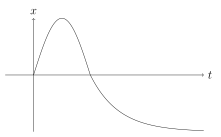
A particle of mass \(m\) moves along the \(x\)-axis. At time \(t=0\) it passes through \(x=0\) with velocity \(v_{0} > 0\). The particle is acted on by a force \(\mathrm{F}(x)\), directed along the \(x\)-axis and measured in the direction of positive \(x\), which is given by \[ \mathrm{F}(x)=\begin{cases} -m\mu^{2}x & \qquad(x\geqslant0),\\ -m\kappa\dfrac{\mathrm{d}x}{\mathrm{d}t} & \qquad(x < 0), \end{cases} \] where \(\mu\) and \(\kappa\) are positive constants. Obtain the particle's subsequent position as a function of time, and give a rough sketch of the \(x\)-\(t\) graph.
Solution: Using Newton's second law in the form, \(\F(x) = m \ddot{x}\). Our two different differential equations can be solved as follows: When \(x \geq 0\) \(-\mu^2x = \ddot{x} \Rightarrow x = A\sin \mu t + B \cos \mu t\) when \(x \geq 0\). And when \(x < 0\) \(-\kappa \dot{x} = \ddot{x} \Rightarrow \dot{x} = Ce^{-\kappa t} \Rightarrow x = De^{-\kappa t} + E\) when \(x < 0\) Following the trajectory of the particle: At \(t = 0, x = 0, \dot{x} = v_0 > 0\), so \(x = \frac{v_0}{\mu} \sin \mu t\) until \(t = \frac{\pi}{\mu}\). When \(t = \frac{\pi}{\mu}\) the particle will head into the negative \(x\)-axis with velocity \(-v_0\). At which point our initial conditions for our differential equations give us that \(De^{-\frac{\pi\kappa}{\mu}} + E = 0, -\kappa De^{-\frac{\pi\kappa}{\mu}} = -v_0 \Rightarrow De^{-\frac{\pi\kappa}{\mu}} = \frac{v_0}{\kappa}, E = -\frac{v_0}{\kappa}\). To summarise: \[ x(t) = \begin{cases} \frac{v_0}{\mu} \sin \mu t & 0 \leq t \leq \frac{\pi}{\mu} \\ -\frac{v_0}{\kappa} \l 1-e^{-\kappa(t-\frac{\pi}{\mu})}\r & t > \frac{\pi}{\mu}\end{cases}\]
1987 Paper 2 Q14
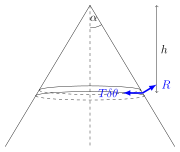
A thin uniform elastic band of mass \(m,\) length \(l\) and modulus of elasticity \(\lambda\) is pushed on to a smooth circular cone of vertex angle \(2\alpha,\) in such a way that all elements of the band are the same distance from the vertex. It is then released from rest. Let \(x(t)\) be the length of the band at time \(t\) after release, and let \(t_{0}\) be the time at which the band becomes slack. Assuming that a small element of the band which subtends an angle \(\delta\theta\) at the axis of the cone experiences a force, due to the tension \(T\) in the band, of magnitude \(T\delta\theta\) directed towards the axis, and ignoring the effects of gravity, show that \[ \frac{\mathrm{d}^{2}x}{\mathrm{d}t^{2}}+\frac{4\pi^{2}\lambda}{ml}(x-l)\sin^{2}\alpha=0,\qquad(0< t< t_{0}). \] Find the value of \(t_{0}.\)
Solution:
1987 Paper 3 Q6
The functions \(x(t)\) and \(y(t)\) satisfy the simultaneous differential equations \begin{alignat*}{1} \dfrac{\mathrm{d}x}{\mathrm{d}t}+2x-5y & =0\\ \frac{\mathrm{d}y}{\mathrm{d}t}+ax-2y & =2\cos t, \end{alignat*} subject to \(x=0,\) \(\dfrac{\mathrm{d}y}{\mathrm{d}t}=0\) at \(t=0.\) Solve these equations for \(x\) and \(y\) in the case when \(a=1\). Without solving the equations explicitly, state briefly how the form of the solutions for \(x\) and \(y\) if \(a>1\) would differ from the form when \(a=1.\)
Solution: Letting \(\mathbf{x} =\begin{pmatrix} x(t) \\ y(t) \end{pmatrix}\) and \(\mathbf{A} = \begin{pmatrix} -2 & 5 \\ -a & 2 \end{pmatrix}\) then our differential equation is \(\mathbf{x}' = \mathbf{Ax} + \begin{pmatrix} 0 \\2 \cos t \end{pmatrix}\). Looking at the eigenvalues of \(\mathbf{A}\), we find: \begin{align*} && \det \begin{pmatrix} -2-\lambda & 5 \\ -a & 2 -\lambda \end{pmatrix} &= (\lambda^2-4)+5a\\ &&&= \lambda^2 +5a-4 \end{align*} Therefore if \(a = 1\), \(\lambda = \pm i\). In which case we should expect the complementary solutions to be of the form \(\mathbf{x} = \begin{pmatrix} A \sin t + B \cos t \\ C \sin t + D \cos t \end{pmatrix}\). The first equation tells us that \((A-5D+B)\cos t + (-B+5C)\sin t=0\) so the complementary solution is:\(\mathbf{x} = \begin{pmatrix} 5(D-C) \sin t + 5C \cos t \\ C \sin t + D \cos t \end{pmatrix}\). Looking for a particular integral, we should expect to try something like \(\mathbf{x} = \begin{pmatrix} Et\cos t+Ft\sin t\\ Gt\cos t+Ht \sin t\end{pmatrix}\) and we find