Problems
Filters
48 problems found
2015 Paper 1 Q2
- Show that \(\cos 15^\circ = \dfrac{\sqrt3 +1}{2\sqrt2}\) and find a similar expression for \(\sin 15^\circ\).
- Show that \(\cos \alpha\) is a root of the equation \[ 4x^3-3 x -\cos 3\alpha =0\,, \] and find the other two roots in terms of \(\cos\alpha\) and \(\sin\alpha\).
- Use parts (i) and (ii) to solve the equation \(y^3-3y -\sqrt2 =0\,\), giving your answers in surd form.
Solution:
- \begin{align*} \cos 15^{\circ} &= \cos (45^{\circ} - 30^{\circ}) \\ &= \cos 45^{\circ} \cos 30^{\circ} + \sin 45^{\circ} \sin 30^{\circ} \\ &= \frac{1}{\sqrt{2}}\frac{\sqrt{3}}{2} + \frac{1}{\sqrt{2}}\frac{1}{2} \\ &= \frac{\sqrt{3}+1}{2\sqrt{2}} \\ \\ \sin15^{\circ} &= \sin(45^{\circ} - 30^{\circ}) \\ &= \sin45^{\circ} \cos 30^{\circ} - \cos 45^{\circ} \sin 30^{\circ} \\ &= \frac{1}{\sqrt{2}}\frac{\sqrt{3}}{2} - \frac{1}{\sqrt{2}}\frac{1}{2} \\ &= \frac{\sqrt{3}-1}{2\sqrt{2}} \\ \end{align*}
- \begin{align*} \cos 3 \alpha &= \cos 2\alpha \cos \alpha - \sin2\alpha \sin \alpha \\ &= (2\cos^2 \alpha -1)\cos \alpha - 2 \cos \alpha \sin^2 \alpha \\ &= 2\cos^3 \alpha - \cos \alpha - 2\cos \alpha (1-\cos^2 \alpha) \\ &= 4\cos^2 \alpha - 3\cos \alpha \end{align*} Therefore if \(x = \cos \alpha\) then \(4x^3 - 3x-\cos3\alpha = 0\). \begin{align*} 0 &= 4x^3 - 3x-\cos3\alpha \\ &= 4x^3 - 3x - 4\cos^3\alpha+ 3\cos \alpha \\ &= 4(x-\cos\alpha)(x^2+x\cos\alpha+\cos^2\alpha)-3(x-\cos\alpha)\\ &= (x - \cos \alpha)(4x^2+4x\cos\alpha+4\cos^2\alpha-3) \end{align*} Therefore the other roots will be solutions to the second quadratic which are: \begin{align*} \frac{-4\cos \alpha \pm \sqrt{16\cos^2\alpha - 16(4\cos^2\alpha-3)}}{8} &= \frac{-\cos \alpha \pm \sqrt{3(1-\cos^2\alpha)}}{2} \\ &= \frac{-\cos \alpha \pm \sqrt{3} \sin \alpha}{2} \end{align*}
- Suppose \(y^3-3y-\sqrt{2} = 0\) then \(4\l \frac{y}{2} \r ^3-3(\frac{y}{2}) -\frac{\sqrt{2}}{2} = 0\) or alternatively, if \(x = \frac{y}{2}\), \(4x^3-3x-\cos 45^{\circ} = 0\). Therefore \(x = \cos 15^{\circ}, \frac{-\cos 15^{\circ} \pm \sqrt{3} \sin 15^{\circ}}{2}\) Therefore \(y =2\cos 15^{\circ}, -\cos 15^{\circ} \pm \sqrt{3} \sin 15^{\circ}\) or \(y = \frac{\sqrt{6}+\sqrt{2}}{2}\), \begin{align*} y &= -\frac{\sqrt{3}+1}{2\sqrt{2}} \pm \frac{3-\sqrt{3}}{2\sqrt{2}} \\ &= \frac{-4}{2\sqrt{2}}, \frac{-2\sqrt{3}}{2\sqrt{2}} \\ &= -\sqrt{2}, -\frac{\sqrt{6}-\sqrt{2}}{2} \end{align*}
2015 Paper 3 Q4
- If \(a\), \(b\) and \(c\) are all real, show that the equation \[ z^3+az^2+bz+c=0 \tag{\(*\)} \] has at least one real root.
- Let \[ S_1= z_1+z_2+z_3, \ \ \ \ S_2= z_1^2 + z_2^2 + z_3^2, \ \ \ \ S_3= z_1^3 + z_2^3 + z_3^3\,, \] where \(z_1\), \(z_2\) and \(z_3\) are the roots of the equation \((*)\). Express \(a\) and \(b\) in terms of \(S_1\) and \(S_2\), and show that \[ 6c =- S_1^3 + 3 S_1S_2 - 2S_3\,. \]
- The six real numbers \(r_k\) and \(\theta_k\) (\(k=1, \ 2, \ 3\)), where \(r_k>0\) and \(-\pi < \theta_k <\pi\), satisfy \[ \textstyle \sum\limits _{k=1}^3 r_k \sin (\theta_k) = 0\,, \ \ \ \ \textstyle \sum\limits _{k=1}^3 r_k^2 \sin (2\theta_k) = 0\,, \ \ \ \ \ \textstyle \sum\limits _{k=1}^3 r_k^3 \sin (3\theta_k) = 0\, . \] Show that \(\theta_k=0\) for at least one value of \(k\). Show further that if \(\theta_1=0\) then \(\theta_2 = - \theta_3\,\).
Solution:
- Let \(z \in \mathbb{R}\) and let \(z \to \pm \infty\) then \(z^3 + az^2 + bz + c\) changes sign, therefore somewhere it must have a real root.
- \begin{align*} &&z^3 + az^2 + bz + c &= (z-z_1)(z-z_2)(z-z_3) \\ && &= z^3 - (z_1+z_2+z_3)z^2 + (z_1z_2 + z_2z_3+z_3z_1)z - (z_1z_2z_3) \\ \\ \Rightarrow && S_1 &= z_1+z_2+z_3 \\ &&&= -a \\ \\ \Rightarrow && S_2 &= z_1^2+z_2^2+z_3^2 \\ &&&= (z_1+z_2+z_3)^2 - 2(z_1z_2 + z_2z_3+z_3z_1) \\ &&&= a^2 - 2b \\ \Rightarrow && a &= -S_1 \\ && b &= \frac12 \l S_1^2 - S_2\r \\ \\ && 0 &= z_i^3 + az_i^2+bz_i+c \\ \Rightarrow && 0 &= S_3 + aS_2+bS_1+3c \\ &&&= S_3 -S_1S_2 + \frac12 \l S_1^2 - S_2\r S_1 + 3c \\ \Rightarrow && 0 &= 2S_3 - 3S_1S_2 + S_1^3 + 6c \end{align*}
- Let \(z_k= r_ke^{i \theta_k}\), then we have \(\textrm{Im}(S_k) = 0\) and so the polynomial with roots \(z_k\) has real coefficients, and therefore at least one root is real. This root will have \(\theta_k = 0\). Moreover, since if \(w\) is a root of a real polynomial \(\overbar{w}\) is also a root, and therefore if \(\theta_1 = 0\), we must have that \(z_2\) and \(z_3\) are complex conjugate, ie \(\theta_2 = - \theta_3\)
2015 Paper 3 Q6
- Let \(w\) and \(z\) be complex numbers, and let \(u= w+z\) and \(v=w^2+z^2\). Prove that \(w\) and \(z\) are real if and only if \(u\) and \(v\) are real and \(u^2\le2v\).
- The complex numbers \(u\), \(w\) and \(z\) satisfy the equations \begin{align*} w+z-u&=0 \\ w^2+z^2 -u^2 &= - \tfrac 23 \\ w^3+z^3 -\lambda u &= -\lambda\, \end{align*} where \(\lambda \) is a positive real number. Show that for all values of \(\lambda\) except one (which you should find) there are three possible values of \(u\), all real. Are \(w\) and \(z\) necessarily real? Give a proof or counterexample.
Solution:
- Notice that \(u^2 = v+2wz\), so \(w,z\) are roots of the quadratic \(t^2 -ut+\frac{u^2-v}{2}\). Therefore they are both real if \(u^2 \geq 2(u^2-v) \Rightarrow 2v \geq u^2\).
- \begin{align*} && w+z &= u \\ && w^2+z^2 &= u^2 - \tfrac23 \\ && w^3+z^3 &= \lambda(u-1) \\ \\ && wz &= \frac{u^2 - (u^2-\tfrac23)}{2} = \tfrac13\\ \\ && (w+z)(w^2+z^2) &= w^3+z^3+wz(w+z) \\ &&u(u^2-\tfrac23)&= \lambda(u-1)+\frac13u \\ \Rightarrow && u^3-u&= \lambda (u-1) \\ \Rightarrow && 0 &= (u-1)(u(u+1) - \lambda) \\ \Rightarrow && 0 &= (u-1)(u^2+u - \lambda) \end{align*} Therefore there will be at most 3 values for \(u\), unless \(1\) is a root of \(u^2+u-\lambda\), ie \(\lambda = 2\). Suppose \(u = 1\), then we have: \(w+z = 1, wz = 1/3 \Rightarrow w,z = \frac{-1 \pm \sqrt{-1/3}}{2}\) which are clearly complex.
2014 Paper 3 Q1
Let \(a\), \(b\) and \(c\) be real numbers such that \(a+b+c=0\) and let \[(1+ax)(1+bx)(1+cx) = 1+qx^2 +rx^3\,\] for all real \(x\). Show that \(q = bc+ca+ab\) and \(r= abc\).
- Show that the coefficient of \(x^n\) in the series expansion (in ascending powers of \(x\)) of \(\ln (1+qx^2+rx^3)\) is \((-1)^{n+1} S_n\) where \[S_n = \frac{a^n+b^n+c^n}{n} \,, \ \ \ \ \ \ \ \ (n\ge1).\]
- Find, in terms of \(q\) and \(r\), the coefficients of \(x^2\), \(x^3\) and \(x^5\) in the series expansion (in ascending powers of \(x\)) of \(\ln (1+qx^2+rx^3)\) and hence show that \(S_2S_3 =S_5\).
- Show that \(S_2S_5 =S_7\).
- Give a proof of, or find a counterexample to, the claim that \(S_2S_7=S_9\).
Solution: \begin{align*} (1+ax)(1+bx)(1+cx) &= (1+(a+b)x+abx^2)(1+cx) \\ &= 1+(a+b+c)x+(ab+bc+ca)x^2+abcx^3 \end{align*} Therefore by comparing coefficients, \(q = bc + ca + ab\) and \(r = abc\) as required.
- \begin{align*} \ln (1+qx^2 + rx^3) &= \ln(1+ax) + \ln(1+bx)+\ln(1+cx) \\ &= -\sum_{n=1}^{\infty} \frac{(-ax)^n}{n}-\sum_{n=1}^{\infty} \frac{(-bx)^n}{n}-\sum_{n=1}^{\infty} \frac{(-cx)^n}{n} \\ &= \sum_{n=1}^{\infty} \frac{(-1)^{n+1}(a^n+b^n+c^n)}{n} x^n \\ &= \sum_{n=1}^{\infty} (-1)^{n+1} S_n x^n \\ \end{align*}
- \begin{align*} \ln (1 + qx^2 + rx^3) &= (qx^2+rx^3) -\frac{(qx^2+rx^3)^2}{2} + O(x^6) \\ &= qx^2 + rx^3 - \frac12 q^2 x^4 - qr x^5 + O(x^6) \\ \end{align*} Comparing coefficients we see that \(S_2 = -q\) and \(S_3 = r\), we also must have \(S_5 = -qr = S_2S_3\) as required.
- \begin{align*} \ln (1 + qx^2 + rx^3) &= (qx^2+rx^3) -\frac{(qx^2+rx^3)^2}{2} +\frac{(qx^2+rx^3)^3}{3}+ O(x^8) \\ &= qx^2 + rx^3 - \frac12 q^2 x^4 - qr x^5 + \frac12 rx^6 + \frac13 q^3 x^6 + q^2r x^7 + O(x^8) \\ &= qx^2 + rx^3 - \frac12 q^2 x^4 - qr x^5 + \left ( \frac12 r+ \frac13 q^3 \right)x^6 + q^2r x^7 \end{align*} Comparing coefficients we see that \(S_2 = -q\) and \(S_5 =-qr\), we also must have \(S_7 = q^2r = S_2S_5\) as required.
- Let \(a = b = 1, c = -2\), then \(S_2 = \frac{1^2+1^2 + (-2)^2}{2} = 3, S_7 = \frac{1^2+1^2+(-2)^7}{7} = -18, S_9 = \frac{1^1+1^2+(-2)^9}{9} = \frac{2 - 512}{9} \neq 3 \cdot (-18)\)
2013 Paper 2 Q3
- Given that the cubic equation \(x^3+3ax^2 + 3bx +c=0\) has three distinct real roots and \(c<0\), show with the help of sketches that either exactly one of the roots is positive or all three of the roots are positive.
- Given that the equation \(x^3 +3ax^2+3bx+c=0\) has three distinct real positive roots show that \begin{equation*} a^2>b>0, \ \ \ \ a<0, \ \ \ \ c<0\,. \tag{\(*\)} \end{equation*} [Hint: Consider the turning points.]
- Given that the equation \(x^3 +3ax^2+3bx+c=0\) has three distinct real roots and that \begin{equation*} ab<0, \ \ \ \ c>0\,, \end{equation*} determine, with the help of sketches, the signs of the roots.
- Show by means of an explicit example (giving values for \(a\), \(b\) and \(c\)) that it is possible for the conditions (\(*\)) to be satisfied even though the corresponding cubic equation has only one real root.
Solution:
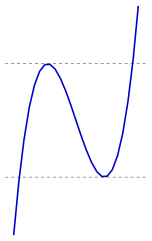
- First notice that this cubic has leading first term \(1\) and three real roots, so it must have the shape:
With the \(x\)-axis running somewhere between the dashed lines. Since \(c < 0\), the \(y\)-axis must meet the curve below the \(x\)-axis, ie somewhere on the blue section of this curve:
 Therefore there will be either \(1\) (if it meets it in the \(\cup\) area) or \(3\) (if it meets it on the far left) positive roots.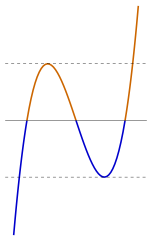
- First notice that if \(c > 0\) we cannot have three positive real roots since the function would need to pass \(0\) between \(0\) and \(-\infty\). Secondly, notice both turning points must be larger than zero, ie \begin{align*} && 0 &= 3x^2 + 6ax + 3b \\ \Leftrightarrow && 0 &= (x+a)^2 + b - a^2 \end{align*} has both roots larger than zero, (and it needs to have two roots, so \(a^2 > b\) and \(-a > 0\), ie \(a < 0\). If \(b < 0\), then just looking at \(x^2+2ax+b\) we can see that it is \(<0\) at \(0\) and one of the roots will be negative, therefore \(c < 0\), \(a^2 > b > 0\) and \(a < 0\)
- Since \(c > 0\) we can see that at least one root is negative.
ie the \(y\)-axis passes through an orange section of this curve. What now matters is where the larger turning point is. Considering \(x^2 + 2ax + b\), we notice that \(ab < 0\) means that \((x-\alpha)(x-\beta)\) we must have \((\alpha + \beta)\alpha \beta > 0\) which isn't possible if both roots are negative. Therefore the \(y\)-axis passes through the orange \(\cap\) and there are \(2\) positive real roots.
- If we take \(a = 1, b = -1, c = 1\) then we have \(x^3 + 3x^2-3x+1\). This has turning points when \(x^2+2x-1 = 0\), ie \(x = -1 \pm \sqrt{2}\) Notice that \begin{align*} && y(-1\pm \sqrt2) &= (-1 \pm \sqrt{2})^3 + 3(-1 \pm \sqrt{2})^2-3(-1 \pm \sqrt{2}) + 1 \\ &&&= (-1\pm \sqrt{2}) \cdot (3 \mp 2\sqrt2) + 3(3 \mp \sqrt2) -3(-1\pm \sqrt2) + 1 \\ &&&= (-7 \pm 5 \sqrt2) + (9 \mp 3\sqrt2) +(3 \mp 3\sqrt2) + 1 \\ &&&= 24 \mp 16\sqrt2 = 8(3 \mp 2 \sqrt2) >0 \end{align*} ie both turning points are above zero and hence only one real root
2013 Paper 3 Q4
Show that \((z-\e^{i\theta})(z-\e^{-i\theta})=z^2 -2z\cos\theta +1\,\). Write down the \((2n)\)th roots of \(-1\) in the form \(\e^{i\theta}\), where \(-\pi <\theta \le \pi\), and deduce that \[ z^{2n} +1 = \prod_{k=1}^n \left(z^2-2z \cos\left( \tfrac{(2k-1)\pi}{2n}\right) +1\right) \,. \] Here, \(n\) is a positive integer, and the \(\prod\) notation denotes the product.
- By substituting \(z=i\) show that, when \(n\) is even, \[ \cos \left(\tfrac \pi {2n}\right) \cos \left(\tfrac {3\pi} {2n}\right) \cos \left(\tfrac {5\pi} {2n}\right) \cdots \cos \left(\tfrac{(2n-1) \pi} {2n}\right) = {(-1\vphantom{\dot A})}^{\frac12 n} 2^{1-n} \,. \]
- Show that, when \(n\) is odd, \[ \cos^2 \left(\tfrac \pi {2n}\right) \cos ^2 \left(\tfrac {3\pi} {2n}\right) \cos ^2 \left(\tfrac {5\pi} {2n}\right) \cdots \cos ^2 \left(\tfrac{(n-2) \pi} {2n}\right) = n 2^{1-n} \,. \] You may use without proof the fact that \(1+z^{2n}= (1+z^2)(1-z^2+z^4 - \cdots + z^{2n-2})\,\) when \(n\) is odd.
Solution: \begin{align*} && (z-e^{i \theta})(z-e^{-i\theta}) &= z^2 - (e^{i\theta}+e^{-i\theta})z + 1 \\ &&&= z^2-2\cos \theta z + 1 \end{align*} The \(2n\)th roots of \(-1\) are \(e^{\frac{i (2k+1)\pi}{2n}}, k \in \{-n, \cdots, n-1 \}\) or \(e^{\frac{i k \pi}{2n}}, k \in \{-2n+1, -2n+3, \cdots, 2n-3, 2n-1 \}\) \begin{align*} && z^{2n}+1 &= (z-e^{-i(2n-1)/2n})\cdot (z-e^{-i(2n-3)/2n})\cdots (z-e^{i(2n-3)/2n})\cdot (z-e^{i(2n-1)/2n}) \\ &&&= \prod_{k=1}^n \left (z - e^{i \frac{2k-1}{2n}\pi} \right)\left (z - e^{-i \frac{2k-1}{2n}\pi} \right)\\ &&&= \prod_{k=1}^n \left (z^2 - 2z \cos \left ( \frac{(2k-1)\pi}{2n}\right) + 1 \right) \end{align*}
- \begin{align*} && i^{2n} + 1 &= \prod_{k=1}^n \left (i^2 - 2i \cos \left ( \frac{(2k-1)\pi}{2n}\right) + 1 \right) \\ \Rightarrow && (-1)^n + 1 &= (-1)^n2^ni^n\prod_{k=1}^n \cos \left ( \frac{(2k-1)\pi}{2n}\right) \\ \Rightarrow && \prod_{k=1}^n \cos \left ( \frac{(2k-1)\pi}{2n}\right) &= 2^{1-n}(-1)^{n/2} \tag{if \(n\equiv 0\pmod{2}\)} \end{align*}
- When \(n\) is odd, we notice that two of the roots are \(i\) and \(-i\), if we exclude those, (ie by factoring out \(z^2+1\), we see that \begin{align*} && 1-z^2+z^4-\cdots + z^{2n-2} &= \prod_{k=1, 2k-1\neq n}^n \left (z^2-2z \cos \left ( \frac{(2k-1)\pi}{2n} \right)+1 \right) \\ &&&= \prod_{k=1}^{(n-1)/2} \left (z^2-2z \cos \left ( \frac{(2k-1)\pi}{2n} \right)+1 \right) \prod_{k=(n+1)/2}^{n} \left (z^2-2z \cos \left ( \frac{(2k-1)\pi}{2n} \right)+1 \right)\\ &&&= \prod_{k=1}^{(n-1)/2} \left (z^2-2z \cos \left ( \frac{(2k-1)\pi}{2n} \right)+1 \right) \prod_{k=1}^{(n-1)/2} \left (z^2+2z \cos \left ( \frac{(2k-1)\pi}{2n} \right)+1 \right)\\ \Rightarrow && 1-i^2 + i^4 + \cdots + i^{2n-2} &= \prod_{k=1}^{(n-1)/2} \left (2 \cos \left ( \frac{(2k-1)\pi}{2n} \right) \right) \prod_{k=1}^{(n-1)/2} \left (2 \cos \left ( \frac{(2k-1)\pi}{2n} \right) \right)\\ \Rightarrow && n &= 2^{n-1} \prod_{k=1}^{(n-1)/2}\cos^2 \left ( \frac{(2k-1)\pi}{2n} \right) \\ \Rightarrow && \prod_{k=1}^{(n-1)/2}\cos^2 \left ( \frac{(2k-1)\pi}{2n} \right) &= n2^{1-n} \end{align*}
2011 Paper 3 Q3
Show that, provided \(q^2\ne 4p^3\), the polynomial \[ \hphantom{(p\ne0, \ q\ne0)\hspace{2cm}} x^3-3px +q \hspace {2cm} (p\ne0, \ q\ne0) \] can be written in the form \[ a(x-\alpha)^3 + b(x-\beta)^3\,, \] where \(\alpha\) and \(\beta\) are the roots of the quadratic equation \(pt^2 -qt +p^2=0\), and \(a\) and \(b\) are constants which you should express in terms of \(\alpha\) and \(\beta\). Hence show that one solution of the equation \(x^3-24x+48=0\,\) is \[ x= \frac{2 (2-2^{\frac13})}{1-2^{\frac13}} \] and obtain similar expressions for the other two solutions in terms of \(\omega\), where \(\omega = \mathrm{e}^{2\pi\mathrm{i}/3}\,\). Find also the roots of \(x^3-3px +q=0\) when \(p=r^2\) and \(q= 2r^3\) for some non-zero constant \(r\).
2010 Paper 2 Q7
- By considering the positions of its turning points, show that the curve with equation \[ y=x^3-3qx-q(1+q)\,, \] where \(q>0\) and \(q\ne1\), crosses the \(x\)-axis once only.
- Given that \(x\) satisfies the cubic equation \[ x^3-3qx-q(1+q)=0\,, \] and that \[ x=u+q/u\,, \] obtain a quadratic equation satisfied by \(u^3\). Hence find the real root of the cubic equation in the case \(q>0\), \(q\ne1\).
- The quadratic equation \[ t^2 -pt +q =0\, \] has roots \(\alpha \) and \(\beta\). Show that \[ \alpha^3+\beta^3 = p^3 -3qp\,. \] It is given that one of these roots is the square of the other. By considering the expression \((\alpha^2 -\beta)(\beta^2-\alpha)\), find a relationship between \(p\) and \(q\). Given further that \(q>0\), \(q\ne1\) and \(p\) is real, determine the value of \(p\) in terms of \(q\).
2009 Paper 3 Q5
The numbers \(x\), \(y\) and \(z\) satisfy \begin{align*} x+y+z&= 1\\ x^2+y^2+z^2&=2\\ x^3+y^3+z^3&=3\,. \end{align*} Show that \[ yz+zx+xy=-\frac12 \,.\] Show also that \(x^2y+x^2z+y^2z+y^2x+z^2x+z^2y=-1\,\), and hence that \[ xyz=\frac16 \,.\] Let \(S_n=x^n+y^n+z^n\,\). Use the above results to find numbers \(a\), \(b\) and \(c\) such that the relation \[ S_{n+1}=aS_{n}+bS_{n-1}+cS_{n-2}\,, \] holds for all \(n\).
Solution: \begin{align*} && (x+y+z)^2 &= x^2 + y^2 + z^2 + 2(xy+yz+zx) \\ \Rightarrow && 1^2 &= 2 + 2(xy+yz+zx) \\ \Rightarrow && xy+yz+zx &= -\frac12 \end{align*} \begin{align*} && 1 \cdot 2 &= (x+y+z)(x^2+y^2+z^2) \\ &&&= x^3 + y^3 + z^3 + x^2y+x^2z+y^2z+y^2x+z^2x+z^2y \\ &&&= 3 + x^2y+x^2z+y^2z+y^2x+z^2x+z^2y\\ \Rightarrow && -1 &= x^2y+x^2z+y^2z+y^2x+z^2x+z^2y \end{align*} \begin{align*} && (x+y+z)^3 &= x^3 + y^3 + z^3 + \\ &&&\quad \quad 3xy^2 + 3xz^2 + \cdots + 3zx^2 + 3zy^2 + \\ &&&\quad \quad \quad 6xyz \\ \Rightarrow && 1 &= 3 + 3(-1) + 6xyz \\ \Rightarrow && xyz &= \frac16 \end{align*} Since we have \(f(t) = (t-x)(t-y)(t-z) = t^3-t^2-\frac12 t - \frac16\) is zero for \(x,y,z\) we can notice that: \(t^{n+1} = t^n +\frac12 t^{n-1} + \frac16 t^{n-2}\) is also true for \(x,y,z\) (by multiplying by \(t^{n-2}\). Therefore: \(S_{n+1} = S_n + \frac12 S_{n-1} + \frac16 S_{n-2}\)
2008 Paper 3 Q1
Find all values of \(a\), \(b\), \(x\) and \(y\) that satisfy the simultaneous equations \begin{alignat*}{3} a&+b & &=1 &\\ ax&+by & &= \tfrac13& \\ ax^2&+by^2& &=\tfrac15& \\ ax^3 &+by^3& &=\tfrac17\,.& \end{alignat*} \noindent{\bf [} {\bf Hint}: you may wish to start by multiplying the second equation by \(x+y\). {\bf ]}
Solution: This is a second order recurrence relation, so we need to find \(m\) and \(n\) such that; \begin{align*} &&\frac15 &= m\frac13 + n \\ &&\frac17 &= m \frac15 + n\frac13 \\ \Rightarrow && m,n &= \frac67, - \frac{3}{35} \end{align*} So we now need to solve the characteristic equation: \(\lambda^2 - \frac67 \lambda + \frac{3}{35} = 0\) So \(x,y = \frac{15 \pm 2 \sqrt{30}}{35}\). We need, \begin{align*} && 1 &= a+ b \\ && \frac13 &= a \frac{15 + 2 \sqrt{30}}{35} + b \frac{15 - 2 \sqrt{30}}{35} \\ && \frac13 &= \frac{15}{35} + \frac{2 \sqrt{30}}{35}(a-b) \\ \Rightarrow && -\frac{\sqrt{30}}{18} &= a-b \\ \Rightarrow && a &= \frac{18-\sqrt{30}}{36} \\ && b &= \frac{18+\sqrt{30}}{38} \end{align*} So our two answers are: \[ (a,b,x,y) = \left (\frac{18\pm\sqrt{30}}{36} ,\frac{18\mp\sqrt{30}}{36},\frac{15 \pm 2 \sqrt{30}}{35},\frac{15 \mp 2 \sqrt{30}}{35}, \right)\]
2007 Paper 3 Q1
In this question, do not consider the special cases in which the denominators of any of your expressions are zero. Express \(\tan(\theta_1+\theta_2+\theta_3+\theta_4)\) in terms of \(t_i\), where \(t_1=\tan\theta_1\,\), etc. Given that \(\tan\theta_1\), \(\tan\theta_2\), \(\tan\theta_3\) and \(\tan\theta_4\) are the four roots of the equation \[at^4+bt^3+ct^2+dt+e=0 \] (where \(a\ne0\)), find an expression in terms of \(a\), \(b\), \(c\), \(d\) and \(e\) for \(\tan(\theta_1+\theta_2+\theta_3+\theta_4)\). The four real numbers \(\theta_1\), \(\theta_2\), \(\theta_3\) and \(\theta_4\) lie in the range \(0\le \theta_i<2\pi\) and satisfy the equation \[ p\cos2\theta+\cos(\theta-\alpha)+p=0\,,\] where \(p\) and \(\alpha\) are independent of \(\theta\). Show that \(\theta_1+\theta_2+\theta_3+\theta_4=n\pi\) for some integer \(n\).
Solution: \begin{align*} \tan(\theta_1 + \theta_2 + \theta_3 + \theta_4) &= \frac{\tan(\theta_1 + \theta_2) + \tan(\theta_3 + \theta_4)}{1 - \tan(\theta_1 +\theta_2)\tan(\theta_3+\theta_4)} \\ &= \frac{\frac{t_1+t_2}{1-t_1t_2}+\frac{t_3+t_4}{1-t_3t_4}}{1-\frac{t_1+t_2}{1-t_1t_2}\frac{t_3+t_4}{1-t_3t_4}} \\ &= \frac{(t_1+t_2)(1-t_3t_4)+(t_3+t_4)(1-t_1t_2)}{(1-t_1t_2)(1-t_3t_4)-(t_1+t_2)(t_3+t_4)} \\ &= \frac{t_1 +t_2+t_3+t_4 - (t_1t_2t_3+t_1t_2t_4+t_1t_3t_4+t_2t_3t_4)}{1-t_1t_2-t_1t_3-t_1t_4-t_2t_3-t_2t_4-t_3t_4} \end{align*} If \(t_1, t_2, t_3, t_4\) are the roots of \(at^4+bt^3+ct^2+dt+e = 0\), then \(t_1+t_2+t_3+t_4 = -\frac{b}{a}, t_1t_2+t_1t_3+t_1t_4+t_2t_3+t_2t_4+t_3t_4 = \frac{c}{a}, t_1t_2t_3+t_1t_2t_4+t_1t_3t_4+t_2t_3t_4 = -\frac{d}{a}\), therefore the expression is: \begin{align*} \tan(\theta_1 + \theta_2 + \theta_3 + \theta_4) &= \frac{-\frac{b}{a}+\frac{d}{a}}{1 - \frac{c}{a}} \\ &= \frac{d-b}{a-c} \end{align*} \begin{align*} &&0 &= p \cos 2\theta + \cos (\theta - \alpha) + p \\ &&&= p (2\cos^2 \theta -1) + \cos \theta \cos \alpha - \sin \theta \sin \alpha + p \\ &&&= 2p \cos^2 \theta + \cos \theta \cos \alpha - \sin \theta \sin \alpha\\ \Rightarrow && 0 &=2p \cos \theta + \cos \alpha - \tan \theta \sin \alpha \\ \Rightarrow && -2p \cos \theta&= \cos \alpha - \tan \theta \sin \alpha \\ \Rightarrow && 4p^2 \cos^2 \theta &= \cos^2 \alpha - 2 \sin \alpha \cos \alpha \tan \theta + \sin^2 \alpha \tan^2 \theta \\ && 4p^2 \frac{1}{1 + \tan^2 \theta} &= \cos^2 \alpha - \sin 2\alpha \tan \theta + \sin^2 \alpha \tan^2 \theta \\ \Rightarrow && 4p^2 &= \cos^2 \alpha - \sin 2\alpha t+t^2-\sin2\alpha t^3+\sin^2 \alpha t^4 \\ \Rightarrow && \tan (\theta_1+\theta_2 + \theta_3+ \theta_4) &= \frac{0}{\sin^2 \alpha - 1} \\ &&&= 0 \\ \Rightarrow && \theta_1 + \theta_2 + \theta_3 + \theta_4 &= n\pi \end{align*}
2006 Paper 1 Q3
In this question \(b\), \(c\), \(p\) and \(q\) are real numbers.
- By considering the graph \(y=x^2 + bx + c\) show that \(c < 0\) is a sufficient condition for the equation \(\displaystyle x^2 + bx + c = 0\) to have distinct real roots. Determine whether \(c < 0\) is a necessary condition for the equation to have distinct real roots.
- Determine necessary and sufficient conditions for the equation \(\displaystyle x^2 + bx + c = 0\) to have distinct positive real roots.
- What can be deduced about the number and the nature of the roots of the equation \(x^3 + px + q = 0\) if \(p>0\) and \(q<0\)? What can be deduced if \(p<0\,\) and \(q<0\)? You should consider the different cases that arise according to the value of \(4p^3+ 27q^2\,\).
Solution:
- Since \(y(0) < 0\) and \(y(\pm \infty) > 0\) we must cross the axis twice. Therefore there are two distinct real roots. It is not necessary, for example \((x-2)(x-3)\) has distinct real roots by the constant term is \(6 > 0\)

- For \(x^2+bx+c=0\) to have distinct, positive real roots we need \(\Delta > 0\) and \(\frac{-b -\sqrt{\Delta}}{2a} > 0\) where \(\Delta = b^2-4ac\), ie \(b < 0\) and \(b^2 > \Delta = b^2-4ac\) or \(4ac > 0\). Therefore we need \(b^2-4ac > 0, b < 0, 4ac > 0\)
- Since \(q < 0\) at least one of the roots is positive. The gradient is \(3x^2+p > 0\) therefore there is exactly one positive root. If \(p < 0\) then there are turning points when \(3x^2+p = 0\) ie \(x = \pm \sqrt{\frac{-p}{3}}\). If the first turning point is above the \(x\)-axis then there will be 3 roots. If it is on the \(x\)-axis then 2, otherwise only 1. \begin{align*} y &= \left (-\sqrt{\frac{-p}{3}}\right)^3 + p\left (-\sqrt{\frac{-p}{3}}\right)+q \\ &= \sqrt{\frac{-p}{3}} \left (p - \frac{p}{3} \right) + q \\ &= \frac{2}{3} \sqrt{\frac{-p}{3}}p +q \\ \end{align*} Therefore it is positive if \(-\frac{4}{27}p^3 >q^2\) ie if \(4p^3+27q^2 < 0\)
2006 Paper 3 Q5
Show that the distinct complex numbers \(\alpha\), \(\beta\) and \(\gamma\) represent the vertices of an equilateral triangle (in clockwise or anti-clockwise order) if and only if \[ \alpha^2 + \beta^2 +\gamma^2 -\beta\gamma - \gamma \alpha -\alpha\beta =0\,. \] Show that the roots of the equation \begin{equation*} z^3 +az^2 +bz +c=0 \tag{\(*\)} \end{equation*} represent the vertices of an equilateral triangle if and only if \(a^2=3b\). Under the transformation \(z=pw+q\), where \(p\) and \(q\) are given complex numbers with \(p\ne0\), the equation (\(*\)) becomes \[ w^3 +Aw^2 +Bw +C=0\,. \tag{\(**\)} \] Show that if the roots of equation \((*)\) represent the vertices of an equilateral triangle, then the roots of equation \((**)\) also represent the vertices of an equilateral triangle.
Solution: The complex numbers represent an equilateral triangle iff \(\gamma\) is a \(\pm 60^\circ\) rotation of \(\beta\) around \(\alpha\), ie \begin{align*} && \gamma - \alpha &= \omega(\beta - \alpha) \\ \Leftrightarrow && \omega &= \frac{\gamma - \alpha}{\beta - \alpha} \\ \Leftrightarrow && -1 &= \left (\frac{\gamma - \alpha}{\beta - \alpha} \right)^3 \\ \Leftrightarrow && -(\beta - \alpha)^3 &=(\gamma - \alpha)^3 \\ \Leftrightarrow && 0 &= (\gamma-\alpha)^3+(\beta-\alpha)^3 \\ &&&= \gamma^3-3\gamma^2\alpha +3\gamma\alpha^2-\alpha^3 +\beta^3-3\beta^2\alpha+3\beta\alpha^2-\alpha^3 \\ &&&= (\beta + \gamma - 2\alpha)(\alpha^2+\beta^2+\gamma^2 - \alpha\beta - \beta\gamma - \gamma \delta) \\ \Leftrightarrow && 0 &= \alpha^2+\beta^2+\gamma^2 - \alpha\beta - \beta\gamma - \gamma \delta \end{align*} The roots of the equation \(z^3+az^2+bz+c = 0\) represents the vertices of an equilateral triangle iff \(a^2-3b = (\alpha+\beta+\gamma^2) - 3(\alpha\beta+\beta\gamma+\gamma\alpha) = \alpha^2+\beta^2+\gamma^2 - \alpha\beta - \beta\gamma - \gamma \delta = 0\) as erquired. Suppose \(a^2 = 3b\), then consider \(z = pw +q\), we must have \begin{align*} && 0 &= (pw+q)^3+a(pw+q)^2 + b(pw+q)+c \\ &&&= p^3w^3 +(3p^2q+ap^2)w^2+(3pq^2+2apq+bp)w+(q^3+aq^2+bq+c) \\ &&&= p^3w^3+p^2(3q+a)w^2+p(3q^2+2aq+b)w+(q^3+aq^2+bq+c) \\ \end{align*} We need to check if \(\left(\frac{3q+a}{p} \right)^2 = 3 \left (\frac{3q^2+2qa+b}{p^2} \right)\). Clearly the denominators match, so consider the numerators \begin{align*} && (3q+a)^2 &= 9q^2+6aq+a^2 \\ &&&= 9q^2+6aq+3b \\ &&&= 3(3q^2+2qa+b) \end{align*} as required
2003 Paper 3 Q5
Find the coordinates of the turning point on the curve \(y = x^2 - 2bx + c\,\). Sketch the curve in the case that the equation \(x^2 - 2bx + c=0\) has two distinct real roots. Use your sketch to determine necessary and sufficient conditions on \(b\) and \(c\) for the equation \(x^2 - 2bx + c = 0\) to have two distinct real roots. Determine necessary and sufficient conditions on \(b\) and \(c\) for this equation to have two distinct positive roots. Find the coordinates of the turning points on the curve \(y = x^3 - 3b^2x + c\) (with \(b>0\)) and hence determine necessary and sufficient conditions on \(b\) and \(c\) for the equation \(x^3 - 3b^2x + c = 0\) to have three distinct real roots. Determine necessary and sufficient conditions on \(a\,\), \(b\) and \(c\) for the equation \(\l x - a \r^3 - 3b^2 \l x - a \r + c = 0\) to have three distinct positive roots. Show that the equation \(2x^3 - 9x^2 + 7x - 1 = 0\) has three distinct positive roots.
Solution: \begin{align*} y &= x^2-2bx+c \\ &= (x-b)^2+c-b^2 \end{align*} Therefore the turning point is at \((b,c-b^2)\)


2002 Paper 1 Q5
Let \[ \f(x) = x^n + a_1 x^{n-1} + \cdots + a_n\;, \] where \(a_1\), \(a_2\), \(\ldots\), \(a_n\) are given numbers. It is given that \(\f(x)\) can be written in the form \[ \f(x) = (x+k_1)(x+k_2)\cdots(x+k_n)\;. \] By considering \(\f(0)\), or otherwise, show that \(k_1k_2 \ldots k_n =a_n\). Show also that $$(k_1+1)(k_2+1)\cdots(k_n+1)= 1+a_1+a_2+\cdots+a_n$$ and give a corresponding result for \((k_1-1)(k_2-1)\cdots(k_n-1)\). Find the roots of the equation \[ x^4 +22x^3 +172x^2 +552x+576=0\;, \] given that they are all integers.
Solution: \begin{align*} && f(0) &= 0^n + a_1\cdot 0^{n-1} + \cdots + a_n \\ &&&= a_n \\ && f(0) &= (0+k_1)(0+k_2) \cdots (0+k_n) \\ &&&= k_1 k_2 \cdots k_n \\ \Rightarrow && a_n &= k_1 k_2 \cdots k_n \\ \\ &&f(1) &= 1^n + a_1 \cdot 1^{n-1} + \cdots + a_n \\ &&&= 1 + a_1 + a_2 + \cdots + a_n \\ && f(1) &= (1 + k_1) (1 + k_2) \cdots (1+k_n) \\ \Rightarrow && (k_1+1)\cdots (k_n+1) &= 1 + a_1 + \cdots + a_n \\ \\ && f(-1) &= (-1)^{n} + a_1 \cdot (-1)^{n-1} + \cdots + a_n \\ &&&= a_n - a_{n-1} + \cdots + (-1)^{n-1} a_1 + (-1)^{n} \\ && f(-1) &= (-1+k_1)(-1+k_2) \cdots (-1+k_n) \\ &&&= (k_1-1)(k_2-1)\cdots(k_n-1) \\ \Rightarrow && (k_1-1)\cdots(k_n-1) &= a_n - a_{n-1} + \cdots + (-1)^{n-1} a_1 + (-1)^{n} \end{align*} \(576 = 2^6 \cdot 3^2\). Notice that \(1 - 22 + 172 -552 + 576 = 175 = 5^2 \cdot 7\) and \(1+22 + 172+552+576 = 1323 = 3^3 \cdot 7^2\). \(k_i = 2, 6, 6, 8\) therefore the roots are \(-2, -6, -6, -8\)