Problems
Filters
43 problems found
2009 Paper 1 Q6
- Show that, for \(m>0\,\), \[ \int_{1/m}^m \frac{x^2}{x+1} \, \d x = \frac{(m-1)^3(m+1)}{2m^2}+ \ln m\,. \]
- Show by means of a substitution that \[ \int_{1/m}^m \frac1 {x^n(x+1)}\,\d x = \int_{1/m}^m \frac {u^{n-1}}{u+1}\,\d u \,. \]
- Evaluate:
- \(\bf (a)\) \(\displaystyle \int_{1/2}^2 \frac {x^5+3}{x^3(x+1)}\,\d x \;;\)
- \(\bf (b)\) \(\displaystyle \int_1^2 \frac{x^5+x^3 +1}{x^3(x+1)}\, \d x\;. \)
Solution:
- \(\,\) \begin{align*} && \int_{1/m}^m \frac{x^2}{x+1} \d x &= \int_{1/m}^m \left ( x- 1 + \frac{1}{x+1} \right) \d x \\ &&&= \left [ \frac{x^2}{2} - x + \ln (x+1) \right]_{1/m}^m \\ &&&= \left ( m^2/2 - m + \ln(m+1) \right)- \left ( \frac{1}{2m^2} - \frac{1}{m} + \ln\left(\frac1m+1\right) \right) \\ &&&= \frac{m^4-2m^3-1+2m}{2m^2} + \ln (m+1) - \ln(m+1) + \ln m \\ &&&= \frac{(m-1)^3(m+1)}{2m^2} + \ln m \end{align*}
- \(\,\) \begin{align*} u = \frac{1}x, \d x = -\frac{1}{u^2} \d u:&& \int_{1/m}^m \frac1 {x^n(x+1)}\,\d x &= \int_{u=m}^{u=1/m} \frac{1}{u^{-n}(u^{-1}+1)} \frac{-1}{u^2} \d u \\ &&&= \int_{1/m}^m \frac{u^{n-1}}{u+1} \d u \end{align*}
- \(\bf (a)\) \(\,\) \begin{align*} && I &= \int_{1/2}^2 \frac {x^5+3}{x^3(x+1)}\,\d x \\ &&&= \int_{1/2}^2 \left ( \frac{x^2}{x+1} + \frac{3}{x^3(x+1)} \right) \d x \\ &&&= \int_{1/2}^2 \frac{x^2}{x+1} \d x + 3 \int_{1/2}^2 \frac{x^2}{x+1} \d x \\ &&&= 4 \left ( \frac{(2-1)^3(2+1)}{2 \cdot 2^2} + \ln 2 \right) \\ &&&= \frac32+4 \ln 2 \end{align*}
- \(\bf (b)\) \(\,\) \begin{align*} && J &= \int_1^2 \frac{x^5+x^3 +1}{x^3(x+1)}\, \d x \\ && K &= \int_1^2 \frac{x^5 +1}{x^3(x+1)}\, \d x\\ u = 1/x, \d x = -1/u^2 \d u: &&&= \int_{u=1}^{u=1/2} \frac{u^{-5}+1}{u^{-3}(u^{-1}+1)} \frac{-1}{u^2} \d u \\ &&&= \int_{1/2}^1 \frac{1 + u^5}{u^3(u+1)} \d u \\ \Rightarrow && K &= \frac12 \int_{1/2}^2 \frac{x^5+1}{x^3(x+1)} \d x \\ &&&= \frac{(2-1)^3(2+1)}{2 \cdot 2^2} + \ln 2 \\ &&&= \frac38 + \ln 2 \\ && L &= \int_1^2 \frac{x^3}{x^3(x+1)} \d x \\ &&&= \ln (3) - \ln 2 \\ \Rightarrow && J &= \frac38 + \ln 3 \end{align*}
2009 Paper 3 Q7
- The functions \(\f_n(x)\) are defined for \(n=0\), \(1\), \(2\), \(\ldots\)\, , by \[ \f_0(x) = \frac 1 {1+x^2}\, \qquad \text{and}\qquad \f_{n+1}(x) =\frac{\d \f_n(x)}{\d x}\,. \] Prove, for \(n\ge1\), that \[ (1+x^2)\f_{n+1}(x) + 2(n+1)x\f_n(x) + n(n+1)\f_{n-1}(x)=0\,. \]
- The functions \(\P_n(x)\) are defined for \(n=0\), \(1\), \(2\), \(\ldots\)\, , by \[ \P_n(x) = (1+x^2)^{n+1}\f_n(x)\,. \] Find expressions for \(\P_0(x)\), \(\P_1(x)\) and \(\P_2(x)\). Prove, for \(n\ge0\), that \[ \P_{n+1}(x) -(1+x^2)\frac {\d \P_n(x)}{\d x}+ 2(n+1)x \P_n(x)=0\,, \] and that \(\P_n(x)\) is a polynomial of degree \(n\).
2008 Paper 2 Q2
Let \(a_n\) be the coefficient of \(x^n\) in the series expansion, in ascending powers of \(x\), of \[\displaystyle \frac{1+x}{(1-x)^2(1+x^2)} \,, \] where \(\vert x \vert <1\,\). Show, using partial fractions, that either \(a_n =n+1\) or \(a_n = n+2\) according to the value of \(n\). Hence find a decimal approximation, to nine significant figures, for the fraction \( \displaystyle \frac{11\,000}{8181}\). \newline [You are not required to justify the accuracy of your approximation.]
Solution: \begin{align*} && \frac{1+x}{(1-x)^2(1+x^2)} &= \frac{A}{1-x} + \frac{B}{(1-x)^2} + \frac{Cx+D}{1+x^2} \\ \Rightarrow && 1 + x &= A(1-x)(1+x^2) + B(1+x^2) + Cx(1-x)^2 + D(1-x)^2 \\ \Rightarrow && 2 &= 2B \tag{\(x = 1\)} \\ \Rightarrow && 1 &= B \\ \Rightarrow && 1 &= A+B+D \tag{\(x = 0\)}\\ \Rightarrow && A &= -D \\ \Rightarrow && 0 &= 4A+2B-4C+4D \tag{\(x = -1\)}\\ \Rightarrow && C &= \frac12\\ \Rightarrow && 3 &= -5A+5B+2C+D \tag{\(x=2\)} \\ \Rightarrow && 3 &= -6A+6 \\ \Rightarrow && A,D &=-\frac12,\frac12 \\ \Rightarrow && \frac{1+x}{(1-x)^2(1+x^2)} &= \frac{1}{(1-x)^2} +\frac{1}{2(1-x)}+ \frac{x-1}{2(1+x^2)} \\ &&&=\sum_{k=0}^{\infty}(k+1)x^k + \sum_{k=0}^{\infty}\frac12 x^k + \sum_{k=0}^{\infty}\frac12 (-1)^kx^{2k+1} - \sum_{k=0}^{\infty}\frac12 (-1)^kx^{2k} \end{align*} Therefore the coefficient of \(x^n\) is \(n+1\) or \(n+2\) depending on whether the coefficients from the final series add constructively \(n \equiv 1, 2 \pmod{4}\) or destructively. \begin{align*} \frac{11\, 000}{8181} &= \frac{(10+1) \cdot 1000}{(10-1)^2 \cdot (100+1)} \\ &= \frac{(1+\frac{1}{10})}{(1-\frac{1}{10})^2 \cdot (1+\frac1{10})} \\ &= 1 + \frac3{10} + \frac4{10^2} + \frac{4}{10^3}+\frac{5}{10^4} + \frac{7}{10^5} + \frac{8}{10^6} + \cdots \\ & \quad \quad \cdots + \frac{8}{10^7} + \frac{9}{10^8} + \frac{11}{10^9} + \frac{12}{10^{10}} + \cdots \\ &= 1.34457890 + \frac{12}{10^{10}} + \cdots \end{align*} \begin{align*} && \sum_{k=m}^{\infty} (k+2)x^k &= x^m \sum_{k=0}^{\infty} (k+m+2)x^{k} \\ && &= \frac{x^k}{(1-x)^2} + \frac{(m+2)x^k}{1-x} \\ \Rightarrow && |\sum_{k=m}^{\infty} a_k \left ( \frac1{10} \right )^k | &\leq \frac{1}{10^m}\left ( \frac{1}{(1-\frac1{10})^2} + \frac{m+2}{1-\frac1{10}} \right) \\ &&&= \frac{1}{10^{m-1}} \left ( \frac{9m+28}{81}\right ) \end{align*} Therefore for this will be less than \(10^{-9}\), when \(m = 11\), so our approximation is valid to 9sf
2006 Paper 3 Q1
Sketch the curve with cartesian equation \[ y = \frac{2x(x^2-5)}{x^2-4} \] and give the equations of the asymptotes and of the tangent to the curve at the origin. Hence determine the number of real roots of the following equations:
- \(3x(x^2-5)= (x^2-4)(x+3)\,\);
- \(4x(x^2-5)= (x^2-4)(5x-2)\,\);
- \(4x^2(x^2-5)^2= (x^2-4)^2(x^2+1)\,\).
Solution: \begin{align*} && y &= \frac{2x(x^2-5)}{x^2-4} \\ &&&= 2x(x^2-5)(-\tfrac14)(1-\tfrac14x^2)^{-1} \\ &&&= \tfrac52x + \cdots \\ &&&= \frac{2x(x^2-4)-2x}{x^2-4} \\ &&&= 2x - \frac{2x}{x^2-4} \end{align*}

- We are looking for the intersections of \(y = \frac23(x+3)\) and \(y = f(x)\)
Therefore 3 real roots.

- We are looking for intersections of \(y = \frac12(5x-2)\) and \(y = f(x)\)
so one solution.

- We are looking for intersections of \(y = f(x)^2\) and \(y = x^2+1\), or \(y = \sqrt{x^2+1}\) and \(y = f(x)\) where \(f(x) \geq 0\)
So \(3\) solutions.

2004 Paper 3 Q2
The equation of a curve is \(y=\f ( x )\) where \[ \f ( x ) = x-4-\frac{16 \l 2x+1 \r^2}{x^2 \l x - 4 \r} \;. \]
- Write down the equations of the vertical and oblique asymptotes to the curve and show that the oblique asymptote is a tangent to the curve.
- Show that the equation \(\f ( x ) =0\) has a double root.
- Sketch the curve.
Solution:
- Clearly \(x = 0\) and \(x = 4\) are vertical asymptotes. Notice that \(\frac{16 \l 2x+1 \r^2}{x^2 \l x - 4 \r}\) tends to \(0\) as \(x \to \infty\). Therefore the oblique asymptote is \(y = x-4\).
- \begin{align*} && 0 &= \frac{x^2(x-4)^2-4^2(2x+1)^2}{x^2(x-4)} \\ &&&= \frac{(x(x-4)-4(2x+1))(x(x-4)+4(2x+1))}{x^2(x-4)} \\ &&&= \frac{(x^2-12x-4)(x^2+4x+4)}{x^2(x-4)}\\ &&&= \frac{(x^2-12x-4)(x+2)^2}{x^2(x-4)} \end{align*} Therefore \(f(x) = 0\) has a double root at \(x = -2\). Notice it also has roots at \(6 \pm 2\sqrt{10}\)

2003 Paper 1 Q6
Evaluate the following integrals, in the different cases that arise according to the value of the positive constant \(a\,\):
- \[ \displaystyle \int_0^1 \frac 1 {x^2 + (a+2)x +2a} \; \d x \]
- \[\displaystyle \int _{1}^2\frac 1 {u^2 +au +a-1} \; \d u\]
Solution:
- \(\,\) \begin{align*} && I &= \int_0^1 \frac 1 {x^2 + (a+2)x +2a} \; \d x \\ &&&= \int_0^1 \frac{1}{(x+a)(x+2)} \d x\\ \end{align*} Case 1: \(a = 2\) \begin{align*} && I &= \int_0^1 \frac{1}{(x+2)^2} \d x \\ &&&= \left [ -(x+2)^{-1}\right]_0^1 = \frac12 - \frac13 = \frac16 \end{align*} Case 2: \(a \neq 2, a \not \in [0,1]\) \begin{align*} && I &=\frac{1}{a-2} \int_0^1 \left ( \frac{1}{x+2} - \frac{1}{x+a} \right) \d x \\ &&&= \frac{1}{a-2} \left [ \ln |x+2| - \ln |x + a|\right]_0^1 \\ &&&= \frac{1}{a-2} \left ( \ln \frac{3}{|1+a|} - \ln \frac{2}{|a|} \right) \\ &&&= \frac{1}{a-2} \ln \frac{3|a|}{2|a+1|} \end{align*} Case 3: \(a \in [0, 1]\), \(I\) does not converge
- \(\,\) \begin{align*} && J &= \int _{1}^2\frac 1 {u^2 +au +a-1} \; \d u \\ &&&= \int_1^2 \frac{1}{(u+a-1)(u+1)} \d u \\ x = u-1:&&&= \int_0^1 \frac{1}{(x+a)(x+2)} \d x \end{align*} So it's the same as the previous integral
2003 Paper 3 Q3
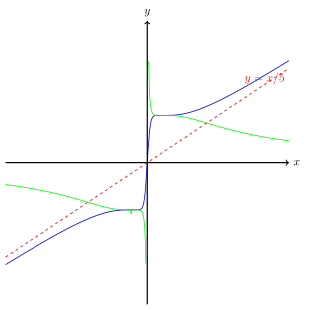
If \(m\) is a positive integer, show that \(\l 1+x \r^m + \l 1-x \r^m \ne 0\) for any real \(x\,\). The function \(\f\) is defined by \[ \f (x) = \frac{ (1+x )^m - ( 1-x )^m}{ (1+x )^m + (1-x )^m} \;. \] Find and simplify an expression for \(\f'(x)\). In the case \(m=5\,\), sketch the curves \(y = \f (x)\) and \(\displaystyle y = \frac1 { \f (x )}\;\).
Solution: If \(m\) is even, clearly that expression is positive since it's the sum of two (different) squares. If \(m\) is odd, then we can expand it as a sum of powers of \(x^2\) with a leading coefficient of \(1\) so it is also positive. \begin{align*} && f (x) = \frac{ (1+x )^m - ( 1-x )^m}{ (1+x )^m + (1-x )^m} \\ && f'(x) &= \frac{(m(1+x )^{m-1} + m( 1-x )^{m-1})((1+x)^m + (1-x)^m ) - ((1+x )^m - ( 1-x )^m)(m(1+x)^{m-1} - m(1-x)^{m-1} )}{\l (1+x)^m + (1-x)^m \r^2} \\ &&&= \frac{2m(1+x)^m(1-x)^{m-1}+2m(1+x)^{m-1}(1-x)^m}{\l (1+x)^m + (1-x)^m \r^2} \\ &&&= \frac{2m(1+x)^{m-1}(1-x)^{m-1}(1+x+1-x)}{\l (1+x)^m + (1-x)^m \r^2} \\ &&&= \frac{4m(1+x)^{m-1}(1-x)^{m-1}}{\l (1+x)^m + (1-x)^m \r^2} \\ \end{align*}
2002 Paper 1 Q4
Give a sketch of the curve \( \;\displaystyle y= \frac1 {1+x^2}\;\), for \(x\ge0\). Find the equation of the line that intersects the curve at \(x=0\) and is tangent to the curve at some point with \(x>0\,\). Prove that there are no further intersections between the line and the curve. Draw the line on your sketch. By considering the area under the curve for \(0\le x\le1\), show that \(\pi>3\,\). Show also, by considering the volume formed by rotating the curve about the \(y\) axis, that \(\ln 2 >2/3\,\). [Note: \(\displaystyle \int_0^ 1 \frac1 {1+x^2}\, \d x = \frac\pi 4\,.\;\)]
Solution:

2001 Paper 1 Q5
Show that (for \(t>0\))
- \[ \int_0^1 \frac1{(1+tx)^2} \d x = \frac1{(1+t)} \]
- \[ \int_0^1 \frac{-2x}{(1+tx)^3} \d x = -\frac1{(1+t)^2} \]
Solution:
- For the first one, consider \begin{align*} && \int_0^1 \frac{1}{(1+tx)^2} \d x &= \left [ -\frac{1}{t}(1+tx)^{-1} \right]_0^1 \\ &&&= \frac{1}{t} - \frac{1}{t(1+t)} \\ &&&= \frac{t+1-1}{t(t+1)} = \frac{1}{t+1} \end{align*}
- Consider \begin{align*} && \int_0^1 \frac{-2x}{(1+tx)^3} \d x &= \int_0^1 \frac{\frac{2}{t}(1+tx) -\frac{2}{t}}{(1+tx)^3} \d x \\ &&&= -\frac{2}{t} \int_0^1 \left (\frac{1}{(1+tx)^2}- \frac{1}{(1+tx)^3} \right) \d x \\ &&&= -\frac{2}{t} \frac{1}{t+1} + \frac{2}{t} \left [ \frac{1}{-2t}(1+tx)^{-2}\right]_0^1 \\ &&&= -\frac{2}{t(t+1)} + \frac2t\left (\frac{1}{2t} - \frac{1}{2t(1+t)^2} \right) \\ &&&= -\frac{2}{t} \left ( \frac{1}{t+1} + \frac{1}{2t(1+t)^2} - \frac{1}{2t}\right) \\ &&&= -\frac{2}{t} \frac{2t(1+t)+1-(1+t)^2}{2t(1+t)^2} \\ &&&= -\frac{2}{t} \frac{2t^2+2t+1-1-2t-t^2}{2t(1+t)^2} \\ &&&= -\frac{1}{(1+t)^2} \end{align*}
2001 Paper 3 Q4
In this question, the function \(\sin^{-1}\) is defined to have domain \( -1\le x \le 1\) and range \linebreak \( - \frac{1}{2}\pi \le x \le \frac{1}{2}\pi\) and the function \(\tan^{-1}\) is defined to have the real numbers as its domain and range \( - \frac{1}{2}\pi < x < \frac{1}{2}\pi\).
- Let
$$
\g(x) = \displaystyle {2x \over 1 + x^2}\;, \ \ \ \ \ \ \ \ \ \ -\infty
- Let \[ \displaystyle \f \l x \r = \sin^{-1} \l {2x \over 1 + x^2} \r \;,\ \ \ \ \ \ \ \ \ -\infty < x < \infty\;. \] Show that $ \f(x ) = 2 \tan^{-1} x\( for \) -1 \le x \le 1\,\( and \)\f(x) = \pi - 2 \tan^{-1} x \( for \)x\ge1\,$. Sketch the graph of \(\f(x)\).
2000 Paper 1 Q4
- Show that, for \(0\le x\le 1\), the largest value of \(\displaystyle \frac{x^6}{(x^2+1)^4}\) is \(\frac1{16}\).
- Find constants \(A\), \(B\), \(C\) and \(D\) such that, for all \(x\), \[ \frac{1}{(x^2+1)^4}= \frac{\d \ }{\d x} \left( \frac{Ax^5+Bx^3+Cx}{(x^2+1)^3}\right) +\frac{Dx^6}{(x^2+1)^4}. \]
- Hence, or otherwise, prove that \[ \frac{11}{24} \le \int_{0}^{1}\frac{1}{(x^{2}+1)^{4}}\, \d x \le \frac{11}{24} + \frac 1{16} \; . \]
Solution:
- \(x^2 + 1 \geq 2x \Rightarrow \frac{1}{x^2+1} \leq \frac1{2x} \Rightarrow \frac{x^6}{(x^2+1)^4}\leq \frac{x^6}{16x^2} = \frac1{16}x^2 \leq \frac1{16}\) with equality when \(x = 1\)
- \(\,\) \begin{align*} && RHS &= \frac{\d \ }{\d x} \left( \frac{Ax^5+Bx^3+Cx}{(x^2+1)^3}\right) +\frac{Dx^6}{(x^2+1)^4} \\ &&&= \frac{(5Ax^4+3Bx^2+C)(x^2+1)^3-6x(x^2+1)^2(Ax^5+Bx^3+Cx)}{(x^2+1)^6}+\frac{Dx^6}{(x^2+1)^4} \\ &&&= \frac{(5Ax^4+3Bx^2+C)(x^2+1)-6x(Ax^5+Bx^3+Cx)+Dx^6}{(x^2+1)^4} \\ &&&= \frac{(D-A) x^6 + (5A-3B) x^4 + (3B-5C)x^2 + C}{(x^2+1)^4} \\ \Rightarrow && C &= 1 \\ && 3B &= 5 \quad\quad\quad\Rightarrow B = \frac53 \\ && 5A &= 3B = 5\Rightarrow A = 1 \\ && D &= A \quad\quad \Rightarrow D = 1 \end{align*}
- So \begin{align*} && I &= \int_{0}^{1}\frac{1}{(x^{2}+1)^{4}}\, \d x \\ &&&= \int_{0}^{1}\frac{\d \ }{\d x} \left( \frac{Ax^5+Bx^3+Cx}{(x^2+1)^3}\right) +\frac{Dx^6}{(x^2+1)^4} \, \d x \\ &&&= \left [ \frac{Ax^5+Bx^3+Cx}{(x^2+1)^3} \right]_0^1 + \int_{0}^{1}\frac{Dx^6}{(x^2+1)^4} \, \d x \\ &&& \leq \frac{A+B+C}{8} + \frac1{16} \\ &&&= \frac{2+\frac53}{8} + \frac1{16} = \frac{11}{24} + \frac{1}{16} \\ && I &\geq \left [ \frac{Ax^5+Bx^3+Cx}{(x^2+1)^3} \right]_0^1 = \frac{11}{24} \end{align*}
2000 Paper 1 Q7
Let \[ {\f}(x)=a x-\frac{x^{3}}{1+x^{2}}, \] where \(a\) is a constant. Show that, if \(a\ge 9/8\), then \(\mathrm{f}' (x) \ge0\) for all \(x\).
Solution: \begin{align*} && f(x) &= a x-\frac{x^{3}}{1+x^{2}} \\ \Rightarrow && f'(x) &= a - \frac{3x^2(1+x^2)-x^3 \cdot 2 x}{(1+x^2)^2} \\ &&&= a - \frac{-x^4+3x^2}{(1+x^2)^2} \\ &&&= a - \frac{-t^2+3t}{(1+t)^2} \\ &&&= \frac{a+2at+at^2-t^2-3t}{(1+t)^2} \\ &&&= \frac{(a-1)t^2+(2a-3)t+a}{(1+t)^2} \\ \\ && 0 \leq \Delta &= (2a-3)^2 - 4 \cdot (a-1) \cdot a \\ &&&= 4a^2-12a+9 - 4a^2+4a \\ &&&= -8a + 9 \\ \Leftrightarrow && a &\geq 9/8 \end{align*} Therefore if \(a \geq 9/8\) the numerator is always non-negative and \(f'(x) \geq 0\)
2000 Paper 3 Q4
The function \(\f(x)\) is defined by $$ \f(x) = \frac{x( x - 2 )(x-a)}{ x^2 - 1}. $$ Prove algebraically that the line \(y = x + c\) intersects the curve \(y = \f ( x )\) if \(\vert a \vert \ge1\), but there are values of \(c\) for which there are no points of intersection if \(\vert a \vert <1\). Find the equation of the oblique asymptote of the curve \(y=\f(x)\). Sketch the graph in the two cases
- \(a<-1\)
- \(-1 < a < -\frac12\)
Solution: \begin{align*} && x+ c &= f(x) \\ \Rightarrow && (x+c)(x^2-1) &= x(x-2)(x-a) \\ \Rightarrow && x^3 + cx^2-x-c &= x^3-(2+a)x^2+2ax \\ \Rightarrow && 0 &= (c+2+a)x^2-(1+2a)x-c \\ && 0 &\leq \Delta = (1+2a)^2 + 4(2+c+a)c \\ &&&= 4c^2+(4a+8)c + (1+2a)^2 \\ && \Delta_c &= 16(a+2)^2-16(1+2a)^2 \\ &&&= 16(1-a)(3a+3) \\ &&&= 48(1-a^2) \end{align*} Therefore if \(|a| \geq 1\) we must have \(\Delta_c \leq 0\) which means \(\Delta \geq 0\) and so there are always solutions. If \(|a| < 1\) there are values for \(c\) where \(\Delta < 0\) and there would be no solutions. \begin{align*} && y &= \frac{x^3-(2+a)x^2+2ax}{x^2-1} \\ &&&= \frac{(x^2-1)(x-(2+a))+(2a+1)x-(2+a)}{x^2-1} \\ &&&= x - (2+a) + \frac{(2a+1)x-(2+a)}{x^2-1} \end{align*} therefore the oblique asymptote has equation \(y = x - (2+a)\)


1999 Paper 2 Q6
Find \(\displaystyle \ \frac{\d y}{\d x} \ \) if $$ y = \frac{ax+b}{cx+d}. \tag{*} $$ By using changes of variable of the form \((*)\), or otherwise, show that \[ \int_0^1 \frac{1}{(x+3)^2} \; \ln \left(\frac{x+1}{x+3}\right)\d x = {\frac16} \ln3 - {\frac14}\ln 2 - \frac 1{12}, \] and evaluate the integrals \[ \int_0^1 \frac{1}{(x+3)^2} \; \ln \left(\frac{x^2+3x+2}{(x+3)^2}\right)\d x \mbox{ and } \int_0^1 \frac{1}{(x+3)^2} \; \ln\left(\frac{x+1}{x+2}\right)\d x . \] [Not on original paper:] By changing to the variable \(y\) defined by $$ y=\frac{2x-3}{x+1},$$ evaluate the integral $$ \int_2^4 \frac{2x-3}{(x+1)^3}\; \ln\!\left(\frac{2x-3}{x+1}\right)\d x.$$ Evaluate the integral $$ \int_9^{25} {\big({2z^{-3/2} -5z^{-2}}\big)}\ln{\big(2-5z^{-1/2}\big)}\; \d z.$$
Solution: \begin{align*} && y &= \frac{ax+b}{cx+d} \\ &&&= \frac{\frac{a}{c}(cx+d) - \frac{da}{c} + b}{cx+d} \\ \Rightarrow && y' &= \left (b - \frac{da}{c} \right)(-1)(cx+d)^{-2} \cdot c \\ &&&= (ad-bc)(cx+d)^{-2} \end{align*} \begin{align*} && y &= \frac{x+1}{x+3} \\ && \frac{\d y}{\d x} &= \frac{2}{(x+3)^2} \\ \Rightarrow && I &= \int_0^1 \frac{1}{(x+3)^2} \; \ln \left(\frac{x+1}{x+3}\right)\d x \\ &&&= \int_{y=1/3}^{y=1/2} \frac12 \ln y \, \d y \\ &&&= \frac12 \left [ y \ln y - y \right]_{1/3}^{1/2} \\ &&&= \frac12 \left ( \frac12\ln \frac12 - \frac12 - \frac13 \ln\frac13 + \frac13 \right) \\ &&&= \frac16 \ln 3 -\frac14 \ln 2 -\frac1{12} \end{align*} \begin{align*} && J &= \int_0^1 \frac1{(x+3)^2} \ln \left ( \frac{x^2+3x+2}{(x+3)^2} \right) \d x \\ &&&= \int_0^1 \frac1{(x+3)^2} \left ( \ln \frac{x+1}{x+3} + \ln \frac{x+2}{x+3} \right) \d x \\ &&&= I + \int_0^1 \frac1{(x+3)^2} \ln \left ( \frac{x+2}{x+3} \right) \d x \\ &&&= I + \int_{y=2/3}^{y=3/4} \ln y\, \d y \\ &&&= I + \left [ y \ln y- y\right]_{2/3}^{3/4} \\ &&&= I + \left ( \frac34 \ln \frac34 - \frac34 - \frac23 \ln \frac23 + \frac23 \right) \\ &&&= I + \left ( \frac34 \ln 3 - \frac32 \ln 2- \frac1{12} - \frac23 \ln 2 + \frac23 \ln 3\right) \\ &&&= I + \left ( \frac{17}{12} \ln 3 - \frac{13}6 \ln 2- \frac1{12} \right) \\ &&&= \frac16 \ln 3 -\frac14 \ln 2 -\frac1{12} + \left ( \frac{17}{12} \ln 3 - \frac{13}6 \ln 2- \frac1{12} \right) \\ &&&= \frac{19}{12} \ln 3 -\frac{29}{12}\ln 2 - \frac16 \end{align*} \begin{align*} && K &= \int_0^1 \frac{1}{(x+3)^2} \; \ln\left(\frac{x+1}{x+2}\right)\d x \\ &&&= \int_0^1 \frac{1}{(x+3)^2} \; \left ( \ln\left(\frac{x+1}{x+3}\right) - \ln \left ( \frac{x+3}{x+2} \right) \right)\d x \\ &&&= \frac16 \ln 3 -\frac14 \ln 2 -\frac1{12} - \left ( \frac{17}{12} \ln 3 - \frac{13}6 \ln 2- \frac1{12} \right) \\ &&&= -\frac54 \ln 3 +\frac{23}{12} \ln 2 \end{align*}
1999 Paper 2 Q7
The curve \(C\) has equation $$ y = \frac x {\sqrt{x^2-2x+a}}\; , $$ where the square root is positive. Show that, if \(a>1\), then \(C\) has exactly one stationary point. Sketch \(C\) when (i) \(a=2\) and (ii) \(a=1\).
Solution: \begin{align*} && y &= \frac x {\sqrt{x^2-2x+a}} \\ && y' &= \frac{\sqrt{x^2-2x+a} - \frac{x(x-1)}{\sqrt{x^2-2x+a}}}{x^2-2x+a} \\ &&&= \frac{-x+a}{(x^2-2x+a)^{3/2}} \end{align*} Since the denominator is always positive, the only stationary point is when \(x = a\)

