Problems
Filters
17 problems found
1992 Paper 3 Q7
The points \(P\) and \(R\) lie on the sides \(AB\) and \(AD,\) respectively, of the parallelogram \(ABCD.\) The point \(Q\) is the fourth vertex of the parallelogram \(APQR.\) Prove that \(BR,CQ\) and \(DP\) meet in a point.
Solution: Let \(\overrightarrow{AX} = \mathbf{x}\) for all points, so: \begin{align*} \mathbf{p} &= p\mathbf{b}\\ \mathbf{r} &= r\mathbf{d}\\ \mathbf{q} &= \mathbf{p}+\mathbf{r} \\ &= p\mathbf{b} + r\mathbf{d} \end{align*} Therefore \begin{align*} BR: && \mathbf{b} + \lambda(\mathbf{r}-\mathbf{b}) \\ &&= (1-\lambda) \mathbf{b}+ \lambda r \mathbf{d} \\ CQ: && \mathbf{c} + \mu(\mathbf{q} - \mathbf{c}) \\ &&= \mathbf{b}+\mathbf{d} + \mu(p\mathbf{b}+r\mathbf{d} - (\mathbf{b}+\mathbf{d}) ) \\ &&= (1+\mu(p-1))\mathbf{b} + (1+\mu(r-1))\mathbf{d} \\ DP: && \mathbf{d} + \nu (\mathbf{p} - \mathbf{d}) \\ &&= \nu p\mathbf{b} +(1-\nu) \mathbf{d} \end{align*} So we need \(1-\nu = \lambda r, \nu p = 1-\lambda, \) so lets say \(1 = \nu + \lambda r, 1 = \lambda + \nu p \Rightarrow \lambda(pr-1) = p-1 \Rightarrow \lambda = \frac{p-1}{pr-1}\) so they intersect at \(\frac{rp-r}{pr-1} \mathbf{d} + \frac{pr-p}{pr-1}\mathbf{b}\). If we take \(\mu = -\frac{\lambda}{p-1} = 1-pr\) this is clearly also on \(CQ\) hence they all meet at a point
1987 Paper 1 Q9
\(ABC\) is a triangle whose vertices have position vectors \(\mathbf{a,b,c}\)brespectively, relative to an origin in the plane \(ABC\). Show that an arbitrary point \(P\) on the segment \(AB\) has position vector \[ \rho\mathbf{a}+\sigma\mathbf{b}, \] where \(\rho\geqslant0\), \(\sigma\geqslant0\) and \(\rho+\sigma=1\). Give a similar expression for an arbitrary point on the segment \(PC\), and deduce that any point inside \(ABC\) has position vector \[ \lambda\mathbf{a}+\mu\mathbf{b}+\nu\mathbf{c}, \] where \(\lambda\geqslant0\), \(\mu\geqslant0\), \(\nu\geqslant0\) and \(\lambda+\mu+\nu=1\). Sketch the region of the plane in which the point \(\lambda\mathbf{a}+\mu\mathbf{b}+\nu\mathbf{c}\) lies in each of the following cases:
- \(\lambda+\mu+\nu=-1\), \(\lambda\leqslant0\), \(\mu\leqslant0\), \(\nu\leqslant0\);
- \(\lambda+\mu+\nu=1\), \(\mu\leqslant0\), \(\nu\leqslant0\).
Solution:

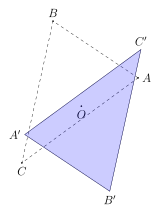
- This is equivalent to the area inside the triangle where every point (\(\mathbf{a}, \mathbf{b}, \mathbf{c}\)) has been send to it's negative (\(-\mathbf{a}, -\mathbf{b}, -\mathbf{c}\)),
ie
- Writing points as:
\begin{align*}
\lambda\mathbf{a}+\mu\mathbf{b}+\nu\mathbf{c} &= (1-\mu - \nu)\mathbf{a}+\mu\mathbf{b}+\nu\mathbf{c} \\
&= \mathbf{a} + (-\mu)(\mathbf{a}-\mathbf{b}) + (-\nu)(\mathbf{a} - \mathbf{c}) \\
&= \mathbf{a} + (-\mu)(\mathbf{a}-\mathbf{b}) + (-\nu)(\mathbf{a} - \mathbf{c}) + (1+\mu+\nu)\mathbf{0}\\
\end{align*}
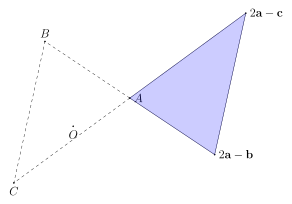
So this is a translation of \(\mathbf{a}\) of the triangle with vertices at \(\mathbf{0}, \mathbf{a-b}, \mathbf{a-c}\), or a triangle with vertices \(\mathbf{a}, 2\mathbf{a-b}, 2\mathbf{a-c}\).