Problems
Filters
29 problems found
2001 Paper 1 Q4
Show that \(\displaystyle \tan 3\theta = \frac{3\tan\theta -\tan^3\theta}{1-3\tan^2\theta}\) . Given that \(\theta= \cos^{-1} (2/\sqrt5)\) and \(0<\theta<\pi/2\), show that \(\tan 3\theta =11/2\) Hence, or otherwise, find all solutions of the equations
- \(\tan(3\cos^{-1} x) =11/2\) ,
- \(\cos ({\frac13}\tan^{-1} y) = 2/\sqrt5\) .
Solution: Let \(\tan \theta = t\) \begin{align*} \tan 3 \theta &\equiv \tan (2 \theta + \theta) \\ &\equiv \frac{\tan 2 \theta +\tan \theta}{1 - \tan 2 \theta \tan \theta} \\ &\equiv \frac{\frac{2t}{1-t^2}+t}{1-\frac{2t^2}{1-t^2}} \\ &\equiv \frac{2t+t-t^3}{1-t^2-2t^2} \\ &\equiv \frac{3t-t^3}{1-3t^3} \\ &\equiv \frac{3\tan \theta - \tan^3 \theta}{1 - 3 \tan^3 \theta} \end{align*} If \(\theta = \cos^{-1} (2/\sqrt{5})\), then \(\sin \theta = 1/\sqrt{5}\) and \(\tan \theta = 1/2\). Hence \begin{align*} \tan 3 \theta &= \frac{3 \cdot \frac12 - \frac18}{1 - \frac34} \\ &= \frac{11}{2} \end{align*}
- Since \(\tan 3 y = 11/2\) has the solution \(y = \cos^{-1} (2/\sqrt{5})\) it will also have the solutions \(y = \cos^{-1}(2/\sqrt{5}) + \frac{\pi}{3}\) and \(y = \cos^{-1}(2/\sqrt{5})+\frac{2\pi}{3}\), therefore \begin{align*} && \cos^{-1} x &= \cos^{-1} (2/\sqrt{5})\\ \Rightarrow && x &= 2/\sqrt{5} \\ && \cos^{-1} x &= \cos^{-1} (2/\sqrt{5}) + \frac{\pi}{3}\\ \Rightarrow && x &= \frac{2}{\sqrt{5}} \frac{1}{2} - \frac{1}{\sqrt{5}} \frac{\sqrt{3}}{2} \\ &&&= \frac{2-\sqrt{3}}{2\sqrt{5}} \\ && \cos^{-1} x &= \cos^{-1} (2/\sqrt{5}) + \frac{2\pi}{3}\\ \Rightarrow && x &= \frac{2}{\sqrt{5}} \left (-\frac{1}{2} \right)- \frac{1}{\sqrt{5}} \frac{\sqrt{3}}{2} \\ &&&= \frac{-\sqrt{3}-2}{2\sqrt{5}} \\ \end{align*}
- Since \(\cos \frac13 x = \frac{2}{\sqrt{5}}\) has the solution \(x = \tan^{-1} \frac{11}{2}\) it will also have the solutions \(x = \tan^{-1} \frac{11}{2} + 2n \pi\) and \(x = -\tan^{-1} \frac{11}{2} + 2n \pi\). \begin{align*} && \tan^{-1} y &= \tan^{-1} \frac{11}{2} \\ \Rightarrow && y &= \frac{11}{2} \\ && \tan^{-1} y &= \tan^{-1} \frac{11}{2} + 2n \pi \\ \Rightarrow && y &= \frac{\frac{11}{2} + 0}{1-0} \\ &&&= \frac{11}{2} \\ && \tan^{-1} y &= -\tan^{-1} \frac{11}{2} + 2n \pi \\ \Rightarrow && y &= \frac{-\frac{11}{2} + 0}{1-0} \\ &&&= -\frac{11}{2} \\ \end{align*} So our two solutions are \(y = \pm \frac{11}{2}\)
2001 Paper 2 Q6
Show that \[ \int_0^1 \frac{x^4}{1+x^2} \, \d x = \frac \pi {4} - \frac 23 \;. \] Determine the values of
- \(\displaystyle \int_0^1 x^3 \; \tan ^{-1} \left(\frac {1-x} {1+x} \right) \,\d x \)
- \(\displaystyle \int_0^1 \frac {(1-y)^3} {(1+y)^5} \; {{\tan}^{-1} y}\, \d y\)
Solution: \begin{align*} && \int_0^1 \frac{x^4}{1+x^2} \d x &= \int_0^1 \frac{(x^2-1)(1+x^2)+1}{x^2+1} \d x\\ &&&= \int_0^1 \frac{1}{1+x^2} \d x -\int_0^1 (1-x^2) \d x \\ &&&= \left [\tan^{-1}x \right]_0^1 - \left [x - \tfrac13x^3 \right]_0^1 \\ &&&= \frac{\pi}{4} - \frac23 \end{align*}
- \(\,\) \begin{align*} && I &= \int_0^1 x^3 \; \tan ^{-1} \left(\frac {1-x} {1+x} \right) \,\d x \\ &&&= \left [ \frac{x^4}{4}\tan ^{-1} \left(\frac {1-x} {1+x} \right) \right]_0^1 -\int_0^1 \frac{x^4}{4} \frac{1}{1 +\left(\frac {1-x} {1+x} \right) ^2 } \cdot \frac{-2}{(1+x)^2} \d x \\ &&&= \frac{1}{2} \int_0^1 \frac{x^4}{(1+x)^2+(1-x)^2} \d x \\ &&&= \frac{1}{4} \int_0^1 \frac{x^4}{1+x^2} \d x \\ &&&= \frac{\pi}{16} - \frac{1}{6} \end{align*}
- \(\,\) \begin{align*} && J &= \int_0^1 \frac {(1-y)^3} {(1+y)^5} \; {{\tan}^{-1} y}\, \d y \\ &&&= \left [ \frac {(y(1+y^2)} {(1+y)^4} \tan^{-1}y \right]_0^1 - \int_0^1 \frac {(y(1+y^2)} {(1+y)^4} \frac{1}{1+y^2} \d y \\ &&&= \frac{\pi}{32} - \int_0^1 \frac{y}{(1+y)^4} \d y \\ &&&= \frac{\pi}{32} - \left[ - \frac{3y+1}{6(1+y)^3} \right]_0^1 \\ &&&= \frac{\pi}{32} +\frac{4}{6 \cdot 8} - \frac{1}{6} \\ &&&= \frac{\pi}{32} - \frac{1}{12} \end{align*}
2001 Paper 3 Q4
In this question, the function \(\sin^{-1}\) is defined to have domain \( -1\le x \le 1\) and range \linebreak \( - \frac{1}{2}\pi \le x \le \frac{1}{2}\pi\) and the function \(\tan^{-1}\) is defined to have the real numbers as its domain and range \( - \frac{1}{2}\pi < x < \frac{1}{2}\pi\).
- Let
$$
\g(x) = \displaystyle {2x \over 1 + x^2}\;, \ \ \ \ \ \ \ \ \ \ -\infty
- Let \[ \displaystyle \f \l x \r = \sin^{-1} \l {2x \over 1 + x^2} \r \;,\ \ \ \ \ \ \ \ \ -\infty < x < \infty\;. \] Show that $ \f(x ) = 2 \tan^{-1} x\( for \) -1 \le x \le 1\,\( and \)\f(x) = \pi - 2 \tan^{-1} x \( for \)x\ge1\,$. Sketch the graph of \(\f(x)\).
1997 Paper 1 Q2
- If \[{\mathrm f}(x)=\tan^{-1}x+\tan^{-1}\left(\frac{1-x}{1+x}\right),\] find \({\mathrm f}'(x)\). Hence, or otherwise, find a simple expression for \({\mathrm f}(x)\).
- Suppose that \(y\) is a function of \(x\) with \(0 < y < (\pi/2)^{1/2}\) and \[x=y\sin y^{2}\] for \(0 < x < (\pi/2)^{1/2}\). Show that (for this range of \(x\)) \[\frac{{\mathrm d}y}{{\mathrm d}x}= \frac{y}{x+2y^2\sqrt{y^{2}-x^{2}}}.\]
Solution:
- \begin{align*} && f(x)&=\tan^{-1}x+\tan^{-1}\left(\frac{1-x}{1+x}\right) \\ \Rightarrow && f'(x) &= \frac{1}{1+x^2} + \frac{1}{1+\l \frac{1-x}{1+x} \r^2} \cdot \l \frac{-2}{(1+x)^2}\r \\ &&&= \frac1{1+x^2}- \frac{2}{(1+x)^2+(1-x)^2} \\ &&&= \frac1{1+x^2} - \frac{2}{2+2x^2} \\ &&&= 0 \end{align*} Therefore $f(x) = \begin{cases} c_1 & \text{if } x < -1 \\ c_2 & \text{if } x > -1 \end{cases}$ \(f(0) = \tan^{-1} 0 + \tan^{-1} 1 = \frac{\pi}{4}\) \(\lim_{x \to \infty} f(x) = -\frac{\pi}{2} + \tan^{-1} -1 = -\frac{3\pi}{4}\) therefore $f(x) = \begin{cases} -\frac{3\pi}{4}& \text{if } x < -1 \\ \frac{\pi}{4} & \text{if } x > -1 \end{cases}$
- \begin{align*} && x &= y \sin y^2 \\ \Rightarrow && \frac{\d x}{\d y} &= \sin y^2 + 2y^2 \cos y^2 \\ \Rightarrow && \frac{\d y}{\d x} &= \frac{1}{\sin y^2+2y^2 \cos y^2} \\ &&&=\frac{1}{\frac{x}{y}+2y^2 \sqrt{1-\sin^2y^2}} \\ &&&= \frac{y}{x + 2y^3 \sqrt{1-\frac{x^2}{y^2}}} \\ &&&= \frac{y}{x+2y^2 \sqrt{y^2-x^2}} \end{align*}
1997 Paper 2 Q3
Find constants \(a,\,b,\,c\) and \(d\) such that $$\frac{ax+b}{ x^2+2x+2}+\frac{cx+d}{ x^2-2x+2}= \frac{1}{ x^4+4}.$$ Show that $$\int_0^1\frac {\d x}{ x^4+4}\;= \frac{1}{16} \ln 5 +\frac{1}{8} \tan^{-1}2 .$$
Solution: First notice that \((x^2+2+2x)(x^2+2-2x) = (x^2+2)^2-4x^2 = x^2+4\) and so \begin{align*} && \frac{1}{x^4+4} &= \frac{ax+b}{ x^2+2x+2}+\frac{cx+d}{ x^2-2x+2} \\ \Rightarrow && 1 &= (ax+b)(x^2-2x+2) + (cx+d)(x^2+2x+2) \\ &&&= (a+c)x^3+(b-2a+d+2c)x^2+(2a-2b+2c+2d)x+2b+2d \\ \Rightarrow && 0 &= a+c \\ && 2a &= b+d+2c \\ && b &= a+c+d \\ && \frac12 &= b+d \\ \Rightarrow && c &= -a \\ && 2a &= \frac12+2(-a) \\ \Rightarrow && a &= \frac18, c = -\frac18 \\ && b &= d \\ \Rightarrow && b &= \frac14, d = \frac14 \end{align*} Therefore \begin{align*} \int_0^1\frac {\d x}{ x^4+4} &= \int_0^1 \frac18\left ( \frac{x+2}{x^2+2x+2} -\frac{x-2}{x^2-2x+2}\right) \d x \\ &= \frac1{16}\int_0^1 \left ( \frac{2x+2+2}{x^2+2x+2} -\frac{2x-2-2}{x^2-2x+2}\right) \d x \\ &= \frac1{16} \left [ \ln(x^2+2x+2) -\ln(x^2-2x+2)\right]_0^1 + \frac1{16} \int_0^1 \left ( \frac{2}{(x+1)^2+1} + \frac{2}{(x-1)^2+1} \right) \d x \\ &= \frac1{16} \left (\ln 5 - \ln 1 -(\ln 2-\ln 2) \right) + \frac18 \left [ \tan^{-1} (x+1)+\tan^{-1}(x-1) \right]_0^1 \\ &= \frac1{16} \ln 5 + \frac18 \left (\tan^{-1} 2+\tan^{-1} 0 - \tan^{-1}1-\tan^{-1} (-1) \right) \\ &= \frac1{16} \ln 5+ \frac18 \tan^{-1} 2 \end{align*}
1996 Paper 1 Q4
Show that \[ \int_{0}^{1}\frac{1}{x^{2}+2ax+1}\,\mathrm{d}x=\begin{cases} \dfrac{1}{\sqrt{1-a^{2}}}\tan^{-1}\sqrt{\dfrac{1-a}{1+a}} & \text{ if }\left|a\right|<1,\\ \dfrac{1}{2\sqrt{a^{2}-1}}\ln |a+\sqrt{a^{2}-1}| & \text{ if }\left|a\right|>1. \end{cases} \]
Solution: First suppose \(|a| < 1\), then \begin{align*} && I &= \int_0^1 \frac{1}{x^2+2ax+1} \d x \\ &&&= \int_0^1 \frac{1}{(x+a)^2 +1-a^2} \d x \\ &&&= \int_0^1 \frac{1}{(x+a)^2 +(\sqrt{1-a^2})^2} \d x \tag{\(1-a^2 > 0\)}\\ &&&= \left [\frac{1}{\sqrt{1-a^2}} \tan^{-1} \frac{x+a}{\sqrt{1-a^2}} \right]_0^1 \\ &&&= \frac{1}{\sqrt{1-a^2}} \left ( \tan^{-1} \frac{a+1}{\sqrt{1-a^2}} - \tan^{-1} \frac{a}{\sqrt{1-a^2}} \right) \\ &&&= \frac{1}{\sqrt{1-a^2}} \tan^{-1} \left ( \frac{\frac{a+1}{\sqrt{1-a^2}}-\frac{a}{\sqrt{1-a^2}}}{1+\frac{(a+1)a}{1-a^2}} \right) \\ &&&= \frac{1}{\sqrt{1-a^2}} \tan^{-1} \left ( \frac{\frac{1}{\sqrt{1-a^2}}}{\frac{1+a}{1-a^2}} \right) \\ &&&= \frac{1}{\sqrt{1-a^2}} \tan^{-1} \left ( \frac{1-a}{\sqrt{1-a^2}}\right) \\ &&&= \frac{1}{\sqrt{1-a^2}} \tan^{-1} \sqrt { \frac{1-a}{1+a}} \\ \end{align*} Second, suppose \(|a| > 1\), then \begin{align*} && I &= \int_0^1 \frac{1}{x^2+2ax+1} \d x \\ &&&= \int_0^1 \frac{1}{(x+a)^2-(a^2-1)} \d x \\ &&&= \int_0^1 \frac{1}{(x+a-\sqrt{a^2-1})(x+a+\sqrt{a^2-1})} \d x \tag{\(a^2-1 > 0\)} \\ &&&= \frac{1}{2\sqrt{a^2-1}}\int_0^1 \left ( \frac{1}{x+a-\sqrt{a^2-1}} - \frac{1}{x+a+\sqrt{a^2-1}} \right) \d x \\ &&&= \frac{1}{2\sqrt{a^2-1}} \left [ \ln |x+a-\sqrt{a^2-1}|- \ln |x+a+\sqrt{a^2-1}| \right]_0^1 \\ &&&= \frac{1}{2\sqrt{a^2-1}} \left ( \ln |1+a-\sqrt{a^2-1}| - \ln|1+a+\sqrt{a^2-1}| - \ln|a-\sqrt{a^2-1}| +\ln|a + \sqrt{a^2-1}| \right) \\ &&&= \frac{1}{2\sqrt{a^2-1}} \ln | \frac{(1+a-\sqrt{a^2-1})(a+\sqrt{a^2-1})}{(1+a+\sqrt{a^2-1})(a-\sqrt{a^2-1})}|\\ &&&= \frac{1}{2\sqrt{a^2-1}} \ln |\frac{a+a^2-(a^2-1) +\sqrt{a^2-1}}{1+a-\sqrt{a^2-1}}| \\ &&&= \frac{1}{2\sqrt{a^2-1}} \ln |\frac{(1+a +\sqrt{a^2-1})^2}{(1+a)^2-(a^2-1)}| \\ &&&= \frac{1}{2\sqrt{a^2-1}} \ln |\frac{1+2a+a^2+a^2-1+2(1+a)\sqrt{a^2-1}}{2+2a}| \\ &&&= \frac{1}{2\sqrt{a^2-1}} \ln |a+\sqrt{a^2-1}| \\ \end{align*}
1996 Paper 3 Q3
Find \[ \int_{0}^{\theta}\frac{1}{1-a\cos x}\,\mathrm{d}x\,, \] where \(0 < \theta < \pi\) and \(-1 < a < 1.\) Hence show that \[ \int_{0}^{\frac{1}{2}\pi}\frac{1}{2-a\cos x}\,\mathrm{d}x=\frac{2}{\sqrt{4-a^{2}}}\tan^{-1}\sqrt{\frac{2+a}{2-a}}\,, \] and also that \[ \int_{0}^{\frac{3}{4}\pi}\frac{1}{\sqrt{2}+\cos x}\,\mathrm{d}x=\frac{\pi}{2}\,. \]
Solution: Let \(t = \tan \tfrac{x}{2}\), then \(\cos x = \frac{1-t^2}{1+t^2}, \frac{d t}{d x} =\tfrac12 (1+t^2)\) so the integral is: \begin{align*} \int_0^{\theta} \frac{1}{1-a \cos x} \d x &= \int_{0}^{\tan \frac{\theta}{2}} \frac{1}{1-a \left (\frac{1-t^2}{1+t^2} \right)} \frac{2}{1+t^2} \d t \\ &= \int_0^{\tan \frac{\theta}{2}} \frac{2}{1+t^2-a+at^2} \d t \\ &= \int_0^{\tan \frac{\theta}{2}} \frac{2}{1-a+(1+a) t^2} \d t \\ &= \frac{2}{1+a}\int_0^{\tan \tfrac{\theta}{2}} \frac{1}{\left (\frac{1-a}{1+a} \right)+t^2} \d t \\ &= \frac{2}{1+a} \sqrt{\frac{1+a}{1-a}} \tan^{-1} \left ( \sqrt{\frac{1+a}{1-a}} \tan \frac{\theta}{2} \right) + C \\ &= \frac{2}{\sqrt{1-a^2}}\tan^{-1} \left ( \sqrt{\frac{1+a}{1-a}} \tan \frac{\theta}{2} \right) + C \end{align*} Therefore \begin{align*} \int_{0}^{\frac{1}{2}\pi}\frac{1}{2-a\cos x}\,\mathrm{d}x &= \frac12 \int_0^{\frac12 \pi} \frac{1}{1-\tfrac{a}{2} \cos x} \d x \\ &= \left [\frac12 \frac{2}{\sqrt{1-\frac{a^2}{4}}} \tan^{-1} \left ( \sqrt{\frac{1+\frac{a}{2}}{1-\frac{a}{2}} } \tan\frac{\theta}{2} \right) \right]_0^{\pi/2} \\ &= \frac12 \frac{2}{\sqrt{1-\frac{a^2}{4}}} \tan^{-1} \left ( \sqrt{\frac{1+\frac{a}{2}}{1-\frac{a}{2}} } \tan\frac{\pi}{4} \right) \\ &= \frac{2}{\sqrt{4-a^2}} \tan^{-1} \left ( \sqrt{\frac{2+a}{2-a} } \right) \\ \end{align*} \begin{align*} \int_{0}^{\frac{3}{4}\pi}\frac{1}{\sqrt{2}+\cos x}\,\mathrm{d}x &= \frac{1}{\sqrt{2}} \int_0^{\frac34 \pi} \frac{1}{1 -\left(- \frac{1}{\sqrt{2}} \right)\cos x} \d x \\ &= \frac{1}{\sqrt{2}} \left [ \frac{2}{\sqrt{1-\tfrac12}} \tan^{-1} \left ( \sqrt{\frac{1-\frac{1}{\sqrt{2}}}{1+\frac{1}{\sqrt{2}}} } \tan\frac{\theta}{2} \right) \right]_0^{3\pi/4} \\ &= \frac{1}{\sqrt{2}} \frac{2}{\sqrt{1/2}} \tan^{-1} \left ( \sqrt{\frac{\sqrt{2}-1}{\sqrt{2}+1} } \tan\frac{3\pi}{8} \right) \\ &= 2 \tan^{-1} \left ( \sqrt{\frac{(\sqrt{2}-1)^2}{2-1} } \tan\frac{3\pi}{8} \right)\\ &= 2 \tan^{-1} \left ( (\sqrt{2}-1) \tan\frac{3\pi}{8} \right) \end{align*} If \(t = \tan \tfrac{3\pi}{8}\), then \(-1 = \tan \tfrac{3\pi}{4} = \frac{2t}{1-t^2} \Rightarrow t^2-2t-1 = 0 \Rightarrow t = 1\pm \sqrt{2}\), since \( t > 0\), we must have \(t = 1 + \sqrt{2}\), so \begin{align*} \int_{0}^{\frac{3}{4}\pi}\frac{1}{\sqrt{2}+\cos x}\,\mathrm{d}x &= 2 \tan^{-1} \left ((\sqrt{2}-1)(\sqrt{2}+1) \right) \\ &= 2 \tan^{-1} 1 \\ &= 2 \frac{\pi}{4} \\ &= \frac{\pi}{2} \end{align*}
1995 Paper 3 Q5
Show that \(y=\sin^{2}(m\sin^{-1}x)\) satisfies the differential equation \[ (1-x^{2})y^{(2)}=xy^{(1)}+2m^{2}(1-2y), \] and deduce that, for all \(n\geqslant1,\) \[ (1-x^{2})y^{(n+2)}=(2n+1)xy^{(n+1)}+(n^{2}-4m^{2})y^{(n)}, \] where \(y^{(n)}\) denotes the \(n\)th derivative of \(y\). Derive the Maclaurin series for \(y\), making it clear what the general term is.
Solution: \begin{align*} && y &= \sin^2 (m \sin^{-1} x) \\ \Rightarrow && y' &= 2 \sin (m \sin^{-1} x) \cdot \cos (m \sin^{-1} x) \cdot m \cdot \frac1{\sqrt{1-x^2}} \\ \Rightarrow && y'' &= 2 \cos^2(m \sin^{-1} x) \cdot m^2 \cdot \frac{1}{1-x^2} + \\ &&&\quad\quad-2\sin^2(m \sin^{-1} x) m^2 \frac{1}{1-x^2} + \\ &&&\quad\quad\quad-\sin(m \sin^{-1} x) \cdot \cos(m \sin^{-1} x) \cdot m \cdot (1-x^2)^{-\frac32} \cdot (-2x) \\ \Rightarrow && (1-x^2)y^{(2)} &= 2m^2-4m^2y+xy' \\ &&&= xy^{(1)} + 2m^2(1-2y) \\ \\ \Rightarrow && (1-x^2)y^{(n+2)}-2nxy^{(n+1)}-2\binom{n}{2}y^{(n)} &= xy^{(n+1)}+ny^{(n)} -4m^2y^{(n)} \\ \Rightarrow && (1-x^2)y^{(n+2)} &= (2n+1)xy^{(n+1)}+(n(n-1)+n-4m^2)y^{(n)} \\ &&&= (2n+1)xy^{(n+1)}+(n^2-4m^2)y^{(n)} \\ \end{align*} \begin{align*} && y(0) &= \sin^2(m \sin^{-1} 0) \\ &&&= \sin^2 0 = 0 \\ \\ && y'(0) &= 0 \\ && (1-0^2)y^{(2)}(0) &= 2m^2(1-2y(0)) \\ \Rightarrow && y^{(2)}(0) &= 2m^2 \\ \\ && y^{(n+2)} (0) &= (2n+1) \cdot 0 \cdot y^{(n+1)} +(n^2-4m^2)y^{(n)}(0) \\ &&&= (n^2-4m^2)y^{(n)}(0) \\ \\ && y^{(2)}(0) &= 2m^2 \\ && y^{(4)}(0) &= (4-4m^2) \cdot 2m^2 \\ &&&= -8m(m+1)m(m-1) \\ && y^{(6)}(0) &= 32m(m+2)(m+1)m(m-1)(m-2) \\ && y^{(2k)}(0) &= (-1)^{k+1}2^{2k-1}m (m+k)\cdots(m-k) \text{ if }k < m \\ \\ && y &= m^2x^2 -2m\binom{m+1}{3} x^4 + \frac{16}{3}m\binom{m+2}{5}x^6 - \cdots \\ &&&+ (-1)^{k}\frac{2^{2k}}{k+1} m \binom{m+k}{2k+1}x^{2k+2}+\cdots \\ &&&= mx^2\sum_{k=0}^{m-1} \frac{(-1)^k2^{2k}}{k+1}\binom{m+k}{2k+1}x^{2k} \end{align*}
1994 Paper 2 Q4
By considering the area of the region defined in terms of Cartesian coordinates \((x,y)\) by \[ \{(x,y):\ x^{2}+y^{2}=1,\ 0\leqslant y,\ 0\leqslant x\leqslant c\}, \] show that \[ \int_{0}^{c}(1-x^{2})^{\frac{1}{2}}\,\mathrm{d}x=\tfrac{1}{2}[c(1-c^{2})^{\frac{1}{2}}+\sin^{-1}c], \] if \(0 < c\leqslant1.\) Show that the area of the region defined by \[ \left\{ (x,y):\ \frac{x^{2}}{a^{2}}+\frac{y^{2}}{b^{2}}=1,\ 0\leqslant y,\ 0\leqslant x\leqslant c\right\} , \] is \[ \frac{ab}{2}\left[\frac{c}{a}\left(1-\frac{c^{2}}{a^{2}}\right)^{\frac{1}{2}}+\sin^{-1}\left(\frac{c}{a}\right)\right], \] if \(0 < c\leqslant a\) and \(0 < b.\) Suppose that \(0 < b\leqslant a.\) Show that the area of intersection \(E\cap F\) of the two regions defined by \[ E=\left\{ (x,y):\ \frac{x^{2}}{a^{2}}+\frac{y^{2}}{b^{2}}\leqslant1\right\} \qquad\mbox{ and }\qquad F=\left\{ (x,y):\ \frac{x^{2}}{b^{2}}+\frac{y^{2}}{a^{2}}\leqslant1\right\} \] is \[ 4ab\sin^{-1}\left(\frac{b}{\sqrt{a^{2}+b^{2}}}\right). \]
1994 Paper 3 Q5
The function \(\mathrm{f}\) is given by \(\mathrm{f}(x)=\sin^{-1}x\) for \(-1 < x < 1.\) Prove that \[ (1-x^{2})\mathrm{f}''(x)-x\mathrm{f}'(x)=0. \] Prove also that \[ (1-x^{2})\mathrm{f}^{(n+2)}(x)-(2n+1)x\mathrm{f}^{(n+1)}(x)-n^{2}\mathrm{f}^{(n)}(x)=0, \] for all \(n>0\), where \(\mathrm{f}^{(n)}\) denotes the \(n\)th derivative of \(\mathrm{f}\). Hence express \(\mathrm{f}(x)\) as a Maclaurin series. The function \(\mathrm{g}\) is given by \[ \mathrm{g}(x)=\ln\sqrt{\frac{1+x}{1-x}}, \] for \(-1 < x < 1.\) Write down a power series expression for \(\mathrm{g}(x),\) and show that the coefficient of \(x^{2n+1}\) is greater than that in the expansion of \(\mathrm{f},\) for each \(n > 0\).
1993 Paper 1 Q16
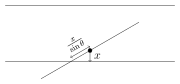
By making the substitution \(y=\cos^{-1}t,\) or otherwise, show that \[ \int_{0}^{1}\cos^{-1}t\,\mathrm{d}t=1. \] A pin of length \(2a\) is thrown onto a floor ruled with parallel lines equally spaced at a distance \(2b\) apart. The distance \(X\) of its centre from the nearest line is a uniformly distributed random variable taking values between \(0\) and \(b\) and the acute angle \(Y\) the pin makes with a direction perpendicular to the line is a uniformly distributed random variable taking values between \(0\) and \(\pi/2\). \(X\) and \(Y\) are independent. If \(X=x\) what is the probability that the pin crosses the line? If \(a < b\) show that the probability that the pin crosses a line for a general throw is \(\dfrac{2a}{\pi b}.\)
Solution: \begin{align*} && I &= \int_0^1 \cos^{-1} t \d t \\ \cos y = t: -\sin y \d y = \d t: &&&= \int_{\frac{\pi}{2}}^0 -y \sin y \d y \\ &&&= \int_0^{\pi/2} y \sin y \d y \\ &&&= \left [-y \cos y \right]_0^{\pi/2} + \int_0^{\pi/2} \cos y \d y \\ &&&= \left [ \sin y \right]_0^{\pi/2} = 1 \end{align*}
1993 Paper 2 Q11
In this question, take the value of \(g\) to be \(10\ \mathrm{ms^{-2}.\)} A body of mass \(m\) kg is dropped vertically into a deep pool of liquid. Once in the liquid, it is subject to gravity, an upward buoyancy force of \(\frac{6}{5}\) times its weight, and a resistive force of \(2mv^{2}\mathrm{N}\) opposite to its direction of travel when it is travelling at speed \(v\) \(\mathrm{ms}^{-1}.\) Show that the body stops sinking less than \(\frac{1}{4}\pi\) seconds after it enters the pool. Suppose now that the body enters the liquid with speed \(1\ \mathrm{ms}^{-1}.\) Show that the body descends to a depth of \(\frac{1}{4}\ln2\) metres and that it returns to the surface with speed \(\frac{1}{\sqrt{2}}\ \mathrm{ms}^{-1},\) at a time \[ \frac{\pi}{8}+\frac{1}{4}\ln\left(\frac{\sqrt{2}+1}{\sqrt{2}-1}\right) \] seconds after entering the pool.
Solution: While descending, the body experiences the force \(-\frac15mg - 2mv^2\). \begin{align*} \text{N2:} && m \dot{v} &= -\frac15 mg - 2mv^2 \\ \Rightarrow && \frac{\dot{v}}{\frac15g + 2v^2} &= -1 \\ \Rightarrow && \frac{1}{2}\tan^{-1} v_1 - \frac{1}{2}\tan^{-1} {v_0} &= -T \end{align*} We care about when \(v_1 = 0\), ie \(\displaystyle T = \frac{1}{2}\tan^{-1} {v_0} < \frac12 \frac{\pi}2 = \frac{\pi}4\) seconds. If the body enters at speed \(1\ \mathrm{ms}^{-1}.\) then for the first part of it's journey it will experience forces \(-\frac15mg - 2mv^2\) and so: \begin{align*} \text{N2:} && m v \frac{\d v}{\d x} &= -\frac15 mg - 2mv^2 \\ \Rightarrow && \int \frac{v}{2(1 + v^2)} \d v &= \int -1 \d x \\ \Rightarrow && \frac14 \ln (1 + v^2) &= -x \end{align*} Therefore the depth is \(\frac14 \ln 2\) metres. When the body is rising, it experiences forces of: \(\frac15mg - 2mv^2\) and so: \begin{align*} \text{N2:} && m v \frac{\d v}{\d x} &= \frac15mg - 2mv^2 \\ \Rightarrow && \int \frac{v}{2(1 - v^2)} \d v &= \int -1 \d x \\ \Rightarrow && -\frac14 \ln (1 - v^2) &= \frac14 \ln 2 \\ \Rightarrow && 1-v^2 &= \frac12 \\ \Rightarrow && v &= \frac{1}{\sqrt{2}} \ \mathrm{ms}^{-1} \end{align*} This will take \begin{align*} \text{N2:} && m \dot{v} &= \frac15mg - 2mv^2 \\ \Rightarrow && \frac{\dot{v}}{2(1-v^2)} &= -1 \\ \Rightarrow && \dot{v} \frac{1}{4}\l \frac{1}{1 - v} + \frac{1}{1+v} \r &= -1 \\ \Rightarrow && \frac{1}{4} \l -\ln(1 - v) + \ln(1 + v)\r &= -T \end{align*} Since \(v = \frac{1}{\sqrt{2}}\) \begin{align*} T &= \frac{1}{4} \ln \l \frac{1+ \frac1{\sqrt{2}}}{1 - \frac1{\sqrt{2}}}\r \\ &= \frac14 \ln \l \frac{\sqrt{2} + 1}{\sqrt{2}-1} \r \end{align*} and therefore the total time will be: \begin{align*} & \frac12 \tan^{-1} 1 + \frac14 \ln \l \frac{\sqrt{2} + 1}{\sqrt{2}-1} \r \\ =& \frac{\pi}{8} + \frac14 \ln \l \frac{\sqrt{2} + 1}{\sqrt{2}-1} \r \end{align*}
1991 Paper 1 Q8
- By a substitution of the form \(y=k-x\) for suitable \(k\), prove that, for any function \(\mathrm{f}\), \[ \int_{0}^{\pi}x\mathrm{f}(\sin x)\,\mathrm{d}x=\pi\int_{0}^{\frac{1}{2}\pi}\mathrm{f}(\sin x)\,\mathrm{d}x. \] Hence or otherwise evaluate \[ \int_{0}^{\pi}\frac{x}{2+\sin x}\,\mathrm{d}x. \]
- Evaluate \[ \int_{0}^{1}\frac{(\sin^{-1}t)\cos\left[(\sin^{-1}t)^{2}\right]}{\sqrt{1-t^{2}}}\,\mathrm{d}t. \] {[}No credit will be given for numerical answers obtained by use of a calculator.{]}
Solution:
- \begin{align*} y = \pi - x, \d y = -\d x: && \int_0^{\pi} x f(\sin x) &= \int_{y = \pi}^{y = 0}(\pi - y) f(\sin(\pi-y))- \d y \\ &&&= \int_0^{\pi} (\pi -y) f(\sin y) \d y \\ \Rightarrow && 2 \int_0^{\pi} x f(\sin x)\d x &= \pi \int_0^{\pi} f(\sin x) \d x \\ &&&= \pi \int_0^{\pi/2} f(\sin x ) \d x + \pi \int_{\pi/2}^{\pi} f(\sin x ) \d x \\ &&&= \pi \int_0^{\pi/2} f(\sin x ) \d x +\pi \int_{y=\pi/2}^{y=0} f(\sin (\pi-y) ) (-\d y) \\ &&&= 2 \pi \int_0^{\pi/2} f(\sin x) \d x \\ \Rightarrow && \int_0^{\pi} x f(\sin x)\d x &= \pi \int_0^{\pi/2} f(\sin x) \d x \end{align*} Therefore if \(f(x) = \frac1{2+\sin x}\), letting \(t = \tan \frac{x}{2}\) we have \(\sin x = \frac{2 t}{1+t^2}, \frac{dt}{\d x} = \frac12 (1+t^2)\) \begin{align*} && \int_0^{\pi} \frac{x}{2 + \sin x } \d x &= \pi \int_0^{\pi/2} \frac{1}{2 + \sin x} \d x \\ &&&= \pi \int_{t = 0}^{t = 1} \frac{1}{2+\frac{2t}{1+t^2}} \frac{2}{1+t^2} \d t \\ &&&=\pi \int_0^1 \frac{2}{2t^2+2t+2} \d t\\ &&&=\pi \int_0^1 \frac{1}{(t+\tfrac12)^2 + \tfrac34} \d t\\ &&&= \pi \left [\frac{1}{\sqrt{3/4}} \tan^{-1} \frac{u}{\sqrt{3/4}} \right ]_{u=1/2}^{3/2} \\ &&&= \frac{2 \pi}{\sqrt{3}} \left ( \tan^{-1} \sqrt{3} - \tan^{-1} \frac1{\sqrt{3}} \right) \\ &&&= \frac{2 \pi}{\sqrt{3}} \left ( \frac{\pi}{3} - \frac{\pi}{6} \right) \\ &&&= \frac{\pi^2}{3\sqrt{3}} \end{align*}
- Let \(u = (\sin^{-1} t)^2, \frac{\d u}{\d t} = 2(\sin^{-1} t) \frac{1}{\sqrt{1-t^2}}\) \begin{align*} \int_{0}^{1}\frac{(\sin^{-1}t)\cos\left[(\sin^{-1}t)^{2}\right]}{\sqrt{1-t^{2}}}\,\mathrm{d}t &= \int_{u=0}^{\pi^2/4} \frac12 \cos u \d u \\ &= \frac12 \sin \frac{\pi^2}{4} \end{align*}
1990 Paper 3 Q5
Prove that, for any integers \(n\) and \(r\), with \(1\leqslant r\leqslant n,\) \[ \binom{n}{r}+\binom{n}{r-1}=\binom{n+1}{r}. \] Hence or otherwise, prove that \[ (uv)^{(n)}=u^{(n)}v+\binom{n}{1}u^{(n-1)}v^{(1)}+\binom{n}{2}u^{(n-2)}v^{(2)}+\cdots+uv^{(n)}, \] where \(u\) and \(v\) are functions of \(x\) and \(z^{(r)}\) means \(\dfrac{\mathrm{d}^{r}z}{\mathrm{d}x^{r}}\). Prove that, if \(y=\sin^{-1}x,\) then \((1-x^{2})y^{(n+2)}-(2n+1)xy^{(n+1)}-n^{2}y^{(n)}=0.\)
Solution: \begin{align*} \binom{n}{r} + \binom{n}{r-1} &= \frac{n!}{r!(n-r)!} + \frac{n!}{(r-1)!(n-r+1)!} \\ &= \frac{n!}{(r-1)!(n-r)!} \left ( \frac{1}{r} + \frac{1}{n-r+1} \right) \\ &= \frac{n!}{(r-1)!(n-r)!} \frac{(n-r+1)+r}{r(n-r+1)} \\ &= \frac{n! (n+1)}{r! (n-r+1)!} \\ &= \frac{(n+1)!}{r!(n+1-r)!} \\ &= \binom{n+1}{r} \end{align*} Claim: \(\displaystyle (uv)^{(n)} = \sum_{r=0}^n \binom{n}{r} u^{(n-r)} v^{(r)}\) Proof: (By induction on \(n\)). Base case: \(n = 0\) is clear. Inductive step: Suppose it is true for \(n = k\), then consider \begin{align*} (uv)^{(k+1)} &= \left ( (uv)^{(k)} \right)' \\ &= \left ( \sum_{r=0}^k \binom{k}{r} u^{(k-r)} v^{(r)} \right)' \tag{by assumption} \\ &=\sum_{r=0}^k \binom{k}{r} \left ( u^{(k-r)} v^{(r)}\right)' \tag{linearity} \\ &=\sum_{r=0}^k \binom{k}{r} \left ( u^{(k-r+1)} v^{(r)} + u^{(k-r)}v^{(r+1)}\right) \\ &= \sum_{r=0}^{k} \binom{k}{r} u^{(k-r+1)} v^{(r)} + \sum_{r=0}^{k} \binom{k}{r} u^{(k-r)}v^{(r+1)} \\ &= \sum_{r=0}^{k} \binom{k}{r} u^{(k-r+1)} v^{(r)} + \sum_{r=1}^{k+1} \binom{k}{r-1} u^{(k-r+1)}v^{(r)} \\ &= u^{(k+1)}v + \sum_{r=1}^k \left (\binom{k}{r} + \binom{k}{r-1} \right)u^{(k-r+1)}v^{(r)} + u v^{(k+1)}\\ &= u^{(k+1)}v + \sum_{r=1}^k \binom{k+1}{r} u^{(k-r+1)}v^{(r)} + u v^{(k+1)}\\ &= \sum_{r=0}^{k+1} \binom{k+1}{r} u^{(k-r+1)}v^{(r)}\\ \end{align*} Therefore if our statement is true for \(n = k\) it is true for \(n = k+1\). Since it is true for \(n = 0\) by the principle of mathematical induction it is true for all integer \(n \geq 0\) Suppose \( y = \sin^{-1} x\), then \(y' = \frac{1}{\sqrt{1-x^2}}\), \(y'' = \frac{x}{(1-x^2)^{3/2}}\). Not that this means that \((1-x^2)y'' - xy' = 0\) (which is our formula when \(n = 0\)). Now apply Leibniz's formula to this. \begin{align*} 0 &= \left ( (1-x^2)y'' - xy' \right)^{(n)} \\ &= \left ( (1-x^2)y'' \right)^{(n)} -\left ( xy' \right)^{(n)} \\ &= \left ( (1-x^2)y^{(n+2)} - n\cdot 2x \cdot y^{(n+1)}-\binom{n}{2} \cdot 2 \cdot y^{(n)} \right )- \left (xy^{(n+1)}+ny^{(n)} \right) \\ &= (1-x^2)y^{(n+2)} - (2n+1)y^{(n+1)} - \left ( n(n-1)+n \right)y^{(n)} \\ &= (1-x^2)y^{(n+2)} - (2n+1)y^{(n+1)} - n^2y^{(n)} \\ \end{align*} as required