Problems
Filters
298 problems found
2023 Paper 3 Q6
- By considering the Maclaurin series for \(\mathrm{e}^x\), show that for all real \(x\), \[\cosh^2 x \geqslant 1 + x^2.\] Hence show that the function \(\mathrm{f}\), defined for all real \(x\) by \(\mathrm{f}(x) = \tan^{-1} x - \tanh x\), is an increasing function. Sketch the graph \(y = \mathrm{f}(x)\).
- Function \(\mathrm{g}\) is defined for all real \(x\) by \(\mathrm{g}(x) = \tan^{-1} x - \frac{1}{2}\pi \tanh x\).
- Show that \(\mathrm{g}\) has at least two stationary points.
- Show, by considering its derivative, that \((1+x^2)\sinh x - x\cosh x\) is non-negative for \(x \geqslant 0\).
- Show that \(\dfrac{\cosh^2 x}{1+x^2}\) is an increasing function for \(x \geqslant 0\).
- Hence or otherwise show that \(\mathrm{g}\) has exactly two stationary points.
- Sketch the graph \(y = \mathrm{g}(x)\).
2023 Paper 3 Q10
A thin uniform beam \(AB\) has mass \(3m\) and length \(2h\). End \(A\) rests on rough horizontal ground and the beam makes an angle of \(2\beta\) to the vertical, supported by a light inextensible string attached to end \(B\). The coefficient of friction between the beam and the ground at \(A\) is \(\mu\). The string passes over a small frictionless pulley fixed to a point \(C\) which is a distance \(2h\) vertically above \(A\). A particle of mass \(km\), where \(k < 3\), is attached to the other end of the string and hangs freely.
- Given that the system is in equilibrium, find an expression for \(k\) in terms of \(\beta\) and show that \(k^2 \leqslant \dfrac{9\mu^2}{\mu^2 + 1}\).
- A particle of mass \(m\) is now fixed to the beam at a distance \(xh\) from \(A\), where \(0 \leqslant x \leqslant 2\). Given that \(k = 2\), and that the system is in equilibrium, show that \[\frac{F^2}{N^2} = \frac{x^2 + 6x + 5}{4(x+2)^2}\,,\] where \(F\) is the frictional force and \(N\) is the normal reaction on the beam at \(A\). By considering \(\dfrac{1}{3} - \dfrac{F^2}{N^2}\), or otherwise, find the minimum value of \(\mu\) for which the beam can be in equilibrium whatever the value of \(x\).
2022 Paper 2 Q3
The Fibonacci numbers are defined by \(F_0 = 0\), \(F_1 = 1\) and, for \(n \geqslant 0\), \(F_{n+2} = F_{n+1} + F_n\).
- Prove that \(F_r \leqslant 2^{r-n} F_n\) for all \(n \geqslant 1\) and all \(r \geqslant n\).
- Let \(S_n = \displaystyle\sum_{r=1}^{n} \frac{F_r}{10^r}\). Show that \[\sum_{r=1}^{n} \frac{F_{r+1}}{10^{r-1}} - \sum_{r=1}^{n} \frac{F_r}{10^{r-1}} - \sum_{r=1}^{n} \frac{F_{r-1}}{10^{r-1}} = 89S_n - 10F_1 - F_0 + \frac{F_n}{10^n} + \frac{F_{n+1}}{10^{n-1}}\,.\]
- Show that \(\displaystyle\sum_{r=1}^{\infty} \frac{F_r}{10^r} = \frac{10}{89}\) and that \(\displaystyle\sum_{r=7}^{\infty} \frac{F_r}{10^r} < 2 \times 10^{-6}\). Hence find, with justification, the first six digits after the decimal point in the decimal expansion of \(\dfrac{1}{89}\).
- Find, with justification, a number of the form \(\dfrac{r}{s}\) with \(r\) and \(s\) both positive integers less than \(10000\) whose decimal expansion starts \[0.0001010203050813213455\ldots\,.\]
2022 Paper 2 Q5
- Given that \(a > b > c > 0\) are constants, and that \(x\), \(y\), \(z\) are non-negative variables, show that \[ax + by + cz \leqslant a(x + y + z).\]
- Find \(\Delta\) in terms of \(a\), \(b\), \(c\), \(x\), \(y\) and \(z\).
- Find both the minimum value of the sum of the perpendicular distances from \(P\) to the three sides of the triangle and the values of \(x\), \(y\) and \(z\) which give this minimum sum, expressing your answers in terms of some or all of \(a\), \(b\), \(c\) and \(\Delta\).
- Show that, for all real \(a\), \(b\), \(c\), \(x\), \(y\) and \(z\), \[(a^2+b^2+c^2)(x^2+y^2+z^2) = (bx-ay)^2 + (cy-bz)^2 + (az-cx)^2 + (ax+by+cz)^2.\]
- Find both the minimum value of the sum of the squares of the perpendicular distances from \(P\) to the three sides of the triangle and the values of \(x\), \(y\) and \(z\) which give this minimum sum, expressing your answers in terms of some or all of \(a\), \(b\), \(c\) and \(\Delta\).
- Find both the maximum value of the sum of the squares of the perpendicular distances from \(P\) to the three sides of the triangle and the values of \(x\), \(y\) and \(z\) which give this maximum sum, expressing your answers in terms of some or all of \(a\), \(b\), \(c\) and \(\Delta\).
2022 Paper 2 Q12
The random variable \(X\) has probability density function \[\mathrm{f}(x) = \begin{cases} kx^n(1-x) & 0 \leqslant x \leqslant 1\,,\\ 0 & \text{otherwise}\,,\end{cases}\] where \(n\) is an integer greater than 1.
- Show that \(k = (n+1)(n+2)\) and find \(\mu\), where \(\mu = \mathrm{E}(X)\).
- Show that \(\mu\) is less than the median of \(X\) if \[6 - \frac{8}{n+3} < \left(1 + \frac{2}{n+1}\right)^{n+1}.\] By considering the first four terms of the expansion of the right-hand side of this inequality, or otherwise, show that the median of \(X\) is greater than \(\mu\).
- You are given that, for positive \(x\), \(\left(1 + \dfrac{1}{x}\right)^{x+1}\) is a decreasing function of \(x\). Show that the mode of \(X\) is greater than its median.
Solution:
- \(\,\) \begin{align*} && 1 &= \int_0^1 kx^n(1-x) \d x \\ &&&= k\left [\frac{x^{n+1}}{n+1} - \frac{x^{n+2}}{n+2} \right]_0^1 \\ &&&= \frac{k}{(n+1)(n+2)} \\ \Rightarrow && k &= (n+1)(n+2) \\ \\ && \E[X] &= \int_0^1 kx^{n+1}(1-x) \d x \\ &&&= k\left [ \frac{x^{n+2}}{n+2} - \frac{x^{n+3}}{n+3} \right]_0^1 \\ &&&= \frac{(n+1)(n+2)}{(n+2)(n+3)} \\ &&&= \frac{n+1}{n+3} \end{align*}
- If \(\mu\) is less than the median then \begin{align*} && \frac12 &> \int_0^{\mu} kx^{n}(1-x) \d x \\ &&&= \left [k \frac{x^{n+1}}{n+1} - \frac{x^{n+2}}{n+2} \right]_0^\mu \\ &&&= \mu^{n+1}\left ((n+2) - (n+1) \frac{n+1}{n+3} \right) \\ \Rightarrow && \left ( 1 + \frac{2}{n+1} \right)^{n+1} &> 2 \frac{(n+2)(n+3) - (n+1)^2}{n+3} \\ &&&= \frac{6n+10}{n+3} = 6 - \frac{8}{n+3} \end{align*} \begin{align*} && \left ( 1 + \frac{2}{n+1} \right)^{n+1} &= 1 + (n+1) \frac{2}{n+1} + \frac{(n+1)n}{2} \frac{4}{(n+1)^2} + \frac{(n+1)n(n-1)}{6} \frac{8}{(n+1)^3} + \cdots \\ &&&= 1 + 2 + \frac{2n}{n+1} + \frac{4n(n-1)}{3(n+1)^2} + \cdots \\ &&&= 5 - \frac{2}{n+1} + \frac{4((n+1)^2-3(n+1)+3)}{3(n+1)^2} \\ &&&= 6 + \frac13 - \frac{6}{n+1} - \frac{4}{3(n+1)^2} \\ &&&> 6 - \frac{8}{n+3} \end{align*} as required.
- To find the mode, we need to find the maximum of \(x^n(1-x)\) which occurs when \(nx^{n-1}(1-x) - x^n = x^{n-1}(n-(n+1)x)\) ie where \(x = \frac{n}{n+1}\), therefore we need to look at: \begin{align*} && \mathbb{P}(X \leq \tfrac{n}{n+1}) &= \int_0^{n/(n+1)} k x^n(1-x) \d x \\ &&&= \frac{n^{n+1}}{(n+1)^{n+1}} \left ( (n+2) - (n+1) \frac{n}{n+1} \right) \\ &&&= 2\frac{n^{n+1}}{(n+1)^{n+1}} \\ &&&= 2 \left ( \frac{1}{1+\frac1n} \right)^{n+1} \\ &&&\geq 2 \frac{1}{(1 + \frac11)^2} = \frac12 \end{align*} as required
2022 Paper 3 Q10
Two light elastic springs each have natural length \(a\). One end of each spring is attached to a particle \(P\) of weight \(W\). The other ends of the springs are attached to the end-points, \(B\) and \(C\), of a fixed horizontal bar \(BC\) of length \(2a\). The moduli of elasticity of the springs \(PB\) and \(PC\) are \(s_1 W\) and \(s_2 W\) respectively; these values are such that the particle \(P\) hangs in equilibrium with angle \(BPC\) equal to \(90^\circ\).
- Let angle \(PBC = \theta\). Show that \(s_1 = \dfrac{\sin\theta}{2\cos\theta - 1}\) and find \(s_2\) in terms of \(\theta\).
- Take the zero level of gravitational potential energy to be the horizontal bar \(BC\) and let the total potential energy of the system be \(-paW\). Show that \(p\) satisfies \[ \frac{1}{2}\sqrt{2} \geqslant p > \frac{1}{4}(1+\sqrt{3}) \] and hence that \(p = 0.7\), correct to one significant figure.
2021 Paper 3 Q2
- Let \[ x = \frac{a}{b - c}, \qquad y = \frac{b}{c - a} \qquad \text{and} \qquad z = \frac{c}{a - b}, \] where \(a\), \(b\) and \(c\) are distinct real numbers. Show that \[ \begin{pmatrix} 1 & -x & x \\ y & 1 & -y \\ -z & z & 1 \end{pmatrix} \begin{pmatrix} a \\ b \\ c \end{pmatrix} = \begin{pmatrix} 0 \\ 0 \\ 0 \end{pmatrix} \] and use this result to deduce that \(yz + zx + xy = -1\). Hence show that \[ \frac{a^2}{(b-c)^2} + \frac{b^2}{(c-a)^2} + \frac{c^2}{(a-b)^2} \geqslant 2. \]
- Let \[ x = \frac{2a}{b+c}, \qquad y = \frac{2b}{c+a} \qquad \text{and} \qquad z = \frac{2c}{a+b}, \] where \(a\), \(b\) and \(c\) are positive real numbers. Using a suitable matrix, show that \(xyz + yz + zx + xy = 4\). Hence show that \[ (2a + b + c)(a + 2b + c)(a + b + 2c) > 5(b+c)(c+a)(a+b). \] Show further that \[ (2a + b + c)(a + 2b + c)(a + b + 2c) > 7(b+c)(c+a)(a+b). \]
Solution:
- \(\,\) \begin{align*} && \begin{pmatrix} 1 & -x & x \\ y & 1 & -y \\ -z & z & 1 \end{pmatrix} \begin{pmatrix} a \\ b \\ c \end{pmatrix} &= \begin{pmatrix} a-xb+xc \\ ay+b-yc \\ -za+zb+c \end{pmatrix} \\ &&&= \begin{pmatrix} a-x(b-c) \\ b-y(c-a) \\ c-z(a-b) \end{pmatrix} \\ &&&= \begin{pmatrix} 0 \\ 0 \\ 0 \end{pmatrix} \end{align*} Notice since \(a,b\) and \(c\) are distinct real numbers the vector \(\langle a,b,c \rangle\) cannot be the zero vector, so the determinant of the matrix is zero, ie \(0= 1(1+yz)+x(y-yz)+x(yz+z) = 1 +yz+yx+zx\). Notice also then that \begin{align*} && \frac{a^2}{(b-c)^2} + \frac{b^2}{(c-a)^2} + \frac{c^2}{(a-b)^2} &= x^2+y^2+z^2 \\ &&&= (x+y+z)^2 - 2(xy+yz+zx) \\ &&&= 2 + (x+y+z)^2 \geq 2 \end{align*}
- \(\,\) \begin{align*} && \begin{pmatrix} 2 & -x & -x \\ -y & 2 & -y \\ -z & -z & 2 \end{pmatrix} \begin{pmatrix} a \\ b \\ c \end{pmatrix} &= \begin{pmatrix} 2a-xb-xc \\ -ay+2b-yc \\ -za-zb+2c \end{pmatrix} \\ &&&= \begin{pmatrix} 2a-x(b+c) \\ 2b-y(c+a) \\ 2c-z(a+b) \end{pmatrix} \\ &&&= \begin{pmatrix} 0 \\ 0 \\ 0 \end{pmatrix} \\ \Rightarrow && 0 &= \det \begin{pmatrix} 2 & -x & -x \\ -y & 2 & -y \\ -z & -z & 2 \end{pmatrix} \\ &&&= 2(4 -yz)+x(-2y-yz)-x(yz+2z) \\ &&&= 8 - 2yz-2yx-2xyz-2zx\\ \Rightarrow && 4 &= xyz+xy+yz+zx \end{align*} \begin{align*} && (2a + b + c)(a + 2b + c)(a + b + 2c) &> 5(b+c)(c+a)(a+b) \\ \Leftrightarrow && \left ( \frac{2a}{b+c}+1 \right)\left ( \frac{2b}{c+a}+1 \right)\left ( \frac{2c}{a+b}+1 \right) &> 5 \\ \Leftrightarrow && \left ( x+1 \right)\left ( y+1 \right)\left ( x+1 \right) &> 5 \\ \Leftrightarrow && xyz+xy+yz+zx+x+y+z+1 &> 5 \\ \Leftrightarrow && 5+x+y+z&> 5 \\ \end{align*} Which is clearly true since if \(a,b,c\) are positve real numbers so are \(x,y,z\). This final inequality is equivalent to showing \(x+y+z > 2\) ie \begin{align*} && x+y+z &> 2 \\ \Leftrightarrow && \frac{a}{b+c} + \frac{b}{c+a} + \frac{c}{a+b} &> 1 \\ \\ && \frac{a}{b+c} + \frac{b}{c+a} + \frac{c}{a+b} & > \frac{a}{a+b+c} + \frac{b}{a+b+c} + \frac{c}{a+b+c} = 1 \end{align*} So we're done.
2021 Paper 3 Q3
- Let \(\displaystyle I_n = \int_0^{\beta} (\sec x + \tan x)^n \, dx\), where \(n\) is a non-negative integer and \(0 < \beta < \dfrac{\pi}{2}\). For \(n \geqslant 1\), show that \[ \tfrac{1}{2}(I_{n+1} + I_{n-1}) = \frac{1}{n}\bigl[(\sec\beta + \tan\beta)^n - 1\bigr]. \] Show also that \[ I_n < \frac{1}{n}\bigl[(\sec\beta + \tan\beta)^n - 1\bigr]. \]
- Let \(\displaystyle J_n = \int_0^{\beta} (\sec x \cos\beta + \tan x)^n \, dx\), where \(n\) is a non-negative integer and \(0 < \beta < \dfrac{\pi}{2}\). For \(n \geqslant 1\), show that \[ J_n < \frac{1}{n}\bigl[(1 + \tan\beta)^n - \cos^n\beta\bigr]. \]
Solution: \begin{questionparts} \item \(\,\) \begin{align*} && I_n &= \int_0^{\beta} (\sec x + \tan x)^n \, \d x \\ && \tfrac12(I_{n+1}+I_{n-1}) &= \tfrac12\int_0^{\beta} \left ( (\sec x + \tan x)^{n+1}+(\sec x + \tan x)^{n-1}\right) \, \d x \\ && \tfrac12(I_{n+1}+I_{n-1}) &= \tfrac12\int_0^{\beta} (\sec x + \tan x)^{n-1}\left ( (\sec x + \tan x)^{2}+1\right) \, \d x \\ && \tfrac12(I_{n+1}+I_{n-1}) &= \tfrac12\int_0^{\beta} (\sec x + \tan x)^{n-1}\left ( \sec^2 x + \tan^2 x + 2\sec x \tan x + 1\right) \, \d x \\ && \tfrac12(I_{n+1}+I_{n-1}) &= \tfrac12\int_0^{\beta} (\sec x + \tan x)^{n-1}\left ( 2\sec x \tan x +2\sec^2 x \right) \, \d x \\ &&& = \left [\frac1n(\sec x + \tan x)^{n} \right]_0^{\beta} \\ &&&= \frac1n[(\sec \beta + \tan \beta)^n - 1] \end{align*} Notice that by AM-GM \(\tfrac12( ( (\sec x + \tan x)^{n+1}+(\sec x + \tan x)^{n-1}) \geq (\sec x + \tan x)^{n}\) with equality not holding most of the time. Integrating we obtain our result. \item \(\,\) \begin{align*} && J_n &= \int_0^{\beta} (\sec x \cos \beta + \tan x )^n \d x \\ && \tfrac12( J_{n+1} + J_{n-1}) &= \tfrac12 \int_0^{\beta} \left ( (\sec x \cos \beta + \tan x )^{n+1} +(\sec x \cos \beta + \tan x )^{n-1}\right ) \d x \\ && &= \tfrac12 \int_0^{\beta}(\sec x \cos \beta + \tan x )^{n-1} \left ( (\sec x \cos \beta + \tan x )^{2} + \right ) \d x \\ && &= \tfrac12 \int_0^{\beta}(\sec x \cos \beta + \tan x )^{n-1} \left ( \sec^2 x \cos^2 \beta + \tan^2 x+ 2\sec x \tan x \cos \beta +1 \right ) \d x \\ && &= \int_0^{\beta}(\sec x \cos \beta + \tan x )^{n-1} \left ( \sec x \tan x \cos \beta +\tfrac12(\cos^2 \beta +1)\sec^2 x \right ) \d x \\ && &< \int_0^{\beta}(\sec x \cos \beta + \tan x )^{n-1} \left ( \sec x \tan x \cos \beta +\sec^2 x \right ) \d x \\ &&&= \left [\frac1n (\sec x \cos \beta + \tan x)^{n} \right]_0^{\beta} \\ &&&= \frac1n[ (1 + \tan \beta)^n - \cos^n \beta] \end{align*} But notice we can use the same AM-GM argument from before to show that \(J_n < \tfrac12( J_{n+1} + J_{n-1}) < \frac1n[ (1 + \tan \beta)^n - \cos^n \beta]\)
2021 Paper 3 Q8
A sequence \(x_1, x_2, \ldots\) of real numbers is defined by \(x_{n+1} = x_n^2 - 2\) for \(n \geqslant 1\) and \(x_1 = a\).
- Show that if \(a > 2\) then \(x_n \geqslant 2 + 4^{n-1}(a-2)\).
- Show also that \(x_n \to \infty\) as \(n \to \infty\) if and only if \(|a| > 2\).
- When \(a > 2\), a second sequence \(y_1, y_2, \ldots\) is defined by \[ y_n = \frac{Ax_1 x_2 \cdots x_n}{x_{n+1}}, \] where \(A\) is a positive constant and \(n \geqslant 1\). Prove that, for a certain value of \(a\), with \(a > 2\), which you should find in terms of \(A\), \[ y_n = \frac{\sqrt{x_{n+1}^2 - 4}}{x_{n+1}} \] for all \(n \geqslant 1\). Determine whether, for this value of \(a\), the second sequence converges.
Solution:
- Claim \(x_n \geqslant 2 + 4^{n-1}(a-2)\) Proof: (By induction) Base case: Note that when \(n = 1\), \(x_1 = a = 2 + 1 \cdot(a - 2)\). Inductive step, suppose true for some \(n\), then \begin{align*} && x_{n+1} &= x_n^2 - 2 \\ &&&\geq (2+4^{n-1}(a-2))^2 - 2 \\ &&&= 4 + 4^{2n-2}(a-2)^2 + 4^n(a-2) - 2 \\ &&&= 2 + 4^{n}(a-2) + 4^{2n-2}(a-2)^2 \\ &&&\geq 2 + 4^{n+1-1}(a-2) \end{align*} as required,
- (\(\Leftarrow\)) Suppose \(a > 2\) then \(x_n \geq 2+4^{n-1}(a-2) \to \infty\) as required. Suppose \(a < -2\) then \(x_2 > 4 -2 = 2\) so the sequence starting from \(x_2\) clearly diverges for the same reason. (\(\Rightarrow\)) suppose \(|x_n| \leq 2\) then \(x_{n+1} = x_n^2 - 2 \leq 2\) so the sequence is bounded and cannot tend to \(\infty\).
- Suppose \(y_n = \frac{Ax_1x_2 \cdots x_n}{x_{n+1}}\) and notice that \(x_{n+1}^2 - 4 = (x_n^2 -2)^2 - 4 = x_n^4 - 4x_n^2 = x_n^2(x_n^2-4)\). In particular, \(\frac{\sqrt{x_{n+1}^2-4}}{x_{n+1}} = \frac{x_n\sqrt{x_n^2-4}}{x_{n+1}} = \frac{x_n x_{n-1} \cdots x_1 \sqrt{x_1^2-4}}{x_{n+1}}\) Therefore if \(A = \sqrt{a^2-4}\) \(y_{n+1} = \frac{\sqrt{x_{n+1}^2-4}}{x_{n+1}}\). Notice that \begin{align*} && y_n &= \frac{\sqrt{x_{n+1}^2-4}}{x_{n+1}} \\ &&&= \sqrt{1 - \frac{4}{x_{n+1}^2}} \to 1 \end{align*}
2020 Paper 2 Q3
A sequence \(u_1, u_2, \ldots, u_n\) of positive real numbers is said to be unimodal if there is a value \(k\) such that \[u_1 \leqslant u_2 \leqslant \ldots \leqslant u_k\] and \[u_k \geqslant u_{k+1} \geqslant \ldots \geqslant u_n.\] So the sequences \(1, 2, 3, 2, 1\);\ \(1, 2, 3, 4, 5\);\ \(1, 1, 3, 3, 2\) and \(2, 2, 2, 2, 2\) are all unimodal, but \(1, 2, 1, 3, 1\) is not. A sequence \(u_1, u_2, \ldots, u_n\) of positive real numbers is said to have property \(L\) if \(u_{r-1}u_{r+1} \leqslant u_r^2\) for all \(r\) with \(2 \leqslant r \leqslant n-1\).
- Show that, in any sequence of positive real numbers with property \(L\), \[u_{r-1} \geqslant u_r \implies u_r \geqslant u_{r+1}.\] Prove that any sequence of positive real numbers with property \(L\) is unimodal.
- A sequence \(u_1, u_2, \ldots, u_n\) of real numbers satisfies \(u_r = 2\alpha u_{r-1} - \alpha^2 u_{r-2}\) for \(3 \leqslant r \leqslant n\), where \(\alpha\) is a positive real constant. Prove that, for \(2 \leqslant r \leqslant n\), \[u_r - \alpha u_{r-1} = \alpha^{r-2}(u_2 - \alpha u_1)\] and, for \(2 \leqslant r \leqslant n-1\), \[u_r^2 - u_{r-1}u_{r+1} = (u_r - \alpha u_{r-1})^2.\] Hence show that the sequence consists of positive terms and is unimodal, provided \(u_2 > \alpha u_1 > 0\). In the case \(u_1 = 1\) and \(u_2 = 2\), prove by induction that \(u_r = (2-r)\alpha^{r-1} + 2(r-1)\alpha^{r-2}\). Let \(\alpha = 1 - \dfrac{1}{N}\), where \(N\) is an integer with \(2 \leqslant N \leqslant n\). In the case \(u_1 = 1\) and \(u_2 = 2\), prove that \(u_r\) is largest when \(r = N\).
2020 Paper 2 Q4
- Given that \(a\), \(b\) and \(c\) are the lengths of the sides of a triangle, explain why \(c < a + b\), \(a < b + c\) and \(b < a + c\).
- Use a diagram to show that the converse of the result in part (i) also holds: if \(a\), \(b\) and \(c\) are positive numbers such that \(c < a + b\), \(a < b + c\) and \(b < c + a\) then it is possible to construct a triangle with sides of length \(a\), \(b\) and \(c\).
- When \(a\), \(b\) and \(c\) are the lengths of the sides of a triangle, determine in each case whether the following sets of three lengths can
- always
- sometimes but not always
- never
- Let \(\mathrm{f}\) be a function defined on the positive real numbers and such that, whenever \(x > y > 0\), \[\mathrm{f}(x) > \mathrm{f}(y) > 0 \quad \text{but} \quad \frac{\mathrm{f}(x)}{x} < \frac{\mathrm{f}(y)}{y}.\] Show that, whenever \(a\), \(b\) and \(c\) are the lengths of the sides of a triangle, then \(\mathrm{f}(a)\), \(\mathrm{f}(b)\) and \(\mathrm{f}(c)\) can also be the lengths of the sides of a triangle.
Solution:
- Not that unless a side is the largest side, it is clearly shorter than the sum of the other two sides (since it's greater than or equal to one on its own). Note also that the distance from one vertex to the other (say \(c\)) is shorter than going via the other vertex \(a+b\), therefore \(c < a+b\).
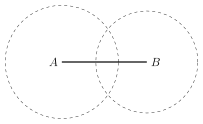
- Draw a line of the length of the largest number, say \(c\), then since \(c < a+b\) we must have circles radius \(a\) and \(b\) at the endpoints cross, and at their intersection we have a vertex of a \(c\)-\(a\)-\(b\) triangle.
- (A) always. Suppose \(c\) is the longest side, then \(c < a+b \Rightarrow c+1 < a + 1 + b+1\) so \((a+1,b+1,c+1)\) are still sides of a triangle. (B) sometimes, but not always. \((1,1,1) \to (1,1,1)\) is still a triangle, but \((10, 10, 1) \to (1, 10, \frac{1}{10})\) is not a triangle since \(10 > 1 + \frac{1}{10}\) (C) never, suppose \(a \leq b \leq c\) then the sides are \(b-a, c-b, c-a\) but \(c-a = (c-b)+(b-a)\) so the triangle inequality cannot be satisfied. (D) always - without loss of generality let \(c\) be the longest side, and since every term is homogeneous degree \(2\) we can divide through by \(c^2\) to see we have the sides \(a^2+b, b^2+a, 1+ab\) and note that \(1 + ab < a+b +ab < a+b+a^2+b^2\), also \(a^2+b < 1 + b < 1 + (a+b)b = 1 + b^2 + ab < (1+ab)+(b^2+a)\).
- Suppose \(f\) is increasing and \(\f(x)/x\) is decreasing, and suppose \(a,b,c\) are side-lengths of a triangle. Wlog \(c\) is the longest side, then note \(f(c) > f(b), f(a)\), so it suffices to prove that \(f(c) < f(a)+f(b)\) \begin{align*} \frac{f(c)}{c} < \frac{f(a)}{a}: && f(a) &> \frac{a}{c} f(c) \\ \frac{f(c)}{c} < \frac{f(b)}{b}: && f(b) &> \frac{b}{c} f(c) \\ \Rightarrow && f(a)+f(b) &> f(c) \underbrace{\left ( \frac{a+b}{c} \right)}_{>1} \\ &&&> f(c) \end{align*} as required
2020 Paper 2 Q9
Point \(A\) is a distance \(h\) above ground level and point \(N\) is directly below \(A\) at ground level. Point \(B\) is also at ground level, a distance \(d\) horizontally from \(N\). The angle of elevation of \(A\) from \(B\) is \(\beta\). A particle is projected horizontally from \(A\), with initial speed \(V\). A second particle is projected from \(B\) with speed \(U\) at an acute angle \(\theta\) above the horizontal. The horizontal components of the velocities of the two particles are in opposite directions. The two particles are projected simultaneously, in the vertical plane through \(A\), \(N\) and \(B\). Given that the two particles collide, show that \[d\sin\theta - h\cos\theta = \frac{Vh}{U}\] and also that
- \(\theta > \beta\);
- \(U\sin\theta \geqslant \sqrt{\dfrac{gh}{2}}\);
- \(\dfrac{U}{V} > \sin\beta\).
2020 Paper 2 Q12
The score shown on a biased \(n\)-sided die is represented by the random variable \(X\) which has distribution \(\mathrm{P}(X = i) = \dfrac{1}{n} + \varepsilon_i\) for \(i = 1, 2, \ldots, n\), where not all the \(\varepsilon_i\) are equal to \(0\).
- Find the probability that, when the die is rolled twice, the same score is shown on both rolls. Hence determine whether it is more likely for a fair die or a biased die to show the same score on two successive rolls.
- Use part (i) to prove that, for any set of \(n\) positive numbers \(x_i\) (\(i = 1, 2, \ldots, n\)), \[\sum_{i=2}^{n}\sum_{j=1}^{i-1} x_i x_j \leqslant \frac{n-1}{2n}\left(\sum_{i=1}^{n} x_i\right)^2.\]
- Determine, with justification, whether it is more likely for a fair die or a biased die to show the same score on three successive rolls.
2020 Paper 3 Q10
A light elastic spring \(AB\), of natural length \(a\) and modulus of elasticity \(kmg\), hangs vertically with one end \(A\) attached to a fixed point. A particle of mass \(m\) is attached to the other end \(B\). The particle is held at rest so that \(AB > a\) and is released. Find the equation of motion of the particle and deduce that the particle oscillates vertically. If the period of oscillation is \(\dfrac{2\pi}{\Omega}\), show that \(kg = a\Omega^2\). Suppose instead that the particle, still attached to \(B\), lies on a horizontal platform which performs simple harmonic motion vertically with amplitude \(b\) and period \(\dfrac{2\pi}{\omega}\). At the lowest point of its oscillation, the platform is a distance \(h\) below \(A\). Let \(x\) be the distance of the particle above the lowest point of the oscillation of the platform. When the particle is in contact with the platform, show that the upward force on the particle from the platform is \[ mg + m\Omega^2(a + x - h) + m\omega^2(b - x). \] Given that \(\omega < \Omega\), show that, if the particle remains in contact with the platform throughout its motion, \[ h \leqslant a\left(1 + \frac{1}{k}\right) + \frac{\omega^2 b}{\Omega^2}. \] Find the corresponding inequality if \(\omega > \Omega\). Hence show that, if the particle remains in contact with the platform throughout its motion, it is necessary that \[ h \leqslant a\left(1 + \frac{1}{k}\right) + b, \] whatever the value of \(\omega\).
2020 Paper 3 Q11
The continuous random variable \(X\) is uniformly distributed on \([a,b]\) where \(0 < a < b\).
- Let \(\mathrm{f}\) be a function defined for all \(x \in [a,b]\)
- with \(\mathrm{f}(a) = b\) and \(\mathrm{f}(b) = a\),
- which is strictly decreasing on \([a,b]\),
- for which \(\mathrm{f}(x) = \mathrm{f}^{-1}(x)\) for all \(x \in [a,b]\).
- The random variable \(Z\) is defined by \(\dfrac{1}{Z} + \dfrac{1}{X} = \dfrac{1}{c}\) where \(\dfrac{1}{c} = \dfrac{1}{a} + \dfrac{1}{b}\). By finding the variance of \(Z\), show that \[ \ln\left(\frac{b-c}{a-c}\right) < \frac{b-a}{c}. \]