Problems
Filters
17 problems found
1990 Paper 3 Q6
The transformation \(T\) from \(\begin{pmatrix} x \\ y \end{pmatrix}\) to \(\begin{pmatrix} X \\ Y \end{pmatrix}\) is given by \[ \begin{pmatrix}X\\ Y \end{pmatrix}=\frac{2}{5}\begin{pmatrix}9 & -2\\ -2 & 6 \end{pmatrix}\begin{pmatrix}x\\ y \end{pmatrix}. \] Show that \(T\) leaves the vector \(\begin{pmatrix} 1\\ 2 \end{pmatrix}\) unchanged in direction but multiplied by a scalar, and that \(\begin{pmatrix} 2\\ -1 \end{pmatrix}\) is similarly transformed. The circle \(C\) whose equation is \(x^{2}+y^{2}=1\) transforms under \(T\) to a curve \(E\). Show that \(E\) has equation \[ 8X^{2}+12XY+17Y^{2}=80, \] and state the area of the region bounded by \(E\). Show also that the greatest value of \(X\) on \(E\) is \(2\sqrt{17/5}.\) Find the equation of the tangent to \(E\) at the point which corresponds to the point \(\frac{1}{5}(3,4)\) on \(C\).
Solution: \begin{align*} T\begin{pmatrix}1\\ 2 \end{pmatrix} &= \frac{2}{5}\begin{pmatrix}9 & -2\\ -2 & 6 \end{pmatrix}\begin{pmatrix}1\\ 2 \end{pmatrix} \\ &= \frac25\begin{pmatrix}9 - 4\\ -2+12 \end{pmatrix} \\ &= \begin{pmatrix}2\\ 4 \end{pmatrix} \\ &= 2 \begin{pmatrix}1\\ 2 \end{pmatrix} \end{align*} \begin{align*} T\begin{pmatrix}1\\ 2 \end{pmatrix} &= \frac{2}{5}\begin{pmatrix}9 & -2\\ -2 & 6 \end{pmatrix}\begin{pmatrix}2\\ -1 \end{pmatrix} \\ &= \frac25\begin{pmatrix}18+2\\ -4-6 \end{pmatrix} \\ &= \begin{pmatrix}8\\ -4 \end{pmatrix} \\ &= 4 \begin{pmatrix}2\\ -1 \end{pmatrix} \end{align*} Consider $T^{-1} = \frac{5}{2} \frac{1}{50}\begin{pmatrix}6 & 2\\ 2 & 9 \end{pmatrix}\(, so \)T^{-1} \begin{pmatrix}X\\ Y \end{pmatrix} = \begin{pmatrix}x\\ y \end{pmatrix}$ and so: \begin{align*} x^2 + y^2 & = \begin{pmatrix}x& y \end{pmatrix}\begin{pmatrix}x\\ y \end{pmatrix} \\ &= \begin{pmatrix}X& Y \end{pmatrix} (T^{-1})^T T^{-1} \begin{pmatrix}X\\ Y \end{pmatrix} \\ &= \frac{1}{400}\begin{pmatrix}X& Y \end{pmatrix}\begin{pmatrix}6 & 2\\ 2 & 9 \end{pmatrix}\begin{pmatrix}6 & 2\\ 2 & 9 \end{pmatrix} \begin{pmatrix}X\\ Y \end{pmatrix} \\ &= \frac{1}{400}\begin{pmatrix}X& Y \end{pmatrix}\begin{pmatrix}6 & 2\\ 2 & 9 \end{pmatrix} \begin{pmatrix}6X+2Y\\ 2X+9Y \end{pmatrix} \\ &= \frac{1}{400}\begin{pmatrix}X& Y \end{pmatrix} \begin{pmatrix}6(6X+2Y)+2(2X+9Y)\\ 2(6X+2Y)+9(2X+9Y) \end{pmatrix} \\ &= \frac{1}{400}\begin{pmatrix}X& Y \end{pmatrix} \begin{pmatrix}40X+30Y\\ 30X +85Y \end{pmatrix} \\ &= \frac{1}{80}\begin{pmatrix}X& Y \end{pmatrix} \begin{pmatrix}8X+6Y\\ 6X +17Y \end{pmatrix} \\ &= \frac{1}{80} \l 8X^2 + 12XY + 17Y^2\r \end{align*} Therefore \(8X^2 + 12XY + 17Y^2 = 80\). The area will be \(\det T \cdot \pi = \frac{4}{25} \cdot 50 \cdot \pi = 8 \pi\). Differentiating we obtain \(2 \cdot 8 \cdot X \cdot \frac{dX}{dY} + 2 \cdot 6 \cdot X + 2 \cdot 6 \cdot Y \cdot \frac{dX}{dY} + 2 \cdot 17 Y \Rightarrow \frac{dX}{dY} = -\frac{6X + 17Y}{8X+6Y}\), at a maximum (or minimum, \(6X = -17Y\)). Therefore \begin{align*} \Rightarrow && 8X^2 + 12 \cdot \frac{6}{17}X^2 + 17 ( -\frac{6}{17} X)^2 &= 80 \\ \Rightarrow && \frac{100}{17}X^2 &= 80 \\ \Rightarrow &&X^2 &= \frac{17 \cdot 4}{5} \\ \Rightarrow && |X| = 2 \sqrt {\frac{17}{5}} \end{align*} The point \(\frac15 (3,4)\) maps to \begin{align*} \frac{2}{5}\frac{1}{5}\begin{pmatrix}9 & -2\\ -2 & 6 \end{pmatrix}\begin{pmatrix}3\\ 4 \end{pmatrix} &= \frac{2}{25} \begin{pmatrix}19\\ 18 \end{pmatrix} \end{align*} So the point is \((\frac{38}{25}, \frac{36}{25})\), with gradient \(\frac{dY}{dX} = -\frac{8X+6Y}{6X + 17Y}\) which is \(-\frac{8 \cdot 19+6 \cdot 18}{6\cdot 19 + 17 \cdot 18} = -\frac{13}{21}\) therefore the equation is \(21Y+13X = 50\)
1989 Paper 2 Q3
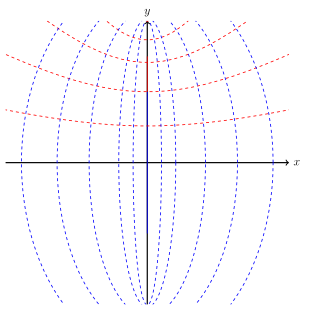
The real numbers \(x\) and \(y\) are related to the real numbers \(u\) and \(v\) by \[ 2(u+\mathrm{i}v)=\mathrm{e}^{x+\mathrm{i}y}-\mathrm{e}^{-x-\mathrm{i}y}. \] Show that the line in the \(x\)-\(y\) plane given by \(x=a\), where \(a\) is a positive constant, corresponds to the ellipse \[ \left(\frac{u}{\sinh a}\right)^{2}+\left(\frac{v}{\cosh a}\right)^{2}=1 \] in the \(u\)-\(v\) plane. Show also that the line given by \(y=b\), where \(b\) is a constant and \(0<\sin b<1,\) corresponds to one branch of a hyperbola in the \(u\)-\(v\) plane. Write down the \(u\) and \(v\) coordinates of one point of intersection of the ellipse and hyperbola branch, and show that the curves intersect at right-angles at this point. Make a sketch of the \(u\)-\(v\) plane showing the ellipse, the hyperbola branch and the line segments corresponding to:
- \(x=0\);
- \(y=\frac{1}{2}\pi,\) \(\quad 0\leqslant x\leqslant a.\)
Solution: \begin{align*} && 2(u+iv) &= e^{a+iy} - e^{-a-iy} \\ && &=(e^a \cos y - e^{-a} \cos y) + (e^a \sin y + e^{-a} \sin y)i \\ &&&= 2 \sinh a \cos y + 2\cosh a \sin y i\\ \Rightarrow && \frac{u}{\sinh a} &= \cos y \\ && \frac{v}{\cosh a} &= \sin y \\ \Rightarrow && 1 &= \left(\frac{u}{\sinh a}\right)^{2}+\left(\frac{v}{\cosh a}\right)^{2} \end{align*} \begin{align*} && 2(u+iv) &= e^{x+ib} - e^{-x-ib} \\ &&&= 2\sinh x \cos b + 2\cosh x \sin b i \\ \Rightarrow && \frac{u}{\cos b} &= \sinh x \\ && \frac{v}{\sin b} &= \cosh x \\ \Rightarrow && 1 &= \left (\frac{v}{\sin b} \right)^2 - \left (\frac{u}{\cos b} \right)^2 \end{align*} Therefore all the points lie of a hyperbola, and since \(\frac{v}{\sin b} > 0 \Rightarrow v > 0\) it's one branch of the hyperbola. (And all points on it are reachable as \(x\) varies from \(-\infty < x < \infty\). \begin{align*} 2(u+iv) &= e^{a+ib} - e^{-a-ib} \\ &= 2 \sinh a \cos b + 2 \cosh a \sin b i \end{align*} so we can take \(u = \sinh a \cos b, v = \cosh a \sin b\). \begin{align*} \frac{\d }{\d u} && 0 &= \frac{2 u}{\sinh^2 a} + \frac{2v}{\cosh^2 a} \frac{\d v}{\d u} \\ \Rightarrow && \frac{\d v}{\d u} &= -\frac{u}{v} \coth^2 a \\ \\ && \frac{\d v}{\d u} \rvert_{(u,v)} &= -\frac{\sinh a \cos b}{\cosh a \sin b} \coth^2 a \\ &&&= -\cot b \coth a \\ \frac{\d }{\d u} && 0 &= \frac{2 v}{\sin^2 b} \frac{\d v}{\d u} - \frac{2u}{\cos^2 b} \\ \Rightarrow && \frac{\d v}{\d u} &= \frac{u}{v} \tan^2 b \\ && \frac{\d v}{\d u} \rvert_{(u,v)} &= \frac{\sinh a \cos b}{\cosh a \sin b} \tan^2 b \\ &&&= \tanh a \tan b \end{align*} Therefore they are negative reciprocals and hence perpendicular.