Problems

Filters
Clear Filters

26 problems found

1994 Paper 1 Q10
D: 1516.0 B: 1484.0

One end \(A\) of a light elastic string of natural length \(l\) and modulus of elasticity \(\lambda\) is fixed and a particle of mass \(m\) is attached to the other end \(B\). The particle moves in a horizontal circle with centre on the vertical through \(A\) with angular velocity \(\omega.\) If \(\theta\) is the angle \(AB\) makes with the downward vertical, find an expression for \(\cos\theta\) in terms of \(m,g,l,\lambda\) and \(\omega.\) Show that the motion described is possible only if \[ \frac{g\lambda}{l(\lambda+mg)}<\omega^{2}<\frac{\lambda}{ml}. \]

1994 Paper 3 Q11
D: 1700.0 B: 1516.0

A step-ladder has two sections \(AB\) and \(AC,\) each of length \(4a,\) smoothly hinged at \(A\) and connected by a light elastic rope \(DE,\) of natural length \(a/4\) and modulus \(W\), where \(D\) is on \(AB,\) \(E\) is on \(AC\) and \(AD=AE=a.\) The section \(AB,\) which contains the steps, is uniform and of weight \(W\) and the weight of \(AC\) is negligible. The step-ladder rests on a smooth horizontal floor and a man of weight \(4W\) carefully ascends it to stand on a rung distant \(\beta a\) from the end of the ladder resting on the floor. Find the height above the floor of the rung on which the man is standing when \(\beta\) is the maximum value at which equilibrium is possible.


Solution:

TikZ diagram
\begin{align*} N2(\uparrow): && 0 &= R_B+R_C - 5W \\ \Rightarrow && 5W &= R_B + R_C \\ \\ \overset{\curvearrowright}{A}: && 0 &= (R_B - R_C) \cdot 4a \cdot \cos \theta -W \cdot 2a \cdot \cos \theta - 4W \cdot (4 - \beta)a \cdot \cos \theta \\ \Rightarrow && R_B-R_C &= W \left ( \frac12 + (4-\beta)\right) \\ \Rightarrow && R_B &= \frac{W}2 \left ( 5+\frac12+(4-\beta)\right) = \frac{W}{2}\left(\frac{19}{2} - \beta\right) \\ && R_C &= \frac{W}{2} \left (5 - \frac12 - 4 +\beta \right) = \frac{W}{2} \left (\frac12 + \beta \right) \\ \\ \overset{\curvearrowright}{(A, AC)}: && 0 &= T \cdot a \cdot \sin \theta - R_C \cdot 4a \cdot \cos \theta \\ \Rightarrow && T &=4 \cot \theta \frac{W}{2} \left ( \frac12 + \beta\right) \\ &&&= 20W \cot \theta \\ \text{Hooke's Law}:&& T &= \frac{W(2a \cos \theta - \frac{a}{4})}{\frac{a}{4}} = W(8 \cos \theta - 1) \\ \Rightarrow && 8 \cos \theta -1 &= \cot \theta (2\beta+1)\\ \Rightarrow && 1+2\beta &=8\sin \theta-\tan \theta \\ \Rightarrow && \beta &= 4 \sin \theta - \frac12 \tan \theta - \frac12 \\ \Rightarrow && \frac{\d \beta}{\d \theta} &= 4 \cos \theta - \frac12 \sec^2 \theta \\ &&&= \frac{8\cos^3 \theta - 1}{\cos^2 \theta} \\ \Rightarrow && \cos \theta &= \frac12 \\ \Rightarrow && h &= \beta a \sin \theta \\ &&&= \left (4 \frac{\sqrt{3}}{2}-\frac12 \sqrt{3}-\frac12 \right) a \frac{\sqrt3}{2} \\ &&&= \left ( \frac{9-\sqrt{3}}{4}\right)a \end{align*}

1993 Paper 3 Q12
D: 1700.0 B: 1432.3

\(ABCD\) is a horizontal line with \(AB=CD=a\) and \(BC=6a\). There are fixed smooth pegs at \(B\) and \(C\). A uniform string of natural length \(2a\) and modulus of elasticity \(kmg\) is stretched from \(A\) to \(D\), passing over the pegs at \(B\) and \(C\). A particle of mass \(m\) is attached to the midpoint \(P\) of the string. When the system is in equilibrium, \(P\) is a distance \(a/4\) below \(BC\). Evaluate \(k\). The particle is pulled down to a point \(Q\), which is at a distance \(pa\) below the mid-point of \(BC\), and is released from rest. \(P\) rises to a point \(R\), which is at a distance \(3a\) above \(BC\). Show that \(2p^2-p-17=0\). Show also that the tension in the strings is less when the particle is at \(R\) than when the particle is at \(Q\).

1992 Paper 1 Q11
D: 1500.0 B: 1470.8

Three light elastic strings \(AB,BC\) and \(CD\), each of natural length \(a\) and modulus of elasticity \(\lambda,\) are joined together as shown in the diagram. \noindent

\psset{xunit=1.0cm,yunit=1.0cm,algebraic=true,dimen=middle,dotstyle=o,dotsize=3pt 0,linewidth=0.5pt,arrowsize=3pt 2,arrowinset=0.25} \begin{pspicture*}(-2.46,-1.7)(5.55,2.55) \psline(-2,2)(-2,-1) \psline(-2,-1)(4,-1) \psline(4,-1)(4,2) \psline(4,2)(-2,2) \psline[linestyle=dashed,dash=2pt 2pt](1,2)(1,-1) \psline{<->}(5,2)(5,-1) \rput[tl](5.15,0.77){\(3d\)} \rput[tl](1.08,2.35){\(A\)} \rput[tl](1.14,0.63){\(B\)} \rput[tl](1.17,-0.32){\(C\)} \rput[tl](1.14,-1.1){\(D\)} \begin{scriptsize} \psdots[dotstyle=*](1,2) \psdots[dotstyle=*](1,-1) \psdots[dotstyle=*](1,0.5) \psdots[dotstyle=*](1,-0.37) \end{scriptsize} \end{pspicture*} \par
\(A\) is attached to the ceiling and \(D\) to the floor of a room of height \(3d\) in such a way that \(A,B,C\) and \(D\) are in a vertical line. Particles of mass \(m\) are attached at \(B\) and \(C\). Find the heights of \(B\) and \(C\) above the floor. Find the set of values of \(d\) for which it is possible, by choosing \(m\) suitably, to have \(CD=a\)?

1992 Paper 2 Q12
D: 1600.0 B: 1500.0

In the figure, \(W_{1}\) and \(W_{2}\) are wheels, both of radius \(r\). Their centres \(C_{1}\) and \(C_{2}\) are fixed at the same height, a distance \(d\) apart, and each wheel is free to rotate, without friction, about its centre. Both wheels are in the same vertical plane. Particles of mass \(m\) are suspended from \(W_{1}\) and \(W_{2}\) as shown, by light inextensible strings would round the wheels. A light elastic string of natural length \(d\) and modulus elasticity \(\lambda\) is fixed to the rims of the wheels at the points \(P_{1}\) and \(P_{2}.\) The lines joining \(C_{1}\) to \(P_{1}\) and \(C_{2}\) to \(P_{2}\) both make an angle \(\theta\) with the vertical. The system is in equilibrium. \noindent

\psset{xunit=1.0cm,yunit=1.0cm,algebraic=true,dimen=middle,dotstyle=o,dotsize=3pt 0,linewidth=0.5pt,arrowsize=3pt 2,arrowinset=0.25} \begin{pspicture*}(-4.94,-1.8)(5.1,3.96) \psline(-4,1)(4,1) \pscircle(-3,2){1.41} \pscircle(3,2){1.41} \psline(-3,2)(-4,1) \psline(-3,2)(-3,0.59) \psline(3,2)(4,1) \psline(3,2)(3,0.59) \psline(1.59,1.98)(1.58,-1) \psline(-1.59,1.96)(-1.6,-1.06) \parametricplot{-2.356194490192345}{-1.5707963267948966}{0.4*cos(t)+-3|0.4*sin(t)+2} \parametricplot{-1.5707963267948966}{-0.7853981633974483}{0.4*cos(t)+3|0.4*sin(t)+2} \rput[tl](-2.88,2.24){\(C_1\)} \rput[tl](3.22,2.24){\(C_2\)} \rput[tl](-4.58,1.04){\(P_1\)} \rput[tl](4.32,1.02){\(P_2\)} \rput[tl](-1.7,-1.36){\(m\)} \rput[tl](1.44,-1.4){\(m\)} \rput[tl](-3.24,3.88){\(W_1\)} \rput[tl](2.76,3.86){\(W_2\)} \rput[tl](-3.42,1.5){\(\theta\)} \rput[tl](3.14,1.52){\(\theta\)} \begin{scriptsize} \psdots[dotstyle=*](-4,1) \psdots[dotstyle=*](4,1) \psdots[dotstyle=*](1.58,-1) \psdots[dotstyle=*](-1.6,-1.06) \end{scriptsize} \end{pspicture*} \par
\vspace{-0.5cm} Show that \[ \sin2\theta=\frac{mgd}{\lambda r}. \]For what value or values of \(\lambda\) (in terms of \(m,d,r\) and \(g\)) are there
  • sep}{3mm}
  • \(\bf (i)\) no equilibrium positions,
  • \(\bf (ii)\) just one equilibrium position,
  • \(\bf (iii)\) exactly two equilibrium positions,
  • \(\bf (iv)\) more than two equilibrium positions?

1992 Paper 3 Q13
D: 1700.0 B: 1500.0

\(\,\)

\psset{xunit=1.0cm,yunit=1.0cm,algebraic=true,dimen=middle,dotstyle=o,dotsize=3pt 0,linewidth=0.3pt,arrowsize=3pt 2,arrowinset=0.25} \begin{pspicture*}(-2.8,-2.34)(3.26,4.36) \pspolygon[linewidth=0.4pt](0.22,-0.18)(0.4,0.04)(0.18,0.22)(0,0) \pscircle(0,0){2} \psline(2,0)(2,4) \rput[tl](2.24,2.64){\(\pi b\)} \rput[tl](2.22,0.02){\(C\)} \rput[tl](2.24,4.3){\(A\)} \rput[tl](1.32,2.1){\(Q\)} \rput[tl](-0.42,0.08){\(O\)} \rput[tl](1.6,-1.38){\(P\)} \psline[linestyle=dashed,dash=3pt 3pt](1.27,1.54)(0,0) \psline[linestyle=dashed,dash=3pt 3pt](0,0)(1.54,-1.27) \rput[tl](0.06,1.1){\(2b\)} \begin{scriptsize} \psdots[dotsize=2pt 0,dotstyle=*](2,4) \end{scriptsize} \end{pspicture*}
A uniform circular disc of radius \(2b,\) mass \(m\) and centre \(O\) is free to turn about a fixed horizontal axis through \(O\) perpendicular to the plane of the disc. A light elastic string of modulus \(kmg\), where \(k>4/\pi,\) has one end attached to a fixed point \(A\) and the other end to the rim of the disc at \(P\). The string is in contact with the rim of the disc along the arc \(PC,\) and \(OC\) is horizontal. The natural length of the string and the length of the line \(AC\) are each \(\pi b\) and \(AC\) is vertical. A particle \(Q\) of mass \(m\) is attached to the rim of the disc and \(\angle POQ=90^{\circ}\) as shown in the diagram. The system is released from rest with \(OP\) vertical and \(P\) below \(O\). Show that \(P\) reaches \(C\) and that then the upward vertical component of the reaction on the axis is \(mg(10-\pi k)/3\).

1991 Paper 2 Q12
D: 1600.0 B: 1500.0

A particle is attached to one end \(B\) of a light elastic string of unstretched length \(a\). Initially the other end \(A\) is at rest and the particle hangs at rest at a distance \(a+c\) vertically below \(A\). At time \(t=0\), the end \(A\) is forced to oscillate vertically, its downwards displacement at time \(t\) being \(b\sin pt\). Let \(x(t)\) be the downwards displacement of the particle at time \(t\) from its initial equilibrium position. Show that, while the string remains taut, \(x(t)\) satisfies \[ \frac{\mathrm{d}^{2}x}{\mathrm{d}t^{2}}=-n^{2}(x-b\sin pt), \] where \(n^{2}=g/c\), and that if \(0 < p < n\), \(x(t)\) is given by \[ x(t)=\frac{bn}{n^{2}-p^{2}}(n\sin pt-p\sin nt). \] Write down a necessary and sufficient condition that the string remains taut throughout the subsequent motion, and show that it is satisfied if \(pb < (n-p)c.\)

1989 Paper 1 Q12
D: 1500.0 B: 1504.2

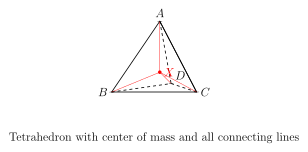
A regular tetrahedron \(ABCD\) of mass \(M\) is made of 6 identical uniform rigid rods, each of length \(2a.\) Four light elastic strings \(XA,XB,XC\) and \(XD\), each of natural length \(a\) and modulus of elasticity \(\lambda,\) are fastened together at \(X\), the other end of each string being attached to the corresponding vertex. Given that \(X\) lies at the centre of mass of the tetrahedron, find the tension in each string. The tetrahedron is at rest on a smooth horizontal table, with \(B,C\) and \(D\) touching the table, and the ends of the strings at \(X\) attached to a point \(O\) fixed in space. Initially the centre of mass of the tetrahedron coincides with \(O.\) Suddenly the string \(XA\) breaks, and the tetrahedron as a result rises vertically off the table. If the maximum height subsequently attained is such that \(BCD\) is level with the fixed point \(O,\) show that (to 2 significant figures) \[ \frac{Mg}{\lambda}=0.098. \]


Solution:
TikZ diagram
The distance of \(A\) to \(X\) is \(\frac34\) the distance from \(A\) to the centre base (\(d\)) The distance of \(C\) to the centre of the base (\(G\)) is \(\frac{2}{3}\) the height of \(BCD\) which is \(\frac{\sqrt{3}}{2} \cdot 2a = \sqrt{3} a\). Therefore we must have \((2a)^2 = d^2 + \frac43a^2 \Rightarrow d = \frac{2\sqrt{2}}{\sqrt{3}}a\) and so \(AX = \frac34 \frac{2\sqrt{2}}{\sqrt{3}}a = \sqrt{\frac32}a\) The tension in each string will be \(\lambda \left (\sqrt{\frac32}-1 \right)\). Considering the energy of the system, when the ABCD reaches it's maximum height, it's velocity will be \(0\). Therefore the only energies to consider are GPE and EPE. Assuming the table is \(0\), we initially have \(EPE\) of \begin{align*} 3 \cdot \frac12 \lambda \frac{(a(\sqrt{\frac32}-1))^2}{a} = \frac32 \lambda a\left (\frac52-2\sqrt{\frac32} \right ) \end{align*} When \(BCD\) is level with \(O\), the height is \(\frac{1}{\sqrt{6}}a\) and GPE of \(\frac{Mga}{\sqrt{6}}\) The \(EPE\) will be: \begin{align*} 3 \cdot \frac12 \lambda \frac{(a(\frac{2}{\sqrt{3}}-1))^2}{a} &= \frac32 \lambda a \left (\frac73 - \frac{4}{\sqrt{3}}\right ) \end{align*} So by conservation of energy: \begin{align*} && \frac32 \lambda a\left (\frac52-2\sqrt{\frac32} \right ) &= \frac{Mga}{\sqrt{6}} + \frac32 \lambda a \left (\frac73 - \frac{4}{\sqrt{3}}\right ) \\ \Rightarrow && \frac{Mg}{\lambda} &= \sqrt{6} \left (\frac32 \left (\frac52-2\sqrt{\frac32} \right ) - \frac32 \left (\frac73 - \frac{4}{\sqrt{3}}\right ) \right) \\ &&&= -9 + 6\sqrt{2}+\sqrt{\frac38} \\ &&&= 0.09765380\ldots \\ &&&= 0.098\, (2\text{ s.f}) \end{align*}

1989 Paper 3 Q13
D: 1700.0 B: 1500.0

The points \(A,B,C,D\) and \(E\) lie on a thin smooth horizontal table and are equally spaced on a circle with centre \(O\) and radius \(a\). At each of these points there is a small smooth hole in the table. Five elastic strings are threaded through the holes, one end of each beging attached at \(O\) under the table and the other end of each being attached to a particle \(P\) of mass \(m\) on top of the table. Each of the string has natural length \(a\) and modulus of elasticity \(\lambda.\) If \(P\) is displaced from \(O\) to any point \(F\) on the table and released from rest, show that \(P\) moves with simple harmonic motion of period \(T\), where \[ T=2\pi\sqrt{\frac{am}{5\lambda}}. \] The string \(PAO\) is replaced by one of natural length \(a\) and modulus \(k\lambda.\) \(P\) is displaced along \(OA\) from its equilibrium position and released. Show that \(P\) still moves in a straight line with simple harmonic motion, and, given that the period is \(T/2,\) find \(k\).


Solution:

TikZ diagram
The extension of \(OAP\) is \(|AP|\) and so the tension \(T_a = \frac{\lambda}{a} |AP|\). To simplify calculations, let \(A = a, B = a \omega, C = a \omega^2, \cdots\) where \(\omega = e^{2 \pi i/5}\) and let \(P = z\). then we can calculate the force as: \begin{align*} &&\sum_{p}T_p \mathbf{n}_{z \to p} &= \sum_{p} \frac{\lambda}{a} |z-p| \frac{p-z}{|p-z|} \\ &&&= \frac{\lambda}{a} \sum_{p} ( p - z) \\ &&&= -\frac{5\lambda}{a}z \end{align*} Therefore the force has magnitude \(\frac{5 \lambda}{a} |OP|\) directly towards the origin. Therefore if we set up our coordinate axis such that \(OP\) is the \(x\) axis, the particle will remain on the \(x\) axis and will move under the equation: \[ m \ddot{x} + \frac{5 \lambda}{a} x = 0 \] But then we can say that \(P\) moves under SHM with period \(\displaystyle 2 \pi \sqrt{\frac{am}{5 \lambda}}\) as required. Now suppose that \(PAO\) has been replaced with the string of modulus \(k \lambda\) but that \(P\) is along \(OA\). \begin{align*} F &= \frac{\lambda}{a}\left ( (a \omega - z) + (a \omega^2 - z)+ (a \omega^3 -z)+ (a \omega^4 - z) + k(a -z) \right) \\ &= \frac{\lambda}{a}(-a - 4z+ka -kz) \\ &= \frac{\lambda}{a}((k-1)a-(k+4)z) \end{align*} Notice that if \(z\) is real, this expression is also real, so all forces are acting along \(OA\). Therefore the particle will remain on the line \(OA\). We can also notice that the particle will move under the differential equation \[ m \ddot{x} + \frac{(k+4) \lambda}{a}x = \lambda(k-1) \] Therefore it will move with SHM about a point slightly displaced from the origin. The period will be: \(\displaystyle 2 \pi \sqrt{\frac{ma}{(k+4)\lambda}}\) which is equal to \(T/2\) if \((k+4) = 20 \Rightarrow k = 16\)

1988 Paper 1 Q13
D: 1484.0 B: 1486.3

A piece of circus apparatus consists of a rigid uniform plank of mass 1000\(\,\)kg, suspended in a horizontal position by two equal light vertical ropes attached to the ends. The ropes each have natural length 10\(\,\)m and modulus of elasticity 490\(\,\)000 N. Initially the plank is hanging in equilibrium. Nellie, an elephant of mass 4000\(\,\)kg, lands in the middle of the plank while travelling vertically downwards at speed 5\(\,\)ms\(^{-1}.\) While carrying Nellie, the plank comes instantaneously to rest at a negligible height above the floor, and at this instant Nellie steps nimbly and gently off the plank onto the floor. Assuming that the plank remains horizontal, and the rope remain vertical, throughout the motion, find to three significant figures its initial height above the floor. During the motion after Nellie alights, do the ropes ever become slack? {[}Take \(g\) to be \(9.8\mbox{\,\ ms}^{-1}.\){]}


Solution: In the initial position, since the system is in equilibrium the tension in the two ropes must be \(500g\). Therefore since \(T = \frac{\lambda x}{l} \Rightarrow x = \frac{10 \cdot 500 g}{490\, 000} = \frac1{10}\) so the initial extension is \(\frac1{10}\) By conservation of momentum, if the initial speed of the plank + Nellie is \(V\), we must have \(4000 \cdot 5 = 5000 V \Rightarrow V = 4\) \begin{array}{ccc} & \text{GPE} & \text{EPE} & \text{KE} \\ \hline \text{Initially} & 5000gh & 2 \cdot \frac12 \frac{\lambda}{l} \frac{1}{100} & \frac12 \cdot 5000 \cdot 4^2 \\ & 49\,000h & 490 & 40\,000 \\ \text{Finally} & 0 & 2 \cdot \frac12 \frac{\lambda}{l} (h + \frac1{10})^2 & 0 \\ & 0 & 49\,000 (h+\frac1{10})^2 & 0 \end{array} By conservation of energy, we can set up a quadratic: \begin{align*} && 49\,000 (h+\frac1{10})^2 &= 49\,000h + 40\,490 \\ \Rightarrow && 49\,000(h + \frac1{10})^2 &= 49\,000(h + \frac1{10})+35\, 590 \\ \Rightarrow&& h + \frac1{10} &= 1.488092\cdots \\ \Rightarrow && h &= 1.49 \,\, (3\text{ s.f.}) \end{align*} When she gets off the plank, it will move according to: \begin{align*} \text{N2}(\uparrow): && \frac{\lambda x}{l} -1000g &= -1000 \ddot{x} \\ && 49 x-g &= -\ddot{x} \\ \Rightarrow && x &= A \sin 7t + B \cos 7t + 0.2 \\ && x(0) = 1.49, &x'(0) = 0 \\ \Rightarrow && B = -1.69, & A=0 \end{align*} If we continued under this motion the string would definitely reach a point \(0.1\) above \(0\), and therefore the ropes would go slack.

1987 Paper 1 Q10
D: 1500.0 B: 1500.0

A rubber band band of length \(2\pi\) and modulus of elasticity \(\lambda\) encircles a smooth cylinder of unit radius, whose axis is horizontal. A particle of mass \(m\) is attached to the lowest point of the band, and hangs in equilibrium at a distance \(x\) below the axis of the cylinder. Obtain an expression in terms of \(x\) for the stretched length of the band in equilibrium. What is the value of \(\lambda\) if \(x=2\)?


Solution:

TikZ diagram
If \(\alpha\) is as labelled then \(\cos \alpha = \frac{1}{x}, \sin \alpha = \frac{\sqrt{x^2-1}}{x}, \tan \alpha = \sqrt{x^2-1}\). We also have the full length of the rubber band is \(2\pi - 2\alpha +2\tan \alpha\) so the extension is \(2 \l \sqrt{x^2-1} - \cos^{-1} \l \frac{1}{x}\r \r\) Therefore \(T = \frac{\l \sqrt{x^2-1} - \cos^{-1} \l \frac{1}{x}\r \r\lambda}{\pi}\). If \(x = 2\), \(T = \frac{\sqrt{3} - \frac{\pi}{3}}{\pi} \lambda, \sin \alpha = \frac{\sqrt{3}}{2}\) \begin{align*} \text{N2}(\uparrow): && 2T\sin \alpha - mg &= 0 \\ \Rightarrow && \frac{\sqrt{3} - \frac{\pi}{3}}{\pi} \lambda \sqrt{3} &= mg \\ \Rightarrow && \lambda &= \frac{\sqrt{3}\pi}{(3\sqrt{3}-\pi)}mg \end{align*}