Problems
Filters
23 problems found
2005 Paper 1 Q4
- Given that \(\displaystyle \cos \theta = \frac35\) and that \(\displaystyle \frac{3\pi }{ 2} \le \theta \le 2\pi\), show that \(\displaystyle \sin 2 \theta = -\frac{24}{25}\), and evaluate \(\cos 3 \theta\).
- Prove the identity \(\displaystyle \tan 3\theta \equiv \frac {3 \tan \theta - \tan^3 \theta}{1 - 3 \tan^2 \theta}\). Hence evaluate \(\tan \theta\), given that \(\displaystyle \tan 3\theta = \frac{11}{ 2}\) and that \(\displaystyle \frac{\pi}{ 4} \le \theta \le \frac{\pi}{2}\).
Solution:
- Since \(\cos^2 \theta + \sin^2 \theta \equiv 1\), \(\sin \theta = \pm \frac45\) and since \(\displaystyle \frac{3\pi }{ 2} \le \theta \le 2\pi\) it must be the case that \(\sin\) is negative, ie \(\sin \theta = -\frac45\). Therefore \(\sin 2 \theta = 2 \sin \theta \cos \theta = 2 \cdot \frac35 \cdot (-\frac45) = -\frac{24}{25}\). \begin{align*} \cos 3 \theta &= \cos 2 \theta \cos \theta - \sin 2\theta \sin \theta \\ &= (\cos^2 \theta - \sin^2 \theta) \cos \theta - \sin 2 \theta \sin \theta \\ &= (\frac{9}{25} - \frac{16}{25}) \frac35 + \frac{24}{25} \cdot (-\frac{4}{5}) \\ &= -\frac{21}{125} - \frac{96}{125} \\ &= -\frac{117}{125} \end{align*}
- \begin{align*} \tan 3 \theta &\equiv \frac{\tan 2 \theta + \tan \theta}{1 - \tan 2 \theta \tan \theta} \\ &\equiv \frac{\frac{2 \tan \theta}{1- \tan^2 \theta} + \tan \theta}{1 - \frac{2 \tan^2 \theta}{1- \tan^2 \theta}} \\ &\equiv \frac{2\tan \theta + \tan \theta -\tan^3 \theta}{1 - \tan^2 \theta - 2 \tan^2 \theta} \\ &\equiv \frac {3 \tan \theta - \tan^3 \theta}{1 - 3 \tan^2 \theta} \end{align*} Let \(t = \tan \theta\), then \begin{align*} && \frac{11}{2} &= \frac{3t - t^3}{1-3t^2} \\ \Leftrightarrow && 11 - 33t^2 &= 6t -2t^3 \\ \Leftrightarrow && 0 &= 2t^3-33t^2-6t+11 \\ \Leftrightarrow && 0 &= (2t-1)(t^2-16t-11) \end{align*} Therefore \(\tan \theta = \frac12, \tan \theta = \frac{16 \pm \sqrt{16^2+4 \cdot 1 \cdot 11}}{2} = \frac{16\pm10\sqrt{3}}{2} = 8 \pm 5 \sqrt{3}\). Since \(\displaystyle \frac{\pi}{ 4} \le \theta \le \frac{\pi}{2}\) we must have that \(\tan\) is both positive and \(\geq 1\), therefore \(\tan \theta = 8 + 5 \sqrt{3}\)
2003 Paper 1 Q3
- Show that \( 2\sin(\frac12\theta)=\sin \theta\) if and only if \(\sin(\frac12\theta)=0\,\).
- Solve the equation \(2\tan (\frac12\theta) = \tan\theta\,\).
- Show that \(2\cos(\frac12\theta)=\cos \theta\) if and only if \(\theta=(4n+2)\pi\pm 2\phi\) where \(\phi\) is defined by \(\cos \phi=\frac12(\sqrt 3-1)\;\), \(0\le \phi\le \frac{1}{2}\pi\), and \(n\) is any integer.
Solution:
- \(\,\) \begin{align*} && 2 \sin (\tfrac12 \theta) &= \sin \theta \\ \Leftrightarrow && 2 \sin (\tfrac12 \theta) &= 2\sin (\tfrac12 \theta) \cos (\tfrac12 \theta) \\ \Leftrightarrow && 0 &= 2\sin(\tfrac12\theta)(1-\cos(\tfrac12 \theta)) \\ \Leftrightarrow && 0 = \sin(\tfrac12 \theta) &\text{ or } 1 = \cos(\tfrac12 \theta) \\ \Leftrightarrow && 0 &= \sin(\tfrac12 \theta) \end{align*}
- Let \(= \tan(\tfrac12 \theta)\), then \begin{align*} && 2t &= \frac{2t}{1-t^2} \\ \Leftrightarrow && 0 &= \frac{2t(1-(1-t^2)}{1-t^2} \\ &&&= \frac{2t^3}{1-t^2} \\ \Leftrightarrow && t&= 0 \\ \Leftrightarrow && \frac12\theta &= n \pi \\ \Leftrightarrow && \theta &= 2n\pi \end{align*}
- Let \(c = \cos(\tfrac12 \theta)\), then \begin{align*} && 2c &= 2c^2 - 1 \\ && 0 &= 2c^2-2c-1 \\ \Leftrightarrow && c &= \frac{2 \pm \sqrt{4+8}}{4} \\ &&&= \frac{1 \pm \sqrt{3}}{2} \\ \Leftrightarrow && c &= \frac{1 - \sqrt{3}}{2} \\ \Leftrightarrow && \frac12 \theta &= \pm \cos^{-1} \frac{1 - \sqrt{3}}{2} + 2n \pi \\ &&&= \mp (\phi+\pi) + 2n \pi \\ \Leftrightarrow && \theta &= (4n+2)\pi \pm 2\phi \end{align*}
2002 Paper 2 Q1
Show that \[ \int_{\frac{1}{6}\pi}^{\frac{1}{4}\pi} \frac 1{1-\cos2\theta} \;\d\theta = \frac{\sqrt3}2 - \frac12\;. \] By using the substitution \(x=\sin2\theta\), or otherwise, show that \[ \int_{\sqrt3/2}^1 \frac 1 {1-\sqrt{1-x^2}} \, \d x = \sqrt 3 -1 -\frac\pi 6 \;. \] Hence evaluate the integral \[ \int_1^{2/\sqrt3} \frac 1{y ( y - \sqrt{y^2-1^2})} \, \d y \;. \]
Solution: \begin{align*} && I &= \int_{\frac{1}{6}\pi}^{\frac{1}{4}\pi} \frac 1{1-\cos2\theta} \;\d\theta \\ &&&= \int_{\frac{1}{6}\pi}^{\frac{1}{4}\pi} \frac 1{2\sin^2 \theta} \;\d\theta \\ &&&= \frac12\int_{\frac{1}{6}\pi}^{\frac{1}{4}\pi} \cosec^2 \theta \;\d\theta \\ &&&= \frac12\left [-\cot \theta \right]_{\frac{1}{6}\pi}^{\frac{1}{4}\pi} \\ &&&= \frac12 \left (\cot \frac{\pi}{6} - \cot \frac{\pi}{4} \right)\\ &&&= \frac{\sqrt{3} - 1}{2} \end{align*} \begin{align*} && J &= \int_{\sqrt3/2}^1 \frac 1 {1-\sqrt{1-x^2}} \, \d x \\ x = \sin 2 \theta, \d x = 2\cos 2\theta \d \theta &&&=\int_{\pi/6}^{\pi/4} \frac{2 \cos 2 \theta }{1-\cos 2 \theta} \d \theta \\ &&&=\int_{\pi/6}^{\pi/4} \frac{2 \cos 2 \theta -2+2}{1-\cos 2 \theta} \d \theta \\ &&&= -2\left (\frac{\pi}{4} - \frac{\pi}6 \right) + 2I \\ &&&= \sqrt{3}-1-\frac{\pi}{6} \end{align*} \begin{align*} && K &= \int_1^{2/\sqrt{3}} \frac{1}{y(y-\sqrt{y^2-1})} \d y \\ y = 1/x, \d x = -1/y^2 \d y &&&= \int_{x=1}^{x=\sqrt{3}/2} \frac{1}{1-\sqrt{1-x^2}} \d x\\ &&&= \sqrt{3}-1 -\frac{\pi}6 \end{align*}
1997 Paper 2 Q6
Show that, if \(\,\tan^2\phi=2\tan\phi+1\), then \(\tan2\phi=-1\). Find all solutions of the equation $$\tan\theta=2+\tan3\theta$$ which satisfy \(0<\theta< 2\pi\), expressing your answers as rational multiples of \(\pi\). Find all solutions of the equation the equation $$\cot\theta=2+\cot3\theta$$ which satisfy $$-\frac{3\pi}{2}<\theta<\frac{\pi}{2}.$$
1996 Paper 2 Q4
Show that \(\cos 4u=8\cos^{4}u-8\cos^{2}u+1\). If \[ I=\int_{-1}^{1} \frac{1}{\vphantom{{\big(}^2}\; \surd(1+x)+\surd(1-x)+2\; }\;{\rm d}x ,\] show, by using the change of variable \(x=\cos t\), that \[ I= \int_0^\pi \frac{\sin t}{4\cos^{2}\left(\frac{t}{4}-\frac{\pi}{8}\right)}\,{\rm d}t.\] By using the further change of variable \(u=\frac{t}{4}-\frac{\pi}{8}\), or otherwise, show that \[I=4\surd{2}-\pi-2.\] \noindent[You may assume that \(\tan\frac{\pi}{8}=\surd{2}-1\).]
Solution: \begin{align*} && \cos 4u &= 2\cos^2 2u - 1 \\ &&&= 2 (2\cos^2 u - 1)^2 - 1 \\ &&&= 2(4\cos^4u - 4\cos^2 u + 1) - 1\\ &&&= 8\cos^4u - 8\cos^2 u + 1 \end{align*} \begin{align*} && I &= \int_{-1}^1 \frac{1}{\sqrt{1+x}+\sqrt{1-x}+2} \d x \\ x = \cos t, \d x = - \sin t \d t: &&&= \int_{t = \pi}^{t=0} \frac{1}{\sqrt{1+\cos t} + \sqrt{1-\cos t} + 2} (- \sin t ) \d t \\ &&&= \int_0^\pi \frac{\sin t}{\sqrt{2 \cos^2 \frac{t}{2}}+\sqrt{2 \sin^2 \frac{t}{2}}+2} \d t \\ &&&= \int_0^\pi \frac{\sin t}{\sqrt{2}(\cos \frac{t}{2} + \sin \frac{t}{2}) + 2} \d t \\ &&&= \int_0^\pi \frac{\sin t}{\sqrt{2}(\sqrt{2} \cos (\frac{t}{2}-\frac{\pi}{4})) + 2} \d t \\ &&&= \int_0^\pi \frac{\sin t}{2(1+\cos (\frac{t}{2}-\frac{\pi}{4}))} \d t \\ &&&= \int_0^\pi \frac{\sin t}{4\cos^2(\frac{t}{4}-\frac{\pi}{8})} \d t \\ \\ u = \tfrac{t}{4} -\tfrac{\pi}{8}, \d u = \tfrac14 \d t:&&&=\int_{-\frac{\pi}{8}}^{\frac{\pi}{8}} \frac{\sin (4u+\frac{\pi}{2})}{4 \cos^2 u} 4 \d u \\ &&&= \int_{-\frac{\pi}{8}}^{\frac{\pi}{8}} \frac{\cos4u}{\cos^2 u} \d u \\ &&&= \int_{-\frac{\pi}{8}}^{\frac{\pi}{8}} 4 (2 \cos^2 u-1)-4 + \sec^2 u \d u \\ &&&= \int_{-\frac{\pi}{8}}^{\frac{\pi}{8}} 4 \cos 2u-4 + \sec^2 u \d u \\ &&&= \left [2\sin 2u - 4u + \tan u \right]_{-\pi/8}^{\pi/8} \\ &&&= 4 \sin \frac{\pi}{4} - \pi+ 2\tan \frac{\pi}{8} \\ &&&= \frac{4}{\sqrt{2}} - \pi + 2\sqrt{2}-2 \\ &&&= 4\sqrt{2} - \pi - 2 \end{align*}
1991 Paper 1 Q1
If \(\theta+\phi+\psi=\tfrac{1}{2}\pi,\) show that \[ \sin^{2}\theta+\sin^{2}\phi+\sin^{2}\psi+2\sin\theta\sin\phi\sin\psi=1. \] By taking \(\theta=\phi=\tfrac{1}{5}\pi\) in this equation, or otherwise, show that \(\sin\tfrac{1}{10}\pi\) satisfies the equation \[ 8x^{3}+8x^{2}-1=0. \]
Solution: \begin{align*} S &= \sin^{2}\theta+\sin^{2}\phi+\sin^{2}\psi+2\sin\theta\sin\phi\sin\psi \\ &= \sin^{2}\theta+\sin^{2}\phi+\sin^{2}(\tfrac\pi2-\theta-\phi)+2\sin\theta\sin\phi\sin(\tfrac\pi2-\theta-\phi) \\ &= \sin^{2}\theta+\sin^{2}\phi+\cos^{2}(\theta+\phi)+2\sin\theta\sin\phi\cos(\theta+\phi) \\ &= \sin^{2}\theta+\sin^{2}\phi+\left ( \cos(\theta)\cos(\phi)-\sin(\theta)\sin(\phi)\right)^2+2\sin\theta\sin\phi\left ( \cos(\theta)\cos(\phi)-\sin(\theta)\sin(\phi)\right) \\ &= \sin^{2}\theta+\sin^{2}\phi+\cos^2 \theta\cos^2 \phi-\sin^2 \theta \sin^2 \phi \\ &= \sin^{2}\theta(1-\sin^2 \phi)+\sin^{2}\phi+\cos^2 \theta\cos^2 \phi \\ &= \sin^{2}\theta\cos^2 \phi+\sin^{2}\phi+\cos^2 \theta\cos^2 \phi \\ &= \sin^{2}\phi+\cos^2 \phi \\ &= 1 \end{align*} Suppose \(\theta = \phi = \tfrac15 \pi, \psi = \tfrac1{10}\pi\). Also let \(s = \sin \tfrac1{10}\) \begin{align*} 1 &= 2\sin^2 \tfrac15 \pi + \sin^2 \tfrac1{10} \pi + 2 \sin^2\tfrac15 \pi \sin \tfrac1{10} \pi \\ &= 8\sin^2 \tfrac1{10} \pi \cos^2 \tfrac1{10} \pi + \sin^2 \tfrac1{10} \pi + 8 \sin^2 \tfrac1{10} \pi \cos^2 \tfrac1{10} \pi \sin \tfrac1{10} \pi \\ &= 8\sin^2 \tfrac1{10} \pi(1- \sin^2 \tfrac1{10} \pi) + \sin^2 \tfrac1{10} \pi + 8 \sin^2 \tfrac1{10} \pi (1-\sin^2 \tfrac1{10} \pi) \sin \tfrac1{10} \pi \\ &= 8s^2(1-s^2)+s^2 + 8s^2(1-s^2)s \\ &= -8 s^5 - 8 s^4 + 8 s^3 + 9 s^2 \end{align*} Therefore \(s\) is a root of \(8s^5+8s^4-8s^3-9s^2+1 = 0\), but notice that \begin{align*} 8s^5+8s^4-8s^3-9s^2+1 &= (s-1)(8 s^4 + 16 s^3 + 8 s^2 - s - 1 ) \\ &= (s-1)(s+1)(8s^3+8s^2-1) \end{align*} Therefore since \(\sin \tfrac{1}{10} \pi \neq \pm 1\) it must be a root of \(8x^3+8x^2-1=0\)
1990 Paper 1 Q1
\(\,\)
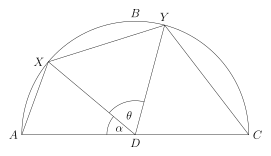
Solution: The area for \(\alpha\) fixed is \(\frac12 r^2 \sin \alpha + \frac12 r^2 \sin \theta + \frac12 r^2 \sin (\pi - \theta - \alpha)\) So we wish to maximise \(V = \sin \theta + \sin(\pi - \theta-\alpha)\) \begin{align*} && V &= \sin \theta + \sin(\pi - \theta-\alpha)\\ &&&= 2\sin \l \frac{\pi-\alpha}2\r\cos \l \frac{2\theta + \alpha - \pi}{2}\r \end{align*} The largest \(\cos\) can be is \(1\) when \(\displaystyle 2\theta + \alpha - \pi = 0 \Rightarrow \theta = \frac{\pi-\alpha}2\). (ie we split the remaining area exactly in half). We are now trying to maximise \(W = \sin \alpha + 2 \sin \frac{\pi - \alpha}2\) ie \begin{align*} && W &= \sin \alpha + 2 \cos \frac{\alpha}{2} \\ \Rightarrow && \frac{\d W}{\d \alpha} &= \cos \alpha-\sin \frac{\alpha}{2} \\ &&&= 1-2 \sin^2 \frac{\alpha}{2} - \sin \frac{\alpha}{2} \\ &&&= (1+\sin \frac{\alpha}{2})(1-2\sin \frac{\alpha}{2}) \end{align*} Therefore \(\frac{\alpha}{2} = -\frac{3\pi}{2}, \frac{\alpha}{2} = \frac{\pi}{6}, \frac{5\pi}{6} \Rightarrow \alpha = -3\pi, \frac{\pi}{3}, \frac{5\pi}{3}\). The only turning point in our range is \(\frac{\pi}{3}\). This is obvious a a maximum by symmetry or checking the end points, but we could also check the second derivative \(\frac{\d^2 W}{\d \alpha^2} = -\sin \frac{\pi}{3}-\cos \frac{\pi}{3} < 0\) so we have a maximum. Therefore the largest possible area is: \(\displaystyle \frac{3\sqrt{3}}{4}r^2\)
1990 Paper 1 Q8
Show that \[ \cos\left(\frac{\alpha}{2}\right)\cos\left(\frac{\alpha}{4}\right)=\frac{\sin\alpha}{4\sin\left(\dfrac{\alpha}{4}\right)}\,, \] where \(\alpha\neq k\pi\), \(k\) is an integer. Prove that, for such \(\alpha\), \[ \cos\left(\frac{\alpha}{2}\right)\cos\left(\frac{\alpha}{4}\right)\cdots\cos\left(\frac{\alpha}{2^{n}}\right)=\frac{\sin\alpha}{2^{n}\sin\left(\dfrac{\alpha}{2^{n}}\right)}\,, \] where \(n\) is a positive integer. Deduce that \[ \alpha=\frac{\sin\alpha}{\cos\left(\dfrac{\alpha}{2}\right)\cos\left(\dfrac{\alpha}{4}\right)\cos\left(\dfrac{\alpha}{8}\right)\cdots}\,, \] and hence that \[ \frac{\pi}{2}=\frac{1}{\sqrt{\frac{1}{2}}\sqrt{\frac{1}{2}+\frac{1}{2}\sqrt{\frac{1}{2}}}\sqrt{\frac{1}{2}+\frac{1}{2}\sqrt{\frac{1}{2}+\frac{1}{2}\sqrt{\frac{1}{2}}}}\cdots}\,. \]
Solution: \begin{align*} &&\sin \alpha &= 2 \sin \frac{\alpha}{2} \cos \frac{\alpha}{2} \\ &&&= 4 \sin \frac{\alpha}{4} \cos \frac{\alpha}{4} \cos \frac{\alpha}{2} \\ \Rightarrow && \frac{\sin \alpha}{4 \sin \frac{\alpha}{4}} &= \cos \frac{\alpha}{2} \cos \frac{\alpha}{4} \end{align*} We proceed by induction on \(n\). Clearly this is true for \(n = 1\) (as we just established). Assume it is true for \(n=k\). Then: \begin{align*} && \frac{\sin \alpha}{2^n \sin \frac{\alpha}{2^n}} &= \cos\left(\frac{\alpha}{2}\right)\cos\left(\frac{\alpha}{4}\right)\cdots\cos\left(\frac{\alpha}{2^{n}}\right) \\ \Rightarrow && \frac{\sin \alpha}{2^{n+1} \sin \frac{\alpha}{2^{n+1}} \cos \frac{\alpha}{2^{n+1}}} &= \cos\left(\frac{\alpha}{2}\right)\cos\left(\frac{\alpha}{4}\right)\cdots\cos\left(\frac{\alpha}{2^{n}}\right) \\ \Rightarrow && \frac{\sin \alpha}{2^{n+1} \sin \frac{\alpha}{2^{n+1}} } &= \cos\left(\frac{\alpha}{2}\right)\cos\left(\frac{\alpha}{4}\right)\cdots\cos\left(\frac{\alpha}{2^{n}}\right)\cos \left ( \frac{\alpha}{2^{n+1}} \right) \\ \end{align*} Therefore it is true for \(n=k+1\) Therefore since it is true for \(n=1\) and if it is true for \(n=k\) it is also true for \(n=k+1\) by the principle of mathematical induction it is true for all \(n \geq 1\) \begin{align*} \lim_{n \to \infty} \frac{\sin \alpha}{\cos\left(\frac{\alpha}{2}\right)\cdots\cos\left(\frac{\alpha}{2^{n}}\right)} &= \lim_{n \to \infty} 2^n \sin \frac{\alpha}{2^n} \\ &= \lim_{n \to \infty} \alpha \frac{\sin \frac{\alpha}{2^n}}{\frac{\alpha}{2^n}} \\ &= \alpha \lim_{t \to 0} \frac{\sin t}{t} \\ &= \alpha \end{align*} When \(\alpha = \frac{\pi}{2}\) notice that \(\sin \alpha =1\), \(\cos \frac{\alpha}{2} = \sqrt{\frac12}\) and \(2\cos^2 \frac{\alpha}{2^{n+1}}-1 = \cos \frac{\alpha}{2} \Rightarrow \cos \frac{\alpha}{2^{n+1}} = \sqrt{\frac12 + \cos \frac{\alpha}{2^n}}\) exactly the series we see.