Problems
Filters
32 problems found
2003 Paper 3 Q5
Find the coordinates of the turning point on the curve \(y = x^2 - 2bx + c\,\). Sketch the curve in the case that the equation \(x^2 - 2bx + c=0\) has two distinct real roots. Use your sketch to determine necessary and sufficient conditions on \(b\) and \(c\) for the equation \(x^2 - 2bx + c = 0\) to have two distinct real roots. Determine necessary and sufficient conditions on \(b\) and \(c\) for this equation to have two distinct positive roots. Find the coordinates of the turning points on the curve \(y = x^3 - 3b^2x + c\) (with \(b>0\)) and hence determine necessary and sufficient conditions on \(b\) and \(c\) for the equation \(x^3 - 3b^2x + c = 0\) to have three distinct real roots. Determine necessary and sufficient conditions on \(a\,\), \(b\) and \(c\) for the equation \(\l x - a \r^3 - 3b^2 \l x - a \r + c = 0\) to have three distinct positive roots. Show that the equation \(2x^3 - 9x^2 + 7x - 1 = 0\) has three distinct positive roots.
Solution: \begin{align*} y &= x^2-2bx+c \\ &= (x-b)^2+c-b^2 \end{align*} Therefore the turning point is at \((b,c-b^2)\)


2002 Paper 2 Q4
Give a sketch to show that, if \(\f(x) > 0\) for \(p < x < q\,\), then \(\displaystyle \int_p^{q} \f(x) \d x > 0\,\).
- By considering \(\f(x) = ax^2-bx+c\,\) show that, if \(a > 0\) and \(b^2 < 4ac\), then \(3b < 2a+6c\,\).
- By considering \(\f(x)= a\sin^2x - b\sin x + c\,\) show that, if \(a > 0\) and \(b^2< 4ac\), then \(4b < (a+2c)\pi\)
- Show that, if \(a > 0\), \(b^2 < 4ac\) and \(q > p > 0\,\), then $$ b\ln(q/p) < a\left(\frac1p -\frac1q\right) +c(q-p)\;. $$
Solution:
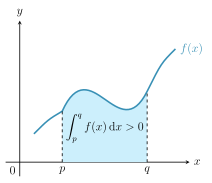
- If \(a > 0\) and \(b^2 < 4ac \Rightarrow \Delta < 0\) then \(f(x) = ax^2-bx+c > 0\) for all \(x\). Therefore \begin{align*} && 0 & < \int_0^1 (ax^2-bx+c) \d x\\ &&&= \frac13 a-\frac12b+c \\ \Rightarrow && 3b &< 2a+6c \end{align*}
- Similar logic tells us this must also be always positive, therefore \begin{align*} && 0 &< \int_0^{\pi} (a \sin^2 x - b \sin x +c ) \d x\\ &&&= \frac{\pi}{2}a - 2b+\pi c \\ \Rightarrow && 4b &< (a+2c)\pi \end{align*}
- Similar logic shows that \(f(x) = \frac{a}{x^2}-\frac{b}{x} +c>0\), therefore \begin{align*} && 0 &< \int_p^q \left (\frac{a}{x^2} - \frac{b}{x} + c\right) \d x \\ &&&=a\left (\frac{1}{p} - \frac{1}{q} \right) - b(\ln q - \ln p)+c(q-p) \\ \Rightarrow && b \ln (q/p) &,< a\left (\frac{1}{p} - \frac{1}{q} \right) +c(q-p) \end{align*}
2002 Paper 3 Q3
Let \[\f(x) = a \sqrt{x} - \sqrt{x - b}\;, \] where \(x\ge b >0\) and \(a>1\,\). Sketch the graph of \(\f(x)\,\). Hence show that the equation \(\f(x) = c\), where \(c>0\), has no solution when \(c^2 < b \l a^2 - 1 \r\,\). Find conditions on \(c^2\) in terms of \(a\) and \(b\) for the equation to have exactly one or exactly two solutions. Solve the equations
- \(3 \sqrt{x} - \sqrt{x - 2} = 4\, ,\)
- \(3 \sqrt{x} - \sqrt{x - 3} = 5\;\).
Solution: \begin{align*} && f'(x) &= \frac12 ax^{-1/2}-\frac12(x-b)^{-1/2} \\ \Rightarrow f'(x) = 0: && 0 &= \frac{a\sqrt{x-b}-\sqrt{x}}{\sqrt{x(x-b)}} \\ \Rightarrow && x &= a^2(x-b)\\ \Rightarrow && x &= \frac{a^2b}{a^2-1} \\ && f(x) &= a^2 \sqrt{\frac{b}{a^2-1}} - \sqrt{\frac{a^2b}{a^2-1}-b} \\ &&&= a^2 \sqrt{\frac{b}{a^2-1}} - \sqrt{\frac{b}{a^2-1}} \\ &&&= \sqrt{b(a^2-1)} \end{align*}

- \(c^2 = 16\), \(2 \cdot (3^2-1) = 16\), so we should have exactly one solution at \(x = \frac{3^2 \cdot 2}{3^2 -1 } = \frac{9}{4}\)
- \(c^2 = 25\) and \(3 \cdot (3^2 - 1) = 24, 3 \cdot (3^2) = 27\), so we look for two solutions. \begin{align*} && 5 & = 3 \sqrt{x} - \sqrt{x-3} \\ \Rightarrow && 25 &= 9x+x-3-6\sqrt{x(x-3)} \\ \Rightarrow && 3\sqrt{x(x-3)} &= 5x-14 \\ \Rightarrow && 9x(x-3) &= 25x^2-140x+196 \\ \Rightarrow && 0 &= 16x^2-113x+196 \\ &&&= (x-4)(16x-49) \\ \Rightarrow && x &= 4, \frac{49}{16} \end{align*}
2002 Paper 3 Q5
Give a condition that must be satisfied by \(p\), \(q\) and \(r\) for it to be possible to write the quadratic polynomial \(px^2 + qx + r\) in the form \(p \l x + h \r^2\), for some \(h\). Obtain an equation, which you need not simplify, that must be satisfied by \(t\) if it is possible to write \[ \l x^2 + \textstyle{{1 \over 2}} bx + t \r^2 - \l x^4 + bx^3 + cx^2 +dx +e \r \] in the form \(k \l x + h \r^2\), for some \(k\) and \(h\). Hence, or otherwise, write \(x^4 + 6x^3 + 9x^2 -2x -7\) as a product of two quadratic factors.
2001 Paper 1 Q3
Sketch, without calculating the stationary points, the graph of the function \(\f(x)\) given by \[ \f(x) = (x-p)(x-q)(x-r)\;, \] where \(p < q < r\). By considering the quadratic equation \(\f'(x)=0\), or otherwise, show that \[ (p+q+r)^2 > 3(qr+rp+pq)\;. \] By considering \((x^2+gx+h)(x-k)\), or otherwise, show that \(g^2>4h\,\) is a sufficient condition but not a necessary condition for the inequality \[ (g-k)^2>3(h-gk) \] to hold.
Solution:

2001 Paper 2 Q4
Let $$ \f(x) = P \, {\sin x} + Q\, {\sin 2x} + R\, {\sin 3x} \;. $$ Show that if \(Q^2 < 4R(P-R)\), then the only values of \(x\) for which \(\f(x) = 0\) are given by \(x=m\pi\), where \(m\) is an integer. \newline [You may assume that \(\sin 3x = \sin x(4\cos^2 x -1)\).] Now let $$ \g(x) = {\sin 2nx} + {\sin 4nx} - {\sin 6nx}, $$ where \(n\) is a positive integer and \(0 < x < \frac{1}{2}\pi \). Find an expression for the largest root of the equation \(\g(x)=0\), distinguishing between the cases where \(n\) is even and \(n\) is odd.
2001 Paper 3 Q3
Consider the equation \[ x^2 - b x + c = 0 \;, \] where \(b\) and \(c\) are real numbers.
- Show that the roots of the equation are real and positive if and only if \(b>0\) and \phantom{} \(b^2\ge4c>0\), and sketch the region of the \(b\,\)-\(c\) plane in which these conditions hold.
- Sketch the region of the \(b\,\)-\(c\) plane in which the roots of the equation are real and less than \(1\) in magnitude.
2001 Paper 3 Q5
Show that the equation \(x^3 + px + q=0\) has exactly one real solution if \(p \ge 0\,\). A parabola \(C\) is given parametrically by \[ x = at^2, \: \ \ y = 2at \: \: \: \ \ \ \ \ \ \l a > 0 \r \;. \] Find an equation which must be satisfied by \(t\) at points on \(C\) at which the normal passes through the point \(\l h , \; k \r\,\). Hence show that, if \(h \le 2a \,\), exactly one normal to \(C\) will pass through \(\l h , \; k \r \, \). Find, in Cartesian form, the equation of the locus of the points from which exactly two normals can be drawn to \(C\,\). Sketch the locus.
Solution: If \(p \geq 0\) then the derivative is \(x^2+p \geq 0\) and in particular the function is increasing. Therefore it will have exactly \(1\) real root (as for very large negative \(x\) it is negative, and vice-versa fo positive \(x\)). \begin{align*} && \frac{\d y}{\d x} &= \frac{\dot{y}}{\dot{x}} \\ &&&= \frac{2a}{2at} \\ &&&= \frac{1}{t} \\ \text{eq of normal} && \frac{k-2at}{h-at^2} &= -t \\ \Rightarrow && k-2at &= at^3-th \\ && 0 &= at^3+(2a-h)t-k \end{align*} Since \(a > 0\) this is the same constraint as the first part, in particular \(2a-h \geq 0 \Leftrightarrow 2a \geq h\). If exactly two normals can be drawn to \(C\) we must have that our equation has a repeated root, ie \begin{align*} && 0 &= at^3+(2a-h)t-k\\ && 0 &= 3at^2+2a-h\\ \Rightarrow && 0 &= 3at^3+ 3(2a-h)t-3k \\ && 0 &= 3at^3+(2a-h)t \\ \Rightarrow && 0 &= 2(2a-h)t-3k \\ \Rightarrow && t &= \frac{3k}{2(2a-h)} \\ \Rightarrow && 0 &= 3a \left (\frac{3k}{2(2a-h)} \right)^2+2a-h \\ && 0 &= 27ak^2+4(2a-h)^3 \end{align*}

2000 Paper 3 Q4
The function \(\f(x)\) is defined by $$ \f(x) = \frac{x( x - 2 )(x-a)}{ x^2 - 1}. $$ Prove algebraically that the line \(y = x + c\) intersects the curve \(y = \f ( x )\) if \(\vert a \vert \ge1\), but there are values of \(c\) for which there are no points of intersection if \(\vert a \vert <1\). Find the equation of the oblique asymptote of the curve \(y=\f(x)\). Sketch the graph in the two cases
- \(a<-1\)
- \(-1 < a < -\frac12\)
Solution: \begin{align*} && x+ c &= f(x) \\ \Rightarrow && (x+c)(x^2-1) &= x(x-2)(x-a) \\ \Rightarrow && x^3 + cx^2-x-c &= x^3-(2+a)x^2+2ax \\ \Rightarrow && 0 &= (c+2+a)x^2-(1+2a)x-c \\ && 0 &\leq \Delta = (1+2a)^2 + 4(2+c+a)c \\ &&&= 4c^2+(4a+8)c + (1+2a)^2 \\ && \Delta_c &= 16(a+2)^2-16(1+2a)^2 \\ &&&= 16(1-a)(3a+3) \\ &&&= 48(1-a^2) \end{align*} Therefore if \(|a| \geq 1\) we must have \(\Delta_c \leq 0\) which means \(\Delta \geq 0\) and so there are always solutions. If \(|a| < 1\) there are values for \(c\) where \(\Delta < 0\) and there would be no solutions. \begin{align*} && y &= \frac{x^3-(2+a)x^2+2ax}{x^2-1} \\ &&&= \frac{(x^2-1)(x-(2+a))+(2a+1)x-(2+a)}{x^2-1} \\ &&&= x - (2+a) + \frac{(2a+1)x-(2+a)}{x^2-1} \end{align*} therefore the oblique asymptote has equation \(y = x - (2+a)\)


1999 Paper 2 Q2
Consider the quadratic equation $$ nx^2+2x \sqrt{pn^2+q} + rn + s = 0, \tag{*} $$ where \(p>0\), \(p\neq r\) and \(n=1\), \(2\), \(3\), \(\ldots\) .
- For the case where \(p=3\), \(q=50\), \(r=2\), \(s=15\), find the set of values of \(n\) for which equation \((*)\) has no real roots.
- Prove that if \(p < r\) and \(4q(p-r) > s^2\), then \((*)\) has no real roots for any value of \(n\).
- If \(n=1\), \(p-r=1\) and \(q={s^2}/8\), show that \((*)\) has real roots if, and only if, \(s \le 4-2\sqrt{2}\ \) or \(\ s \ge 4+2\sqrt{2}\).
Solution:
- \(\,\) \begin{align*} && 0 &= nx^2 + 2\sqrt{3n^2+50}x + 2n + 15 \\ && 0 &> \Delta = 4(3n^2+5) - 4\cdot n \cdot (2n + 15) \\ \Leftrightarrow && 0 &> n^2-15n+5\\ \text{cv}: && n &= \frac{15 \pm \sqrt{225 - 20}}{2} \\ &&&\approx \frac{15\pm14.x}{2}\\ \Leftrightarrow &&n &\in \{1, 2, \cdots, 14\} \end{align*}
- \(\,\) \begin{align*} && 0 &> \Delta = 4(pn^2+q) - 4\cdot n \cdot (rn+s) \\ \Leftrightarrow && 0&>(p-r)n^2-sn+q \end{align*} Which is always true if \(r > p\) and \(s^2 < 4q(p-r)\)
- \(\,\) \begin{align*} && 0 &= x^2 + 2\sqrt{p+q}x+ r+s \\ && 0 &\leq \Delta = 4(p+q) - 4(r+s) \\ && 0 &\leq 1 + s^2/8 - s \\ \text{c.v}: && s &= \frac{1 \pm \sqrt{1-4 \cdot \frac{1}{8}}}{2\cdot\frac18} \\ &&&= 4 \pm 4\sqrt{\frac12} \\ &&&= 4 \pm 2\sqrt{2} \\ \Rightarrow && s \leq 4 - 2\sqrt{2} &\text{ or } s \geq 4 + 2\sqrt{2} \end{align*}
1994 Paper 1 Q9
A cannon-ball is fired from a cannon at an initial speed \(u\). After time \(t\) it has reached height \(h\) and is at a distance \(\sqrt{x^{2}+h^{2}}\) from the cannon. Ignoring air resistance, show that \[ \tfrac{1}{4}g^{2}t^{4}-(u^{2}-gh)t^{2}+h^{2}+x^{2}=0. \] Hence show that if \(u^{2}>2gh\) then the horizontal range for a given height \(h\) and initial speed \(u\) is less than or equal to \[ \frac{u\sqrt{u^{2}-2gh}}{g}. \] Show that there is always an angle of firing for which this value is attained.
Solution: Suppose it is fired with angle to the horizontal \(\alpha\), then \begin{align*} \rightarrow: && x &= u\cos \alpha \cdot t \\ \uparrow: && h &= u \sin \alpha \cdot t - \frac12 g t^2 \\ \Rightarrow && u\cos \alpha &= \frac{x}{t} \\ && u \sin \alpha &= \frac{h + \frac12 gt^2}{t} \\ \Rightarrow && u^2 &= \frac{x^2}{t^2} + \frac{(h + \frac12 gt^2)^2}{t^2} \\ \Rightarrow && 0 &= x^2+h^2-u^2t^2+ght^2+\tfrac14 g^2 t^4 \\ &&&= \tfrac14 g^2 t^4 - (u^2 - gh)t^2 + h^2 + x^2 \end{align*} For a distance \(x\) to be achievable there must be a root to this quadratic in \(t^2\), ie \begin{align*} && 0 &\leq \Delta = (u^2-gh)^2 - 4 \cdot \tfrac14 g^2 (h^2 + x^2) \\ \Rightarrow && x^2 &\leq \frac{(u^2-gh)^2}{g^2} - h^2 \\ &&&= \frac{u^4+g^2h^2 - 2ghu^2-g^2h^2}{g^2} \\ &&&= \frac{u^2(u^2-2gh)}{g^2} \\ \Rightarrow && x &\leq \frac{u\sqrt{u^2-2gh}}{g} \end{align*} This is achieved when \begin{align*} && t^2 &= \frac{u^2-gh}{\tfrac12g^2}\\ &&&= \frac{2(u^2-gh)}{g^2} \\ \Rightarrow && \cos \alpha &= \frac{u\sqrt{u^2-2gh}}{g} \cdot \frac{g}{\sqrt{2(u^2-gh)}} \frac{1}{u} \\ &&&= \frac{1}{\sqrt{2}} \end{align*} ie when \(\alpha = \frac{\pi}{4}\)
1993 Paper 1 Q7
Sketch the curve \[ \mathrm{f}(x)=x^{3}+Ax^{2}+B \] first in the case \(A>0\) and \(B>0\), and then in the case \(A<0\) and \(B>0.\) Show that the equation \[ x^{3}+ax^{2}+b=0, \] where \(a\) and \(b\) are real, will have three distinct real roots if \[ 27b^{2}+3a^{3}b<0, \] but will have fewer than three if \[ 27b^{2}+4a^{3}b<0. \]
1992 Paper 2 Q7
The cubic equation \[ x^{3}-px^{2}+qx-r=0 \] has roots \(a,b\) and \(c\). Express \(p,q\) and \(r\) in terms of \(a,b\) and \(c\).
- If \(p=0\) and two of the roots are equal to each other, show that \[ 4q^{3}+27r^{2}=0. \]
- Show that, if two of the roots of the original equation are equal to each other, then \[ 4\left(q-\frac{p^{2}}{3}\right)^{3}+27\left(\frac{2p^{3}}{27}-\frac{pq}{3}+r\right)^{2}=0. \]
Solution: \(p = a+b+c, q = ab+bc+ca, r = abc\)
- Suppose two roots are equal to each other, this means that one of the roots is also a root of the derivative. ie \begin{align*} && 0 &= x^3+qx - r \\ && 0 &= 3x^2+q \end{align*} have a common root, but this root must satisfy \(x^2 = -\frac{q}{3}\). Then \begin{align*} &&0 &= x^3 + qx - r \\ &&&= x^3 -3x^3 - r \\ &&&= -2x^3 -r \\ \Rightarrow && r^2 &= 4x^6 \\ &&&= 4 \left ( -\frac{q}{3}\right)^3 \\ \Rightarrow && 0 &= 27r^2+4q^3 \end{align*}
- Consider \(x = z + \frac{p}{3}\), then the equation is: \begin{align*} x^{3}-px^{2}+qx-r &= (z + \frac{p}{3})^3 - p(z + \frac{p}{3})^2 + q(z + \frac{p}{3}) - r \\ &= z^3 + pz^2 + \frac{p^2}{3}z + \frac{p^3}{27} - \\ &\quad -pz^2-\frac{2p^2}{3}z-\frac{p^3}{9} + \\ &\quad\quad qz + \frac{pq}{3} - r \\ &= z^3+\left (\frac{p^2}{3}-\frac{2p^2}{3}+q \right)z + \left (\frac{p^3}{27}-\frac{p^3}{9}+\frac{pq}{3}-r \right) \\ &= z^3+\left (-\frac{p^2}{3}+q \right)z + \left (-\frac{2p^3}{27}+\frac{pq}{3}-r \right) \\ \end{align*} Since this equation must also have repeated roots we must have: \begin{align*} 4\left (-\frac{p^2}{3}+q \right)^3 + 27 \left (-\frac{2p^3}{27}+\frac{pq}{3}-r \right)^2 = 0 \end{align*} which is exactly our desired result
1991 Paper 2 Q1
Let \(\mathrm{h}(x)=ax^{2}+bx+c,\) where \(a,b\) and \(c\) are constants, and \(a\neq0\). Give a condition which \(a,b\) and \(c\) must satisfy in order that \(\mathrm{h}(x)\) can be written in the form \[ a(x+k)^{2},\tag{*} \] where \(k\) is a constant. If \(\mathrm{f}(x)=3x^{2}+4x\) and \(\mathrm{g}(x)=x^{2}-2\), find the two constant values of \(\lambda\) such that \(\mathrm{f}(x)+\lambda\mathrm{g}(x)\) can be written in the form \((*)\). Hence, or otherwise, find constants \(A,B,C,D,m\) and \(n\) such that \begin{alignat*}{1} \mathrm{f}(x) & =A(x+m)^{2}+B(x+n)^{2}\\ \mathrm{g}(x) & =C(x+m)^{2}+D(x+n)^{2}. \end{alignat*} If \(\mathrm{f}(x)=3x^{2}+4x\) and \(\mathrm{g}(x)=x^{2}+\alpha\) and it is given by that there is only one value of \(\lambda\) for which \(\mathrm{f}(x)+\lambda\mathrm{g}(x)\) can be written in the form \((*)\), find \(\alpha\).
Solution: For \(h(x)\) to be written in this form \(b^2=4ac\). Suppose \(f(x) = 3x^2+4x\), \(g(x) = x^2-2\). then, \begin{align*} && f(x) + \lambda g(x) &= (3+\lambda)x^2+4x - 2 \lambda \\ \Rightarrow && 0 &= 16 + 8(3+\lambda) \lambda \\ \Rightarrow && 0 &= 2+ 3 \lambda + \lambda^2 \\ &&&= (\lambda +1)(\lambda + 2) \\ \Rightarrow && \lambda &= -1 , -2 \\ \end{align*} \begin{align*} && f(x) - g(x) &= 2(x+1)^2 \\ && f(x) -2g(x) &= (x+2)^2 \\ \Rightarrow && g(x) &= 2(x+1)^2 - (x+2)^2 \\ && f(x) &= 4(x+1)^2 - (x+2)^2 \end{align*} Suppose \(f(x) = 3x^2+4x, g(x) = x^2 + \alpha\), then \begin{align*} && f(x) + \lambda g(x) &= (3+\lambda)x^2+4x+\lambda \alpha \\ \Rightarrow && 0 &= 16 -2\lambda \alpha(\lambda + 3) \\ && 0 &= \alpha \lambda^2 +3\lambda-8 \\ \Rightarrow && 0 &= 9 +32 \alpha \\ \Rightarrow && \alpha &= -\frac{9}{32} \end{align*}
1990 Paper 2 Q3
Sketch the curves given by \[ y=x^{3}-2bx^{2}+c^{2}x, \] where \(b\) and \(c\) are non-negative, in the cases: \begin{questionparts} \item \(2b < c\sqrt{3}\) \item \(2b=c\sqrt{3}\neq0\) \item \(c\sqrt{3} < 2b < 2c\), \item \(b=c\neq0\) \item \(b > c > 0\), \item \(c=0,b\neq0\) \item \(c=b=0\). \end{questionpart} Sketch also the curves given by \(y^{2}=x^{3}-2bx^{2}+c^{2}x\) in the cases \((i), (v)\) and \((vii)\).
Solution:


