Problems
Filters
28 problems found
2003 Paper 2 Q12
The life of a certain species of elementary particles can be described as follows. Each particle has a life time of \(T\) seconds, after which it disintegrates into \(X\) particles of the same species, where \(X\) is a random variable with binomial distribution \(\mathrm{B}(2,p)\,\). A population of these particles starts with the creation of a single such particle at \(t=0\,\). Let \(X_n\) be the number of particles in existence in the time interval \(nT < t < (n+1)T\,\), where \(n=1\,\), \(2\,\), \(\ldots\). Show that \(\P(X_1=2 \mbox { and } X_2=2) = 6p^4q^2\;\), where \(q=1-p\,\). Find the possible values of \(p\) if it is known that \(\P(X_1=2 \vert X_2=2) =9/25\,\). Explain briefly why \(\E(X_n) =2p\E(X_{n-1})\) and hence determine \(\E(X_n)\) in terms of \(p\). Show that for one of the values of \(p\) found above \(\lim_{n \to \infty}\E(X_n) = 0\) and that for the other \(\lim_{n \to \infty}\E(X_n) = + \infty\,\).
Solution: Notice that we can see the total number generated as \(X_n \sim B(2X_{n-1},p)\), since a Binomial is a sum of independent Bernoullis, and there are two Bernoullis per particle. \begin{align*} && \mathbb{P}(X_1=2 \mbox { and } X_2=2) &= \underbrace{p^2}_{\text{two generated in first iteration}} \cdot \underbrace{\binom{4}{2}p^2q^2}_{\text{two generated from the first two}} \\ &&&= 6p^4q^2 \end{align*} \begin{align*} && \mathbb{P})(X_1 = 2 |X_2 = 2) &= \frac{ \mathbb{P}(X_1=2 \mbox { and } X_2=2) }{ \mathbb{P}( X_2=2) } \\ &&&= \frac{6p^4q^2}{6p^4q^2+2pq \cdot p^2} \\ &&&= \frac{3pq}{3pq+1} \\ \Rightarrow && \frac{9}{25} &= \frac{3pq}{3pq+1} \\ \Rightarrow && 27pq + 9 &= 75pq \\ \Rightarrow && 9 &= 48pq \\ \Rightarrow && pq &= \frac{3}{16} \\ \Rightarrow && 0 &= p^2 - p + \frac3{16} \\ \Rightarrow && p &= \frac14, \frac34 \end{align*} By the same reasoning about the Bernoullis, we must have \(\E[X_n] = \E[\E[X_n | X_{n-1}]] = \E[2pX_{n-1}] = 2p \E[X_{n-1}]\) therefore \(\E[X_n] = (2p)^n\). If \(p = \frac14\) then \(\E[X_n] = \frac1{2^n} \to 0\) If \(p = \frac34\) then \(\E[X_n] = \left(\frac32 \right)^n \to \infty\)
2002 Paper 3 Q1
Find the area of the region between the curve \(\displaystyle y = {\ln x \over x}\,\) and the \(x\)-axis, for \(1 \le x \le a\). What happens to this area as \(a\) tends to infinity? Find the volume of the solid obtained when the region between the curve \(\displaystyle y = {\ln x \over x}\,\) and the \(x\)-axis, for \(1 \le x\le a\), is rotated through \(2 \pi\) radians about the \(x\)-axis. What happens to this volume as \(a\) tends to infinity?
Solution: \begin{align*} && \int_1^a \frac{\ln x}{x} \d x &= \left [ \ln x \cdot \ln x\right ]_1^a - \int_1^a \frac{\ln x}{x} \d x \\ \Rightarrow && \int_1^a \frac{\ln x}{x} \d x &= \frac12 \left ( \ln a \right) ^2 \\ && \int_1^\infty \frac{\ln x}{x} \d x &= \lim_{a \to \infty} \frac12 (\ln a)^2 \\ &&&= \infty \end{align*} \begin{align*} && \pi \int_1^a \left ( \frac{\ln x}{x} \right)^2 \d x &= \pi \int_{u=0}^{u=\ln a} \left ( \frac{u}{e^u} \right)^2 e^u \d u \\ &&&= \pi \int_0^{\ln a} u^2 e^{-u} \d u \\ &&&= \pi \left [-u^2e^{-u} \right]_0^{\ln a} +\pi \int_0^{\ln a} 2u e^{-u} \d u \\ &&&= -\frac{\pi}{a} (\ln a)^2 + \pi \left [-2u e^{-u} \right]_0^{\ln a} + \pi \int_0^{\ln a} e^{-u} \d u \\ &&&= -\frac{\pi}{a} (\ln a)^2- \frac{2 \pi}{a}\ln a+\pi \left (1 - \frac{1}{a} \right) \\ \\ && \pi \int_1^{\infty} \left ( \frac{\ln x}{x} \right)^2 \d x &= \lim_{a \to \infty} \left ( -\frac{\pi}{a} (\ln a)^2- \frac{2 \pi}{a}\ln a+\pi \left (1 - \frac{1}{a} \right) \right) \\ &&&= \pi \end{align*}
2002 Paper 3 Q11
A particle moves on a smooth triangular horizontal surface \(AOB\) with angle \(AOB = 30^\circ\). The surface is bounded by two vertical walls \(OA\) and \(OB\) and the coefficient of restitution between the particle and the walls is \(e\), where \(e < 1\). The particle, which is initially at point \(P\) on the surface and moving with velocity \(u_1\), strikes the wall \(OA\) at \(M_1\), with angle \(PM_1A = \theta\), and rebounds, with velocity \(v_1\), to strike the wall \(OB\) at \(N_1\), with angle \(M_1N_1B = \theta\). Find \(e\) and \(\displaystyle {v_1 \over u_1}\) in terms of \(\theta\). The motion continues, with the particle striking side \(OA\) at \(M_2\), \(M_3\), \( \ldots \) and striking side \(OB\) at \(N_2\), \(N_3\), \(\ldots \). Show that, if \(\theta < 60^\circ\,\), the particle reaches \(O\) in a finite time.
2001 Paper 2 Q8
The function \(\f\) satisfies \(\f(x+1)= \f(x)\) and \(\f(x)>0\) for all \(x\).
- Give an example of such a function.
- The function \(\F\) satisfies \[ \frac{\d \F}{\d x} =\f(x) \] and \(\F(0)=0\). Show that \(\F(n) = n\F(1)\), for any positive integer \(n\).
- Let \(y\) be the solution of the differential equation \[ \frac{\d y}{\d x} +\f(x) y=0 \] that satisfies \(y=1\) when \(x=0\). Show that \(y(n) \to 0\) as \(n\to\infty\), where \(n= 1,\,2,\, 3,\, \ldots\)
Solution:
- \(f(x) = \lfloor x \rfloor+1\)
- Clearly \(\displaystyle F(x) = \int_0^x f(t) \d t\), in particular: \begin{align*} && F(n) &= \int_0^n f(t) \d t \\ &&&= \sum_{i=1}^n \int_{i-1}^i f(t) \d t \\ &&&= \sum_{i=1}^n \int_{0}^1 f(t-i+1) \d t \\ &&&= \sum_{i=1}^n \int_{0}^1 f(t) \d t \\ &&&= n \int_{0}^1 f(t) \d t\\ &&&= n F(1) \end{align*}
- \(\,\) \begin{align*} && 0 &= \frac{\d y}{\d x} +f(x) y \\ \Rightarrow && \int -f(x) \d x &= \int \frac1y \d y\\ \Rightarrow && -F(x) & = \ln y + C \\ x=0,y=1: && C &= -F(0) \\ \Rightarrow && y &= \exp(F(0)-F(x)) \end{align*} Well this \(F(0)-F(x)\) is equivalent to \(-F(x)\) where \(F(0) = 0\), in particular \(F(n) = nF(1)\), so \(y(n) = e^{-nF(1)}\) which tends to zero as long as \(F(1) > 0\), but since \(f(x) > 0\) for all \(x\) this must be true.
2000 Paper 3 Q7
Given that $$\e = 1 + {1 \over 1 !} + {1 \over 2 !} + {1 \over 3 !} + \cdots + {1 \over r !} + \cdots \; ,$$ use the binomial theorem to show that $$ {\left( 1 + {1 \over n} \right)}^{\!n} < \e $$ for any positive integer \(n\). The product \({\rm P }( n )\) is defined, for any positive integer \(n\), by $$ {\rm P} ( n ) = {3 \over 2} \cdot {5 \over 4} \cdot {9 \over 8} \cdot \ldots \cdot {2^n + 1 \over 2^n} . $$ Use the arithmetic-geometric mean inequality, $$ {a_1 + a_2 + \cdots + a_n \over n} \ge \ {\left( a_1 \cdot a_2 \cdot \ldots \cdot a_n \right)}^{1 \over n}\,, $$ to show that \({\rm P }( n ) < \e\) for all \(n\) . Explain briefly why \({\rm P} ( n )\) tends to a limit as \(n\to\infty\). Show that this limit, \(L\), satisfies \(2 < L\le\e\).
1999 Paper 3 Q3
Justify, by means of a sketch, the formula $$ \lim_{n\rightarrow\infty}\left\{{1\over n}\sum_{m=1}^n \f(1+m/n)\right\} = \int_1^2 \f(x)\,\d x \,. $$ Show that $$ \lim_{n\rightarrow\infty}\left\{{1\over n+1} + {1\over n+2} + \cdots + {1\over n+n}\right\} = \ln 2 \,. $$ Evaluate $$ \lim_{n\rightarrow\infty}\left\{{n\over n^2+1} + {n\over n^2+4} + \cdots + {n\over n^2+n^2}\right\}\,. $$
Solution:

1998 Paper 2 Q3
Show that the sum \(S_N\) of the first \(N\) terms of the series $$\frac{1}{1\cdot2\cdot3}+\frac{3}{\cdot3\cdot4}+\frac{5}{3\cdot4\cdot5}+\cdots +\frac{2n-1}{n(n+1)(n+2)}+\cdots$$ is $${1\over2}\left({3\over2}+{1\over N+1}-{5\over N+2}\right).$$ What is the limit of \(S_N\) as \(N\to\infty\)? The numbers \(a_n\) are such that $$\frac{a_n}{a_{n-1}}=\frac{(n-1)(2n-1)}{(n+2)(2n-3)}.$$ Find an expression for \(a_n/a_1\) and hence, or otherwise, evaluate \(\sum\limits_{n=1}^\infty a_n\) when \(\displaystyle a_1=\frac{2}{9}\;\).
Solution: First notice by partial fractions: \begin{align*} \frac{2n-1}{n(n+1)(n+2)} &= \frac{-1/2}{n} + \frac{3}{n+1} + \frac{-5/2}{n+2} \\ &= \frac{-1}{2n} + \frac{3}{n+1} - \frac{5}{2(n+2)} \end{align*} And therefore: \begin{align*} \sum_{n = 1}^N \frac{2n-1}{n(n+1)(n+2)} &= -\frac12 \sum_{n=1}^N \frac1n +3\sum_{n=1}^N \frac1{n+1} -\frac52 \sum_{n=1}^N \frac1{n+2} \\ &= -\frac12-\frac14 + \frac{3}{2}+ \sum_{n=3}^N (3-\frac12 -\frac52)\frac1n + \frac{3}{N+1} - \frac{5}{2(N+1)} - \frac{5}{2(N+2)} \\ &= \frac12 \l \frac32+\frac1{N+1}-\frac{5}{N+2} \r \end{align*} As \(N \to \infty, S_N \to \frac{3}{4}\). \begin{align*} && \frac{a_n}{a_{n-1}}&=\frac{(n-1)(2n-1)}{(n+2)(2n-3)} \\ \Rightarrow && \frac{a_n}{a_1} &= \frac{a_n}{a_{n-1}} \cdot \frac{a_{n-1}}{a_{n-2}} \cdots \frac{a_2}{a_1} \\ &&&= \frac{(n-1)(2n-1)}{(n+2)(2n-3)} \cdot \frac{(n-2)(2n-3)}{(n+1)(2n-5)} \cdots \frac{(1)(3)}{(4)(1)} \\ &&&= \frac{(2n-1)3\cdot 2\cdot 1}{(n+2)(n+1)n} \\ &&& = \frac{6(2n-1)}{n(n+1)(n+2)} \end{align*} Therefore \(a_n = \frac{4}{3} \frac{2n-1}{n(n+1)(n+2)}\) and so our sequence is \(\frac43\) the earlier sum, ie \(1\)
1993 Paper 1 Q2
If \(\left|r\right|\neq1,\) show that \[ 1+r^{2}+r^{4}+\cdots+r^{2n}=\frac{1-r^{2n+2}}{1-r^{2}}\,. \] If \(r\neq1,\) find an expression for \(\mathrm{S}_{n}(r),\) where \[ \mathrm{S}_{n}(r)=r+r^{2}+r^{4}+r^{5}+r^{7}+r^{8}+r^{10}+\cdots+r^{3n-1}. \] Show that, if \(\left|r\right|<1,\) then, as \(n\rightarrow\infty,\) \[ \mathrm{S}_{n}(r)\rightarrow\frac{1}{1-r}-\frac{1}{1-r^{3}}\,. \] If \(\left|r\right|\neq1,\) find an expression for \(\mathrm{T}_{n}(r),\) where \[ \mathrm{T}_{n}(r)=1+r^{2}+r^{3}+r^{4}+r^{6}+r^{8}+r^{9}+r^{10}+r^{12}+r^{14}+r^{15}+r^{16}+\cdots+r^{6n}. \] If \(\left|r\right|<1,\) find the limit of \(\mathrm{T}_{n}(r)\) as \(n\rightarrow\infty.\) What happens to \(\mathrm{T}_{n}(r)\) as \(n\rightarrow\infty\) in the three cases \(r>1,r=1\) and \(r=-1\)? In each case give reasons for your answer.
Solution: \begin{align*} && S &= 1 + r^2 + r^4 + \cdots + r^{2n} \\ && r^2S &= \quad \,\,\,\, r^2 + r^4 + \cdots+r^{2n}+r^{2n+2} \\ \Rightarrow && (1-r^2)S &= 1 - r^{2n+2} \\ \Rightarrow && S &= \frac{1-r^{2n+2}}{1-r^2} \end{align*} \begin{align*} && S_n(r) &= r + r^2 + r^4 + r^5 + r^7 + \cdots + r^{3n-1} \\ &&&= 1 + r + r^2 + \cdots + r^{3n} - (1 + r^3 + r^6 + r^{3n}) \\ &&&= \frac{1-r^{3n+1}}{1-r} - \frac{1-r^{3n+3}}{1-r^3} \\ \\ \Rightarrow && \lim_{n \to \infty} S_n(r) &= \frac{1-0}{1-r} - \frac{1-0}{1-r^3} = \frac{1}{1-r} - \frac{1}{1-r^3} \end{align*} \begin{align*} && T_n(r) &= 1 + r^2 + r^3 + r^4 + r^6 + \cdots + r^{6n} \\ &&&= \frac{1-r^{6n+6}}{1-r^6} + \frac{r^2-r^{6n+2}}{1-r^6} + \frac{r^3-r^{6n+3}}{1-r^6} + \frac{r^4-r^{6n+4}}{1-r^6} \\ &&&= \frac{1+r^2+r^3+r^4-r^{6n}(r^2+r^3+r^4+r^6))}{1-r^6} \\ \\ &&\lim_{n \to \infty} T_n(r) &= \frac{1+r^2+r^3+r^4}{1-r^6} \end{align*} If \(r > 1\) clear it diverges. if \(r = 1\) same story. if \(r = -1\) the sums in blocks of \(4\) are all \(1+1-1+1 = 2 > 0\) and so it also diverges.
1989 Paper 1 Q2
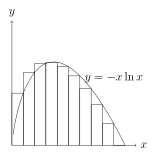
For \(x>0\) find \(\int x\ln x\,\mathrm{d}x\). By approximating the area corresponding to \(\int_{0}^{1}x\ln(1/x)\, \d x\) by \(n\) rectangles of equal width and with their top right-hand vertices on the curve \(y=x\ln(1/x)\), show that, as \(n\rightarrow\infty\), \[ \frac{1}{2}\left(1+\frac{1}{n}\right)\ln n-\frac{1}{n^{2}}\left[\ln\left(\frac{n!}{0!}\right)+\ln\left(\frac{n!}{1!}\right)+\ln\left(\frac{n!}{2!}\right)+\cdots+\ln\left(\frac{n!}{(n-1)!}\right)\right]\rightarrow\frac{1}{4}. \] {[}You may assume that \(x\ln x\rightarrow0\) as \(x\rightarrow0\).{]}
Solution: Integrating by parts we obtain: \begin{align*} \int x \ln x \, \d x &= [\frac12 x^2 \ln x] - \int \frac12x^2 \cdot \frac1x \d x \\ &= \frac12 x^2 \ln x - \frac14 x^2 + C \end{align*}
1988 Paper 2 Q1
The function \(\mathrm{f}\) is defined, for \(x\neq1\) and \(x\neq2\) by \[ \mathrm{f}(x)=\frac{1}{\left(x-1\right)\left(x-2\right)} \] Show that for \(\left|x\right|<1\) \[ \mathrm{f}(x)=\sum_{n=0}^{\infty}x^{n}-\frac{1}{2}\sum_{n=0}^{\infty}\left(\frac{x}{2}\right)^{n} \] and that for \(1<\left|x\right|<2\) \[ \mathrm{f}(x)=-\sum_{n=1}^{\infty}x^{-n}-\frac{1}{2}\sum_{n=0}^{\infty}\left(\frac{x}{2}\right)^{n} \] Find an expression for \(\mbox{f}(x)\) which is valid for \(\left|x\right|>2\).
Solution: \begin{align*} && \f(x) &= \frac1{(x-1)(x-2)} \\ &&&=\frac{1}{x-2} -\frac{1}{x-1} \\ \end{align*} Therefore, for \(|x| < 1\) \begin{align*} && \f(x) &=\frac{1}{x-2} -\frac{1}{x-1} \\ &&&= -\frac12 \frac{1}{1-\frac{x}{2}} + \frac{1}{1-x} \\ &&&= \sum_{n=0}^{\infty} x^n - \frac12 \sum_{n=0}^\infty \l \frac{x}2 \r^2 \end{align*} where both geometric series converge since \(|x| < 1\) and \(|\frac{x}{2}| < 1\) When \(1 < |x|< 2 \Rightarrow |\frac{1}{x}| < 1\), we must have: \begin{align*} && \f(x) &=\frac{1}{x-2} -\frac{1}{x-1} \\ &&&= -\frac12 \frac{1}{1-\frac{x}{2}} + \frac1{x}\frac{1}{1-\frac{1}{x}} \\ &&&= - \frac12 \sum_{n=0}^\infty \l \frac{x}2 \r^2 - \frac{1}{x} \sum_{n=0}^{\infty} x^{-n} \\ &&&= - \frac12 \sum_{n=0}^\infty \l \frac{x}2 \r^2 - \sum_{n=1}^{\infty} x^{-n} \\ \end{align*} Finally, when \(|x| > 2\), ie \(|\frac{2}{x}| < 1\) we have \begin{align*} && \f(x) &=\frac{1}{x-2} -\frac{1}{x-1} \\ &&& =\frac1{x} \frac{1}{1-\frac{2}{x}} - \frac{1}{x}\frac{1}{1-\frac{1}{x}} \\ &&&= \frac1{x} \sum_{n=0}^{\infty} \l \frac{2}{x} \r^n - \sum_{n=1}^{\infty}x^{-n} \\ &&&= \sum_{n=1}^{\infty} 2^{n-1} x^{-n} - \sum_{n=1}^{\infty}x^{-n} \\ \end{align*}
1987 Paper 1 Q4
Show that the sum of the infinite series \[ \log_{2}\mathrm{e}-\log_{4}\mathrm{e}+\log_{16}\mathrm{e}-\ldots+(-1)^{n}\log_{2^{2^{n}}}\mathrm{e}+\ldots \] is \[ \frac{1}{\ln(2\sqrt{2})}. \] {[}\(\log_{a}b=c\) is equivalent to \(a^{c}=b\).{]}
Solution: Let \(S = \log_{2}\mathrm{e}-\log_{4}\mathrm{e}+\log_{16}\mathrm{e}-\ldots+(-1)^{n}\log_{2^{2^{n}}}\mathrm{e}+\ldots\) then \begin{align*} S &= \sum_{n=0}^{\infty} (-1)^n \log_{2^{2^n}} e \\ &= \sum_{n=0}^{\infty} (-1)^n \frac{\log e}{\log {2^{2^n}}} \\ &= \sum_{n=0}^{\infty} (-1)^n \frac{\log e}{2^n\log {2}} \\ &= \frac{\log e}{\log 2} \sum_{n=0}^{\infty} \frac{(-1)^n}{2^n} \\ &= \frac{1}{\log_e 2} \frac{1}{1+\frac12} \\ &= \frac{1}{\ln (2^{3/2})} \\ &= \frac{1}{\ln (2 \sqrt{2})} \end{align*}
1987 Paper 2 Q5
If \(y=\mathrm{f}(x)\), then the inverse of \(\mathrm{f}\) (when it exists) can be obtained from Lagrange's identity. This identity, which you may use without proof, is \[ \mathrm{f}^{-1}(y)=y+\sum_{n=1}^{\infty}\frac{1}{n!}\frac{\mathrm{d}^{n-1}}{\mathrm{d}y^{n-1}}\left[y-\mathrm{f}\left(y\right)\right]^{n}, \] provided the series converges.
- Verify Lagrange's identity when \(\mathrm{f}(x)=\alpha x\), \((0<\alpha<2)\).
- Show that one root of the equation \[ \tfrac{1}{2}=x-\tfrac{1}{4}x^{3} \] is \[ x=\sum_{n=0}^{\infty}\frac{\left(3n\right)!}{n!\left(2n+1\right)!2^{4n+1}} \]
- Find a solution for \(x\), as a series in \(\lambda,\) of the equation \[ x=\mathrm{e}^{\lambda x}. \]
Solution:
- If \(f(x) = \alpha x\) then \(f^{-1}(x) = \frac{1}{\alpha}x\). \begin{align*} && \frac{\d^{n-1}}{\d y^{n-1}} [y - \alpha y]^n &= \frac{\d^{n-1}}{\d y^{n-1}} [(1 - \alpha)^n y^n] \\ && &= (1-\alpha)^n n! y \\ \Rightarrow && y + \sum_{n=1}^{\infty} \frac{1}{n!}\frac{\d^{n-1}}{\d y^{n-1}} [y - \alpha y]^n &= y +\sum_{n=1}^{\infty} (1-\alpha)^ny \\ &&&= y + y\l \frac{1}{1-(1-\alpha)}-1 \r \\ &&&= \frac{1}{\alpha}y \end{align*} Where we can sum the geometric progression if \(|1-\alpha| < 1 \Leftrightarrow 0 < \alpha < 2\)
- Suppose that \(f(x) = x-\frac14x^3\). We would like to find \(f^{-1}(\frac12)\). \begin{align*} && \frac{\d^{n-1}}{\d y^{n-1}} [y - (y+\frac14 y^3)]^n &= \frac{\d^{n-1}}{\d y^{n-1}} [\frac1{4^n} y^{3n}] \\ && &= \frac{1}{4^n} \frac{(3n)!}{(2n+1)!} y^{2n+1} \\ \Rightarrow && f^{-1}(\frac12) &= \frac12 + \sum_{n=1}^{\infty} \frac{1}{4^n} \frac{(3n)!}{n!(2n+1)!} \frac{1}{2^{2n+1}} \\ &&&= \frac12 + \sum_{n=1}^{\infty} \frac{(3n)!}{n!(2n+1)!} \frac{1}{2^{4n+1}} \\ \end{align*} Since when \(n = 0\) \(\frac{0!}{0!1!} \frac{1}{2^{0+1}} = \frac12\) we can include the wayward \(\frac12\) in our infinite sum and so we have the required result.
- Consider \(f(x) = x - e^{\lambda x}\) we are interested in \(f^{-1}(0)\). \begin{align*} && \frac{\d^{n-1}}{\d y^{n-1}} [y - (y-e^{\lambda y})]^n &= \frac{\d^{n-1}}{\d y^{n-1}} [e^{n\lambda y}] \\ &&&= n^{n-1} \lambda^{n-1}e^{n \lambda y} \\ \Rightarrow && f^{-1}(0) &= \sum_{n=1}^\infty \frac{1}{n!} n^{n-1} \lambda^{n-1} \end{align*} We don't care about convergence, but it's worth noting this has a radius of convergence of \(\frac{1}{e}\) (ie this series is valid if \(|\lambda| < \frac1e\)).
1987 Paper 3 Q7
Prove that \[ \tan^{-1}t=t-\frac{t^{3}}{3}+\frac{t^{5}}{5}-\cdots+\frac{(-1)^{n}t^{2n+1}}{2n+1}+(-1)^{n+1}\int_{0}^{t}\frac{x^{2n+2}}{1+x^{2}}\,\mathrm{d}x. \] Hence show that, if \(0\leqslant t\leqslant1,\) then \[ \frac{t^{2n+3}}{2(2n+3)}\leqslant\left|\tan^{-1}t-\sum_{r=0}^{n}\frac{(-1)^{r}t^{2r+1}}{2r+1}\right|\leqslant\frac{t^{2n+3}}{2n+3}. \] Show that, as \(n\rightarrow\infty,\) \[ 4\sum_{r=0}^{n}\frac{(-1)^{r}}{(2r+1)}\rightarrow\pi, \] but that the error in approximating \(\pi\) by \({\displaystyle 4\sum_{r=0}^{n}\frac{(-1)^{r}}{(2r+1)}}\) is at least \(10^{-2}\) if \(n\) is less than or equal to \(98\).
Solution: We start by noticing that \(\displaystyle \tan^{-1} t = \int_0^t \frac{1}{1+x^2} \d x\). Consider the geometric series \(1-x^2+(-x^2)^2+ \cdots + (-x^2)^n = \frac{1-(-x^2)^{n+1}}{1+x^2}\). Therefore, \((1+x^2)(1-x^2+(-x^2)^2+ \cdots + (-x^2)^n) = 1-(-x^2)^{n+1}\) or \(1 = (1+x^2)(1-x^2+x^4-\cdots+(-1)^nx^{2n}) +(-1)^{n+1}x^{2n+2}\) \begin{align*} \tan^{-1} t &= \int_0^t \frac{1}{1+x^2} \d x \\ &= \int_0^t \frac{(1+x^2)(1-x^2+x^4-\cdots+(-1)^nx^{2n}) +(-1)^{n+1}x^{2n+2}}{x^2+1} \d x \\ &= \int_0^t (1-x^2+x^4-\cdots+(-1)^nx^{2n})\d x + \int_0^t \frac{(-1)^{n+1}x^{2n+2}}{x^2+1} \d x \\ &= t - \frac{t^3}{3}+\frac{t^5}{5}-\cdots + (-1)^n \frac{t^{2n+1}}{2n+1}+\int_0^t \frac{(-1)^{n+1}x^{2n+2}}{x^2+1} \d x \\ &= \sum_{r=0}^n \frac{(-1)^r t^{2r+1}}{2r+1} + \int_0^t \frac{(-1)^{n+1}x^{2n+2}}{x^2+1} \d x \\ \end{align*} Therefore we can say (for \(0 \leq t \leq 1\)) \begin{align*} \left | \tan^{-1} t - \sum_{r=0}^n \frac{(-1)^r t^{2r+1}}{2r+1} \right | &= \left | \int_0^t \frac{(-1)^{n+1}x^{2n+2}}{x^2+1} \d x \right | \\ &\leq \left | \int_0^t x^{2n+2} \d x \right | \\ &= \frac{t^{2n+3}}{2n+3} \\ \\ \left | \tan^{-1} t - \sum_{r=0}^n \frac{(-1)^r t^{2r+1}}{2r+1} \right | &= \left | \int_0^t \frac{(-1)^{n+1}x^{2n+2}}{x^2+1} \d x \right | \\ &\geq \left | \int_0^t \frac{(-1)^{n+1}x^{2n+2}}{1+1} \d x \right | \\ &= \frac{t^{2n+3}}{2(2n+3)} \\ \end{align*} Since \(\tan^{-1} 1 = \frac{\pi}{4}\) we must have that: \begin{align*} \lim_{n \to \infty} \left | \frac{\pi}{4} - \sum_{r=0}^{n}\frac{(-1)^{r}}{(2r+1)} \right | \to 0 \Rightarrow \lim_{n \to \infty} 4\sum_{r=0}^{n}\frac{(-1)^{r}}{(2r+1)} \to \pi \end{align*} However, \begin{align*} && \left | 4\sum_{r=0}^{n}\frac{(-1)^{r}}{(2r+1)} - \pi \right | &\geq 4 \frac{1}{2(2n+3)} \\ && &= \frac{2}{2n+3} \\ \\ && \frac{2}{2n+3} \geq 10^{-2} \\ \Leftrightarrow && 200 \geq 2n+3 \\ \Leftrightarrow && 197 \geq 2n \\ \Leftrightarrow && 98.5 \geq n \\ \end{align*} Therefore we need more than \(98\) terms to get two decimal places of accuracy. Not great!