Problems

Filters
Clear Filters

19 problems found

1991 Paper 1 Q10
D: 1500.0 B: 1484.0

\(\ \)\vspace{-1cm} \noindent

\psset{xunit=1.1cm,yunit=0.7cm,algebraic=true,dotstyle=o,dotsize=3pt 0,linewidth=0.5pt,arrowsize=3pt 2,arrowinset=0.25} \begin{pspicture*}(-0.32,-0.43)(11.1,8.55) \pspolygon[linewidth=0pt,linecolor=white,hatchcolor=black,fillstyle=hlines,hatchangle=45.0,hatchsep=0.11](0,0)(0,-0.2)(10,-0.2)(10,0) \psline(0,0)(10,0) \psline(0,8)(1,5.5) \psline(1,5.5)(2,4) \psline(3,3)(4,2.5) \psline(5,2.3)(6,2.5) \psline(2,4)(3,3) \psline[linestyle=dashed,dash=1pt 1pt](4,2.5)(5,2.3) \parametricplot[linestyle=dashed,dash=1pt 1pt]{5.080052976030177}{5.934024592002003}{1*5.25*cos(t)+0*5.25*sin(t)+4.11|0*5.25*cos(t)+1*5.25*sin(t)+7.4} \psline(9,5.5)(10,8) \psline(1,5.5)(1,0) \psline(2,4)(2,0) \psline(3,3)(3,0) \psline(4,2.5)(4,0) \psline(5,2.3)(5,0) \psline(6,2.51)(6,0) \psline(9,5.5)(9,0) \rput[tl](0.02,8.53){\(A_0\)} \rput[tl](1.03,6.06){\(A_1\)} \rput[tl](2.01,4.52){\(A_2\)} \rput[tl](2.98,3.56){\(A_3\)} \rput[tl](3.98,3.12){\(A_n\)} \rput[tl](4.8,2.9){\(A_{n+1}\)} \rput[tl](5.75,3.2){\(A_{n+2}\)} \rput[tl](8.1,6.1){\(A_{2n+1}\)} \rput[tl](10.13,8.19){\(A_{2n+2}\)} \end{pspicture*} \par
The above diagram represents a suspension bridge. A heavy uniform horizontal roadway is attached by vertical struts to a light flexible chain at points \(A_{1}=(x_{1},y_{1}),\) \(A_{2}=(x_{2},y_{2}),\ldots,\) \(A_{2n+1}=(x_{2n+1},y_{2n+1}),\) where the coordinates are referred to horizontal and vertically upward axes \(Ox,Oy\). The chain is fixed to external supports at points \[ A_{0}=(x_{0},y_{0})\quad\mbox{ and }\quad A_{2n+2}=(x_{2n+2},y_{2n+2}) \] at the same height. The weight of the chain and struts may be neglected. Each strut carries the same weight \(w\). The horizontal spacing \(h\) between \(A_{i}\) and \(A_{i+1}\) (for \(0\leqslant i\leqslant2n+1\)) is constant. Write down equations satisfied by the tensions \(T_{i}\) in the portion \(A_{i-1}A_{i}\) of the chain for \(1\leqslant i\leqslant n+1\). Hence or otherwise show that \[ \frac{h}{y_{n}-y_{n+1}}=\frac{3h}{y_{n-1}-y_{n}}=\cdots=\frac{(2n+1)y}{y_{0}-y_{1}}. \] Verify that the points \(A_{0},A_{1},\ldots,A_{2n+1},A_{2n+2}\) lie on a parabola.

1989 Paper 2 Q11
D: 1600.0 B: 1484.0

A lift of mass \(M\) and its counterweight of mass \(M\) are connected by a light inextensible cable which passes over a light frictionless pulley. The lift is constrained to move vertically between smooth guides. The distance between the floor and the ceiling of the lift is \(h\). Initially, the lift is at rest, and the distance between the top of the lift and the pulley is greater than \(h\). A small tile of mass \(m\) becomes detached from the ceiling of the lift. Show that the time taken for it to fall to the floor is \[ t=\sqrt{\frac{\left(2M-m\right)h}{Mg}}. \] The collision between the tile and the lift floor is perfectly inelastic. Show that the lift is reduced to rest by the collision, and that the loss of energy of the system is \(mgh\). Note: the question on the STEP database is \[ t=\sqrt{\frac{2\left(M-m\right)h}{Mg}}. \]


Solution:
TikZ diagram
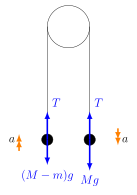
Considering the pulley system with the lift (now of mass \(M-m\)) and the counterweight of mass \(M\). Once they start moving, since they are connected by a light inextensible string they must move with the same speed (and by extension the same acceleration). (Up to sign) \begin{align*} \text{N2(lift,}\uparrow):&&(M-m)a &= T-(M-m)g \\ \text{N2(couterweight,}\downarrow):&&Ma &= Mg - T \\ \Rightarrow && (2M-m)a &= mg \\ \Rightarrow && a &= \frac{mg}{2M-m} \end{align*} We could treat the situation as the tile travelling a distance of \(h\) with acceleration \(\displaystyle g \left ( 1 + \frac{m}{2M-m} \right) = g \frac{2M}{2M-m}\). \begin{align*} t &= \sqrt{\frac{2h}{g \frac{2M}{2M-m}}} \\ &= \sqrt{\frac{(2M-m)h}{Mg}} \\ \end{align*}
TikZ diagram
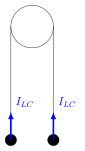
Since the collision between the lift and tile is perfectly inelastic, they immediately coalesce. There is also an impulse in the pulley system, which goes over the pulley, which means there is an impulse acting vertically on the lift and the counterweight. Assume afterwards the lift (and tile) is travelling upwards with speed \(V\) and the counterweight is travelling downwards with speed \(V\) (ie velocity \(-V\)). \begin{align*} \text{for the lift/tile}: && I_{LC} &= (\text{momentum after}) - (\text{momentum before})\\ &&&= MV - ((M-m)at +m(-g)t) \\ &&&= MV - Mat + m(a-g)t \\ \text{for the counterweight}: && I_{LC} &= (\text{momentum after}) - (\text{momentum before})\\ &&&= M(-V) - (M(-a)t) \\ &&&= -MV +Mat \\ \Rightarrow && 2MV &= m(g-a)t + 2Mat \\ &&&= t (2Ma -ma+mg) \\ &&&= 0 \\ \Rightarrow && V &= 0 \end{align*} Therefore, the lift ends up stationary. The energy lost in the collision is: \begin{align*} && E &= KE_{before} - KE_{after} \\ &&&= \underbrace{\frac12 (M-m)a^2 t^2}_{lift} + \underbrace{\frac12 mg^2 t^2}_{tile} + \underbrace{\frac12 Ma^2 t^2}_{counterweight} - \underbrace{0}_{\text{everything is at rest after}} \\ &&&= \frac12 \l (M-m)a^2 + mg^2 + Ma^2 \r t^2 \\ &&&= \frac12 \l 2Ma^2-ma^2 + mg^2 \r t^2 \\ &&&= \frac12 \l (2M-m)a^2 + mg^2 \r t^2 \\ &&&= \frac12 \l mga + mg^2 \r t^2 \\ &&&= \frac12 mg (a + g)t^2 \\ &&&= \frac12 mg \left ( \frac{mg}{2M-m} + g\right ) \frac{(2M-m)h}{Mg} \\ &&&= \frac12 mg \left ( \frac{mg +2Mg - mg}{2M-m} \right) \frac{(2M-m)h}{Mg} \\ &&&= mgh \end{align*} as required.

1988 Paper 2 Q12
D: 1600.0 B: 1500.0

One end of a thin uniform inextensible, but perfectly flexible, string of length \(l\) and uniform mass per unit length is held at a point on a smooth table a distance \(d(< l)\) away from a small vertical hole in the surface of the table. The string passes through the hole so that a length \(l-d\) of the string hangs vertically. The string is released from rest. Assuming that the height of the table is greater than \(l\), find the time taken for the end of the string to reach the top of the hole.


Solution: Consider some point once the string is moving, there will be \(x\) above the table and \(l - x\) hanging in the air. For the hanging string we must have \((l-x)mg - T = -(l-x)m\ddot{x}\). For the string on the table we must have that \(T = -xm \ddot{x}\). Eliminating T, we have \((l-x)g = -l \ddot{x}\) Solving the differential equation, we must have \(x = A \cosh \sqrt \frac{g}{l}t+B \sinh\sqrt \frac{g}{l}t+l\), Since \(x(0) = d, \dot{x}(0) = 0 \Rightarrow B = 0, A = (-d)\). Therefore \(x = l-(l-d) \cosh \sqrt \frac{g}{l} t \Rightarrow t =\sqrt \frac{l}{g} \cosh^{-1} \l \frac{l-x}{l-d} \r\) and we go over the edge when \(x = 0\), ie \(\sqrt \frac{l}{g} \cosh^{-1} \l \frac{l}{l-d} \r\)

1988 Paper 2 Q13
D: 1600.0 B: 1500.0

A librarian wishes to pick up a row of identical books from a shelf, by pressing her hands on the outer covers of the two outermost books and lifting the whole row together. The covers of the books are all in parallel vertical planes, and the weight of each book is \(W\). With each arm, the librarian can exert a maximum force of \(P\) in the vertical direction, and, independently, a maximum force of \(Q\) in the horizontal direction. The coefficient of friction between each pair of books and also between each hand and a book is \(\mu.\) Derive an expression for the maximum number of books that can be picked up without slipping, using this method. {[}You may assume that the books are thin enough for the rotational effect of the couple on each book to be ignored.{]}


Solution:

TikZ diagram
The force acting vertically on each of the outer books must be (by symmetry) \(\frac{nW}{2}\). The force acting horizontally on the outer books (and between each book in the horizontal direction) will be the same (we might as well say \(Q\) since increasing this force doesn't make any task less achievable. Looking at an end book, it will have force \(\frac{nW}{2}\) acting on one side, but it this force needs to not slip, ie \(\frac{nW}{2} \leq \mu Q\) \begin{align*} && \frac{nW}{2} &\leq \mu Q \\ \Rightarrow && n &\leq \frac{2\mu Q}{W} \\ && \frac{nW}{2} & \leq P \\ && n & \leq \frac{2P}{W} \\ \Rightarrow && n &\leq \frac2{W}\min \left (P, \mu Q \right) \end{align*}