Problems
Filters
22 problems found
1997 Paper 1 Q10
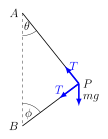
The point \(A\) is vertically above the point \(B\). A light inextensible string, with a smooth ring \(P\) of mass \(m\) threaded onto it, has its ends attached at \(A\) and \(B\). The plane \(APB\) rotates about \(AB\) with constant angular velocity \(\omega\) so that \(P\) describes a horizontal circle of radius \(r\) and the string is taut. The angle \(BAP\) has value \(\theta\) and the angle \(ABP\) has value \(\phi\). Show that \[\tan\frac{\phi-\theta}{2}=\frac{g}{r\omega^{2}}.\] Find the tension in the string in terms of \(m\), \(g\), \(r\), \(\omega\) and \(\sin\frac{1}{2}(\theta+\phi)\). Deduce from your results that if \(r\omega^2\) is small compared with \(g\), then the tension is approximately \(\frac{mg}{2}\)
Solution: None \begin{multicols}{2}
1996 Paper 3 Q14
Whenever I go cycling I start with my bike in good working order. However if all is well at time \(t\), the probability that I get a puncture in the small interval \((t,t+\delta t)\) is \(\alpha\,\delta t.\) How many punctures can I expect to get on a journey during which my total cycling time is \(T\)? When I get a puncture I stop immediately to repair it and the probability that, if I am repairing it at time \(t\), the repair will be completed in time \((t,t+\delta t)\) is \(\beta\,\delta t.\) If \(p(t)\) is the probability that I am repairing a puncture at time \(t\), write down an equation relating \(p(t)\) to \(p(t+\delta t)\), and derive from this a differential equation relating \(p'(t)\) and \(p(t).\) Show that \[ p(t)=\frac{\alpha}{\alpha+\beta}(1-\mathrm{e}^{-(\alpha+\beta)t}) \] satisfies this differential equation with the appropriate initial condition. Find an expression, involving \(\alpha,\beta\) and \(T\), for the time expected to be spent mending punctures during a journey of total time \(T\). Hence, or otherwise, show that, the fraction of the journey expected to be spent mending punctures is given approximately by \[ \quad\frac{\alpha T}{2}\quad\ \mbox{ if }(\alpha+\beta)T\text{ is small, } \] and by \[ \frac{\alpha}{\alpha+\beta}\quad\mbox{ if }(\alpha+\beta)T\text{ is large.} \]
1995 Paper 3 Q13
A message of \(10^{k}\) binary digits is sent along a fibre optic cable with high probabilities \(p_{0}\) and \(p_{1}\) that the digits 0 and 1, respectively, are received correctly. If the probability of a digit in the original message being a 1 is \(\alpha,\) find the probability that the entire message is received correctly. Find the probability \(\beta\) that a randomly chosen digit in the message is received as a 1 and show that \(\beta=\alpha\) if, and only if \[ \alpha=\frac{q_{0}}{q_{1}+q_{0}}, \] where \(q_{0}=1-p_{0}\) and \(q_{1}=1-p_{1}.\) If this condition is satisfied and the received message consists entirely of zeros, what is the probability that it is correct? If now \(q_{0}=q_{1}=q\) and \(\alpha=\frac{1}{2},\) find the approximate value of \(q\) which will ensure that a message of one million binary digits has a fifty-fifty chance of being received entirely correctly. The probability of error \(q\) is proportional to the square of the length of the cable. Initially the length is such that the probability of a message of one million binary bits, among which 0 and 1 are equally likely, being received correctly is \(\frac{1}{2}.\) What would this probability become if a booster station were installed at its mid-point, assuming that the booster station re-transmits the received version of the message, and assuming that terms of order \(q^{2}\) may be ignored?
1993 Paper 1 Q6
Let \(N=10^{100}.\) The graph of \[ \mathrm{f}(x)=\frac{x^{N}}{1+x^{N}}+2 \] for \(-3\leqslant x\leqslant3\) is sketched in the following diagram. \noindent
1988 Paper 3 Q6
Let \(\mathrm{f}(x)=\sin2x\cos x.\) Find the 1988th derivative of \(\mathrm{f}(x).\) Show that the smallest positive value of \(x\) for which this derivative is zero is \(\frac{1}{3}\pi+\epsilon,\) where \(\epsilon\) is approximately equal to \[ \frac{3^{-1988}\sqrt{3}}{2}. \]
Solution: \begin{align*} && f(x) &= \sin 2x \cos x \\ &&&= \frac12 \l \sin 3x + \sin x \r \\ \Rightarrow && f^{(1988)}(x) &= \frac12 \l 3^{1988} (-1)^{994} \sin 3x+ (-1)^{994} \sin x \r \\ &&&= \boxed{\frac12 \left (3^{1998} \sin 3x + \sin x \right)} \\ \\ f^{(1988)}(x) = 0: && 0 &= 3^{1988} \sin 3x + \sin x \\ \Rightarrow && 0 &= 3^{1988} ( 3\sin x-4\sin^3 x) + \sin x \\ \Rightarrow && 0 &= \sin x \left (1+3^{1989}-4\cdot 3^{1988}\sin^{2} x \right) \end{align*} Since \(\sin x\) will first contribute a zero when \(x = \frac{\pi}{2}\) we focus on the second bracket, in particular, we need: \begin{align*} && \sin^2 x &= \frac{3}{4} \left ( 1 + \frac{1}{3^{1988}} \right) \\ \Rightarrow && \sin x &= \frac{\sqrt{3}}2 \left (1 + \frac{1}{2 \cdot 3^{1988}} + \cdots \right ) \end{align*} Since near \(\frac{\pi}{3}\), \begin{align*} \sin (\frac{\pi}{3} + \epsilon) &= \sin \frac{\pi}{3} \cos \epsilon + \cos \frac{\pi}{3} \sin \epsilon \\ &\approx \frac{\sqrt{3}}{2} (1-\epsilon^2 + \cdots ) + \frac{1}{2}(\epsilon + \cdots) \\ &= \frac{\sqrt{3}}2 + \frac12 \epsilon + \cdots \end{align*} Therefore by comparison we can see that \(x = \frac{\pi}{3} + \frac{\sqrt{3}}{2} 3^{-1988}\) will be a very good approximation for the root.
1987 Paper 2 Q3
Let \(a\) and \(b\) be positive integers such that \(b<2a-1\). For any given positive integer \(n\), the integers \(N\) and \(M\) are defined by \[ [a+\sqrt{a^{2}-b}]^{n}=N-r, \] \[ [a-\sqrt{a^{2}-b}]^{n}=M+s, \] where \(0\leqslant r<1\) and \(0\leqslant s<1\). Prove that \begin{questionparts} \item \(M=0\), \item \(r=s\), \item \(r^{2}-Nr+b^{n}=0.\) \end{questionpart} Show that for large \(n\), \(\left(8+3\sqrt{7}\right)^{n}\) differs from an integer by about \(2^{-4n}\).
Solution:
- If we can show that \(0 < a - \sqrt{a^2-b} < 1\) then we will be done, since raising a number in \([0,1)\) to a positive integer power will always remain in the same interval. Clearly \(\sqrt{a^2-b} < \sqrt{a^2} = a\) so we have \(a-\sqrt{a^2-b} > 0\) We also have that \(\sqrt{a^2-b} > \sqrt{a^2-(2a-1)} = (a-1)\). Therefore \(a - \sqrt{a^2-b} < a - (a-1) = 1\) as required.
- If we can show that \(\l a + \sqrt{a^2-b} \r^n + \l a - \sqrt{a^2-b} \r^n = N -r + s\) is an integer we will be done, since the only integer value \(-r+s\) can be is \(0\). This is easy to see, since \begin{align*} \l a + \sqrt{a^2-b} \r^n + \l a - \sqrt{a^2-b} \r^n &= \sum_{k=0}^n \binom{n}{k}a^{n-k}(\sqrt{a^2-b})^k +\sum_{k=0}^n \binom{n}{k}a^{n-k}(-\sqrt{a^2-b})^k \\ &= \sum_{k=0}^n \binom{n}{k}a^{n-k}\l (\sqrt{a^2-b})^k +(-\sqrt{a^2-b})^k \r \\ \end{align*} But every term where \(k\) is odd in this sum is \(0\) (since they cancel) and ever term where \(k\) is even in this sum is an integer. Therefore the sum is an integer and we're done.
- \begin{align*} -r^2+rN &= -r(r-N) \\ &= s(r-N) \\ &=- \l a - \sqrt{a^2-b} \r^n \l a + \sqrt{a^2-b} \r^n \\ &= -\l \l a - \sqrt{a^2-b} \r \l a + \sqrt{a^2-b} \r\r^n \\ &= - \l a^2 - a^2+b\r^n \\ &= b^n \end{align*} Therefore \(r^2-rN + b^n = 0\)
1987 Paper 2 Q7
A definite integral can be evaluated approximately by means of the Trapezium rule: \[ \int_{x_{0}}^{x_{N}}\mathrm{f}(x)\,\mathrm{d}x\approx\tfrac{1}{2}h\left\{ \mathrm{f}\left(x_{0}\right)+2\mathrm{f}\left(x_{1}\right)+\ldots+2\mathrm{f}\left(x_{N-1}\right)+\mathrm{f}\left(x_{N}\right)\right\} , \] where the interval length \(h\) is given by \(Nh=x_{N}-x_{0}\), and \(x_{r}=x_{0}+rh\). Justify briefly this approximation. Use the Trapezium rule with intervals of unit length to evaluate approximately the integral \[ \int_{1}^{n}\ln x\,\mathrm{d}x, \] where \(n(>2)\) is an integer. Deduce that \(n!\approx\mathrm{g}(n)\), where \[ \mathrm{g}(n)=n^{n+\frac{1}{2}}\mathrm{e}^{1-n}, \] and show by means of a sketch, or otherwise, that \[ n!<\mathrm{g}(n). \] By using the Trapezium rule on the above integral with intervals of width \(k^{-1}\), where \(k\) is a positive integer, show that \[ \left(kn\right)!\approx k!n^{kn+\frac{1}{2}}\left(\frac{\mathrm{e}}{k}\right)^{k\left(1-n\right)}. \] Determine whether this approximation or \(\mathrm{g}(kn)\) is closer to \(\left(kn\right)!\).
Solution:

