Problems
Filters
87 problems found
2016 Paper 2 Q2
Use the factor theorem to show that \(a+b-c\) is a factor of \[ (a+b+c)^3 -6(a+b+c)(a^2+b^2+c^2) +8(a^3+b^3+c^3) \,. \tag{\(*\)} \] Hence factorise (\(*\)) completely.
- Use the result above to solve the equation \[ (x+1)^3 -3 (x+1)(2x^2 +5) +2(4x^3+13)=0\,. \]
- By setting \(d+e=c\), or otherwise, show that \((a+b-d-e)\) is a factor of \[ (a+b+d+e)^3 -6(a+b+d+e)(a^2+b^2+d^2+e^2) +8(a^3+b^3+d^3+e^3) \, \] and factorise this expression completely. Hence solve the equation \[ (x+6)^3 - 6(x+6)(x^2+14) +8(x^3+36)=0\,. \]
Solution: Suppose \(c = a+b\) then \begin{align*} (a+b+c)^3 &-6(a+b+c)(a^2+b^2+c^2) +8(a^3+b^3+c^3) \\ &= (2(a+b))^3-6(2(a+b))(a^2+b^2+(a+b)^2) + 8(a^3+b^3+(a+b)^3) \\ &=16(a+b)^3 - 24(a+b)(a^2+b^2+ab)+8(a^3+b^3) \\ &= 8(a+b)(2(a+b)^2-3(a^2+b^2+ab)+(a^2-ab+b^2)) \\ &= 0 \end{align*} Therefore \(a+b-c\) is a factor. By symmetry \(a-b+c\) and \(-a+b+c\) are also factors. Since our polynomial is degree \(3\) it must be \(K(a+b-c)(b+c-a)(c+a-b)\) for some \(K\). Since the coefficient of \(a^3\) is \(3\), \(K = 3\). so we have: \(3(a+b-c)(b+c-a)(c+a-b)\)
- We want \(x + a + b = x+1\), \(x^2 + a^2 + b^2 = x^3+\frac52, x^3 + a^3 + b^3 = x^3+ \frac{13}{4}\). \(a+b = 1, a^2 + b^2 = 5/2\) so \(a = \frac32, b = -\frac12\) \begin{align*} 0 &= (x+1)^3 - 3(x+1)(2x^2+5)+2(4x^3+13) \\ &= 3(x +\frac{3}{2}+\frac{1}{2})(x - \frac{3}{2} - \frac{1}{2})(-x + \frac{3}{2} - \frac{1}{2}) \\ &= 3(x+2)(x-2)(1-x) \end{align*} and so the roots are \(x = 1, 2, -2\)
- Letting \(c = d+e\) we have \begin{align*} (a+b+d+e)^3 &-6(a+b+d+e)(a^2+b^2+d^2+e^2) +8(a^3+b^3+d^3+e^3) \\ &= (a+b+c)^3 -6(a+b+c)(a^2+b^2+c^2-2de) +8(a^3+b^3+c^3 - 3cde) \\ &= (a+b+c)^3 -6(a+b+c)(a^2+b^2+c^2)+8(a^3+b^3+c^3)+12(a+b+c)de - 24cde \\ &= \underbrace{(a+b+c)^3 -6(a+b+c)(a^2+b^2+c^2)+8(a^3+b^3+c^3)}_{\text{has a factor of }a+b-c} + 12(a+b-c)de \end{align*} Therefore there is a factor of \(a+b-c\) or \(a+b-d-e\). By symmetry we must have the factors: \((a+b-d-e)(a-b-d+e)(a-b+d-e)\) and so the final expression must be: \(K(a+b-d-e)(a-b-d+e)(a-b+d-e)\) The coefficient of \(a^3\) is \(3\), therefore \(K = 3\) We want \(x+a+b+c = x + 6\), \(x^2+a^2+b^2+c^2 = 14\) and \(x^3 + a^3+b^3+c^3 = 36\), ie \(a = 1,b=2,c=3\) would work, so \begin{align*} 0 &= (x+6)^3 - 6(x+6)(x^2+14) +8(x^3+36) \\ &= 3(x+1-2-3)(x-1+2-3)(x-1-2+3) \\ &= 3x(x-4)(x-2) \end{align*} ie the roots are \(x = 0, 2, 4\)
2016 Paper 3 Q8
- The function f satisfies, for all \(x\), the equation \[ \f(x) + (1- x)\f(-x) = x^2\, . \] Show that \(\f(-x) + (1 + x)\f(x) = x^2\,\). Hence find \(\f(x)\) in terms of \(x\). You should verify that your function satisfies the original equation.
- The function \({\rm K}\) is defined, for \(x\ne 1\), by \[{\rm K}(x) = \dfrac{x+1}{x-1}\,.\] Show that, for \(x\ne1\), \({\rm K(K(}x)) =x\,\). The function g satisfies the equation \[ \g(x)+ x\, \g\Big(\frac{ x+1 }{x-1}\Big) = x \ \ \ \ \ \ \ \ \ \ \ ( x\ne 1) \,. \] Show that, for \(x\ne1\), \(\g(x)= \dfrac{2x}{x^2+1}\,\).
- Find \(\h(x)\), for \(x\ne0\), \(x\ne1\), given that \[ \h(x)+ \h\Big(\frac 1 {1-x}\Big)= 1-x -\frac1{1-x} \ \ \ \ \ \ ( x\ne0, \ \ x\ne1 ) \,. \]
Solution:
- \(\,\) Let \(P(x)\) mean the proposition that \(f(x) + (1-x)f(-x) = x^2\) so \begin{align*} P(x): && f(x) + (1-x)f(-x) &= x^2 \\ P(-x): && f(-x)+(1+x)f(x) &= (-x)^2 = x^2 \\ \Rightarrow && f(x)+(1-x)\left (x^2-(1+x)f(x) \right) &= x^2 \\ \Rightarrow && f(x) \left (1 -(1-x^2) \right) &= x^2 + (x-1)x^2 \\ \Rightarrow && f(x)x^2 &= x^3 \\ \Rightarrow && f(x) &= x \end{align*} Notice that \(x + (1-x)(-x) = x^2\) so it does satisfy the functional equation.
- Let \(K(x) = \frac{x+1}{x-1}\) if \(x \neq 1\) so \begin{align*} && K(K(x)) &= \frac{K(x)+1}{K(x)-1} \\ &&&= \frac{\frac{x+1}{x-1}+1}{\frac{x+1}{x-1}-1} \\ &&&= \frac{\frac{2x}{x-1}}{\frac{2}{x-1}} \\ &&&= x \end{align*} Let \(Q(x)\) denote the proposition that \(g(x) + xg(K(x)) = x\) so \begin{align*} Q(x): && g(x) + xg(K(x)) &= x \\ Q(K(x)): && g(K(x)) + K(x)g(x) &= K(x) \\ \Rightarrow && g(x) +xK(x)[1-g(x)] &= x \\ \Rightarrow && g(x)[1-xK(x)] &= x(1-K(x)) \\ \Rightarrow && g(x) \frac{x-1-x^2-x}{x-1} &= \frac{-2x}{x-1} \\ \Rightarrow && g(x) &= \frac{2x}{x^2+1} \end{align*}. And notice that \(\frac{2x}{x^2+1} + x \frac{2\frac{x+1}{x-1}}{\left( \frac{x+1}{x-1}\right)^2+1} = \frac{2x}{x^2+1} + \frac{2x(x^2-1)}{2x^2+2} = x\)
- Consider \(H(x) = \frac{1}{1-x}\) then notice that \(H(H(x)) = \frac{1}{1-\frac{1}{1-x}} = \frac{x-1}{x}\) and \(H^3(x) = \frac{\frac{1}{1-x}-1}{\frac{1}{1-x}} = 1-(1-x) = x\). So So letting \(S(x)\) be the statement that \(h(x) + h(H(x)) = 1 - x - \frac{1}{1-x}\) we have \begin{align*} S(x): && h(x) + h(H(x)) &= 1 - x - H(x) \\ S(H(x)): && h(H(x)) + h(H^2(x)) &= 1 - H(x) - H^2(x) \\ S(H^2(x)): && h(H^2(x)) + h(x) &= 1 - H^2(x) - x \\ S(x) - S(H(x)) + S(H^2(x)): && 2h(x) &= 1 - 2x \\ \Rightarrow && h(x)& = \frac12 - x \end{align*} and notice that \(\frac12 -x +\frac12 - \frac{1}{1-x} = 1 - x - \frac{1}{1-x}\) so it does satisfy the equation.
2014 Paper 1 Q3
The numbers \(a\) and \(b\), where \(b > a\ge0\), are such that \[ \int_a^b x^2 \d x = \left ( \int_a^b x \d x\right)^{\!\!2}\,. \]
- In the case \(a=0\) and \(b>0\), find the value of \(b\).
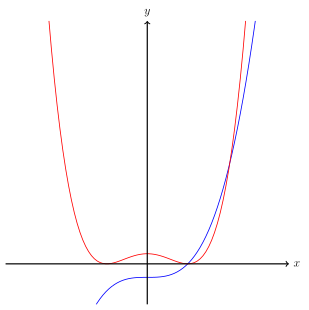
- In the case \(a=1\), show that \(b\) satisfies \[ 3b^3 -b^2-7b -7 =0\,. \] Show further, with the help of a sketch, that there is only one (real) value of \(b\) that satisfies this equation and that it lies between \(2\) and \(3\).
- Show that \(3p^2 + q^2 = 3p^2q\), where \(p=b+a\) and \(q=b-a\), and express \(p^2\) in terms of \(q\). Deduce that \(1< b-a\le\frac43\).
Solution:
- \(\,\) \begin{align*} && \int_0^b x^2 \d x &= \left ( \int_0^b x \d x \right)^2 \\ \Rightarrow && \frac{b^3}{3} &= \left ( \frac{b^2}{2} \right)^2 \\ \Rightarrow && b &= \frac{4}{3} \end{align*}
- \(\,\)
\begin{align*}
&& \int_1^b x^2 \d x &= \left ( \int_1^b x \d x \right)^2 \\
\Rightarrow && \frac{b^3}{3} - \frac{1}{3} &= \left ( \frac{b^2}{2} - \frac{1}{2} \right)^2 \\
\Rightarrow && 4(b^3 - 1) &= 3(b^2-1)^2 \\
\Rightarrow && 4(b^3-1) &= 3(b^4-2b^2+1) \\
\Rightarrow && 0 &= 3b^4-4b^3-6b^2+7 \\
&&&= (b-1)(3b^3-b^2-7b-7) \\
\Rightarrow && 0 &= 3b^3-b^2-7b-7
\end{align*}
Let \(f(x) = 3x^3-x^2-7x-7\) then \(f(2) = 3 \cdot 8 - 4 - 14 - 7 = -1 < 0\), \(f(3) = 3 \cdot 27 - 9 - 21 - 7 = 44 > 0\) therefore the root must lie between \(2\) and \(3\).
- \(,\) \begin{align*} && \int_a^b x^2 \d x &= \left ( \int_a^b x \d x \right)^2 \\ \Rightarrow && \frac{b^3}{3} - \frac{a^3}{3} &= \left ( \frac{b^2}{2} - \frac{a^2}{2} \right)^2 \\ \Rightarrow && 4(b^3 - a^3) &= 3(b^2-a^2)^2 \\ \Rightarrow && 4(b^2+ab+a^2) &= 3(b-a)(b+a)^2 \\ \Rightarrow && 4 \left ( \left ( \frac{p+q}{2}\right)^2+\left ( \frac{p+q}{2}\right)\left ( \frac{p-q}{2}\right)+\left ( \frac{p-q}{2}\right)^2\right) &= 3qp^2 \\ \Rightarrow && 3p^2 + q^2 &= 3qp^2 \\ \Rightarrow && 3p^2(q-1) &= q^2 \\ \Rightarrow && p^2 &= \frac{q^2}{3(q-1)} \\ \Rightarrow && 1 &\leq \frac{1}{3(q-1)} \\ \Rightarrow && 3(q-1) &\leq 1 \\ \Rightarrow && q & \leq \frac{4}{3} \\ \end{align*}
2013 Paper 1 Q3
For any two points \(X\) and \(Y\), with position vectors \(\bf x\) and \(\bf y\) respectively, \(X*Y\) is defined to be the point with position vector \(\lambda {\bf x}+ (1-\lambda){\bf y}\), where \(\lambda\) is a fixed number.
- If \(X\) and \(Y\) are distinct, show that \(X*Y\) and \(Y*X\) are distinct unless \(\lambda\) takes a certain value (which you should state).
- Under what conditions are \((X*Y)*Z\) and \(X*(Y*Z)\,\) distinct?
- Show that, for any points \(X\), \(Y\) and \(Z\), \[ (X*Y)*Z = (X*Z)*(Y*Z)\, \] and obtain the corresponding result for \(X*(Y*Z)\).
- The points \(P_1\), \(P_2\), \(\ldots\) are defined by \( P_1 = X*Y\) and, for \(n \ge2\), \(P_n= P_{n-1}*Y\,.\) Given that \(X\) and \(Y\) are distinct and that \(0<\lambda<1\), find the ratio in which \(P_n\) divides the line segment \(XY\).
Solution:
- Suppose \(X*Y = Y*X\), then \begin{align*} && X * Y &= \lambda \mathbf{x} + (1-\lambda) \mathbf{y} \\ && Y * X &= \lambda \mathbf{y} + (1-\lambda) \mathbf{x}\\ \Rightarrow && 0 &= (2\lambda - 1)(\mathbf{x} -\mathbf{y}) \end{align*} Therefore, either \(\mathbf{x} = \mathbf{y}\) or \(\lambda = \frac12\). Since we assumed \(X,Y\) were distinct, \(\mathbf{x} \neq \mathbf{y}\) and so \(X*Y\) and \(Y*X\) are distinct unless \(\lambda = \frac12\)
- Suppose \((X*Y)*Z = X*(Y*Z)\) \begin{align*} &&(X*Y)*Z &= (\lambda \mathbf{x} + (1-\lambda) \mathbf{y}) * \mathbf{z} \\ &&&= (\lambda^2 \mathbf{x} + \lambda(1-\lambda)\mathbf{y} + (1-\lambda)\mathbf{z}\\ &&X*(Y*Z) &=\mathbf{x}* (\lambda \mathbf{y} + (1-\lambda) \mathbf{z}) \\ &&&= (\lambda \mathbf{x} + \lambda(1-\lambda)\mathbf{y} + (1-\lambda)^2\mathbf{z}\\ \Rightarrow && 0 &= (\lambda^2 - \lambda)\mathbf{x} + ((1-\lambda) - (1-\lambda)^2)\mathbf{z} \\ &&&=(1-\lambda)(-\lambda \mathbf{x} +\lambda \mathbf{z}) \\ &&&= \lambda(1-\lambda)(\mathbf{z}-\mathbf{x}) \end{align*} Therefore they are distinct unless \(\lambda = 1, 0\) or \(\mathbf{x} = \mathbf{z}\).
- Claim: \((X*Y)*Z = (X*Z)*(Y*Z)\) Proof: \begin{align*} && (X*Y)*Z &= (\lambda \mathbf{x} + \lambda(1-\lambda)\mathbf{y} + (1-\lambda)^2\mathbf{z} \\ && (X*Z)*(Y*Z) &= (\lambda \mathbf{x} + (1-\lambda)\mathbf{z}) * (\lambda \mathbf{y} + (1-\lambda)\mathbf{z}) \\ &&&= \lambda(\lambda \mathbf{x} + (1-\lambda)\mathbf{z}) + (1-\lambda)(\lambda \mathbf{y} + (1-\lambda)\mathbf{z}) \\ &&&= \lambda^2 \mathbf{x} + \lambda(1-\lambda)\mathbf{y} + (1-\lambda) \mathbf{z} \end{align*} Claim: \(X*(Y*Z) = (X*Y)*(X*Z)\) Proof: \begin{align*} X*(Y*Z) &= \lambda \mathbf{x} + \lambda(1-\lambda)\mathbf{y} + (1-\lambda)^2\mathbf{z} \\ (X*Y)*(X*Z) &= (\lambda \mathbf{x} + (1-\lambda)\mathbf{y})*(\lambda \mathbf{x} + (1-\lambda)\mathbf{z}) \\ &= \lambda (\lambda \mathbf{x} + (1-\lambda)\mathbf{y}) + (1-\lambda)(\lambda \mathbf{x} + (1-\lambda)\mathbf{z}) \\ &= \lambda \mathbf{x} + \lambda(1-\lambda)\mathbf{y} + (1-\lambda)^2\mathbf{z} \end{align*}
- \(P_1 = X*Y\) divides the line segment into the ratio \(\lambda:(1-\lambda)\). \(P_n\) divides the line segment \(P_{n-1}Y\) into the ratio \(\lambda:(1-\lambda)\), therefore it divides the line segment \(XY\) in the ratio \(\lambda^n : 1- \lambda^n\) Alternatively, \begin{align*} P_1 &= \lambda \mathbf{x} + (1-\lambda)\mathbf{y} \\ P_2 &= (\lambda \mathbf{x} + (1-\lambda)\mathbf{y} )*\mathbf{y} \\ &= \lambda^2 \mathbf{x} + (1-\lambda^2) \mathbf{y} \end{align*} Suppose \(P_k = \lambda^k\mathbf{x} + (1-\lambda^k)\mathbf{y}\) then \begin{align*}P_{k+1} &= (\lambda^k\mathbf{x} + (1-\lambda^k)\mathbf{y}) * \mathbf{y} \\ &= \lambda^{k+1}\mathbf{x} + \lambda(1-\lambda^k)\mathbf{y} + (1-\lambda)\mathbf{y}\\ & = \lambda^{k+1}\mathbf{x} + (1-\lambda^{k+1})\mathbf{y}\end{align*}
2013 Paper 3 Q6
Let \(z\) and \(w\) be complex numbers. Use a diagram to show that \(\vert z-w \vert \le \vert z\vert + \vert w \vert\,.\) For any complex numbers \(z\) and \(w\), \(E\) is defined by \[ E = zw^* + z^*w +2 \vert zw \vert\,. \]
- Show that \(\vert z-w\vert^2 = \left( \vert z \vert + \vert w\vert\right)^2 -E\,\), and deduce that \(E\) is real and non-negative.
- Show that \(\vert 1-zw^*\vert^2 = \left ( 1 +\vert zw \vert \right)^2 -E\,\).
Solution:
- \(\,\) \begin{align*} && |z-w|^2 &= (z-w)(z^*-w^*) \\ &&&= zz^* - wz^*-zw^* + ww^* \\ &&&= |z|^2+|w|^2 - E + 2|zw| \\ &&&= (|z|+|w|)^2 - E \\ \Rightarrow && E &= (|z|+|w|)^2 - |z-w|^2 &\in \mathbb{R} \end{align*} and by the triangle inequality \(|z|+|w| \geq |z-w|\), so \(E \geq 0\)
- \(\,\) \begin{align*} && |1-zw^*|^2 &= (1-zw^*)(1-z^*w) \\ &&&= 1 - zw^*-z^*w + |zw|^2 \\ &&&= 1 - E + 2|zw| + |zw|^2 \\ &&&= (1+|zw|)^2 - E \end{align*} \begin{align*} && \frac{|z-w|^2}{|1-zw^*|^2} &= \frac{(|z|+|w|)^2-E}{(1+|zw|)^2-E} \\ \Leftrightarrow && (1+|zw|^2)|z-w|^2 -E|z-w|^2 &= (|z|+|w|)^2|1-zw^*|^2-E|1-zw^*|^2\\ \Leftrightarrow && (1+|zw|^2)|z-w|^2-(|z|+|w|)^2|1-zw^*|^2 &= E(|z-w|^2-|1-zw^*|^2)\\ &&&= E(|z|^2-zw^*-z^*w+|w|^2-1+zw^*+z^*w-|z|^2|w|^2) \\ &&&= E(|z|^2+|w|^2-1-|z|^2|w|^2) \\ &&&= -E(1-|z|^2)(1-|w|^2) \\ &&&\leq 0 \\ \Leftrightarrow&& (1+|zw|^2)|z-w|^2& \leq (|z|+|w|)^2|1-zw^*|^2\\ \Leftrightarrow&& \frac{|z-w|^2}{|1-zw^*|^2} &\leq \frac{(|z|+|w|)^2}{(1+|zw|)^2}\\ \Leftrightarrow && \frac{|z-w|}{|1-zw^*|} &\leq \frac{(|z|+|w|)}{(1+|zw|)}\\ \end{align*} Yes, this inequality holds if \(|z|, |w|\) are the same side of \(1\) and is reversed otherwise.
2012 Paper 1 Q7
A sequence of numbers \(t_0\), \(t_1\), \(t_2\), \(\ldots\,\) satisfies \[ \ \ \ \ \ \ \ \ \ \ \ \ \ \ \ \ \ \ \ \ \ \ \ \ t_{n+2} = p t_{n+1}+qt_{n} \ \ \ \ \ \ \ \ \ \ (n\ge0), \] where \(p\) and \(q\) are real. Throughout this question, \(x\), \(y\) and \(z\) are non-zero real numbers.
- Show that, if \(t_n=x\) for all values of \(n\), then \(p+q=1\) and \(x\) can be any (non-zero) real number.
- Show that, if \(t_{2n} = x\) and \(t_{2n+1}=y\) for all values of \(n\), then \(q\pm p=1\). Deduce that either \(x=y\) or \(x=-y\), unless \(p\) and \(q\) take certain values that you should identify.
- Show that, if \(t_{3n} = x\), \(t_{3n+1}=y\) and \(t_{3n+2}=z\) for all values of \(n\), then \[ p^3+q^3 +3pq-1=0\,. \] Deduce that either \(p+q=1\) or \((p-q)^2 +(p+1)^2+(q+1)^2=0\). Hence show that either \(x=y=z\) or \(x+y+z=0\).
Solution:
- Suppose \(t_n = x\) for all \(n\), then we must have \begin{align*} && x &= p x + q x \\ \Leftrightarrow && 1 &= p+q \end{align*} and this clearly works for any value of \(x\).
- Suppose \(t_{2n} = x, t_{2n+1} = y\) for all \(n\), then \begin{align*} && x &= py + q x \\ && y &= px + q y \\ \Rightarrow && 0 &= py + (q-1) x \\ && 0 &= px + (q-1) y \\ \Rightarrow && p &= (q-1) \frac{x}{y} = (q-1) \frac{y}{x} \\ \Rightarrow && \frac{y}{x} = \pm 1 & \text{ or } q = 1, p = 0 \\ \Rightarrow && y = \pm x & \text{ or } (p,q) = (0,1) \\ \end{align*}
- Suppose \(t_{3n} = x\), \(t_{3n+1}=y\) and \(t_{3n+2}=z\) , so \begin{align*} && x &= pz + qy \\ && y & = px + qz \\ && z &= py + qx \\ \\ && z &= p(px+qz) + q(pz + qy) \\ &&&= p^2x + 2pqz + q^2 y \\ &&&= p^2(pz+qy) + 2pqz + q^2(px+qz) \\ &&&= p^3 z + p^2qy + 2pqz + q^2p x + q^3 z \\ &&&= (p^3+q^3+2pq)z + pq(py+qx) \\ &&&= (p^3 + q^3 + 2pq)z + pq z \\ &&&= (p^3 + q^3 + 3pq)z \\ \Rightarrow && 0 &= p^3 + q^3 + 3pq- 1 \\ &&&= (p+q-1)(p^2+q^2+1+p+q-pq) \\ &&&= \tfrac12(p+q-1)((p-q)^2+(p+1)^2+(q+1)^2) \end{align*} Therefore \(p+q = 1\) or \((p-q)^2+(p+1)^2+(q+1)^2 = 0 \Rightarrow p = q = -1\). If \(p+q = 1\), then \(z = py + (1-p)x\) and \(x = p(py+(1-p)x) + (1-p)y \Rightarrow (1-p+p^2)x = (1-p+p^2)y \Rightarrow x = y \Rightarrow x= y = z\). If \(p = q = -1\) then adding all the equations we get \(x + y + z = -2(x+y+z) \Rightarrow x + y + z = 0\)
2012 Paper 2 Q3
Show that, for any function f (for which the integrals exist), \[ \int_0^\infty \f\big(x+\sqrt{1+x^2}\big) \,\d x = \frac12 \int_1^\infty \left(1+\frac 1 {t^2}\right) \f(t)\, \d t \,. \] Hence evaluate \[ \int_0^\infty \frac1 {2x^2 +1 + 2 x\sqrt{x^2+1} \ } \, \, \d x \,, \] and, using the substitution \(x=\tan\theta\), \[ \int_0^{\frac12\pi} \frac{1}{(1+\sin\theta)^3}\,\d \theta \,. \]
Solution: \begin{align*} && t &= x + \sqrt{1+x^2} \\ &&\frac1t &= \frac{1}{x+\sqrt{1+x^2}} \\ &&&= \frac{\sqrt{1+x^2}-x}{1+x^2-1} \\ &&&= \sqrt{1+x^2}-x \\ \Rightarrow && x &=\frac12 \left ( t - \frac1t\right) \\ \Rightarrow && \d x &=\frac12 \left (1 + \frac1{t^2} \right)\d t \\ \\ \Rightarrow && \int_0^\infty \f\big(x+\sqrt{1+x^2}\big) \,\d x &= \int_{t=1}^{t = \infty}f(t) \frac12\left (1 + \frac1{t^2} \right)\d t \\ &&&= \frac12 \int_1^\infty \left (1 + \frac1{t^2} \right)f(t) \d t \end{align*} \begin{align*} && I &= \int_0^\infty \frac1 {2x^2 +1 + 2 x\sqrt{x^2+1} \ } \d x \\ &&&= \int_0^\infty \frac1 {(x+\sqrt{x^2+1})^2} \d x \\ &&&= \frac12 \int_1^\infty \left (1 + \frac1{t^2} \right) \frac{1}{t^2} \d t \\ &&&= \frac12 \left [-\frac1t-\frac13\frac1{t^3} \right]_1^{\infty} \\ &&&= \frac12 \cdot \frac43 = \frac23 \end{align*} \begin{align*} && J &= \int_0^{\frac12 \pi} \frac{1}{(1+\sin \theta)^3} \d \theta \\ &&x &= \tan \theta\\ && \d x &= \sec^2 \theta = (1+x^2) \d \theta\\ && \tan\theta &= \frac{s}{\sqrt{1-s^2}}\\ \Rightarrow && \tan^2 \theta &= \frac{s^2}{1-s^2} \\ \Rightarrow && \sin \theta &= \frac{\tan\theta}{\sqrt{1+\tan^2\theta}} \\ && J &= \int_0^{\frac12 \pi} \frac{1}{(1+\sin \theta)^3} \d \theta \\ &&&= \int_0^{\frac12 \pi} \frac{1}{\left (1+ \frac{\tan\theta}{\sqrt{1+\tan^2\theta}} \right )^3} \d \theta \\ &&&= \int_{x=0}^{x=\infty} \frac{1}{\left(1 + \frac{x}{\sqrt{1+x^2}} \right)^3} \frac{1}{1+x^2} \d x \\ &&&= \int_0^{\infty} \frac{\sqrt{1+x^2}}{(\sqrt{1+x^2}+x)^3} \d x \\ &&J_a &= \int_0^{\infty} \frac{\sqrt{1+x^2}+x}{(\sqrt{1+x^2}+x)^3} \d x \\ &&&= \frac23 \\ &&J_b &= \int_0^{\infty} \frac{\sqrt{1+x^2}-x}{(\sqrt{1+x^2}+x)^3} \d x \\ &&&= \int_0^{\infty} \frac{1}{(\sqrt{1+x^2}+x)^4} \d x\\ &&&= \frac12\int_1^{\infty} \left (1 +\frac1{t^2} \right)\frac{1}{t^4} \d t \\ &&&= \frac12 \left [-\frac13 t^{-3}-\frac15t^{-5} \right]_1^{\infty} \\ &&&= \frac12 \cdot \frac8{15} = \frac4{15} \\ \Rightarrow && J &= \frac12(J_a+J_b) = \frac7{15} \end{align*}
2012 Paper 2 Q6
A cyclic quadrilateral \(ABCD\) has sides \(AB\), \(BC\), \(CD\) and \(DA\) of lengths \(a\), \(b\), \(c\) and \(d\), respectively. The area of the quadrilateral is \(Q\), and angle \(DAB\) is \(\theta\). Find an expression for \(\cos\theta\) in terms of \(a\), \(b\), \(c\) and \(d\), and an expression for \(\sin\theta\) in terms of \(a\), \(b\), \(c\), \(d\) and \(Q\). Hence show that \[ 16Q^2 = 4(ad+bc)^2 - (a^2+d^2-b^2-c^2)^2 \,, \] and deduce that \[ Q^2 = (s-a)(s-b)(s-c)(s-d)\,, \] where \(s= \frac12(a+b+c+d)\). Deduce a formula for the area of a triangle with sides of length \(a\), \(b\) and \(c\).
Solution:

2012 Paper 2 Q8
The positive numbers \(\alpha\), \(\beta\) and \(q\) satisfy \(\beta-\alpha >q\). Show that \[ \frac{\alpha^2+\beta^2 -q^2}{\alpha\beta}-2> 0\,. \] The sequence \(u_0\), \(u_1\), \(\ldots\) is defined by \(u_0=\alpha\), \(u_1=\beta\) and \[ \ \ \ \ \ \ \ \ \ \ \ \ \ \ \ u_{n+1} = \frac {u_{n}^2 -q^2}{u_{n-1}} \ \ \ \ \ \ \ \ \ \ \ (n\ge1), \] where \(\alpha\), \(\beta\) and \(q\) are given positive numbers (and \(\alpha\) and \(\beta\) are such that no term in the sequence is zero). Prove that \(u_n(u_n+u_{n+2}) = u_{n+1}(u_{n-1}+u_{n+1})\,\). Prove also that \[ u_{n+1} -pu_n + u_{n-1}=0 \] for some number \(p\) which you should express in terms of \(\alpha\), \(\beta\) and \(q\). Hence, or otherwise, show that if \(\beta> \alpha+q\), the sequence is strictly increasing (that is, \(u_{n+1}-u_n > 0\) for all \(n\)). Comment on the case \(\beta =\alpha +q\).
Solution: \begin{align*} && \beta - \alpha &> q \\ \Rightarrow &&(\beta - \alpha)^2 &> q^2 \\ \Rightarrow && \beta^2 +\alpha^2 - 2\beta \alpha &> q^2 \\ \Rightarrow && \alpha^2+\beta^2-q^2 -2 \beta \alpha &> 0 \\ \Rightarrow && \frac{\alpha^2+\beta^2-q^2}{\alpha\beta} - 2 &> 0 \end{align*} \begin{align*} && u_n(u_n+u_{n+2}) &= u_n \cdot \left (u_n + \frac {u_{n+1}^2 -q^2}{u_{n}}\right) \\ &&&= u_n^2 + u_{n+1}^2-q^2 \\ &&&= u_n^2 + u_{n+1}^2 - (u_n^2-u_{n-1}u_{n+1}) \\ &&&= u_{n+1}^2 + u_{n+1}u_{n-1} \\ &&&= u_{n+1}(u_{n-1}+u_{n+1}) \\ \\ && u_{n+1}-pu_n+u_{n-1} &= -pu_n+\frac{u_{n}(u_{n-2}+u_n)}{u_{n-1}} \\ &&&= \frac{u_n(u_{n}-pu_{n-1}+u_{n-2})}{u_{n-1}} \end{align*} Therefore if \(u_2 -pu_1 + u_0 = 0\) it is always zero, ie if \begin{align*} && u_2 &= p\beta - \alpha \\ && u_2 &= \frac{\beta^2-q^2}{\alpha} \\ \Rightarrow && \frac{\beta^2-q^2}{\alpha} &= p\beta - \alpha \\ \Rightarrow && p &= \frac{\alpha^2+\beta^2-q^2}{\alpha\beta} \end{align*} If \(\beta > \alpha + q\) we must have that \(p > 2\), and so \(u_{n+1}-u_n = (p-1)u_n - u_{n-1} > u_n-u_{n-1} > 0\), therefore the sequence is strictly increasing. If \(\beta = \alpha + q\) the sequence follows \(u_{n+1} - 2u_n + u_{n-1} =0\) and so \(u_{n+1}-u_n = u_n - u_{n-1}\) for all \(n\) (which is still increasing - it's an arithmetic progression with common difference \(\beta - \alpha\)).
2012 Paper 3 Q5
- The point with coordinates \((a, b)\), where \(a\) and \(b\) are rational numbers,is called an integer rational point if both \(a\) and \(b\) are integers; a non-integer rational point if neither \(a\) nor \(b\) is an integer.
- \(\bf (a)\) Write down an integer rational point and a non-integer rational point on the circle \(x^2+y^2 =1\).
- [\bf (b)] Write down an integer rational point on the circle \(x^2+y^2=2\). Simplify \[ (\cos\theta + \sqrt m \sin\theta)^2 + (\sin\theta - \sqrt m \cos\theta)^2 \, \] and hence obtain a non-integer rational point on the circle \(x^2+y^2=2\,\).
- The point with coordinates \((p+\sqrt 2 \, q\,,\, r+\sqrt 2 \, s)\), where \(p\), \(q\), \(r\) and \(s\) are rational numbers, is called: an integer \(2\)-rational point if all of \(p\), \(q\), \(r\) and \(s\) are integers; a non-integer \(2\)-rational point if none of \(p\), \(q\), \(r\) and \(s\) is an integer.
- \(\bf (a)\) Write down an integer \(2\)-rational point, and obtain a non-integer \(2\)-rational point, on the circle \(x^2+y^2=3\,\).
- [\bf(b)] Obtain a non-integer \(2\)-rational point on the circle \(x^2+y^2=11\,\).
- [\bf(c)]Obtain a non-integer \(2\)-rational point on the hyperbola \(x^2-y^2 =7 \).
Solution:
- \(\bf (a)\) \((1, \sqrt2)\) is an integer \(2\)-rational point. \((\frac35 + \frac45\sqrt2, \frac45 - \frac{3}{5}\sqrt2)\) is a non-integer \(2\)-rational point.
- [\bf(b)] First notice that \((\sqrt2)^2 +3^2 = 11\) so then consider \((1 + \tfrac32\sqrt2, 1-\tfrac32\sqrt2)\) will work as \(\pi/4\) degree rotation.
- [\bf(c)] First notice \(3^2-(\sqrt2)^2 = 2\). Notice that \((k\sec \theta + \sqrt{m} \tan \theta)^2 - (k\tan \theta + \sqrt{m} \sec \theta)^2 = k^2-m\). Taking \(k= 3\) we have \((3 \cdot \frac{13}{5} + \frac{12}{5}\sqrt{2}, 3\cdot\frac{12}5+\frac{13}{5}\sqrt2)\)
2011 Paper 1 Q1
- Show that the gradient of the curve \(\; \dfrac a x + \dfrac by =1\), where \(b\ne0\), is \(\; -\dfrac{ay^2}{bx^2}\,\). The point \((p,q)\) lies on both the straight line \(ax+by=1\) and the curve \(\dfrac a x + \dfrac by =1\,\), where \(ab\ne0\). Given that, at this point, the line and the curve have the same gradient, show that \( p=\pm q\,\). Show further that either \((a-b)^2 =1\,\) or \((a+b)^2 =1\,\).
- Show that if the straight line \(ax+by=1\), where \(ab\ne0\), is a normal to the curve \(\dfrac a x - \dfrac by =1\), then \(a^2-b^2 = \frac12\,\).
Solution:
- \(\,\) \begin{align*} && 1 &= \frac{a}{x} + \frac{b}{y} \\ \frac{\d}{\d x}: && 0 &= -\frac{a}{x^2} - \frac{b}{y^2} \frac{\d y}{\d x} \\ \Rightarrow && \frac{\d y}{\d x} &= -\frac{ay^2}{bx^2} \\ \\ (p,q): && -\frac{aq^2}{bp^2} &= -\frac{a}{b} \\ \Rightarrow && p^2 &= q^2 \\ \Rightarrow && p &= \pm q \\ \\ \Rightarrow && ap \pm b p &= 1 \\ \Rightarrow && (a\pm b)p &= 1 \\ \Rightarrow && \frac{a}{p} \pm \frac{b}{p} &= 1 \\ \Rightarrow && (a \pm b)\frac{1}{p} &= 1 \\ \Rightarrow && (a \pm b)^2 &= 1 \end{align*}
- \(\,\) \begin{align*} && 1 &= \frac{a}{x} - \frac{b}{y} \\ \Rightarrow && \frac{\d y}{\d x} &= \frac{ay^2}{bx^2} \\ \Rightarrow && \frac{aq^2}{bp^2} &= \frac{b}{a} \\ \Rightarrow && aq &= \pm bp \\ \Rightarrow && 1 &= \frac{a}{p} - \frac{b}{q} \\ &&&= \frac{aq-bp}{pq} \\ \Rightarrow && aq &= -bp \\ \Rightarrow && 1 &= \frac{2aq}{pq} \\ \Rightarrow && p &= 2a \\ \Rightarrow && q &= -2b \\ \Rightarrow && 1 &= 2a^2-2b^2 \\ \Rightarrow && \frac12 &= a^2-b^2 \end{align*}
2011 Paper 1 Q2
The number \(E\) is defined by $\displaystyle E= \int_0^1 \frac{\e^x}{1+x} \, \d x\,.$ Show that \[ \int_0^1 \frac{x \e^x}{1+x} \, \d x = \e -1 -E\, ,\] and evaluate \(\ds \int_0^1 \frac{x^2\e^x}{1+x} \, \d x\) in terms of \(\e\) and \(E\). Evaluate also, in terms of \(E\) and \(\rm e\) as appropriate:
- \[ \int_0^1 \frac{\e^{\frac{1-x}{1+x}}}{1+x}\, \d x\,\]
- \[ \int_1^{\sqrt2} \frac {\e^{x^2}}x \, \d x \, \]
Solution: \begin{align*} \int_0^1 \frac{x \e^x}{1+x} \, \d x &= \int_0^1 \frac{(x+1-1) \e^x}{1+x} \, \d x \\ &= \int_0^1 \left ( e^x -\frac{\e^x}{1+x} \right )\, \d x \\ &= \e-1-E \end{align*} \begin{align*} \int_0^1 \frac{x^2 \e^x}{1+x} \, \d x &= \int_0^1 \frac{(x^2+x-x) \e^x}{1+x} \, \d x \\ &= \int_0^1 \left ( xe^x -\frac{x\e^x}{1+x} \right )\, \d x \\ &= \left [xe^{x} \right]_0^1 - \int_0^1 e^x \, \d x -(\e-1-E) \\ &= \e-(\e-1)-(\e -1 -E) \\ &= 2-\e + E \end{align*}
- Since \(\displaystyle u = \frac{1-x}{1+x},\frac{\d u}{\d x} = \frac{-(1+x)-(1-x)}{(1+x)^2}\), \begin{align*} && \int_0^1 \frac{\e^{\frac{1-x}{1+x}}}{1+x}\, \d x &= \int_{u=1}^{u=0} \frac{e^u}{1+x} \cdot \frac{(1+x)^2}{-2} \d u \\ &&&= \int_0^1 \frac{(1+x) e^u}{2} \d u \\ &&&= \int_0^1 \frac{\left ( 1 + \frac{1-u}{1+u} \right) e^u}{2}\, \d u \\ &&&= \frac12 \int_0^1 \left (e^u + \frac{e^{u}}{1+u} - \frac{ue^u}{1+u} \right) \, \d u \\ &&&= \frac12 \left( \e-1 + E - (\e - 1 - E) \right) \\ &&&= E \end{align*}
- Since \(\displaystyle u = x^2-1, \d u = 2x \d x\)\begin{align*} \int_1^{\sqrt2} \frac {\e^{x^2}}x \, \d x &= \int_{u=0}^{u=1} \frac{e^{u+1}}{x} \frac{1}{2x} \d u \\ &= \int_0^1 \frac{e^{u+1}}{2(u+1)} \d u \\ &= \frac{\e}{2} E \\ &= \frac{E\e}{2} \end{align*}
2011 Paper 1 Q9
A particle is projected at an angle \(\theta\) above the horizontal from a point on a horizontal plane. The particle just passes over two walls that are at horizontal distances \(d_1\) and \(d_2\) from the point of projection and are of heights \(d_2\) and \(d_1\), respectively. Show that \[ \tan\theta = \frac{d_1^2+d_\subone d_\subtwo +d_2^2}{d_\subone d_\subtwo}\,. \] Find (and simplify) an expression in terms of \(d_1\) and \(d_2\) only for the range of the particle.
2011 Paper 2 Q1
- Sketch the curve \(y=\sqrt{1-x} + \sqrt{3+x}\;\). Use your sketch to show that only one real value of \(x\) satisfies \[ \sqrt{1-x} + \sqrt{3+x} = x+1\,, \] and give this value.
- Determine graphically the number of real values of \(x\) that satisfy \[ 2\sqrt{1-x} = \sqrt{3+x} + \sqrt{3-x}\;. \] Solve this equation.
Solution:
- Clearly the only solution is \(x = 1\)

- There is clearly only one solution, with \(x \approx -2\) \begin{align*} && 4(1-x) &= 6+2\sqrt{9-x^2} \\ && -2x-1 &=\sqrt{9-x^2} \\ \Rightarrow && 4x^2+4x+1 &= 9-x^2 \\ \Rightarrow && 0 &= 5x^2+4x-8 \\ &&x&= \frac{-2\pm 2\sqrt{11}}{5} \\ \Rightarrow && x &= -\left ( \frac{2+2\sqrt{11}}{5} \right) \end{align*}

2011 Paper 2 Q2
Write down the cubes of the integers \(1, 2, \ldots , 10\). The positive integers \(x\), \(y\) and \(z\), where \(x < y\), satisfy \[ x^3+y^3 = kz^3\,, \tag{\(*\)} \] where \(k\) is a given positive integer.
- In the case \(x+y =k\), show that \[ z^3 = k^2 -3kx+3x^2\,. \] Deduce that \((4z^3 - k^2)/3\) is a perfect square and that \(\frac14 {k^2} \le z^3 < k^2\,\). Use these results to find a solution of \((*)\) when \(k=20\).
- By considering the case \(x+y = z^2\), find two solutions of \((*)\) when \(k=19\).
Solution: \begin{array}{c|c} n & n^3 \\ \hline 1 & 1 \\ 2 & 8 \\ 3 & 27 \\ 4 & 64 \\ 5 & 125 \\ 6 & 216 \\ 7 & 343 \\ 8 & 512 \\ 9 & 729 \\ 10 & 1000 \\ \end{array}
- \(\,\) \begin{align*} && x^3 + y^3 &= kz^3 \\ \Rightarrow &&k(x^2-xy+y^2)&=kz^3 \\ \Rightarrow && z^3 &= (x+y)^2-3xy \\ &&&= k^2-3x(k-x) \\ &&&= k^2-3xk+3x^2 \\ \\ \Rightarrow && \frac{4z^3-k^2}{3} &= \frac{4(k^2-3xk+3x^2)-k^2}{3} \\ &&&= \frac{3k^2-12xk+12x^2}{3} \\ &&&= k^2-4xk+4x^2 \\ &&&= (k-2x)^2 \end{align*} Therefore \(\frac{4z^3-k^2}{3}\) is a perfect square and so \(4z^3 \geq k^2 \Rightarrow z^3 \geq \frac14k^2\). Clearly \(kz^3 < x^3+3x^2y+3xy^2+y^3 = k^3 \Rightarrow z^3 < k^2\), therefore \(\frac14 k^2 \leq z^3 < k^2\) Therefore if \(k = 20\), \(100 \leq z^3 < 400 \Rightarrow z \in \{ 5, 6,7\}\). Mod \(3\) it is clear that \(4z^3-k^2\) is not divisible by \(3\) for \(z = 5,6\) therefore \(z = 7\) \begin{align*} && 343 &= 3x^2-60x+400 \\ \Rightarrow && 0 &= 3x^2-60x+57 \\ \Rightarrow && 0 &= x^2-20x+19 \\ \Rightarrow && x &= 1,19 \end{align*} Therefore a solution is \(1^3 + 19^3 = 20 \cdot 7^3\)
- When \(x+y = z^2\) we must have \begin{align*} && x^3 + y^3 &= kz^3 \\ \Rightarrow &&(x^2-xy+y^2)&=kz \\ \Rightarrow && kz &= (x+y)^2-3xy \\ &&&= z^4-3x(z^2-x)\\ &&&= z^4-3xz^2+3x^2 \\ \Rightarrow && 0 &= 3x^2-3z^2x+z^4-kz \\ \\ \Rightarrow && 0 &\leq \Delta = 9z^4-12(z^4-kz) \\ &&&=12kz-3z^4 \\ \Rightarrow && z^3 &\leq 4k \end{align*} If \(k = 19\) this means \(z \leq 4\) \begin{array}{c|c|c|c} z & 19z^3 & x & y \\ \hline 1 & 19 & - & - \\ 2 & 152 & 3 & 5 \\ 3 & 513 & 1 & 8 \end{array} So two solutions are \(1^3+8^3 = 19 \cdot 3^3\) and \(3^3+5^3=19 \cdot 2^3\)