Problems
Filters
20 problems found
1993 Paper 1 Q6
Let \(N=10^{100}.\) The graph of \[ \mathrm{f}(x)=\frac{x^{N}}{1+x^{N}}+2 \] for \(-3\leqslant x\leqslant3\) is sketched in the following diagram. \noindent
1991 Paper 3 Q1
- Evaluate \[ \sum_{r=1}^{n}\frac{6}{r(r+1)(r+3)}. \]
- Expand \(\ln(1+x+x^{2}+x^{3})\) as a series in powers of \(x\), where \(\left|x\right|<1\), giving the first five non-zero terms and the general term.
- Expand \(\mathrm{e}^{x\ln(1+x)}\) as a series in powers of \(x\), where \(-1 < x\leqslant1\), as far as the term in \(x^{4}\).
Solution:
- \begin{align*} && \frac{6}{r(r+1)(r+3)} &= \frac{2}{r} - \frac{3}{r+1} + \frac{1}{r+3} \\ \Rightarrow && \sum_{r=1}^n \frac{6}{r(r+1)(r+3)} &= \sum_{r=1}^n \l \frac{2}{r} - \frac{3}{r+1} + \frac{1}{r+3} \r \\ &&&= \sum_{r=1}^n \frac{2}{r} - \sum_{r=1}^n \frac{3}{r+1} + \sum_{r=1}^n \frac{1}{r+3} \\ &&&= \sum_{r=1}^n \frac{2}{r} - \sum_{r=2}^{n+1} \frac{3}{r} + \sum_{r=3}^{n+2} \frac{1}{r} \\ &&& = \frac{2}{1} + \frac{2}{2} - \frac{3}{2} - \frac{3}{n+1} + \frac{1}{n+1} + \frac{1}{n+2} \\ &&& = \frac{3}{2} - \frac{2}{n+1} + \frac{1}{n+2} \end{align*}
- \begin{align*} && \ln (1 + x+ x^2 + x^3) &= \ln \l \frac{1-x^4}{1-x} \r \\ &&&= \ln (1-x^4) - \ln(1-x) \\ &&&= \sum_{k=1}^{\infty} -\frac{x^{4k}}{k} - \sum_{k=1}^{\infty} - \frac{x^k}{k} \\ &&&= x + \frac12x^2+\frac13x^3-\frac34x^4+\frac15x^5 + \cdots \\ &&&= \sum_{k=1}^{\infty}a_k x^k \end{align*} Where \(a_k = \frac{1}{k}\) if \(k \neq 0 \pmod{4}\) otherwise \(a_k = -\frac{3}{k}\) if \(k \equiv 0 \pmod{4}\)
- \begin{align*} \exp(x \ln (1+x) ) &= \exp\l x \l x-\frac12x^2+\frac13x^3-\cdots \r \r \\ &= \exp\l x^2-\frac12x^3+\frac13x^4 \r \\ &= 1 + \l x^2-\frac12x^3+\frac13x^4 \r + \frac12 \l x^2-\frac12x^3+\frac13x^4 \r^2 + \cdots \\ &= 1 + x^2-\frac12x^3+\frac13x^4 + \frac12x^4 + \cdots \\ &= 1 + x^2 -\frac12x^3+\frac56x^4+\cdots \end{align*}
1990 Paper 3 Q7
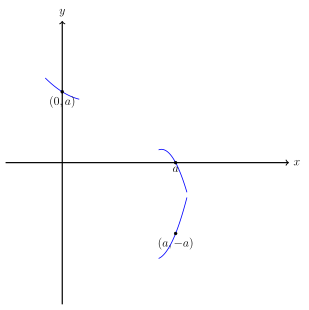
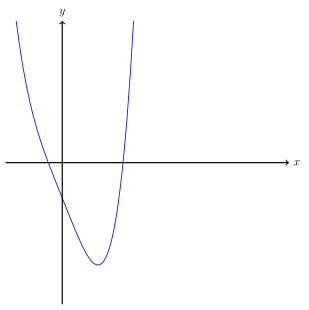
The points \(P\,(0,a),\) \(Q\,(a,0)\) and \(R\,(a,-a)\) lie on the curve \(C\) with cartesian equation \[ xy^{2}+x^{3}+a^{2}y-a^{3}=0,\qquad\mbox{ where }a>0. \] At each of \(P,Q\) and \(R\), express \(y\) as a Taylor series in \(h\), where \(h\) is a small increment in \(x\), as far as the term in \(h^{2}.\) Hence, or otherwise, sketch the shape of \(C\) near each of these points. Show that, if \((x,y)\) lies on \(C\), then \[ 4x^{4}-4a^{3}x-a^{4}\leqslant0. \] Sketch the graph of \(y=4x^{4}-4a^{3}x-a^{4}.\) Given that the \(y\)-axis is an asymptote to \(C\), sketch the curve \(C\).
Solution: \begin{align*} && 0 &= xy^{2}+x^{3}+a^{2}y-a^{3} \\ \frac{\d }{\d x} : && 0 &= y^2+2xyy' + 3x^2+a^2y' \\ \Rightarrow && y' &= -\frac{y^2+3x^2}{a^2+2xy} \\ \\ \frac{\d^2 }{\d x^2}: && 0 &= 2yy'+2yy'+2x(y')^2+2xyy''+6x+a^2y'' \\ \Rightarrow && y'' &= -\frac{4yy'+2x(y')^2+6x}{a^2+2xy} \\ \\ P: && y &= a \\ && y' &= -\frac{a^2}{a^2} = -1 \\ && y'' &= -\frac{-4a}{a^2} = \frac{4}{a} \\ \Rightarrow && y &\approx a - h+\frac{2}{a}h^2 \\ \\ Q: && y &= 0 \\ && y' &= -\frac{3a^2}{a^2} = -3 \\ && y'' &= -\frac{18a+6a}{a^2} = -\frac{24}{a} \\ \Rightarrow && y &\approx 0-3h-\frac{12}{a}h \\ \\ R: && y &= -a \\ && y' &= -\frac{a^2+3a^2}{a^2-2a^2} = 4 \\ && y'' &= -\frac{-16a+32a+6a}{a^2-2a^2} = \frac{22}{a} \\ \Rightarrow && y &\approx -a+4h + \frac{11}{a}h^2 \end{align*} Alternatively: \begin{align*} && 0 &= xy^{2}+x^{3}+a^{2}y-a^{3} \\ P(0,a): && y &\approx a + c_1h + c_2h^2 \\ && 0 &= h(a+c_1h)^2 + a^2(a + c_1h + c_2h^2)-a^3 \\ &&&= a^3-a^3 + (a^2+a^2c_1)h+(2ac_1+a^2c_2)h^2 \\ \Rightarrow && c_1 &=-1, c_2 =\frac{2}{a} \\ \Rightarrow && y &\approx a - h + \frac{2}{a}h^2 \\ \\ Q(a,0): && y &\approx c_1h + c_2h^2 \\ && 0 &= (a+h)(c_1h)^2+(a+h)^3+a^2(c_1h + c_2h^2 )-a^3 \\ &&&= a^3-a^3+(3a^2+a^2c_1)h + (ac_1^2+3a+a^2c_2)h^2 + \cdots \\ \Rightarrow && c_1 &=-3, c_2 = -\frac{12}{a} \\ \Rightarrow && y &\approx -3h -\frac{12}{a}h \\ \\ R(a,-a): && y &\approx -a + c_1h + c_2h^2 \\ && 0 &= (a+h)(-a + c_1h+c_2h^2)^2+(a+h)^3+a^2(-a + c_1h + c_2h^2)-a^3 \\ &&&= (a^2-2a^2c_1+3a^2+a^2c_1)h+(-2ac_1+c_1^2+\cdots)h^2 \\ \Rightarrow && c_1 &=4, c_2 = \frac{11}{a} \\ \Rightarrow && y &\approx -a + 4h + \frac{11}{a} \end{align*}

1989 Paper 2 Q2
Let \begin{alignat*}{2} \tan x & =\ \ \, \quad{\displaystyle \sum_{n=0}^{\infty}a_{n}x^{n}} & & \text{ for small }x,\\ x\cot x & =1+\sum_{n=1}^{\infty}b_{n}x^{n}\quad & & \text{ for small }x\text{ and not zero}. \end{alignat*} Using the relation \[ \cot x-\tan x=2\cot2x,\tag{*} \] or otherwise, prove that \(a_{n-1}=(1-2^{n})b_{n}\), for \(n\geqslant1\). Let \[ x\mathrm{cosec}x=1+{\displaystyle \sum_{n=1}^{\infty}c_{n}x^{n}\quad\text{ for small }x\neq0. \qquad \qquad \, } \] Using a relation similar to \((*)\) involving \(2\mathrm{cosec}2x\), or otherwise, prove that \[ c_{n}=\frac{2^{n-1}-1}{2^{n}-1}\frac{1}{2^{n-1}}a_{n-1}\qquad(n\geqslant1). \]
Solution: \begin{align*} && \cot x - \tan x &= 2 \cot 2x \\ \Rightarrow && x\cot x - x\tan x &= 2x\cot 2x \\ \Rightarrow && 1 + \sum_{n=1}^{\infty} b_n x^n - \sum_{n=0}^{\infty}a_n x^{n+1} &= 1 + \sum_{n=1}^{\infty} b_n (2x)^n \\ \Rightarrow && \sum_{n=1}^{\infty}(1-2^n)b_nx^n &= \sum_{n=1}^{\infty} a_{n-1}x^n \\ \Rightarrow && a_{n-1} &= (1-2^n)b_n \quad \text{if }n \geq 1 \end{align*} \begin{align*} \cot x + \tan x &= 2 \cosec 2x \end{align*} So \begin{align*} && \cot x + \tan x &= 2 \cosec 2x \\ \Rightarrow && x \cot x + x\tan x &= 2x \cosec 2x \\ \Rightarrow && 1 + \sum_{n=1}^{\infty} b_n x^n + \sum_{n=0}^{\infty} a_n x^{n+1} &= 1+\sum_{n=1}^\infty c_n (2x)^n \\ \Rightarrow && \sum_{n=1}^{\infty} \frac{1}{1-2^n}a_{n-1} +\sum_{n=1}^{\infty}a_{n-1}x^n &= \sum_{n=1}^{\infty} 2^nc_n x^n \\ \Rightarrow && c_n &= \frac{1}{2^n} \left ( 1 + \frac{1}{1-2^n} \right)a_{n-1} \\ &&&= \frac1{2^n} \frac{2^n-2}{2^n-1} a_{n-1}\\ &&&= \frac1{2^{n-1}}\frac{2^{n-1}-1}{2^n-1} a_{n-1} \end{align*}
1987 Paper 3 Q7
Prove that \[ \tan^{-1}t=t-\frac{t^{3}}{3}+\frac{t^{5}}{5}-\cdots+\frac{(-1)^{n}t^{2n+1}}{2n+1}+(-1)^{n+1}\int_{0}^{t}\frac{x^{2n+2}}{1+x^{2}}\,\mathrm{d}x. \] Hence show that, if \(0\leqslant t\leqslant1,\) then \[ \frac{t^{2n+3}}{2(2n+3)}\leqslant\left|\tan^{-1}t-\sum_{r=0}^{n}\frac{(-1)^{r}t^{2r+1}}{2r+1}\right|\leqslant\frac{t^{2n+3}}{2n+3}. \] Show that, as \(n\rightarrow\infty,\) \[ 4\sum_{r=0}^{n}\frac{(-1)^{r}}{(2r+1)}\rightarrow\pi, \] but that the error in approximating \(\pi\) by \({\displaystyle 4\sum_{r=0}^{n}\frac{(-1)^{r}}{(2r+1)}}\) is at least \(10^{-2}\) if \(n\) is less than or equal to \(98\).
Solution: We start by noticing that \(\displaystyle \tan^{-1} t = \int_0^t \frac{1}{1+x^2} \d x\). Consider the geometric series \(1-x^2+(-x^2)^2+ \cdots + (-x^2)^n = \frac{1-(-x^2)^{n+1}}{1+x^2}\). Therefore, \((1+x^2)(1-x^2+(-x^2)^2+ \cdots + (-x^2)^n) = 1-(-x^2)^{n+1}\) or \(1 = (1+x^2)(1-x^2+x^4-\cdots+(-1)^nx^{2n}) +(-1)^{n+1}x^{2n+2}\) \begin{align*} \tan^{-1} t &= \int_0^t \frac{1}{1+x^2} \d x \\ &= \int_0^t \frac{(1+x^2)(1-x^2+x^4-\cdots+(-1)^nx^{2n}) +(-1)^{n+1}x^{2n+2}}{x^2+1} \d x \\ &= \int_0^t (1-x^2+x^4-\cdots+(-1)^nx^{2n})\d x + \int_0^t \frac{(-1)^{n+1}x^{2n+2}}{x^2+1} \d x \\ &= t - \frac{t^3}{3}+\frac{t^5}{5}-\cdots + (-1)^n \frac{t^{2n+1}}{2n+1}+\int_0^t \frac{(-1)^{n+1}x^{2n+2}}{x^2+1} \d x \\ &= \sum_{r=0}^n \frac{(-1)^r t^{2r+1}}{2r+1} + \int_0^t \frac{(-1)^{n+1}x^{2n+2}}{x^2+1} \d x \\ \end{align*} Therefore we can say (for \(0 \leq t \leq 1\)) \begin{align*} \left | \tan^{-1} t - \sum_{r=0}^n \frac{(-1)^r t^{2r+1}}{2r+1} \right | &= \left | \int_0^t \frac{(-1)^{n+1}x^{2n+2}}{x^2+1} \d x \right | \\ &\leq \left | \int_0^t x^{2n+2} \d x \right | \\ &= \frac{t^{2n+3}}{2n+3} \\ \\ \left | \tan^{-1} t - \sum_{r=0}^n \frac{(-1)^r t^{2r+1}}{2r+1} \right | &= \left | \int_0^t \frac{(-1)^{n+1}x^{2n+2}}{x^2+1} \d x \right | \\ &\geq \left | \int_0^t \frac{(-1)^{n+1}x^{2n+2}}{1+1} \d x \right | \\ &= \frac{t^{2n+3}}{2(2n+3)} \\ \end{align*} Since \(\tan^{-1} 1 = \frac{\pi}{4}\) we must have that: \begin{align*} \lim_{n \to \infty} \left | \frac{\pi}{4} - \sum_{r=0}^{n}\frac{(-1)^{r}}{(2r+1)} \right | \to 0 \Rightarrow \lim_{n \to \infty} 4\sum_{r=0}^{n}\frac{(-1)^{r}}{(2r+1)} \to \pi \end{align*} However, \begin{align*} && \left | 4\sum_{r=0}^{n}\frac{(-1)^{r}}{(2r+1)} - \pi \right | &\geq 4 \frac{1}{2(2n+3)} \\ && &= \frac{2}{2n+3} \\ \\ && \frac{2}{2n+3} \geq 10^{-2} \\ \Leftrightarrow && 200 \geq 2n+3 \\ \Leftrightarrow && 197 \geq 2n \\ \Leftrightarrow && 98.5 \geq n \\ \end{align*} Therefore we need more than \(98\) terms to get two decimal places of accuracy. Not great!