Problems
Filters
28 problems found
2004 Paper 3 Q11
Particles \(P\), of mass \(2\), and \(Q\), of mass \(1\), move along a line. Their distances from a fixed point are \(x_1\) and \(x_2\), respectively where \(x_2>x_1\,\). Each particle is subject to a repulsive force from the other of magnitude \(\displaystyle {2 \over z^3}\), where \(z = x_2-x_1 \,\). Initially, \(x_1=0\), \(x_2 = 1\), \(Q\) is at rest and \(P\) moves towards \(Q\) with speed 1. Show that \(z\) obeys the equation \(\displaystyle {\mathrm{d}^2 z \over \mathrm{d}t^2} = {3 \over z^3}\). By first writing \(\displaystyle {\mathrm{d}^2 z \over \mathrm{d}t^2} = v {\mathrm{d}v \over \mathrm{d}z} \,\), where \(\displaystyle v={\mathrm{d}z \over \mathrm{d}t}\,\), show that \(z=\sqrt{4t^2-2t+1}\,\). By considering the equation satisfied by \(2x_1+x_2\,\), find \(x_1\) and \(x_2\) in terms of \(t \,\).
Solution: \begin{align*} \text{N2}: && 2\ddot{x}_1 &= -\frac{2}{(x_2-x_1)^3}\\ \text{N2}: && \ddot{x}_2 &= \frac{2}{(x_2-x_1)^3}\\ \Rightarrow && \ddot{x}_2 - \ddot{x}_1 &= \frac{3}{(x_1-x_2)^3} \\ \Rightarrow && \frac{\d^2 z}{\d t^2} &= \frac{3}{z^3} \\ \Rightarrow && v \frac{\d v}{\d z} &= \frac{3}{z^3} \\ \Rightarrow && \int v \d v &= \int \frac{3}{z^3} \d z \\ \Rightarrow && \frac{v^2}{2} &= -\frac{3}{2}z^{-2} + C \\ \Rightarrow && v^2 &= -3 z^{-2} + C' \\ t=0,z=1,v=-1: && 1 &= -3+C \Rightarrow C = 4 \\ \Rightarrow && \frac{\d z}{\d t} &= -\sqrt{4-3z^{-2}} \\ \Rightarrow && \int \d t &= -\int \frac{1}{\sqrt{4-3z^{-2}}} \d z \\ \Rightarrow && t &= \int \frac{z}{\sqrt{4z^2-3}} \d z \\ \Rightarrow && t &= -\frac14\sqrt{4z^2-3} + C \\ t=0, z = 1: && 0 &= -\frac14+C \\ \Rightarrow && C &= \frac14\\ \Rightarrow && 4t -1 &= -\sqrt{4z^2-3} \\ \Rightarrow && 16t^2+1-8t &= 4z^2-3 \\ \Rightarrow && z &= \sqrt{4t^2-2t+1} \end{align*} \begin{align*} && 2\ddot{x}_1 + \ddot{x}_2 &= 0 \\ \Rightarrow && 2x_1+x_2 &= At + B \\ t = 0, v = -1: && 2x_1+x_2 &= -t+1 \\ \\ \Rightarrow && x_2-x_1 &= \sqrt{4t^2-2t+1}\\ && 2x_1+x_2 &= 1-t \\ \Rightarrow && x_1 &= \frac13 \left (1-t-\sqrt{4t^2-2t+1} \right) \\ && x_2 &= \frac13(1-t + \sqrt{4t^2-2t+1}) \end{align*} This method of considering the relative position and considering the motion of the centre of mass is extremely common for solving systems of particles problems.
2003 Paper 3 Q10
A particle moves along the \(x\)-axis in such a way that its acceleration is \(kx \dot{x}\,\) where \(k\) is a positive constant. When \(t = 0\), \(x = d\) (where \(d>0\)) and \(\dot{x} =U\,\).
- Find \(x\) as a function of \(t\) in the case \(U = kd^2\) and show that \(x\) tends to infinity as \(t\) tends to \(\displaystyle \frac{\pi }{2 dk}\,\).
- If \(U < 0\), find \(x\) as a function of \(t\) and show that it tends to a limit, which you should state in terms of \(d\) and \(U\,\), as \(t\) tends to infinity.
Solution:
- \(\,\) \begin{align*} && \ddot{x} &= kx \dot{x} \\ \Rightarrow && \frac{\d v}{\d x} \dot{x} &= k x \dot{x} \\ \Rightarrow && \int \d v &= \int k x \d x \\ \Rightarrow && v &= \frac12kx^2 + C \\ t=0, x = d, \dot{x} = kd^2: && kd^2 &= \frac12kd^2 + C \\ \Rightarrow && \dot{x} &= \frac12k(x^2+d^2) \\ \Rightarrow && \frac{\d x}{\d t} &= \frac12k(x^2+d^2) \\ \Rightarrow && \int \d t &= \int \frac{1}{\frac12k(x^2+d^2)} \d x \\ &&&= \frac{2}{kd}\tan^{-1} \frac{x}{d} \\ \Rightarrow && t &= \frac{2}{kd}\tan^{-1} \frac{x}{d} + C' \\ t = 0, x = d: && 0 &= \frac{\pi}{2kd} + C' \\ \Rightarrow && t &= \frac{2}{kd}\tan^{-1} \frac{x}{d}-\frac{\pi}{2kd} \end{align*} As \(x \to \infty\), \(t \to \frac{2}{kd} \frac{\pi}{2} - \frac{\pi}{2kd} = \frac{\pi}{2kd} \)
- \(\,\) \begin{align*} && v &= \frac12kx^2 + C \\ t=0, x = d, \dot{x} = U && U &= \frac12kd^2 + C \\ \Rightarrow && \dot{x} &= \frac12k(x^2-d^2)+U \\ \Rightarrow && \frac{\d x}{\d t} &=\frac12k(x^2-d^2)+U \\ \Rightarrow && \int \d t &= \int \frac{1}{\frac12k(x^2-d^2)+U} \d x \\ && &=\frac{2}{k} \int \frac{1}{x^2-d^2+\frac{2U}k} \d x \\ &&&= \frac2{k} \frac{1}{2\sqrt{d^2-\frac{2U}k}} \ln \frac{ \sqrt{d^2-\frac{2U}k}-x}{x+\sqrt{d^2-\frac{2U}k}} \\ \Rightarrow && t &= \frac2{k} \frac{1}{2\sqrt{d^2-\frac{2U}k}} \ln \frac{ \sqrt{d^2-\frac{2U}k}-x}{x+\sqrt{d^2-\frac{2U}k}} + C'' \\ t = 0, \dot{x} = d: && 0 &= \frac2{k} \frac{1}{2\sqrt{d^2-\frac{2U}k}} \ln \frac{ \sqrt{d^2-\frac{2U}k}-d}{d+\sqrt{d^2-\frac{2U}k}} + C'' \\ \Rightarrow && t &= \frac2{k} \frac{1}{2\sqrt{d^2-\frac{2U}k}} \ln \left ( \frac{ \sqrt{d^2-\frac{2U}k}-x}{x+\sqrt{d^2-\frac{2U}k}} \frac{d+\sqrt{d^2-\frac{2U}k}}{ \sqrt{d^2-\frac{2U}k}-d} \right ) \end{align*} as \(t \to \infty\) the denominator needs to head to \(0\), ie \(x \to -\sqrt{d^2-\frac{2U}k}\)
2000 Paper 2 Q9
In an aerobatics display, Jane and Karen jump from a great height and go through a period of free fall before opening their parachutes. While in free fall at speed \(v\), Jane experiences air resistance \(kv\) per unit mass but Karen, who spread-eagles, experiences air resistance \mbox{\(kv + (2k^2/g)v^2\)} per unit mass. Show that Jane's speed can never reach \(g/k\). Obtain the corresponding result for Karen. Jane opens her parachute when her speed is \(g/(3{k})\). Show that she has then been in free fall for time \(k^{-1}\ln (3/2)\). Karen also opens her parachute when her speed is \(g/(3{k})\). Find the time she has then been in free fall.
Solution: Looking at the forces on Jane, \(kv < g \Rightarrow v < \frac{g}{k}\). For Karen we have \begin{align*} kv + (2k^2/g)v^2 &< g\\ -g^2 + gkv + (2k^2)v^2 &< 0 \\ (2kv-g)(kv+g) &< 0\\ \Rightarrow v &< \frac{g}{2k} \end{align*} \begin{align*} && \dot{v} &= g - kv \\ \Rightarrow && \frac{\dot{v}}{g - kv} &= 1 \\ \Rightarrow && T &= \int_0^{g/(3k)} \frac{1}{g - kv} dv \\ && &= \int_0^{g/(3k)} \frac{1}{g - kv} dv\\ && &= \int_0^{g/(3k)} \frac{1}{g - kv} dv \\ && &= \left [-\frac{1}{k} \ln \l g - kv \r \right ]_0^{g/(3k)} \\ && &= \frac{1}{k} \ln \l g \r - \frac{1}{k} \ln \l \frac{2}{3}g \r\\ &&&= \frac{1}{k} \ln \l \frac{3}{2} \r \end{align*} \begin{align*} && \dot{v} &= g - kv - (2k^2/g)v^2 \\ \Rightarrow && \frac{\dot{v}}{g - kv - (2k^2/g)v^2} &= 1 \\ \Rightarrow && T &= \int_0^{g/(3k)} \frac{1}{g - kv - (2k^2/g)v^2} dv \\ && &= \int_0^{g/(3k)} \frac{g}{(g-2kv)(kv+g)} dv\\ && &= \int_0^{g/(3k)} \l \frac{2}{3(g-2kv)} + \frac{1}{3(kv+g)} \r dv\\ && &= \left [ \l -\frac{1}{3k} \ln (g-2kv) + \frac{1}{3k}\ln(kv+g) \r \right ]_0^{g/(3k)} \\ && &= \left [ \l -\frac{1}{3k}\ln \l \frac{g}{3} \r + \frac{1}{3k}\ln \l \frac{4g}{3} \r \r \right ] - \left [- \frac1{3k} \ln(g) + \frac{1}{3k} \ln (g) \right ] \\ && &= \frac{1}{3k} \ln \l 4 \r \end{align*} NB: \(\sqrt[3]{4} \approx 1.58 > \frac{3}{2}\) so Karen has been in free-fall for longer, but not \emph{much} longer than Jane.
2000 Paper 2 Q10
A long light inextensible string passes over a fixed smooth light pulley. A particle of mass 4~kg is attached to one end \(A\) of this string and the other end is attached to a second smooth light pulley. A long light inextensible string \(BC\) passes over the second pulley and has a particle of mass 2 kg attached at \(B\) and a particle of mass of 1 kg attached at \(C\). The system is held in equilibrium in a vertical plane. The string \(BC\) is then released from rest. Find the accelerations of the two moving particles. After \(T\) seconds, the end \(A\) is released so that all three particles are now moving in a vertical plane. Find the accelerations of \(A\), \(B\) and \(C\) in this second phase of the motion. Find also, in terms of \(g\) and \(T\), the speed of \(A\) when \(B\) has moved through a total distance of \(0.6gT^{2}\)~metres.
1998 Paper 1 Q11
Hank's Gold Mine has a very long vertical shaft of height \(l\). A light chain of length \(l\) passes over a small smooth light fixed pulley at the top of the shaft. To one end of the chain is attached a bucket \(A\) of negligible mass and to the other a bucket \(B\) of mass \(m\). The system is used to raise ore from the mine as follows. When bucket \(A\) is at the top it is filled with mass \(2m\) of water and bucket \(B\) is filled with mass \(\lambda m\) of ore, where \(0<\lambda<1\). The buckets are then released, so that bucket \(A\) descends and bucket \(B\) ascends. When bucket \(B\) reaches the top both buckets are emptied and released, so that bucket \(B\) descends and bucket \(A\) ascends. The time to fill and empty the buckets is negligible. Find the time taken from the moment bucket \(A\) is released at the top until the first time it reaches the top again. This process goes on for a very long time. Show that, if the greatest amount of ore is to be raised in that time, then \(\lambda\) must satisfy the condition \(\mathrm{f}'(\lambda)=0\) where \[\mathrm{f}(\lambda)=\frac{\lambda(1-\lambda)^{1/2}} {(1-\lambda)^{1/2}+(3+\lambda)^{1/2}}.\]
1994 Paper 1 Q11
\(\,\)
- Find the condition which \(m,M\) and \(\theta\) must satisfy to ensure that the ball will fall to the ground. Assuming that this condition is satisfied, show that the velocity \(v\) of the ball when it hits the ground satisfies \[ v^{2}=\frac{2g(M-m\sin\theta)d\sin\theta}{M+m}. \]
- Find the condition which \(m,M\) and \(\theta\) must satisfy if the wagon is not to collide with the pulley at the top of the incline.
1993 Paper 1 Q13
A train starts from a station. The tractive force exerted by the engine is at first constant and equal to \(F\). However, after the speed attains the value \(u\), the engine works at constant rate \(P,\) where \(P=Fu.\) The mass of the engine and the train together is \(M.\) Forces opposing motion may be neglected. Show that the engine will attain a speed \(v\), with \(v\geqslant u,\) after a time \[ t=\frac{M}{2P}\left(u^{2}+v^{2}\right). \] Show also that it will have travelled a distance \[ \frac{M}{6P}(2v^{3}+u^{3}) \] in this time.
Solution: While the force is constant, the train is accelerating at \(\frac{F}{M}\), and since \(u = \frac{F}{M} t_1 \Rightarrow t_1 = \frac{Mu^2}{Fu} = \frac{Mu^2}{P}\). Once the train is being driven at a constant rate, we can observe that change in energy will be power times time, ie \(Pt_2 = \frac{1}{2}M(v^2 - u^2) \Rightarrow t_2 = \frac{M}{2P} ( v^2 - u^2)\). Therefore the total time will be \(t_1 + t_2 = \frac{M}{2P} ( u^2 + v^2)\). During the first period, the distance will be: \(s_1 = \frac12 \frac{F}{M} t_1^2 = \frac12 \frac{F}{M} \frac{M^2u^2}{F^2} = \frac{Mu^3}{2P}\) In the second period, \(P = Fu\) and so \(\text{Force} = \frac{P}{v} \Rightarrow M v \frac{\d v}{\d x} = \frac{P}{v} \Rightarrow M \l \frac{v^3}{3} - \frac{u^3}{3}\r = Ps_2\) and therefore total distance will be: \(\frac{M}{6P}(2v^{3}+u^{3})\)
1993 Paper 2 Q11
In this question, take the value of \(g\) to be \(10\ \mathrm{ms^{-2}.\)} A body of mass \(m\) kg is dropped vertically into a deep pool of liquid. Once in the liquid, it is subject to gravity, an upward buoyancy force of \(\frac{6}{5}\) times its weight, and a resistive force of \(2mv^{2}\mathrm{N}\) opposite to its direction of travel when it is travelling at speed \(v\) \(\mathrm{ms}^{-1}.\) Show that the body stops sinking less than \(\frac{1}{4}\pi\) seconds after it enters the pool. Suppose now that the body enters the liquid with speed \(1\ \mathrm{ms}^{-1}.\) Show that the body descends to a depth of \(\frac{1}{4}\ln2\) metres and that it returns to the surface with speed \(\frac{1}{\sqrt{2}}\ \mathrm{ms}^{-1},\) at a time \[ \frac{\pi}{8}+\frac{1}{4}\ln\left(\frac{\sqrt{2}+1}{\sqrt{2}-1}\right) \] seconds after entering the pool.
Solution: While descending, the body experiences the force \(-\frac15mg - 2mv^2\). \begin{align*} \text{N2:} && m \dot{v} &= -\frac15 mg - 2mv^2 \\ \Rightarrow && \frac{\dot{v}}{\frac15g + 2v^2} &= -1 \\ \Rightarrow && \frac{1}{2}\tan^{-1} v_1 - \frac{1}{2}\tan^{-1} {v_0} &= -T \end{align*} We care about when \(v_1 = 0\), ie \(\displaystyle T = \frac{1}{2}\tan^{-1} {v_0} < \frac12 \frac{\pi}2 = \frac{\pi}4\) seconds. If the body enters at speed \(1\ \mathrm{ms}^{-1}.\) then for the first part of it's journey it will experience forces \(-\frac15mg - 2mv^2\) and so: \begin{align*} \text{N2:} && m v \frac{\d v}{\d x} &= -\frac15 mg - 2mv^2 \\ \Rightarrow && \int \frac{v}{2(1 + v^2)} \d v &= \int -1 \d x \\ \Rightarrow && \frac14 \ln (1 + v^2) &= -x \end{align*} Therefore the depth is \(\frac14 \ln 2\) metres. When the body is rising, it experiences forces of: \(\frac15mg - 2mv^2\) and so: \begin{align*} \text{N2:} && m v \frac{\d v}{\d x} &= \frac15mg - 2mv^2 \\ \Rightarrow && \int \frac{v}{2(1 - v^2)} \d v &= \int -1 \d x \\ \Rightarrow && -\frac14 \ln (1 - v^2) &= \frac14 \ln 2 \\ \Rightarrow && 1-v^2 &= \frac12 \\ \Rightarrow && v &= \frac{1}{\sqrt{2}} \ \mathrm{ms}^{-1} \end{align*} This will take \begin{align*} \text{N2:} && m \dot{v} &= \frac15mg - 2mv^2 \\ \Rightarrow && \frac{\dot{v}}{2(1-v^2)} &= -1 \\ \Rightarrow && \dot{v} \frac{1}{4}\l \frac{1}{1 - v} + \frac{1}{1+v} \r &= -1 \\ \Rightarrow && \frac{1}{4} \l -\ln(1 - v) + \ln(1 + v)\r &= -T \end{align*} Since \(v = \frac{1}{\sqrt{2}}\) \begin{align*} T &= \frac{1}{4} \ln \l \frac{1+ \frac1{\sqrt{2}}}{1 - \frac1{\sqrt{2}}}\r \\ &= \frac14 \ln \l \frac{\sqrt{2} + 1}{\sqrt{2}-1} \r \end{align*} and therefore the total time will be: \begin{align*} & \frac12 \tan^{-1} 1 + \frac14 \ln \l \frac{\sqrt{2} + 1}{\sqrt{2}-1} \r \\ =& \frac{\pi}{8} + \frac14 \ln \l \frac{\sqrt{2} + 1}{\sqrt{2}-1} \r \end{align*}
1993 Paper 3 Q13
\(\ \)\vspace{-1cm} \noindent
1992 Paper 2 Q14
\noindent
1989 Paper 1 Q10
A spaceship of mass \(M\) is travelling at constant speed \(V\) in a straight line when it enters a force field which applies a resistive force acting directly backwards and of magnitude \(M\omega(v^{2}+V^{2})/v\), where \(v\) is the instantaneous speed of the spaceship, and \(\omega\) is a positive constant. No other forces act on the spaceship. Find the distance travelled from the edge of the force field until the speed is reduced to \(\frac{1}{2}V\). As soon as the spaceship has travelled this distance within the force field, the field is altered to a constant resistive force, acting directly backwards, whose magnitude is within 10% of that of the force acting on the spaceship immediately before the change. If \(z\) is the extra distance travelled by the spaceship before coming instantaneously to rest, determine limits between which \(z\) must lie.
Solution: Using Newton's second law, we have: \begin{align*} && -M\omega(v^2+V^2)/v &= M v \frac{\d v}{\d x} \\ \Rightarrow && \frac{v^2}{v^2+V^2} \frac{\d v}{\d x} &= -\omega \\ \Rightarrow && \omega X &= \int_{V/2}^V \frac{v^2}{v^2+V^2} \d v \\ &&&= \int_{V/2}^V \l 1 - \frac{V^2}{v^2+V^2} \r \d v \\ &&&= \left [v - V\tan^{-1} \frac{v}{V} \right]_{V/2}^V \\ &&&= V \l \frac12 - \tan^{-1} 1 + \tan^{-1} \frac12 \r \\ \Rightarrow X &= \frac{V}{\omega} \l \tan^{-1} \frac12 + \frac12 - \frac{\pi}{4} \r \end{align*}. The resistive force just before the field changes is \(M \omega (\frac{V^2}{4} + V^2)/\frac{V}{2} = \frac52MV\omega\). Therefor the constant resistive force is between \(\frac{11}4MV\omega\) and \(\frac{9}{4}MV \omega\) and acceleration is \(\frac{11}{4}V\omega, \frac{9}{4}V\omega\). Since \(v^2 = u^2 + 2as \Rightarrow s = \frac{v^2-u^2}{2a} = \frac{\frac{V^2}{4}}{2kV\omega} = \frac{V}{8k\omega}\) therefore \(z \in \left [ \frac{V}{22\omega},\frac{V}{18 \omega} \right]\)
1989 Paper 2 Q11
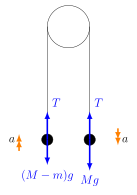
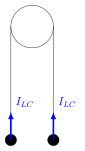
A lift of mass \(M\) and its counterweight of mass \(M\) are connected by a light inextensible cable which passes over a light frictionless pulley. The lift is constrained to move vertically between smooth guides. The distance between the floor and the ceiling of the lift is \(h\). Initially, the lift is at rest, and the distance between the top of the lift and the pulley is greater than \(h\). A small tile of mass \(m\) becomes detached from the ceiling of the lift. Show that the time taken for it to fall to the floor is \[ t=\sqrt{\frac{\left(2M-m\right)h}{Mg}}. \] The collision between the tile and the lift floor is perfectly inelastic. Show that the lift is reduced to rest by the collision, and that the loss of energy of the system is \(mgh\). Note: the question on the STEP database is \[ t=\sqrt{\frac{2\left(M-m\right)h}{Mg}}. \]
Solution:
1987 Paper 1 Q13
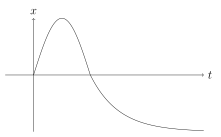
A particle of mass \(m\) moves along the \(x\)-axis. At time \(t=0\) it passes through \(x=0\) with velocity \(v_{0} > 0\). The particle is acted on by a force \(\mathrm{F}(x)\), directed along the \(x\)-axis and measured in the direction of positive \(x\), which is given by \[ \mathrm{F}(x)=\begin{cases} -m\mu^{2}x & \qquad(x\geqslant0),\\ -m\kappa\dfrac{\mathrm{d}x}{\mathrm{d}t} & \qquad(x < 0), \end{cases} \] where \(\mu\) and \(\kappa\) are positive constants. Obtain the particle's subsequent position as a function of time, and give a rough sketch of the \(x\)-\(t\) graph.
Solution: Using Newton's second law in the form, \(\F(x) = m \ddot{x}\). Our two different differential equations can be solved as follows: When \(x \geq 0\) \(-\mu^2x = \ddot{x} \Rightarrow x = A\sin \mu t + B \cos \mu t\) when \(x \geq 0\). And when \(x < 0\) \(-\kappa \dot{x} = \ddot{x} \Rightarrow \dot{x} = Ce^{-\kappa t} \Rightarrow x = De^{-\kappa t} + E\) when \(x < 0\) Following the trajectory of the particle: At \(t = 0, x = 0, \dot{x} = v_0 > 0\), so \(x = \frac{v_0}{\mu} \sin \mu t\) until \(t = \frac{\pi}{\mu}\). When \(t = \frac{\pi}{\mu}\) the particle will head into the negative \(x\)-axis with velocity \(-v_0\). At which point our initial conditions for our differential equations give us that \(De^{-\frac{\pi\kappa}{\mu}} + E = 0, -\kappa De^{-\frac{\pi\kappa}{\mu}} = -v_0 \Rightarrow De^{-\frac{\pi\kappa}{\mu}} = \frac{v_0}{\kappa}, E = -\frac{v_0}{\kappa}\). To summarise: \[ x(t) = \begin{cases} \frac{v_0}{\mu} \sin \mu t & 0 \leq t \leq \frac{\pi}{\mu} \\ -\frac{v_0}{\kappa} \l 1-e^{-\kappa(t-\frac{\pi}{\mu})}\r & t > \frac{\pi}{\mu}\end{cases}\]