Problems
Filters
37 problems found
2000 Paper 2 Q11
The string \(AP\) has a natural length of \(1\!\cdot5\!\) metres and modulus of elasticity equal to \(5g\) newtons. The end \(A\) is attached to the ceiling of a room of height \(2\!\cdot\!5\) metres and a particle of mass \mbox{\(0\!\cdot\!5\) kg} is attached to the end \(P\). The end \(P\) is released from rest at a point \(0\!\cdot\!5\) metres above the floor and vertically below \(A\). Show that the string becomes slack, but that \(P\) does not reach the ceiling. Show also that while the string is in tension, \(P\) executes simple harmonic motion, and that the time in seconds that elapses from the instant when \(P\) is released to the instant when \(P\) first returns to its original position is $$ \left(\frac8{3g}\right)^{\!\frac12}+ \left(\frac3 {5g}\right)^{\!\frac12} {\Big(\pi - \arccos (3/7)\Big)}. $$ \noindent [Note that \(\arccos x\) is another notation for \(\cos^{-1} x\).]
1999 Paper 1 Q10
A particle is attached to a point \(P\) of an unstretched light uniform spring \(AB\) of modulus of elasticity \(\lambda\) in such a way that \(AP\) has length \(a\) and \(PB\) has length \(b\). The ends \(A\) and \(B\) of the spring are now fixed to points in a vertical line a distance \(l\) apart, The particle oscillates along this line. Show that the motion is simple harmonic. Show also that the period is the same whatever the value of \(l\) and whichever end of the string is uppermost.
1997 Paper 3 Q9
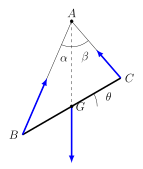
A uniform rigid rod \(BC\) is suspended from a fixed point \(A\) by light stretched springs \(AB,AC\). The springs are of different natural lengths but the ratio of tension to extension is the same constant \(\kappa\) for each. The rod is not hanging vertically. Show that the ratio of the lengths of the stretched springs is equal to the ratio of the natural lengths of the unstretched springs.
Solution:
1996 Paper 1 Q9
A bungee-jumper of mass \(m\) is attached by means of a light rope of natural length \(l\) and modulus of elasticity \(mg/k,\) where \(k\) is a constant, to a bridge over a ravine. She jumps from the bridge and falls vertically towards the ground. If she only just avoids hitting the ground, show that the height \(h\) of the bridge above the floor of the ravine satisfies \[ h^{2}-2hl(k+1)+l^{2}=0, \] and hence find \(h.\) Show that the maximum speed \(v\) which she attains during her fall satisfies \[ v^{2}=(k+2)gl. \]
Solution: \begin{align*} && \text{Energy at the top} &= mgh \\ && \text{Energy at the bottom} &= \frac12\frac{\lambda (h-l)^2}{l} \\ \Rightarrow && mgh & = \frac{\frac{mg}{k}(h-l)^2}{2l} \\ \Rightarrow && 2hkl &= (h-l)^2 \\ \Rightarrow && 0 &= h^2-2lh-2hlk+l^2 \\ &&0&= h^2-2hl(k+1)+l^2 \\ \Rightarrow && \frac{h}{l} &= \frac{2(k+1)\pm \sqrt{4(k+1)^2-4}}{2} \\ &&&= (k+1) \pm \sqrt{k^2+2k} \\ \Rightarrow && h &= l \left ( (k+1) \pm \sqrt{k^2+2k} \right) \end{align*} Since the negative root is less than \(1\), she would have not fully extended the cord. Therefore \(h = l \left ( (k+1) + \sqrt{k^2+2k} \right)\) Her maximum speed will be when her acceleration is \(0\), ie \(g = \text{force from cord}\) ie \(mg = \frac{\lambda x}{l}\) or \(x = \frac{mgl}{\lambda} = \frac{mglk}{mg} = kl\). At this point by conservation of energy we will have \begin{align*} && mgh &= mg(h-l-x) + \frac12 m v^2+\frac{1}{2} \frac{mgx^2}{kl} \\ \Rightarrow && mg\left ( l + kl \right) &= \frac12 m v^2 + \frac12 \frac{mgl^2k^2}{kl} \\ \Rightarrow && 2g\left ( l + kl \right) &= v^2 + glk \\ \Rightarrow && v^2 &= gl(2+k) \end{align*}
1996 Paper 2 Q11
A particle hangs in equilibrium from the ceiling of a stationary lift, to which it is attached by an elastic string of natural length \(l\) extended to a length \(l+a\). The lift now descends with constant acceleration \(f\) such that \(0 < f < g/2\). Show that the extension \(y\) of the string from its equilibrium length satisfies the differential equation $$ {{\rm d}^2 y \over {\rm d} t^2} +{g \over a}\, y = g-f. $$ Hence show that the string never becomes slack and the amplitude of the oscillation of the particle is \(af/g\). After a time \(T\) the lift stops accelerating and moves with constant velocity. Show that the string never becomes slack and the amplitude of the oscillation is now \[\frac{2af}{g}|\sin {\textstyle \frac{1}{2}}\omega T|,\] where \(\omega^{2}=g/a\).
1996 Paper 3 Q11
A smooth circular wire of radius \(a\) is held fixed in a vertical plane with light elastic strings of natural length \(a\) and modulus \(\lambda\) attached to the upper and lower extremities, \(A\) and \(C\) respectively, of the vertical diameter. The other ends of the two strings are attached to a small ring \(B\) which is free to slide on the wire. Show that, while both strings remain taut, the equation for the motion of the ring is $$2ma \ddot\theta=\lambda(\cos\theta-\sin\theta)-mg\sin\theta,$$ where \(\theta\) is the angle \( \angle{CAB}\). Initially the system is at rest in equilibrium with \(\sin\theta=\frac{3}{5}\). Deduce that \(5\lambda=24mg\). The ring is now displaced slightly. Show that, in the ensuing motion, it will oscillate with period approximately $$10\pi\sqrt{a\over91g}\,.$$
1995 Paper 1 Q10
A small ball of mass \(m\) is suspended in equilibrium by a light elastic string of natural length \(l\) and modulus of elasticity \(\lambda.\) Show that the total length of the string in equilibrium is \(l(1+mg/\lambda).\) If the ball is now projected downwards from the equilibrium position with speed \(u_{0},\) show that the speed \(v\) of the ball at distance \(x\) below the equilibrium position is given by \[ v^{2}+\frac{\lambda}{lm}x^{2}=u_{0}^{2}. \] At distance \(h\), where \(\lambda h^{2} < lmu_{0}^{2},\) below the equilibrium position is a horizontal surface on which the ball bounces with a coefficient of restitution \(e\). Show that after one bounce the velocity \(u_{1}\) at \(x=0\) is given by \[ u_{1}^{2}=e^{2}u_{0}^{2}+\frac{\lambda}{lm}h^{2}(1-e^{2}), \] and that after the second bounce the velocity \(u_{2}\) at \(x=0\) is given by \[ u_{2}^{2}=e^{4}u_{0}^{2}+\frac{\lambda}{lm}h^{2}(1-e^{4}). \]
1994 Paper 1 Q10
One end \(A\) of a light elastic string of natural length \(l\) and modulus of elasticity \(\lambda\) is fixed and a particle of mass \(m\) is attached to the other end \(B\). The particle moves in a horizontal circle with centre on the vertical through \(A\) with angular velocity \(\omega.\) If \(\theta\) is the angle \(AB\) makes with the downward vertical, find an expression for \(\cos\theta\) in terms of \(m,g,l,\lambda\) and \(\omega.\) Show that the motion described is possible only if \[ \frac{g\lambda}{l(\lambda+mg)}<\omega^{2}<\frac{\lambda}{ml}. \]
1994 Paper 2 Q10
A truck is towing a trailer of mass \(m\) across level ground by means of an elastic rope of natural length \(l\) whose modulus of elasticity is \(\lambda.\) At first the rope is slack and the trailer stationary. The truck then accelerates until the rope becomes taut and thereafter the truck travels in a straight line at a constant speed \(u\). Assuming that the effect of friction on the trailer is negligible, show that the trailer will collide with the truck at a time \[ \pi\left(\frac{lm}{\lambda}\right)^{\frac{1}{2}}+\frac{l}{u} \] after the rope first becomes taut.
1994 Paper 3 Q11
A step-ladder has two sections \(AB\) and \(AC,\) each of length \(4a,\) smoothly hinged at \(A\) and connected by a light elastic rope \(DE,\) of natural length \(a/4\) and modulus \(W\), where \(D\) is on \(AB,\) \(E\) is on \(AC\) and \(AD=AE=a.\) The section \(AB,\) which contains the steps, is uniform and of weight \(W\) and the weight of \(AC\) is negligible. The step-ladder rests on a smooth horizontal floor and a man of weight \(4W\) carefully ascends it to stand on a rung distant \(\beta a\) from the end of the ladder resting on the floor. Find the height above the floor of the rung on which the man is standing when \(\beta\) is the maximum value at which equilibrium is possible.
Solution:

1993 Paper 1 Q10
A small lamp of mass \(m\) is at the end \(A\) of a light rod \(AB\) of length \(2a\) attached at \(B\) to a vertical wall in such a way that the rod can rotate freely about \(B\) in a vertical plane perpendicular to the wall. A spring \(CD\) of natural length \(a\) and modulus of elasticity \(\lambda\) is joined to the rod at its mid-point \(C\) and to the wall at a point \(D\) a distance \(a\) vertically above \(B\). The arrangement is sketched below. \noindent
1993 Paper 3 Q12
\(ABCD\) is a horizontal line with \(AB=CD=a\) and \(BC=6a\). There are fixed smooth pegs at \(B\) and \(C\). A uniform string of natural length \(2a\) and modulus of elasticity \(kmg\) is stretched from \(A\) to \(D\), passing over the pegs at \(B\) and \(C\). A particle of mass \(m\) is attached to the midpoint \(P\) of the string. When the system is in equilibrium, \(P\) is a distance \(a/4\) below \(BC\). Evaluate \(k\). The particle is pulled down to a point \(Q\), which is at a distance \(pa\) below the mid-point of \(BC\), and is released from rest. \(P\) rises to a point \(R\), which is at a distance \(3a\) above \(BC\). Show that \(2p^2-p-17=0\). Show also that the tension in the strings is less when the particle is at \(R\) than when the particle is at \(Q\).
1992 Paper 1 Q11
Three light elastic strings \(AB,BC\) and \(CD\), each of natural length \(a\) and modulus of elasticity \(\lambda,\) are joined together as shown in the diagram. \noindent
1992 Paper 2 Q12
In the figure, \(W_{1}\) and \(W_{2}\) are wheels, both of radius \(r\). Their centres \(C_{1}\) and \(C_{2}\) are fixed at the same height, a distance \(d\) apart, and each wheel is free to rotate, without friction, about its centre. Both wheels are in the same vertical plane. Particles of mass \(m\) are suspended from \(W_{1}\) and \(W_{2}\) as shown, by light inextensible strings would round the wheels. A light elastic string of natural length \(d\) and modulus elasticity \(\lambda\) is fixed to the rims of the wheels at the points \(P_{1}\) and \(P_{2}.\) The lines joining \(C_{1}\) to \(P_{1}\) and \(C_{2}\) to \(P_{2}\) both make an angle \(\theta\) with the vertical. The system is in equilibrium. \noindent
- sep}{3mm}
- \(\bf (i)\) no equilibrium positions,
- \(\bf (ii)\) just one equilibrium position,
- \(\bf (iii)\) exactly two equilibrium positions,
- \(\bf (iv)\) more than two equilibrium positions?
1992 Paper 3 Q13
\(\,\)