Problems

Filters
Clear Filters
1993 Paper 1 Q11
D: 1516.0 B: 1472.3

A piece of uniform wire is bent into three sides of a square \(ABCD\) so that the side \(AD\) is missing. Show that if it is first hung up by the point \(A\) and then by the point \(B\) then the angle between the two directions of \(BC\) is \(\tan^{-1}18.\)


Solution:

TikZ diagram
In the coordinate system where \(A\) is \((0,0)\) and \(AD\) is the \(x\)-axis and \(AB\) the \(y\)-axis and all side lengths are \(2\), we find the centre of mass of each of the sides are: \begin{align*} AB :& (0,1) \\ BC :& (1,2) \\ CD :& (2,1) \\ \\ ABCD:& \l 1, \frac{4}{3} \r \end{align*} When hung from \(A\), the angle \(AB\) makes to the vertical is \(\alpha\) and the angle \(BC\) makes to the vertical will be \(90^{\circ} + \alpha\). When hung from \(B\) the angle \(BC\) makes to the vertical will be \(\beta\). The value we are interested in therefore is \(\beta + 90^{\circ} + \alpha\) \begin{align*} && \tan \alpha &= \frac{1}{\frac{4}{3}} \\ &&& = \frac{4}{3} \\ \\ && \tan \beta &= \frac{\frac{2}{3}}{1} \\ &&&= \frac{2}{3} \\ \\ && \tan \l \beta + (90^{\circ} + \alpha) \r &= \frac{\tan \beta + \tan\l 90^{\circ} + \alpha \r}{1 - \tan \beta \tan\l 90^{\circ} + \alpha \r} \\ &&&= \frac{\frac23 + \frac43}{1- \frac23 \frac43} \\ &&&= \frac{2}{1 - \frac89} \\ &&&= 18 \end{align*}

1993 Paper 1 Q12
D: 1500.0 B: 1484.0

In a clay pigeon shoot the target is launched vertically from ground level with speed \(v\). At a time \(T\) later the competitor fires a rifle inclined at angle \(\alpha\) to the horizontal. The competitor is also at ground level and is a distance \(l\) from the launcher. The speed of the bullet leaving the rifle is \(u\). Show that, if the competitor scores a hit, then \[ l\sin\alpha-\left(vT-\tfrac{1}{2}gT^{2}\right)\cos\alpha=\frac{v-gT}{u}l. \] Suppose now that \(T=0\). Show that if the competitor can hit the target before it hits the ground then \(v < u\) and \[ \frac{2v\sqrt{u^{2}-v^{2}}}{g}>l. \]

1993 Paper 1 Q13
D: 1516.0 B: 1470.3

A train starts from a station. The tractive force exerted by the engine is at first constant and equal to \(F\). However, after the speed attains the value \(u\), the engine works at constant rate \(P,\) where \(P=Fu.\) The mass of the engine and the train together is \(M.\) Forces opposing motion may be neglected. Show that the engine will attain a speed \(v\), with \(v\geqslant u,\) after a time \[ t=\frac{M}{2P}\left(u^{2}+v^{2}\right). \] Show also that it will have travelled a distance \[ \frac{M}{6P}(2v^{3}+u^{3}) \] in this time.


Solution: While the force is constant, the train is accelerating at \(\frac{F}{M}\), and since \(u = \frac{F}{M} t_1 \Rightarrow t_1 = \frac{Mu^2}{Fu} = \frac{Mu^2}{P}\). Once the train is being driven at a constant rate, we can observe that change in energy will be power times time, ie \(Pt_2 = \frac{1}{2}M(v^2 - u^2) \Rightarrow t_2 = \frac{M}{2P} ( v^2 - u^2)\). Therefore the total time will be \(t_1 + t_2 = \frac{M}{2P} ( u^2 + v^2)\). During the first period, the distance will be: \(s_1 = \frac12 \frac{F}{M} t_1^2 = \frac12 \frac{F}{M} \frac{M^2u^2}{F^2} = \frac{Mu^3}{2P}\) In the second period, \(P = Fu\) and so \(\text{Force} = \frac{P}{v} \Rightarrow M v \frac{\d v}{\d x} = \frac{P}{v} \Rightarrow M \l \frac{v^3}{3} - \frac{u^3}{3}\r = Ps_2\) and therefore total distance will be: \(\frac{M}{6P}(2v^{3}+u^{3})\)

1993 Paper 1 Q14
D: 1500.0 B: 1505.6

When he sets out on a drive Mr Toad selects a speed \(V\) kilometres per minute where \(V\) is a random variable with probability density \[ \alpha v^{-2}\mathrm{e}^{-\alpha v^{-1}} \] and \(\alpha\) is a strictly positive constant. He then drives at constant speed, regardless of other drivers, road conditions and the Highway Code. The traffic lights at the Wild Wood cross-roads change from red to green when Mr Toad is exactly 1 kilometre away in his journey towards them. If the traffic light is green for \(g\) minutes, then red for \(r\) minutes, then green for \(g\) minutes, and so on, show that the probability that he passes them after \(n(g+r)\) minutes but before \(n(g+r)+g\) minutes, where \(n\) is a positive integer, is \[ \mathrm{e}^{-\alpha n(g+r)}-\mathrm{e}^{-\alpha\left(n(g+r)\right)+g}. \] Find the probability \(\mathrm{P}(\alpha)\) that he passes the traffic lights when they are green. Show that \(\mathrm{P}(\alpha)\rightarrow1\) as \(\alpha\rightarrow\infty\) and, by noting that \((\mathrm{e}^{x}-1)/x\rightarrow1\) as \(x\rightarrow0\), or otherwise, show that \[ \mathrm{P}(\alpha)\rightarrow\frac{g}{r+g}\quad\mbox{ as }\alpha\rightarrow0. \] {[}NB: the traffic light show only green and red - not amber.{]}

1993 Paper 1 Q15
D: 1500.0 B: 1532.0

Captain Spalding is on a visit to the idyllic island of Gambriced. The population of the island consists of the two lost tribes of Frodox and the latest census shows that \(11/16\) of the population belong to the Ascii who tell the truth \(3/4\) of the time and \(5/16\) to the Biscii who always lie. The answers of an Ascii to each question (even if it is the same as one before) are independent. Show that the probability that an Ascii gives the same answer twice in succession to the same question is \(5/8\). Show that the probability that an Ascii gives the same answer twice is telling the truth is \(9/10.\) Captain Spalding addresses one of the natives as follows. \hspace{1.5em} \textsl{Spalding: }My good man, I'm afraid I'm lost. Should I go left or right to reach the nearest town?\nolinebreak \hspace{1.5em}\textsl{Native: }Left. \hspace{1.5em}\textsl{Spalding: }I am a little deaf. Should I go left or right to reach the nearest town? \hspace{1.5em}\textsl{Native (patiently): }Left. Show that, on the basis of this conversation, Captain Spalding should go left to try and reach the nearest town and that there is a probability \(99/190\) that this is the correct direction. The conversation resumes as follows. \hspace{1.5em}\textsl{Spalding: }I'm sorry I didn't quite hear that. Should I go left or right to reach the nearest town? \hspace{1.5em}\textsl{Native (loudly and clearly): }Left. Shouls Captain Spalding go left or right and why? Show that if he follows your advice the probability that this is the correct direction is \(331/628\).

1993 Paper 1 Q16
D: 1516.0 B: 1531.3

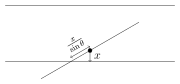
By making the substitution \(y=\cos^{-1}t,\) or otherwise, show that \[ \int_{0}^{1}\cos^{-1}t\,\mathrm{d}t=1. \] A pin of length \(2a\) is thrown onto a floor ruled with parallel lines equally spaced at a distance \(2b\) apart. The distance \(X\) of its centre from the nearest line is a uniformly distributed random variable taking values between \(0\) and \(b\) and the acute angle \(Y\) the pin makes with a direction perpendicular to the line is a uniformly distributed random variable taking values between \(0\) and \(\pi/2\). \(X\) and \(Y\) are independent. If \(X=x\) what is the probability that the pin crosses the line? If \(a < b\) show that the probability that the pin crosses a line for a general throw is \(\dfrac{2a}{\pi b}.\)


Solution: \begin{align*} && I &= \int_0^1 \cos^{-1} t \d t \\ \cos y = t: -\sin y \d y = \d t: &&&= \int_{\frac{\pi}{2}}^0 -y \sin y \d y \\ &&&= \int_0^{\pi/2} y \sin y \d y \\ &&&= \left [-y \cos y \right]_0^{\pi/2} + \int_0^{\pi/2} \cos y \d y \\ &&&= \left [ \sin y \right]_0^{\pi/2} = 1 \end{align*}
TikZ diagram
If \(X = x\) then the rod will cross the line if \(\frac{x}{\sin \theta} < a\) or \(\frac{2b-x}{\sin \theta} < a\), ie \(a\sin \theta > \max (x, 2b-x)\). Therefore the probability is \(\frac{2\sin^{-1} \left (\max(\frac{x}{a}, \frac{2b-x}{a}) \right)}{\pi}\). Therefore the probability the pin crosses a line is: \begin{align*} \mathbb{P} &= \frac{1}{2b}\int_{x=0}^{x=2b} \frac{2\sin^{-1} \left (\max(\frac{x}{a}, \frac{2b-x}{a}) \right)}{\pi} \d x \\ &= \frac{2a}{b\pi} \end{align*}