Problems
Filters
219 problems found
1988 Paper 3 Q11
A uniform ladder of length \(l\) and mass \(m\) rests with one end in contact with a smooth ramp inclined at an angle of \(\pi/6\) to the vertical. The foot of the ladder rests, on horizontal ground, at a distance \(l/\sqrt{3}\) from the foot of the ramp, and the coefficient of friction between the ladder and the ground is \(\mu.\) The ladder is inclined at an angle \(\pi/6\) to the horizontal, in the vertical plane containing a line of greatest slope of the ramp. A labourer of mass \(m\) intends to climb slowly to the top of the ladder.
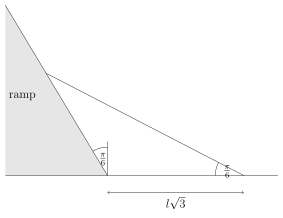
- Find the value of \(\mu\) if the ladder slips as soon as the labourer reaches the midpoint.
- Find the minimum value of \(\mu\) which will ensure that the labourer can reach the top of the ladder.
Solution:
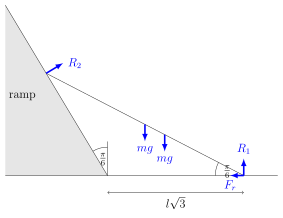
- \begin{align*} \text{N2}(\uparrow): && R_1 + R_2\sin(\frac{\pi}{6})-2mg &= 0 \\ \text{N2}(\rightarrow): && R_2 \cos (\frac{\pi}{6})-F_r &= 0 \\ \overset{\curvearrowleft}{X}: && lmg \cos \tfrac{\pi}{6} - l R_2 \cos \tfrac{\pi}{6} &= 0 \\ \\ \Rightarrow && R_2 &= mg \\ \Rightarrow && R_1 &= 2mg - \frac12mg \\ &&&=\frac32mg \\ \Rightarrow && \frac{\sqrt{3}}2mg - \mu\frac32mg &= 0 \\ \Rightarrow && \mu &= \frac{1}{\sqrt{3}} \end{align*}
- \begin{align*} \text{N2}(\uparrow): && R_1 + R_2\sin(\frac{\pi}{6})-2mg &= 0 \\ \overset{\curvearrowleft}{X}: && \frac12 lmg \cos \tfrac{\pi}{6}+xmg \cos \tfrac{\pi}{6} - l R_2 \cos \tfrac{\pi}{6} &= 0 \\ \\ \Rightarrow && R_2 &= mg(\frac{1}2+\frac{x}{l}) \\ \Rightarrow && R_1 &= 2mg - \frac12mg(\frac{1}2+\frac{x}{l}) \\ &&&=(\frac74 - \frac{x}{2l})mg \\ &&&\geq \frac{5}{4}mg\\ \text{N2}(\rightarrow): && R_2 \cos (\frac{\pi}{6})-\mu R_1& \leq 0 \\ \Rightarrow && \frac{\sqrt{3}}2mg - \mu\frac54mg &\leq 0 \\ \Rightarrow && \mu &\geq \frac{2\sqrt{3}}{5} \end{align*}
1988 Paper 3 Q12
A smooth billiard ball moving on a smooth horizontal table strikes another identical ball which is at rest. The coefficient of restitution between the balls is \(e(<1)\). Show that after the collision the angle between the velocities of the balls is less than \(\frac{1}{2}\pi.\) Show also that the maximum angle of deflection of the first ball is \[ \sin^{-1}\left(\frac{1+e}{3-e}\right). \]
Solution:

1987 Paper 1 Q10
A rubber band band of length \(2\pi\) and modulus of elasticity \(\lambda\) encircles a smooth cylinder of unit radius, whose axis is horizontal. A particle of mass \(m\) is attached to the lowest point of the band, and hangs in equilibrium at a distance \(x\) below the axis of the cylinder. Obtain an expression in terms of \(x\) for the stretched length of the band in equilibrium. What is the value of \(\lambda\) if \(x=2\)?
Solution:

1987 Paper 2 Q15
A train of length \(l_{1}\) and a lorry of length \(l_{2}\) are heading for a level crossing at speeds \(u_{1}\) and \(u_{2}\) respectively. Initially the front of the train and the front of the lorry are at distances \(d_{1}\) and \(d_{2}\) from the crossing. Find conditions on \(u_{1}\) and \(u_{2}\) under which a collision will occur. On a diagram with \(u_{1}\) and \(u_{2}\) measured along the \(x\) and \(y\) axes respectively, shade in the region which represents collision. Hence show that if \(u_{1}\) and \(u_{2}\) are two independent random variables, both uniformly distributed on \((0,V)\), then the probability of a collision in the case when initially the back of the train is nearer to the crossing than the front of the lorry is \[ \frac{l_{1}l_{2}+l_{2}d_{1}+l_{1}d_{2}}{2d_{2}\left(l_{2}+d_{2}\right)}. \] Find the probability of a collision in each of the other two possible cases.
1987 Paper 3 Q4

Solution: The initial volume of water in \(A\) is: \begin{align*} \pi \int_0^4 x^2 \, \d y &= \pi \int_0^4 y \d y \\ &= \pi [ \frac{y^2}{2}]_0^4 \\ &= 8\pi \end{align*} We assume that no water is in the tube as it is `thin'. Therefore we must have: \begin{align*} && 8\pi &= \pi \int_0^{h-1} x^2 \d y +\pi \int_0^{h} x^2 \d y \\ &&&= \pi \int_0^{h-1} y \d y +\pi \int_0^{h} \l \sinh \frac{x}{2}\r^2 \d y \\ &&&= \pi \left [\frac{y^2}{2} \right]_0^{h-1} + \pi \int_0^h \frac{-1+\cosh y}{2}\d y \\ &&&= \pi \frac{(h-1)^2}{2} + \pi \left [ -\frac{y}{2} +\frac{\sinh y}{2}\right]_0^h \\ &&&= \pi \frac{(h-1)^2}{2} -\pi \frac{h}{2} + \pi \frac{\sinh h}{2} \\ \Rightarrow && 0 &= h^2-2h+1-h+\sinh h -16 \\ &&&= h^2 -3h+\sinh h - 15 \\ \Rightarrow && 15 &= h^2 -3h+\sinh h \end{align*}
1987 Paper 3 Q8
Show that, if the lengths of the diagonals of a parallelogram are specified, then the parallogram has maximum area when the diagonals are perpendicular. Show also that the area of a parallelogram is less than or equal to half the square of the length of its longer diagonal. The set \(A\) of points \((x,y)\) is given by \begin{alignat*}{1} \left|a_{1}x+b_{1}y-c_{1}\right| & \leqslant\delta,\\ \left|a_{2}x+b_{2}y-c_{2}\right| & \leqslant\delta, \end{alignat*} with \(a_{1}b_{2}\neq a_{2}b_{1}.\) Sketch this set and show that it is possible to find \((x_{1},y_{1}),(x_{2},y_{2})\in A\) with \[ (x_{1}-x_{2})^{2}+(y_{1}-y_{2})^{2}\geqslant\frac{8\delta^{2}}{\left|a_{1}b_{2}-a_{2}b_{1}\right|}. \]
Solution: In a parallelogram the diagonals meet at their mid points. Fixing one diagonal, we can look at the two triangles formed by the other diagonal. Suppose the angle between them is \(\theta\). Then the area of the triangles will be \(\frac12 \frac{l_1}{2} \frac{l_2}2 \sin \theta+\frac12 \frac{l_1}{2} \frac{l_2}2 \sin (\pi -\theta) = \frac{l_1l_2}{4} \sin \theta\). This will be true on both sides. Therefore we can maximise this area by setting \(\theta = \frac{\pi}{2}\).

1987 Paper 3 Q11
A woman stands in a field at a distance of \(a\,\mathrm{m}\) from the straight bank of a river which flows with negligible speed. She sees her frightened child clinging to a tree stump standing in the river \(b\,\mathrm{m}\) downstream from where she stands and \(c\,\mathrm{m}\) from the bank. She runs at a speed of \(u\,\mathrm{ms}^{-1}\) and swims at \(v\,\mathrm{ms}^{-1}\) in straight lines. Find an equation to be satisfied by \(x,\) where \(x\,\mathrm{m}\) is the distance upstream from the stump at which she should enter the river if she is to reach the child in the shortest possible time. Suppose now that the river flows with speed \(v\) ms\(^{-1}\) and the stump remains fixed. Show that, in this case, \(x\) must satisfy the equation \[ 2vx^{2}(b-x)=u(x^{2}-c^{2})[a^{2}+(b-x)^{2}]^{\frac{1}{2}}. \] For this second case, draw sketches of the woman's path for the three possibilities \(b>c,\) \(b=c\) and \(b< c\).
Solution:


1987 Paper 3 Q15
A patient arrives with blue thumbs at the doctor's surgery. With probability \(p\) the patient is suffering from Fenland fever and requires treatment costing \(\pounds 100.\) With probability \(1-p\) he is suffering from Steppe syndrome and will get better anyway. A test exists which infallibly gives positive results if the patient is suffering from Fenland fever but also has probability \(q\) of giving positive results if the patient is not. The test cost \(\pounds 10.\) The doctor decides to proceed as follows. She will give the test repeatedly until either the last test is negative, in which case she dismisses the patient with kind words, or she has given the test \(n\) times with positive results each time, in which case she gives the treatment. In the case \(n=0,\) she treats the patient at once. She wishes to minimise the expected cost \(\pounds E_{n}\) to the National Health Service.
- Show that \[ E_{n+1}-E_{n}=10p-10(1-p)q^{n}(9-10q), \] and deduce that if \(p=10^{-4},q=10^{-2},\) she should choose \(n=3.\)
- Show that if \(q\) is larger than some fixed value \(q_{0},\) to be determined explicitly, then whatever the value of \(p,\) she should choose \(n=0.\)
Solution:
- \(E_{n+1} - E_n\) is the additional cost of the extra test \(10p+10(1-p)q^n\) from people who have yet to fail a test plus the reduce cost of people who will fail the final test, \(-100(1-p)q^n(1-q)\) \begin{align*} E_{n+1}-E_{n} &= 10p+10(1-p)q^n-100(1-p)q^n(1-q) \\ &=10p +10(1-p)q^n(1-10(1-q)) \\ &= 10p +10(1-p)q^n(-9+10q) \\ &= 10p - 10(1-p)q^n(9-10q) \end{align*} \begin{align*} && 10p - 10(1-p)q^n(9-10q) &> 0 \\ \Leftrightarrow && \frac{p}{(1-p)(9-10q)} &>q^n \end{align*} If \(p = 10^{-4}, q = 10^{-2}\) we have: \begin{align*} \frac{p}{(1-p)(9-10q)} &= \frac{10^{-4}}{(1-10^{-4})(9-10^{-3})} \\ &\approx 10^{-5} \end{align*} and \(q^2 < 10^{-5} < q^3\) so she should stop after the 3rd test.
- She shouldn't bother testing if \begin{align*} && \frac{p}{(1-p)(9-10q)} &>1 \\ \Leftrightarrow && \frac{p}{1-p} &>9-10q \\ \Leftrightarrow && 10q &>9 \\ \Leftrightarrow && q &> \frac9{10} = q_0 \end{align*}
1987 Paper 3 Q16
- \(X_{1},X_{2},\ldots,X_{n}\) are independent identically distributed random variables drawn from a uniform distribution on \([0,1].\) The random variables \(A\) and \(B\) are defined by \[ A=\min(X_{1},\ldots,X_{n}),\qquad B=\max(X_{1},\ldots,X_{n}). \] For any fixed \(k\), such that \(0< k< \frac{1}{2},\) let \[ p_{n}=\mathrm{P}(A\leqslant k\mbox{ and }B\geqslant1-k). \] What happens to \(p_{n}\) as \(n\rightarrow\infty\)? Comment briefly on this result.
- Lord Copper, the celebrated and imperious newspaper proprietor, has decided to run a lottery in which each of the \(4,000,000\) readers of his newspaper will have an equal probability \(p\) of winning \(\pounds 1,000,000\) and their changes of winning will be independent. He has fixed all the details leaving to you, his subordinate, only the task of choosing \(p\). If nobody wins \(\pounds 1,000,000\), you will be sacked, and if more than two readers win \(\pounds 1,000,000,\) you will also be sacked. Explaining your reasoning, show that however you choose \(p,\) you will have less than a 60\% change of keeping your job.
Solution:
- \begin{align*} && p_n &= \mathrm{P}(A\leqslant k\mbox{ and }B\geqslant1-k) \\ &&&= \mathrm{P}(A\leqslant k) +\P(B\geqslant1-k) - \mathrm{P}(A\leqslant k\mbox{ or }B\geqslant1-k)\\ &&&= 1-\mathrm{P}(A\geq k) +1-\P(B \leq 1-k) - \l 1- \mathrm{P}(A\geq k\mbox{ and }B\leq 1-k)\r\\ &&&= 1 - \P(X_i \geq k) - \P(X_i \leq 1-k) + \P(k \leq X_i \leq 1-k) \\ &&&= 1 - k^n - (1-k)^n + (1-2k)^n \end{align*} Therefore as \(n \to \infty\) \(p_n \to 1\), since \(k, (1-k), (1-2k)\) are all between \(0\) and \(1\) and so their powers will tend to \(0\).
- Let \(N = 4\,000\,000\). The probability exactly one person wins is \(Np(1-p)^{N-1}\). The probability exactly two people win is \(\binom{N}{2} p^2 (1-p)^{N-2}\). We wish to maximise the sum of these probabilities. To find this maximum, differentiate wrt \(p\). \begin{align*} \frac{\d}{\d p} : && \small N(1-p)^{N-1}-N(N-1)p(1-p)^{N-2} + N(N-1)p(1-p)^{N-2} - \frac12 N(N-1)(N-2)p^2(1-p)^{N-3} \\ &&= N(1-p)^{N-3} \l (1-p)^2 - \frac12(N-1)(N-2)p^2\r \\ \Rightarrow && \frac{(1-p)}{p} = \sqrt{\frac{(N-1)(N-2)}{2}} \\ \Rightarrow && p = \frac{1}{1+ \sqrt{\frac{(N-1)(N-2)}{2}}} \end{align*} This will be a maximum, since this is an increasing function at \(p=0\) and decreasing at \(p=1\) and there's only one stationary point. Note that \(p > \frac{\sqrt{2}}{(N-2)}\) and \(p < \frac{\sqrt{2}}{N-1+\sqrt{2}} < \frac{\sqrt{2}}{N}\) and so: \begin{align*} Np(1-p)^{N-1} &< \sqrt{2}(1-\frac{\sqrt{2}}{N-2})^{N-1} \\ &\approx \sqrt{2} e^{-\sqrt{2}} \end{align*} \begin{align*} \frac{N(N-1)}{2}p^2(1-p)^{N-2} &<(1-\frac{\sqrt{2}}{N-2})^{N-1} \\ &\approx e^{-\sqrt{2}} \end{align*} Alternatively, we can use a Poisson approximation. The number of winners is \(B(N, p)\) where we are hoping \(np\) is small but not zero. Therefore it's reasonable to approximation \(B(N,p)\) by \(Po(Np)\). (Call this value \(\lambda\)). Then we wish to maximise: \begin{align*} && p &= e^{-\lambda} \l \lambda + \frac{\lambda^2}{2} \r \\ &&&= e^{-\lambda} \lambda \l 1+ \frac{\lambda}{2} \r \\ \Rightarrow && \ln p &= -\lambda + \ln \lambda + \ln(1+\frac12 \lambda) \\ \frac{\d}{\d \lambda}: && \frac{p'}{p} &= -1 + \frac{1}{\lambda} + \frac{1}{2+\lambda} \\ &&&= \frac{-(2+\lambda)\lambda+2+2\lambda}{\lambda(2+\lambda)} \\ &&&= \frac{2-\lambda^2}{\lambda(2+\lambda)} \\ \Rightarrow && \lambda &= \sqrt{2} \end{align*} \begin{align*} \frac{\sqrt{2}+1}{e^{\sqrt{2}}} &< \frac{\sqrt{2}+1}{1+\sqrt{2}+1+\frac{1}{3}\sqrt{2}+\frac{1}{6}} \\ &= \frac{30\sqrt{2}-18}{41} \end{align*} Either way, we find we want to estimate \(e^{-\sqrt{2}}(1+\sqrt{2})\)