Problems
Filters
183 problems found
1990 Paper 2 Q16
Each day, I choose at random between my brown trousers, my grey trousers and my expensive but fashionable designer jeans. Also in my wardrobe, I have a black silk tie, a rather smart brown and fawn polka-dot tie, my regimental tie, and an elegant powder-blue cravat which I was given for Christmas. With my brown or grey trousers, I choose ties (including the cravat) at random, except of course that I don\textquoteright t wear the cravat with the brown trousers or the polka-dot tie with the grey trousers. With the jeans, the choice depends on whether it is Sunday or one of the six weekdays: on weekdays, half the time I wear a cream-coloured sweat-shirt with \(E=mc{}^{2}\) on the front and no tie; otherwise, and on Sundays (when naturally I always wear a tie), I just pick at random from my four ties. This morning, I received through the post a compromising photograph of myself. I often receive such photographs and they are equally likely to have been taken on any day of the week. However, in this particular photograph, I am wearing my black silk tie. Show that, on the basis of this information, the probability that the photograph was taken on Sunday is \(11/68\). I should have mentioned that on Mondays I lecture on calculus and I therefore always wear my jeans (to make the lectures seem easier to understand). Find, on the basis of the complete information, the probability that the photograph was taken on Sunday. [The phrase `at random' means `with equal probability'.]
1990 Paper 3 Q15
An unbiased twelve-sided die has its faces marked \(A,A,A,B,B,B,B,B,B,B,B,B.\) In a series of throws of the die the first \(M\) throws show \(A,\) the next \(N\) throws show \(B\) and the \((M+N+1)\)th throw shows \(A\). Write down the probability that \(M=m\) and \(N=n\), where \(m\geqslant0\) and \(n\geqslant1.\) Find
- the marginal distributions of \(M\) and \(N\),
- the mean values of \(M\) and \(N\).
Solution: \begin{align*} \mathbb{P}(M = m, N = n) &= \left ( \frac{3}{12} \right)^m \left ( \frac{9}{12} \right)^n \frac{3}{12} \\ &= \frac{3^n}{4^{m+n+1}} \end{align*}
- \begin{align*} \mathbb{P}(M = m) &= \sum_{n = 1}^{\infty} \mathbb{P}(M=m,N=n) \\ &= \sum_{n = 1}^{\infty} \frac{3^n}{4^{m+n+1}} \\ &= \frac{1}{4^{m+1}} \sum_{n = 1}^{\infty} \left ( \frac34\right)^n \\ &= \frac{1}{4^{m+1}} \frac{3/4}{1/4} \\ &= \frac{3}{4^{m+1}} \\ \\ \mathbb{P}(N = n) &= \sum_{m = 0}^{\infty} \mathbb{P}(M=m,N=n) \\ &= \sum_{m = 0}^{\infty} \frac{3^n}{4^{m+n+1}} \\ &= \frac{3^n}{4^{n+1}} \sum_{m = 0}^{\infty} \left ( \frac14\right)^n \\ &= \frac{3^n}{4^{n+1}} \frac{1}{3/4} \\ &= \frac{3^{n-1}}{4^{n}} \\ \end{align*}
- \(M+1 \sim Geo(\frac34) \Rightarrow \mathbb{E}(M) = \frac43 -1 = \frac13\) \(N \sim Geo(\frac14) \Rightarrow \mathbb{E}(N) = 4\)
1990 Paper 3 Q16
- A rod of unit length is cut into pieces of length \(X\) and \(1-X\); the latter is then cut in half. The random variable \(X\) is uniformly distributed over \([0,1].\) For some values of \(X\) a triangle can be formed from the three pieces of the rod. Show that the conditional probability that, if a triangle can be formed, it will be obtuse-angled is \(3-2\sqrt{2.}\)
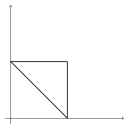
- The bivariate distribution of the random variables \(X\) and \(Y\) is uniform over the triangle with vertices \((1,0),(1,1)\) and \((0,1).\) A pair of values \(x,y\) is chosen at random from this distribution and a (perhaps degenerate) triangle \(ABC\) is constructed with \(BC=x\) and \(CA=y\) and \(AB=2-x-y.\) Show that the construction is always possible and that \(\angle ABC\) is obtuse if and only if \[ y>\frac{x^{2}-2x+2}{2-x}. \] Deduce that the probability that \(\angle ABC\) is obtuse is \(3-4\ln2.\)
Solution:
- The construction is possible if \(x + y > 2-x-y \Rightarrow x+y > 1\) (which is as the triangle is above the diagonal line), and \(x + (2-x-y) > y \Rightarrow 1 > y\) (true as the triangle is below the horizontal line) and \(y + (2-x-y) > x \Rightarrow 1 > x\) (true as the triangle is left of the vertical arrow). By the cosine rule: \begin{align*} && y^2 &= x^2 + (2-x-y)^2 - 2 x (2-x-y) \cos \angle ABC \\ \Rightarrow && \cos \angle ABC &= \frac{x^2+(2-x-y)^2 - y^2}{2x(2-x-y)} \\ &&&= \frac{4+2x^2-4x-4y+2xy}{2x(2-x-y)} \\ \underbrace{\Rightarrow}_{\cos \angle ABC < 0} && 0 &> 4+2x^2-4x-4y+2xy \\ \Rightarrow && 0 &> 2x^2-4x+4 - 2(x-2)y \\ \Rightarrow && y &> \frac{x^2-2x+2}{2-x} \\ &&&= -x + \frac{2}{2-x} \end{align*}
 Therefore the area we want is: \begin{align*} A &= 1 - \int_0^1 \left ( -x + \frac{2}{2-x} \right)\d x \\ &= 1 - \left [-\frac12 x^2 - 2 \ln(2-x) \right]_0^1 \\ &= 1 + \frac12 -2 \ln 2 \\ &= \frac32 - 2 \ln 2 \end{align*} Therefore the relative area is: \(\frac{\frac32 - 2 \ln 2}{1/2} = 3 - 4 \ln 2\)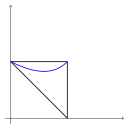
1989 Paper 1 Q14
The prevailing winds blow in a constant southerly direction from an enchanted castle. Each year, according to an ancient tradition, a princess releases 96 magic seeds from the castle, which are carried south by the wind before falling to rest. South of the castle lies one league of grassy parkland, then one league of lake, then one league of farmland, and finally the sea. If a seed falls on land it will immediately grow into a fever tree. (Fever trees do not grow in water). Seeds are blown independently of each other. The random variable \(L\) is the distance in leagues south of the castle at which a seed falls to rest (either on land or water). It is known that the probability density function \(\mathrm{f}\) of \(L\) is given by \[ \mathrm{f}(x)=\begin{cases} \frac{1}{2}-\frac{1}{8}x & \mbox{ for }0\leqslant x\leqslant4,\\ 0 & \mbox{ otherwise.} \end{cases} \] What is the mean number of fever trees which begin to grow each year?
- The random variable \(Y\) is defined as the distance in leagues south of the castle at which a new fever tree grows from a seed carried by the wind. Sketch the probability density function of \(Y\), and find the mean of \(Y\).
- One year messengers bring the king the news that 23 new fever trees have grown in the farmland. The wind never varies, and so the king suspects that the ancient tradition have not been followed properly. Is he justified in his suspicions?
Solution: \begin{align*} \mathbb{P}(\text{fever tree grows}) &= \mathbb{P}(0 \leq L \leq 1) + \mathbb{P}(2 \leq L \leq 3) \\ &= \int_0^1 \frac12 -\frac18 x \d x + \int_2^3 \frac12 - \frac18 x \d x \\ &= \left [\frac12 x - \frac1{16}x^2 \right]_0^1+ \left [\frac12 x - \frac1{16}x^2 \right]_2^3 \\ &= \frac12 - \frac1{16}+\frac32-\frac9{16} - 1 + \frac{4}{16} \\ &= \frac58 \end{align*} The expected number of fever trees is just \(96 \cdot \frac58 = 60\).
- \(f_Y(t)\) must match the distribution for \(L\), but limited to the points we care about, therefore it should be:
$f_Y(t) = \begin{cases} ( \frac45 - \frac15t ) & \text{if } t \in [0,1]\cup[2,3] \\
0 & \text{otherwise} \end{cases}$
\begin{align*} \mathbb{E}(Y) &= \frac12 \cdot \frac15 (4 - \frac12)+\frac52 \cdot (1 - \frac15 (4 - \frac12)) \\ &= \frac12 \cdot \frac7{10} + \frac52 \cdot \frac3{10} \\ &= \frac{22}{20} \\ &= \frac{11}{10} \end{align*}

- Given the seeds are blown independently and the wind hasn't changed, it is reasonable to model the number of fever trees as \(B(96, \frac{5}{8})\), it is also acceptable to approximate this using a Normal distribution, ie \(N(60, 22.5)\), \(23\) is \(\frac{23-60}{\sqrt{22.5}}\) is a very negative number, so he should be extremely suspicious.
1989 Paper 1 Q15
I can choose one of three routes to cycle to school. Via Angle Avenue the distance is 5\(\,\)km, and I am held up at a level crossing for \(A\) minutes, where \(A\) is a continuous random variable uniformly distributed between \(0\) and 10. Via Bend Boulevard the distance is 4\(\,\)km, and I am delayed, by talking to each of \(B\) friends for 3\(\,\)minutes, for a total of \(3B\) minutes, where \(B\) is a random variable whose distribution is Poisson with mean 4. Via Detour Drive the distance should be only 2\(\,\)km, but in addition, due to never-ending road works, there are five places at each of which, with probability \(\frac{4}{5},\) I have to make a detour that increases the distance by 1\(\,\)km. Except when delayed by talking to friends or at the level crossing, I cycle at a steady 12\(\,\)km\(\,\)h\(^{-1}\). For each of the three routs, calculate the probability that a journey lasts at least 27 minutes. Each day I choose one of the three routes at random, and I am equally likely to choose any of the three alternatives. One day I arrive at school after a journey of at least 27 minutes. What is the probability that I came via Bend Boulevard? Which route should I use all the time: \begin{questionparts} \item if I wish my average journey time to be as small as possible; \item if I wish my journey time to be less than 32 minutes as often as possible? \end{questionpart} Justify your answers.
Solution: \(A \sim 5\cdot 5 + U[0,10]\) \(B \sim 4 \cdot 5 + 3 \textrm{Po}(4)\) \(C \sim 2 \cdot 5 + B(5, \frac{4}{5}) \cdot 5\) \begin{align*} && \mathbb{P}(A \leq 27) &= \mathbb{P}(U \leq 2) = 0.2 \\ && \mathbb{P}(B \leq 27) &= \mathbb{P}(3 \textrm{Po}(4) \leq 7) \\\ &&&= \mathbb{P}(Po(4) \leq 2) \\ &&&= e^{-4}(1 + 4 + \frac{4^2}{2}) \\ &&&= 0.23810\ldots \\ && \mathbb{P}(C \leq 27) &= \mathbb{P}(5 \cdot B(5,\tfrac45) \leq 17) \\ &&&= \mathbb{P}(B(5,\tfrac45) \leq 3) \\ &&&= \binom{5}{0} (\tfrac15)^5 + \binom{5}{1} (\tfrac45)(\tfrac 15)^4+ \binom{5}{2} (\tfrac45)^2(\tfrac 15)^3 + \binom{5}3 (\tfrac45)^3(\tfrac 15)^2+\\ &&&= 0.26272 \end{align*} \begin{align*} \mathbb{P}(\text{came via B} | \text{at least 27 minutes}) &= \frac{\mathbb{P}(\text{came via B and at least 27 minutes})}{\mathbb{P}(\text{at least 27 minutes})} \\ &= \frac{\frac13 \cdot 0.23810\ldots }{\frac13 \cdot 0.2 + \frac13 \cdot 0.23810\ldots + \frac13 \cdot 0.26272} \\ &= 0.3397\ldots \\ &= 0.340 \, \, (3\text{ s.f.}) \end{align*}
- \begin{align*} \mathbb{E}(A) &= 25 + 5 &= 30 \\ \mathbb{E}(B) &= 20 + 3\cdot 4 &= 32 \\ \mathbb{E}(C) &= 10 + 5 \cdot 4 &= 30 \end{align*} \(A\) and \(C\) are equally good.
- \begin{align*} \mathbb{P}(A \leq 32) &= \mathbb{P}(U \leq 7) &= 0.7 \\ \mathbb{P}(B \leq 32) &= \mathbb{P}(Po(4) \leq 4) \\ &= e^{-4}(1 + 4 + 8 + \frac{4^3}{6}) &= 0.4334\ldots \\ \mathbb{P}(C \leq 32) &= \mathbb{P}(B(5,\tfrac45) \leq 4) \\ &= 1 - \mathbb{P}(B(5,\tfrac45) = 5) \\ &= 1 - \frac{4^5}{5^5} &=0.67232 \end{align*} So you should choose route \(A\).
1989 Paper 1 Q16
A and B play a guessing game. Each simultaneously names one of the numbers \(1,2,3.\) If the numbers differ by 2, whoever guessed the smaller pays the opponent £\(2\). If the numbers differ by 1, whoever guessed the larger pays the opponent £\(1.\) Otherwise no money changes hands. Many rounds of the game are played.
- If A says he will always guess the same number \(N\), explain (for each value of \(N\)) how B can maximise his winnings.
- In an attempt to improve his play, A announces that he will guess each number at random with probability \(\frac{1}{3},\) guesses on different rounds being independent. To counter this, B secretly decides to guess \(j\) with probability \(b_{j}\) (\(j=1,2,3,\, b_{1}+b_{2}+b_{3}=1\)), guesses on different rounds being independent. Derive an expression for B's expected winnings on any round. How should the probabilities \(b_{j}\) be chosen so as to maximize this expression?
- A now announces that he will guess \(j\) with probability \(a_{j}\) (\(j=1,2,3,\, a_{1}+a_{2}+a_{3}=1\)). If B guesses \(j\) with probability \(b_{j}\) (\(j=1,2,3,\, b_{1}+b_{2}+b_{3}=1\)), obtain an expression for his expected winnings in the form \[ Xa_{1}+Ya_{2}+Za_{3}. \] Show that he can choose \(b_{1},b_{2}\) and \(b_{3}\) such that \(X,Y\) and \(Z\) are all non-negative. Deduce that, whatever values for \(a_{j}\) are chosen by A, B can ensure that in the long run he loses no money.
Solution:
- Suppose A always plays \(1\), then B should always play \(2\) and every time they will win 1. Suppose A always plays \(2\) then B should always play \(3\) and every time they will win 1. If A always plays \(3\) then B should always play \(1\) and every time they will win 2.
- \begin{array}{cccc} & b_1 & b_2 & b_3 \\ \frac13 & (0, \frac{b_1}{3}) & (1, \frac{b_2}{3}) & (-2, \frac{b_3}{3}) \\ \frac13 & (-1, \frac{b_1}{3}) & (0, \frac{b_2}{3}) & (1, \frac{b_3}{3}) \\ \frac13 & (2, \frac{b_1}{3}) & (-1, \frac{b_2}{3}) & (0, \frac{b_3}{3}) \\ \end{array} Therefore the expected value is: \(\frac{b_1}{3} - \frac{b_3}{3}\) and to maximise this he should always guess \(1\) (ie \(b_1 = 1, b_2 = 0, b_3 = 0\).)
- \begin{array}{cccc} & b_1 & b_2 & b_3 \\ a_1 & (0, a_1b_1) & (1, a_1b_2) & (-2, a_1b_3) \\ a_2 & (-1, a_2b_1) & (0, a_2b_2) & (1, a_2b_3) \\ a_3 & (2, a_3b_1) & (-1, a_3b_2) & (0, a_3b_3) \\ \end{array} Therefore the expected value is: \((b_2-2b_3)a_1 + (b_3-b_1)a_2 + (2b_1-b_2)a_3\) We need \(b_2 \geq 2b_3, b_3 \geq b_1, 2b_1 \geq b_2\) so \(b_1 \leq b_3 \leq \frac12 b_2 \leq b_1\) so we could take \(b_1 = b_3 = \frac12 b_2\) or \(b_1 = b_3 = \frac14, b_2 = \frac12\) and all values would be \(0\). Therefore by choosing these values \(B\) can guarantee his expected value is \(0\) and therefore shouldn't expect to lose money in the long run.
1989 Paper 2 Q16
Widgets are manufactured in batches of size \((n+N)\). Any widget has a probability \(p\) of being faulty, independent of faults in other widgets. The batches go through a quality control procedure in which a sample of size \(n\), where \(n\geqslant2\), is taken from each batch and tested. If two or more widgets in the sample are found to be faulty, all widgets in the batch are tested and all faults corrected. If fewer than two widgets in the sample are found to be faulty, the sample is replaced in the batch and no faults are corrected. Show that the probability that the batch contains exactly \(k\), where \(k\leqslant N\), faulty widgets after quality control is \[ \frac{\left[N+1+k\left(n-1\right)\right]N!}{\left(N-k+1\right)!k!}p^{k}\left(1-p\right)^{N+n-k}, \] and verify that this formula also gives the correct answer for \(k=N+1\). Show that the expected number of faulty widgets in a batch after quality control is \[ \left[N+n+pN(n-1)\right]p(1-p)^{n-1}. \]
Solution: \begin{align*} \mathbb{P}(\text{exactly }k\text{ faults after test}) &= \mathbb{P}(k\text{ faults in non-tested, 0 in batch})+\mathbb{P}(k-1\text{ faults in non-tested, 1 in batch}) \\ &=\binom{N}{k}(1-p)^{N-k}p^k\binom{n}{0}(1-p)^n+\binom{N}{k-1}(1-p)^{N-k+1}p^{k-1}\binom{n}{1}(1-p)^{n-1}p \\ &= (1-p)^{N-k+n}p^k \cdot \left ( \binom{N}{k}+n\binom{N}{k-1} \right) \\ &= (1-p)^{N-k+n}p^k \cdot \left (\frac{N!}{k!(N-k)!}+\frac{N!n}{(k-1)!(N-k+1)!}\right) \\ &= (1-p)^{N-k+n}p^k \frac{N!}{k!(N-k+1)!} \cdot \left ((N-k+1)+nk \right) \\ &= \frac{\left[N+1+k\left(n-1\right)\right]N!}{\left(N-k+1\right)!k!}p^{k}\left(1-p\right)^{N+n-k} \end{align*} When \(k = N+1\) we get: \begin{align*} \frac{(N+1)n N!}{(N+1)!} p^{N+1}(1-p)^{N+n-k} &= np^{N+1}(1-p)^{N+n-k} \end{align*} and the probability is: \begin{align*} \mathbb{P}(\text{exactly }N+1\text{ faults after test}) &= \mathbb{P}(N\text{ faults in non-tested, 1 in batch}) \\ &= \binom{N}{N}p^N \cdot \binom{n}{1}p(1-p)^{N-1} \\ &= np^{N+1}(1-p)^{N+n-k} \end{align*} So the formula does work for \(k = N+1\). \begin{align*} \mathbb{E}(faults) &= \sum_{k=0}^{N+1} k \cdot \mathbb{P}(\text{exactly }k\text{ faults after test}) \\ &= \sum_{k=0}^{N+1} k \cdot \frac{\left[N+1+k\left(n-1\right)\right]N!}{\left(N-k+1\right)!k!}p^{k}\left(1-p\right)^{N+n-k} \\ &= \sum_{k=1}^{N+1} \frac{\left[N+1+k\left(n-1\right)\right]N!}{\left(N-k+1\right)!(k-1)!}p^{k}\left(1-p\right)^{N+n-k} \\ &= \sum_{k=1}^{N+1} \left[N+1+k\left(n-1\right)\right] p(1-p)^{n-1}\binom{N}{k-1}p^{k-1}\left(1-p\right)^{N-k+1} \\ &= p(1-p)^{n-1} \cdot \left ( (N+1+n-1)\sum_{k=1}^{N+1} \binom{N}{k-1}p^{k-1}\left(1-p\right)^{N-k+1}+ (n-1)\sum_{k=1}^{N+1} (k-1)\binom{N}{k-1}p^{k-1}\left(1-p\right)^{N-k+1} \right) \\ &= p(1-p)^{n-1} \left ((N+1+n-1) + (n-1)pN \right) \\ &= \left[N+n+pN(n-1)\right]p(1-p)^{n-1} \end{align*}
1989 Paper 3 Q15
The continuous random variable \(X\) is uniformly distributed over the interval \([-c,c].\) Write down expressions for the probabilities that:
- \(n\) independently selected values of \(X\) are all greater than \(k\),
- \(n\) independently selected values of \(X\) are all less than \(k\),
Solution:
- \begin{align*} \mathbb{P}(n\text{ independent values of }X > k) &= \prod_{i=1}^n \mathbb{P}(X > k) \\ &= \left ( \frac{c-k}{2c}\right)^n \end{align*}
- \begin{align*} \mathbb{P}(n\text{ independent values of }X < k) &= \prod_{i=1}^n \mathbb{P}(X < k) \\ &= \left ( \frac{k+c}{2c}\right)^n \end{align*}
1989 Paper 3 Q16
It is believed that the population of Ruritania can be described as follows:
- \(25\%\) are fair-haired and the rest are dark-haired;
- \(20\%\) are green-eyed and the rest hazel-eyed;
- the population can also be divided into narrow-headed and broad-headed;
- no narrow-headed person has green eyes and fair hair;
- those who are green-eyed are as likely to be narrow-headed as broad-headed;
- those who are green-eyed and broad-headed are as likely to be fair-headed as dark-haired;
- half of the population is broad-headed and dark-haired;
- a hazel-eyed person is as likely to be fair-haired and broad-headed as dark-haired and narrow-headed.
Solution:


1988 Paper 1 Q15
In Fridge football, each team scores two points for a goal and one point for a foul committed by the opposing team. In each game, for each team, the probability that the team scores \(n\) goals is \(\left(3-\left|2-n\right|\right)/9\) for \(0\leqslant n\leqslant4\) and zero otherwise, while the number of fouls committed against it will with equal probability be one of the numbers from \(0\) to \(9\) inclusive. The numbers of goals and fouls of each team are mutually independent. What is the probability that in some game a particular team gains more than half its points from fouls? In response to criticisms that the game is boring and violent, the ruling body increases the number of penalty points awarded for a foul, in the hope that this will cause large numbers of fouls to be less probable. During the season following the rule change, 150 games are played and on 12 occasions (out of 300) a team committed 9 fouls. Is this good evidence of a change in the probability distribution of the number of fouls? Justify your answer.
Solution: \begin{array}{c|c|c|c} k & \P(k \text{ goals}) & \P(\geq 2k+1 \text{ fouls}) & \P(k \text{ goals and } \geq 2k+1 \text{ fouls}) \\ \hline 0 & \frac{3-|2|}{9} = \frac19 & \frac{9}{10} & \frac{9}{90}\\ 1 & \frac{3-|2-1|}{9} = \frac29 & \frac{7}{10} & \frac{14}{90} \\ 2 & \frac{3-|2-2|}{9} = \frac39 & \frac{5}{10} & \frac{15}{90} \\ 3 & \frac{3-|2-3|}{9} = \frac29 & \frac{3}{10} & \frac{6}{90} \\ 4 & \frac{3-|2-4|}{9} = \frac19 & \frac{1}{10} & \frac{1}{90} \\ \hline &&& \frac{9+14+15+6+1}{90} = \frac12 \end{array} The probability a team scores more than half its points from fouls is \(\frac12\). Letting \(X\) be the number of times a team committed \(9\) fouls, then \(X \sim B(300, p)\). Consider two hypotheses: \(H_0: p = \frac1{10}\) \(H_1: p < \frac1{10}\) Under \(H_0\), we are interested in \(\P(X \leq 9)\). Since \(300 \frac{1}{10} > 5\) it is appropriate to use a normal approximation, \(N(30, 27)\). Therefore, \begin{align*} && \P(X \leq 9) &\approx \P(3\sqrt{3}Z + 30 \leq 9.5) \\ &&&= \P( Z \leq \frac{9.5-30}{3\sqrt{3}}) \\ &&&= \P(Z \leq \frac{-20.5}{3\sqrt{3}}) \\ &&&< \P(Z \leq -\frac{7}{2}) \end{align*} Which is very small. Therefore there is good evidence to believe there has been a change in the number of fouls.
1988 Paper 1 Q16
Wondergoo is applied to all new cars. It protects them completely against rust for three years, but thereafter the probability density of the time of onset of rust is proportional to \(t^{2}/(1+t^{2})^{2}\) for a car of age \(3+t\) years \((t\geqslant0)\). Find the probability that a car becomes rusty before it is \(3+t\) years old. Every car is tested for rust annually on the anniversary of its manufacture. If a car is not rusty, it will certainly pass; if it is rusty, it will pass with probability \(\frac{1}{2}.\) Cars which do not pass are immediately taken off the road and destroyed. What is the probability that a randomly selected new car subsequently fails a test taken on the fifth anniversary of its manufacture? Find also the probability that a car which was destroyed immediately after its fifth anniversary test was rusty when it passed its fourth anniversary test.
Solution: Given the probability density after \(3\) years is proportional to \(\frac{t^2}{(1+t^2)^2}\) then we must have that: \begin{align*} && 1 &= A \int_0^{\infty} \frac{t^2}{(1+t^2)^2} \, \d t \\ &&&= A \left [ -\frac12 \frac{t}{1+t^2} \right]_0^{\infty} + \frac{A}2 \int_0^{\infty} \frac{1}{1+t^2} \d t \\ &&&= \frac{A}{2} \frac{\pi}{2} \\ \Rightarrow && A &= \frac{4}{\pi} \end{align*} In order to fail a test on the fifth anniversary, there are two possibilities for when we went faulty. We could have gone faulty before \(4\) years, got lucky once and then failed the second test, or gone faulty in the next year and then failed the first test. \begin{align*} \P(\text{rusty before } 4 \text{ years}) &=\frac{4}{\pi} \int_0^1 \frac{t^2}{(1+t^2)^2} \d t \\ &= \frac{4}{\pi} \left [ -\frac12 \frac{t}{1+t^2} \right]_0^{1} + \frac{2}{\pi} \int_0^{1} \frac{1}{1+t^2} \d t \\ &= -\frac{1}{\pi} + \frac{2}{\pi} \frac{\pi}{4} \\ &= \frac12 - \frac{1}{\pi} \\ &\approx 0.181690\cdots \\ \\ \P(\text{rusty before } 5 \text{ years}) &=\frac{4}{\pi} \int_0^1 \frac{t^2}{(1+t^2)^2} \d t \\ &= \frac{4}{\pi} \left [ -\frac12 \frac{t}{1+t^2} \right]_0^{2} + \frac{2}{\pi} \int_0^{2} \frac{1}{1+t^2} \d t \\ &= -\frac{4}{5\pi} + \frac{2}{\pi} \tan^{-1} 2 \\ &\approx 0.450184\cdots \\ \end{align*} Therefore: \begin{align*} \P(\text{fails 5th anniversary}) &= \P(\text{rusty before } 4 \text{ years}) \P(\text{pass one, fail other}) + \\ & \quad \quad + \P(\text{rusty between 4 and 5 years}) \P(\text{fail}) \\ &= 0.181690\cdots \cdot \frac{1}{4} + \frac{1}{2} ( 0.450184\cdots- 0.181690\cdots) \\ &= \frac{1}{2} 0.450184\cdots - \frac{1}{4} 0.181690\cdots \\ &= 0.1796688\cdots \\ &= 18.0\%\,\, (3\text{ s.f.}) \end{align*} We also must have that: \begin{align*} \P(\text{rusty at 4 years}|\text{destroyed at 5}) &= \frac{\P(\text{rusty at 4 years and destroyed at 5})}{\P(\text{destroyed at 5})} \\ &= \frac{0.181690\cdots \cdot \frac{1}{4}}{\frac{1}{2} 0.450184\cdots - \frac{1}{4} 0.181690\cdots} \\ &= 0.252811\cdots \\ &= 25.3\%\,\,(3\text{ s.f.}) \end{align*}
1988 Paper 2 Q15
An examination consists of several papers, which are marked independently. The mark given for each paper can be an integer from \(0\) to \(m\) inclusive, and the total mark for the examination is the sum of the marks on the individual papers. In order to make the examination completely fair, the examiners decide to allocate the mark for each paper at random, so that the probability that any given candidate will be allocated \(k\) marks \((0\leqslant k\leqslant m)\) for a given paper is \((m+1)^{-1}\). If there are just two papers, show that the probability that a given candidate will receive a total of \(n\) marks is \[ \frac{2m-n+1}{\left(m+1\right)^{2}} \] for \(m< n\leqslant2m\), and find the corresponding result for \(0\leqslant n\leqslant m\). If the examination consists of three papers, show that the probability that a given candidate will receive a total of \(n\) marks is \[ \frac{6mn-4m^{2}-2n^{2}+3m+2}{2\left(m+1\right)^{2}} \] in the case \(m< n\leqslant2m\). Find the corresponding result for \(0\leqslant n\leqslant m\), and deduce the result for \(2m< n\leqslant3m\).
Solution: In order to receive \(n\) marks over the two papers, where \(m < n \leq 2m\) the student must receive \(k\) and \(n-k\) marks in each paper. Since \(n > m\), \(n-k\) is a valid mark when \(n-k \leq m\) ie when \(n-m\leq k\), therefore the probability is: \begin{align*} \sum_{k = n-m}^m \mathbb{P}(\text{scores }k\text{ and }n-k) &= \sum_{k=n-m}^m \frac{1}{(m+1)^2} \\ &= \frac{m-(n-m-1)}{(m+1)^2} \\ &= \frac{2m-n+1}{(m+1)^2} \end{align*} If \(0 \leq n \leq m\) then we need \(n-k\) marks in the second paper to be positive, ie \(n-k \geq 0 \Rightarrow n \geq k\), so \begin{align*} \sum_{k = 0}^n \mathbb{P}(\text{scores }k\text{ and }n-k) &= \sum_{k = 0}^n \frac{1}{(m+1)^2} \\ &= \frac{n+1}{(m+1)^2} \end{align*} On the first paper, they can score any number of marks, since \(n > m\), so we must have: \begin{align*} \sum_{k=0}^m \mathbb{P}(\text{scores }k\text{ and }n-k) &= \frac{1}{m+1} \sum_{k=0}^m \mathbb{P}(\text{scores }n-k\text{ on second papers}) \\ &= \frac{1}{m+1}\l \sum_{k=0}^{n-m} \frac{2m-(n-k)+1}{(m+1)^2} +\sum_{k=n-m+1}^m \frac{n-k+1}{(m+1)^2}\r \end{align*}
1988 Paper 2 Q16
Find the probability that the quadratic equation \[ X^{2}+2BX+1=0 \] has real roots when \(B\) is normally distributed with zero mean and unit variance. Given that the two roots \(X_{1}\) and \(X_{2}\) are real, find:
- the probability that both \(X_{1}\) and \(X_{2}\) are greater than \(\frac{1}{5}\);
- the expected value of \(\left|X_{1}+X_{2}\right|\);
Solution: The roots are \(X_1, X_2 = -B \pm \sqrt{B^2-1}\)
- The smallest root will be \(-B - \sqrt{B^2-1}\). For this to be larger than \(\frac15\) we must have, \begin{align*} && -B -\sqrt{B^2-1} &\geq \frac15 \\ \Rightarrow && -B - \frac15 &\geq \sqrt{B^2 - 1} \\ \Rightarrow && B^2 + \frac25 B + \frac1{25} &\geq B^2 - 1 \\ \Rightarrow && \frac25 B \geq -\frac{26}{25} \\ \Rightarrow && B \geq -\frac{13}{5} \end{align*} Therefore \(-\frac{13}5 \leq B \leq -1\). Therefore we want: \begin{align*} \frac{\P(-\frac{13}5 \leq B \leq -1)}{\P(B < -1) + \P(B > 1)} &= \frac{\Phi(-1) - \Phi(-\frac{13}{5})}{\Phi(-1)+1-\Phi(1)} \\ &= \frac{0.1586\ldots - 0.0046\ldots}{0.1586\ldots + 1- 0.8413\ldots} \\ &= 0.4853\ldots \\ &= 0.485 \,\,(3 \text{ s.f.}) \end{align*}
- \(X_1 + X_2 = -2B\). Therefore we want: \begin{align*} \mathbb{E}(|X_1 + X_2| &= \mathbb{E}(|2B|) \\ &= 2 \l\frac{1}{2\Phi(-1)} \int_1^{\infty} B \frac{1}{\sqrt{2 \pi}} e^{-\frac12 B^2} \, \d B+\frac{1}{2\Phi(-1)} \int_{-\infty}^{-1} B \frac{1}{\sqrt{2 \pi}} e^{-\frac12 B^2} \, \d B \r \\ &= \frac{4}{2\Phi(-1)} \int_1^{\infty} B \frac{1}{\sqrt{2 \pi}} e^{-\frac12 B^2} \, \d B \\ &=\frac{4}{2\sqrt{2 \pi} \Phi(-1)} \left [ -e^{-\frac12 B^2}\right]_1^{\infty} \\ &= \frac{4}{2\sqrt{2 \pi} \Phi(-1) \sqrt{e}} \\ &= 3.0502\ldots \\ &= 3.05\,\, (3\text{ s.f.}) \end{align*}
1988 Paper 3 Q15
Each day, books returned to a library are placed on a shelf in order of arrival, and left there. When a book arrives for which there is no room on the shelf, that book and all books subsequently returned are put on a trolley. At the end of each day, the shelf and trolley are cleared. There are just two-sizes of book: thick, requiring two units of shelf space; and thin, requiring one unit. The probability that a returned book is thick is \(p\), and the probability that it is thin is \(q=1-p.\) Let \(M(n)\) be the expected number of books that will be put on the shelf, when the length of the shelf is \(n\) units and \(n\) is an integer, on the assumption that more books will be returned each day than can be placed on the shelf. Show, giving reasoning, that
- \(M(0)=0;\)
- \(M(1)=q;\)
- \(M(n)-qM(n-1)-pM(n-2)=1,\) for \(n\geqslant2.\)
Solution:
- \(M(0) = 0\) since if there's no space on the shelf, we wont be able to put any books on the shelf.
- If the shelf has length \(1\) it can only fit a thin book. For a thin book to be placed on the shelf, the very first book which comes to be placed must be thin. But this happens with probability \(q\). Therefore \(M(1) = q\).
- Suppose no books have been placed on the shelf, then with probability \(p\) a large book gets placed on the shelf, and the expected number of books to be placed on the shelf is equivalent to how many books will be placed on the shelf if the shelf only had \(n-2\) spaces. This is \(M(n-2)\). Similar if the book which arrives first is thin (with probability \(q\)) then there will be \(M(n-1)\) more books placed on the shelf in expectation. We've just added \(1\) more book, therefore \(M(n) = 1+pM(n-2) + qM(n-1)\) or rearranging \(M(n) - qM(n-1) - pM(n-2) = 1\).
1988 Paper 3 Q16
Balls are chosen at random without replacement from an urn originally containing \(m\) red balls and \(M-m\) green balls. Find the probability that exactly \(k\) red balls will be chosen in \(n\) choices \((0\leqslant k\leqslant m,0\leqslant n\leqslant M).\) The random variables \(X_{i}\) \((i=1,2,\ldots,n)\) are defined for \(n\leqslant M\) by \[ X_{i}=\begin{cases} 0 & \mbox{ if the \(i\)th ball chosen is green}\\ 1 & \mbox{ if the \(i\)th ball chosen is red. } \end{cases} \] Show that
- \(\mathrm{P}(X_{i}=1)=\dfrac{m}{M}.\)
- \(\mathrm{P}(X_{i}=1\mbox{ and }X_{j}=1)=\dfrac{m(m-1)}{M(M-1)}\), for \(i\neq j\).
Solution: There are \(\displaystyle \binom{m}{k} \binom{M-m}{n-k}\) ways to choose \(k\) red and and \(n-k\) green balls out of a total \(\displaystyle \binom{M}{n}\) ways to choose balls. Therefore the probability is: \[ \mathbb{P}(\text{exactly }k\text{ red balls in }n\text{ choices}) = \frac{\binom{m}{k} \binom{M-m}{n-k}}{ \binom{M}{n}}\]
- Note that there is nothing special about the \(i\)th ball chosen. (We could consider all draws look at the \(i\)th ball, or consider all draws apply a permutation to make the \(i\)th ball the first ball, and both would look like identical sequences). Therefore \(\mathbb{P}(X_i = 1) = \mathbb{P}(X_1 = 1) = \frac{m}{M}\).
- Similarly we could apply a permutation to all sequences which takes the \(i\)th ball to the first ball and the \(j\)th ball to the second ball, therefore: \begin{align*} \mathbb{P}(X_i = 1, X_j = 1) &= \mathbb{P}(X_1 = 1, X_2 = 1) \\ &= \mathbb{P}(X_1 = 1) \cdot \mathbb{P}(X_2 = 1 | X_1 = 1) \\ &= \frac{m}{M} \cdot \frac{m-1}{M-1} \\ &= \frac{m(m-1)}{M(M-1)} \end{align*}