Problems
Filters
219 problems found
1994 Paper 2 Q8
`24 Hour Spares' stocks a small, widely used and cheap component. Every \(T\) hours \(X\) units arrive by lorry from the wholesaler, for which the owner pays a total \(\pounds (a+qX)\). It costs the owner \(\pounds b\) per hour to store one unit. If she has the units in stock she expects to sell \(r\) units per hour at \(\pounds(p+q)\) per unit. The other running costs of her business remain at \(\pounds c\) pounds an hour irrespective of whether she has stock or not. (All of the quantities \(T,X,a,b,r,q,p\) and \(c\) are greater than 0.) Explain why she should take \(X\leqslant rT\). Given that the process may be assumed continuous (the items are very small and she sells many each hour), sketch \(S(t)\) the amount of stock remaining as a function of \(t\) the time from the last delivery. Compute the total profit over each period of \(T\) hours. Show that, if \(T\) is fixed with \(T\geqslant p/b\), the business can be made profitable if \[ p^{2}>2\frac{(a+cT)b}{r}. \]
1994 Paper 2 Q11
As part of a firework display a shell is fired vertically upwards with velocity \(v\) from a point on a level stretch of ground. When it reaches the top of its trajectory an explosion it splits into two equal fragments each travelling at speed \(u\) but (since momentum is conserved) in exactly opposite (not necessarily horizontal) directions. Show, neglecting air resistance, that the greatest possible distance between the points where the two fragments hit the ground is \(2uv/g\) if \(u\leqslant v\) and \((u^{2}+v^{2})/g\) if \(v\leqslant u.\)
Solution: Since \(v^2 - u^2 = 2as\) we have the initial height reached is \(\frac{v^2}{2g}\). At the point of explosion, the velocities are \(\pm \binom{u \cos \theta}{u \sin \theta}\) where \(0 \leq \theta < \frac{\pi}{2}\). Looking vertically: \begin{align*} && -\frac{v^2}{2g} &= \pm u \sin \theta t - \frac12gt^2 \\ \Rightarrow && t &= \frac{\mp u \sin \theta \pm \sqrt{u^2 \sin^2 \theta - 4 \cdot \left (-\frac12 g \right) \cdot (\frac{v^2}{2g})}}{2(-\frac12g)} \\ &&&= \frac{\pm u \sin \theta \mp \sqrt{u^2 \sin^2 \theta+v^2}}{g}\\ &&&= \frac{\pm u \sin \theta +\sqrt{u^2 \sin^2 \theta+v^2}}{g} \end{align*} Since we always want the positive \(t\). Then the horizontal distance travelled will be \begin{align*} && s &= u \cos \theta (t_1 + t_2) \\ &&&= u \cos \theta \frac{2\sqrt{u^2 \sin^2 \theta+v^2}}{g} \\ &&&= \frac{2u \cos \theta \sqrt{u^2 \sin^2 \theta + v^2}}{g} \\ &&s^2 &= \frac{4u^2}{g^2} \cos^2 \theta ({u^2 \sin^2 \theta + v^2}) \\ &&&= \frac{4u^2}{g^2} \left (-u^2\cos^4 \theta + (v^2+u^2)\cos^2 \theta \right) \\ &&&= \frac{4u^2}{g^2} \left (-u^2\left ( \cos^2 \theta - \frac{v^2+u^2}{2u^2}\right)^2 + \frac{(v^2+u^2)^2}{4u^2} \right) \\ &&&= \frac{(v^2+u^2)^2}{g^2} - \frac{4u^4}{g^2}\left ( \cos^2 \theta - \frac{v^2+u^2}{2u^2}\right)^2 \end{align*} If \(u \geq v\) then such a \(\theta\) exists such that we can achieve the maximum, ie \(s = \frac{v^2+u^2}{g}\). If not, then we will achieve our maximum when \(\cos \theta = 1\), ie \(\sin \theta = 0\) and \(s = \frac{2uv}{g}\)
1994 Paper 2 Q14
When Septimus Moneybags throws darts at a dart board they are certain to end on the board (a disc of radius \(a\)) but, it must be admitted, otherwise are uniformly randomly distributed over the board.
- Show that the distance \(R\) that his shot lands from the centre of the board is a random variable with variance \(a^{2}/18.\)
- At a charity fete he can buy \(m\) throws for \(\pounds(12+m)\), but he must choose \(m\) before he starts to throw. If at least one of his throws lands with \(a/\sqrt{10}\) of the centre he wins back \(\pounds 12\). In order to show that a good sport he is, he is determined to play but, being a careful man, he wishes to choose \(m\) so as to minimise his expected loss. What values of \(m\) should he choose?
Solution:
- \(\,\) \begin{align*} && \mathbb{P}(R < d) &= \frac{\pi d^2}{\pi a^2} \\ &&&= \frac{d^2}{a^2} \\ \Rightarrow && f_R(d) &= \frac{2d}{a^2}\\ \\ && \E[R] &= \int_0^a x \cdot f_R(x) \d x \\ &&&= \int_0^a \frac{2x^2}{a^2} \d x \\ &&&= \frac{2a}{3} \\ \\ && \E[R^2] &= \int_0^a x^2 \cdot f_R(x) \d x \\ &&&= \int_0^a \frac{2x^3}{a^2} \d x \\ &&&= \frac{a^2}{2} \\ \Rightarrow && \var[R] &= \frac{a^2}2 - \frac{4a^2}{9} \\ &&7= \frac{a^2}{18} \end{align*}
- Let \(p = \mathbb{P}(R < \frac{a}{\sqrt{10}}) = \frac{a^2}{10a^2} = \frac{1}{10}\) be the probability of hitting the target on each throw. His expected loss is \((12+m)p^m + m(1-p^m) = 12p^m + m\). \begin{array}{c|c} m & \text{expected loss} \\ \hline 0 & 12 \\ 1 & \frac{12}{10} + 1 \approx 2.2 \\ 2 & \frac{12}{100} + 2 \approx 2.12 \\ \end{array} If he takes more than \(2\) throws it will definitely cost more than \(3\), therefore he should take exactly \(2\) throws.
1994 Paper 3 Q11
A step-ladder has two sections \(AB\) and \(AC,\) each of length \(4a,\) smoothly hinged at \(A\) and connected by a light elastic rope \(DE,\) of natural length \(a/4\) and modulus \(W\), where \(D\) is on \(AB,\) \(E\) is on \(AC\) and \(AD=AE=a.\) The section \(AB,\) which contains the steps, is uniform and of weight \(W\) and the weight of \(AC\) is negligible. The step-ladder rests on a smooth horizontal floor and a man of weight \(4W\) carefully ascends it to stand on a rung distant \(\beta a\) from the end of the ladder resting on the floor. Find the height above the floor of the rung on which the man is standing when \(\beta\) is the maximum value at which equilibrium is possible.
Solution:

1993 Paper 1 Q10
A small lamp of mass \(m\) is at the end \(A\) of a light rod \(AB\) of length \(2a\) attached at \(B\) to a vertical wall in such a way that the rod can rotate freely about \(B\) in a vertical plane perpendicular to the wall. A spring \(CD\) of natural length \(a\) and modulus of elasticity \(\lambda\) is joined to the rod at its mid-point \(C\) and to the wall at a point \(D\) a distance \(a\) vertically above \(B\). The arrangement is sketched below. \noindent
1993 Paper 1 Q12
In a clay pigeon shoot the target is launched vertically from ground level with speed \(v\). At a time \(T\) later the competitor fires a rifle inclined at angle \(\alpha\) to the horizontal. The competitor is also at ground level and is a distance \(l\) from the launcher. The speed of the bullet leaving the rifle is \(u\). Show that, if the competitor scores a hit, then \[ l\sin\alpha-\left(vT-\tfrac{1}{2}gT^{2}\right)\cos\alpha=\frac{v-gT}{u}l. \] Suppose now that \(T=0\). Show that if the competitor can hit the target before it hits the ground then \(v < u\) and \[ \frac{2v\sqrt{u^{2}-v^{2}}}{g}>l. \]
1993 Paper 2 Q1
In the game of ``Colonel Blotto'' there are two players, Adam and Betty. First Adam chooses three non-negative integers \(a_{1},a_{2}\) and \(a_{3},\) such that \(a_{1}+a_{2}+a_{3}=9,\) and then Betty chooses non-negative integers \(b_{1},b_{2}\) and \(b_{3}\), such that \(b_{1}+b_{2}+b_{3}=9.\) If \(a_{1} > b_{1}\) then Adam scores one point; if \(a_{1} < b_{1}\) then Betty scores one point; and if \(a_{1}=b_{1}\) no points are scored. Similarly for \(a_{2},b_{2}\) and \(a_{3},b_{3}.\) The winner is the player who scores the greater number of points: if the socres are equal then the game is drawn. Show that, if Betty knows the numbers \(a_{1},a_{2}\) and \(a_{3},\) she can always choose her numbers so that she wins. Show that Adam can choose \(a_{1},a_{2}\) and \(a_{3}\) in such a way that he will never win no matter what Betty does. Now suppose that Adam is allowed to write down two triples of numbers and that Adam wins unless Betty can find one triple that beats both of Adam's choices (knowing what they are). Confirm that Adam wins by writing down \((5,3,1)\) and \((3,1,5).\)
1993 Paper 2 Q4
Two non-parallel lines in 3-dimensional space are given by \(\mathbf{r}=\mathbf{p}_{1}+t_{1}\mathbf{m}_{1}\) and \(\mathbf{r}=\mathbf{p}_{2}+t_{2}\mathbf{m}_{2}\) respectively, where \(\mathbf{m}_{1}\) and \(\mathbf{m}_{2}\) are unit vectors. Explain by means of a sketch why the shortest distance between the two lines is \[ \frac{\left|(\mathbf{p}_{1}-\mathbf{p}_{2})\cdot(\mathbf{m}_{1}\times\mathbf{m}_{2})\right|}{\left|(\mathbf{m}_{1}\times\mathbf{m}_{2})\right|}. \]
- Find the shortest distance between the lines in the case \[ \mathbf{p}_{1}=(2,1,-1)\qquad\mathbf{p}_{2}=(1,0,-2)\qquad\mathbf{m}_{1}=\tfrac{1}{5}(4,3,0)\qquad\mathbf{m}_{2}=\tfrac{1}{\sqrt{10}}(0,-3,1). \]
- Two aircraft, \(A_{1}\) and \(A_{2},\) are flying in the directions given by the unit vectors \(\mathbf{m}_{1}\) and \(\mathbf{m}_{2}\) at constant speeds \(v_{1}\) and \(v_{2}.\) At time \(t=0\) they pass the points \(\mathbf{p}_{1}\) and \(\mathbf{p}_{2}\), respectively. If \(d\) is the shortest distance between the two aircraft during the flight, show that \[ d^{2}=\frac{\left|\mathbf{p}_{1}-\mathbf{p}_{2}\right|^{2}\left|v_{1}\mathbf{m}_{1}-v_{2}\mathbf{m}_{2}\right|^{2}-[(\mathbf{p}_{1}-\mathbf{p}_{2})\cdot(v_{1}\mathbf{m}_{1}-v_{2}\mathbf{m}_{2})]^{2}}{\left|v_{1}\mathbf{m}_{1}-v_{2}\mathbf{m}_{2}\right|^{2}}. \]
- Suppose that \(v_{1}\) is fixed. The pilot of \(A_{2}\) has chosen \(v_{2}\) so that \(A_{2}\) comes as close as possible to \(A_{1}.\) How close is that, if \(\mathbf{p}_{1},\mathbf{p}_{2},\mathbf{m}_{1}\) and \(\mathbf{m}_{2}\) are as in (i)?
1992 Paper 1 Q9
The diagram shows a coffee filter consisting of an inverted hollow right circular cone of height \(H\) cm and base radius \(a\) cm. \noindent
1992 Paper 1 Q15
Trains leave Barchester Station for London at 12 minutes past the hour, taking 60 minutes to complete the journey and at 48 minutes past the hour taking 75 minutes to complete the journey. The arrival times of passengers for London at Barchester Station are uniformly distributed over the day and all passengers take the first available train. Show that their average journey time from arrival at Barchester Station to arrival in London is 84.6 minutes. Suppose that British Rail decide to retime the fast 60 minute train so that it leaves at \(x\) minutes past the hour. What choice of \(x\) will minimise the average journey time?
Solution: If you arrive between 12 to and 12 past, it will take 60 minutes + how many minutes you wait at the station. If you arrive between 12 past and 12 to, it will take 75 minutes plus waiting at the station. Let's say arrival time \(X \sim U(0,60)\) minutes past the hour, then travel time is. Let's say there are two random variables, \(X_{fast} \sim U(0,24)\) \(X_{slow} \sim U(0, 36)\). Then if you wait for a fast train your expected wait time is \(72\), if you wait for a slow time, your expected wait time is \(75 + 18 = 93\). There is a \(\frac{24}{60} = \frac{4}{10}\) chance of being in the first case, and \(\frac{6}{10}\) chance of the second, ie: \(\frac{4}{10} \cdot 72 + \frac{6}{10} \cdot 93 = \frac{846}{10} = 84.6\) expected wait time. Suppose the time the trains so the expected fraction of time waiting for the fast train is \(t\) and the slow train is \(1-t\). Then the expected time is: \begin{align*} t \l 30t + 60 \r + (1-t) \l 30(1-t) + 75 \r &= 60t^2 -75t + 105 \\ &= 60 \l t^2 - \frac{5}{4}t \r + 105 \\ &= 60 \l t - \frac{5}{8} \r^2 - ? + 105 \\ \end{align*} Threfore we should choose \(x\) such that \(t = \frac58\), which is \(~37.5\) minutes after the slower train, \(25.5\) minutes past.
1992 Paper 1 Q16
The four towns \(A,B,C\) and \(D\) are linked by roads \(AB,AC,CB,BD\) and \(CD.\) The probability that any one road will be blocked by snow on the 1st of January is \(p\), independent of what happens to any other \([0 < p < 1]\). Show that the probability that any open route from \(A\) to \(D\) is \(ABCD\) is \[ p^{2}(1-p)^{3}. \] In order to increase the probability that it is possible to get from \(A\) to \(D\) by a sequence of unblocked roads the government proposes either to snow-proof the road \(AB\) (so that it can never be blocked) or to snow-proof the road \(CB.\) Because of the high cost it cannot do both. Which road should it choose (or are both choices equally advantageous)? In fact, \(p=\frac{1}{10}\) and the government decides that it is only worth going ahead if the present probability of \(A\) being cut off from \(D\) is greater than \(\frac{1}{100}.\) Will it go ahead?
1992 Paper 2 Q6
Sketch the graphs of \(y=\sec x\) and \(y=\ln(2\sec x)\) for \(0\leqslant x\leqslant\frac{1}{2}\pi\). Show graphically that the equation \[ kx=\ln(2\sec x) \] has no solution with \(0\leqslant x<\frac{1}{2}\pi\) if \(k\) is a small positive number but two solutions if \(k\) is large. Explain why there is a number \(k_{0}\) such that \[ k_{0}x=\ln(2\sec x) \] has exactly one solution with \(0\leqslant x<\frac{1}{2}\pi\). Let \(x_{0}\) be this solution, so that \(0\leqslant x_{0}<\frac{1}{2}\pi\) and \(k_{0}x_{0}=\ln(2\sec x_0)\). Show that \[ x_{0}=\cot x_{0}\ln(2\sec x_{0}). \] Use any appropriate method to find \(x_{0}\) correct to two decimal places. Hence find an approximate value for \(k_{0}\).
Solution:

1992 Paper 2 Q11
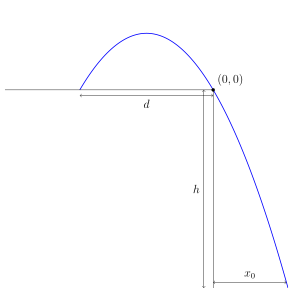
I am standing next to an ice-cream van at a distance \(d\) from the top of a vertical cliff of height \(h\). It is not safe for me to go any nearer to the top of the cliff. My niece Padma is on the broad level beach at the foot of the cliff. I have just discovered that I have left my wallet with her, so I cannot buy her an ice-cream unless she can throw the wallet up to me. She can throw it at speed \(V\), at any angle she chooses and from anywhere on the beach. Air resistance is negligible; so is Padma's height compared to that of the cliff. Show that she can throw the wallet to me if and only if \[ V^{2}\geqslant g(2h+d). \]
Solution:
1992 Paper 2 Q12
In the figure, \(W_{1}\) and \(W_{2}\) are wheels, both of radius \(r\). Their centres \(C_{1}\) and \(C_{2}\) are fixed at the same height, a distance \(d\) apart, and each wheel is free to rotate, without friction, about its centre. Both wheels are in the same vertical plane. Particles of mass \(m\) are suspended from \(W_{1}\) and \(W_{2}\) as shown, by light inextensible strings would round the wheels. A light elastic string of natural length \(d\) and modulus elasticity \(\lambda\) is fixed to the rims of the wheels at the points \(P_{1}\) and \(P_{2}.\) The lines joining \(C_{1}\) to \(P_{1}\) and \(C_{2}\) to \(P_{2}\) both make an angle \(\theta\) with the vertical. The system is in equilibrium. \noindent
- sep}{3mm}
- \(\bf (i)\) no equilibrium positions,
- \(\bf (ii)\) just one equilibrium position,
- \(\bf (iii)\) exactly two equilibrium positions,
- \(\bf (iv)\) more than two equilibrium positions?
1992 Paper 2 Q15
A point moves in unit steps on the \(x\)-axis starting from the origin. At each step the point is equally likely to move in the positive or negative direction. The probability that after \(s\) steps it is at one of the points \(x=2,x=3,x=4\) or \(x=5\) is \(\mathrm{P}(s).\) Show that \(\mathrm{P}(5)=\frac{3}{16},\) \(\mathrm{P}(6)=\frac{21}{64}\) and \[ \mathrm{P}(2k)=\binom{2k+1}{k-1}\left(\frac{1}{2}\right)^{2k} \] where \(k\) is a positive integer. Find a similar expression for \(\mathrm{P}(2k+1).\) Determine the values of \(s\) for which \(\mathrm{P}(s)\) has its greatest value.
Solution: After \(5\) steps we can get to: \begin{array}{c|c} x & \text{ways} \\ \hline 5 & 1 \text { - go positive every time}\\ 4 & 0 \\ 3 & \binom{5}{1} \text { - go positive every time but 1} \\ 2 &0 \\ \hline & 6 \end{array} Therefore there are \(\frac{6}{2^5} = \frac{3}{16}\) ways to get to \(\{2,3,4,5\}\) After \(6\) steps we can get to: \begin{array}{c|c} x & \text{ways} \\ \hline 5 & 0 \\ 4 & \binom{6}{1} \text { - go positive every time but 1}\\ 3 & 0 \\ 2 & \binom{6}{2} - \text{ - go positive every time but 2} \\ \hline & 21 \end{array} Therefore there are \(\frac{21}{2^6} = \frac{21}{64}\) ways to get to \(\{2,3,4,5\}\) After \(2k\) steps we can reach \(2\) or \(4\). To get to \(2\) we must take \(k+1\) positive steps and \(k-1\) negative steps, ie \(\binom{2k}{k-1}\). To get to \(4\) we must take \(k+2\) positive steps and \(k-2\) negative steps, ie \(\binom{2k}{k-2}\) Therefore there are \(\binom{2k+1}{k-1}\) routes, ie a probability of \(\frac{1}{2^{2k}} \binom{2k+1}{k-1}\) After \(2k+1\) steps we can reach \(3\) or \(5\). To get to \(3\) we must take \(k+2\) positive steps and \(k-1\) negative steps, ie \(\binom{2k+1}{k-1}\). To get to \(5\) we must take \(k+3\) positive steps and \(k-2\) negative steps, ie \(\binom{2k+1}{k-2}\) Therefore there are \(\binom{2k+2}{k-1}\) routes, ie a probability of \(\frac{1}{2^{2k+1}} \binom{2k+2}{k-1}\) To find the maximum of \(P(s)\) notice that \begin{align*} && \frac{P(2k+1)}{P(2k)} &= \frac12 \frac{\binom{2k+2}{k-1}}{\binom{2k+1}{k-1}} \\ &&&= \frac12 \frac{(2k+2)!(k-1)!(k+2)!}{(2k+1)!(k-1)!(k+3)!} \\ &&&= \frac12 \frac{2k+2}{k+3} = \frac{k+1}{k+3} < 1 \end{align*} So we should only look at the even terms. \begin{align*} && \frac{P(2k+2)}{P(2k)} &= \frac14 \frac{\binom{2k+3}{k}}{\binom{2k+1}{k-1}} \\ &&&= \frac14 \frac{(2k+3)!(k-1)!(k+2)!}{(2k+1)!k!(k+3)!} \\ &&&= \frac14 \frac{(2k+3)(2k+2)}{k(k+3)} \\ &&&= \frac{(2k+3)(k+1)}{2k(k+3)} \geq 1 \\ \Leftrightarrow && (2k+3)(k+1) &\geq 2k(k+3) \\ \Leftrightarrow && 2k^2+5k+3 &\geq 2k^2+6k \\ \Leftrightarrow && 3 &\geq k \\ \end{align*} Therefore the maximum is when \(s = 2\cdot 3\) or \(s = 2\cdot 4\) which we computed earlier to be \(\frac{21}{64}\)