Problems
Filters
298 problems found
2004 Paper 2 Q2
Prove that, if \(\vert \alpha\vert < 2\sqrt{2},\) then there is no value of \(x\) for which \begin{equation} x^2 -{\alpha}\vert x \vert + 2 < 0\;. \tag{\(*\)} \end{equation} Find the solution set of \((*)\) for \({\alpha}=3\,\). For \({\alpha} > 2\sqrt{2}\,\), the sum of the lengths of the intervals in which \(x\) satisfies \((*)\) is denoted by \(S\,\). Find \(S\) in terms of \({\alpha}\) and deduce that \(S < 2{\alpha}\,\). Sketch the graph of \(S\,\) against \(\alpha \,\).
Solution: There are two cases to consider by they are equivalent to \(x^2 \pm \alpha x + 2 < 0\), which has no solution solutions if \(\Delta < 0\), ie if \(\alpha^2 - 4\cdot1\cdot2 < 0 \Leftrightarrow |\alpha| < 2\sqrt{2}\). If \(\alpha = 3\), we have \begin{align*} && 0 & > x^2-3x+2 \\ &&&= (x-2)(x-1) \\ \Rightarrow && x & \in (1,2) \\ \\ && 0 &> x^2+3x+2 \\ &&& = (x+2)(x+1) \\ \Rightarrow && x &\in (-2,-1) \end{align*} Both cases work here, so \(x \in (-2, -1) \cup (1,2)\). \begin{align*} && 0 &> x^2 \pm \alpha x + 2 \\ &&&= (x \pm \tfrac{\alpha}{2})^2 -\frac{\alpha^2-8}{4} \end{align*} The potential intervals therefore are \((\frac{\alpha -\sqrt{\alpha^2-8}}{2}, \frac{\alpha +\sqrt{\alpha^2-8}}{2})\) and \((\frac{-\alpha -\sqrt{\alpha^2-8}}{2}, \frac{-\alpha +\sqrt{\alpha^2-8}}{2})\). Neither of these intervals overlap with \(0\), since \(\alpha^2 > \alpha^2-8\), and their lengths are both \(\sqrt{\alpha^2-8}\), therefore \(S = 2\sqrt{\alpha^2-8} < 2\alpha\)

2004 Paper 2 Q8
Let \(x\) satisfy the differential equation $$ \frac {\d x}{\d t} = {\big( 1-x^n\big)\vphantom{\Big)}}^{\!1/n} $$ and the condition \(x=0\) when \(t=0 \,\).
- Solve the equation in the case \(n=1\) and sketch the graph of the solution for \(t > 0 \,\).
- Prove that \(1-x < (1-x^2)^{1/2} \) for \(0 < x < 1 \,\). Use this result to sketch the graph of the solution in the case \(n=2\) for \(0 < t < \frac12 \pi \,\), using the same axes as your previous sketch. By setting \(x=\sin y\,\), solve the equation in this case.
- Use the result (which you need not prove) \[ (1-x^2)^{1/2} < (1-x^3)^{1/3} \text{ \ \ for \ \ } 0 < x < 1 \;, \] to sketch, without solving the equation, the graph of the solution of the equation in the case \(n=3\) using the same axes as your previous sketches. Use your sketch to show that \(x=1\) at a value of \(t\) less than \(\frac12 \pi \,\).
Solution:
- \(\,\) \begin{align*}
&& \dot{x} &= (1-x) \\
\Rightarrow &&\int \frac{1}{1-x} \d x &= \int \d t \\
\Rightarrow && -\ln |1-x| &= t + C \\
t=0, x = 0: && -\ln 1 &= C \Rightarrow C = 0\\
\Rightarrow && -\ln|1-x| &= t \\
\Rightarrow && 1-x&= e^{-t} \\
\Rightarrow && x &= 1-e^{-t}
\end{align*}

- Notice that \((1-x^2)^{1/2} = (1-x)^{1/2}(1+x)^{1/2} > (1-x)^{1/2} > 1-x\)
\begin{align*} && \dot{x} &= \sqrt{1-x^2} \\ \Rightarrow && \int \frac{1}{\sqrt{1-x^2}} \d x &= t + C \\ x = \sin y, \d x = \cos y && \int \frac{\cos y}{\cos y} \d y &= t + C \\ \Rightarrow && y &= t + C \\ \Rightarrow && \sin^{-1} x &= t + C \\ t = 0, x = 0: && x &= \sin t \end{align*}

- \(\,\)
We know the gradient is steeper, so the solution must always be above \(\sin t\), which means it reaches \(1\) before \(\frac{\pi}{2}\)

2004 Paper 2 Q12
Sketch the graph, for \(x \ge 0\,\), of $$ y = kx\e^{-ax^2} \;, $$ where \(a\) and \(k\) are positive constants. The random variable \(X\) has probability density function \(\f(x)\) given by \begin{equation*} \f(x)= \begin{cases} kx\e^{-ax^2} & \text{for \(0 \le x \le 1\)}\\[3pt] 0 & \text{otherwise}. \end{cases} \end{equation*} Show that \(\displaystyle k=\frac{2a}{1-\e^{-a}}\) and find the mode \(m\) in terms of \(a\,\), distinguishing between the cases \(a < \frac12\) and \(a > \frac12\,\). Find the median \(h\) in terms of \(a\), and show that \(h > m\) if \(a > -\ln\left(2\e^{-1/2} - 1\right).\) Show that, \(-\ln\left(2\e^{-1/2}-1\right)> \frac12 \,\). Show also that, if \(a > -\ln\left(2\e^{-1/2} - 1\right) \,\), then $$ P(X > m \;\vert\; X < h) = {{2\e^{-1/2}-\e^{-a}-1} \over 1-\e^{-a}}\;. $$
Solution:
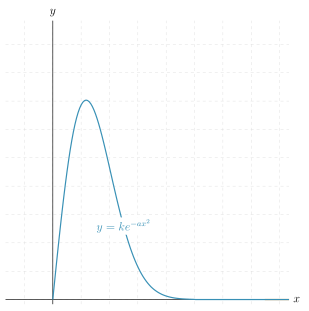
2004 Paper 2 Q14
Explain why, if \(\mathrm{A, B}\) and \(\mathrm{C}\) are three events, \[ \mathrm{P(A \cup B \cup C) = P(A) + P(B) + P(C) - P(A \cap B) - P(B \cap C) - P(C \cap A) +P(A \cap B \cap C)}, \] where \(\mathrm{P(X)}\) denotes the probability of event \(\mathrm{X}\). A cook makes three plum puddings for Christmas. He stirs \(r\) silver sixpences thoroughly into the pudding mixture before dividing it into three equal portions. Find an expression for the probability that each pudding contains at least one sixpence. Show that the cook must stir 6 or more sixpences into the mixture if there is to be less than \({1 \over 3}\) chance that at least one of the puddings contains no sixpence. Given that the cook stirs 6 sixpences into the mixture and that each pudding contains at least one sixpence, find the probability that there are two sixpences in each pudding.
Solution:

2004 Paper 3 Q3
Given that \(\f''(x) > 0\) when \(a \le x \le b\,\), explain with the aid of a sketch why \[ (b-a) \, \f \Big( {a+b \over 2} \Big) < \int^b_a \f(x) \, \mathrm{d}x < (b-a) \, \displaystyle \frac{\f(a) + \f(b)}{2} \;. \] By choosing suitable \(a\), \(b\) and \(\f(x)\,\), show that \[ {4 \over (2n-1)^2} < {1 \over n-1} - {1 \over n} < {1 \over 2} \l {1 \over n^2} + {1 \over (n-1)^2}\r \,, \] where \(n\) is an integer greater than 1. Deduce that \[ 4 \l {1 \over 3^2} +{1 \over 5^2} + {1 \over 7^2} + \cdots \r < 1 < {1 \over 2} + \left( {1 \over 2^2} +{1 \over 3^2} + {1 \over 4^2} + \cdots \right)\,. \] Show that \[ {1 \over 2} \l {1 \over 3^2} + {1 \over 4^2} + {1 \over 5^2} + \frac 1 {6^2} + \cdots \r < {1 \over 3^2} +{1 \over 5^2} + {1 \over 7^2} + \cdots \] and hence show that \[ {3 \over 2} \displaystyle < \sum_{n=1}^\infty {1 \over n^2} <{7 \over 4}\;. \]
2004 Paper 3 Q4
The triangle \(OAB\) is isosceles, with \(OA = OB\) and angle \(AOB = 2 \alpha\) where \(0< \alpha < {\pi \over 2}\,\). The semi-circle \(\mathrm{C}_0\) has its centre at the midpoint of the base \(AB\) of the triangle, and the sides \(OA\) and \(OB\) of the triangle are both tangent to the semi-circle. \(\mathrm{C}_1, \mathrm{C}_2, \mathrm{C}_3, \ldots\) are circles such that \(\mathrm{C}_n\) is tangent to \(\mathrm{C}_{n-1}\) and to sides \(OA\) and \(OB\) of the triangle. Let \(r_n\) be the radius of \(\mathrm{C}_n\,\). Show that \[ \frac{r_{n+1}}{r_n} = \frac{1-\sin\alpha}{1+\sin\alpha}\;. \] Let \(S\) be the total area of the semi-circle \(\mathrm{C}_0\) and the circles \(\mathrm{C}_1\), \(\mathrm{C}_2\), \(\mathrm{C}_3\), \(\ldots\;\). Show that \[ S = {1 + \sin^2 \alpha \over 4 \sin \alpha} \, \pi r_0^2 \;. \] Show that there are values of \(\alpha\) for which \(S\) is more than four fifths of the area of triangle~\(OAB\).
2004 Paper 3 Q7
For \(n=1\), \(2\), \(3\), \(\ldots\,\), let \[ I_n = \int_0^1 {t^{n-1} \over \l t+1 \r^n} \, \mathrm{d} t \, . \] By considering the greatest value taken by \(\displaystyle {t \over t+1}\) for \(0 \le t \le 1\) show that \(I_{n+1} < {1 \over 2} I_{n}\,\). Show also that \(\; \displaystyle I_{n+1}= - \frac 1{\; n\, 2^n} + I_{n}\,\). Deduce that \(\; \displaystyle I_n < \frac1 {\; n \, 2^{n-1}}\,\). Prove that \[ \ln 2 = \sum_{r=1}^n {1 \over \; r\, 2^r} + I_{n+1} \] and hence show that \({2 \over 3} < \ln 2 < {17 \over 24}\,\).
Solution: \begin{align*} && \frac{t}{t+1} &= 1 - \frac{1}{t+1} \geq \frac12 \\ \Rightarrow && I_{n+1} &= \int_0^1 \frac{t^{n}}{(t+1)^{n+1}} \d t \\ &&&= \int_0^1\frac{t}{t+1} \frac{t^{n-1}}{(t+1)^{n}} \d t \\ &&&< \int_0^1\frac12\frac{t^{n-1}}{(t+1)^{n}} \d t \\ &&&= \frac12 I_n \\ \\ && I_{n+1} &= \int_0^1 \frac{t^{n}}{(t+1)^{n+1}} \d t \\ &&&= \left [ t^n \frac{(1+t)^{-n}}{-n} \right]_0^1 +\frac1n \int_0^1 n t^{n-1}(1+t)^{-n} \d t \\ &&&= -\frac{1}{n2^n} + I_n \\ \Rightarrow && \frac12 I_n &> -\frac1{n2^n} + I_n \\ \Rightarrow && \frac{1}{n2^{n-1}} &> I_n \end{align*} \begin{align*} && \ln 2 &= \int_0^1 \frac{1}{1+t} \d t \\ &&&= I_1 \\ &&&= \frac1{2} + I_2 \\ &&&= \frac1{2} + \frac{1}{2 \cdot 2^2} + I_3 \\ &&&= \sum_{r=1}^n \frac{1}{r2^r} + I_{n+1} \\ \\ && \ln 2 &= \frac12 + \frac18 + \frac1{24} + I_4 \\ \Rightarrow && \ln 2 &> \frac12 + \frac18 + \frac1{24} = \frac{12+3+1}{24} = \frac{16}{24} = \frac23 \\ \Rightarrow && \ln 2 &= \frac12 + \frac18 + I_3 \\ &&&< \frac12 + \frac18 +\frac{1}{3 \cdot 4} \\ &&&< \frac{12}{24} + \frac{3}{24} + \frac{2}{24} = \frac{17}{24} \end{align*}
2003 Paper 1 Q4
Solve the inequality $$\frac{\sin\theta+1}{\cos\theta}\le1\;$$ where \(0\le\theta<2\pi\,\) and \(\cos\theta\ne0\,\).
Solution:

2003 Paper 1 Q7
Let \(k\) be an integer satisfying \(0\le k \le 9\,\). Show that \(0\le 10k-k^2\le 25\) and that \(k(k-1)(k+1)\) is divisible by \(3\,\). For each \(3\)-digit number \(N\), where \(N\ge100\), let \(S\) be the sum of the hundreds digit, the square of the tens digit and the cube of the units digit. Find the numbers \(N\) such that \(S=N\). [Hint: write \(N=100a+10b+c\,\) where \(a\,\), \(b\,\) and \(c\) are the digits of \(N\,\).]
Solution: First note that \(10k - k^2 = 25 - (5-k)^2\) which is clearly bounded above by \(25\). The smallest it can be is when \(|5-k|\) is as large as possible, ie when \(k =0\) and we get a lower bound of \(0\). For \((k-1)k(k+1)\) notice this is the product of \(3\) consecutive integers, and therefore must be divisible by \(3\). (In fact, it's divisible by six, since \(\binom{k+1}{3}\) is the number of ways to choose \(3\) objects from \(k+1\). Let \(N = 100a + 10b + c\) where \(0 \leq a,b,c < 10\) and \(1 \leq a\). \(S = a + b^2 + c^3\) we want to find \begin{align*} && 100a +10b + c &= a + b^2 + c^3 \\ \Rightarrow && 0 &= \underbrace{99a}_{3 \mid 99 } + 10b - b^2 -\underbrace{c(c+1)(c-1)}_{3 \mid c(c+1)(c-1)} \\ \end{align*} Therefore \(3 \mid 10b - b^2 = b(10-b)\). Therefore \(3 \mid b\) or \(3 \mid 10-b\) so \(b = 0, 3, 6, 1, 4, 7\) We also have \(99a \geq 99\) and \(10b-b^2 \in [0, 25]\) so we need \(c^3-c \geq 99\), so \(c \geq 5\) Case \(c = 5\), Then \(c^3-c = 120\) so \(a = 1\) and \(10b-b^2 = 21\) so \(b= 3, 7\) \(N = 135, 175\) Case \(c = 6\), so \(c^3 - c = 210\) so \(a = 2\) and \(25-(5-k)^2 = 12\) so no solutions. Case \(c = 7\), so \(7^3 - 7 = 336\) so \(a = 3\) and \(25-(5-k)^2 = 39\) so no solutions. Case \(c = 8\) so \(8^3-8 = 504\) so \(a = 5\) and \(25-(5-k)^2 = 9\), so \(b = 1, 9\) and \(N = 518, 598\) Case \(c = 9\) so \(9^3 - 9 = 720\), so \(a = 7\) and \(25-(5-k)^2 = 27\) so no solutions. Therefore all the solutions are \(N = 135, 175, 518, 598\)
2003 Paper 1 Q9
A particle is projected with speed \(V\) at an angle \(\theta\) above the horizontal. The particle passes through the point \(P\) which is a horizontal distance \(d\) and a vertical distance \(h\) from the point of projection. Show that \[ T^2 -2kT + \frac{2kh}{d}+1=0\;, \] where \(T=\tan\theta\) and \(\ds k= \frac{V^2}{gd}\,\). %Derive an equation relating \(\tan \theta\), \(V\), \(g\), \(d\) and \(h\). Show that, if \(\displaystyle {kd > h + \sqrt {h^2 + d^2}}\;\), there are two distinct possible angles of projection. Let these two angles be \(\alpha\) and \(\beta\). Show that \(\displaystyle \alpha + \beta = \pi - \arctan ( {d/ h}) \,\).
2003 Paper 2 Q7
Show that, if \(n>0\,\), then $$ \int_{e^{1/n}}^\infty\,{{\ln x} \over {x^{n+1}}}\,\d x = {2 \over {n^2\e}}\;. $$ You may assume that \(\ds \frac{\ln x} x \to 0\;\) as \(x\to\infty\,\). Explain why, if \(1 < a < b\,\), then $$ \int_b^\infty\,{{\ln x} \over {x^{n+1}}}\,\d x < \int_a^\infty\,{{\ln x} \over {x^{n+1}}}\,\d x\;. $$ Deduce that $$ \sum_{n=1}^{N}{1 \over n^2} < {\e \over 2}\int_{\e^{1/N}}^{\infty} \left({1-x^{-N}} \over {x^2-x}\right) \ln x\,\d x\;, $$ where \(N\,\) is any integer greater than \(1\).
2003 Paper 2 Q13
The random variable \(X\) takes the values \(k=1\), \(2\), \(3\), \(\dotsc\), and has probability distribution $$ \P(X=k)= A{{{\lambda}^k\e^{-{\lambda}}} \over {k!}}\,, $$ where \(\lambda \) is a positive constant. Show that \(A = (1-\e^{-\lambda})^{-1}\,\). Find the mean \({\mu}\) in terms of \({\lambda}\) and show that $$ \var(X) = {\mu}(1-{\mu}+{\lambda})\;. $$ Deduce that \({\lambda} < {\mu} < 1+{\lambda}\,\). Use a normal approximation to find the value of \(P(X={\lambda})\) in the case where \({\lambda}=100\,\), giving your answer to 2 decimal places.
Solution: Let \(Y \sim Po(\lambda)\) \begin{align*} && 1 &= \sum_{k=1}^\infty \mathbb{P}(X = k ) \\ &&&= \sum_{k=1}^\infty A \frac{\lambda^k e^{-\lambda}}{k!}\\ &&&= Ae^{-\lambda} \sum_{k=1}^{\infty} \frac{\lambda^k e^{-\lambda}}{k!} \\ &&&= Ae^{-\lambda} \left (e^{\lambda}-1 \right) \\ \Rightarrow && A &= (1-e^{-\lambda})^{-1} \\ \\ && \E[X] &= \sum_{k=1}^{\infty} k \cdot \mathbb{P}(X=k) \\ &&&= A\sum_{k=1}^{\infty} k \frac{\lambda^k e^{-\lambda}}{k!} \\ &&&= A\E[Y] = A\lambda = \lambda(1-e^{-\lambda})^{-1} \\ \\ && \var[X] &= \E[X^2] - (\E[X])^2 \\ &&&= A\sum_{k=1}^{\infty} k^2 \frac{\lambda^k e^{-\lambda}}{k!} - \mu^2 \\ &&&= A\E[Y^2] - \mu^2 \\ &&&= A(\var[Y]+\lambda^2) - \mu^2 \\ &&&= A(\lambda + \lambda^2) - \mu^2 \\ &&&= A\lambda(1+\lambda) - \mu^2 \\ &&&= \mu(1+\lambda - \mu) \end{align*} Since \(A > 1\) we must have \(\mu > \lambda\) and since \(\var[X] > 0\) we must have \(1 + \lambda > \mu\) as required. If \(\lambda = 100\), then \(A \approx 1\) and \(P(X=\lambda) \approx P(Y = \lambda)\) and \(Y \approx N(\lambda, \lambda)\) so the value is approximately \(\displaystyle \int_{-\frac12}^{\frac12} \frac{1}{\sqrt{2\pi \lambda}} e^{-\frac{x^2}{2\lambda}} \d x \approx \frac{1}{\sqrt{200\pi}} = \frac{1}{\sqrt{630.\ldots}} \approx \frac{1}{25} = 0.04 \)
2003 Paper 3 Q3
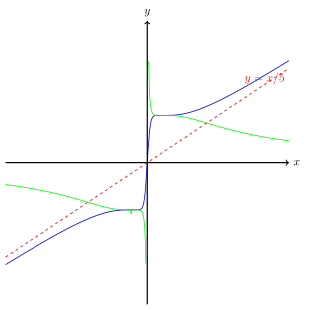
If \(m\) is a positive integer, show that \(\l 1+x \r^m + \l 1-x \r^m \ne 0\) for any real \(x\,\). The function \(\f\) is defined by \[ \f (x) = \frac{ (1+x )^m - ( 1-x )^m}{ (1+x )^m + (1-x )^m} \;. \] Find and simplify an expression for \(\f'(x)\). In the case \(m=5\,\), sketch the curves \(y = \f (x)\) and \(\displaystyle y = \frac1 { \f (x )}\;\).
Solution: If \(m\) is even, clearly that expression is positive since it's the sum of two (different) squares. If \(m\) is odd, then we can expand it as a sum of powers of \(x^2\) with a leading coefficient of \(1\) so it is also positive. \begin{align*} && f (x) = \frac{ (1+x )^m - ( 1-x )^m}{ (1+x )^m + (1-x )^m} \\ && f'(x) &= \frac{(m(1+x )^{m-1} + m( 1-x )^{m-1})((1+x)^m + (1-x)^m ) - ((1+x )^m - ( 1-x )^m)(m(1+x)^{m-1} - m(1-x)^{m-1} )}{\l (1+x)^m + (1-x)^m \r^2} \\ &&&= \frac{2m(1+x)^m(1-x)^{m-1}+2m(1+x)^{m-1}(1-x)^m}{\l (1+x)^m + (1-x)^m \r^2} \\ &&&= \frac{2m(1+x)^{m-1}(1-x)^{m-1}(1+x+1-x)}{\l (1+x)^m + (1-x)^m \r^2} \\ &&&= \frac{4m(1+x)^{m-1}(1-x)^{m-1}}{\l (1+x)^m + (1-x)^m \r^2} \\ \end{align*}
2003 Paper 3 Q5
Find the coordinates of the turning point on the curve \(y = x^2 - 2bx + c\,\). Sketch the curve in the case that the equation \(x^2 - 2bx + c=0\) has two distinct real roots. Use your sketch to determine necessary and sufficient conditions on \(b\) and \(c\) for the equation \(x^2 - 2bx + c = 0\) to have two distinct real roots. Determine necessary and sufficient conditions on \(b\) and \(c\) for this equation to have two distinct positive roots. Find the coordinates of the turning points on the curve \(y = x^3 - 3b^2x + c\) (with \(b>0\)) and hence determine necessary and sufficient conditions on \(b\) and \(c\) for the equation \(x^3 - 3b^2x + c = 0\) to have three distinct real roots. Determine necessary and sufficient conditions on \(a\,\), \(b\) and \(c\) for the equation \(\l x - a \r^3 - 3b^2 \l x - a \r + c = 0\) to have three distinct positive roots. Show that the equation \(2x^3 - 9x^2 + 7x - 1 = 0\) has three distinct positive roots.
Solution: \begin{align*} y &= x^2-2bx+c \\ &= (x-b)^2+c-b^2 \end{align*} Therefore the turning point is at \((b,c-b^2)\)


2003 Paper 3 Q11
Point \(B\) is a distance \(d\) due south of point \(A\) on a horizontal plane. Particle \(P\) is at rest at \(B\) at \(t=0\), when it begins to move with constant acceleration \(a\) in a straight line with fixed bearing~\(\beta\,\). Particle \(Q\) is projected from point \(A\) at \(t=0\) and moves in a straight line with constant speed \(v\,\). Show that if the direction of projection of \(Q\) can be chosen so that \(Q\) strikes \(P\), then \[ v^2 \ge ad \l 1 - \cos \beta \r\;. \] Show further that if \(v^2 >ad(1-\cos\beta)\) then the direction of projection of \(Q\) can be chosen so that \(Q\) strikes \(P\) before \(P\) has moved a distance \(d\,\).