Problems
Filters
42 problems found
1994 Paper 1 Q1
My house has an attic consisting of a horizontal rectangular base of length \(2q\) and breadth \(2p\) (where \(p < q\)) and four plane roof sections each at angle \(\theta\) to the horizontal. Show that the length of the roof ridge is independent of \(\theta\) and find the volume of the attic and the surface area of the roof.
Solution:

1994 Paper 1 Q2
Given that \(a\) is constant, differentiate the following expressions with respect to \(x\):
- \(x^{a}\);
- \(a^{x}\);
- \(x^{x}\);
- \(x^{(x^{x})}\);
- \((x^{x})^{x}.\)
Solution: \begin{align*} && y &= x^a \\ && \frac{\d y}{\d x} &= \begin{cases} ax^{a-1} & a \neq 0 \\ 0 & a = 0 \end{cases} \\ \\ && y &= a^x \\ &&&= e^{(\ln a) \cdot x} \\ && \frac{\d y}{\d x} &= \ln a e^{(\ln a) x} \\ &&&= \ln a \cdot a^ x \\ \\ && y &= x^x \\ &&&= e^{x \ln x}\\ && \frac{\d y}{\d x} &= e^{x \ln x} \cdot \left ( \ln x + x \cdot \frac1x \right) \\ &&&= x^x \left (1 + \ln x \right) \\ \\ && y&= x^{(x^x)} \\ &&&= e^{x^ x \cdot \ln x} \\ && \frac{\d y}{\d x} &= e^{x^x \cdot \ln x} \left ( x^x \left (1 + \ln x \right) \cdot \ln x + x^x \cdot \frac1x\right) \\ &&&= x^{x^x} \left (x^x (1+ \ln x) \ln x +x^{x-1} \right) \\ &&&= x^{x^x+x-1} \left (1 + x \ln x + x (\ln x)^2 \right) \\ \\ && y &= (x^x)^x \\ &&&= x^{2x} \\ &&&= e^{2x \ln x} \\ && \frac{\d y}{\d x} &= e^{2 x \ln x} \left (2 \ln x + 2 \right) \\ &&&= 2(x^x)^x(1 + \ln x) \end{align*}
1994 Paper 1 Q3
By considering the coefficient of \(x^{n}\) in the identity \((1-x)^{n}(1+x)^{n}=(1-x^{2})^{n},\) or otherwise, simplify \[ \binom{n}{0}^{2}-\binom{n}{1}^{2}+\binom{n}{2}^{2}-\binom{n}{3}^{2}+\cdots+(-1)^{n}\binom{n}{n}^{2} \] in the cases (i) when \(n\) is even, (ii) when \(n\) is odd.
Solution: The coefficient of \(x^n\) on the LHS is \begin{align*} && (1-x^2)^n &= (1-x)^n(1+x)^n \\ [x^n]: && \begin{cases} (-1)^{\lfloor \frac{n}2 \rfloor}\binom{n}{\lfloor \frac{n}2 \rfloor} &\text{if } n\text{ even} \\ 0 & \text{otherwise} \end{cases} &= \sum_{i=0}^n \underbrace{(-1)^i\binom{n}{i}}_{\text{take }(-x)^i\text{ from first bracket}} \cdot \underbrace{\binom{n}{n-i}}_{\text{take }x^{n-i}\text{ from second bracket}} \\ &&&= \sum_{i=0}^n (-1)^i\binom{n}{i}\binom{n}{i} \\ &&&= \sum_{i=0}^n (-1)^i\binom{n}{i}^2\\ \end{align*}
1994 Paper 1 Q4
Show that
- \(\dfrac{1-\cos\alpha}{\sin\alpha}=\tan\frac{1}{2}\alpha,\)
- if \(\left|k\right|<1\) then \({\displaystyle \int\frac{\mathrm{d}x}{1-2kx+x^{2}}=\frac{1}{\sqrt{1-k^{2}}}\tan^{-1}\left(\frac{x-k}{\sqrt{1-k^{2}}}\right)+C,}\) where \(C\) is a constant of integration.
Solution:
- \begin{align*} \frac{1-\cos \alpha}{\sin \alpha} &= \frac{1-(1-2\sin^2 \frac{\alpha}{2})}{2 \sin \frac \alpha2 \cos \frac\alpha2} \\ &= \frac{2 \sin^2 \frac \alpha2}{2 \sin \frac \alpha2 \cos \frac\alpha2} \\ &= \frac{\sin \frac \alpha2}{ \cos \frac\alpha2} \\ &= \tan \tfrac{\alpha}{2} \end{align*}
- \begin{align*} \int\frac{\mathrm{d}x}{1-2kx+x^{2}} &= \int \frac{\d x}{(x-k)^2+1-k^2} \\ &= \frac{1}{1-k^2}\int \frac{\d x}{\left (\frac{x-k}{\sqrt{1-k^2}} \right)^2+1} \\ &= \frac{1}{\sqrt{1-k^2}} \tan^{-1} \left (\frac{x-k}{\sqrt{1-k^2}} \right)+C \end{align*}
1994 Paper 1 Q5
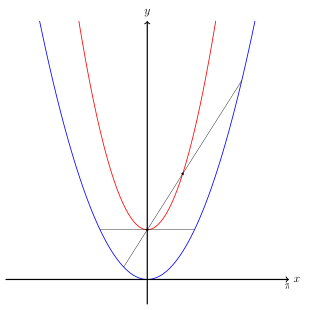
A parabola has the equation \(y=x^{2}.\) The points \(P\) and \(Q\) with coordinates \((p,p^{2})\) and \((q,q^{2})\) respectively move on the parabola in such a way that \(\angle POQ\) is always a right angle.
- Find and sketch the locus of the midpoint \(R\) of the chord \(PQ.\)
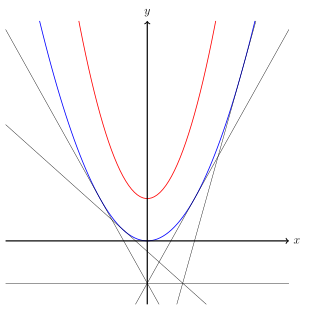
- Find and sketch the locus of the point \(T\) where the tangents to the parabola at \(P\) and \(Q\) intersect.
Solution:
- The line \(PO\) has gradient \(\frac{p^2}{p} = p\) and teh line \(QO\) has gradient \(q\), therefore we must have that \(pq = -1\). Therefore, \(R\) is the point
\begin{align*}
&& R &= \left ( \frac{p-\frac{1}{p}}{2}, \frac{p^2+\frac{1}{p^2}}{2} \right) \\
&&&= \left ( \frac12\left ( p - \frac{1}{p} \right),2\left (\frac12 \left(p-\frac{1}{p}\right) \right)^2+1 \right) \\
&&&= \left ( t, 2t^2+1\right)
\end{align*}
So we are looking at another parabola.
- The tangents are \(y = 2px+c\), ie \(p^2 = 2p^2+c\), ie \(y = 2px -p^2\) so we have
\begin{align*}
&& y - 2px &= -p^2 \\
&& y - 2qx &= -q^2 \\
\Rightarrow && (2p-2q)x &= p^2-q^2 \\
\Rightarrow && x &= \frac12 (p+q)\\
&& y &= p(p+q)-p^2 \\
&& y &= pq = -1
\end{align*}
Therefore \(x = \frac12(p - \frac1p), y= -1\), so we have the line \(y = -1\) (the directrix)
1994 Paper 1 Q6
The function \(\mathrm{f}\) is defined, for any complex number \(z\), by \[ \mathrm{f}(z)=\frac{\mathrm{i}z-1}{\mathrm{i}z+1}. \] Suppose throughout that \(x\) is a real number.
- Show that \[ \mathrm{Re}\,\mathrm{f}(x)=\frac{x^{2}-1}{x^{2}+1}\qquad\mbox{ and }\qquad\mathrm{Im}\,\mathrm{f}(x)=\frac{2x}{x^{2}+1}. \]
- Show that \(\mathrm{f}(x)\mathrm{f}(x)^{*}=1,\) where \(\mathrm{f}(x)^{*}\) is the complex conjugate of \(\mathrm{f}(x)\).
- Find expressions for \(\mathrm{Re}\,\mathrm{f}(\mathrm{f}(x))\) and \(\mathrm{Im}\,\mathrm{f}(\mathrm{f}(x)).\)
- Find \(\mathrm{f}(\mathrm{f}(\mathrm{f}(x))).\)
Solution:
- \begin{align*} && f(x) &= \frac{ix-1}{ix+1} \\ &&&= \frac{ix-1}{ix+1} \frac{1-ix}{1-ix} \\ &&&= \frac{ix-1+x^2+ix}{1^2+x^2} \\ &&&= \frac{x^2-1}{x^2+1} + i \frac{2x}{x^2+1} \\ \Rightarrow && \textrm{Re}(f(x)) &= \frac{x^2-1}{x^2+1} \\ && \textrm{Im}(f(x)) &= \frac{2x}{x^2+1} \end{align*}
- \begin{align*} && f(x)f(x)^* &= \frac{ix-1}{ix+1} \frac{(ix-1)^*}{(ix+1)^*} \\ &&&= \frac{ix-1}{ix+1} \frac{-ix-1}{-ix+1} \\ &&&= \frac{ix-1}{ix+1} \frac{-(ix+1)}{-(ix-1)} \\ &&&= 1
- \begin{align*} && \begin{pmatrix} i & -1 \\ i & 1 \end{pmatrix}^2 &= \begin{pmatrix} -1-i & -i-1 \\ -1+i & -i+1 \end{pmatrix} \\ \Rightarrow && f(f(z)) &= \frac{-(1+i)(z+1)}{(-1+i)(z-1)} \\ &&&= \frac{2i}{2} \frac{z+1}{z-1} \\ &&&= i \frac{z+1}{z-1} \\ \Rightarrow && \textrm{Re}(f(f(x))) &= 0 \\ && \textrm{Im}(f(f(x))) &= \frac{x+1}{x-1} \end{align*}
- \begin{align*} && \begin{pmatrix} i & -1 \\ i & 1 \end{pmatrix} \begin{pmatrix} i & i \\ 1 & -1 \end{pmatrix} &= \begin{pmatrix} -2 & 0 \\ 0 & -2 \end{pmatrix} \\ \Rightarrow && f(f(f(z))) &= z \end{align*}
1994 Paper 1 Q7
From the facts \begin{alignat*}{2} 1 & \quad=\quad & & 0\\ 2+3+4 & \quad=\quad & & 1+8\\ 5+6+7+8+9 & \quad=\quad & & 8+27\\ 10+11+12+13+14+15+16 & \quad=\quad & & 27+64 \end{alignat*} guess a general law. Prove it. Hence, or otherwise, prove that \[ 1^{3}+2^{3}+3^{3}+\cdots+N^{3}=\tfrac{1}{4}N^{2}(N+1)^{2} \] for every positive integer \(N\). [Hint. You may assume that \(1+2+3+\cdots+n=\frac{1}{2}n(n+1)\).]
Solution: \begin{align*} && (n^2+1) + (n^2+2) + \cdots + (n+1)^2 &= n^3+(n+1)^3 \\ \Leftrightarrow && \sum_{i=n^2+1}^{(n+1)^2} i &= n^3 + (n+1)^3 \\ && \sum_{i=n^2+1}^{(n+1)^2} i &= \sum_{i=1}^{(n+1)^2} i- \sum_{i=1}^{n^2} i \\ &&&= \frac{(n+1)^2((n+1)^2+1)}{2} - \frac{n^2(n^2+1)}{2} \\ &&&= \frac{(n+1)^2(n^2+2n+2) - n^2(n^2+1)}{2} \\ &&&= \frac{2(n+1)^3+n^2(n^2+2n+1) - n^2(n^2+1)}{2}\\ &&&= \frac{2(n+1)^3+2n^3 + n^2(n^2+1) - n^2(n^2+1)}{2}\\ &&&= (n+1)^3+n^3 \end{align*} \begin{align*} && \sum_{i=1}^{N^2} i &=(0^3+1^3)+ (1^3+2^3)+(2^3+3^3) + \cdots + ((N-1)^3+N^3) \\ &&&= 2 \left (1^3+2^3 + 3^3 + \cdots + (N-1)^3 \right) + N^3 \\ \Rightarrow && \sum_{i=1}^N i^3 &= \frac12 \left ( N^3+ \sum_{i=1}^{N^2} i \right) \\ &&&= \frac12 \left ( N^3 + \frac{N^2(N^2+1)}{2} \right) \\ &&&= \frac{N^2(N^2+1)+2N^3}{4} \\ &&&= \frac{N^2(N^2+2N+1)}{4} \\ &&&= \frac{N^2(N+1)^2}{4} \\ \end{align*}
1994 Paper 1 Q8
By means of the change of variable \(\theta=\frac{1}{4}\pi-\phi,\) or otherwise, show that \[ \int_{0}^{\frac{1}{4}\pi}\ln(1+\tan\theta)\,\mathrm{d}\theta=\tfrac{1}{8}\pi\ln2. \] Evaluate \[ {\displaystyle \int_{0}^{1}\frac{\ln(1+x)}{1+x^{2}}\,\mathrm{d}x}\qquad\mbox{ and }\qquad{\displaystyle \int_{0}^{\frac{1}{2}\pi}\ln\left(\frac{1+\sin x}{1+\cos x}\right)\,\mathrm{d}x}. \]
Solution: \begin{align*} && I &= \int_0^{\frac14\pi} \ln (1 + \tan \theta) \d \theta \\ \theta = \tfrac14\pi - \phi, \d \theta = -\d\phi: &&&= \int_0^{\frac14 \pi} \ln ( 1 + \tan (\tfrac14\pi - \phi)) \d \phi \\ &&&= \int_0^{\frac14 \pi} \ln \left ( 1 + \frac{1 - \tan \phi}{1+\tan \phi} \right) \d \phi \\ &&&= \int_0^{\frac14 \pi} \ln \left ( \frac{2}{1+\tan \phi} \right) \d \phi \\ &&&= \tfrac14 \pi \ln 2 - I \\ \Rightarrow && I &= \tfrac18\pi \ln 2 \end{align*} \begin{align*} && J &= \int_0^1 \frac{\ln(1+x)}{1+x^2} \d x \\ x= \tan \theta \d \theta, \d \theta = \frac{\d x}{1+x^2} &&&= \int_0^{\frac14 \pi} \ln(1 + \tan \theta) \d \theta \\ &&&= \tfrac18 \pi \ln 2 \end{align*} \begin{align*} && K &= \int_0^{\frac12 \pi} \ln \left ( \frac{1 + \sin x}{1 + \cos x} \right) \d x \\ y = \tfrac12\pi - x, \d y = -\d x: &&&= \int_0^{\frac12\pi} \ln \left ( \frac{1+\cos y}{1+\sin y}\right) \d y \\ &&&= -K \\ \Rightarrow && K &= 0 \end{align*}
1994 Paper 1 Q9
A cannon-ball is fired from a cannon at an initial speed \(u\). After time \(t\) it has reached height \(h\) and is at a distance \(\sqrt{x^{2}+h^{2}}\) from the cannon. Ignoring air resistance, show that \[ \tfrac{1}{4}g^{2}t^{4}-(u^{2}-gh)t^{2}+h^{2}+x^{2}=0. \] Hence show that if \(u^{2}>2gh\) then the horizontal range for a given height \(h\) and initial speed \(u\) is less than or equal to \[ \frac{u\sqrt{u^{2}-2gh}}{g}. \] Show that there is always an angle of firing for which this value is attained.
Solution: Suppose it is fired with angle to the horizontal \(\alpha\), then \begin{align*} \rightarrow: && x &= u\cos \alpha \cdot t \\ \uparrow: && h &= u \sin \alpha \cdot t - \frac12 g t^2 \\ \Rightarrow && u\cos \alpha &= \frac{x}{t} \\ && u \sin \alpha &= \frac{h + \frac12 gt^2}{t} \\ \Rightarrow && u^2 &= \frac{x^2}{t^2} + \frac{(h + \frac12 gt^2)^2}{t^2} \\ \Rightarrow && 0 &= x^2+h^2-u^2t^2+ght^2+\tfrac14 g^2 t^4 \\ &&&= \tfrac14 g^2 t^4 - (u^2 - gh)t^2 + h^2 + x^2 \end{align*} For a distance \(x\) to be achievable there must be a root to this quadratic in \(t^2\), ie \begin{align*} && 0 &\leq \Delta = (u^2-gh)^2 - 4 \cdot \tfrac14 g^2 (h^2 + x^2) \\ \Rightarrow && x^2 &\leq \frac{(u^2-gh)^2}{g^2} - h^2 \\ &&&= \frac{u^4+g^2h^2 - 2ghu^2-g^2h^2}{g^2} \\ &&&= \frac{u^2(u^2-2gh)}{g^2} \\ \Rightarrow && x &\leq \frac{u\sqrt{u^2-2gh}}{g} \end{align*} This is achieved when \begin{align*} && t^2 &= \frac{u^2-gh}{\tfrac12g^2}\\ &&&= \frac{2(u^2-gh)}{g^2} \\ \Rightarrow && \cos \alpha &= \frac{u\sqrt{u^2-2gh}}{g} \cdot \frac{g}{\sqrt{2(u^2-gh)}} \frac{1}{u} \\ &&&= \frac{1}{\sqrt{2}} \end{align*} ie when \(\alpha = \frac{\pi}{4}\)
1994 Paper 1 Q10
One end \(A\) of a light elastic string of natural length \(l\) and modulus of elasticity \(\lambda\) is fixed and a particle of mass \(m\) is attached to the other end \(B\). The particle moves in a horizontal circle with centre on the vertical through \(A\) with angular velocity \(\omega.\) If \(\theta\) is the angle \(AB\) makes with the downward vertical, find an expression for \(\cos\theta\) in terms of \(m,g,l,\lambda\) and \(\omega.\) Show that the motion described is possible only if \[ \frac{g\lambda}{l(\lambda+mg)}<\omega^{2}<\frac{\lambda}{ml}. \]
1994 Paper 1 Q11
\(\,\)
- Find the condition which \(m,M\) and \(\theta\) must satisfy to ensure that the ball will fall to the ground. Assuming that this condition is satisfied, show that the velocity \(v\) of the ball when it hits the ground satisfies \[ v^{2}=\frac{2g(M-m\sin\theta)d\sin\theta}{M+m}. \]
- Find the condition which \(m,M\) and \(\theta\) must satisfy if the wagon is not to collide with the pulley at the top of the incline.
1994 Paper 1 Q12
There are 28 colleges in Cambridge, of which two (New Hall and Newnham) are for women only; the others admit both men and women. Seven women, Anya, Betty, Celia, Doreen, Emily, Fariza and Georgina, are all applying to Cambridge. Each has picked three colleges at random to enter on her application form.
- What is the probability that Anya's first choice college is single-sex?
- What is the probability that Betty has picked Newnham?
- What is the probability that Celia has picked at least one single-sex college?
- Doreen's first choice is Newnham. What is the probability that one of her other two choices is New Hall?
- Emily has picked Newnham. What is the probability that she has also picked New Hall?
- Fariza's first choice college is single-sex. What is the probability that she has also chosen the other single-sex college?
- One of Georgina's choices is a single-sex college. What is the probability that she has also picked the other single-sex college?
Solution:
- \(\frac{2}{28} = \frac{1}{14}\)
- \(1-\frac{27}{28}\frac{26}{27}\frac{25}{26} = \frac{3}{28}\)
- \(1 - \frac{26}{28}\frac{25}{27}\frac{24}{26} = \frac{13}{63}\)
- \(1-\frac{26}{27}\frac{25}{26} = \frac{2}{27}\)
- \(\frac{1}{27}\)
- There are \(\binom{2}{1} \binom{26}{2} + \binom{2}{2}\binom{26}{1}\) ways to choose at least one single sex college and \( \binom{2}{2}\binom{26}{1}\) ways to choose both, therefore \begin{align*} P &= \frac{ \binom{2}{2}\binom{26}{1}}{\binom21 \binom{26}2+ \binom{2}{2}\binom{26}{1}} \\ &= \frac{26}{2\cdot \frac{26\cdot25}{2}+26 }\\ &= \frac{1}{25+1} = \frac{1}{26} \end{align*}
1994 Paper 1 Q13
I have a bag containing \(M\) tokens, \(m\) of which are red. I remove \(n\) tokens from the bag at random without replacement. Let \[ X_{i}=\begin{cases} 1 & \mbox{ if the ith token I remove is red;}\\ 0 & \mbox{ otherwise.} \end{cases} \] Let \(X\) be the total number of red tokens I remove.
- Explain briefly why \(X=X_{1}+X_{2}+\cdots+X_{n}.\)
- Find the expectation \(\mathrm{E(}X_{i}).\)
- Show that \(\mathrm{E}(X)=mn/M\).
- Find \(\mathrm{P}(X=k)\) for \(k=0,1,2,\ldots,n\).
- Deduce that \[ \sum_{k=1}^{n}k\binom{m}{k}\binom{M-m}{n-k}=m\binom{M-1}{n-1}. \]
Solution:
- The left hand side counts the number of red tokens we have taken. The right hand side counts the number of red tokens we have taken at each point, across all points. Therefore these must be the same.
- \(\E[X_i] = \mathbb{P}(i\text{th token is red}) = \frac{m}{M}\) (since there is nothing special about the \(i\)th token.
- Therefore \(\E[X] = \E[X_1 + \cdots + X_n] = n\E[X_i] = \frac{nm}{M}\)
- \(\mathbb{P}(X=k) = \binom{m}{k}\binom{M-m}{n-k}/\binom{M}{n}\) since this is the number of ways we can choose \(k\) of the \(m\) red objects, \(n-k\) of the \(M-m\) non-red objects divided by the total number of ways we can choose our \(n\) tokens.
- \(\,\) \begin{align*} && \frac{mn}{M} &= \E[X] \\ &&&= \sum_{k=1}^n k \mathbb{P}(X=k) \\ &&&= \sum_{k=1}^n k \binom{m}{k}\binom{M-m}{n-k}/\binom{M}{n} \\ \Rightarrow && \sum_{k=1}^n k \binom{m}{k}\binom{M-m}{n-k} &= m \frac{n}{M} \binom{M}{n} = m \binom{M-1}{n-1} \end{align*}
1994 Paper 1 Q14
Each of my \(n\) students has to hand in an essay to me. Let \(T_{i}\) be the time at which the \(i\)th essay is handed in and suppose that \(T_{1},T_{2},\ldots,T_{n}\) are independent, each with probability density function \(\lambda\mathrm{e}^{-\lambda t}\) (\(t\geqslant0\)). Let \(T\) be the time I receive the first essay to be handed in and let \(U\) be the time I receive the last one.
- Find the mean and variance of \(T_{i}.\)
- Show that \(\mathrm{P}(U\leqslant u)=(1-\mathrm{e}^{-\lambda u})^{n}\) for \(u\geqslant0,\) and hence find the probability density function of \(U\).
- Obtain \(\mathrm{P}(T>t),\) and hence find the probability density function of \(T\).
- Write down the mean and variance of \(T\).
Solution:
- \(T_i \sim \textrm{Exp}(\lambda)\) so \(\E[T_i] = \lambda^{-1}, \var[T_i] = \lambda^{-2}\)
- \(\,\) \begin{align*} && \mathbb{P}(U \leq u) &= \mathbb{P}(T_i \leq u\quad \forall i) \\ &&&= \prod \mathbb{P}(T_i \leq u) \\ &&&= \prod \int_0^u \lambda e^{-\lambda t} \d t \\ &&&= (1-e^{-\lambda u})^n \\ \\ \Rightarrow && f_U(u) &= n\lambda e^{-\lambda u}(1-e^{-\lambda u})^{n-1} \end{align*}
- \(\,\) \begin{align*} && \mathbb{P}(T > t) &= \mathbb{P}(T_i > t \quad \forall i) \\ &&&= \prod \mathbb{P}(T_i > t) \\ &&&= e^{-n\lambda t} \\ \Rightarrow && f_T(t) &= n\lambda e^{-n\lambda t} \end{align*}
- Therefore \(\E[T] = \frac{1}{n\lambda}, \var[T] = \frac{1}{(n\lambda)^2}\)
1994 Paper 2 Q1
In this question we consider only positive, non-zero integers written out in the usual (decimal) way. We say, for example, that 207 ends in 7 and that 5310 ends in 1 followed by 0. Show that, if \(n\) does not end in 5 or an even number, then there exists \(m\) such that \(n\times m\) ends in 1. Show that, given any \(n\), we can find \(m\) such that \(n\times m\) ends either in 1 or in 1 followed by one or more zeros. Show that, given any \(n\) which ends in 1 or in 1 followed by one or more zeros, we can find \(m\) such that \(n\times m\) contains all the digits \(0,1,2,\ldots,9\).
Solution: \begin{array}{c|c} \text{ends in} & \text{multiply by} \\ \hline 1 & 1 \\ 3 & 7 \\ 7 & 3 \\ 9 & 9 \end{array} If if \(n = 2^a \cdot 5^b \cdot c\) where \(c\) has no factors of \(2\) and \(5\) then we can multiply by \(2^b \cdot 5^a\) to obtain \(c\) followed by \(0\)s. Since \(c\) is neither even, nor a multiple of \(5\), by the earlier part of the question we can find a multiple such that it ends in \(1\). Suppose it is a \(k\) digit number, the consider Now consider \(1\underbrace{00\cdots0}_{k\text{ digits}}2\underbrace{00\cdots0}_{k\text{ digits}}\cdots 8\underbrace{00\cdots0}_{k\text{ digits}}9\cdot 0\), then clearly each section will end in the leading digit (ie all digits from \(1\) to \(9\)) and also end with a \(0\)