Problems
Filters
4 problems found
2009 Paper 2 Q11
A train consists of an engine and \(n\) trucks. It is travelling along a straight horizontal section of track. The mass of the engine and of each truck is \(M\). The resistance to motion of the engine and of each truck is \(R\), which is constant. The maximum power at which the engine can work is \(P\). Obtain an expression for the acceleration of the train when its speed is \(v\) and the engine is working at maximum power. The train starts from rest with the engine working at maximum power. Obtain an expression for the time \(T\) taken to reach a given speed \(V\), and show that this speed is only achievable if \[ P>(n+1)RV\,. \]
- In the case when \((n+1) RV/P\) is small, use the approximation \(\ln (1-x) \approx -x -\frac12 x^2\) (valid for small \( x \)) to obtain the approximation \[ PT\approx \tfrac 12 (n+1) MV^2\, \] and interpret this result.
- In the general case, the distance moved from rest in time \(T\) is \(X\). {\em Write down}, with explanation, an equation relating \(P\), \(T\), \(X\), \(M\), \(V\), \(R\) and \(n\) and hence show that \[ X= \frac{2PT - (n+1)MV^2}{2(n+1)R} \,. \]
2004 Paper 2 Q10
In this question take \(g = 10 ms^{-2}.\) The point \(A\) lies on a fixed rough plane inclined at \(30^{\circ}\) to the horizontal and \(\ell\) is the line of greatest slope through \(A\). A particle \(P\) is projected up \(\ell\) from \(A\) with initial speed \(6\)ms\(^{-1}\). A time \(T\) seconds later, a particle \(Q\) is projected from \(A\) up \(\ell\), also with speed \(6\)ms\(^{-1}\). The coefficient of friction between each particle and the plane is \(1/(5\sqrt{3})\,\) and the mass of each particle is \(4\)kg.
- Given that \(T<1+\sqrt{3/2}\), show that the particles collide at a time \((3-\sqrt6)T+1\) seconds after \(P\) is projected.
- In the case \(T=1+\sqrt{2/3}\,\), determine the energy lost due to friction from the instant at which \(P\) is projected to the time of the collision.
Solution: Since the particles are identical and are projected with the same speed, the only way they can reach the same point \(x\) at the same time, is if \(A\) has reached it's apex and started descending. Considering \(P\), we must have (setting the level of \(A\) to be the \(0\) G.P.E. level), suppose it travels a distance \(x\) before becoming stationary: \begin{align*} \text{N2}(\nwarrow): && R - 4g \cos(30^\circ) &= 0 \\ \Rightarrow && R &= 20\sqrt{3} \\ \Rightarrow && \mu R &= \frac1{5 \sqrt{3}} (20 \sqrt{3}) \\ &&&= 4 \\ \end{align*} Therefore in the two phases of the journey the particle is being accelerated down the slope by either \(6\) or \(4\). \(v^2 = u^2 + 2as \Rightarrow 0 = 36 - 12s \Rightarrow s = 3\). \(v = u + at \Rightarrow t = 1\). Therefore after \(1\) second \(P\) reaches its highest point having travelled \(3\) metres. It will pass back to the start in \(s = ut + \frac12 a t^2 \Rightarrow 3 = \frac12 4 t^2 \Rightarrow t = \sqrt{3/2}\) seconds, ie the constraint is that the particle hasn't already past \(Q\) before the collision. The collision will occur when \(s = 6t - \frac12 6 t^2\) and \(s =3 - \frac12 4 (t+T-1)^2\) coincide, ie: \begin{align*} && 6t - 3t^2 &= 3 - 2(t+T-1)^2 \\ && 0 &= 3 -2(T-1)^2 -(4(T-1)+6)t + t^2 \\ && 0 &= 3 -2(T-1)^2 -(4T+2)t + t^2 \\ \Rightarrow && t &= \frac{4T+2 \pm \sqrt{(4T+2)^2 - 4(3-2(T-1)^2)}}{2} \\ &&&= \frac{4T+2 \pm \sqrt{24T^2}}{2} \\ &&&= 2T + 1 \pm \sqrt{6} T \\ &&&= (2 \pm \sqrt{6})T + 1 \end{align*} we must take the smaller root, ie \((2-\sqrt{6})T + 1\). In the case the collision occurs exactly at the start, the particle \(P\) has traveled \(6\) meters, against a force of \(4\) newtons of friction, ie work done is \(24\) Joules.
1990 Paper 1 Q10
In a certain race, runners run 5\(\,\)km in a straight line to a fixed point and then turn and run back to the starting point. A steady wind of 3\(\,\text{ms}^{-1}\) is blowing from the start to the turning point. At steady racing pace, a certain runner expends energy at a constant rate of 300\(\,\)W. Two resistive forces act. One is of constant magnitude \(50\,\text{N}\). The other, arising from air resistance, is of magnitude \(2w\,\mathrm{N}\), where \(w\,\text{ms}^{-1}\) is the runner's speed relative to the air. Give a careful argument to derive formulae from which the runner's steady speed in each half of the race may be found. Calculate, to the nearest second, the time the runner will take for the whole race. \textit{Effects due to acceleration and deceleration at the start and turn may be ignored.} The runner may use alternative tactics, expending the same total energy during the race as a whole, but applying different constant powers, \(x_{1}\,\)W in the outward trip, and \(x_{2}\,\)W on the return trip. Prove that, with the wind as above, if the outward and return speeds are \(v_{1}\,\)ms\(^{-1}\) and \(v_{2}\,\)ms\(^{-1}\) respectively, then \(v_{1}+v_{2}\) is independent of the choices for \(x_{1}\) and \(x_{2}\). Hence show that these alternative tactics allow the runner to run the whole race approximately 15 seconds faster.
Solution: Note that \(P = Fv\). Since he is running at a steady pace, we can say that \(F\) must be equal to the resistive forces (as net force is \(0\)). Therefore \(F = 50 + 2(v+3)\) on the way out. ie, \(300 = (2v + 56)v \Rightarrow 150 = v^2 + 28v \Rightarrow v = \sqrt{346}-14\) On the way back, \(F = 50 + 2(v-3)\), ie \(300 = (2v+44)v \Rightarrow 150 = v^2 +22v \Rightarrow v = \sqrt{271}-11\) Therefore the total time will be \(\frac{5000}{\sqrt{346}-150} + \frac{5000}{\sqrt{271}-11} \approx 2002\), or 33 minutes, 22 seconds. Very respectable! The total energy in this first run is \(E = Pt = 2002 \cdot 300\). Now suppose we apply two different powers as in the question, then we must have: \begin{align*} && x_1 &= 2v_1^2 + 56v_1 \\ && x_2 &= 2v_2^2 + 44v_2 \\ && E &= x_1 \frac{5000}{v_1} + x_2 \frac{5000}{v_2} \\ &&&= 5000 \left ( \frac{x_1}{v_1} + \frac{x_2}{v_2} \right) \\ \Rightarrow && \frac{x_1}{v_1} &= 2v_1 + 56 \\ && \frac{x_2}{v_2} &= 2v_2 + 44 \\ \Rightarrow && \frac{E}{5000} &= 2(v_1+v_2) + 100 \\ \Rightarrow && v_1+v_2 &\text{ is independent of the choices for }x_i \end{align*} We wish to minimize \begin{align*} && \frac{5000}{v_1} + \frac{5000}{v_2} &\underbrace{\geq}_{AM-HM} 10\,000 \cdot \frac{2}{v_1+v_2} \\ &&&= 10\,000 \cdot \frac{2}{\sqrt{346}-14+\sqrt{271}-11} \\ &&&\approx 1987 \end{align*} ie they can go 15 seconds quicker with better strategy.
1989 Paper 2 Q11
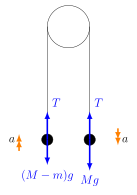
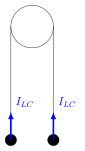
A lift of mass \(M\) and its counterweight of mass \(M\) are connected by a light inextensible cable which passes over a light frictionless pulley. The lift is constrained to move vertically between smooth guides. The distance between the floor and the ceiling of the lift is \(h\). Initially, the lift is at rest, and the distance between the top of the lift and the pulley is greater than \(h\). A small tile of mass \(m\) becomes detached from the ceiling of the lift. Show that the time taken for it to fall to the floor is \[ t=\sqrt{\frac{\left(2M-m\right)h}{Mg}}. \] The collision between the tile and the lift floor is perfectly inelastic. Show that the lift is reduced to rest by the collision, and that the loss of energy of the system is \(mgh\). Note: the question on the STEP database is \[ t=\sqrt{\frac{2\left(M-m\right)h}{Mg}}. \]
Solution: