Problems
Filters
11 problems found
2017 Paper 2 Q10
A car of mass \(m\) makes a journey of distance \(2d\) in a straight line. It experiences air resistance and rolling resistance so that the total resistance to motion when it is moving with speed \(v\) is \(Av^2 +R\), where \(A\) and \(R\) are constants. The car starts from rest and moves with constant acceleration \(a\) for a distance \(d\). Show that the work done by the engine for this half of the journey is \[ \int_0^d (ma+R+Av^2) \, \d x \] and that it can be written in the form \[ \int_0^w \frac {(ma+R+Av^2)v}a\; \d v \,, \] where \(w =\sqrt {2ad\,}\,\). For the second half of the journey, the acceleration of the car is \(-a\).
- In the case \(R>ma\), show that the work done by the engine for the whole journey is \[ 2Aad^2 + 2Rd \,. \]
- In the case \(ma-2Aad< R< ma\), show that at a certain speed the driving force required to maintain the constant acceleration falls to zero. Thereafter, the engine does no work (and the driver applies the brakes to maintain the constant acceleration). Show that the work done by the engine for the whole journey is \[ 2Aad^2 + 2 Rd + \frac{(ma-R)^2}{4Aa} \, .\]
Solution: The force delivered by the engine must be \(ma + R + Av^2\), (so the net force is \(ma\)). Therefore the work done is \(\displaystyle \int_0^d F \d x = \int_0^d (ma + R + Av^2) \d x\) Notice that \(a = v \frac{\d v}{\d x} \Rightarrow \frac{a}{v} = \frac{\d v}{\d x}\) and so \begin{align*} && WD &= \int_0^d (ma + R + Av^2) \d x \\ &&&= \int_{x=0}^{x=d} (ma + R + Av^2) \frac{v}{a} \frac{\d v}{\d x} \d x \\ &&&= \int_{x=0}^{x=d} \frac{ (ma + R + Av^2)v}{a} \d v \\ \end{align*} Also notice that if we move with constant acceleration from rest for a distance \(d\) the final speed is \(v^2 = 2ad \Rightarrow v = \sqrt{2ad}\)
- For the second part of the journey, the engine will be putting out a force of \(-ma+R+Av^2>0\), and the car will have a final speed of \(0\) \begin{align*} WD &= \int_0^{w} \frac{(ma+R+Av^2)v}{a} \d v + \int_w^0 \frac{(-ma+R+Av^2)v}{-a} \d v \\ &= \int_0^w \frac{2(Rv+Av^3)}{a} \d v \\ &= \frac{Rw^2+\frac12Aw^4}{a} \\ &= \frac{R2ad+\frac12A4a^2d^2}{a} \\ &= 2Rd + 2Aad^2 \end{align*}
- If \(ma - 2Aad < R < ma\) then the driving force is still \(-ma+R+Av^2\) which is positive when \(v = \sqrt{2as}\) but negative when \(v = 0\), and therefore at some point in-between the driving force must be \(0\). The engine will stop working when \(-ma+R+Av^2 =0 \Rightarrow v = \sqrt{\frac{ma-R}{A}}\) so \begin{align*} WD &= \int_0^w \frac{(ma+R+Av^2)v}{a} \d v + \int_w^{ \sqrt{\frac{ma-R}{A}}} \frac{(-ma+R+Av^2)v}{-a} \d v \\ &= \int_0^w \frac{2(R+Av^2)v}{a} \d v - \int_0^{\sqrt{\frac{ma-R}{A}}} \frac{(-ma+R+Av^2)v}{a}\d v \\ &= 2Aad^2+2Rd + \frac1a\left (\frac12(R-ma)\frac{ma-R}{A} + \frac{A}{4}\left ( \frac{ma-R}{A}\right)^2 \right) \\ &= 2Aad^2+2Rd - \frac{(ma-R)^2}{Aa}\left (-\frac12+ \frac14 \right) \\ &= 2Aad^2+2Rd - \frac{(ma-R)^2}{4Aa} \end{align*}
2016 Paper 2 Q9
A small bullet of mass \(m\) is fired into a block of wood of mass \(M\) which is at rest. The speed of the bullet on entering the block is \(u\). Its trajectory within the block is a horizontal straight line and the resistance to the bullet's motion is \(R\), which is constant.
- The block is fixed. The bullet travels a distance \(a\) inside the block before coming to rest. Find an expression for \(a\) in terms of \(m\), \(u\) and \(R\).
- Instead, the block is free to move on a smooth horizontal table. The bullet travels a distance \(b\) inside the block before coming to rest relative to the block, at which time the block has moved a distance \(c\) on the table. Find expressions for \(b\) and \(c\) in terms of \(M\), \(m\) and \(a\).
Solution:
- Since \(R\) is constant, \(F=ma \Rightarrow \text{acc} = \frac{R}{m}\) and \(v^2 = u^2 + 2as\) so \(0 = u^2 - 2 \frac{R}{m}a\), ie \(a = \frac{m u^2}{2R}\)
- By conservation of momentum, the bullet/block combination will eventually be travelling at \(v = \frac{m}{m+M}u\). The bullet will slow down to this speed in a time of \(\frac{m}{m+M}u = u - \frac{R}{m} T \Rightarrow T = \frac{Mm}{R(m+M)}u\) and will travel \(b+c = \frac{\left ( 1 - \left ( \frac{m}{m+M} \right)^2\right)u^2m}{2R}= \left ( 1 - \left ( \frac{m}{m+M} \right)^2\right)a\). The block will travell \(c = \frac12 \frac{R}{M} \frac{M^2m^2u^2}{R^2(m+M)^2} = \frac{Mm}{(m+M)^2}a\) Therefore the \(b = \left ( 1 - \left ( \frac{m}{m+M} \right)^2\right)a - \frac{Mm}{(m+M)^2}a = \frac{M}{M+m}a\)
2013 Paper 3 Q11
An equilateral triangle, comprising three light rods each of length \(\sqrt3a\), has a particle of mass \(m\) attached to each of its vertices. The triangle is suspended horizontally from a point vertically above its centre by three identical springs, so that the springs and rods form a tetrahedron. Each spring has natural length \(a\) and modulus of elasticity \(kmg\), and is light. Show that when the springs make an angle \(\theta\) with the horizontal the tension in each spring is \[ \frac{ kmg(1-\cos\theta)}{\cos\theta}\,. \] Given that the triangle is in equilibrium when \(\theta = \frac16 \pi\), show that \(k=4\sqrt3 +6\). The triangle is released from rest from the position at which \(\theta=\frac13\pi\). Show that when it passes through the equilibrium position its speed \(V\) satisfies \[ V^2 = \frac{4ag}3(6+\sqrt3)\,. \]
2009 Paper 2 Q11
A train consists of an engine and \(n\) trucks. It is travelling along a straight horizontal section of track. The mass of the engine and of each truck is \(M\). The resistance to motion of the engine and of each truck is \(R\), which is constant. The maximum power at which the engine can work is \(P\). Obtain an expression for the acceleration of the train when its speed is \(v\) and the engine is working at maximum power. The train starts from rest with the engine working at maximum power. Obtain an expression for the time \(T\) taken to reach a given speed \(V\), and show that this speed is only achievable if \[ P>(n+1)RV\,. \]
- In the case when \((n+1) RV/P\) is small, use the approximation \(\ln (1-x) \approx -x -\frac12 x^2\) (valid for small \( x \)) to obtain the approximation \[ PT\approx \tfrac 12 (n+1) MV^2\, \] and interpret this result.
- In the general case, the distance moved from rest in time \(T\) is \(X\). {\em Write down}, with explanation, an equation relating \(P\), \(T\), \(X\), \(M\), \(V\), \(R\) and \(n\) and hence show that \[ X= \frac{2PT - (n+1)MV^2}{2(n+1)R} \,. \]
2005 Paper 3 Q10
Two thin discs, each of radius \(r\) and mass \(m\), are held on a rough horizontal surface with their centres a distance \(6r\) apart. A thin light elastic band, of natural length \(2\pi r\) and modulus \(\dfrac{\pi mg}{12}\), is wrapped once round the discs, its straight sections being parallel. The contact between the elastic band and the discs is smooth. The coefficient of static friction between each disc and the horizontal surface is \(\mu\), and each disc experiences a force due to friction equal to \(\mu mg\) when it is sliding. The discs are released simultaneously. If the discs collide, they rebound and a half of their total kinetic energy is lost in the collision.
- Show that the discs start sliding, but come to rest before colliding, if and only if \mbox{\(\frac23 <\mu <1\)}.
- Show that, if the discs collide at least once, their total kinetic energy just before the first collision is \(\frac43 mgr(2-3\mu)\).
- Show that if \(\frac 4 9 > \mu^2 >\frac{5}{27}\) the discs come to rest exactly once after the first collision.
2001 Paper 2 Q9
A particle of unit mass is projected vertically upwards with speed \(u\). At height \(x\), while the particle is moving upwards, it is found to experience a total force \(F\), due to gravity and air resistance, given by \(F=\alpha \e^{-\beta x}\), where \(\alpha\) and \(\beta\) are positive constants. Calculate the energy expended in reaching this height. Show that \[ F= {\textstyle \frac12} \beta v^2+ \alpha - {\textstyle \frac12} \beta u^2 \;, \] where \(v\) is the speed of the particle, and explain why \( \alpha = \frac12 \beta u^2 +g\), where \(g\) is the acceleration due to gravity. Determine an expression, in terms of \(y\), \(g\) and \(\beta\), for the air resistance experienced by the particle on its downward journey when it is at a distance \(y\) below its highest point.
Solution: Considering the energy of the particle, we have initial kinetic energy of \(\frac12 u^2\) and final energy is \(\frac12 v^2\), the change in energy is the work done by the force, \begin{align*} &&\text{Work done against resistance} &= \text{loss in kinetic energy} \\ &&\int F \, \d x &= \int \alpha e^{-\beta x} \, \d x \\ &&&= \frac{\alpha}{\beta} \l 1 - e^{-\beta x} \r \\ &&&= \frac{1}{\beta} \l \alpha - F\r \\ &&&= \frac12 u^2 - \frac12 v^2 \\ \Rightarrow && F &= \frac12 \beta v^2 + \alpha - \frac12 \beta u^2 \end{align*} When \(v = 0\) there is no air resistance, ie \(F = g\), but \(g = 0 + \alpha - \frac12 \beta u^2 \Rightarrow \alpha = g + \frac12 \beta u^2\) \(F = \frac12 \beta v^2 + g\), ie air resistance is \(\frac12 \beta v^2\) Looking at forces acting on the particle when it's descending, \begin{align*} && v \frac{dv}{dx} &= g - \frac12 \beta v^2 \\ \Rightarrow && \frac{v}{g - \frac12 \beta v^2} \frac{dv}{dx} &= 1 \\ \Rightarrow && \int \frac{v}{g - \frac12 \beta v^2} \, dv &= \int dx \\ \Rightarrow && \frac1{\beta}\l\ln(g - \frac12\beta v^2) - \ln(g)\r &= y\\ \Rightarrow && \ln \l 1 - \frac12 \frac{\beta}{g}v^2 \r &= \beta y \\ \Rightarrow && \frac{g}{\beta} \l 1-e^{-\beta y} \r = \frac12 v^2 \end{align*} Since force is the rate of change of work, we can say that the force is \(ge^{-\beta y}\) and the air resistance is \(g \l 1-e^{-\beta y} \r\)
1995 Paper 1 Q10
A small ball of mass \(m\) is suspended in equilibrium by a light elastic string of natural length \(l\) and modulus of elasticity \(\lambda.\) Show that the total length of the string in equilibrium is \(l(1+mg/\lambda).\) If the ball is now projected downwards from the equilibrium position with speed \(u_{0},\) show that the speed \(v\) of the ball at distance \(x\) below the equilibrium position is given by \[ v^{2}+\frac{\lambda}{lm}x^{2}=u_{0}^{2}. \] At distance \(h\), where \(\lambda h^{2} < lmu_{0}^{2},\) below the equilibrium position is a horizontal surface on which the ball bounces with a coefficient of restitution \(e\). Show that after one bounce the velocity \(u_{1}\) at \(x=0\) is given by \[ u_{1}^{2}=e^{2}u_{0}^{2}+\frac{\lambda}{lm}h^{2}(1-e^{2}), \] and that after the second bounce the velocity \(u_{2}\) at \(x=0\) is given by \[ u_{2}^{2}=e^{4}u_{0}^{2}+\frac{\lambda}{lm}h^{2}(1-e^{4}). \]
1993 Paper 3 Q12
\(ABCD\) is a horizontal line with \(AB=CD=a\) and \(BC=6a\). There are fixed smooth pegs at \(B\) and \(C\). A uniform string of natural length \(2a\) and modulus of elasticity \(kmg\) is stretched from \(A\) to \(D\), passing over the pegs at \(B\) and \(C\). A particle of mass \(m\) is attached to the midpoint \(P\) of the string. When the system is in equilibrium, \(P\) is a distance \(a/4\) below \(BC\). Evaluate \(k\). The particle is pulled down to a point \(Q\), which is at a distance \(pa\) below the mid-point of \(BC\), and is released from rest. \(P\) rises to a point \(R\), which is at a distance \(3a\) above \(BC\). Show that \(2p^2-p-17=0\). Show also that the tension in the strings is less when the particle is at \(R\) than when the particle is at \(Q\).
1992 Paper 1 Q10
A projectile of mass \(m\) is fired horizontally from a toy cannon of mass \(M\) which slides freely on a horizontal floor. The length of the barrel is \(l\) and the force exerted on the projectile has the constant value \(P\) for so long as the projectile remains in the barrel. Initially the cannon is at rest. Show that the projectile emerges from the barrel at a speed relative to the ground of \[ \sqrt{\frac{2PMl}{m(M+m)}}. \]
1989 Paper 1 Q12
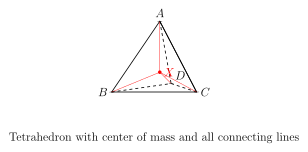
A regular tetrahedron \(ABCD\) of mass \(M\) is made of 6 identical uniform rigid rods, each of length \(2a.\) Four light elastic strings \(XA,XB,XC\) and \(XD\), each of natural length \(a\) and modulus of elasticity \(\lambda,\) are fastened together at \(X\), the other end of each string being attached to the corresponding vertex. Given that \(X\) lies at the centre of mass of the tetrahedron, find the tension in each string. The tetrahedron is at rest on a smooth horizontal table, with \(B,C\) and \(D\) touching the table, and the ends of the strings at \(X\) attached to a point \(O\) fixed in space. Initially the centre of mass of the tetrahedron coincides with \(O.\) Suddenly the string \(XA\) breaks, and the tetrahedron as a result rises vertically off the table. If the maximum height subsequently attained is such that \(BCD\) is level with the fixed point \(O,\) show that (to 2 significant figures) \[ \frac{Mg}{\lambda}=0.098. \]
Solution:
1988 Paper 1 Q13
A piece of circus apparatus consists of a rigid uniform plank of mass 1000\(\,\)kg, suspended in a horizontal position by two equal light vertical ropes attached to the ends. The ropes each have natural length 10\(\,\)m and modulus of elasticity 490\(\,\)000 N. Initially the plank is hanging in equilibrium. Nellie, an elephant of mass 4000\(\,\)kg, lands in the middle of the plank while travelling vertically downwards at speed 5\(\,\)ms\(^{-1}.\) While carrying Nellie, the plank comes instantaneously to rest at a negligible height above the floor, and at this instant Nellie steps nimbly and gently off the plank onto the floor. Assuming that the plank remains horizontal, and the rope remain vertical, throughout the motion, find to three significant figures its initial height above the floor. During the motion after Nellie alights, do the ropes ever become slack? {[}Take \(g\) to be \(9.8\mbox{\,\ ms}^{-1}.\){]}
Solution: In the initial position, since the system is in equilibrium the tension in the two ropes must be \(500g\). Therefore since \(T = \frac{\lambda x}{l} \Rightarrow x = \frac{10 \cdot 500 g}{490\, 000} = \frac1{10}\) so the initial extension is \(\frac1{10}\) By conservation of momentum, if the initial speed of the plank + Nellie is \(V\), we must have \(4000 \cdot 5 = 5000 V \Rightarrow V = 4\) \begin{array}{ccc} & \text{GPE} & \text{EPE} & \text{KE} \\ \hline \text{Initially} & 5000gh & 2 \cdot \frac12 \frac{\lambda}{l} \frac{1}{100} & \frac12 \cdot 5000 \cdot 4^2 \\ & 49\,000h & 490 & 40\,000 \\ \text{Finally} & 0 & 2 \cdot \frac12 \frac{\lambda}{l} (h + \frac1{10})^2 & 0 \\ & 0 & 49\,000 (h+\frac1{10})^2 & 0 \end{array} By conservation of energy, we can set up a quadratic: \begin{align*} && 49\,000 (h+\frac1{10})^2 &= 49\,000h + 40\,490 \\ \Rightarrow && 49\,000(h + \frac1{10})^2 &= 49\,000(h + \frac1{10})+35\, 590 \\ \Rightarrow&& h + \frac1{10} &= 1.488092\cdots \\ \Rightarrow && h &= 1.49 \,\, (3\text{ s.f.}) \end{align*} When she gets off the plank, it will move according to: \begin{align*} \text{N2}(\uparrow): && \frac{\lambda x}{l} -1000g &= -1000 \ddot{x} \\ && 49 x-g &= -\ddot{x} \\ \Rightarrow && x &= A \sin 7t + B \cos 7t + 0.2 \\ && x(0) = 1.49, &x'(0) = 0 \\ \Rightarrow && B = -1.69, & A=0 \end{align*} If we continued under this motion the string would definitely reach a point \(0.1\) above \(0\), and therefore the ropes would go slack.