Problems

Filters
Clear Filters

1 problem found

2011 Paper 2 Q9
D: 1600.0 B: 1484.0

Two particles, \(A\) of mass \(2m\) and \(B\) of mass \(m\), are moving towards each other in a straight line on a smooth horizontal plane, with speeds \(2u\) and \(u\) respectively. They collide directly. Given that the coefficient of restitution between the particles is \(e\), where \(0 < e \le 1\), determine the speeds of the particles after the collision. After the collision, \(B\) collides directly with a smooth vertical wall, rebounding and then colliding directly with \(A\) for a second time. The coefficient of restitution between \(B\) and the wall is \(f\), where \(0 < f \le 1\). Show that the velocity of \(B\) after its second collision with \(A\) is \[ \tfrac23 (1-e^2)u - \tfrac13(1-4e^2)fu \] towards the wall and that \(B\) moves towards (not away from) the wall for all values of \(e\) and \(f\).


Solution:

TikZ diagram
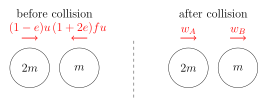
Since the coefficient of restitution is \(e\) and the speed of approach is \(3u\), \(v_B = v_A + 3eu\), \begin{align*} \text{COM}: && 2m\cdot2u + m \cdot (-u) &= 2m v_A + m(v_A + 3eu) \\ \Rightarrow && 3u &= 3v_A + 3eu \\ \Rightarrow && v_A &= (1-e)u \\ \Rightarrow && v_B &= (1+2e)u \end{align*} After rebounding from the wall, the velocity of \(B\) will be \(-fv_B\). So for the second collision (between the particles) we will have:
TikZ diagram
\begin{align*} \text{NEL}: && w_B - w_A &= e((1-e)u+(1+2e)fu) \\ \Rightarrow && w_B - w_A &= (1-e+f+2ef)eu \tag{1} \\ \text{COM}: && 2m w_A + w_B &= 2m(1-e)u -m(1+2e)fu \\ \Rightarrow && 2w_A + w_B &= (2-2e -f-2ef)u \tag{2} \\ (2) + 2\times(1): && 3w_B &= (2-2e -f-2ef)u +2(1-e+f+2ef)eu \\ &&&= (2-2e-f-2ef)u+(2e-2e^2+2ef+4e^2f)u \\ &&&= (2-2e^2-f+4e^2f)u \\ &&&= 2(1-e^2)-f(1-4e^2)u \\ \Rightarrow && w_B &= \frac23 (1-e^2)u-\frac13(1-4e^2)fu \end{align*} Since we've always taken towards the wall as positive, the question is whether or not this is positive for all values of \(e\) and \(f\). The first term is clearly positive, so in order to have a chance of being negative, we must have that \(1-4e^2 > 0\) and \(f\) is as large as possible, so wlog \(f = 1\). \begin{align*} 2-2e^2-1+4e^2 = 1+2e^2 > 0 \end{align*} \end{align*}