Problems
Filters
8 problems found
2013 Paper 3 Q9
A sphere of radius \(R\) and uniform density \(\rho_{\text{s}}\) is floating in a large tank of liquid of uniform density \(\rho\). Given that the centre of the sphere is a distance \(x\) above the level of the liquid, where \(x < R\), show that the volume of liquid displaced is \[ \frac \pi 3 (2R^3-3R^2x +x^3)\,. \] The sphere is acted upon by two forces only: its weight and an upward force equal in magnitude to the weight of the liquid it has displaced. Show that \[ 4 R^3\rho_{\text{s}} (g+\ddot x) = (2R^3 -3R^2x +x^3)\rho g\,. \] Given that the sphere is in equilibrium when \(x=\frac12 R\), find \(\rho_{\text{s}}\) in terms of \(\rho\). Find, in terms of \(R\) and \(g\), the period of small oscillations about this equilibrium position.
2010 Paper 1 Q4
Use the substitution \(x=\dfrac{1}{t^{2}-1}\; \), where \(t>1\), to show that, for \( x>0\), \[ \int \frac{1}{\sqrt{x\left(x+1\right) \; } \ }\; \d x =2 \ln \left(\sqrt x+ \sqrt{x +1} \; \right)+c \,. \] Note: You may use without proof the result \(\displaystyle \int \! \frac{1}{t^2-a^2} \, \d t = \frac{1}{2a} \ln \left| \frac{t-a}{t+a}\right| + \rm {constant}\). The section of the curve \[ y=\dfrac{1}{\sqrt{x}\; }-\dfrac{1}{\sqrt{x+1}\; } \] between \(x=\frac{1}{8}\) and \(x=\frac{9}{16}\) is rotated through \(360^{o}\) about the \(x\)-axis. Show that the volume enclosed is \(2\pi \ln \tfrac{5}{4}\,\). \(\phantom{\dfrac AB}\)
Solution: \begin{align*} && x &= \frac{1}{t^2-1} \\ && t &= \sqrt{\frac{x+1}{x}}\\ \Rightarrow && \frac{\d x}{\d t} &= \frac{-2t}{(t^2-1)^2} \\ \Rightarrow && I &= \int \frac{1}{\sqrt{x(x+1)}} \d x \\ &&&= \int \frac{1}{\sqrt{\frac1{t^2-1} \frac{t^2}{t^2-1}}} \cdot \frac{-2 t}{(t^2-1)^2} \d t \\ &&&= \int \frac{t^2-1}{t} \frac{-2t}{(t^2-1)^2} \d t \\ &&&= -\int \frac{2}{t^2-1} \d t \\ &&&= - \frac{2}{2 \cdot 1} \ln \left | \frac{t-1}{t+1} \right| +C \\ &&&= \ln \left | \frac{t+1}{t-1} \right| + C \\ &&&= \ln \left | \frac{\sqrt{\frac{x+1}{x}}+1}{\sqrt{\frac{x+1}{x}}-1} \right| + C \\ &&&= \ln \left | \frac{\sqrt{x+1}+\sqrt{x}}{\sqrt{x+1}-\sqrt{x}} \right| + C \\ &&&= 2\ln \left | \sqrt{x+1}+\sqrt{x}\right| + C \\ &&&= 2\ln \left ( \sqrt{x+1}+\sqrt{x}\right) + C \\ \end{align*} \begin{align*} && V&= \pi \int_{1/8}^{9/16} y^2 \d x \\ &&&= \pi \int_{1/8}^{9/16} \left ( \frac1x + \frac{1}{x+1} - \frac{2}{\sqrt{x(x+1)}}\right) \d x \\ &&&= \pi \left [ \ln x + \ln (x+1) - 4 \ln(\sqrt{x+1} + \sqrt{x}) \right]_{1/8}^{9/16} \\ &&&= \pi \left ( \ln \frac{9}{16} + \ln \frac{25}{16} - 4 \ln \left ( \frac54 + \frac34\right) \right) +\\ &&&\quad -\pi \left ( \ln \frac{1}{8} + \ln \frac{9}{8} - 4 \ln \left ( \frac1{2\sqrt{2}} + \frac3{2\sqrt{2}}\right) \right) \\ &&&= \pi \left ( 2 \ln 3 - 8 \ln 2 + 2 \ln 5 - 4\ln2 \right) - \pi \left ( -6 \ln 2 + 2\ln 3 - 2\ln 2\right) \\ &&&= \pi (2 \ln 5 - 4 \ln 2 ) \\ &&&= 2 \pi \ln \tfrac54 \end{align*}
2002 Paper 1 Q4
Give a sketch of the curve \( \;\displaystyle y= \frac1 {1+x^2}\;\), for \(x\ge0\). Find the equation of the line that intersects the curve at \(x=0\) and is tangent to the curve at some point with \(x>0\,\). Prove that there are no further intersections between the line and the curve. Draw the line on your sketch. By considering the area under the curve for \(0\le x\le1\), show that \(\pi>3\,\). Show also, by considering the volume formed by rotating the curve about the \(y\) axis, that \(\ln 2 >2/3\,\). [Note: \(\displaystyle \int_0^ 1 \frac1 {1+x^2}\, \d x = \frac\pi 4\,.\;\)]
Solution:

2002 Paper 3 Q1
Find the area of the region between the curve \(\displaystyle y = {\ln x \over x}\,\) and the \(x\)-axis, for \(1 \le x \le a\). What happens to this area as \(a\) tends to infinity? Find the volume of the solid obtained when the region between the curve \(\displaystyle y = {\ln x \over x}\,\) and the \(x\)-axis, for \(1 \le x\le a\), is rotated through \(2 \pi\) radians about the \(x\)-axis. What happens to this volume as \(a\) tends to infinity?
Solution: \begin{align*} && \int_1^a \frac{\ln x}{x} \d x &= \left [ \ln x \cdot \ln x\right ]_1^a - \int_1^a \frac{\ln x}{x} \d x \\ \Rightarrow && \int_1^a \frac{\ln x}{x} \d x &= \frac12 \left ( \ln a \right) ^2 \\ && \int_1^\infty \frac{\ln x}{x} \d x &= \lim_{a \to \infty} \frac12 (\ln a)^2 \\ &&&= \infty \end{align*} \begin{align*} && \pi \int_1^a \left ( \frac{\ln x}{x} \right)^2 \d x &= \pi \int_{u=0}^{u=\ln a} \left ( \frac{u}{e^u} \right)^2 e^u \d u \\ &&&= \pi \int_0^{\ln a} u^2 e^{-u} \d u \\ &&&= \pi \left [-u^2e^{-u} \right]_0^{\ln a} +\pi \int_0^{\ln a} 2u e^{-u} \d u \\ &&&= -\frac{\pi}{a} (\ln a)^2 + \pi \left [-2u e^{-u} \right]_0^{\ln a} + \pi \int_0^{\ln a} e^{-u} \d u \\ &&&= -\frac{\pi}{a} (\ln a)^2- \frac{2 \pi}{a}\ln a+\pi \left (1 - \frac{1}{a} \right) \\ \\ && \pi \int_1^{\infty} \left ( \frac{\ln x}{x} \right)^2 \d x &= \lim_{a \to \infty} \left ( -\frac{\pi}{a} (\ln a)^2- \frac{2 \pi}{a}\ln a+\pi \left (1 - \frac{1}{a} \right) \right) \\ &&&= \pi \end{align*}
2001 Paper 1 Q6
A spherical loaf of bread is cut into parallel slices of equal thickness. Show that, after any number of the slices have been eaten, the area of crust remaining is proportional to the number of slices remaining. A European ruling decrees that a parallel-sliced spherical loaf can only be referred to as `crusty' if the ratio of volume \(V\) (in cubic metres) of bread remaining to area \(A\) (in square metres) of crust remaining after any number of slices have been eaten satisfies \(V/A<1\). Show that the radius of a crusty parallel-sliced spherical loaf must be less than \(2\frac23\) metres. [{\sl The area \(A\) and volume \(V\) formed by rotating a curve in the \(x\)--\(y\) plane round the \(x\)-axis from \(x=-a\) to \(x=-a+t\) are given by \[ A= 2\pi\int_{-a}^{-a+t} { y}\left( 1+ \Big(\frac{\d {y}}{\d x}\Big)^2\right)^{\frac12} \d x\;, \ \ \ \ \ \ \ \ \ \ \ V= \pi \int_{-a}^{-a+t} {y}^2 \d x \;. \ \ ] \] }
1993 Paper 3 Q1
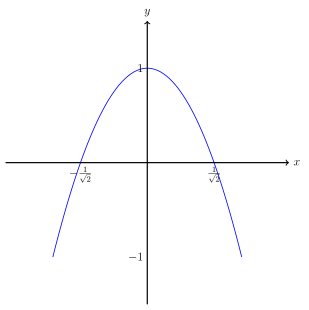
The curve \(P\) has the parametric equations $$ x= \sin\theta, \quad y=\cos2\theta \qquad\hbox{ for }-\pi/2 \le \theta \le \pi/2. $$ Show that \(P\) is part of the parabola \(y=1-2x^2\) and sketch \(P\). Show that the length of \(P\) is \(\surd (17) + {1\over 4} \sinh^{-1}4\). Obtain the volume of the solid enclosed when \(P\) is rotated through \(2\pi\) radians about the line \(y=-1\).
Solution: First notice that \(y = \cos 2 \theta = 1 - 2\sin^2 \theta = 1- 2x^2\), therefore \(P\) is lies on that parabola.
1989 Paper 2 Q6
The function \(\mathrm{f}\) satisfies the condition \(\mathrm{f}'(x)>0\) for \(a\leqslant x\leqslant b\), and \(\mathrm{g}\) is the inverse of \(\mathrm{f}.\) By making a suitable change of variable, prove that \[ \int_{a}^{b}\mathrm{f}(x)\,\mathrm{d}x=b\beta-a\alpha-\int_{\alpha}^{\beta}\mathrm{g}(y)\,\mathrm{d}y, \] where \(\alpha=\mathrm{f}(a)\) and \(\beta=\mathrm{f}(b)\). Interpret this formula geometrically, in the case where \(\alpha\) and \(a\) are both positive. Prove similarly and interpret (for \(\alpha>0\) and \(a>0\)) the formula \[ 2\pi\int_{a}^{b}x\mathrm{f}(x)\,\mathrm{d}x=\pi(b^{2}\beta-a^{2}\alpha)-\pi\int_{\alpha}^{\beta}\left[\mathrm{g}(y)\right]^{2}\,\mathrm{d}y. \]
Solution: Let \(u = f(x)\) then \(\frac{\d u}{\d x} = f'(x)\) and \begin{align*} \int_a^b f(x) \d x &\underbrace{=}_{\text{IBP}} \left [ xf(x) \right]_a^b - \int_a^b x f'(x) \d x \\ &\underbrace{=}_{u = f(x)} b \beta - a \alpha - \int_{u = f(a) = \alpha}^{u = f(b) = \beta} g(u) \d u \\ &= b \beta - a \alpha - \int_{\alpha}^{\beta} g(u) \d u \end{align*}

1987 Paper 3 Q4

Solution: The initial volume of water in \(A\) is: \begin{align*} \pi \int_0^4 x^2 \, \d y &= \pi \int_0^4 y \d y \\ &= \pi [ \frac{y^2}{2}]_0^4 \\ &= 8\pi \end{align*} We assume that no water is in the tube as it is `thin'. Therefore we must have: \begin{align*} && 8\pi &= \pi \int_0^{h-1} x^2 \d y +\pi \int_0^{h} x^2 \d y \\ &&&= \pi \int_0^{h-1} y \d y +\pi \int_0^{h} \l \sinh \frac{x}{2}\r^2 \d y \\ &&&= \pi \left [\frac{y^2}{2} \right]_0^{h-1} + \pi \int_0^h \frac{-1+\cosh y}{2}\d y \\ &&&= \pi \frac{(h-1)^2}{2} + \pi \left [ -\frac{y}{2} +\frac{\sinh y}{2}\right]_0^h \\ &&&= \pi \frac{(h-1)^2}{2} -\pi \frac{h}{2} + \pi \frac{\sinh h}{2} \\ \Rightarrow && 0 &= h^2-2h+1-h+\sinh h -16 \\ &&&= h^2 -3h+\sinh h - 15 \\ \Rightarrow && 15 &= h^2 -3h+\sinh h \end{align*}