Problems
Filters
10 problems found
2018 Paper 2 Q9
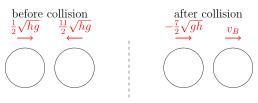
Two small beads, \(A\) and \(B\), of the same mass, are threaded onto a vertical wire on which they slide without friction, and which is fixed to the ground at \(P\). They are released simultaneously from rest, \(A\) from a height of \(8h\) above \(P\) and \(B\) from a height of \(17h\) above \(P\). When \(A\) reaches the ground for the first time, it is moving with speed \( V\). It then rebounds with coefficient of restitution \(\frac{1}{2}\) and subsequently collides with \(B\) at height \(H\) above \(P\). Show that \(H= \frac{15}8h\) and find, in terms of \(g\) and \(h\), the speeds \(u_A\) and \(u_B\) of the two beads just before the collision. When \(A\) reaches the ground for the second time, it is again moving with speed \( V\). Determine the coefficient of restitution between the two beads.
Solution: \begin{align*} && v^2 &= u^2 +2as \\ \Rightarrow && V^2 &= 2 g \cdot (8h)\\ \Rightarrow && V &=4\sqrt{hg}\\ \end{align*} When the first particle collides with the ground, the second particle is at \(9h\) traveling with speed \(V\), the first particle is at \(0\) traveling (upwards) with speed \(\tfrac12 V\). For a collision we need: \begin{align*} && \underbrace{\frac12 V t- \frac12 g t^2}_{\text{position of A}} &= \underbrace{9h - Vt - \frac12 gt^2}_{\text{position of B}} \\ \Rightarrow && \frac32Vt &= 9h \\ \Rightarrow && t &= \frac{6h}{V} \\ \\ && \underbrace{\frac12 V t- \frac12 g t^2}_{\text{position of A}} &= \frac12 V \frac{6h}{V} - \frac12 g t^2 \\ &&&= 3h - \frac12 g\frac{36h^2}{16hg} \\ &&&= 3h - \frac{9}{8}h \\ &&&= \frac{15}{8}h \end{align*} Just before the collision, \(A\) will be moving with velocity (taking upwards as positive) \begin{align*} && u_A &= \frac12 V-gt \\ &&&= 2\sqrt{hg}-g \frac{6h}{V} \\ &&&= 2\sqrt{hg} - g \frac{6h}{4\sqrt{hg}} \\ &&&= 2\sqrt{hg}-\frac32\sqrt{hg} \\ &&&= \frac12 \sqrt{hg} \end{align*} Similarly, for \(B\). \begin{align*} && u_B &= -V -gt \\ &&&= -4\sqrt{hg} - \frac32\sqrt{hg} \\ &&&= -\frac{11}{2}\sqrt{hg} \end{align*} Considering \(A\), to figure out \(v_A\). \begin{align*} && v^2 &= u^2 + 2as \\ && V^2 &= v_A^2 + 2g\frac{15}{8}h \\ && 16hg &= v_A^2 + \frac{15}{4}gh \\ \Rightarrow && v_A^2 &= \frac{49}{4}gh \\ \Rightarrow && v_A &= -\frac{7}{2}\sqrt{gh} \end{align*}
2011 Paper 1 Q10
A particle, \(A\), is dropped from a point \(P\) which is at a height \(h\) above a horizontal plane. A~second particle, \(B\), is dropped from \(P\) and first collides with \(A\) after \(A\) has bounced on the plane and before \(A\) reaches \(P\) again. The bounce and the collision are both perfectly elastic. Explain why the speeds of \(A\) and \(B\) immediately before the first collision are the same. The masses of \(A\) and \(B\) are \(M\) and \(m\), respectively, where \(M>3m\), and the speed of the particles immediately before the first collision is \(u\). Show that both particles move upwards after their first collision and that the maximum height of \(B\) above the plane after the first collision and before the second collision is \[ h+ \frac{4M(M-m)u^2}{(M+m)^2g}\,. \]
2001 Paper 2 Q9
A particle of unit mass is projected vertically upwards with speed \(u\). At height \(x\), while the particle is moving upwards, it is found to experience a total force \(F\), due to gravity and air resistance, given by \(F=\alpha \e^{-\beta x}\), where \(\alpha\) and \(\beta\) are positive constants. Calculate the energy expended in reaching this height. Show that \[ F= {\textstyle \frac12} \beta v^2+ \alpha - {\textstyle \frac12} \beta u^2 \;, \] where \(v\) is the speed of the particle, and explain why \( \alpha = \frac12 \beta u^2 +g\), where \(g\) is the acceleration due to gravity. Determine an expression, in terms of \(y\), \(g\) and \(\beta\), for the air resistance experienced by the particle on its downward journey when it is at a distance \(y\) below its highest point.
Solution: Considering the energy of the particle, we have initial kinetic energy of \(\frac12 u^2\) and final energy is \(\frac12 v^2\), the change in energy is the work done by the force, \begin{align*} &&\text{Work done against resistance} &= \text{loss in kinetic energy} \\ &&\int F \, \d x &= \int \alpha e^{-\beta x} \, \d x \\ &&&= \frac{\alpha}{\beta} \l 1 - e^{-\beta x} \r \\ &&&= \frac{1}{\beta} \l \alpha - F\r \\ &&&= \frac12 u^2 - \frac12 v^2 \\ \Rightarrow && F &= \frac12 \beta v^2 + \alpha - \frac12 \beta u^2 \end{align*} When \(v = 0\) there is no air resistance, ie \(F = g\), but \(g = 0 + \alpha - \frac12 \beta u^2 \Rightarrow \alpha = g + \frac12 \beta u^2\) \(F = \frac12 \beta v^2 + g\), ie air resistance is \(\frac12 \beta v^2\) Looking at forces acting on the particle when it's descending, \begin{align*} && v \frac{dv}{dx} &= g - \frac12 \beta v^2 \\ \Rightarrow && \frac{v}{g - \frac12 \beta v^2} \frac{dv}{dx} &= 1 \\ \Rightarrow && \int \frac{v}{g - \frac12 \beta v^2} \, dv &= \int dx \\ \Rightarrow && \frac1{\beta}\l\ln(g - \frac12\beta v^2) - \ln(g)\r &= y\\ \Rightarrow && \ln \l 1 - \frac12 \frac{\beta}{g}v^2 \r &= \beta y \\ \Rightarrow && \frac{g}{\beta} \l 1-e^{-\beta y} \r = \frac12 v^2 \end{align*} Since force is the rate of change of work, we can say that the force is \(ge^{-\beta y}\) and the air resistance is \(g \l 1-e^{-\beta y} \r\)
2000 Paper 2 Q11
The string \(AP\) has a natural length of \(1\!\cdot5\!\) metres and modulus of elasticity equal to \(5g\) newtons. The end \(A\) is attached to the ceiling of a room of height \(2\!\cdot\!5\) metres and a particle of mass \mbox{\(0\!\cdot\!5\) kg} is attached to the end \(P\). The end \(P\) is released from rest at a point \(0\!\cdot\!5\) metres above the floor and vertically below \(A\). Show that the string becomes slack, but that \(P\) does not reach the ceiling. Show also that while the string is in tension, \(P\) executes simple harmonic motion, and that the time in seconds that elapses from the instant when \(P\) is released to the instant when \(P\) first returns to its original position is $$ \left(\frac8{3g}\right)^{\!\frac12}+ \left(\frac3 {5g}\right)^{\!\frac12} {\Big(\pi - \arccos (3/7)\Big)}. $$ \noindent [Note that \(\arccos x\) is another notation for \(\cos^{-1} x\).]
1998 Paper 1 Q11
Hank's Gold Mine has a very long vertical shaft of height \(l\). A light chain of length \(l\) passes over a small smooth light fixed pulley at the top of the shaft. To one end of the chain is attached a bucket \(A\) of negligible mass and to the other a bucket \(B\) of mass \(m\). The system is used to raise ore from the mine as follows. When bucket \(A\) is at the top it is filled with mass \(2m\) of water and bucket \(B\) is filled with mass \(\lambda m\) of ore, where \(0<\lambda<1\). The buckets are then released, so that bucket \(A\) descends and bucket \(B\) ascends. When bucket \(B\) reaches the top both buckets are emptied and released, so that bucket \(B\) descends and bucket \(A\) ascends. The time to fill and empty the buckets is negligible. Find the time taken from the moment bucket \(A\) is released at the top until the first time it reaches the top again. This process goes on for a very long time. Show that, if the greatest amount of ore is to be raised in that time, then \(\lambda\) must satisfy the condition \(\mathrm{f}'(\lambda)=0\) where \[\mathrm{f}(\lambda)=\frac{\lambda(1-\lambda)^{1/2}} {(1-\lambda)^{1/2}+(3+\lambda)^{1/2}}.\]
1997 Paper 1 Q11
A particle of unit mass is projected vertically upwards in a medium whose resistance is \(k\) times the square of the velocity of the particle. If the initial velocity is \(u\), prove that the velocity \(v\) after rising through a distance \(s\) satisfies \begin{equation*} v^{2}=u^{2}\e^{-2ks}+\frac{g}{k}(\e^{-2ks}-1). \tag{*} \end{equation*} Find an expression for the maximum height of the particle above he point of projection. Does equation \((*)\) still hold on the downward path? Justify your answer.
Solution: \begin{align*} \text{N2}(\uparrow): && 1 \cdot v\frac{\d v}{\d s} &= -g - kv^2 \\ \Rightarrow && \int \frac{v}{g+kv^2} \d v &= \int -1 \d s \\ \Rightarrow && \frac{1}{2k}\ln(g+kv^2) &= -s + C \\ s =0, v = u: && \frac{1}{2k} \ln(g+ku^2) &= C \\ \Rightarrow && s &= \frac{1}{2k} \ln \frac{g+ku^2}{g+kv^2} \\ \Rightarrow && e^{-2ks} &= \frac{g+kv^2}{g+ku^2} \\ \Rightarrow && v^2 &= u^2e^{-2ks} + \frac{g}{k}(e^{-2ks}-1) \end{align*} The maximum height will be when \(v = 0\), ie \(\displaystyle s = \frac{1}{2k}\ln\left(1 + \frac{k}{g}u^2 \right)\). On the downward path the resistance will be going upwards, ie \begin{align*} \text{N2}(\uparrow): && 1 \cdot v\frac{\d v}{\d s} &= -g + kv^2 \end{align*} but our solution is solving a different differential equation, therefore unless \(k=0\) the equation will be different.
1995 Paper 2 Q11
Two identical particles of unit mass move under gravity in a medium for which the magnitude of the retarding force on a particle is \(k\) times its speed. The first particle is allowed to fall from rest at a point \(A\) whilst, at the same time, the second is projected upwards with speed \(u\) from a point \(B\) a positive distance \(d\) vertically above \(A\). Find their distance apart after a time \(t\) and show that this distance tends to the value \[ d+\frac{u}{k} \] as \(t\rightarrow\infty.\)
Solution: Both particles have equations of motion, \(\ddot{x} = -g-k\dot{x}\), so we can note that the distance between them has the equation of motion: \(\ddot{x} = -k \ddot{x} \Rightarrow x = Ae^{-kt} + B\) \begin{align*} && x(0) &= d \\ \Rightarrow && A+B &= d \\ && x'(0) &= u \\ \Rightarrow && -kA &= u \\ \Rightarrow && A &= -\frac{u}{k} \\ \Rightarrow && B &= d+\frac{u}{k} \\ \Rightarrow && x(t) &= -\frac{u}{k}e^{-kt} + d + \frac{u}{k} \to d + \frac{u}{k} \end{align*} as required.
1994 Paper 2 Q11
As part of a firework display a shell is fired vertically upwards with velocity \(v\) from a point on a level stretch of ground. When it reaches the top of its trajectory an explosion it splits into two equal fragments each travelling at speed \(u\) but (since momentum is conserved) in exactly opposite (not necessarily horizontal) directions. Show, neglecting air resistance, that the greatest possible distance between the points where the two fragments hit the ground is \(2uv/g\) if \(u\leqslant v\) and \((u^{2}+v^{2})/g\) if \(v\leqslant u.\)
Solution: Since \(v^2 - u^2 = 2as\) we have the initial height reached is \(\frac{v^2}{2g}\). At the point of explosion, the velocities are \(\pm \binom{u \cos \theta}{u \sin \theta}\) where \(0 \leq \theta < \frac{\pi}{2}\). Looking vertically: \begin{align*} && -\frac{v^2}{2g} &= \pm u \sin \theta t - \frac12gt^2 \\ \Rightarrow && t &= \frac{\mp u \sin \theta \pm \sqrt{u^2 \sin^2 \theta - 4 \cdot \left (-\frac12 g \right) \cdot (\frac{v^2}{2g})}}{2(-\frac12g)} \\ &&&= \frac{\pm u \sin \theta \mp \sqrt{u^2 \sin^2 \theta+v^2}}{g}\\ &&&= \frac{\pm u \sin \theta +\sqrt{u^2 \sin^2 \theta+v^2}}{g} \end{align*} Since we always want the positive \(t\). Then the horizontal distance travelled will be \begin{align*} && s &= u \cos \theta (t_1 + t_2) \\ &&&= u \cos \theta \frac{2\sqrt{u^2 \sin^2 \theta+v^2}}{g} \\ &&&= \frac{2u \cos \theta \sqrt{u^2 \sin^2 \theta + v^2}}{g} \\ &&s^2 &= \frac{4u^2}{g^2} \cos^2 \theta ({u^2 \sin^2 \theta + v^2}) \\ &&&= \frac{4u^2}{g^2} \left (-u^2\cos^4 \theta + (v^2+u^2)\cos^2 \theta \right) \\ &&&= \frac{4u^2}{g^2} \left (-u^2\left ( \cos^2 \theta - \frac{v^2+u^2}{2u^2}\right)^2 + \frac{(v^2+u^2)^2}{4u^2} \right) \\ &&&= \frac{(v^2+u^2)^2}{g^2} - \frac{4u^4}{g^2}\left ( \cos^2 \theta - \frac{v^2+u^2}{2u^2}\right)^2 \end{align*} If \(u \geq v\) then such a \(\theta\) exists such that we can achieve the maximum, ie \(s = \frac{v^2+u^2}{g}\). If not, then we will achieve our maximum when \(\cos \theta = 1\), ie \(\sin \theta = 0\) and \(s = \frac{2uv}{g}\)
1993 Paper 2 Q14
A ball of mass \(m\) is thrown vertically upwards from the floor of a room of height \(h\) with speed \(\sqrt{2kgh},\) where \(k>1.\) The coefficient of restitution between the ball and the ceiling or floor is \(a\). Both the ceiling and floor are level. Show that the kinetic energy of the ball immediately before hitting the ceiling for the \(n\)th time is \[ mgh\left(a^{4n-4}(k-1)+\frac{a^{4n-4}-1}{a^{2}+1}\right). \] Hence show that the number of times the ball hits the ceiling is at most \[ 1-\frac{\ln[a^{2}(k-1)+k]}{4\ln a}. \]
Solution: \begin{align*} && \text{energy when projected} &= \frac12 m(2kgh) \\ &&&= kghm \\ && \text{energy when hitting ceiling the first time} &= mgh + \frac12 m v^2 \\ \text{COE}: && kghm &= mgh + \frac12 mv^2 \\ \Rightarrow && v^2 &= 2gh(k-1) \end{align*} It will rebound with speed \(\sqrt{2gh(k-1)}a\). \begin{align*} && \text{energy when rebounding from ceiling} &=gh(k-1)a^2 + mgh \\ && \text{energy before hitting the floor} &= \frac12 mv^2 \\ \text{COE}: && gh(k-1)a^2 + mgh &= \frac12 mv^2 \\ \Rightarrow && v^2 &= 2gh((k-1)a^2+1) \end{align*} The ball will rebound with kinetic energy \(m gh((k-1)a^2+1)a^2 = mgh((k-1)a^4+a^2)\) And will reach the ceiling with kinetic energy \(mgh((k-1)a^4+a^2-1)\). When \(n = 1\), the kinetic energy (before hitting the ceiling for the first time) is \(mgh(k-1)\). Suppose \(s_n\) is the expression for the kinetic energy divided by \(mgh\), ie \(s_1 = k-1\), then: Clearly \(s_1 = k-1 = a^{4\cdot1-4}(k-1) + \frac{a^{4\cdot-4}-1}{a^2+1}\), so our hypothesis holds for \(n=1\). Suppose it is true for \(n\), then the \(n+1\)th time it will be: \begin{align*} s_{n+1} &= s_n a^4+a^2-1 \\ &= \left ( a^{4n-4}(k-1)+\frac{a^{4n-4}-1}{a^{2}+1} \right) a^4 + a^2 - 1 \\ &= a^{4(n+1)-4}(k-1) + \frac{a^{4(n+1)-4}-a^4}{a^2+1} + \frac{a^4-1}{a^2+1} \\ &= a^{4(n+1)-4}(k-1) + \frac{a^{4(n+1)-4}-a^4+a^4-1}{a^2+1} \\ &= a^{4(n+1)-4}(k-1) + \frac{a^{4(n+1)-4}-1}{a^2+1} \end{align*} Which is our desired expression, therefore it is true by induction. We wont reach the ceiling if this energy is not positive, ie: \begin{align*} && 0 &\leq a^{4n-4}(k-1)+\frac{a^{4n-4}-1}{a^{2}+1} \\ \Rightarrow && \frac{1}{a^2+1}&\geq a^{4n-4}\left (k - 1 + \frac{1}{a^2+1} \right) \\ \Rightarrow && a^{4n-4} &\geq \frac{1}{a^2+1} \cdot \frac{1}{k - 1 + \frac{1}{a^2+1}} \\ \Rightarrow && a^{4n-4} &\geq \frac{1}{(k-1)(a^2+1)+1} \\ \Rightarrow && 4(n-1) \ln a &\geq - \ln[(k-1)(a^2+1)+1] \\ \underbrace{\Rightarrow}_{\ln a < 0} && (n-1) &\leq \frac{ - \ln[(k-1)(a^2+1)+1]}{4\ln a} \\ \Rightarrow && n & \leq 1 -\frac{ \ln[(k-1)(a^2+1)+1]}{4\ln a} \\ &&&= 1 -\frac{ \ln[(k-1)a^2+k]}{4\ln a} \end{align*}
1988 Paper 1 Q13
A piece of circus apparatus consists of a rigid uniform plank of mass 1000\(\,\)kg, suspended in a horizontal position by two equal light vertical ropes attached to the ends. The ropes each have natural length 10\(\,\)m and modulus of elasticity 490\(\,\)000 N. Initially the plank is hanging in equilibrium. Nellie, an elephant of mass 4000\(\,\)kg, lands in the middle of the plank while travelling vertically downwards at speed 5\(\,\)ms\(^{-1}.\) While carrying Nellie, the plank comes instantaneously to rest at a negligible height above the floor, and at this instant Nellie steps nimbly and gently off the plank onto the floor. Assuming that the plank remains horizontal, and the rope remain vertical, throughout the motion, find to three significant figures its initial height above the floor. During the motion after Nellie alights, do the ropes ever become slack? {[}Take \(g\) to be \(9.8\mbox{\,\ ms}^{-1}.\){]}
Solution: In the initial position, since the system is in equilibrium the tension in the two ropes must be \(500g\). Therefore since \(T = \frac{\lambda x}{l} \Rightarrow x = \frac{10 \cdot 500 g}{490\, 000} = \frac1{10}\) so the initial extension is \(\frac1{10}\) By conservation of momentum, if the initial speed of the plank + Nellie is \(V\), we must have \(4000 \cdot 5 = 5000 V \Rightarrow V = 4\) \begin{array}{ccc} & \text{GPE} & \text{EPE} & \text{KE} \\ \hline \text{Initially} & 5000gh & 2 \cdot \frac12 \frac{\lambda}{l} \frac{1}{100} & \frac12 \cdot 5000 \cdot 4^2 \\ & 49\,000h & 490 & 40\,000 \\ \text{Finally} & 0 & 2 \cdot \frac12 \frac{\lambda}{l} (h + \frac1{10})^2 & 0 \\ & 0 & 49\,000 (h+\frac1{10})^2 & 0 \end{array} By conservation of energy, we can set up a quadratic: \begin{align*} && 49\,000 (h+\frac1{10})^2 &= 49\,000h + 40\,490 \\ \Rightarrow && 49\,000(h + \frac1{10})^2 &= 49\,000(h + \frac1{10})+35\, 590 \\ \Rightarrow&& h + \frac1{10} &= 1.488092\cdots \\ \Rightarrow && h &= 1.49 \,\, (3\text{ s.f.}) \end{align*} When she gets off the plank, it will move according to: \begin{align*} \text{N2}(\uparrow): && \frac{\lambda x}{l} -1000g &= -1000 \ddot{x} \\ && 49 x-g &= -\ddot{x} \\ \Rightarrow && x &= A \sin 7t + B \cos 7t + 0.2 \\ && x(0) = 1.49, &x'(0) = 0 \\ \Rightarrow && B = -1.69, & A=0 \end{align*} If we continued under this motion the string would definitely reach a point \(0.1\) above \(0\), and therefore the ropes would go slack.