Problems
Filters
3 problems found
2018 Paper 2 Q10
A uniform elastic string lies on a smooth horizontal table. One end of the string is attached to a fixed peg, and the other end is pulled at constant speed \(u\). At time \(t=0\), the string is taut and its length is \(a\). Obtain an expression for the speed, at time \(t\), of the point on the string which is a distance \(x\) from the peg at time \(t\). An ant walks along the string starting at \(t=0\) at the peg. The ant walks at constant speed \(v\) along the string (so that its speed relative to the peg is the sum of \(v\) and the speed of the point on the string beneath the ant). At time \(t\), the ant is a distance \(x\) from the peg. Write down a first order differential equation for \(x\), and verify that \[ \frac{\d }{\d t} \left( \frac x {a+ut}\right) = \frac v {a+ut} \,. \] Show that the time \(T\) taken for the ant to reach the end of the string is given by \[uT = a(\e^k-1)\,,\] where \(k=u/v\). On reaching the end of the string, the ant turns round and walks back to the peg. Find in terms of \(T\) and \(k\) the time taken for the journey back.
Solution: Points always maintain a constant fraction of the distance from the start, so the point distance \(x\) from the start at time \(t\) is moving with speed \(\frac{x}{a+ut} u\) The point is moving with speed \(v+\frac{x}{a+ut} u\) or in other words \begin{align*} && \frac{\d x}{\d t} &= v + \frac{x}{a+ut}u \\ \Rightarrow && \frac{\d x }{\d t} - \frac{u}{a+ut} x &= v \\ \Rightarrow && \frac{1}{a+ut} \frac{\d x}{\d t} - \frac{u}{(a+ut)^2} x &= \frac{1}{a+ut} v\\ \Rightarrow && \frac{\d}{\d x} \left ( \frac{x}{a+ut} \right) &= \frac{v}{a+ut} \\ \Rightarrow && \frac{x}{a+ut} &=\frac{v}{u} \ln (a + ut) + C \\ t = 0, x = 0: && 0 &= \frac{v}{u} \ln a + C \\ \Rightarrow && x &= (a+ut) \frac{v}{u} \ln \left ( \frac{a+ut}{a} \right) \\ \\ \Rightarrow && 1 &= \frac{v}{u} \ln \left ( \frac{a+uT}{a} \right) \\ \Rightarrow && e^k &= 1 + \frac{uT}{a} \\ \Rightarrow && uT &= a(e^k-1) \end{align*} On the return journey, we have \begin{align*} && \frac{\d x}{\d t} &= \frac{x}{a+ut}u - v \\ \Rightarrow && \frac{\d x}{\d t} - \frac{u}{a+ut} x &= - v \\ \Rightarrow && \frac{\d }{\d x} \left ( \frac{x}{a+ut} \right) &= -\frac{v}{a+ut} \\ \Rightarrow &&f &= -\frac{v}{u} \ln(a+ut) + K \\ t = T, f = 1: && 1 &= -\frac{v}{u}\ln(a+uT) + K \\ \Rightarrow && f &= 1+\frac{v}{u}\ln \left ( \frac{a+uT}{a+ut} \right) \\ \Rightarrow && 0 &= 1+\frac{v}{u} \ln \left ( \frac{a+uT}{a+uT_2} \right) \\ \Rightarrow && e^k &= \frac{a+uT_2}{a+uT}\\ \Rightarrow && uT_2 &= (a+uT)e^k - a \\ \Rightarrow && T_2 - T &= \frac{1}{u} \left ( (a+uT)e^k - a - uT\right) \\ &&&= \frac{1}{u} \left ((a+a(e^k-1))e^k-a-a(e^k-1) \right) \\ &&&= \frac{1}{u} \left (ae^{2k} -ae^k \right) \\ &&&= \frac{ae^k}{u} \left ( e^k-1 \right) \\ &&&= Te^k \end{align*}
2010 Paper 1 Q10
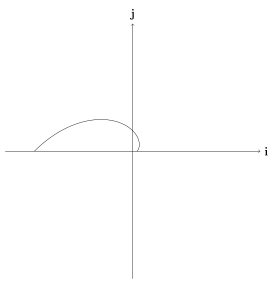
A particle \(P\) moves so that, at time \(t\), its displacement \( \bf r \) from a fixed origin is given by \[ {\bf r} =\left( \e^{t}\cos t \right) {\bf i}+ \left(\e^t \sin t\right) {\bf j}\,.\] Show that the velocity of the particle always makes an angle of \(\frac{\pi}{4}\) with the particle's displacement, and that the acceleration of the particle is always perpendicular to its displacement. Sketch the path of the particle for \(0\le t \le \pi\). A second particle \(Q\) moves on the same path, passing through each point on the path a fixed time \(T\) after \(P\) does. Show that the distance between \(P\) and \(Q\) is proportional to \(\e^{t}\).
Solution: \begin{align*} && {\bf r} &=\left( \e^{t}\cos t \right) {\bf i}+ \left(\e^t \sin t\right) {\bf j} \\ \Rightarrow && \dot{\bf r} &= \left( \e^{t}\cos t -\e^t \sin t\right) {\bf i}+ \left(\e^t \sin t+\e^t \cos t\right) {\bf j} \\ \Rightarrow && \mathbf{r}\cdot\dot{ \mathbf{r}} &= e^{2t}(\cos^2 t - \sin t \cos t) + e^{2t}(\sin^2 t+ \sin t \cos t) \\ &&&= e^{2t} (\cos^2 t + \sin ^2 t)\\ &&&= e^{2t} \\ \\ && | {\bf r}| &= e^{t} \\ && |{\bf \dot{r}}| &= e^t \sqrt{(\cos t - \sin t)^2 + (\sin t + \cos t)^2} \\ &&&= e^t \sqrt{2 \cos^2 t + 2 \sin^2 t} \\ &&&= \sqrt{2} e^t \\ \\ \Rightarrow && \frac{\mathbf{r}\cdot\dot{ \mathbf{r}}}{ |{\bf {r}}| |{\bf \dot{r}}|} &= \frac{e^{2t}}{\sqrt{2}e^te^t} \\ &&&= \frac{1}{\sqrt{2}} \end{align*} Therefore the angle between the velocity and displacement is \(\frac{\pi}{4}\). \begin{align*} && \ddot{\bf{r}} &= \left( \e^{t}(\cos t - \sin t) - \e^t (\sin t + \cos t)\right) {\bf i}+ \left(\e^t (\sin t + \cos t) + \e^t(\cos t - \sin t)\right) {\bf j} \\ &&&= \left ( -2\e^{t} \sin t \right) {\bf i}+ \left ( 2\e^{t} \cos t \right) {\bf j} \\ \Rightarrow && {\bf r} \cdot \ddot{\bf{r}} &= 2e^{2t} \left ( -\sin t \cos t + \sin t \cos t \right) \\ &&&= 0 \end{align*} Therefore the acceleration is perpendicular.
2005 Paper 1 Q11
A particle moves so that \({\bf r}\), its displacement from a fixed origin at time \(t\), is given by \[{\bf r} = \l \sin{2t} \r {\bf i} + \l 2\cos t \r \bf{j}\,,\] where \(0 \le t < 2\pi\).
- Show that the particle passes through the origin exactly twice.
- Determine the times when the velocity of the particle is perpendicular to its displacement.
- Show that, when the particle is not at the origin, its velocity is never parallel to its displacement.
- Determine the maximum distance of the particle from the origin, and sketch the path of the particle.
Solution:
- It is at the origin when both \(\sin 2t\) and \(\cos t = 0\), but this \(\sin 2t = 2 \sin t \cos t\) so this happens precisely when \(\cos t = 0\), ie when \(t = \frac{\pi}{2}, \frac{3\pi}{2}\)
- \(\,\) \begin{align*} && \dot{\mathbf{r}} &= 2 \cos 2t \mathbf{i} - 2 \sin t \mathbf{j} \\ && \mathbf{r} \cdot \dot{\mathbf{r}} &= 2\cos 2t \sin 2t - 2 \sin t 2 \cos t \\ &&&= \sin 2t \left (2\cos 2t - 2 \right) \end{align*} Therefore they are perpendicular when \(\sin 2t = 0 \Rightarrow t = 0, \frac{\pi}{2}, \pi, \frac{3\pi}{2}, 2\pi\) and when \(\cos 2t = 1 \Rightarrow 2t = 0, 2\pi, 4\pi \Rightarrow t = 0, \pi, 2\pi\), therefore all solutions are \( t = 0, \frac{\pi}{2}, \pi, \frac{3\pi}{2}, 2\pi\)
- For \(\mathbf{r}\) and \(\dot{\mathbf{r}}\) to be parallel, we would need \begin{align*} && \frac{2 \cos 2t}{\sin 2t} &= \frac{-2 \sin t}{2 \cos t}\\ && 2 \cos 2t \cos t &= - \sin t \sin 2t \\ && 0 &= 2\cos t (\cos 2t + \sin ^2 t) \\ &&&= 2 \cos t (\cos^2 t) \\ &&&= 2 \cos^3 t \end{align*} Therefore the only time we can be parallel is when \(\cos t = 0\), which is when we are at the origin.
- \(\frac{\d }{\d t} (\mathbf{r} \cdot \mathbf{r}) = 2 \mathbf{r} \cdot \mathbf{\dot{r}}\) so we should check the values when velocity and displacement are perpendicular, ie \( t = 0, \frac{\pi}{2}, \pi, \frac{3\pi}{2}, 2\pi\) which have values \(\mathbf{r} = \binom{0}{2}, \binom{0}{0}, \binom{0}{-2}, \binom{0}{0}, \binom{0}{2}\). Therefore the maximum distance is \(2\).
