Problems
Filters
2 problems found
2002 Paper 2 Q11
A rigid straight beam \(AB\) has length \(l\) and weight \(W\). Its weight per unit length at a distance \(x\) from \(B\) is \(\alpha Wl^{-1} (x/l)^{\alpha-1}\,\), where \(\alpha\) is a positive constant. Show that the centre of mass of the beam is at a distance \(\alpha l/(\alpha+1)\) from \(B\). The beam is placed with the end \(A\) on a rough horizontal floor and the end \(B\) resting against a rough vertical wall. The beam is in a vertical plane at right angles to the plane of the wall and makes an angle of \(\theta\) with the floor. The coefficient of friction between the floor and the beam is \(\mu\) and the coefficient of friction between the wall and the beam is also \(\mu\,\). Show that, if the equilibrium is limiting at both \(A\) and \(B\), then \[ \tan\theta = \frac{1-\alpha \mu^2}{(1+\alpha)\mu}\;. \] Given that \(\alpha =3/2\,\) and given also that the beam slides for any \(\theta<\pi/4\,\) find the greatest possible value of \(\mu\,\).
1989 Paper 3 Q14
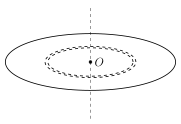
- A solid circular disc has radius \(a\) and mass \(m.\) The density is proportional to the distance from the centre \(O\). Show that the moment of inertia about an axis through \(C\) perpendicular to the plane of the disc is \(\frac{3}{5}ma^{2}.\)
- A light inelastic string has one end fixed at \(A\). It passes under and supports a smooth pulley \(B\) of mass \(m.\) It then passes over a rough pulley \(C\) which is a disc of the type described in (i), free to turn about its axis which is fixed and horizontal. The string carries a particle \(D\) of mass \(M\) at its other end. The sections of the string which are not in contact with the pulleys are vertical. The system is released from rest and moves under gravity for \(t\) seconds. At the end of this interval the pulley \(B\) is suddenly stopped. Given that \(m<2M\), find the resulting impulse on \(D\) in terms of \(m,M,g\) and \(t\). {[}You may assume that the string is long enough for there to be no collisions between the elements of the system, and that the pulley \(C\) is rough enough to prevent slipping throughout.{]}
Solution:
- \begin{align*} m &= \int_0^a \underbrace{(\rho r)}_{\text{mass per area}} \underbrace{\pi r^2}_{\text{area}} \d r \\ &= \rho \pi \frac{a^3}{3} \\ \\ I &= \sum m r^2 \\ &= \sum (\rho r) \pi r^2 \cdot r^2 \\ &\to \int_0^a \rho \pi r^4 \\ &= \frac15 \rho \pi a^5 \\ &= \frac35 m a^2 \end{align*}
- \begin{align*} \text{N2}(\downarrow, D): && Mg -T_C &= Mf \\ \overset{\curvearrowright}{C} && (T_C - T_B)a &= I \frac{f}{a} \\ &&&= \frac35 m a f \\ \text{N2}(\uparrow, B): && 2T_B-mg &= \frac12 m f \\ \\ \Rightarrow && Mg-T_B &= \left (M + \frac35 m \right)f \\ \Rightarrow && Mg - \frac12 mg &= \left (M + \frac35 m + \frac14 m \right)f \\ \Rightarrow && f &= \frac{(M-\frac12 m)g}{M + \frac{17}{20} m} \\ &&&= \frac{(2M-m)g}{2M +\frac{17}{10}m} \end{align*} Therefore the speed after a time \(t\) is \(\displaystyle \frac{(2M-m)g}{2M +\frac{17}{10}m} t\) and the impulse will be the change in momentum, ie \(\displaystyle \frac{(2M-m)g}{2M +\frac{17}{10}m} Mt\)
