Problems
Filters
1 problem found
2018 Paper 3 Q10
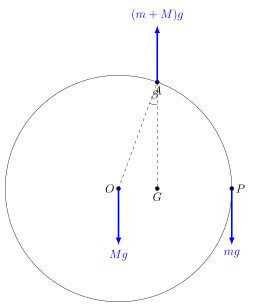
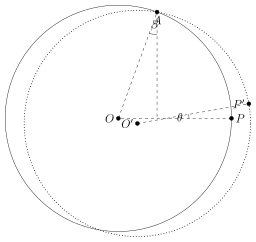
A uniform disc with centre \(O\) and radius \(a\) is suspended from a point \(A\) on its circumference, so that it can swing freely about a horizontal axis \(L\) through \(A\). The plane of the disc is perpendicular to \(L\). A particle \(P\) is attached to a point on the circumference of the disc. The mass of the disc is \(M\) and the mass of the particle is \(m\). In equilibrium, the disc hangs with \(OP\) horizontal, and the angle between \(AO\) and the downward vertical through \(A\) is \(\beta\). Find \(\sin\beta\) in terms of \(M\) and \(m\) and show that \[ \frac{AP}{a} = \sqrt{\frac{2M}{M+m}} \,. \] The disc is rotated about \(L\) and then released. At later time \(t\), the angle between \(OP\) and the horizontal is \(\theta\); when \(P\) is higher than \(O\), \(\theta\) is positive and when \(P\) is lower than \(O\), \(\theta\) is negative. Show that \[ \tfrac12 I \dot\theta^2 + (1-\sin\beta)ma^2 \dot \theta^2 + (m+M)g a\cos\beta \, (1- \cos\theta) \] is constant during the motion, where \(I\) is the moment of inertia of the disc about \(L\). Given that \(m= \frac 32 M\) and that \(I=\frac32Ma^2\), show that the period of small oscillations is \[ 3\pi \sqrt{\frac {3a}{5g}} \,. \]
Solution: